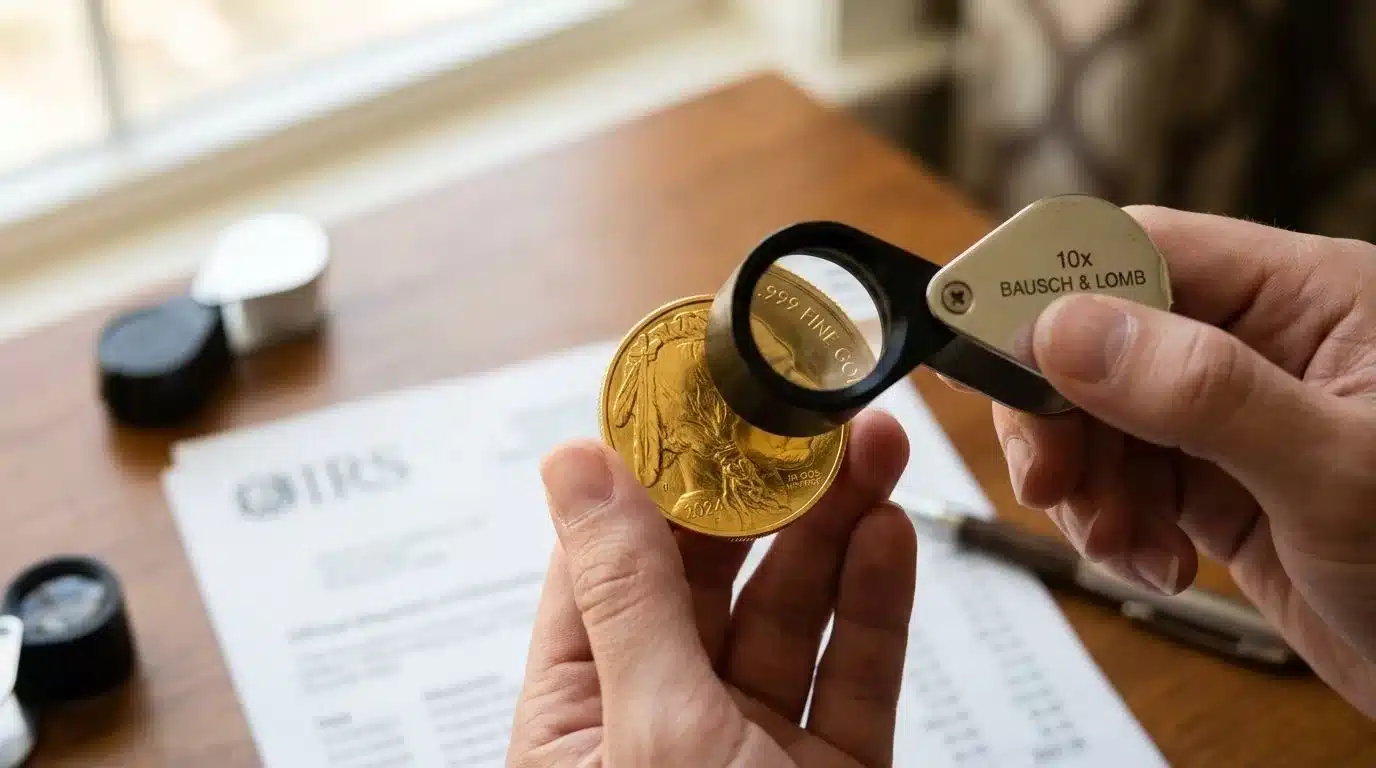

A lot of pre-retirees reach the same point. They've built most of their retirement savings in mutual funds, stocks, or bond-heavy accounts, but they don't love having everything tied to paper assets and market sentiment. A self directed Gold IRA can look like a practical way to add something tangible, but the rules are stricter than many people expect.

This guide walks through how a self directed Gold IRA works, what metals qualify, how rollovers usually happen, where investors get tripped up on storage, and how to think about fees without hype. It also covers two issues many articles gloss over: the tax danger of “home storage” setups and the actual tradeoff between segregated and commingled storage.

Table of Contents

Toggle

What Is a Self-Directed Gold IRA?

A pre-retiree rolls money from an old 401(k) into a new Gold IRA, buys bullion, and assumes the hardest part is over. Then a salesperson mentions an IRA-owned LLC and "home storage" as a way to keep the coins close at hand. That is the point where a useful retirement tool can turn into a compliance trap.

A self directed Gold IRA is an Individual Retirement Account that can hold certain physical precious metals within the IRA structure, rather than limiting you to standard brokerage assets. The account is still a retirement account with tax rules, contribution rules, rollover rules, and custody requirements. What changes is the investment menu and the amount of responsibility placed on the account owner to choose approved assets and follow the handling rules carefully.

The term "self-directed" causes a lot of confusion. It does not mean you become your own IRA custodian or store IRA metals in your house. It means you direct the investment choices, while a specialized custodian administers the account and an approved depository holds the metal. If you want a plain-English overview of those self-directed precious metal IRA rules, start there before evaluating any sales pitch.
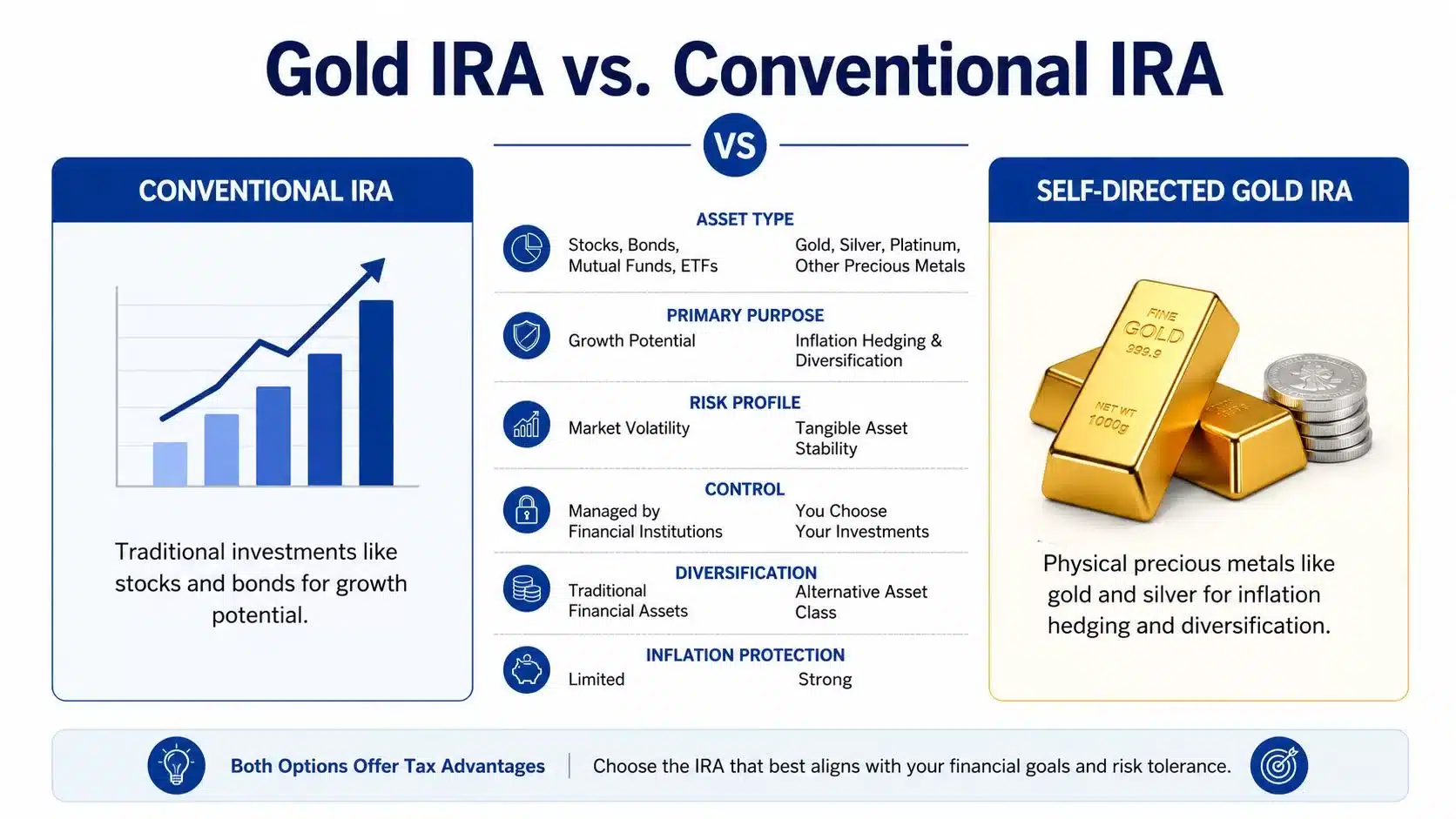
How it differs from a conventional IRA

A conventional IRA usually holds financial assets such as mutual funds, stocks, bonds, ETFs, and cash equivalents. A self directed Gold IRA uses the same tax-advantaged account framework, but part of the account can be allocated to approved forms of gold and, in many cases, other permitted precious metals.

In practice, that means your retirement savings may include a physical asset layer instead of only paper claims tied to markets, issuers, or fund managers. Some investors like that added tangibility. Others underestimate the extra administration that comes with it.

The metal is bought for the IRA, titled to the IRA, and stored for the IRA. That separation matters.

Why investors consider one

Many pre-retirees look at a Gold IRA as a diversification tool, not as a replacement for the rest of a retirement plan. The goal is often to hold one asset class that behaves differently from stocks or bonds, while keeping the tax treatment of an IRA.

That said, owning bullion inside an IRA is not the same as buying coins personally. Personal ownership gives you direct possession and fewer retirement-account rules. IRA ownership gives you tax advantages, but it also brings custodial oversight, storage fees, reporting requirements, and strict limits on how the metal is held.

This is also where many articles stay too general. The key decision is not just "gold or no gold." It is whether the benefits of holding physical metal inside a retirement account outweigh the ongoing costs and the narrower compliance lane.

The hidden complexity many buyers miss

The biggest misunderstanding is storage. Some promoters present "home storage" or IRA-LLC arrangements as a shortcut that lets you control the metal directly while keeping IRA tax treatment. Investors should treat that claim with caution. If the arrangement fails IRS scrutiny, the account can be treated as a distribution, which may create current taxes and possible penalties.

A safer starting assumption is simple. If metals are owned by the IRA, the account owner should not keep them in a home safe, safe-deposit box, garage, or personal vault.

There is a second complexity that matters in practice: storage format. Once investors accept that approved depository storage is part of the deal, they still need to compare segregated storage and commingled storage. Segregated storage usually means your specific coins or bars are kept separate from other clients' holdings, which can provide more precision in recordkeeping but often costs more. Commingled storage usually means your holdings are stored with like assets of other IRA owners, which may reduce fees but offers less item-by-item separation. The right choice depends on account size, product type, and whether the extra cost buys peace of mind you value.

A self directed Gold IRA can serve a clear purpose in a retirement plan. It just works best when you view it as a regulated account with physical assets, not as a loophole for private possession.

IRS Rules for Eligible Gold and Precious Metals

A common mistake happens before any metal is purchased. An investor sees a well-known coin, assumes "gold is gold," and later learns the IRA cannot hold it. In this part of the process, small wording differences matter because the IRS draws a line between approved bullion and products treated as collectibles.

Under this explanation of IRA-eligible precious metals, Internal Revenue Code Section 408(m)(3) sets fineness standards for bullion that can be held in an IRA. The practical point is simple. IRA eligibility depends on the metal's purity and on whether the product fits the IRS rules for approved bullion.

The purity rules investors need to know

The baseline standards are:

  • Gold: at least 99.5% pure
  • Silver: at least 99.9% pure
  • Platinum: at least 99.95% pure
  • Palladium: at least 99.95% pure

Those numbers are the first filter, not the only filter. A product can contain precious metal and still fail IRA rules if it is treated as a collectible or does not come from an acceptable source. That is why a retirement account should be handled more like a regulated inventory system than a personal coin collection.

The exception that causes confusion

One coin trips up many careful buyers: the American Gold Eagle. It is 91.67% pure, which is below the usual gold standard, yet it is still allowed in an IRA because the statute specifically permits it.

That exception is narrow. It does not open the door for other 22-karat coins. A useful way to read the rule is this: the IRS framework has a general purity test, and then a few products pass because the law names them specifically.

What usually qualifies, and what usually creates trouble

Products that generally fit the rules are bullion coins and bars made for metal investment, not collector appeal. Products that often create problems are rare coins, graded coins, proof sets sold mainly for numismatic value, and items priced far above their melt value.

A simple screening process helps:

  • Check fineness first. If it misses the purity threshold, the IRA usually cannot buy it.
  • Check whether it is bullion or a collectible. Marketing language often gives this away.
  • Check the producer. Recognized government mints and approved refiners are usually the safer lane.
  • Check before money leaves the account. Undoing a non-eligible purchase can create delays, fees, and tax reporting issues.

This is one of the hidden complexities many articles gloss over. Product eligibility sounds like a shopping question, but it is really a compliance question. If a dealer pushes "special" coins with high premiums, the safer response is to ask whether the item is IRA-eligible and to get that confirmed by the custodian before purchase.

Readers who want a more detailed list of precious metal IRA rules and eligible product categories can review that guide.

How to Set Up an Account and Fund It via Rollover

The setup process is manageable when it's viewed as a sequence. Confusion usually comes from trying to think about custodians, funding, and metal selection all at once. In practice, most investors move through it in three stages.
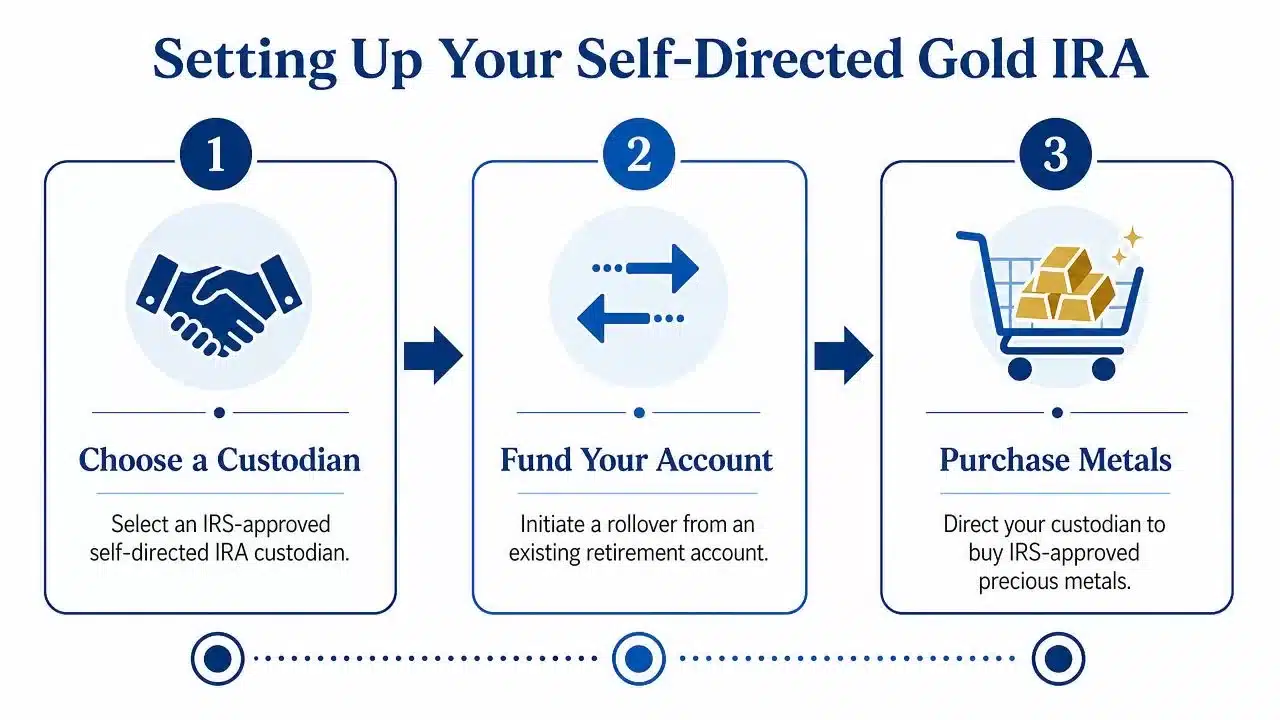
Step one starts with the account structure

First, the investor opens a self-directed IRA with a custodian that supports precious metals. At this stage, the focus isn't on buying coins yet. It's on getting the legal account framework in place so retirement money has somewhere compliant to go.

Individuals considering this route are funding it in one of two ways:

  1. A new annual contribution
  2. A rollover or transfer from an existing retirement account

For a broader walkthrough, this Gold IRA rollover guide is useful when evaluating the mechanics.

Funding usually matters more than product selection

Once the account is open, the next decision is how money gets into it. For this process, readers often hear the terms direct rollover and indirect rollover.

A direct rollover generally means funds move from one retirement account institution to another without the investor taking possession of the money. That tends to be the cleaner path from a compliance standpoint.

An indirect rollover generally means the money is paid out first and then has to be redeposited into the retirement account according to IRS rules. This can be where avoidable tax issues arise if the timing or paperwork goes wrong.

For most retirees, simpler is better. If a trustee-to-trustee movement is available, that usually reduces room for error.

Here's a quick visual summary of the setup flow:

The purchase happens after the account is funded

Only after the account is funded does the investor direct the purchase of approved metals. At that point, the custodian coordinates the transaction and the metals are sent to the approved storage facility, not to the investor's home.

That sequence matters:

  • Open the account first
  • Fund it through contribution, transfer, or rollover
  • Select approved metals
  • Have the IRA purchase and store them properly

A common mistake is thinking personally owned gold can be dropped into the IRA later. That isn't how these accounts are typically structured. The IRA needs to acquire eligible assets through the account process itself.

Where paperwork errors usually happen

Most setup delays come from ordinary administrative issues, not from the metal itself. Missing account forms, unclear rollover instructions, incomplete beneficiary designations, or mismatched names across retirement accounts can slow things down.

A careful investor usually asks three questions before signing anything:

  • Who is the custodian handling the IRA administration?
  • How is the rollover or transfer being documented?
  • Which approved metals will the IRA purchase once funds arrive?

Those questions keep the process grounded in compliance instead of marketing.

Choosing a Custodian and Secure Storage

A lot of confusion starts here. An investor finishes the rollover paperwork, picks the coins or bars, and assumes the hard part is over. In practice, this is the stage where small misunderstandings can create expensive mistakes, especially around who controls the metal and where it is allowed to sit.

A self directed Gold IRA usually involves two separate firms with two separate jobs. The custodian handles the IRA itself. The depository handles the metal. If those roles get blurred together, it becomes harder to compare fees, verify responsibility, and spot risky marketing claims.

IRS rules generally require IRA-owned precious metals to be held by a qualified trustee or custodian, not by the account owner personally. In plain English, the gold belongs to the IRA, so it has to stay inside the IRA's custody chain. The same basic rule is why the popular "home storage" pitch deserves extra scrutiny. If an arrangement is marketed as letting you keep IRA gold in your house, safe, or personal lockbox through an IRA-LLC structure, that is a compliance trap. If the IRS treats the metals as distributed to you, the account can lose its tax-advantaged status and trigger taxes and penalties.

What the custodian does and what the depository does

The custodian is the IRA administrator. This party usually handles:

  • Account records
  • IRS reporting
  • Transaction processing
  • Required administrative oversight

The depository is the vaulting facility. This party usually handles:

  • Receiving the metals
  • Secure storage
  • Inventory tracking
  • Release procedures when metals are sold or distributed

That division matters. A sales representative may describe the process as if one company does everything, but investors should know exactly which firm is responsible for paperwork and which one is responsible for physical control.

If you want a clearer framework for vetting account administrators, this guide on choosing an IRA custodian for gold is a useful starting point.

The home storage IRA-LLC trap

This issue gets less attention than it should.

Some promoters frame an IRA-owned LLC as a shortcut to personal control. The pitch often sounds simple: your IRA owns an LLC, the LLC buys gold, and you store it yourself as manager of that LLC. The problem is that legal control and physical possession are not the same thing. IRS rules around prohibited transactions and constructive receipt are strict, and a setup that gives you direct personal possession can invite the argument that the IRA assets were distributed or used for your personal benefit.

That is not a minor paperwork problem. It can mean ordinary income tax on the distributed amount, early withdrawal penalties if you are under the applicable age threshold, and loss of the IRA's intended tax treatment. A careful investor treats any promise of easy at-home possession as a warning sign, not a convenience.

Commingled and segregated storage are different choices

Once the custody issue is clear, the next decision is how the metals are stored inside the depository. The two common options are commingled and segregated storage.

Storage typeHow it worksBest fit
CommingledYour metals are stored with the same type of metals belonging to other IRA account holdersInvestors who want lower ongoing storage costs
SegregatedYour specific bars or coins are stored separately and identified to your accountInvestors who want item-level separation

The practical difference is similar to airport baggage versus a private checked case. In both situations, your property is tracked and returned to you. The question is whether you want your exact items kept apart the whole time, and whether that added separation is worth the higher annual cost.

How to judge the cost-benefit tradeoff

Bigger accounts often justify more scrutiny here.

Commingled storage usually costs less and works well for investors who care more about broad precious-metals exposure than about receiving the exact same coins or bars later. Segregated storage usually costs more, but it gives clearer item-specific identification, which some investors value for recordkeeping, peace of mind, or large concentrated holdings.

Ask direct questions before you agree to either option:

  • Will my account hold exact identified bars or coins, or equivalent like-kind metals?
  • How is inventory documented and audited?
  • How is insurance described in the storage agreement?
  • What event triggers extra fees, such as shipping, liquidation, or in-kind distribution?

Insurance language deserves special attention. Some depositories describe coverage at the facility or accounting level rather than as a simple promise tied to one investor's exact coin tube or bar number. That does not automatically make commingled storage a bad choice. It does mean the lower-cost option should be chosen with clear eyes.

A careful investor is not only buying gold. The investor is also buying a custody process, a documentation trail, and a storage arrangement that needs to hold up if the IRS ever asks questions.

Understanding the Fees and Tax Implications

A lot of investors focus on the price of the gold and underestimate the price of the wrapper around it. With a self directed Gold IRA, the account structure, custody rules, and storage requirements often cost as much attention as the metal itself.

That matters because fees reduce returns every year, while tax mistakes can trigger a much larger hit all at once.

A neutral overview from ConsumerAffairs notes that Gold IRA investors commonly face a setup charge, ongoing account administration fees, and separate storage costs. In plain terms, you are paying for three different jobs: someone to administer the IRA, someone to hold title and keep records, and someone to store the bullion in an approved facility.

The main fee buckets

Most accounts have three core cost categories:

  • Setup fee: A one-time charge to open the IRA and process the paperwork
  • Annual administrative fee: Ongoing custodian charges for reporting, recordkeeping, and compliance
  • Storage fee: Depository charges for holding and insuring the metals

Some providers also add transaction fees for purchases, sales, wire transfers, account termination, or taking metals out of the vault. Such additional charges often surprise investors. A quoted annual fee can sound reasonable until the smaller line items start stacking up.

A practical way to judge cost is to ask for a full fee schedule in writing and read it like a closing disclosure on a house. The headline number rarely tells the whole story.

Contribution limits for 2026

A self directed Gold IRA follows the same annual contribution rules as other IRAs. It does not get a special higher limit because the account holds bullion.

For current annual IRA contribution limits, use the official IRS retirement topics and publications rather than a dealer summary. The IRS updates those figures when limits change, and that is the cleanest source for year-specific numbers.

Tax treatment in plain English

The tax treatment depends first on whether the account is structured as a traditional IRA or a Roth IRA. Traditional IRA contributions may be deductible in some cases, and withdrawals are generally taxed later. Roth IRA contributions are generally made with after-tax dollars, and qualified withdrawals are generally tax-free.

The key point is simpler than the jargon. The tax advantage belongs to the IRA, not to the gold itself. If the account breaks IRA rules, the IRS can treat the metals as distributed to you personally.

That is why the so-called home storage arrangement deserves extra scrutiny. Some promoters package an IRA-owned LLC and suggest that this gives the investor direct physical control over the coins or bars. The trap is that personal possession can be treated as a distribution if the structure fails IRS requirements. If that happens, the value may become taxable in the year of the violation, and early-withdrawal penalties may also apply if the account owner is below the applicable age threshold.

A safe rule of thumb is this: if the setup leaves you holding IRA metals at home, in a personal safe, or in a safe deposit box under your direct control, stop and get a tax opinion from a qualified CPA or tax attorney before proceeding.

A few practical reminders help keep the tax side clear:

  • Contributions follow normal IRA rules: Income limits, deduction rules, and annual caps still apply
  • Rollovers and transfers need careful handling: A mistake in timing or paperwork can create a taxable event
  • Distributions are reportable: Cash withdrawals and in-kind distributions of metals both have tax consequences
  • Possession matters: Personal control of IRA metals can create a compliance problem, especially in home storage arrangements

Fees are a nuisance. Compliance errors are more serious. A good self directed Gold IRA decision weighs both, because the cheapest-looking setup can become the most expensive if it cuts corners on custody or storage rules.

This is not financial or tax advice. Investors should review account documents carefully and speak with a licensed financial advisor, CPA, or tax professional before acting.

Pros, Cons, and How to Mitigate Risks

A self directed Gold IRA often looks simple from a distance. You buy gold inside a retirement account and hold it for the long term. In practice, it works more like owning a rental property inside an IRA than buying a stock fund. The asset may be familiar, but the rules, handling, and costs are much more specialized.
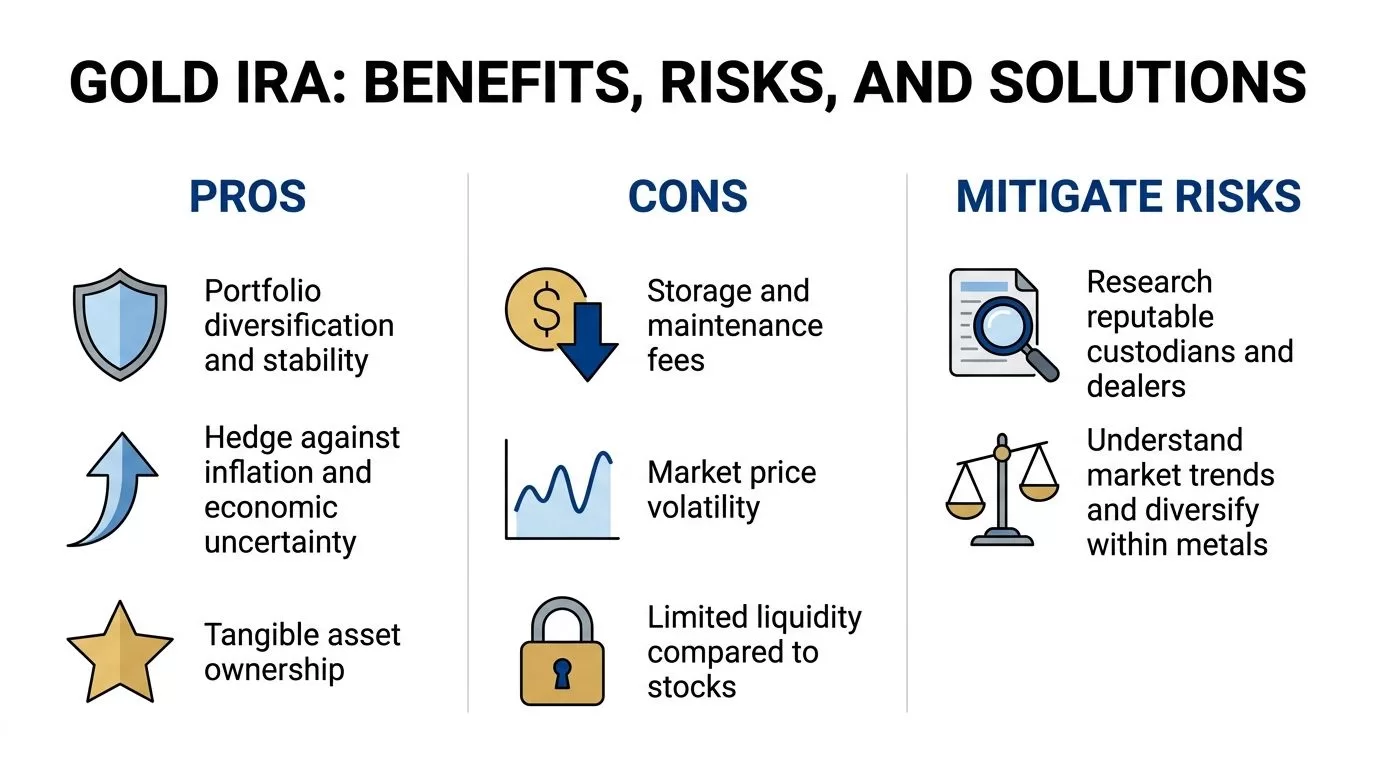
The upside is clear enough. Gold can give a retirement portfolio exposure to a physical asset that does not behave exactly like stocks or bonds. Some investors also like the discipline of owning bullion through a tax-advantaged account instead of trading in and out based on headlines.

The limitations matter just as much.

Physical bullion does not produce income. The account also adds custody, storage, paperwork, and product-selection rules that do not exist in a plain vanilla IRA. That means a Gold IRA has a higher hurdle to justify itself. The account has to earn its place in the portfolio despite the extra friction.

Where a Gold IRA can add value

A Gold IRA may fit an investor who wants to broaden retirement holdings beyond financial assets alone.

  • Diversification: Gold may respond differently than stocks and bonds in some market environments.
  • Physical asset exposure: The account holds bullion, not just shares of a fund or mining company.
  • Long-term hedge role: Some investors use precious metals as one layer of protection against inflation concerns, currency anxiety, or financial-system stress.

Those are possible uses, not promises. Gold can help with diversification, but it also has long stretches of weak or flat performance.

The costs are not just fees

Most articles stop at annual charges. The harder question is whether the structure delivers enough benefit to offset those charges and the added rules.

Two cost areas deserve close attention:

  • Ongoing account expenses: setup, custodial administration, storage, insurance, and transaction spreads
  • Behavioral cost: investors sometimes overallocate to gold because the metal feels safer than it is
  • Compliance cost: one bad decision about storage or possession can create a tax problem far larger than the annual fees

That last point is the one investors miss.

The home storage trap can turn a retirement account into a taxable event

A common sales pitch suggests an IRA-owned LLC or "checkbook control" lets the account owner keep IRA metals at home, in a personal safe, or in a safe deposit box they control. That sounds efficient. It can also be the most expensive mistake in the whole setup.

The IRS explains in Publication 590-A and Publication 590-B that IRA assets are subject to specific custody and distribution rules. Tax professionals often warn that personal possession of IRA-owned precious metals can be treated as a distribution if the arrangement fails IRA requirements. If that happens, the metal's value may become taxable for that year, and an early-distribution penalty may apply for account holders under the applicable age threshold.

A simple way to read this is: if the retirement asset ends up under your direct personal control, the tax shelter may no longer hold up.

An IRA-owned LLC does not automatically fix that problem. The LLC is just a legal wrapper. It is not a free pass to ignore custody rules. Investors who hear phrases like "home storage IRA" or "store your IRA gold yourself" should slow down and get a written opinion from a qualified CPA or tax attorney before signing anything.

Storage choice affects both cost and peace of mind

Storage is not just an administrative detail. It is one of the main tradeoffs in a Gold IRA.

Commingled storage usually costs less. Your metals are held with metals of the same type owned by other clients, while records track your account's holdings. For many investors, that is enough.

Segregated storage usually costs more. Specific coins or bars are stored separately for your account. Investors who care about exact item identification, or who are holding larger balances, may prefer it.

A practical way to compare the two is to ask two questions:

  • Do I care about receiving the exact same bars or coins back later?
  • Is the added annual cost small enough relative to my account size and holding period?

For a modest account, segregated storage can eat up a noticeable share of the expected benefit. For a larger account, the extra cost may be reasonable if it improves clarity and comfort. The best choice is not the fanciest option. It is the option whose cost matches the size and purpose of the allocation.

How to reduce the biggest risks

Investors usually lower their odds of trouble by keeping the process boring and well documented.

  • Get storage terms in writing. Verbal promises about home possession or special exceptions are not enough.
  • Use only clearly eligible metals. "Rare" or promotional coins often create confusion.
  • Read the fee schedule line by line. Ask about setup charges, annual administration, storage, insurance, and selling spreads.
  • Question any loophole-based pitch. If the sales message focuses on getting around custody rules, assume the risk is higher.
  • Keep the allocation proportionate. Gold can play a role in retirement savings without becoming the whole strategy.

The best risk control is simple. Treat a self directed Gold IRA as a specialized retirement account, not as a workaround for personal possession. That mindset helps separate legitimate diversification from expensive compliance mistakes.

Your Gold IRA Checklist and Next Steps

A lot of the confusion around Gold IRAs comes from trying to solve everything at once. A shorter checklist makes the decision easier because it separates suitability, compliance, and logistics.

A practical due-diligence checklist

Before opening a self directed Gold IRA, an investor should work through the basics:

  • Clarify the role in the portfolio: Is this meant for diversification, inflation concern, or long-term tangible exposure?
  • Assess time horizon carefully: Because of setup and storage costs, this structure is usually better suited to longer holding periods than quick tactical moves.
  • Review the rollover path: Existing retirement funds need a clean, documented path into the new account.
  • Confirm eligible metals before buying: Product mistakes can create avoidable compliance problems.
  • Understand the storage choice: Commingled and segregated storage solve different concerns.
  • Read the fee schedule line by line: Setup, administration, and storage should all be clear before funding.
  • Ask who does what: The custodian and depository have different roles.
  • Avoid any “store it yourself” pitch: That's where many of the worst tax surprises begin.

What a thoughtful next step looks like

A smart next step usually isn't rushing into a purchase. It's gathering the account documents, rollover details, and storage options in one place, then reviewing them with a qualified professional who understands retirement-account rules.

The strongest Gold IRA decisions usually come from slow, boring due diligence. That's a good thing.

This is not financial advice. Consult a licensed financial advisor, CPA, or tax professional before making investment decisions. Rules can change, and the right account structure depends on individual circumstances.

Frequently Asked Questions About Gold IRAs

Can someone put gold they already own into a Gold IRA?

Usually, investors should think of the IRA as buying its own assets through the proper account process. Personally owned metals and IRA-owned metals are not the same thing. Mixing the two can create compliance issues.

Can an investor store IRA gold at home?

No. As covered earlier, IRS rules require approved third-party possession for IRA metals, and personal possession can turn the holding into a taxable distribution.

How do distributions work in retirement?

Distributions can generally happen in cash or in kind, depending on the account arrangement and the investor's circumstances. In a cash distribution, the metals are sold and the proceeds are distributed. In an in-kind distribution, the metals themselves are distributed out of the IRA. The tax result depends on account type and individual tax circumstances.

Is a Gold IRA different from a Silver IRA?

The account structure is basically the same. The difference is the underlying metal. Eligibility rules for silver use a different purity threshold than gold, which is why product selection still needs to be checked carefully.

Is a self directed Gold IRA appropriate for everyone near retirement?

No. It may fit investors who want tangible assets and are comfortable with added rules, fees, and administration. It may be less attractive for investors who want maximum simplicity, low costs, or income-producing retirement assets.


If a reader wants a neutral place to continue researching, Gold IRA Association offers educational guides, rollover resources, and company comparison content designed to help pre-retirees evaluate their options. A simple next step is to compare top Gold IRA companies or speak with a specialist at 888-910-8386 before making any account decision.

Share.
Gold IRA Association

Gold IRA Association is an independent educational resource helping retirement savers understand precious metals investing. We research Gold IRA rules, custodians, and providers to publish clear, unbiased guides, so readers can make informed decisions about protecting and diversifying their retirement savings.

Your Self Directed Gold IRA: A 2026 Retirement Guide

A lot of pre-retirees reach the same point. They've built most of their retirement savings in mutual funds, stocks, or bond-heavy accounts, but they don't love having everything tied to paper assets and market sentiment. A self directed Gold IRA can look like a practical way to add something tangible, but the rules are stricter than many people expect. This guide walks through how a self directed Gold IRA works, what metals qualify, how rollovers usually happen, where investors get tripped up on storage, and how to think about fees without hype. It also covers two issues many articles gloss over: the tax danger of “home storage” setups and the actual tradeoff between segregated and commingled storage. What Is a Self-Directed Gold IRA? A pre-retiree rolls money from an old 401(k) into a new Gold IRA, buys bullion, and assumes the hardest part is over. Then a salesperson mentions an IRA-owned LLC and "home storage" as a way to keep the coins close at hand. That is the point where a useful retirement tool can turn into a compliance trap. A self directed Gold IRA is an Individual Retirement Account that can hold certain physical precious metals within the IRA...

Gold IRA Rollover Guide 2026: Protect Your Retirement

A lot of pre-retirees reach the same moment. They're looking at an old 401(k) or IRA, they're uneasy about market swings, and they want to know whether physical gold belongs in their retirement mix without creating a tax headache. A good Gold IRA rollover guide should do more than list steps. It should help readers spot the decision points where costly mistakes happen, understand the rules in plain English, and move carefully if they decide a rollover makes sense. This is not financial advice. Consult a licensed financial advisor, CPA, or tax professional before making investment decisions. Are You Eligible for a Gold IRA Rollover? A common frustration happens before any forms are signed. Someone has an old 401(k) or an active workplace plan, they decide they want part of it in physical gold, and then they learn the account may not be eligible to move yet. That first checkpoint matters because eligibility depends on the retirement account rules, not on investment preference. If the account cannot be rolled over, the rest of the process stops there. Accounts that may be eligible Several account types can qualify, but each comes with its own rules: Old employer 401(k) plans: These are...

Finding an IRA Custodian for Gold: Your 2026 Guide

Retirement investors often get to the same point. They've decided a Gold IRA may fit their diversification goals, then they hit a confusing term that seems far more technical than expected: custodian. That confusion matters, because an IRA custodian for gold isn't just paperwork. It's the party that helps keep the account compliant, coordinates storage, and protects the account from mistakes that can trigger taxes and penalties. For anyone nearing retirement, that role deserves careful attention. Introduction A common situation looks like this. Someone has an old 401(k) or a traditional IRA, likes the idea of holding some retirement savings in physical gold, and starts researching how to open the account. Then the process suddenly shifts from gold bars and coins to custodians, depositories, forms, and IRS rules. That's where many readers pause. A Gold IRA can feel simple in theory and bureaucratic in practice. The missing piece is understanding that the custodian is not a side detail. The custodian is the long-term partner that helps keep the account legal, organized, and secure. For pre-retirees, this is the proper frame to use. The question isn't only who stores the gold. The better question is who helps protect the entire retirement...

Austrian Philharmonic Silver Coin a Smart IRA Investment?

The Austrian Silver Philharmonic is eligible for a Silver IRA because it contains 1 troy ounce (31.103 grams) of.999 fine silver, which meets the IRS minimum purity requirement for silver held in a precious metals IRA. The part that trips up many U.S. investors isn't the coin itself. It's the process for buying it through the right custodian and storing it correctly inside the account. A lot of retirees reach this question after looking for a familiar silver coin that feels more established than a generic round but less expensive than some domestic bullion options. The Austrian Philharmonic often shows up on that short list. It has a long-running mint program, strong recognition, and a reputation for being a practical bullion coin rather than a novelty item. Still, "IRA eligible" doesn't mean "buy it anywhere and put it in retirement savings however you want." U.S. rules add a layer of procedure. The coin's European origin, euro face value, and handling through a self-directed IRA all matter in ways most basic coin guides never explain. Your Complete Guide to the Austrian Philharmonic Silver Coin For a U.S. retiree exploring silver for portfolio diversification, the Austrian Philharmonic can make sense. It is...

Gold IRA Comparison: The 2026 Guide to Top Providers

A lot of near-retirees are sitting with the same uneasy habit right now. They open a 401(k) statement, see the balance, and then wonder how much of that buying power will still feel real after more inflation, more market swings, and another decade of withdrawals. That's where a Gold IRA enters the conversation. Not as a magic fix, and not as a replacement for everything else, but as a diversification tool that deserves a hard, skeptical comparison before any rollover happens. Is a Gold IRA the Right Move for Your Retirement Savings You are a few years from retirement. Your account balance looks solid on paper, but one bad market stretch right before withdrawals could change the math fast. That is usually the moment people start asking whether part of their savings should sit in something they can understand more plainly and worry about less. A Gold IRA can serve that purpose for the right person. It gives a retirement portfolio some exposure to physical metal inside a tax-advantaged account. What matters is using it with discipline. My view is simple. A Gold IRA works best as a limited diversification position, not a full retirement strategy. If you are considering...

Best Silver IRA Companies of 2026: A Complete Guide

Retirement investors often start the search for the best silver IRA companies by comparing fees and minimums. That's necessary, but it's not enough. The company you choose also controls how clearly you're educated, how quickly someone answers during a volatile market, and how easy it is to sell later if your plan changes. That's where many investors make a bad choice. A silver IRA is a long-term relationship, not a one-time purchase, so the right provider is the one that handles service, compliance, and liquidity well when conditions get stressful. How We Evaluated the Top Silver IRA Companies A silver IRA company shouldn't win on marketing polish. It should win on the parts that affect a retiree's day-to-day experience once the account is open. The editorial standard here focuses on four decision pillars. The first is price clarity. Not low advertised costs. Clear costs. If a company can't explain setup charges, annual administration, storage, transaction handling, and the spread between buy and sell pricing in plain English, that's a problem. What matters more than a flashy pitch The second pillar is education and support quality. A retiree rolling over part of a 401(k) needs patient explanations, not a rushed script....

IRA Approved Gold Coins: Your Authoritative 2026 Guide

A lot of retirees reach the same point at the same time. They look at a 401(k) or traditional IRA built around paper assets, watch the market swing, and start asking whether part of that nest egg should sit in something tangible instead. That's where confusion starts. Gold inside an IRA is allowed, but only if it follows strict IRS rules. The difference between an approved coin and a prohibited purchase can come down to purity, source, packaging, or who holds the metal. A mistake here isn't minor. It can create taxes, penalties, or worse, put the account's status at risk. Securing Your Retirement with IRA Approved Gold For near-retirees, gold usually isn't about chasing excitement. It's about control, durability, and reducing reliance on assets that exist only on a statement. Physical gold can play that role inside a retirement account, but only when the investor follows the rules exactly. Many individuals start with the wrong question. They ask, “Which gold coins should be bought?” The better question is, “Which gold coins are legal to hold in an IRA?” Those aren't the same thing. Practical rule: If a gold product isn't clearly IRA eligible before purchase, it shouldn't be purchased...

Precious Metal IRA Rules: Your 2026 Guide

Retirement savers often reach the same point at the same time. The stock market feels unsettled, inflation worries linger, and physical gold or silver starts to look appealing, but then the IRS rules turn a simple idea into a confusing maze. A precious metals IRA can work, but only if the account is set up and handled correctly from the start. This guide explains the precious metal IRA rules that matter most in plain English. It covers which metals qualify, how custody works, what contribution limits apply, how distributions and RMDs are handled, and which mistakes can trigger taxes or penalties. Your Guide to Navigating Precious Metal IRA Regulations Many near-retirees aren't confused about why gold or silver might belong in a retirement plan. They're confused about the mechanics. Can the account hold coins or only bars? Can the metal stay at home? Can an old 401(k) be moved over? What happens later when distributions start? Those are reasonable questions because a precious metals IRA doesn't work like a standard brokerage IRA. Physical assets bring extra rules around purity, storage, and distributions. A useful way to think about these rules is to break them into four checkpoints: What can the...

What is IRA-approved Gold?

1- Introduction : Think of a seasoned sailor navigating the unpredictable seas where calm waters can suddenly turn into a tempestuous storm. In retirement planning, long-lost savings feel threatened by these uncertainties: economic downturns, inflationary pressures, and turbulent markets. In this choppy financial sea, Gold approved for IRAs is not just a haven but a lifeboat that can navigate economic storms. Diversification is the strategy of the seasoned sailor who knows full well that depending solely on his more traditional stocks and bonds is like sailing close to perilous shores. By integrating IRA-approved Gold into your retirement portfolio, you'll embrace a broader range of assets and enhance your defenses against economic unpredictability. 2- What is an IRA-Approved Gold? IRA-accepted Gold is not just about any purchase from a jeweler or a commodity trading platform you invest in. Gold is supposed to meet a certain purity standard and be formed according to specific IRS requirements. Usually, this is defined as gold bars and coins that are 99.5% pure or above. Most approval forms may include popular pieces like American Eagle coins, Canadian Maple Leafs, or specific gold bars accredited refiners produce. This distinction is significant as not all gold investments are...

What are Physical Gold IRA Accounts?

1- Introduction Physical Gold IRA Accounts: Countless retirement investment options have been available when planning for retirement. There are many options, ranging from investments in the stock market and bonds to real estate and mutual funds, and it is too hard to decide how an individual needs to save and invest for their future. Nonetheless, only some are the typically missed options, and one is the Physical Gold IRA Accounts. Thus, the investment allows for holding physical gold in a retirement account. These details help us unveil why a Physical Gold IRA Account might be a great addition to your retirement plan and a powerful way to diversify your investment portfolio. 2- Why Consider a Physical Gold IRA Account ? Investment in a Physical Gold IRA Account would imply that one has shiny precious metals and strategic financial planning to secure one's future. Gold has been a symbol of wealth and a store of value for thousands of years. While it continues to offer this appeal, today's economic situation is quite volatile. Gold tends to hold its value or even appreciate during economic distress, unlike paper assets, whose values can be easily wiped out by inflation or other market downturns....

How to Buy Gold with IRA Money?  

1- Introduction :  Imagine being near retirement and thinking of various ways to secure a sound financial future. Among a host of different investment options, one shines out. This idea is quite quirky but very modern for investing in gold. Not only will this strategy give you growth, but it will also act as a hedge against inflation and economic uncertainty. How exactly does one buy gold with IRA money, and what are the implications? We delve deep into the world of Gold IRAs and using an IRA to invest in gold, from basic setup to the nuances of managing your investment. Therefore, whether you are an experienced investor or just in the learning stages concerning your retirement options, this guide will provide insight and crucial advice on making informed decisions. Ultimately, you will learn to change your IRA into gold, what possible pros and cons lie in this investment approach, and, most importantly, how to buy gold using IRA money. 2- What Is an IRA and How Can It Be Used to Buy Gold with IRA Money ? 2.1 What Is an IRA? An Individual Retirement Account is a tax-advantaged investment tool specifically designed to save for retirement by...

What are the Benefits of a Gold IRA?

1- Introduction: The scenario of investment changes every minute in the financial world, while the investor is on the lookout for a secure and safe instrument that can secure their future. In a plethora of investment platforms, the Gold IRA emerges as a very solid investment option. Realizing all the strengths of physical gold while working as a hedge against inflation and uncertainty in the economy, the Gold IRA offers individuals the option of holding gold alongside other precious metals in a retirement account with the same benefits as a traditional IRA in relation to a tax advantage. The major benefits of a Gold IRA are that it improves portfolio stability and protects from market volatility; hence, it is a good investment for securing a future in a world of uncertainties. 1.1-Introduce the Benefits of a Gold IRA and its Relevance in Today's Financial Scenario: The volatility in the traditional financial markets marks the relevance of a Gold IRA in today's economic scenario. Since stocks, bonds, and mutual funds may fall vulnerable to fluctuations in the market, gold most often moves inversely to these assets, cushioning oneself during economic downturns. This fact makes Gold IRAs a perfect choice to diversify...

What is a Gold Bullion IRA?

1- Introduction: An Individual Retirement Account refers to a Gold Bullion IRA investment as an appealing way to seek portfolio diversification away from the traditional holding of stocks and bonds. A Gold Bullion IRA investment offers the investor the ability to hold physical gold, in the form of bars and coins, within their retirement savings portfolio. Concerns over economic stability and inflation are palpable at the moment, as is the peace of mind that goes along with a gold bullion IRA. There's some pretty uncertain stuff going on right now; therefore, a Gold Bullion IRA gives a security blanket that paper assets do not. 1.1-Gold as a Store of Value in History Throughout the centuries and across civilizations, gold has symbolized wealth and the store of value. Due to its rarity, resistance to any forces that can corrode or destroy it for eternity, and its universal appeal due to its luster, gold became a compelling medium of exchange and a powerful hedge against economic instability. Since gold has provided a haven from the dangers of inflation and the devaluation of paper currency, this is still the role that today's Gold Bullion IRA serves. 2- The Emergence of IRAs and the...

What are the best IRA Gold Funds? 

1- Introduction : Investing in the best IRA gold fund offers a great opportunity to secure your retirement with a stable and historically resilient asset. In this complete guide, we will explain to you why and how to ensure that deciding on the best gold IRA fund is very crucial to your financial future. You will work your way into retirement planning with the advantages of gold investments and all the other things that come with understanding their nuances. As we go deeper into the topic, we find the historical significance of gold as an investment and how it diversified portfolios. We also find how it acted as a bulwark against the inflationary type of tendencies and how it was a bulwark against volatile market conditions. Besides, we will also elaborate on the practical steps that one needs to take to establish a gold IRA, the nature of the gold assets that are available, and, most strategically, how one may arrive at the right choice of the fund in relation to your long-term retirement goals. Hopefully, at the end of this guide, you will have been armed with the necessary knowledge to invest in a Gold IRA confidently; hence, it...

What are GOLD IRA Rules? 

1- Introduction:  1.1- The Basics of How to Navigate GOLD IRA Investment A Gold IRA is probably a good idea for those considering diversifying their retirement investment portfolio with some precious metals. This guide covers all the basic Gold IRA rules, therefore, ensuring to understand all the details of managing such an investment. We will further look at how the self-directed IRA could empower the holders to use the precious metals gold and silver and what can be entailed in your retirement planning. We will also discuss why gold has remained a preferred asset class for most of the investors looking to hedge risks emanating from market volatilities and economic meltdowns. You would further be apprised of probable tax benefits and essential steps that would be necessary for the setup and maintenance of a Gold IRA account with compliance. At the end of this introduction, you hopefully don't have a more muddled view of how investing in gold may offer some security and opportunities for growth in your retirement strategy, clearly having been and continuing to be a trusted component in diversified investment portfolios. 1.2- What is a Gold IRA: A Gold IRA is a retirement account that allows an...

 Why Include Gold in Your IRA ?

1- Introduction: 1.1-The Appeal of Gold in Your IRA: Gold held as an investment in an Individual Retirement Account (IRA) is a rare combination that offers financial security with room for growth. Gold has been admired for its beauty and value since time immemorial. But integrating this precious metal into your retirement planning just might have its benefits at hand. A Gold IRA, also known as a Precious Metals IRA, is a self-directed Individual Retirement Account (IRA) retirement savings vehicle in which investors can include physical gold, along with other approved precious metals. Unlike other IRAs like Traditional or Roth, where the investors usually carry stocks, bonds, and mutual funds, Gold IRA avails an excellent option for the diversification of the retirement portfolio by including tangible assets. 2- Why own gold in your IRA?  It's not just a heritage thing; this is about adopting gold in an IRA in order to take advantage of the distinct features for growth and protection of your retirement savings. When one diversifies his investment portfolio to include gold, he is not only hedging against inflation but also putting oneself in a position to humanely milk possible market gains, as gold prices rise due to...

 Which are the best Gold IRA Accounts?

1- Introduction: When it comes to protecting your retirement savings, diversification is a big deal. Precious metals like gold have stood the test of time, dating back centuries, as an excellent form of investment that offers a hedge against economic uncertainties and inflation. Gold IRA Accounts will not provide you with a diversified portfolio, but it offers the individual special benefits that come from holding physical assets. It is specially outlined to look into the best Gold IRA plans that offer the outlined benefits and give emphasis to the need for the inclusion of physical gold in your retirement planning. 2- What is a Gold IRA? A Gold IRA is a type of self-directed Individual Retirement Account (IRA) that permits you to invest in physical gold, including other precious metals. This type of IRA provides tax benefits similar to those allowed in both traditional and Roth IRAs, permitting tax-deferred or tax-free growth of investments. We're going to take a much closer look at the varied aspects of a Gold IRA, inclusive of its legalities and the kind of gold that's acceptable for investment in the account. We're also going to look at how these accounts function in practice. 2.1-Legal Stipulations: ...

What is a Gold and Silver IRA ?

1-Introduction to Gold and Silver IRAs: One of the most popular investments for individual retirement accounts (IRAs). Thereby, an equally sound strategy to diversify your retirement portfolio and secure your financial future may be an investment in a Gold and Silver IRA. Precious Metals, especially gold and silver, have been considered safe havens during history when it comes to economic uncertainties. In this comprehensive guide, we shall demystify Gold and Silver IRAs, discuss the benefits that accrue to investors, and leave you with the most practical steps to kickstart your investment in valuable assets today. With a Gold and Silver IRA, the investor has physical possession of the precious metals they own. Therein, for many investors, lies some psychological comfort in knowing that their investment is tangible and historically resilient. We'll also get into how these various types of IRAs work in the larger context of retirement planning. This will, in turn, allow you to make an even more informed decision on how best to incorporate such precious metals into a long-term investment plan, given the specific tax benefits and security features pertinent to storing physical gold and silver. 1.2-Historical Significance of Gold & Silver IRA: The concept of an...

Exploring Gold Roth IRA

1- Introduction: Retirement planning is a maze of financial planning and strategies that you might be thrust into without ample preparation. It's really one of a kind—a vehicle to bring together tax-efficient security found in the Roth IRA and a timeless value of gold, presenting quite a unique option for those seeking stabilization and growth for their hard-earned wealth. This definitive guide leads you through the world of Gold Roth IRAs, unfolding the tale of how to give security for a golden retirement. 1.2-Background to Gold in Investment History: Gold has been a symbol of wealth and stability over many years, with it being used as currency, a store of value, and even investment for some millennia. In history, gold has always saved its value, even increasing through working against inflation and reducing the devaluation of a currency. Gold has become the safe-haven asset that many investors turn to in times of economic uncertainty or high inflation. Accordingly, it is highly prized due to its relative safety and intrinsic value. The Gold IRA concept was brought in under the Taxpayer Relief Act of 1997, where the concept allowed more types of allowable assets in Individual Retirement Accounts (IRAs), including certain...

What is a Gold Backed IRA?

1- Introduction: Diversification becomes more of a necessity than a strategy in the world of retirement planning. Among fluctuating markets and an uncertain economy, there remains one investment option that has continued for ages: gold. The Gold Backed IRA really is a once-in-a-lifetime opportunity to secure your savings in retirement with a tangible asset that has really proven the test of time. This complete guide will give you all the details of the benefits and the considerations to be made when opting to open a Gold IRA account so that you can make a well-informed decision for your golden years. This makes gold a good investment, and these are the qualities that add to the attractiveness of the precious metal. The intrinsic value of gold brings stability and security that paper currencies do not bear. Considering the chance for devaluation and inflation, a person with a discerning eye toward the future safety of their financial interests turns to gold. Moreover, gold is flexible. In this case, an investor can have gold, held in the IRA, in any form that may include coins, bullion, or certificates. This will give the investor the needed flexibility in putting away their nest eggs. 1.1-...

What is Precious Metal Gold IRA?

Introduction: Most people own paper assets, such as stocks, Precious Metal gold IRAs represent an investment in precious metals for retirement savings. Precious Metal IRAs are different from traditional IRAs that only contain paper assets like stocks, bonds, and mutual funds since Precious Metal IRAs allow for the flexibility of investment in either gold, silver, platinum, or palladium in physical form. This type of investment can help diversify the investment portfolio. Such diversification would potentially help in reducing risks and volatility commonly associated with more conventional assets. 1.1- What is a Precious Metal IRA?  A Precious Metal IRA is a certain type of self-directed IRA account that allows an investor to include precious metals in their retirement portfolio. This type of IRA complies with IRS rules on retirement savings and provides a wide array of potential investments that may be acceptable, including certain bullion coins, bars, and other forms of precious metal. Investors can choose to place their IRA under the management of a custodian who specifically deals with such accounts and can provide expertise in the purchase and storage of precious metals. 1.2- The Benefits of Investing in Gold and Other Precious Metals: Diversification of the investment Investing in...

What are Goldbacks?

i-What are Goldbacks Few ideas in the shining world of alternative currencies are as shiny as goldbacks. These innovative notes hold their own as a unique hybrid of currency and investment and are thus drawing quite a bit of attention—especially in places like Utah. This blog post will take you through goldbacks: from their history, concept, and modern-day relevance to what they are as well as where they are accepted and how they may be bought. This will be an informative journey, backed by the historical insight that only a storyteller can provide, bringing to life the very concept of goldbacks. ii-The Origins of the Goldback  The concept of using gold as a currency goes long back into ancient history. Gold has been the most valued and valuable thing on earth, either for its scarcity or its beauty. However, the idea of gold notes arose quite recently in history—practical and innovative answers to using gold not only as a metal of value but as an exchange medium. The concept was first introduced in Utah, and thereafter, goldbacks saw some popularity as a type of voluntary currency. The idea was that of a gold currency that could be used in making...

What is South African Gold Krugerrand ?

Introduction to Krugerrands The Krugerrand quickly gained a worldwide reputation as the first gold bullion coin to be offered for private investment. These coins were born in South Africa and have laid the foundation for gold investment from the year of their inauguration, 1967. Minted with a design fit for easy and inexpensive trade of gold, they quickly became a staple in the portfolio of precious metal investors and an iconic representation of wealth and stability. The Appeal of Gold Krugerrands This one-of-a-kind color and design make the Gold Krugerrand likely the most recognized and world-acknowledged gold coin. These are minted in a gold-copper alloy, which gives durability and at the same time a color slightly orange, unlike many other gold bullion coins that tend to be slightly more yellow. This current article will explore why gold Krugerrands remain the option of choice for very many investors from design to market value and even investment benefits perspective. The Emergence of the Krugerrand a- History and Purpose The driving force behind the inception of the Gold Krugerrand was basically the need to market South African gold into the international markets. The coin was designed to be traded at only a modest...

What are American Gold Eagle Coins?

Understanding the Value of Gold Eagles: Gold is the most respected value throughout history and is linked with riches. In the precious metal space, gold coins have always occupied a unique place—many times in a form that one can take home, possibly the attractiveness of gold itself. In this blog we will discuss completely about gold eagle coins. Among all of them, one of the most valued is the American Eagle Gold Coins. The present blog post will undertake the meaning, history, and investment value that lies behind these golden treasures, from general consideration to some particular details that should be taken into account by every collector or investor. They represent much more than just pieces of metal. They are symbols of art, rich history, and full symbolism. U.S. Mint started to mint them in 1986, hence continuing the tradition of gold coins used as reliable stores of value and safe investments. "American Eagle Gold Coins" carry the classic design with one of the guaranteed gold content; it is one of those that a collector may love and an investor may die for. Historical Precursors:  Before the start of the American Eagle Gold Coin, the history of gold coins in...

Top 10 Best Gold IRA Companies of May 2026

This changing financial scene has seen many turn to gold IRAs only as a way of securing retirement savings from inflation and economic uncertainties. Moving into July 2026, here are the top 10 gold IRA companies that have been able to distinguish themselves on account of their peerless service, strong options for investment, and unrivaled customer support. This guide will not only spotlight these top performers but also help in understanding how a Gold IRA helps to make a sound choice for your retirement portfolio. Understanding Gold IRAs:   Before we take a closer look at these top companies, let's first understand what a gold IRA is. A Gold IRA is a special kind of Individual Retirement Account that allows an investor to hold physical gold and other approved precious metals. This kind of IRA is a popular pick with people who want to diversify their investment into retirement past the traditional stock and bond mixture. It is valued because the price of gold moves inversely with the stock market; for its ability to provide economic stability. In addition, gold inherently has value, has played the historical role of wealth storage, and thus is not simply another common commodity. A proven...

Gold Investment: Worth It for Stability & Growth?

Is Investing in Gold Worth It? Exploring the Transition from Gold to Paper Currency On an economic history basis, gold has always been the symbol of wealth and security. From the kings and their crowns of gold times long past to the modern investor's portfolio, the fascination with gold spans thousands of years. The question then begs: Is today the time to invest in gold? Let us try and look at the transformation precious metal has gone through since the time it was used as regular currency and into its current form and role in today's finances with an eye on history. During times of economic uncertainty in the 21st century, it has remained a haven for government and people to run, and it has remained an indispensable element for national reserves. This reflects the appeal thereof, undiminished, never mind trends or fashions. Vast quantities of gold continue to be hoarded by central banks all over the world. Despite all these dynamics, gold has never lost its place as a haven. The history of gold—from ancient to modern civilizations and bullion in vaults through coinage—is more than an economic story. It stands as a tale of human culture, ambition, and...

Gold IRA vs Traditional IRA

When planning for retirement, choosing the right type of Individual Retirement Account (IRA) can significantly impact your financial security. Two popular options are the Gold IRA and the Traditional IRA. Each has distinct characteristics and benefits, tailored to different investment goals and risk tolerances. In this article, we'll delve into the differences between a Gold IRA, which primarily involves investing in physical precious metals, and a Traditional IRA, which is typically invested in stocks, bonds, and mutual funds. Understanding these differences will help you determine which IRA might best serve your long-term retirement needs, particularly in terms of hedging against inflation and maximizing tax advantages. Let's move forward to discuss the specifics of what a Gold IRA is. If this introduction aligns with your expectations, we can proceed to the next section. What is a Gold IRA? Definition and Key Characteristics A Gold IRA is a type of self-directed Individual Retirement Account that allows you to invest in approved physical precious metals like gold, silver, platinum, and palladium. Unlike traditional investment accounts, a Gold IRA provides the opportunity to hold physical gold and other metals, offering a tangible asset that acts as a hedge against economic uncertainty and inflation. How...

What is a Gold Backed IRA

A Gold-Backed IRA is increasingly becoming a cornerstone of diversified retirement planning for those looking to enhance financial security and stability. This special type of Individual Retirement Account (IRA) allows investors to include physical precious metals—like gold, silver, platinum, and palladium—in their retirement savings. With its compelling attributes as a hedge against inflation and a reliable asset in times of economic uncertainty, a Gold-Backed IRA offers more than just financial returns; it provides peace of mind. In this article, we'll explore what a Gold-Backed IRA is, how it works, and the myriad benefits it can bring to a diversified investment portfolio. Whether you're looking to safeguard your future financial well-being or diversify your investment approach, understanding the value and workings of a Gold-Backed IRA is crucial. Understanding Gold-Backed IRAs Definition and Basic Principles A Gold-Backed IRA, often simply referred to as a Gold IRA, is a specialized type of Individual Retirement Account that allows investors to hold physical precious metals within their retirement savings. Unlike traditional IRAs, which are typically invested in stocks, bonds, and mutual funds, a Gold IRA includes tangible assets such as gold, silver, platinum, and palladium. This type of IRA operates under the same tax rules...

How Much is an American Eagle Gold Coin Worth

The American Eagle Gold Coin is more than just a piece of precious metal; it's a symbol of American heritage and a popular choice among investors and collectors alike. Recognized worldwide for its beauty and reliability, the value of an American Eagle Gold Coin extends beyond its gold content, encompassing its historical significance and its role as a secure investment. This article explores the worth of the American Eagle Gold Coin, examining its design, features, and investment potential. Whether you're considering adding this coin to a Gold IRA or simply appreciating its artistry, understanding its value is essential for any investor or enthusiast. Overview of the American Eagle Gold Coin History and Design First introduced by the United States Mint in 1986, the American Eagle Gold Coin quickly set the standard for gold bullion coins. The coin features a design inspired by Augustus Saint-Gaudens, originally crafted for the $20 gold piece in 1907, which is often considered one of the most beautiful U.S. coins. On its obverse, the coin depicts Lady Liberty holding a torch and an olive branch, walking against a backdrop of the Capitol building. The reverse showcases a male bald eagle returning to his nest, where a...

How Much Are Gold IRA Fees

Investing in a Gold IRA has become increasingly popular among those looking to diversify their retirement portfolios and protect against economic fluctuations. Known for its stability and potential as a hedge against inflation, gold presents a viable investment option within the realm of individual retirement accounts (IRAs). However, like any financial venture, setting up and maintaining a Gold IRA involves certain costs that investors should understand before diving in. This article breaks down the various fees associated with Gold IRA investments, including setup fees, annual fees, and storage fees, providing a clear overview of what you can expect when opening a Gold IRA. Whether you're transitioning funds from existing retirement accounts or starting fresh, understanding these costs is crucial in making an informed investment decision. Additionally, we'll explore the benefits that a Gold IRA can offer, despite the associated fees, emphasizing why it remains a recommended choice for securing your financial future. Let's delve into the specifics of Gold IRA fees to help you determine if this type of investment aligns with your retirement planning goals. Understanding Gold IRA Fees Overview of Gold IRA Costs Investing in a Gold IRA involves several types of fees that are important to understand...

Gold IRA vs Physical Gold

In an ever-changing economic landscape, the allure of gold as a staple in retirement planning has never been more pronounced. Investors drawn to the timeless value of gold face a pivotal choice: to embrace the traditional route of physical gold ownership or to navigate the modern path of a Gold IRA. This decision is crucial, not just for diversification but for the security and growth of retirement funds in the face of inflation and market volatility. While both avenues offer the protective sheen of gold, a Gold IRA distinguishes itself as a superior choice. Marrying the tangible benefits of gold with the tax advantages and flexibility of individual retirement accounts, Gold IRAs provide a sophisticated solution to modern investment challenges. Opting for a Gold IRA means not just investing in gold but doing so in a way that is both tax advantaged and tailored for long-term growth, making it an unmatched strategy for safeguarding one's financial future. Understanding Gold Investments The Appeal of Gold as a Safe Haven Gold's allure as a bastion of security in tumultuous economic times is unrivaled. Historically, it has served as a hedge against inflation, preserving the value of assets even when traditional investments like...

Augusta Precious Metals Review [Updated 2026]

As more individuals seek stable and secure investment options for their retirement, Augusta Precious Metals emerges as a distinguished choice for diversifying retirement portfolios through precious metals. Specializing in gold and silver IRAs, Augusta Precious Metals offers a robust solution for those looking to enhance their retirement savings with the time-tested value of precious metals. In this comprehensive review, we'll explore the unique offerings and exceptional customer service that make Augusta Precious Metals a preferred partner for investors aiming to secure their financial future. Furthermore, for those ready to take the first step, Augusta provides a free guide that simplifies the process of opening a Gold IRA, ensuring clients can start with confidence and ease. Whether you are new to precious metals or seeking to expand your retirement account, Augusta Precious Metals stands out with its commitment to transparency, education, and unmatched support in the precious metals marketplace. Overview of Augusta Precious Metals Company Background Augusta Precious Metals has carved a niche for itself as a reputable leader in the precious metals industry, known for its integrity, transparency, and customer-focused approach. Established with the mission to provide investors with a secure way to diversify their retirement savings, Augusta has built...

What is the Best Month to Retire in 2026

Deciding on the best month to retire in 2026 is more than just a mark on the calendar; it's a strategic choice that can significantly impact your financial landscape and the effectiveness of your retirement planning. As you approach this milestone, understanding how timing affects everything from tax liabilities to benefit payouts is crucial. This article aims to guide you through the factors that make one month stand out from the rest, with a particular emphasis on the end of the calendar year. With careful planning, including the potential inclusion of a Gold IRA in your retirement portfolio, you can maximize your financial benefits and ensure a smoother transition into retirement. Let’s delve into the key considerations and strategic benefits that make December 2026 the prime candidate for your retirement. Key Factors Influencing Your Retirement Date Understanding the Calendar Year and Retirement The timing of your retirement within the calendar year can significantly influence your financial well-being in retirement. Key factors such as the payout of annual leave, the application of cost of living adjustments, and the accrual of benefits are all tied to specific dates on the calendar. Choosing the right month to retire can optimize these factors in...

How to Leave Grandkids Your Retirement Savings

Planning for the future encompasses not just securing our own financial stability but also ensuring we leave a lasting legacy for our loved ones. Grandparents, in particular, often seek ways to pass on their wealth to their grandchildren in the most beneficial manner possible. Among the various strategies for legacy planning, leaving retirement savings to grandchildren stands out as a thoughtful and impactful means of support. This article delves into the nuances of how to effectively leave your retirement savings to your grandchildren, with a special focus on the advantages of utilizing a Gold IRA for this purpose. As we explore the options and considerations for this generous act, we emphasize strategies that maximize tax advantages and growth potential, ensuring that your legacy is both meaningful and financially sound. Understanding Your Options for Leaving Money Overview of Retirement Accounts When considering leaving a legacy to your grandchildren, it's essential to understand the types of retirement accounts at your disposal. Roth IRAs are particularly noteworthy due to their tax-free withdrawal feature, making them an attractive option for legacy planning. Unlike traditional retirement accounts, which are tax-deferred and may impose tax liabilities on heirs, Roth IRAs offer tax-free growth and withdrawals, ensuring...

Gold IRA Pros and Cons

In an era of financial uncertainty, Gold IRAs emerge as a beacon of stability for savvy investors looking to safeguard their retirement savings. Unlike traditional retirement accounts, which often rely heavily on stocks and bonds, a Gold IRA offers the unique opportunity to invest in physical gold. This not only diversifies your investment portfolio but also provides a hedge against inflation and economic downturns. Gold's enduring value and its historical performance as a stable asset make it an attractive option for those seeking to protect and grow their retirement funds. As we delve into the nuances of Gold IRAs, it's clear that the benefits extend beyond mere diversification, offering peace of mind and potential for long-term growth. Understanding Gold IRAs What Is a Gold IRA? A Gold IRA is a type of Individual Retirement Account that allows investors to hold gold as a part of their retirement savings. Unlike traditional or Roth IRAs, which are often limited to stocks, bonds, and mutual funds, a Gold IRA permits the inclusion of physical precious metals, such as gold, silver, platinum, and palladium. This investment option is favored for its potential to provide financial security in times of market volatility, acting as a...

What Gold Coins Are IRA Eligible

Investing in gold within an Individual Retirement Account (IRA) offers a unique opportunity for investors seeking to diversify their retirement portfolios and protect against economic volatility. As a timeless asset, gold provides a hedge against inflation and currency devaluation, making it an attractive option for those looking to secure their financial future. However, not all gold investments are created equal, especially when it comes to IRA eligibility. This article will delve into the specifics of what gold coins are IRA eligible, guided by Internal Revenue Service (IRS) regulations, and why understanding these guidelines is crucial for any investor looking to hold gold in their retirement account. The Basics of Gold Investment in IRAs Understanding IRA Eligible Gold IRA eligible gold refers to certain types of gold, particularly gold coins, that meet specific criteria set by the IRS for inclusion in an Individual Retirement Account. The appeal of adding precious metal to an IRA lies not only in its intrinsic value but also in its potential to provide financial stability in uncertain times. To be considered IRA eligible, gold coins must adhere to purity and authenticity standards that ensure they are suitable for long-term investment. The Role of the Internal Revenue...

Can I Store My Gold IRA At Home

In the diverse world of retirement savings, a Gold Individual Retirement Account (IRA) stands out for offering something tangible: the allure of physical gold. Unlike traditional IRAs focused on stocks and bonds, a Gold IRA allows investors to include gold and other precious metals in their retirement portfolio. This unique feature not only diversifies an investor's assets but also taps into gold's historic stability amidst financial turmoil. However, when it comes to storing these valuable assets, many investors wonder: can they keep their gold IRA at home? This article dives into the complexities of Gold IRAs, the rules set by the Internal Revenue Service (IRS) for such investments, and the feasibility of home storage. Understanding Gold IRAs What Is a Gold IRA? A Gold IRA is a self-directed retirement account that permits the inclusion of IRS-approved physical precious metals. Unlike a standard IRA, which deals in paper assets, a Gold IRA allows for the ownership of physical bullion, coins, and bars as part of a retirement savings plan. This account type caters to investors seeking to hedge against economic downturns and inflation, offering a tangible asset with intrinsic value. The Benefits of a Precious Metals IRA Investing in a Precious...

Why Is A Roth IRA Better Than a 401k

Why is a Roth IRA better than a 401k? When it comes to saving for retirement, you've probably heard about Roth IRAs and 401ks. Both are ways to save money for the future, but they work a bit differently. It's kind of like choosing between two video game consoles that have their own unique games and features. Let's break it down so it's easy to understand, especially if you're just starting to think about saving for retirement. Understanding the Differences Between Roth IRA and 401k A 401k is something your job might offer you. It's a way to put some of your paycheck into a savings account before taxes are taken out. This means you could pay less in taxes now, but when you retire and start taking the money out, you'll have to pay income tax on it. Also, there's something called an "employer match" which is super cool. If your job offers this, they'll put the same amount of money into your 401k as you do, up to a certain point. Think of it as free money for your future self! On the flip side, a Roth IRA is a bit different. With a Roth, you put in...

3 Benefits of a Direct 401k Rollover Into a Roth IRA

There are many benefits of a direct 401k rollover into a Roth IRA. A 401k retirement plan is severely limited in the different amount of options that investors can choose to invest in, but that is not true for a Roth IRA. Roth IRAs provide investors with an incredibly large array of investing choices. This has made direct 401k rollovers to a Roth IRA incredibly popular for investors who want more options, control, and tax benefits. A direct rollover from a 401k to a Roth IRA skips your handling of the money and ensures that you will not be penalized by delaying the deposit of money into your Roth IRA account. 3 Reasons to do a Direct 401k Rollover into a Roth IRA Looking for a place to transfer your 401k to? Here are 3 great reasons a Roth IRA is one of the best spots for your rollover. Roth IRAs Have More Investing Options Typically, Roth IRAs have more investing options than 401k retirement plans. Most employers only provide employees with a few investment options in a 401k retirement plan. But, investors in a Roth IRA can typically designate any mutual fund to be a Roth IRA. A Roth...

10 Common Retirement Investment Mistakes

One of the fundamental limitations of investing is that gains and losses are unequal in terms of impact. A 50% loss over just one or two years will require five years of 15% to 20% returns just to get back to where you were when you started! Translation: investment mistakes need to be avoided! This is especially true when it comes to retirement investing. Don’t Make These 10 Retirement Investing Mistakes A comfortable retirement will take far more money than most people assume it will, and one of the best ways to reach your goal successfully is by avoiding mistakes. Here are ten common retirement investment mistakes: 1. Investing too much at market tops This is really about emotional control more than anything else, and that’s a critical factor when the topic is investments. One of the biggest mistakes investors make is following the crowd loading up on stocks (or any other investments) at or near market tops. Though it feels like “the thing to do”, when investors do this they’re often setting themselves up for a bigger fall than necessary when the market slides. 2. Investing too little at market bottoms After a big sell off the masses in the investment...

Should I Pay Off My Mortgage or Save for Retirement?

I have a saying, “If someone asks you if you want one thing or another, always choose both.” Unfortunately, this advice is not always applicable. When a family is trying to decide the best vehicle invest their money, they are often presented with the choice of paying down their mortgage or saving for retirement. Let’s examine the benefits and drawbacks of each strategy: Paying Down The Mortgage First While it can be tempting to pay down your mortgage towards the end of its length, the greatest advantages are actually realized at the beginning of it. That is when the most of your payment is being applied to interest. Paying down the balance is essentially like earning returns at the interest rate your mortgage is set at. Complicating the matter is the fact that the interest paid on your home mortgage is tax deductible. Another downside is that you will continue to pay the same monthly payment, even though you have effectively reduced the principal owed and the terms of the mortgage. For those with non-standard mortgages, paying down principal can be an even larger advantage. Building equity in a home that is financed by an adjustable rate product will allow...

How To Change 401k Contribution?

Planning for retirement has become an integral part of financial well-being, and your 401(k) plan contributes to the process. The flexibility of the 401(k) contribution modification enables you to redesign your savings plan to correspond to your changing financial goals and life circumstances. Whether you decide to increase your savings to take advantage of employer matching, make adjustments in the wake of a change in income, or alter your investment strategy, financial education is key to modifying your 401(k) contributions. This writing aims to clearly understand the 401(k) contribution changes flexibility features, such as the rules and when and how they are made.  How often can I change my 401k contribution? Many 401(k) plans provide the possibility of adjusting the amount you put into the plan at least once a year. Many plans even allow for the opportunity to change the amount of your contributions more often. The employer's insurance plan establishes the employer's frequency. Some schemes enable modifications to be made anytime, whereas others have fixed quarters or monthly options. Learning the subtle details of your plan is very important to successfully handle your retirement savings and seize the opportunities to make additional contributions whenever your financial circumstances are...

How Do I Convert My IRA to Gold Without Penalty?

In today's uncertain economic climate, diversifying one's retirement portfolio by converting an IRA to gold without penalty has become a topic of increasing interest among savvy investors. Gold, with its enduring value and historical stability, offers a compelling hedge against inflation and market volatility. This comprehensive guide aims to navigate the intricate process of converting your IRA into gold, ensuring you can do so without incurring penalties. Understanding the Basics of IRA Conversion to Gold Before delving into the specifics of converting your IRA to gold, it's crucial to grasp the foundational principles governing such a transition. IRAs, or Individual Retirement Accounts, are designed to facilitate retirement savings, offering various tax advantages that vary by account type. Gold IRAs, specifically, allow investors to hold physical gold or other approved precious metals within a retirement account. The appeal of gold IRAs lies in their potential to diversify investment portfolios, mitigating the risk associated with stock market fluctuations. Steps to Convert Your IRA to Gold Without Incurring Penalties Researching Gold IRA Providers The first step in converting your IRA to gold is to identify a reputable gold IRA provider. Selecting a provider with a strong track record, transparent pricing, and excellent customer...

How to Move 401k to Gold Without Penalty

Navigating the seas of retirement planning, you might find yourself wondering how to move 401k to gold without penalty. It's a quest many embark on, seeking the stability and security that gold offers against the backdrop of economic volatility. This journey doesn't have to be fraught with peril. With the right map and compass, you can transfer your 401k into gold, diversifying your retirement portfolio without incurring penalties. Understanding the Basics What is a Gold IRA? A Gold IRA is a self-directed Individual Retirement Account that allows you to invest in physical gold and other precious metals. It's a fortress for your retirement, safeguarding your savings against inflation and economic downturns. Why Move Your 401k to Gold? In a world of financial uncertainty, gold stands as a beacon of stability. By moving your 401k to gold, you're not just investing in a metal; you're investing in peace of mind for your golden years. How to Move 401k to Gold Without Penalty The Direct Rollover The direct rollover method stands out as the safest route to transfer your 401k to gold without facing early withdrawal penalties. For instance, consider Sarah's journey as a 45-year-old software developer looking to protect her retirement...

Investing In Gold Mining Stocks

Gold investment has become more popular than ever. While many people concentrate their initial interest in gold on buying physical quantities of gold, such as coins or bars, others migrate into investment in gold mining companies. Buying stocks from these companies can be very beneficial for your portfolio. Why Invest in Gold Mining Companies? One general rule that you can apply to your precious metals investments is that of diversification. It is not wise to invest in anything in too much concentration. Your gold investments should comprise various quantities of gold as well as shares in companies involved in the gold business otherwise. Investing in gold mining companies exposes you to the advantages of the strong support in gold prices. However, it does not leave you reliant on a rising gold price in order to make profits. A company’s stock can advance even if its underlying product is left stagnant. You can also enjoy other advantages of stocks, such as dividends, which you cannot get from investing in gold. In fact, investing directly in gold can be troublesome because you must sell of the physical pieces of gold in order to make a profit. With stocks, your shares have high...

401k Rollover to IRA Account: What You Need to Know

If you’ve changed jobs and still have a 401k balance with that former employer, you should know that you have options for what you can do with your money.  One of the best choices you can exercise is to make a 401k rollover to IRA account where your money can continue to grow tax free just as it did inside the old 401k account. When you consider an IRA vs 401k, there can be a lot of advantages to switching your money from one to the other.  Here are a few things you need to know about making the rollover. Making a 401k Rollover to IRA: Here are the basic steps to getting your rollover started: Open an IRA.  If you’ve already got an existing IRA with a financial institution, then this step is already complete.  If you don’t, chose from any of the discount brokers that are out there such as Vanguard, Fidelity, etc.  Be sure to choose someone with a great reputation, good choices, and low expense fees.  Once you have a broker selected, you should speak to a representative at the company and inquire if there are any fees associated with making the rollover and whether your account...

Is Borrowing from 401k Funds Ever Okay?

“Never, ever, ever resort to borrowing from 401k funds. Ever.” If you have a 401k account through your employer, you have probably heard those words over and over again. Although the option for you to take out a loan on your 401k exists, most financial advisors will tell you that taking one out is a really bad idea. After all, you are trying to use your 401k funds to secure your financial future after you retire. Some people will even tell you that taking out a 401k loan is like stealing from yourself, since you won’t be earning anything on the money you have out. Certainly, taking out a loan on your 401k is not encouraged; however, there are some times when it’s actually okay to borrow from your 401k. In fact, a study by the Employee Benefits Research Institute (EBRI) found that 18 percent of all 401k accounts had outstanding loans in 2006. This number has only increased since that time, given the recession and slow recovery. A 401k loan doesn’t have to spell retirement disaster, if you are taking one out for the right reasons and know how it’s going to impact your nest egg savings. The Basics of Borrowing from 401k...

Comparing Pension vs 401k

One of the biggest changes to hit retirement planning in the last 30 years has been the shift of defined benefit pension plans to 401k employer sponsored plans.  Basically the difference between the pension vs 401k was that it shifted the responsibility of saving and planning for retirement from the employer to the employee. This transition started around the 1980’s after 401k plans were created and started gaining more popularity.  As you can guess, this was a huge cost save for employers because they no longer had to administer and maintain the plans of their employees and retirees. Despite whether you think one is better than the other, this shift in plans has been met with a great deal of criticism from everyone ranging from the media to politicians.  In case you’re not aware of what the benefits and pitfalls are to each plan, here is a brief summary of each: Pension vs 401k – Pension Advantages: Guaranteed income – As long as the pension plan remains intact, you should receive income for life.  Basically you will never run out of money. Little to no maintenance.  You don’t have to do anything with this plan except participate.   Someone else (a professional...

Traditional vs Roth 401k – Which One Is Better?

Even though they may appear similar, the amount of money you can effectively contribute to a traditional vs Roth 401k can be quite different.  The IRS states that you are allowed to contribute up to $17,500 to one account or the other each year.  But when you take a closer look and consider how taxes influence those contributions, you’ll discover that there are benefits in using the Roth over the traditional. As you probably know, the major difference between a Roth vs traditional 401k is this: You pay taxes later with a traditional 401k You pay taxes now with a Roth 401k So if we assume that you’ll be in the same tax bracket later as your are now, then there doesn’t really seem to be a lot of difference on the surface.  But let’s illustrate how you can actually save more with the Roth 401k. Traditional vs Roth 401k Savings Example: For simplicity, let’s assume we have two employees: A and B. Employee A has a traditional 401k Employee B has a Roth 401k Both want to contribute the full $17,500 limit to their 401k plans and both are in a 25% tax bracket. So how will Employee B end up contributing more...

401k Withdrawal Rules: Can I get my money back?

Before you go putting too much money into your employers retirement plan to try to hide it from Uncle Sam, it may help you to understand the 401k withdrawal rules and what is involved with getting your money back.  For example: What if you have an emergency and you need the money right now? What if you are planning on buying a house? What if you are plan to retire early (before age 59-1/2)? It’s Always Your Money:  The first thing you should know is that when it comes to putting your money into your employer’s 401k retirement plan is that the money is always yours (not your employers)! This is a very common misconception for people are unfamiliar with how a 401k works.  They sometimes mistakenly think that if they put their money into this plan and then lose their job or get fired, then they lose it. This is just not true. Your money is always your money; by law.  Whatever you invest into your account is yours to keep. Now keep in perspective that this IS an investment account.  And just like any investment account, the assets can either go up or they can go down (depending on the market...

Can I Borrow Against My 401k Plan?

It can be tempting.  You spend years and years building up a stockpile of money that just sits in an account and doesn’t seem to do anything for you in the present.  Sure you know your savings is for retirement.  But that seems so far away.  What about my problems and needs for today?   Can I borrow against my 401k and use the money to tide me over for a little while? This line of thinking is exactly the rationale that gets many people into trouble with their retirement savings.  Sometimes when you’ve got a decent chunk of money stashed away in your IRA or 401k, it can be very tempting to think that you should be able to help yourself to even a small portion of it if needed. The IRS recognizes this too.  Although your employer can restrict the terms of the loan, they do have to be reasonably available to all participants of the retirement plan.  Some of the common reasons people decide to borrow against their 401k include: Paying for education expenses Preventing eviction Medical expenses Buying your first-time home Can I Borrow Against My 401k – Not If You Want to Succeed: While borrowing from your 401k can...

Rosland Capital Review – Gold IRA Company Reviews

Rosland Capital, LLC  Address: 429 Santa Monica Boulevard, Suite 450, Santa Monica, California 90401 Telephone: (800) 461-1246 Hours: Telephone – Monday through Friday from 9:00 A.M. to 5:00 P.M. Pacific Standard Time About Rosland Capital In 2008, Roseland Capital was founded in Santa Monica, California. It deals in precious metals, specializing in trading, selling and purchasing coins and bullion. Their primarily focus is on palladium, platinum, silver and gold. Rosland Capital nurtures a staff of experienced representatives who are there for customers over the long-term. They focus on building company relationships that stand the test of time and result in multiple business transactions. Every customer is given a representative to personally explain and tailor their investment options, so that they understand every selection. In addition, Roseland Capital has the rare policy of a buy back offer at the current market price. Because of this, it doesn’t take a profit or commission on purchased liquidated precious metals and coins, deepening its customer service reputation. Services and Products There are two methods for placing orders with Roseland Capital, their toll-free number, where you can speak with a representative personally, and their website. On the website you can create a free account, where you can order,...

Lear Capital Review – Gold IRA Company Review

Lear Capital, Inc. Address:1990 S. Bundy Drive, Suite 600, Los Angeles, California 90025 Telephone:(800) 576-9355 Hours:Telephone – everyday from 9:00 A.M. to 6:00 P.M. Pacific Standard TimeLear Capital opened in 1997, and provides a variety of benefits to its customers, one of which is a simple process for acquiring silver and gold coins for retirement protection and investment. Since it has a rather narrow focus as far as silver and gold coins go, Lear Capital knows the market well, passing this knowledge on to those it does business with. Every customer of Lear Capital is paired with a personal account representative so that they receive counseling on economic information, spot pricing and applicable news, so that they can make informed decisions when buying precious metals. Also, they offer a Price Advantage Guarantee that starts with an account agreement, in writing, continues with confirmation over the phone, and finishes with confirmation in writing for every purchase of precious metals. They also guarantee no hidden fees. Services and Products Lear Capital process orders online throughout the work week at any time of day. The website has real-time, current pricing, and online orders are immediately confirmed through a direct email from Lear Capital...

How to Open a Precious Metals IRA

Ever pondered how to open a precious metals IRA? This journey is like embarking on a quest for a treasure trove that not only glitters but offers a solid financial foundation for your retirement years. Let’s navigate this path together, step by step, making sure you’re well-equipped to secure your golden years with the luster of precious metals. Understanding Precious Metals IRA Before we set sail, let’s decode what a precious metals IRA actually is. Unlike traditional retirement accounts focusing on stocks and bonds, a precious metals IRA is a self-directed IRA allowing investment in real gold, silver, platinum, and palladium. It’s not just any investment vehicle; it's your ticket to diversifying your retirement portfolio beyond the usual suspects of the financial markets. Step 1: Choose the Right Custodian Your quest begins with finding a custodian. Not just any custodian, but one that specializes in precious metals IRAs. This custodian acts as the guardian of your account, handling transactions, storage, and compliance with IRS regulations. Make sure they’re reputable and experienced in the realm of precious metals. Step 2: Select Your Precious Metals Once your custodian is in place, it’s time to choose your treasure. Not all that glitters is...

What Is IRA Approved Silver

Ever wondered what is IRA approved silver? In the realm of retirement planning, diversifying your investment portfolio is akin to setting sails for a voyage across the vast ocean of financial security. Among the treasure trove of options, IRA approved silver stands out as a shining beacon for those navigating the choppy waters of market volatility and inflation. Understanding IRA Approved Silver The Basics of IRA Approved Silver IRA approved silver isn't your everyday silver coin or bar. It's a select tier of silver, meeting stringent purity and fineness standards set by the IRS for inclusion in Individual Retirement Accounts (IRAs). This isn't just any silver; it's a financial lifeline approved for your retirement safety net. Why Silver? Before we dive deeper into the specifics of IRA approved silver, let's take a moment to appreciate the timeless allure of silver itself. Beyond its gleaming beauty, silver has been a cornerstone of wealth and commerce for centuries. Its dual role as both an industrial commodity and a monetary metal makes it uniquely positioned to withstand economic downturns, offering a hedge against inflation and currency devaluation. The Criteria for IRA Approved Silver Purity Standards For silver to be considered IRA approved, it...

Small Businesses Required Offer Retirement Plans?

Whether small businesses are mandated to offer retirement plans is more relevant today than ever. With an aging workforce and a growing concern for financial security in later years, understanding the obligations and options of small business owners is crucial. This comprehensive guide aims to shed light on this topic, ensuring you walk away with a clear understanding and, perhaps, a plan of action. The Legal Landscape First and foremost, let's dive into the legalities. Are small businesses required to offer retirement plans? In short, the answer is no; no federal law mandates small businesses to provide retirement plans to their employees. However, this doesn't mean it's an area that should be overlooked. Offering a retirement plan can be a significant step in attracting and retaining top talent, besides fostering a culture of loyalty and appreciation. Understanding the Benefits Let's consider the benefits before we explore the mechanics and options available. Offering a retirement plan can significantly enhance your value proposition as an employer. It signals to current and potential employees that you're invested in their long-term well-being and success, not just their contributions to your business today. Moreover, there are tax advantages for businesses that contribute to retirement plans,...

Why Working Longer Is a Bad Retirement Plan

These are the real costs of betting on extended work years for retirement security The average retirement age in the United States is 61, showing an increase from past decades when people retired earlier. Between 2016 and 2022, only 32% of U.S. adults aged 60-64 and 70% of those aged 65-69 were retired, indicating a trend towards delaying retirement. A 2021 survey found that 24% of non-retired U.S. adults aged 50 or older had delayed or were considering delaying their retirement due to the pandemic, highlighting the impact of recent economic events on retirement planning​. Why working longer is a bad retirement plan is a question that many find themselves pondering as they approach their golden years. This question is crucial, considering the significant number of U.S. workers who are adjusting their retirement expectations. Why Working Longer Is a Bad Retirement Plan On the surface, the idea of working longer presents a seemingly straightforward solution to insufficient retirement savings. After all, more years of income equates to more savings, right? Yet, this approach is fraught with misconceptions and overlooked risks. The Reality Behind Retirement Age Expectations Recent studies indicate that the average age at which U.S. workers expect to retire...

What is a Silver IRA and How Does it Work?

A Silver Individual Retirement Account (IRA) is a type of self-directed IRA that allows investors to hold silver as a part of their retirement portfolio. Unlike traditional or Roth IRAs, which typically hold stocks, bonds, and mutual funds, a Silver IRA enables the inclusion of silver, along with other precious metals, offering a way to diversify investments and potentially safeguard against inflation and economic downturns. Understanding Silver IRAs Silver IRAs function under the same general rules and contribution limits as traditional IRAs. The key difference lies in the investment options available. Investors can add silver in various forms, such as coins or bullion, provided they meet the IRS purity standards and are held within an IRS-approved depository. The Benefits of Investing in Silver Investing in silver through an IRA offers several benefits. It acts as a hedge against inflation, as the value of silver tends to move inversely to the stock market and currency values. Additionally, silver has industrial demand that can drive its value independently of financial markets. Eligibility and How to Open a Silver IRA Virtually anyone with earned income can open a Silver IRA. The process involves choosing a custodian specialized in precious metals, opening an account,...

Gold Investing Options – 4 Ways of Investing in Gold

Are you looking for Gold Investing Options? Advice about investing in gold is pretty standard. Even people who have nothing invested seem to think they know what is best. The truth is that there are many ways to invest in this precious metal, and none of them should be exalted above the other. All of them share in the profits that are derived from the rampant inflation of currencies. Four Ways of Investing in Gold Coins and Bullion When some people think of investing in gold, they imagine digits on a screen and pieces of paper representing stocks or certificates of some sort. Others want the real thing. They want to hold the gold in their hands or put it in their safes or in secure boxes at their bank. They typically buy coins but it is even possible to buy small and large masses of pure gold bullion and possess them physically. Various governments continue to issue gold coins, even if they are not commonly used as currency and do not back the value of the paper currency in use. Examples of such countries include the US, Australia, Austria and South Africa. If you are interested in larger quantities,...

Goldline International Review – Gold IRA Company Reviews

Are you researching Goldline International? Then this Goldline International Review is a must-read. This review is part of our Gold IRA Company Reviews. Goldline International began operations in 1960 and carries various products and precious metals, not excluding Platinum, Silver, and gold.  Over fifty years ago, the company began as Deak Investor Services, Inc. In 1989, when they bought Dreyful Precious Metals Inc., they changed their name to Goldline International.  The company's leadership team has experience in buying and selling precious metal bars and coins. Goldline is also active in the community. They have paid for students in the community to go to the Middle East and Washington, D.C., for Campus Crusade for Christ International.  In addition, it has supported the Boys and Girls Clubs of Santa Monica, Stand Up for Kids, the American Cancer Society, and many other local charities and schools. Services and Products Goldline operates differently than most companies, because it doesn’t work online. People who are interested must instead dial a toll-free number and ask for a free Investor’s Kit from an Account Executive. In the Investor’s Kit there is an account agreement which must be filled out and signed prior to doing business with the company,...

What is IRA Eligible Silver? Diversify Your IRA with Silver

In today's ever-changing economic landscape, it's important to consider diversification and protection against inflation. I want to bring your attention to an asset class many investors overlook - IRA-eligible Silver. Investing in Silver can be a compelling opportunity that can yield significant returns. While traditional retirement accounts typically restrict investments to stocks, bonds, and mutual funds, self-directed IRAs unlock the potential for alternative assets. With its unique characteristics and historical performance, Silver is a fascinating option for sophisticated investors seeking strategic portfolio diversification. Understanding Eligibility: It's crucial to differentiate between "silver" and IRA-eligible Silver. The Internal Revenue Service (IRS) imposes strict criteria for inclusion in retirement accounts. Only government-issued coins or bars of at least .999 fine Silver produced by accredited refiners qualify. Secure storage in IRS-approved depositories further underscores the importance of adhering to these regulations. Weighing the Pros and Cons: Advantages: Potential Inflation Hedge: Silver's historical price resilience during inflationary periods presents a possible safeguard against eroding purchasing power. Diversification Benefits: Integrating Silver into a portfolio can mitigate risk by reducing dependence on traditional asset classes. Tangible Asset Security: Unlike intangible stocks or bonds, physical Silver offers some investors security and control. Disadvantages: Market Volatility: Silver prices can experience more significant fluctuations than some traditional assets, necessitating a higher risk tolerance. Storage Considerations: Secure storage of physical Silver incurs additional fees...

What is a Gold Bullion? A Beginner’s Guide

Gold bullion is a quantity or weight of gold in bars, ingots, or coins. It is a foundational asset in investment portfolios worldwide. Investors can buy physical gold bullion from bullion markets or online dealers, often in standard sizes such as 400 troy ounces. These gold bullion bars are recognized as legal tender. They are traded on various platforms, including exchange-traded funds (ETFs) and futures contracts. The London bullion market operates 24 hours daily, facilitating global trading of gold bullion coins and bars. When considering the price of gold bullion, it's essential to understand the different forms available and their respective premiums. Whether you're looking to diversify your investment portfolio or hedge against inflation, buying physical gold bullion offers a tangible and reliable store of value. So, what exactly is a Gold Bullion? Simply put, it's physical gold in its purest form, typically shaped into bars, ingots, or coins. Unlike the gold jewelry you wear, bullion boasts a purity of at least 99.5%, sometimes even 99.99%. This high purity ensures consistency and maximizes its value. Why does gold bullion exist? Throughout history, gold has held a unique place as a store of value, a hedge against inflation, and a tangible asset. Unlike stocks or bonds, you...

Can I Take Physical Possession of Gold in my IRA?

Can I Take Physical Possession of Gold in my IRA? As an investor with a Gold IRA, you have the option to physically possess your gold holdings, thereby benefiting from the tax advantages offered by this distinct retirement account structure. This feature distinguishes Gold IRAs from traditional retirement accounts, offering greater control over your wealth and tangible security during economic uncertainty. Taking possession of your Gold means you physically hold the precious metal in your hands or store it securely. This can provide peace of mind, knowing that your wealth is not solely dependent on the stability of financial institutions. Moreover, holding physical Gold within your Gold IRA protects against inflation, safeguarding your purchasing power over time. The benefits of Gold in your IRA extend beyond mere ownership. Gold, renowned for its intrinsic value and stability, is a reliable asset in your Gold IRA portfolio. When you purchase Gold within your IRA, you invest in a tangible asset with a proven record of preserving wealth, especially during economic downturns. Understanding how a Gold IRA works is crucial before holding physical Gold. While there are tax benefits associated with Gold IRAs, it's essential to adhere to IRS regulations, including minimum distribution...

Gold Bars vs Gold Coins | Which is Better?

Photo by Zlaťáky.cz The debate between gold bars vs gold coins when investing has long been discussed. Understanding the nuances between these two investment forms is crucial for making informed decisions about your financial portfolio. In this article, we'll delve into the key differences between gold bars and coins to help you determine which option is better suited to your investment goals. Gold Bars: Gold bars, also known as gold bullion or ingots, are typically larger in size and weight compared to gold coins. Reputable mints produce them and come in various weights ranging from small bars to larger ones weighing several kilograms. One of the primary advantages of investing in gold bars is their lower premium over the spot price of gold, making them a cost-effective option for investors looking to acquire more significant quantities of gold at once. Additionally, gold bars are highly liquid assets and can be easily bought or sold on the global market. Their standardized size and purity make them a preferred choice for institutional investors and central banks seeking to diversify their holdings. However, one drawback of gold bars is that they may require secure storage facilities due to their larger size, which could...

Gold vs Money | Which Holds True Value in Today’s Economy?

Gold vs money, which holds true value in today's economy? Choosing between gold and money, particularly in times of high inflation and amidst gold price dynamics, is crucial for investors. Gold, valued for its historical significance spanning thousands of years and its ability to hedge against inflation, and money, backed by governments and central banks in the United States, offer distinct advantages and considerations as an asset class in the stock market. Understanding the impact of money supply on the bottom line of investment portfolios is essential, particularly for investors holding gold coins or physical gold for both short-term and long-term goals. Gold: Store of Value: Throughout history, people have valued gold for its rarity, durability, and intrinsic worth. It often serves as a hedge against inflation and a store of wealth during economic uncertainty. Limited Supply: Gold is a finite resource, and its supply is relatively stable, which can help maintain its value over time. Diversification: Investing in gold can diversify a portfolio, reducing overall risk and providing a buffer against market fluctuations. Long-Term Investment: Some investors view gold as a long-term investment to preserve purchasing power and protect against currency devaluation. Money (Fiat Currency): Medium of Exchange: People...

How Many People in USA own Gold?

Determining the exact number of people in the USA who own Gold is quite tricky, but here's what we know based on available data: Percentage of ownership: Estimates range from 10.5% to 38% of American adults owning Gold. A 2020 World Gold Council survey suggested that 38% of retail investors hold physical Gold. Another study placed the figure at 10.8% of all Americans but acknowledged potential inaccuracies. Considering these variations: A significant portion, but not a majority, of Americans own Gold in some form.  Challenges in determining precise numbers: Gold ownership can be private and undisclosed, making comprehensive data collection difficult. Definitions of "owning gold" can vary, encompassing physical bullion, jewelry, or gold-backed investments. Additional insights: The average amount of gold individuals own needs to be clarified, with most studies not reporting this data. Ownership patterns likely vary based on demographics, wealth, and investment preferences. While a definitive answer isn't possible, the available evidence suggests that many Americans own Gold. However, the exact figure still needs to be discovered. How much Gold can a US citizen legally own? No legal limit exists on the amount of Gold a US citizen can own, meaning you are free to buy, sell, and hold as much Gold as you want, regardless of...

401k Gold Rollover | How Do I Roll My IRA Into Gold?

401k Gold Rollover, how do I roll my IRA into gold? Moving your Retirement Account (IRA) into gold involves several steps. Here's a general guide: Choose a Gold IRA Custodian: Please ensure to choose a trustworthy custodian or trustee who specializes in Precious Metals IRAs. Open a Gold IRA Account: Work with the chosen custodian to open a new Gold IRA account. Fund the Gold IRA: Fund the Gold IRA by transferring funds from your existing IRA or 401(k). This is typically done through a direct rollover. Select Precious Metals: Once your Gold IRA is funded, choose the precious metals you want to include in your account. Ensure these meet IRS eligibility criteria. Secure Storage Arrangements: The custodian will keep your gold safe in a special place that follows IRS rules. Complete Required Paperwork: Fulfill any paperwork or documentation required by the custodian and the IRS for the rollover. Monitor Your Investment: Keep track of your Gold IRA investment and stay informed about market conditions. It's important to team up with a trustworthy Gold IRA custodian. Also, think about talking to a financial advisor to make sure everything matches your money goals and retirement plan. Additionally, be aware of any...

Gold Ira Rollover Fees | What Are The Fees For A Gold IRA?

The fees for a Gold IRA (Individual Retirement Account) may differ based on the custodian or company you select to handle your account. Before deciding on a Gold IRA provider, you must review their fee structure and terms carefully. Some typical fees you may come across include: Setup Fees: Some companies charge an initial setup fee when establishing a Gold IRA account. Annual Custodian Fees: Most Gold IRA custodians charge a yearly fee for your account's ongoing management and administration. Storage Fees: You may incur storage fees if "You can store physical gold or other precious metals in a depository."The fees can change depending on the quantity and kind of precious metals in your possession. Transaction Fees: Certain companies may impose charges for purchasing or selling precious metals within your IRA. Shipping and Handling Fees: Opting to possess the gold physically may incur additional fees for shipping and handling. Inactivity Fees: Certain providers might impose fees if your account stays inactive for a specific duration. Wire Transfer Fees: There may be associated fees if you fund your Gold IRA through wire transfers. Make sure to read the terms and conditions of your Gold IRA provider carefully. Ask about fees and compare what different companies charge. This way,...

Gold IRA Rollover Guide | How Does It Work?

A Gold IRA rollover entails converting your existing individual retirement account (IRA) or other eligible retirement plan into a Gold IRA.  In contrast to traditional Individual Retirement Accounts (IRAs), which typically serve as vehicles for stocks, bonds, and mutual funds, Gold IRAs present a unique opportunity to include physical precious metals, such as gold, silver, platinum, and palladium, within one's retirement portfolio. This option may attract investors seeking to diversify their holdings and hedge against inflation or economic instability. By offering an alternative investment means, the Gold IRA provides a valuable avenue for retirement planning and financial security. In contrast to traditional Individual Retirement Accounts (IRAs), which typically serve as vehicles for stocks, bonds, and mutual funds, Gold IRAs present a unique opportunity to include physical precious metals, such as gold, silver, platinum, and palladium, within one's retirement portfolio. This option may attract investors seeking to diversify their holdings and hedge against inflation or economic instability.  By offering an alternative investment means, the Gold IRA provides a valuable avenue for retirement planning and financial security. Choosing a reputable Gold IRA company  The rollover process entails initiating a reputable Gold IRA company to transfer funds from your existing IRA account to...

Free Gold IRA Kit – What You Need to Know in 2026

Companies provide a "free gold IRA kit" to help people set up a Gold Individual Retirement Account (IRA). This kit contains information and guidance for the process. Its purpose is to assist individuals in establishing a Gold IRA. How do I get a free gold IRA kit? To obtain a free Gold IRA kit, follow these steps Research Reputable Companies: Begin by researching reputable Gold IRA companies. Look for firms with positive reviews, transparent practices, and expertise in precious metal investments. Visit the Company's Website: Go to the official website of the chosen Gold IRA company. Many companies offer a free Gold IRA kit directly on their website. Locate the Free Kit Offer: Look for information about the free Gold IRA kit offer. This may be on the homepage or within a section related to IRA services or precious metal investments. Request the Kit: Complete the form or use the designated button on the website to request the free Gold IRA kit. Provide basic information like your name, email address, and possibly your phone number. Submit Your Information: Fill out the required fields and submit your information. Some companies may also offer the option to request the kit via a...

Exit mobile version