




A routine family arrangement can create a serious problem inside a self-directed IRA. Letting a brother help repair an IRA-owned rental, hiring a daughter's company, or lending retirement funds to a relative may seem harmless, but the IRS focuses on who is involved, how the transaction works, and whether a disqualified person benefits. This guide explains the Section 4975 framework, the people and entities it covers, the transactions that can trigger trouble, and a practical review process for every new investment.
Why Disqualified Person Rules Matter for Your Self-Directed IRA
Suppose your self-directed IRA owns a rental property. Your adult child owns a repair company, or your family LLC holds the property next door. A service agreement, loan repayment, or shared expense may look ordinary outside retirement planning. Inside the IRA, that relationship can raise a prohibited-transaction issue before any money changes hands.
A self-directed IRA can invest in real estate, private notes, and interests in certain business structures, not only publicly traded securities. This broader choice comes with a narrower margin for informal arrangements. Investors considering precious metals can review this self-directed gold IRA guide for broader information about account structure.
The key idea is self-dealing. Under Section 4975, transferring IRA income or assets to, or using them for the benefit of, a disqualified person can be prohibited. The restricted circle may include the owner, spouse, certain family members, fiduciaries, service providers, and related entities. A fair price does not automatically make the arrangement acceptable, and good intentions do not remove the IRS boundary. IRS guidance on prohibited transactions describes these restrictions for retirement accounts.
The risk can reach beyond one payment or asset. An industry explanation notes that a prohibited transaction may cause the entire IRA to be treated as disqualified from the beginning of that year and treated as distributed at fair market value. The result may include a taxable event, rather than a problem limited to the transaction that triggered review.
Before signing anything, ask:
- Is the other party the owner, spouse, ancestor, descendant, fiduciary, service provider, or a related entity?
- Could the IRA owner or that party receive a personal benefit?
- Does the arrangement involve family property, a family LLC, an adult child's rental business, or repayment of a personal loan?
- Are IRA funds, services, or assets being used to satisfy a personal obligation?
A short pause can protect the account. Treat each connected transaction as a compliance question before it becomes a transaction, and make that review a recurring habit rather than a one-time check at account opening.
How IRS Section 4975 Defines a Disqualified Person
Suppose your self-directed IRA invests in a family LLC. The arrangement may look separate from your household finances, yet the relationship between the IRA, the LLC, and its owners can determine whether the investment follows the rules. An adult child's rental business or repayment of a personal loan can create the same concern. Section 4975 asks two connected questions: who is involved, and what is the transaction doing?
The rule works like a boundary around retirement property. You can direct the IRA's investments, but you cannot treat its assets as a personal wallet, family bank, or private business account. Retirement funds must remain separate from personal consumption, personal obligations, and benefits flowing to restricted parties.
The two statutory anchors
Two parts of Section 4975 provide the basic map:
- Section 4975(e)(2) identifies people and entities treated as disqualified persons.
- Section 4975(c) describes prohibited transactions involving retirement-plan assets and those parties.
The first provision identifies the restricted relationship. The second examines the conduct. Both matter because recognizing a disqualified person does not, by itself, explain whether a proposed sale, loan, lease, service, or transfer is prohibited.
The framework includes the IRA owner, the owner's spouse, certain ancestors and descendants, fiduciaries, service providers, and entities meeting the ownership test. A transfer of plan income or assets to, or use of them by or for the benefit of, a disqualified person can threaten the account's tax treatment. The IRS retirement-topic guidance provides the primary explanation of the general rule.
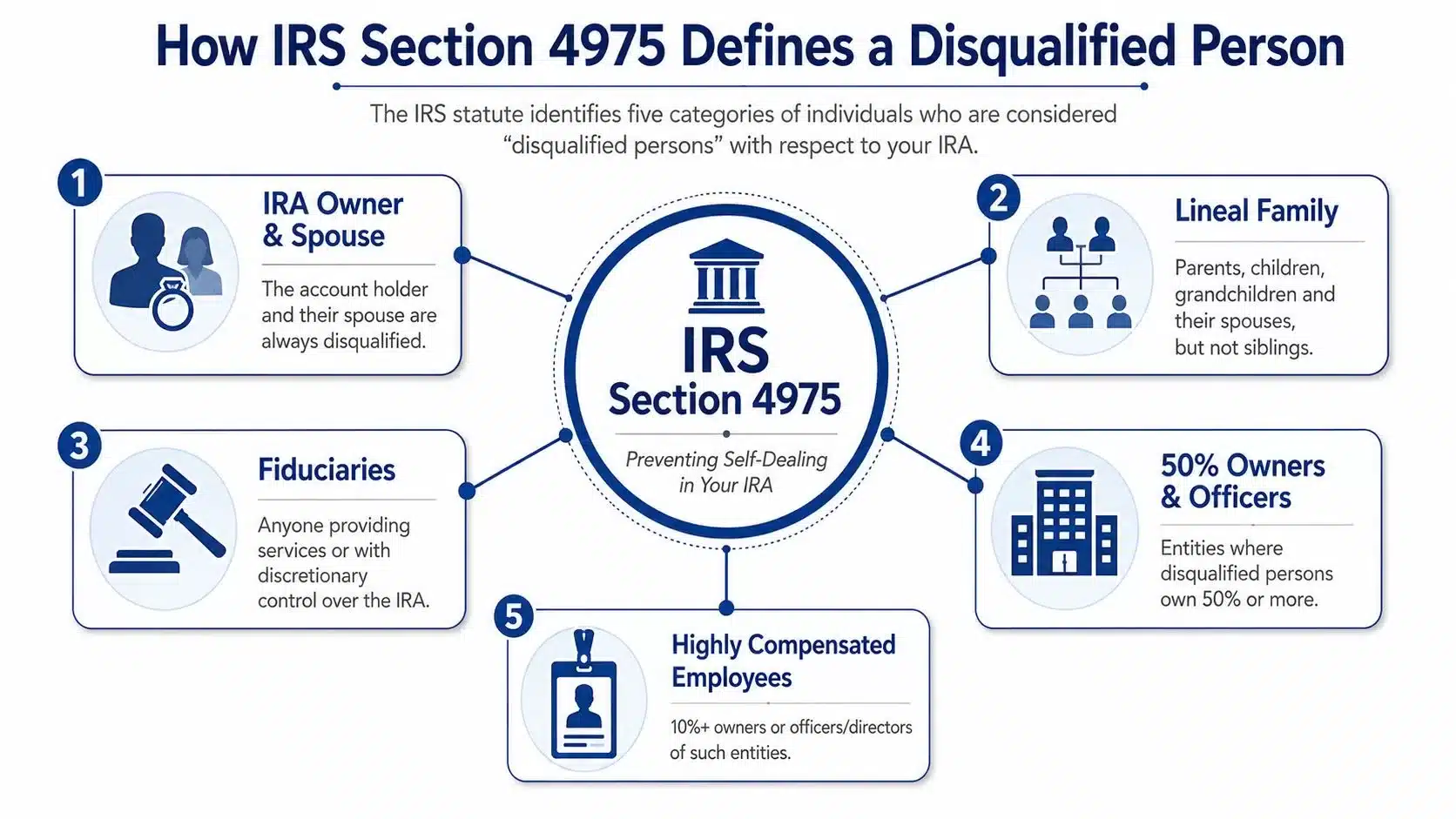

Before signing, map every relationship and follow the money. Ask whether a family LLC, an adult child's rental, or a personal loan repayment connects the IRA to someone within the restricted circle. Also ask whether the IRA, its assets, or its services would satisfy a personal obligation. A fair price does not erase a prohibited relationship.
These restrictions apply across traditional, Roth, SEP, and SIMPLE self-directed IRAs. The account label does not turn personal or family dealings into retirement investments.
Every Category of Disqualified Person You Need to Know
A family LLC, an adult child's rental, or a personal loan repayment can change the answer before the IRA buys anything. The phrase self-directed IRA disqualified person covers more than the owner's immediate household. Section 4975 uses overlapping categories, so review every person, role, and entity connected to the proposed transaction.
| Category | Example |
|---|---|
| IRA owner | The account holder who directs or benefits from the investment |
| Spouse | The owner's spouse participating in a loan, sale, lease, or service arrangement |
| Lineal ancestors | Parents and grandparents |
| Lineal descendants | Children and grandchildren |
| Spouses of lineal descendants | A child's or grandchild's spouse |
| Fiduciaries | A person with authority or responsibility over IRA assets |
| Service providers | A custodian, trustee, or other person providing services to the plan |
| Related entities | A corporation, partnership, LLC, trust, or estate owned at least 50% by disqualified persons |
| Certain officers, directors, and owners | Individuals holding the covered ownership or management position in related entities |
The IRA owner is the starting point. An owner cannot sell a personally owned rental to the IRA, transfer a personal asset into the account, or use IRA funds to pay a private bill. Retirement money is meant to hold investments for the account, not absorb the owner's property or expenses.
The family rules reach ancestors and lineal descendants. Parents, grandparents, children, and grandchildren are included, along with the spouses of children and grandchildren. If the IRA owns a rental, paying a child's spouse's contracting company to renovate it can raise a prohibited-transaction issue because the contractor is connected through a lineal descendant.
Siblings need a separate analysis. A brother or sister is not a lineal ancestor or descendant, so the relationship alone does not place a sibling in the same category as a parent or child. A sibling-owned business may still fall within the restricted group through ownership or control, and the IRA owner cannot receive a personal benefit from the investment.
Why business ownership changes the answer
The entity test is an easy connection to overlook. A corporation, partnership, LLC, trust, or estate may be a disqualified person when disqualified persons own 50% or more, directly or indirectly, as explained in the business-entity explanation of disqualified-person rules. A family LLC can therefore sit inside the restricted perimeter even when the IRA does not transact directly with a family member.
Fiduciaries and service providers also require review. A custodian may receive compensation for custodial work, but an adviser, manager, or vendor should not participate merely because the task appears routine. Check the person's authority, role, relationship, payment path, and potential benefit together.
Before signing, write down every ownership link and follow every dollar. Check whether an adult child's rental, a family LLC, or repayment of a personal loan connects the IRA to a restricted person. This short pre-transaction review can expose a problem that a fair price or ordinary paperwork will not fix.
Prohibited Transactions That Catch Investors Off Guard
The prohibited-transaction rules become clearer when applied to ordinary decisions. The following examples show why the parties, payment path, and personal benefit matter as much as the asset itself.
Selling a personal rental condo to the IRA is a direct conflict. The owner is a disqualified person, so transferring the condo into the account isn't cured by an appraisal, a written contract, or a price that appears reasonable.
Hiring a brother-in-law electrician requires relationship analysis rather than a quick assumption. A sibling's spouse isn't automatically the same as the spouse of a lineal descendant, but the arrangement still needs review for fiduciary involvement, personal benefit, and other connections. A family business may also be disqualified if relevant persons meet the ownership test.
Buying an interest in a sibling's LLC can be restricted when disqualified persons collectively own at least 50% of the entity. The family connection may look indirect, but the ownership structure can put the LLC inside the prohibited perimeter. A current organizational chart and ownership records are more reliable than a casual understanding of who “runs” the business.
Paying yourself back for repairs is another quiet hazard. If the owner personally purchases supplies or performs work for an IRA-owned property, the payment or service can create a prohibited transaction involving the furnishing of goods or services and a personal benefit. The owner shouldn't treat the IRA as a reimbursement account.
Lending IRA funds to a parent's business creates a direct lending concern because a parent is a disqualified person. The loan's interest rate, collateral, repayment schedule, and business purpose don't erase the relationship problem.
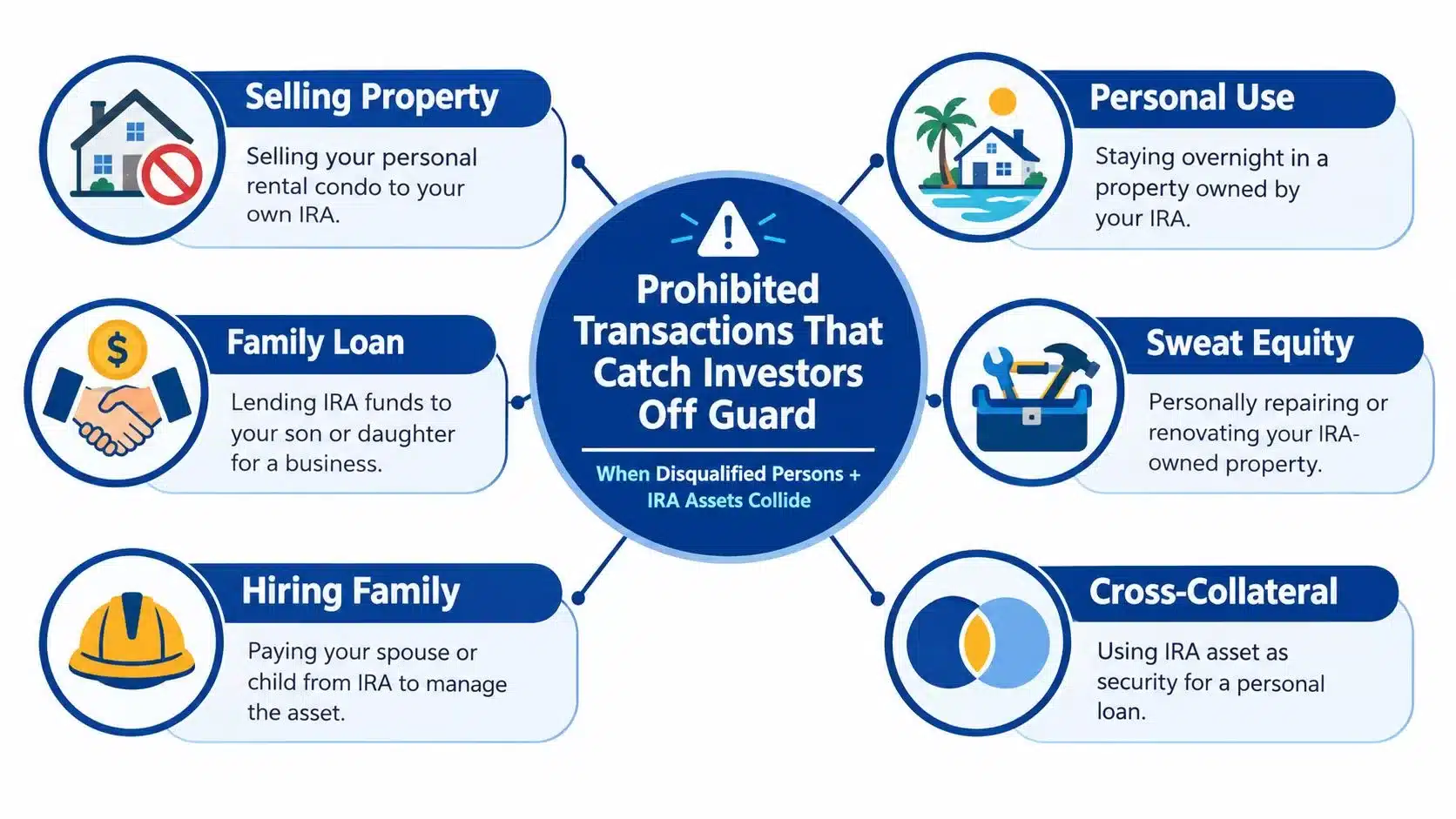
Section 4975(c) addresses conduct such as self-dealing, conflicts of interest, lending, and furnishing goods or services. The practical lesson is strict: intent doesn't control the outcome. An owner may believe the deal is fair, beneficial to the IRA, and properly documented, but those facts don't necessarily cure a prohibited act.
This short video can provide another visual explanation of the issue:

What Happens If Your IRA Engages in a Prohibited Transaction
A prohibited transaction can affect the status of the entire account, not just the investment involved. That's why a small payment, personal use of property, or family service arrangement deserves attention before funds move.
The verified IRS framework establishes that a transfer of plan income or assets to, or use of them by or for the benefit of, a disqualified person is treated as a prohibited transaction. An industry legal explanation further states that one prohibited transaction can cause the IRA to be disqualified as of January 1 of the year involved and treated as distributed at fair market value. The result may include taxable income and additional consequences depending on the owner's circumstances.
| Outcome | IRS rule | Effect on the IRA |
|---|---|---|
| Prohibited transaction occurs | Section 4975 restricts transactions involving plan assets and disqualified persons | The account's tax-advantaged status may be jeopardized |
| Account treated as disqualified | The entire IRA may be treated as disqualified for the relevant year | The full account value may be treated as distributed |
| Fair-market-value treatment | The account can be deemed distributed at fair market value | Taxable income may arise even when the owner didn't receive cash personally |
| Additional tax exposure | Consequences depend on facts, age, account type, and correction steps | The owner may need professional tax and legal guidance |
The severity explains why prevention is more practical than repair. An owner shouldn't assume that reversing a payment, returning an asset, or ending a lease automatically restores the account. The correct response depends on the facts, timing, records, account structure, and applicable IRS procedures.
When in doubt: Stop the transaction, preserve the records, and ask the custodian and a qualified tax or legal professional to review the facts before attempting a correction.
Account expenses also deserve a separate review. Understanding self-directed IRA fees can help an owner distinguish ordinary account charges from personal expenses that should never be routed through retirement assets. This article isn't a substitute for individualized advice, especially where a transaction has already occurred.
A Simple Workflow to Avoid Disqualifying Your Account
A pre-transaction review should feel like a pilot's pre-flight check. It may seem repetitive, but the routine catches relationship and payment problems before the account commits funds.
Six checks before money moves
Map every party. List the buyer, seller, lender, borrower, tenant, contractor, manager, adviser, and entity involved. Compare each name with the disqualified-person categories.
Check family and ownership. Confirm whether an owner, spouse, parent, grandparent, child, grandchild, or spouse of a lineal descendant is connected to the deal. Then review LLC members, partners, shareholders, trustees, officers, directors, and indirect ownership.
Screen for personal benefit. Ask whether the owner or a restricted person will use the property, receive compensation, obtain a discount, avoid a private obligation, or gain another direct or indirect advantage.
Document independence. For non-public assets, retain valuation support and written terms showing that the IRA will receive fair value. An independent appraisal can be useful, but documentation doesn't make a prohibited relationship permissible.
Get custodian review. Send contracts, ownership records, invoices, loan documents, and proposed payment instructions to the custodian before signing or wiring funds. Investors researching account administration can learn about an IRA custodian for gold as part of the broader custodial process.
Keep a record trail. Save the relationship analysis, valuation materials, approvals, contracts, invoices, resolutions, and payment confirmations. If the transaction involves IRS correspondence, a general PerPageFax guide for taxpayers can help explain document-transmission considerations, but it doesn't replace tax or legal advice.
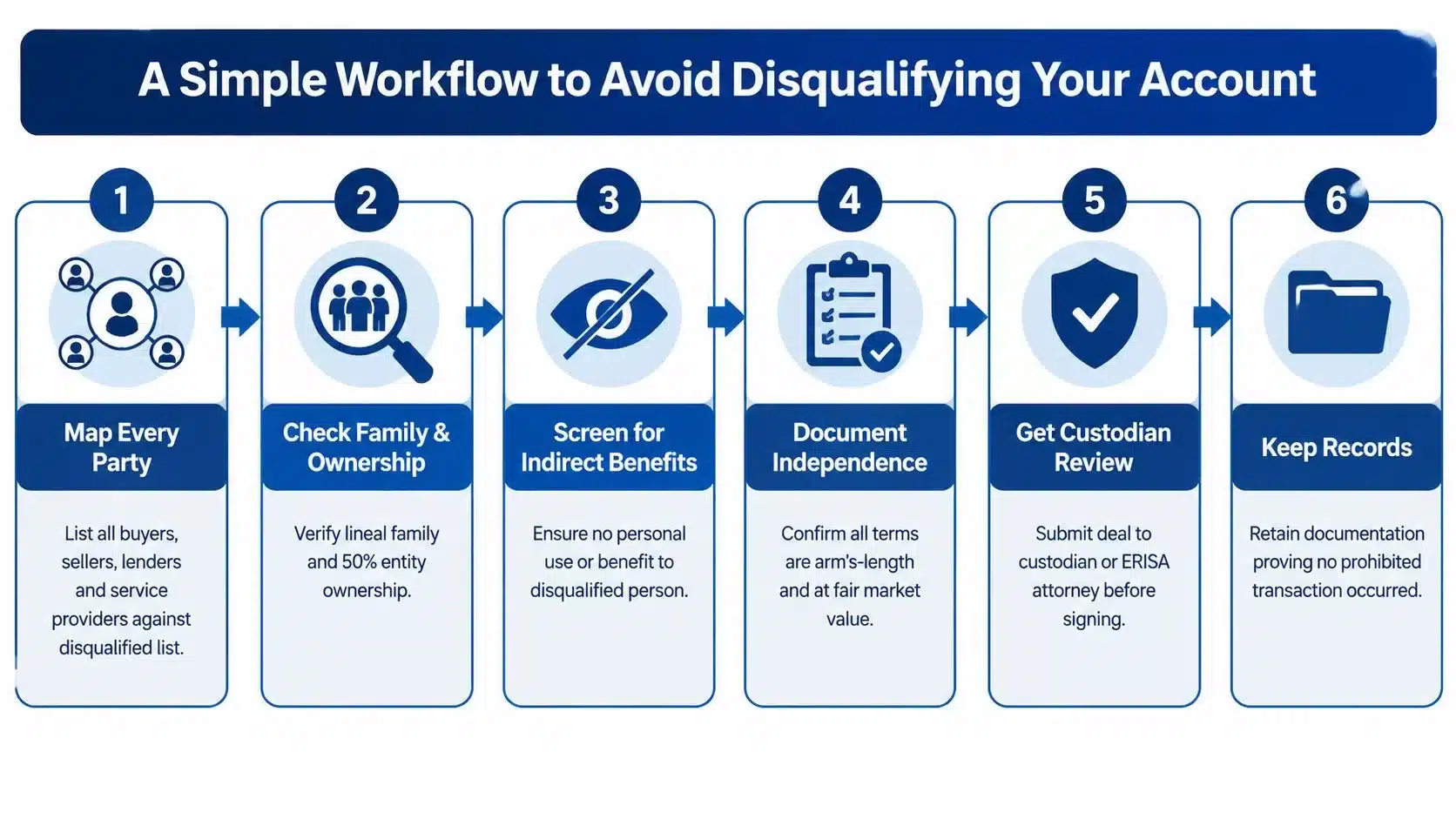
A short pause before closing is valuable. The owner can use a cooling-off period to reread the documents, confirm that personal funds aren't involved, and request a final compliance call. Finding a problem before funding is usually easier than unwinding a completed transaction.
Self-Directed IRA Disqualified Person Compliance Checklist
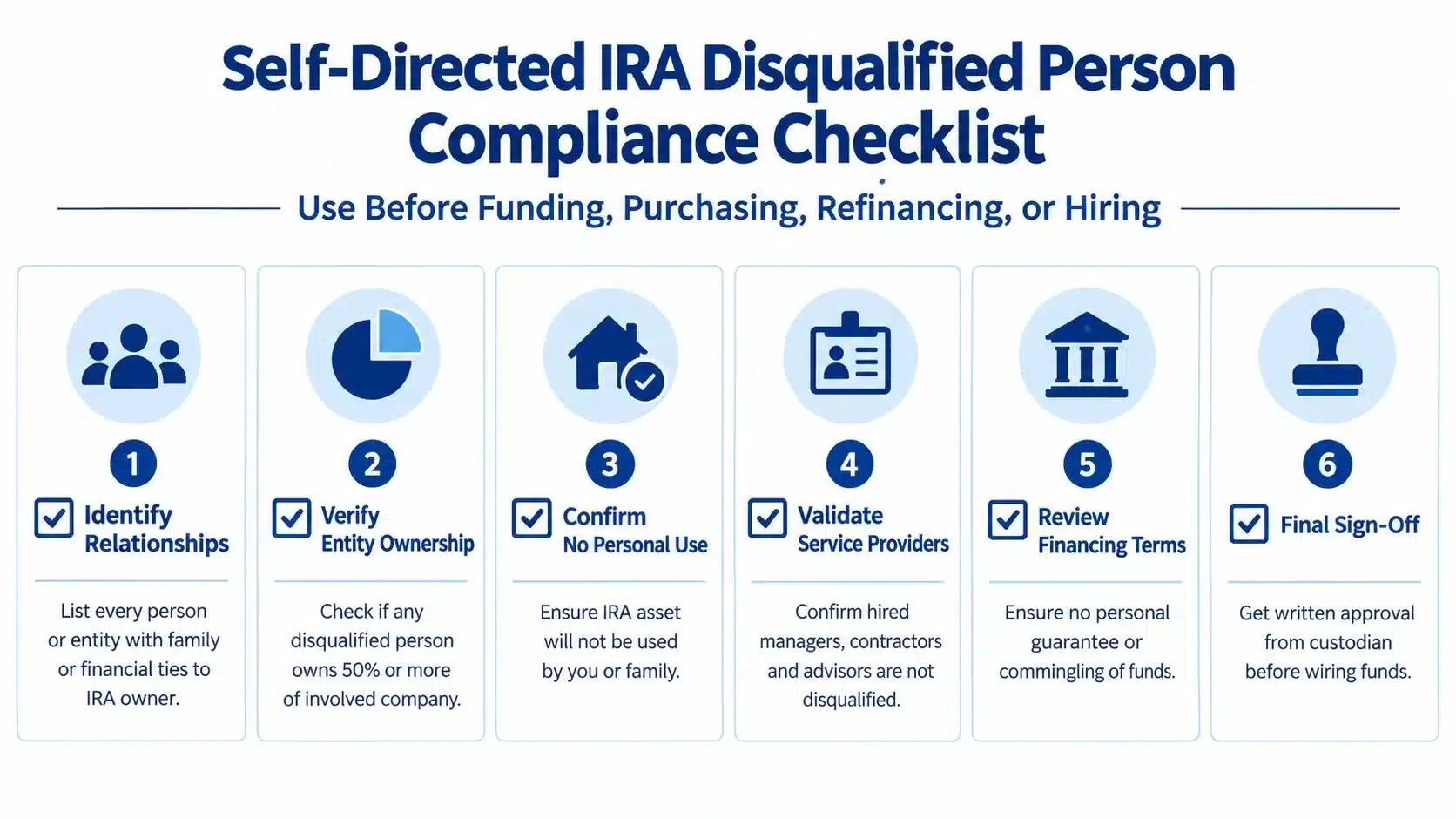
Use this compact review before funding, purchasing, refinancing, leasing, or hiring anyone connected with the account.
- Identify relationships: List every person or entity with a family, financial, ownership, or management connection to the IRA owner.
- Check restricted parties: Review the owner, spouse, parents, grandparents, children, grandchildren, spouses of lineal descendants, fiduciaries, advisers, custodians, and service providers.
- Verify entity ownership: Examine LLC members, managers, partners, officers, directors, trustees, and indirect ownership. Determine whether disqualified persons own 50% or more of an involved entity.
- Confirm no personal use: Make sure the owner and restricted family members won't use IRA-owned property or receive another personal benefit.
- Validate services and payments: Confirm that personal labor, reimbursements, repairs, management compensation, and private expenses won't be paid from or directed to the IRA.
- Review financing: Check loans, guarantees, collateral, leases, and related-party financing before closing.
- Gather records: Retain appraisals, contracts, invoices, organizational documents, resolutions, payment records, and custodian communications.
- Get written guidance: If a relationship, valuation, payment, or loan structure remains unclear, pause and request advice from a qualified tax or legal professional.

Key Takeaways and Your Next Smart Step
The core rule is straightforward. A self-directed IRA may offer broad investment flexibility, but it can't buy from, sell to, lend to, lease to, provide services for, or otherwise benefit a disqualified person. Start with the people closest to the owner, including the owner, spouse, parents, children, and qualifying in-laws, then examine businesses they own or control.
Ownership through an LLC or family business doesn't automatically create distance from the rule. An entity can fall within the restricted category when disqualified persons collectively own 50% or more, directly or indirectly. A family LLC, personal repayment, property-management arrangement, or private loan can therefore create a compliance issue even when the transaction appears commercially sensible.
Run the checklist before every transaction, not just when opening the account. Keep the supporting documents, route payments through the custodian, and obtain professional guidance when the parties, valuation, financing, or benefit structure is uncertain. The rules can be fact-specific, and this is not financial advice. Consult a licensed financial advisor, CPA, or tax professional before making investment decisions.
Gold IRA Association provides educational guides on self-directed precious metals IRAs, rollover procedures, IRS-related account rules, fees, and provider evaluation. Visit Gold IRA Association to review the relevant materials and prepare informed questions for a qualified custodian or professional adviser.


