




An IRA custodian is the bank, federally insured credit union, savings and loan association, or IRS-approved entity that legally holds and administers an IRA. A Gold IRA can't be kept as personal bullion outside that structure, because the account exists only when a qualified institution maintains it.
Why an IRA Custodian Matters Before You Buy Gold
A near-retiree comparing Gold IRA companies usually starts with coins. The pages show American Eagles, bars, storage photos, and rollover offers, and it's easy to assume the company selling the metal is also the account itself. That assumption is where confusion begins, because the dealer's product menu isn't the retirement account.
The account behind the purchase is the compliance gate. An IRA exists only when a qualified institution holds it under a written retirement document, and that institution keeps the records that connect contributions, rollovers, purchases, and distributions. Without that structure, there's no IRA to buy gold inside, only personal metal that may be taxed very differently.
What a Reader Should Be Able to Tell Apart
After working through what is an IRA custodian, a reader should be able to name the custodian's job in plain language. The reader should also be able to separate that job from a trustee, a dealer, and a depository, and to spot what custody doesn't promise. Those distinctions matter more than a sales pitch, because they determine who is responsible when money moves.
The same institution may administer a traditional IRA or a Roth IRA, but the rules for contributions, withdrawals, and reporting aren't identical. Paperwork also doesn't end when the account opens. Contributions must be processed, distributions must be reported, and required minimum distribution rules must be applied where they fit, year after year.
The scale of that infrastructure is easy to underestimate. Congressional Research Service analysis reported that 25.3% of U.S. households owned an IRA in 2019, and IRS data cited in that analysis found 4.5 million taxpayers contributed to traditional IRAs in 2017 while 6.8 million contributed to Roth IRAs, figures detailed in IRS Publication 590-B on IRA distributions. Those numbers show how widely custodians are used. They don't show that custody removes risk.
A custodian preserves the account's legal structure and records. It doesn't guarantee investment performance or eliminate market risk.
That last point is the practical test for any Gold or Silver IRA pitch. If a presentation talks only about inflation, market swings, and shiny products, but never names the custodian or explains its limits, the reader is missing the most important part. Tax rules and figures should also be checked against current IRS guidance before anyone acts, because they change over time and personal circumstances vary.
What an IRA Custodian Is Under IRS Rules
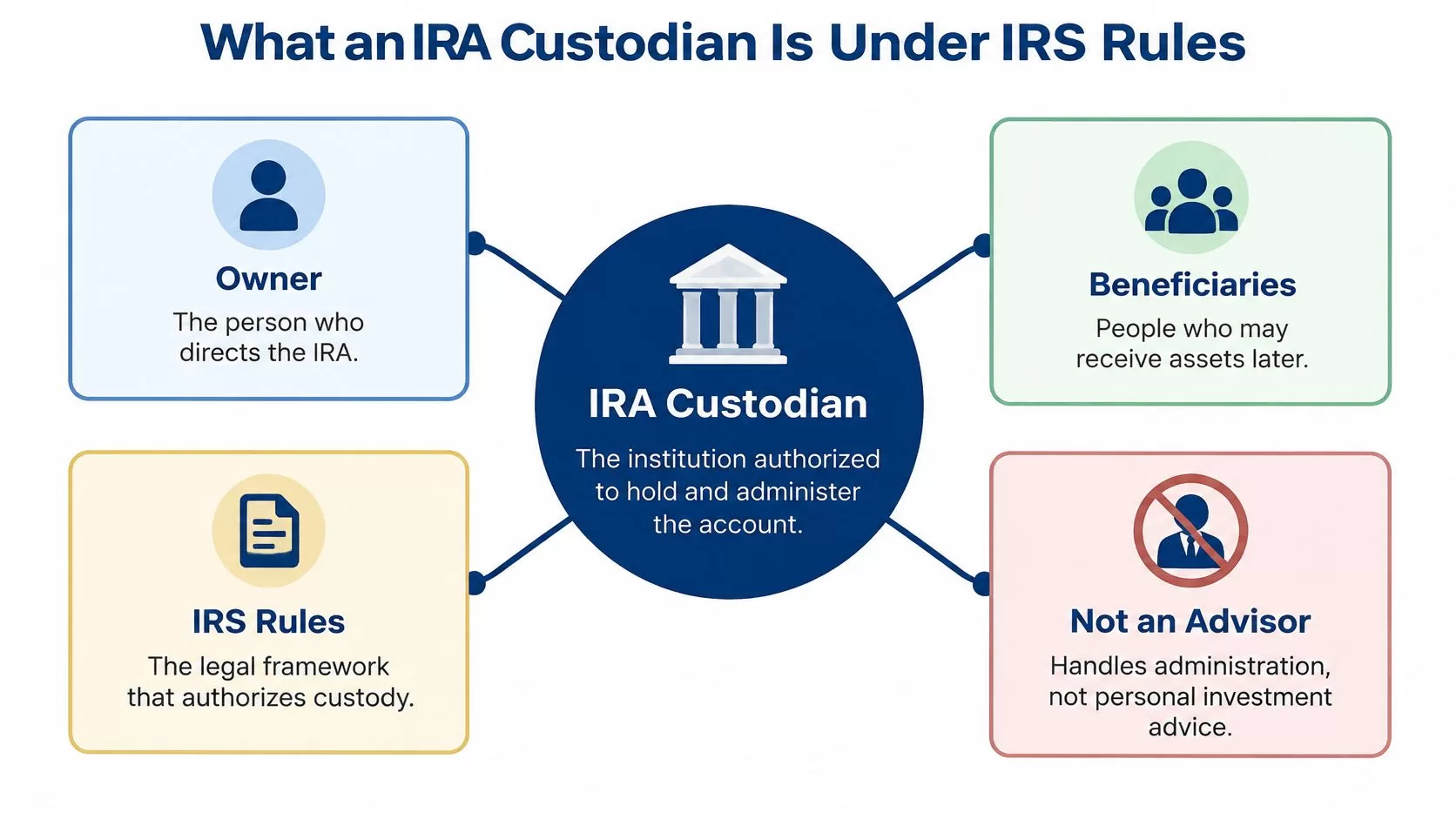
An IRA custodian is the legally authorized institution that holds and administers an individual retirement account for the owner or beneficiaries. It doesn't own the assets for its own benefit. It holds them inside an account that exists exclusively for retirement benefits, and it acts under the written agreement that created that account.
IRS rules require an IRA to be established through a written document and structured as either a trust or a custodial account. The custodian or trustee must be a bank, a federally insured credit union, a savings and loan association, or another entity specifically approved by the IRS, as explained in IRS Publication 590-A on IRA contributions and setup. That's a legal threshold, not a marketing label.

Who May Serve and Who May Not
A broker, investment company, or precious metals administrator can't just adopt the title of custodian. Nonbank entities must apply for approval under Treasury Regulation §1.408-2(e) and demonstrate that they satisfy prescribed requirements before accepting fiduciary IRA accounts. Provider selection therefore starts with authority to serve, not with a product brochure.
Readers can apply a simple check before looking at any coin list. They can ask for the institution's legal name, ask which category it falls into, and ask to see the written IRA agreement. If those answers are vague, the account structure itself deserves more scrutiny. For background on the broader framework, readers can review the IRS rules that govern Gold IRAs in plain language.
What the Custodian Does Each Day
Daily administration is unglamorous, and that's the point. The custodian maintains account records, processes contributions and distributions, reports required information to the IRS, and executes transactions according to the IRA agreement and tax rules. Each entry creates the paper trail that shows money entered, moved, or left the account correctly.
- Maintains records: Keeps the account history, ownership records, and transaction documentation in order.
- Processes money movement: Handles contributions, rollovers, purchases, and distributions inside the account.
- Reports to the IRS: Sends required information so the account's activity is documented for tax purposes.
- Executes instructions: Carries out permitted transactions under the agreement rather than inventing an investment strategy.
For specialized self-directed IRAs, including precious metals IRAs, that work stays administrative and fiduciary rather than promotional. The custodian holds the IRA assets, verifies that transactions follow applicable rules, and coordinates with approved storage or other service providers where necessary. It isn't there to sell the investment.
Calling an account self-directed doesn't change that foundation. The label describes who directs the investment choices, not who may legally maintain the account. An owner still can't hold IRA metals personally or operate a Gold IRA outside an approved custodial structure and expect the account to remain qualified.
Plain-language rule: Self-directed means the owner directs. It doesn't mean the owner becomes the custodian.
That distinction protects the reader from a common shortcut. A helpful salesperson, a polished website, or a familiar coin design doesn't create custodial authority. Only an eligible institution, acting under a written IRA document and applicable tax rules, can do that, and verifying that authority is the first step before any rollover money moves.
Custodian Versus Trustee Dealer and Storage
Four roles get blended in most Gold IRA conversations. A website may sell coins, arrange a rollover, introduce a custodian, and mention a vault, all in one flow. The reader hears one brand name and assumes one company does everything, when several separate parties may be involved with very different duties.
Trustee and custodian are the legally eligible roles that maintain the IRA. A dealer sells metal. A depository stores approved bullion under the custodian's arrangement. An adviser or promoter may recommend a strategy, but recommending something doesn't make that person the IRA, and it doesn't transfer custodial responsibility to them.
Who Does What in a Precious Metals IRA
| Role | Primary job | Does not do |
|---|---|---|
| Custodian or trustee | Holds and administers the IRA, processes transactions, keeps records, and reports to the IRS | Doesn't guarantee the metal's price, quality, or return |
| Account owner | Directs investment choices inside the account | Doesn't hold IRA metal at home or act as the custodian |
| Dealer | Sells eligible coins or bars to the IRA through the custodian | Doesn't become the IRA by selling the product |
| Depository | Stores bullion under institutional custody arrangements | Doesn't administer the IRA or file its tax reports |
| Adviser or promoter | May discuss strategy or present an opportunity | Doesn't validate the account's legal status by endorsing it |
The table shows why labels aren't interchangeable. The party that chooses the metal isn't necessarily the party that stores it, and the party that stores it isn't the party that maintains the retirement account. Each handoff should be documented, because the IRA's qualified status depends on the chain staying inside the rules.
Why Self-Directed Custodians Offer Wider Menus
Mainstream custodians commonly limit their menus to stocks, bonds, and mutual funds. A self-directed custodian generally expands the permitted menu beyond those options, and examples can include real estate, promissory notes, tax lien certificates, and private placement securities. For precious metals, that wider menu only works if the custodian coordinates eligible purchases rather than treating bullion as household property.
The account owner generally directs the investment. The custodian executes it and keeps the account's legal form. That division is easy to miss when a dealer handles most of the visible conversation, so readers benefit from learning what Gold IRA companies actually do before comparing offers.
A practical test cuts through the branding. If a website sells coins but can't show that it is the bank, credit union, savings and loan, or IRS-approved trustee or custodian, it isn't the IRA custodian. It may still play a legitimate role as a dealer or facilitator, but that role should be named plainly and checked separately.
Readers should ask who holds the assets, who chooses the metal, who stores it, and who reports the account activity. Clear answers produce a short list of separate names and duties. Blurred answers, where every question returns to the same sales contact, are a reason to slow down and request the underlying custodial documents before funding anything.
What an IRA Custodian Does Not Guarantee
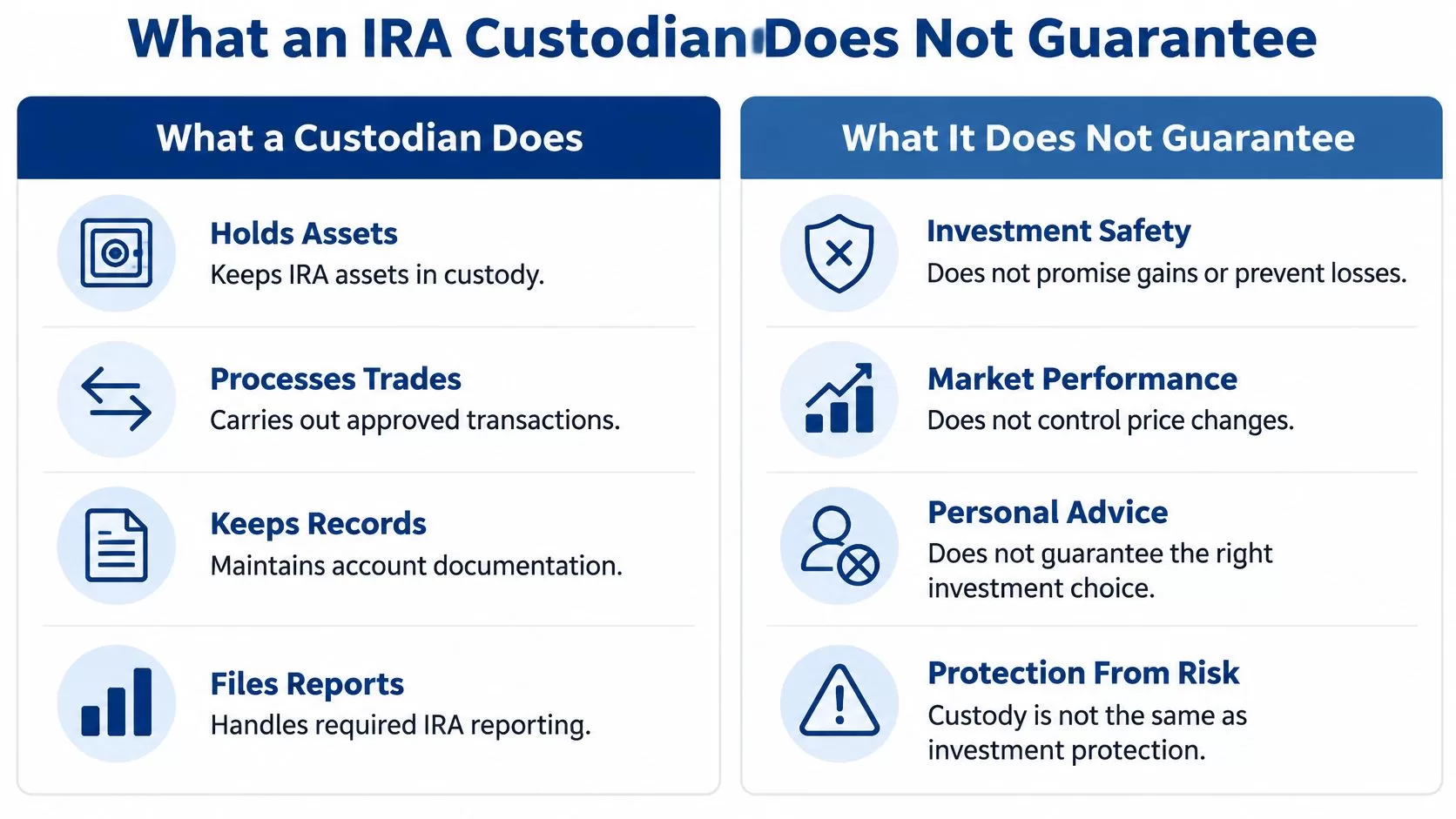
Administrative custody isn't investment protection. Many explanations list holding assets, processing trades, keeping records, and filing reports, then blur that list into an implied promise that the purchase itself is sound. That leap is unsafe, especially with self-directed accounts where the owner carries more of the decision-making burden.
The SEC states that self-directed IRA custodians typically do not investigate or recommend investments, verify the accuracy of an investment's information, ensure complete disclosure, or evaluate the quality and legitimacy of an investment or its promoter, a limitation described in the SEC material on self-directed IRA custodians. Acceptance of a transaction therefore shouldn't be treated as an endorsement of the metal, dealer, pricing, or strategy.
The Endorsement Mistake
A custodian may process a Gold IRA order correctly and still have no view on whether the coin was fairly priced. It may confirm that paperwork arrived, funds moved, and storage was arranged, without judging whether the dealer charged too much or whether the product suits the owner's goals. Treating routine processing as approval gives the purchase credit it hasn't earned.
Alternative assets can also be harder to value and sell than widely traded securities. That difficulty raises fraud and liquidity concerns, while the custodian may only provide administrative services. A familiar logo on account statements doesn't mean anyone has independently verified a promoter's claims or promised a ready resale market.
Custodian involvement does not eliminate fraud risk, market risk, or the owner's duty to investigate.
Questions That Reveal the Real Protection
Readers don't need legal training to test the boundary. They need direct questions, asked before funding, with answers in writing rather than reassurance by phone.
- Execution only: Is the custodian merely following the owner's instructions, or does it review anything beyond required paperwork?
- Verification scope: What does it verify about asset ownership, pricing, storage, insurance, and counterparties?
- Failure plan: What protections apply if a promoter fails, a dealer misrepresents a product, or an asset can't be sold promptly?
- Advice boundary: Is anyone providing fiduciary investment advice, and if so, who is that person in a legal sense?
Those questions separate custody from brokerage supervision, fiduciary advice, and government insurance. Custody keeps assets inside the retirement structure and documents what happened. It doesn't supervise a recommendation the way a brokerage relationship might, it doesn't replace personalized advice, and it shouldn't be confused with deposit protection for the investment itself.
No performance is guaranteed, and market risk remains with the account owner. Gold and silver prices move, spreads and fees affect results, and a correctly administered account can still hold an investment that loses value. Understanding that limit before funding is more useful than discovering it after a disappointing statement arrives.
How a Gold or Silver IRA Stays in Custody
A representative purchase shows the custody chain more clearly than definitions do. The owner selects an eligible coin or bar, the custodian processes the acquisition inside the IRA, and an approved depository stores the metal. The owner never takes it home, and that separation is what keeps the purchase inside the retirement account.
The image below reflects the review stage that should happen before that chain begins, when documents, eligibility, and storage arrangements are checked together.


Possession Is the Bright Line
IRS guidance states that qualifying coins and bullion must remain in the possession of the IRA trustee or custodian, and if the owner or beneficiary takes possession, the assets may be treated as distributed, a rule summarized in the SEC investor alert on self-directed IRAs. The same material notes that a custodian doesn't automatically validate an investment's quality, valuation, liquidity, or fraud risk. Both points belong together. Custody controls possession, not investment merit.
That's the concrete line between a Gold IRA and a personal safe. Metal bought personally can be held at home because it's personal property. Metal bought by an IRA belongs to the IRA, so it stays under institutional custody through arrangements described in guidance on precious metals storage for IRAs. Taking it home breaks the structure that made it a retirement asset.
The short video below offers a visual walkthrough of that possession principle for readers who prefer to see the sequence rather than only read it.

Prohibited Transactions and Eligible Metal
Possession is only the first filter. Transactions with the owner or other disqualified persons can also destroy the account's tax-advantaged status. IRS rules identify prohibited transactions such as borrowing from the IRA, selling property to it, pledging it as loan security, or purchasing property for the owner's present or future personal use, as listed in the IRS guidance on prohibited transactions.
The rule reaches improper use by the owner, beneficiary, fiduciary, or specified family members. If a prohibited transaction occurs, the IRA can cease to qualify as an IRA as of the first day of that year, causing assets to be treated as distributed at fair market value. Any amount exceeding basis can become taxable income, which turns a paperwork error into a serious tax event.
- Borrowing: Using IRA funds or assets as a personal loan source isn't permitted.
- Self-dealing sales: Selling personal property to the IRA crosses the disqualified person boundary.
- Loan security: Pledging the IRA to secure outside borrowing puts its status at risk.
- Personal use: Buying property through the IRA for present or future personal benefit isn't allowed.
Precious metals face an added eligibility screen. Collectibles are generally excluded, while certain precious metals are permitted only when statutory requirements are satisfied. Practically, the custodian should document that the metal meets the applicable category and specifications, that the transaction is between permitted parties, and that storage remains under institutional custody.
Even careful documentation has limits. Custodian acceptance isn't a substitute for independent tax or legal advice, and the investor remains responsible for avoiding self-dealing and confirming transaction compliance. A processed purchase order shows the custodian carried out the steps it agreed to perform. It doesn't certify that every tax consequence has been solved for that owner's situation.
How to Choose an IRA Custodian With Confidence
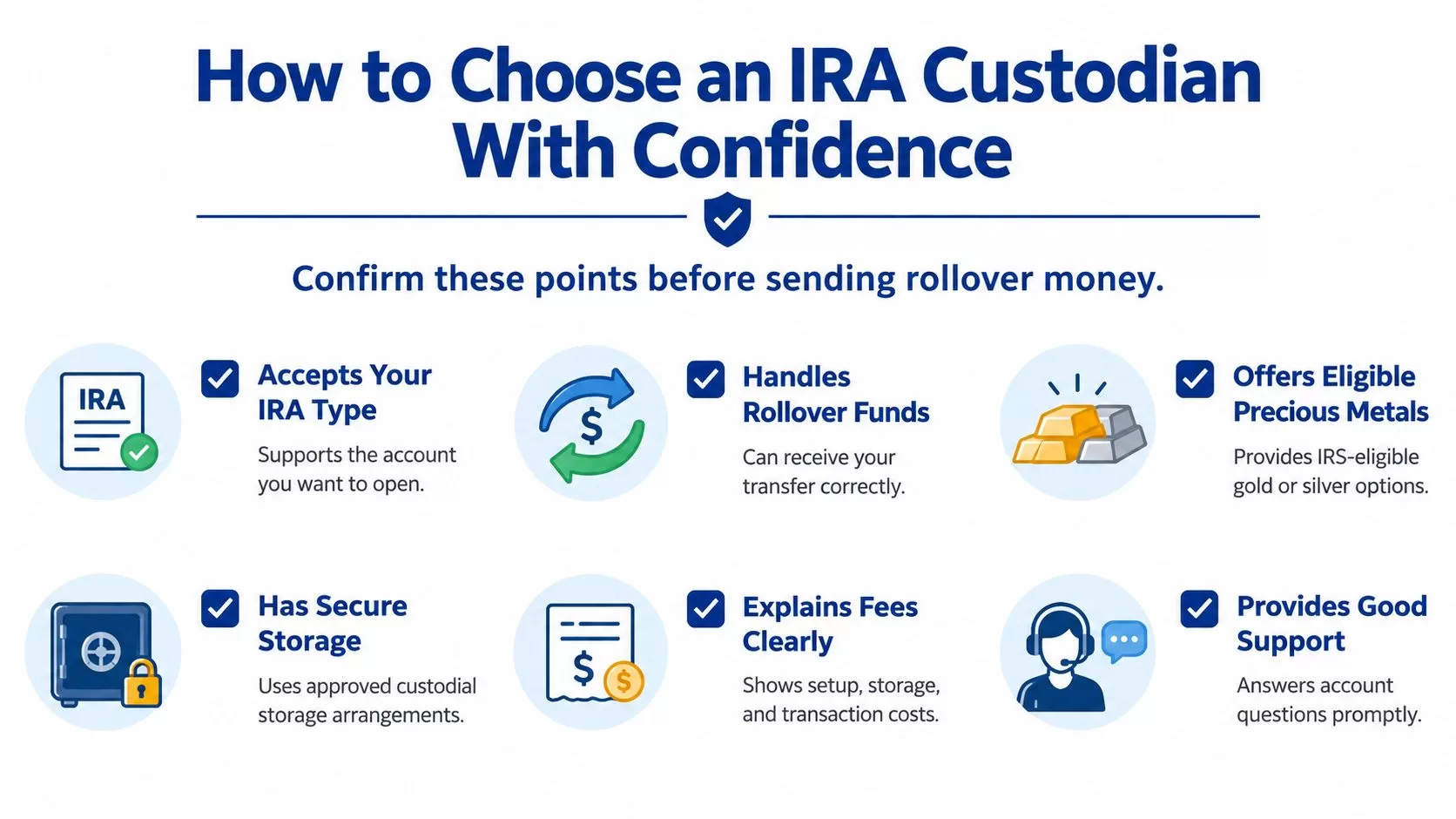
Confidence comes from verification, not familiarity. Before rollover money is sent, the reader should confirm that the institution is a bank, federally insured credit union, savings and loan, or IRS-approved trustee or custodian. The written IRA agreement should be reviewed in full, including who may give instructions and how transactions are authorized.

A Pre-Funding Checklist
- Authority first: Confirm the legal category that allows the institution to serve as trustee or custodian.
- Transaction steps: Ask how rollovers, purchases, sales, and distributions are processed and how long each step takes.
- Depository relationships: Identify approved storage arrangements and the insurance terms that apply to stored metal.
- Valuation method: Ask how assets are valued for statements and annual reporting, especially when pricing isn't obvious.
- Full fee schedule: Request setup, custodial, storage, and transaction charges together, not as separate surprises.
- Support quality: Test whether account questions receive clear, documented answers before money is committed.
Fees deserve special attention because they're layered. A low setup charge can sit beside higher storage or transaction costs, and a dealer price is separate from custodial charges. Comparing the total cost of maintaining the account over time gives a fairer picture than comparing an opening offer alone.
Gold IRA Association functions as an independent educational resource that publishes plain-English guides and criteria-based company comparisons covering credibility, service, fees, and metal options. It isn't a metals dealer, custodian, or licensed advisory firm. Readers can use that kind of comparison material to structure their own questions rather than treating any single company as the only available choice.
Closing distinction: The custodian preserves the retirement structure and the records. The investor still owns the decision and the market risk.
Precious metals may help some investors diversify a retirement portfolio, but that possibility isn't guaranteed protection against losses, inflation, or volatility. This is not financial advice. Consult a licensed financial advisor, CPA, or tax professional before making investment decisions, because rules and outcomes vary by individual circumstances and current IRS guidance should be checked.
A calm next step is to compare top Gold IRA companies side by side and note which custodian and depository each one uses. Readers who prefer a conversation can talk with a Gold IRA specialist at 888-910-8386 and ask for the custodial documents before discussing specific coins. Starting with custody keeps the product decision in its proper place, after the account itself has been verified.
Readers who want to keep separating custodians, dealers, and depositories before a rollover can use the educational guides, fee explanations, and company comparisons available through Gold IRA Association. Those resources help a near-retiree verify who would hold the IRA, who would sell and store any metal, and what questions to ask before funding. Visit the site to compare providers in plain language and prepare a custodian checklist with confidence.


