



A 55-year-old investor may be balancing a former employer's 401(k), an IRA rollover, IRS requirements, provider paperwork, storage arrangements, and questions about fees. One missed step can create confusion at exactly the point when retirement decisions need careful attention. That's why the question “why use a checklist” deserves a practical answer, especially when a Gold IRA or another precious metals IRA is under consideration.
A checklist isn't a sign that an investor lacks knowledge. It's a simple protection tool for decisions with several connected parts. Used properly, it helps keep compliance steps, questions, documents, and follow-up actions in the right order.
Introduction Why a Simple Checklist Protects Complex Decisions
Consider a common rollover situation. An investor leaves an employer and wants to move retirement savings into a self-directed account that can hold eligible precious metals. The investor speaks with a provider, reviews forms, asks about storage, selects metals, and contacts the existing plan administrator. Each step may seem manageable on its own.
The difficulty comes from the connections between them. The account structure affects the rollover process. The rollover process affects tax handling. The chosen metals must meet applicable requirements, and the storage arrangement must fit the account structure. Provider fees may appear in several places rather than on a single page.
A person can be careful, financially experienced, and still lose track of one document or assume that someone else handled a verification step. Memory works well for familiar routines. It's less dependable when a task involves unfamiliar terminology, multiple organizations, deadlines, and financial consequences.
A personal checklist gives the investor a written sequence:
- Confirm the objective: Decide whether the purpose is diversification, a rollover, a provider comparison, or a combination of these.
- Verify the account path: Identify the existing account, the receiving account, and the parties responsible for each transfer step.
- Record questions and answers: Keep written notes about fees, storage, eligible metals, and transaction procedures.
- Mark completion: Treat a task as complete only when supporting documentation has been received and reviewed.
The pages that follow explain why checklists work, where they can create false confidence, and how to build four practical versions for retirement investors. The aim isn't to turn a personal financial decision into a rigid script. It's to give the investor a reliable way to catch omissions before they become expensive problems.
How Checklists Prevent Costly Human Errors
People often make mistakes in complex workflows for ordinary reasons. They're interrupted, they rely on assumptions, they receive information from several people, or they focus on an urgent question while overlooking a quieter requirement. A checklist moves essential actions out of memory and onto a visible sequence.
The aviation lesson became especially clear after the 1935 crash of the Boeing Model 299. Aviation safety sources describe checklists becoming standard practice in the 1930s. One industry history places the term “checklist” as far back as 1853, while the Model 299 accident helped turn the idea into a formal operating tool. The important lesson isn't that pilots lacked skill. It's that even skilled people can miss a step when a complicated task must be completed under pressure.
Core principle: A checklist compensates for attention limits. It doesn't replace intelligence, experience, or judgment.
The same logic applies to a retirement rollover. An investor might remember to ask about the account custodian but forget to ask how storage fees are calculated. Another investor might verify a provider's advertised fee but fail to ask whether transaction costs, shipping, or annual administrative charges are separate. A checklist makes those questions part of the process rather than matters of memory.
What medical evidence adds
Medicine provides a useful validation because the consequences of skipped steps can be serious and the workflows involve several professionals. A systematic review of surgical checklists found that mortality risk fell to 0.57 and complications fell to 0.63 across the included studies, which corresponds to roughly a 43% reduction in death risk and a 37% reduction in complications. The findings are reported in a systematic review of surgical checklists.
The mechanism is straightforward. A checklist creates a consistent sequence, prompts people to confirm information, and reduces variation in execution. It also helps a team see whether a step was completed instead of assuming that someone else handled it.
Applying the lesson to retirement decisions
Retirement paperwork rarely looks as urgent as an operating room or a cockpit, but the structure can be similar. A rollover may involve an existing plan administrator, a new custodian, a metals dealer, a storage facility, and the investor's tax professional. Each party may control only part of the process.
The checklist should therefore focus on handoffs and verification points, not just broad intentions. Investors researching common mistakes can also review this guide to avoid common retirement investment mistakes, then convert the relevant warnings into questions for a personal worksheet.
A useful checklist asks, “What must be confirmed before the next step begins?” That question is more protective than “What should happen eventually?” It directs attention to evidence, ownership, and sequence.
What Makes a Checklist Actually Work
A useful checklist is not a long collection of reminders. It's a short operating guide that tells a person when to act, what to verify, and how to know the step is finished.
The World Health Organization's Surgical Safety Checklist offers a helpful model. It uses 19 items at three critical points in surgery, before anesthesia, before skin incision, and before the patient leaves the operating room. The World Health Organization says this structure supports teamwork and communication while reducing errors and adverse events, as described in its Surgical Safety Checklist resources.
A retirement checklist can use the same design logic without copying the medical content.
Start with a clear trigger
A trigger tells the investor when to open the checklist. Examples include:
- Before requesting a rollover
- Before selecting a provider
- Before approving a metals purchase
- Before signing account documents
- Before reviewing annual charges
Without a trigger, a checklist can become a document that gets saved but never used. The investor should know which event activates it.
Use precise, observable language
“Review fees” is too broad. “Request a written list of setup, custodial, storage, and transaction charges” is more useful because another person can tell whether the action occurred.
“Confirm eligible metals” can also be sharpened. A stronger instruction is to verify the proposed product against current requirements and retain the supporting information for review with the custodian or qualified professional.
Keep the sequence logical
An investor shouldn't choose products before confirming the account structure and eligibility rules. The order should reflect actual dependencies:
- Define the account objective.
- Confirm the receiving account and custodian.
- Ask how the transfer will be handled.
- Verify eligible metals and storage.
- Review all charges.
- Sign only after unresolved questions are answered.
The sequence prevents a later discovery from forcing an earlier decision to be revisited.
For readers who want help turning recurring work into an organized process, this resource explains how to organize your workflow with checklists. The practical value lies in making ownership, timing, and completion visible.
Practical rule: If an item can't be marked complete using a document, confirmation, or clear answer, rewrite the item.
A good checklist also leaves room for judgment. It can require the investor to record an answer without dictating whether that answer is acceptable. That distinction keeps the checklist useful without pretending that every retirement decision has one universal solution.
When a Checklist Helps Most and When It Can Hurt
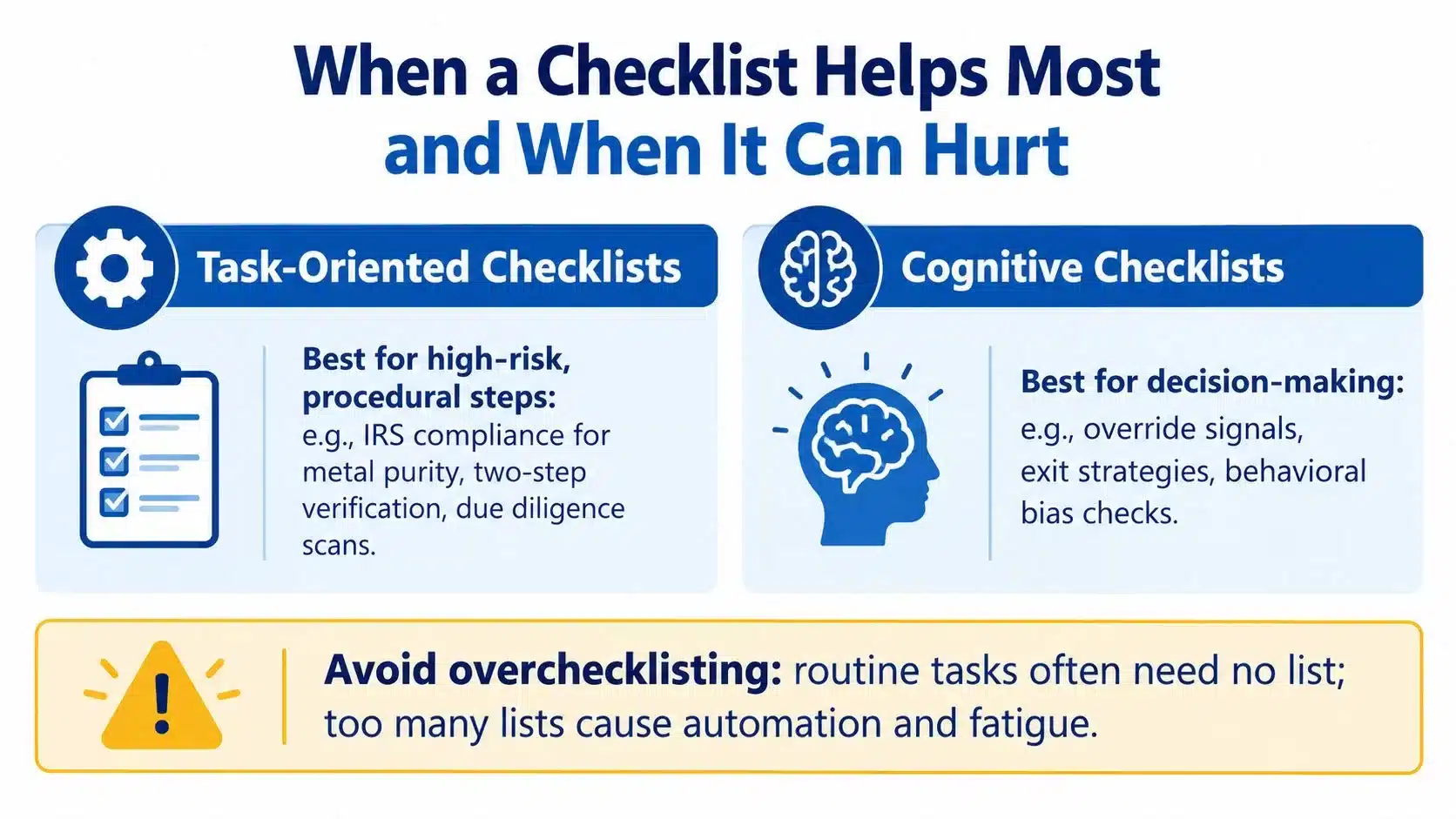
More checklist use isn't automatically better. A list helps most when it structures a high-risk, repeatable workflow with identifiable steps. It can hurt when it creates the appearance of diligence without requiring meaningful verification.
Task-oriented and cognitive checklists serve different purposes. A task-oriented list tells someone to complete an action, such as confirming that a proposed metal meets applicable eligibility standards or obtaining written details about storage. A cognitive checklist prompts reflection, such as asking whether fear, urgency, or overconfidence is influencing a provider decision.
A systematic review of diagnostic checklists found that 7 of 14 checklists improved outcomes. Task-oriented checklists were more often associated with error reduction, with 5 of 7 showing that association, compared with 4 of 10 checklists targeting cognitive processes. The findings appear in the diagnostic checklist review.

Where structure is valuable
A task-oriented list is particularly suitable for:
- Rollover documentation: Confirming which institution sends funds and which institution receives them.
- Compliance checks: Recording how metal eligibility and storage arrangements were verified.
- Provider review: Requesting written fee information and asking how buyback procedures work.
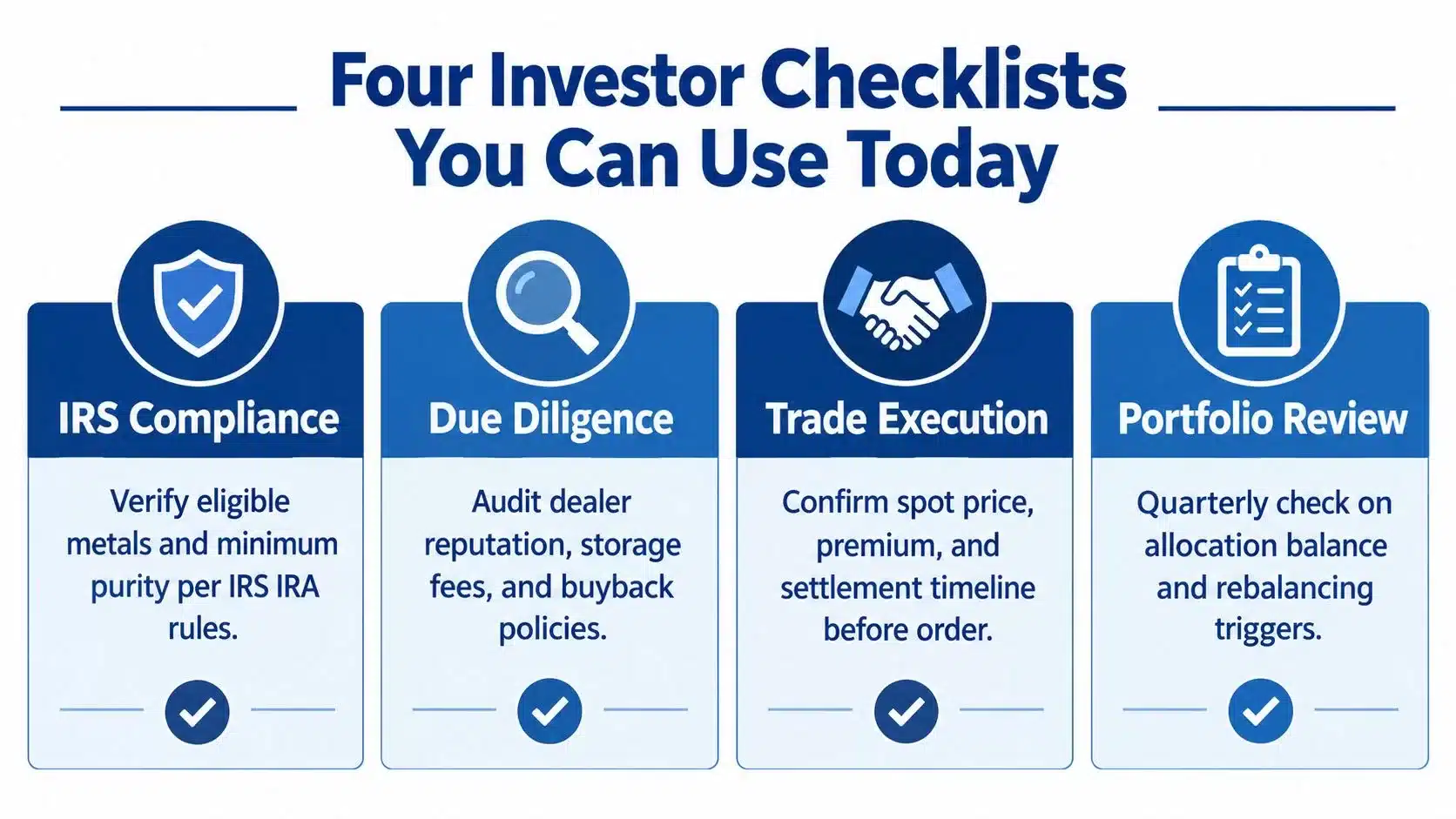
- Trade execution: Confirming the product, price terms, premiums, and settlement process before authorization.
These are actions that can be documented. A completed item should leave a paper trail or a clear written response.
Where judgment must remain flexible
A cognitive checklist can support, but shouldn't replace, an investor's judgment. It may prompt questions such as:
- What role would precious metals play in the broader retirement plan?
- What circumstances would cause the investor to reconsider the allocation?
- Does the proposed decision fit the investor's time horizon and risk tolerance?
- Has an independent professional reviewed tax or legal implications?
The risk of overuse is false confidence. Checking a box doesn't prove that the answer was accurate, current, or suitable for the individual. Selective use is often better than forcing a checklist into every routine decision.
Four Investor Checklists You Can Use Today
A practical checklist should match the decision in front of the investor. Combining compliance, provider research, rollover mechanics, and portfolio review into one oversized document makes it harder to use. Four shorter checklists create clearer ownership and reduce the chance that an important question disappears in a crowded page.
The compliance checklist
Use this before approving a metals purchase or moving forward with account paperwork.
- Identify the account type: Record whether the receiving account is intended to be a self-directed traditional IRA, Roth IRA, or another structure.
- Verify proposed metals: Confirm that each product meets current applicable IRA eligibility and purity requirements. Don't rely only on a product name or sales description.
- Confirm custody: Ask which custodian holds the account and how the metals are held for the IRA.
- Confirm storage: Obtain written information about the storage arrangement and charges.
- Keep records: Save product details, account documents, confirmations, and professional guidance.
The due diligence checklist
This list helps separate a persuasive presentation from information that can be checked.
- Request complete fees: Ask for setup, custodial, storage, transaction, and other applicable charges in writing.
- Review the service model: Identify who answers questions, who processes paperwork, and who handles account servicing after opening.
- Examine policies: Ask how purchases, transfers, distributions, and potential buybacks are handled.
- Check consistency: Compare written documents with verbal explanations.
- Record unresolved issues: Don't mark the provider review complete while important questions remain unanswered.
The rollover checklist
The sequence matters more than speed.
- Identify the existing 401(k) or IRA administrator.
- Confirm whether the proposed transaction is a direct transfer, a rollover, or another process.
- Ask the receiving custodian and existing administrator what forms and instructions each requires.
- Confirm where funds should be sent and who is responsible for each step.
- Keep copies of submitted documents and confirmations.
- Ask a qualified tax professional about individual tax consequences before signing.
The provider evaluation checklist
Investors can compare providers without allowing a polished presentation to decide the outcome. Use the matrix below to place answers side by side.
| Evaluation Criteria | What to Verify | Why It Matters |
|---|---|---|
| Account administration | Custodian identity, paperwork process, and service responsibilities | Clarifies who controls each part of the account |
| Fees | Setup, custodial, storage, transaction, and other charges | Shows the potential cost structure before commitment |
| Metals | Eligible products, purity information, and documentation | Helps reduce compliance and product-selection risk |
| Storage | Storage arrangement, access terms, and pricing | Explains how assets are held and what the investor pays |
| Transactions | Pricing, premiums, order confirmation, and settlement steps | Reduces misunderstandings before an order |
| Ongoing service | Contact process, statements, and issue resolution | Helps the investor assess support after opening |
Investors coordinating several retirement resources may also find it useful to review guidance on how to maximize federal benefits for retirement. For storage-specific questions, review precious metals storage as a separate research task rather than treating it as a minor detail.
A review of surgical safety checklists found compliance ranging from 12% to 100%, with a mean of 75%. For the critical “time out” step, compliance ranged from 70% to 100%, with a mean of 91%. A separate review found that 25 of 29 effectiveness studies, or 86.2%, reported that checklists were effective. These findings are summarized in the checklist review literature. The figures don't guarantee a result for an individual investor, but they show why structured verification can improve adherence in complicated workflows.
How to Make Sure Your Checklist Gets Completed
A checklist can fail even when its content is sensible. The investor may save it in a folder, skip items during a rushed call, or assume that a provider completed a task without requesting confirmation. Completion requires a process, not just a document.
A 2025 systematic review of WHO surgical safety checklist studies found overall compliance of 73%, but completeness was only 51%. The review identified barriers including insufficient staffing, high workloads, weak audit systems, resistance to change, and lack of ownership, as reported in the review summary.
The lesson applies outside healthcare. A checklist item without an owner is an intention. A checklist item with an owner, trigger, evidence requirement, and review point is a control.
Give each item a responsible person
For a rollover, the investor may own the decision and document retention, while the account institutions handle transfer instructions. The checklist should identify those roles rather than placing every task under a vague heading such as “provider.”
Use language that makes responsibility visible:
- Investor: Gather statements, record questions, and retain confirmations.
- Existing administrator: Explain distribution or transfer procedures.
- Receiving custodian: Provide account-opening and funding instructions.
- Tax professional: Review individual tax considerations.
- Provider representative: Explain products, pricing, and service procedures.
Attach evidence to completion
A checkmark should point to something. That might be an email, statement, signed form, fee schedule, product document, or written answer. If the investor can't identify the evidence, the item should remain open.
Automation and workflow support can also reduce friction when they make the next action obvious. In one quality-improvement project, checklist compliance improved from 31% to 80%, while average completion time fell from 46 seconds to 11 seconds. The operational data are reported in the pediatric oncology checklist study.
Schedule a review point
A checklist shouldn't disappear after the account opens. Set a personal review point for documents, charges, account statements, and the reasons the investment was originally considered. The review should examine whether the plan still matches the investor's circumstances, not encourage unnecessary trading.
A completed checklist should create confidence in the process, not certainty about the investment outcome.
Building Your Personal Gold IRA Checklist and Next Steps
A personal Gold IRA checklist can fit on one page. Start with the decision, list the required confirmations, assign an owner to each action, and leave space for the date and supporting document. Keep separate versions for compliance, rollover administration, provider evaluation, and later account review.
The checklist should protect against omissions, not promise a return or guarantee that a decision will be suitable. It should also direct the investor toward qualified help when the question involves personal tax treatment, legal consequences, or retirement-income planning. Readers reviewing broader independence and retirement planning concepts may also benefit from FIRE number adjustment tips, while those focused on a transfer can use this Gold IRA rollover guide as a starting point for organizing questions.
This is not financial advice. Consult a licensed financial advisor, CPA, or tax professional before making investment decisions.
A careful investor can begin with three questions: What must be verified, who provides the proof, and what event confirms completion? Those questions turn a general intention into a practical safeguard.
Gold IRA Association offers educational guides, provider comparisons, rollover resources, and checklists for investors evaluating precious metals in retirement accounts. Visit Gold IRA Association to compare information at your own pace, organize the questions that matter, and take the next step with greater clarity.


