


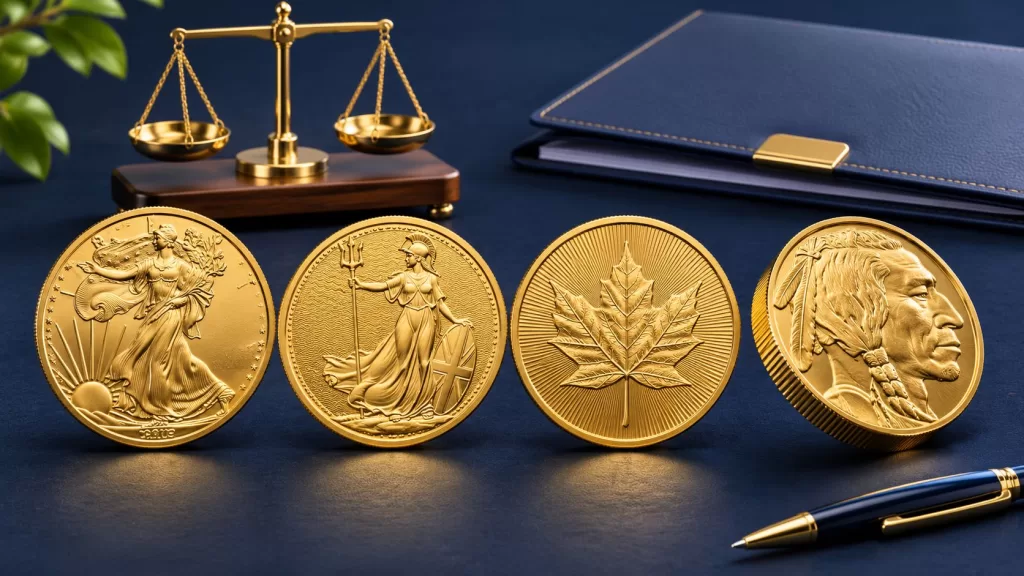
Why can two 1 oz gold coins weigh different amounts yet contain the same quantity of gold? The answer separates total coin weight, fine gold content, and Gold IRA eligibility, three details that buyers shouldn't treat as interchangeable. Understanding those differences, along with purchase premiums and resale costs, helps retirement investors compare the metal they're getting rather than just the coin's label.
1 Oz Gold Coin Specs Side by Side
A 1 oz gold coin normally contains one troy ounce of fine gold, approximately 31.1035 grams, as illustrated by the U.S. Mint's American Eagle product page. The troy ounce is the precious-metals measure, distinct from the ordinary ounce used for household weights.
Read the specifications as separate measurements. Fineness describes the share of a coin's mass that is gold. Fine gold content measures the gold itself, while total weight includes gold and any alloy metals. The distinction works like weighing a container and its contents separately: the combined weight alone doesn't tell you how much of the desired material you have.
Specifications of Common 1 Oz Gold Coins
These typical weights let you compare the gold quantity across familiar products. Match the exact issue before purchasing, especially when buying older coins.
| Coin | Fineness | Fine gold content | Total weight | Face value |
|---|---|---|---|---|
| American Gold Eagle | .9167, 22K | 1.000 troy oz | 33.931 g | $50 |
| Royal Mint Britannia, modern high-purity issue | .9999, also written 999.9 | 1.000 troy oz | Approximately 31.104 g | £100 |
| Canadian Maple Leaf | .9999 | 1.000 troy oz | Approximately 31.103 g | $50 CAD |
| American Gold Buffalo | .9999 | 1.000 troy oz | Approximately 31.103 g | $50 |
Dimensions need a separate, issue-specific check. For example, the Royal Mint's Britannia specification lists a 32.69 mm diameter, 999.9 fineness, one troy ounce of pure gold, and a £100 denomination. Diameter helps identify a product, but cannot establish its gold content by itself.
Face value records the coin's legal-tender denomination. A bullion purchase or resale quote depends much more on the contained metal, prevailing gold price, and transaction costs. Keep the denomination separate from your ownership-cost comparison: the purchase premium and the amount a dealer offers on resale affect what owning that ounce costs.
Why the Eagle Weighs More
The Eagle provides a useful worked example. Its composition is 91.67% gold, 3% silver, and the balance copper, and its complete weight is 1.0909 troy ounces, or 33.931 grams, while its fine-gold content remains 1.000 troy ounce, according to the U.S. Mint's American Eagle specifications.
The alloy adds hardness and resistance to scratching. Enough total material is included to preserve the promised gold quantity.
Practical rule: Compare fine gold with fine gold. Gross-weight comparisons alone can make an alloyed coin appear inconsistent with a nearly pure coin.
Appearance has limits, too. Britannia authentication features include micro-text, a latent image, tincture lines, and surface animation, as described in the Royal Mint's current Britannia product description. Older alloyed issues require their own specifications.
Before comparing dealer quotes:
- Confirm the unit. Look for an explicit troy-ounce description.
- Confirm fineness. Match the stated purity to the exact issue.
- Confirm fine weight and dimensions. Use product-specific measurements; the Maple Leaf gold coin specifications guide helps identify details to examine.
These checks establish what coin is offered. Gold IRA eligibility remains a separate account-rule question; weight and purity alone should not be treated as confirmation.
Purity Standards From 22K to 99.99 Percent Gold
Purity tells you the gold fraction; fine-gold weight tells you the amount. Karat counts parts out of 24, while fineness counts parts per thousand, so the same coin can sound different in a listing depending on which scale the dealer uses.
The Royal Mint's Britannia guide says Britannias struck from 1987 through 2012 used 22-carat gold while retaining one troy ounce of fine gold, then changed the specification to 999.9 fineness, or 99.99% gold, in 2013. That date split matters when a dealer offers mixed-year inventory.
Reading Purity Marks Correctly
| Mark in a listing | Coin example | How to read it |
|---|---|---|
| 22K | Britannias struck 1987 through 2012 | 22 parts gold out of 24, about .9167 fineness, with one troy ounce of fine gold still specified |
| 999.9 | Britannias from 2013 onward | 999.9 parts gold per 1,000, stated as 99.99% gold |
| Fine weight: 1 oz | A coin whose specification lists one troy ounce fine | The gold quantity after purity is applied |
A notation trap deserves attention: 999.9 fineness corresponds to .9999. Treat .999 as a different claim.
The familiar comparison puts an alloyed American Eagle beside higher-purity Britannia, Maple Leaf, and Buffalo coins. Apply a storage test: if the coin will move between tubes, capsules, and hands, the harder alloy earns the advantage; if it will stay sealed in a capsule inside a safe deposit box and the buyer wants the highest fineness, the higher-purity piece fits better.
Choosing Between Purity and Durability
Alloyed coins better tolerate routine handling, though careless storage can still mark their surfaces. Higher-purity coins suit buyers who prioritize fineness and who keep protective packaging intact.
Assay methods must suit the product. A tester should account for the declared alloy rather than treating every deviation from nearly pure gold as evidence of a counterfeit.
Date is a specification: match the coin's year and stated fineness before using a description meant for a newer version.
Which 1 oz Gold Coins Qualify for a Gold IRA
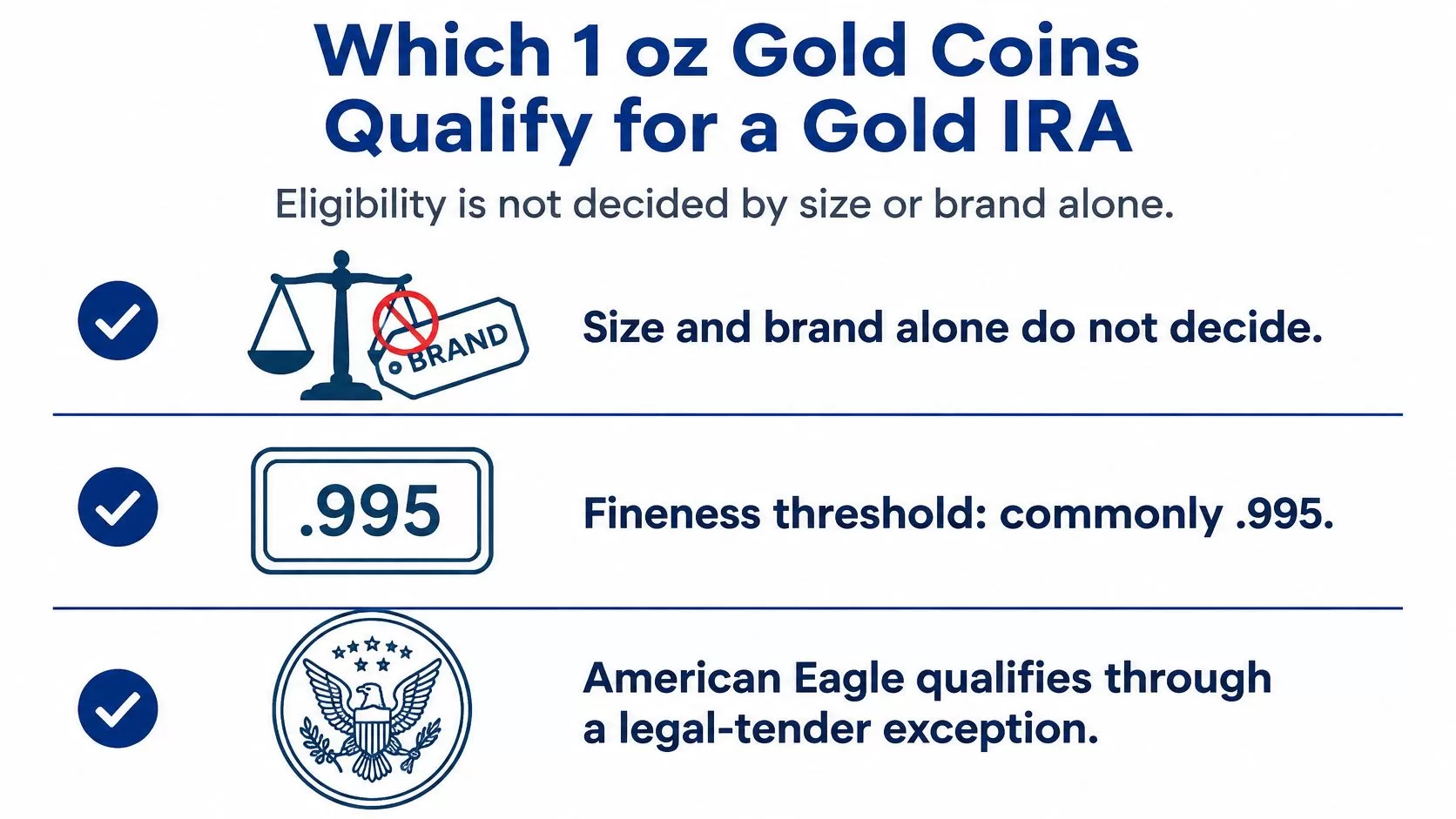
Size and brand alone don't decide IRA eligibility. IRS rules set the minimum gold fineness for IRA bullion at .995, and this gold-coin eligibility overview carried by Fidelity summarizes that threshold alongside the product exceptions that sit beside it.
The U.S. Mint's American Eagle retirement-account information identifies Eagles as products that long-term savers can include in IRAs despite their 91.67% gold composition. A specific statutory exception covers the Eagle, so its alloyed purity falls below the general threshold without costing it eligibility. A one-ounce Eagle still delivers its stated ounce of fine gold inside a heavier alloyed coin, which is why total weight, fine-gold content, and legal status each deserve a separate check.
A pre-purchase checklist keeps those three checks from blurring together.
Verify the Exact Product
Before authorizing a retirement-account purchase, the buyer should assemble:
- Product identity. Record the complete coin name, year, and version offered.
- Issuer and specifications. Retain the mint's description of fineness and fine-gold weight.
- Current legal eligibility. Confirm the applicable rule or exception for that particular product.
- Account acceptance. Obtain confirmation that the intended custodian can accept the product and arrange suitable storage.
- Written transaction details. Keep the invoice, product description, and account instructions together.
Maple Leaf and Buffalo bullion coins generally satisfy the .995 threshold on their own, but eligibility still requires product-level confirmation. The buyer should verify the exact coin, version, and year rather than rely on a familiar design or a high-purity marking.
Separate Eligibility From Suitability
An eligible product isn't automatically a suitable retirement investment. The one-ounce label says nothing about dealer spread, storage requirements, or whether the purchase fits the account holder's broader plan.
The IRA-approved gold coins guide provides a starting point for organizing product questions. Final decisions should use current IRS guidance and the account's actual requirements, since rules and their application can change.
A purchase made personally can't be folded into an IRA after the fact. Account ownership, payment, custody, and documentation should be settled before funds move.
Premiums and Resale Costs to Compare Before You Buy
The purchase premium is only part of ownership cost. A buyer needs to compare the amount paid to acquire a coin with the amount likely to be received when selling it.
Premiums differ by product, dealer inventory, and market conditions. A low advertised premium can lose its advantage after shipping, payment charges, or unfavorable resale terms.
A Hypothetical Break-Even Test
Using the illustrative scenario associated with the World Gold Council outlook discussion, suppose a buyer pays a 4% purchase premium and later sells at a 1% discount to spot. Gold would need to rise roughly 5% before the buyer breaks even, ignoring other costs; these are hypothetical assumptions, not current dealer quotes.
The calculation compares the original purchase price with future sale proceeds. Additional charges increase the rise required to recover the original outlay.
Build a Round-Trip Quote
- Purchase premium. Record the amount above the referenced spot price.
- Transaction expenses. Include shipping, insurance, payment, and dealer charges.
- Bid-ask spread. Compare the dealer's selling price with its buying price at the same time.
- Resale adjustment. Check whether the quoted buyback price assumes particular condition or packaging.
A resale discount may already be reflected in the dealer's bid, so it shouldn't be counted twice. For an IRA, custodial and storage expenses also belong in the ownership budget.
The useful comparison is the all-in purchase cost against realistic net sale proceeds, not the advertised premium alone.
The gold bars versus gold coins comparison offers another way to examine product format. For broader portfolio research, TradeLikeInsiders' resource to compare VTI and VOO holdings addresses a different question, examining equity exposure rather than physical-gold transaction costs.
Before buying, the investor should ask: What is the likely all-in exit price? How liquid is this exact coin in the intended resale market? Investing in precious metals and IRAs involves risk, including the potential loss of principal.
Frequently Asked Questions About 1 oz Gold Coins
Coin and Bar Comparisons
Is a 1 oz gold coin the same as a 1 oz gold bar?
No. They are different products even when the stated fine-gold content is identical. A coin carries a government-issued design and usually a legal-tender denomination, while a bar carries refinery markings. Both are priced on metal content plus a premium, and that premium often differs. At a single dealer, a one-ounce Eagle will generally quote higher than a one-ounce bar, because the coin's price reflects minting, recognition, and resale demand as well as its gold.
Does the face value on a 1 oz gold coin matter?
Almost never in the purchase price. The printed denomination is nominal and sits far below the coin's metal value, which is what trades. Its real function is identification: a face value marks the product as a government issue, separating it from privately made rounds and bars that carry no denomination at all.
Retirement Accounts and Different Issues
Can a 1 oz gold coin be held in a Gold IRA?
Yes, if the product is on the eligible list and the custodian accepts it. Eligibility attaches to the exact product, its fineness, and who produced it, so a "1 oz" label or a familiar name proves nothing on its own. Before paying, the buyer needs confirmation of the product's status under current rules, the custodian's acceptance, and the required storage arrangement.
Why does the same coin look different across years?
Mints change portraits, reverse designs, security details, and finishes between issues, so two genuine examples of the same coin can differ visibly. The date and version should still match the issuer's published description for that year, rather than a generic photograph. A mismatch between the stated year and the described design is the detail worth questioning.
Buyer's distinction: A familiar design helps identify a coin. Identification is the first step; product verification and account review are separate ones.
How to Check a 1 oz Coin Before Buying
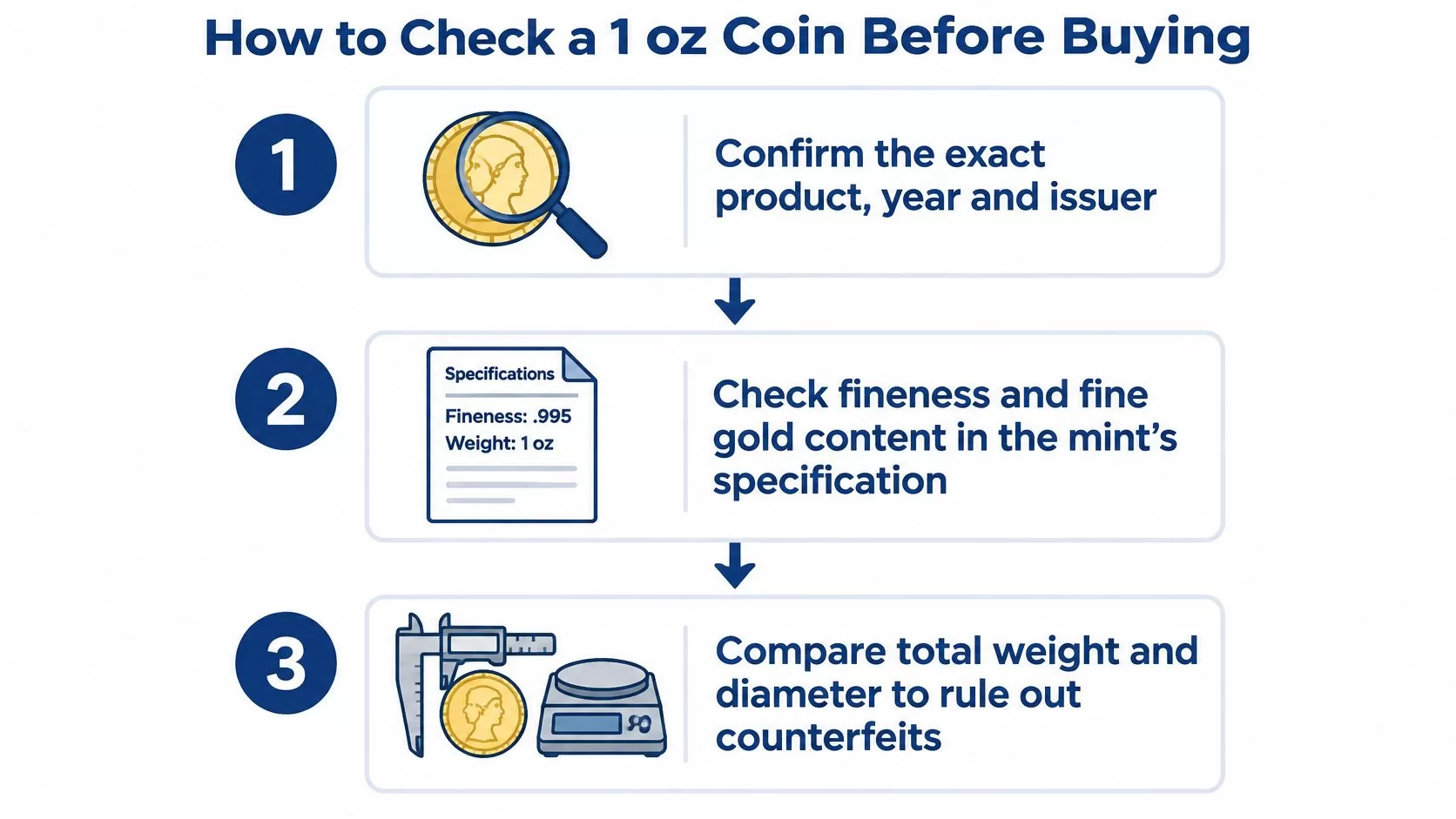
A specification sheet describes what a coin should be. A scale, a caliper, and a non-destructive test show what the item in your hand is. Run both checks before money moves.
Follow a Documented Purchase Sequence
Weigh the coin on a calibrated scale. Record the reading in grams and troy ounces, then compare it to the mint's published specification. A coin struck in a 22-karat alloy holds one troy ounce of fine gold inside a heavier gross weight, so the correct number depends on the alloy and may sit above the round figure buyers expect.
Measure diameter and thickness with a caliper. Counterfeits often fail on dimensions even when the weight looks convincing. Check both readings against the issuer's stated measurements, and treat rounded numbers in a listing as unverified until the coin matches them.
Run a non-destructive authenticity check. Gold shows no magnetic response, so a basic magnet test screens out some fakes immediately. Anything questionable warrants professional, non-destructive testing such as an assay before the sale proceeds.
Match the coin to its written description. Check the date, mint mark, and any serial or certification number on the packaging against the invoice. Paperwork that names a different year or version is grounds to pause the transaction.
Calculate the net exit value. Ask the dealer for the buy-back price on the same day you request the purchase quote, then subtract shipping and insurance to find your net exit value. The gap between the two figures is the cost of owning the coin.
Compare equivalent offers. Keep fine-gold quantity and product condition consistent across quotations. A collectible presentation, special finish, or packaging premium adds no bullion content.
Confirm custody and storage terms. Establish who holds the metal, how the account records ownership, what storage costs apply, and how a future sale or distribution would be handled.
The video below walks through the weighing and measurement steps in this sequence.
Get Every Document Before You Pay
Keep the specification sheet, written purchase quote, same-day buy-back indication, eligibility confirmation, and storage terms together in one file. Each unanswered question on those pages is a reason to pause the purchase until the dealer answers in writing.
Gross weight, fine-gold content, and legal eligibility are three separate checks.
This is not financial advice. Consult a licensed financial advisor, CPA or tax professional before making investment decisions, and rules vary by individual circumstances.
Gold IRA Association offers educational guides and provider comparisons to help readers evaluate eligible coins, account rules, and ownership costs. Visit Gold IRA Association to prepare questions about a potential purchase, or talk with a specialist at 888-910-8386 about finding educational information on account requirements and provider comparisons.