



What determines whether the IRS sees a trustee to trustee transfer as a tax-free move or a taxable distribution? Many guess the deadline. The answer sits on two lines of the form: the payee line and the account title printed next to it. The rest of the paperwork is bookkeeping, and the bookkeeping is where quiet, expensive mistakes live.
Choosing Between a Direct Transfer and a 60-Day Rollover
Two paths move retirement money between custodians, and only one of them puts a check in your hand.
| Feature | Trustee-to-trustee transfer | 60-day rollover |
|---|---|---|
| Who receives the funds | Receiving custodian directly | Account owner, who then redeposits |
| Deadline | No 60-day deadline applies | 60 days from receipt |
| Counts toward one-rollover-per-12-months limit | No | Yes |
| Mandatory 20% withholding on eligible plan distributions | Does not apply | Applies when paid to the owner |
A direct transfer works like a wire between two banks: the money never pauses in your hands. When the sending trustee pays the receiving trustee, the IRS does not classify the event as a rollover at all, and that holds even when the existing trustee writes a check payable to the new trustee and hands it to the account owner to deliver, as IRS Publication 590-A sets out. The money moves tax-free and sits outside the once-a-year rollover restriction, so a properly executed direct transfer never uses up your annual allowance.
The rollover column runs on a clock. When a distribution is paid to the owner, the owner generally has 60 days from receipt to deposit the eligible amount into another qualifying account, and the IRS retirement plan FAQs limit deadline relief to specific hardships, such as certain financial-institution errors, death, disability, hospitalization, incarceration, serious illness, foreign-country restrictions or postal mistakes. Plan the rollover as a 60-day deadline you must actively meet, and treat those exceptions strictly as backup.
Withholding is the cost people notice last. No federal income tax withholding applies to the portion of an eligible distribution sent directly to the receiving account. A payer that sends the check to the participant generally must withhold part of the taxable amount up front, even when the participant fully intends to roll it over. Replacing that withheld money from other savings is what makes a full rollover of a participant-paid distribution work.
Decision rule: If a custodian tells you the money will come to you personally, ask whether the same assets can be sent to the new trustee instead. That one question turns a timed rollover into a transfer.
For a longer side-by-side of the two routes, the direct transfer versus rollover comparison lays out the trade-offs before you sign anything.
Trustee to Trustee Transfer Form Fields at a Glance
The form does one job. It authorizes the current custodian to send assets straight to the receiving custodian and keeps the account owner off the payee line. It doesn't move money by itself. It instructs two institutions and tells them to code the event as a transfer rather than a distribution.
| Form field | What to enter | Why it matters |
|---|---|---|
| Sending custodian | Legal name and account number of the current IRA trustee | Identifies where the assets are coming from |
| Receiving custodian | Legal name of the new trustee or custodian | Directs payment to the institution, not to the owner |
| Account title | Exact registration of the receiving account | Mismatched titles are a common reason transfers stall |
| Owner details | Owner name and taxpayer identification number | Matches the transfer to the correct account |
| Account type | Traditional, Roth, SEP or SIMPLE | Tax treatment depends on the account type |
| Assets or amount | Specific holdings or dollar amount, or the full balance | Defines what moves and what the receiving custodian must accept |
| Delivery instructions | Payable to the receiving custodian for the benefit of the owner | Keeps the transaction a direct transfer, not a payment to the owner |
| Authorizations | Signatures of the owner and, where required, both custodians | Confirms the transfer was authorized |
The payee line decides the tax treatment
The IRS describes a trustee-to-trustee transfer as a direct payment from one IRA institution to another and states that no tax is withheld from the transferred amount, as the IRS rollover guidance for plans and IRAs explains. A form that names you as payee converts the same movement into a distribution, which brings the deadline and possible withholding with it. Look for the receiving custodian's legal name, followed by "for the benefit of" and your name.
Where titles and account types go wrong
Registration mismatches stop more transfers than any other single field. If the new account reads "Jane A. Doe IRA" and the form says "J. Doe Traditional IRA," expect a rejection or a phone call. Account type matters just as much, because tax treatment depends on which kind of account the money leaves and which kind it enters. Traditional to traditional and Roth to Roth are the straightforward pairings.
Where the account type box earns its keep
Label a SIMPLE account accurately even when you plan to move it later. The receiving custodian needs that label to know what it's accepting and how to report it.
Before you send: Hold the completed form next to the new custodian's account opening confirmation and read them side by side. The title, account number and registration type should match character for character.
Custodian forms use different labels for these fields, but they ask for the same core information. Check every line against the new account paperwork, not against your memory of it.
How to Get and Complete the Transfer Form
A saver asks her custodian to mail a check "while the new account gets sorted," deposits it into the new IRA herself, and finds out months later that the IRS recorded a distribution rather than a transfer. Each custodian issues its own transfer request for exactly this reason: the agency separates a direct transfer from a distribution by how the institutions move the money, not by which document you filled in. What the IRS Publication 590-A guidance rewards is assets that never pass through your hands and a record showing the transaction was coded as a transfer.
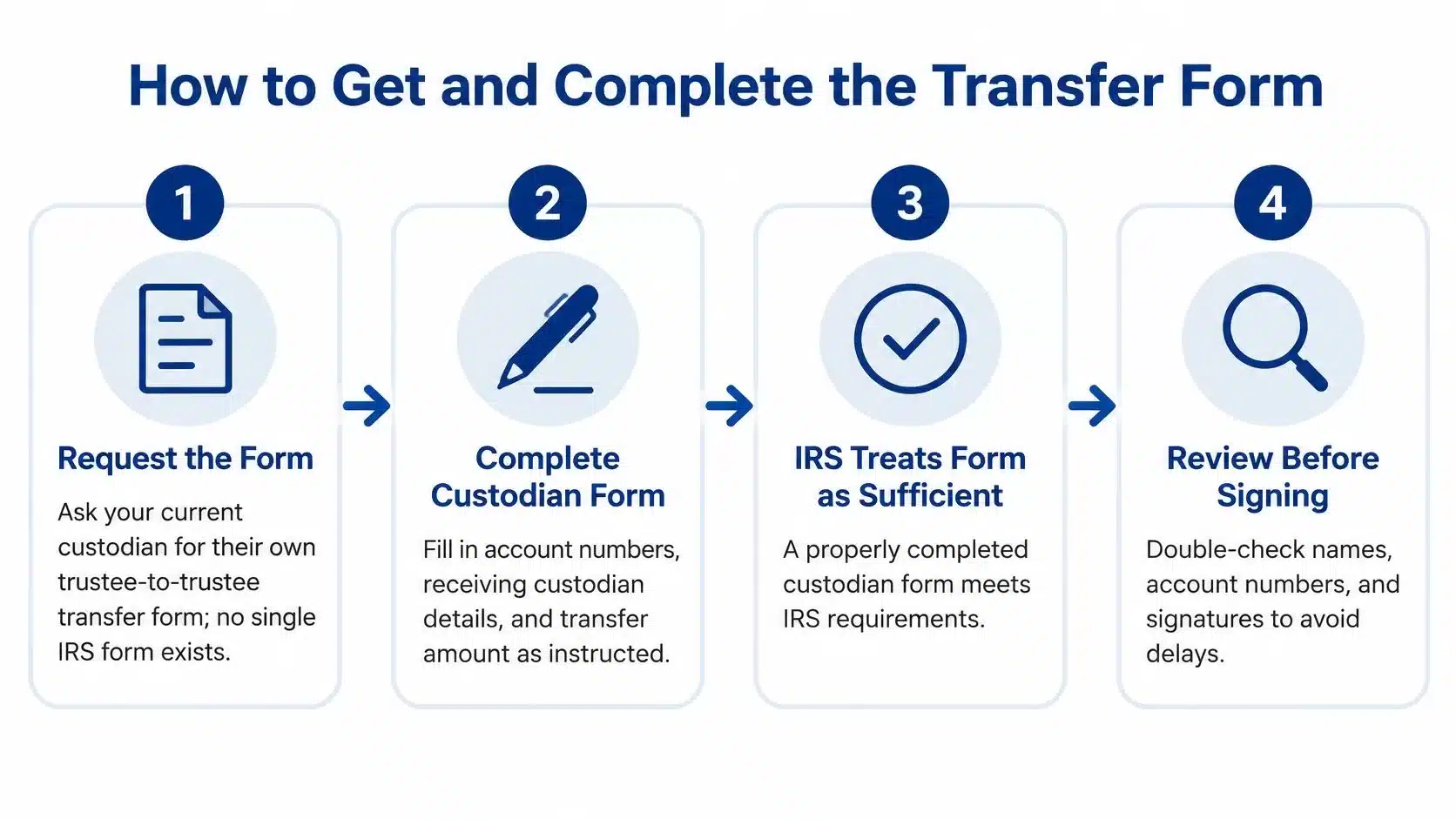
- Confirm the new account first. Verify the receiving custodian will accept the account and can hold what you're moving, whether that's cash, fund shares or physical metals. A transfer aimed at an account that can't hold the assets stalls at the receiving end, sometimes for weeks.
- Request the form from the current custodian. Phone, online portal or branch all work. Ask which version they want and whether anything else has to be attached.
- Copy the receiving title exactly. Pull it from the new custodian's account confirmation.
- Enter both institutions and your account number. The sending side needs the current account number, and the receiving side needs its own registration and address.
- State what moves. Full balance, a specific dollar amount, or named holdings. Vague instructions invite a partial transfer you didn't intend.
- Choose the delivery method. Custodians typically offer a wire or a check sent institution to institution. Pick whichever the receiving side prefers and confirm its address before the form goes out.
- Sign, date and copy. Keep the signed form and every attachment.
If the custodian still sends a fillable PDF instead of an online workflow, you can fill and sign PDFs without software and return it the same afternoon rather than waiting on a printer.
Before you start, have these within reach: the transfer request itself, the new account registration, wire or check delivery instructions, an estimate of processing time, and a place to write the confirmation number. A finished form shows two legal institution names, an exact receiving title, an unambiguous statement of what moves, and a signature with a date. The confirmation number then becomes your reference while the assets are in transit.
When Signatures or Notarization Are Required
A trust-owned IRA can fail at the last inch: the form is complete, the payee is right, and the packet still comes back because the signature line says “John Smith” instead of “John Smith, Trustee of the Smith Family Trust.” The money did not move, but the clock did. That is why the signature block deserves the same care as the payee and coding fields.
Signing rules are set by each custodian, not by one universal transfer standard. A plain IRA-to-IRA request may ask only for the account owner's signature and date. Requirements tend to rise when the account sits in a trust, has joint owners, uses an agent under power of attorney, or when the receiving title is new enough that the sender wants extra proof.
Read the signature block before you fill anything in
The requirement is printed above the signature line, sometimes in small type. Read it first, then work backward.
- Identify the exact signer. Match capacity to title: owner, trustee, co-owner, agent, or successor trustee.
- Check the stamp requested. A signature guarantee is a bank or broker medallion-style verification; a notary acknowledgment is a state-law identity check. They are not interchangeable.
- Confirm attachments. Trust papers, death certificates, or authority documents may have to travel with the form.
- Book the appointment before mailing. Guarantees and notarizations create delay if the rest of the packet waits in a drawer.
- Keep the stamped copy with the transfer record. Pair it with confirmation and final coding so a later tax question has one file.
Joint accounts can require both owners even when one person manages the paperwork. Ask specifically who must sign for the surviving, successor, or authorized party before anyone assumes a single signature covers the account.
Notarization proves identity and signature. It does not decide whether the movement is reported as a direct transfer or a distribution.
That distinction matters because a clean notarized packet can still be taxed if the check is payable to the owner or the receiving title is wrong. Confirm signer, stamp, title, payee and coding with both custodians before the envelope leaves your desk.
How to Submit the Form and Track the Transfer
Submission is a handoff, and handoffs lose paperwork. Build a small record as you go, because the year-end tax forms will refer back to dates you'll otherwise be reconstructing from memory.
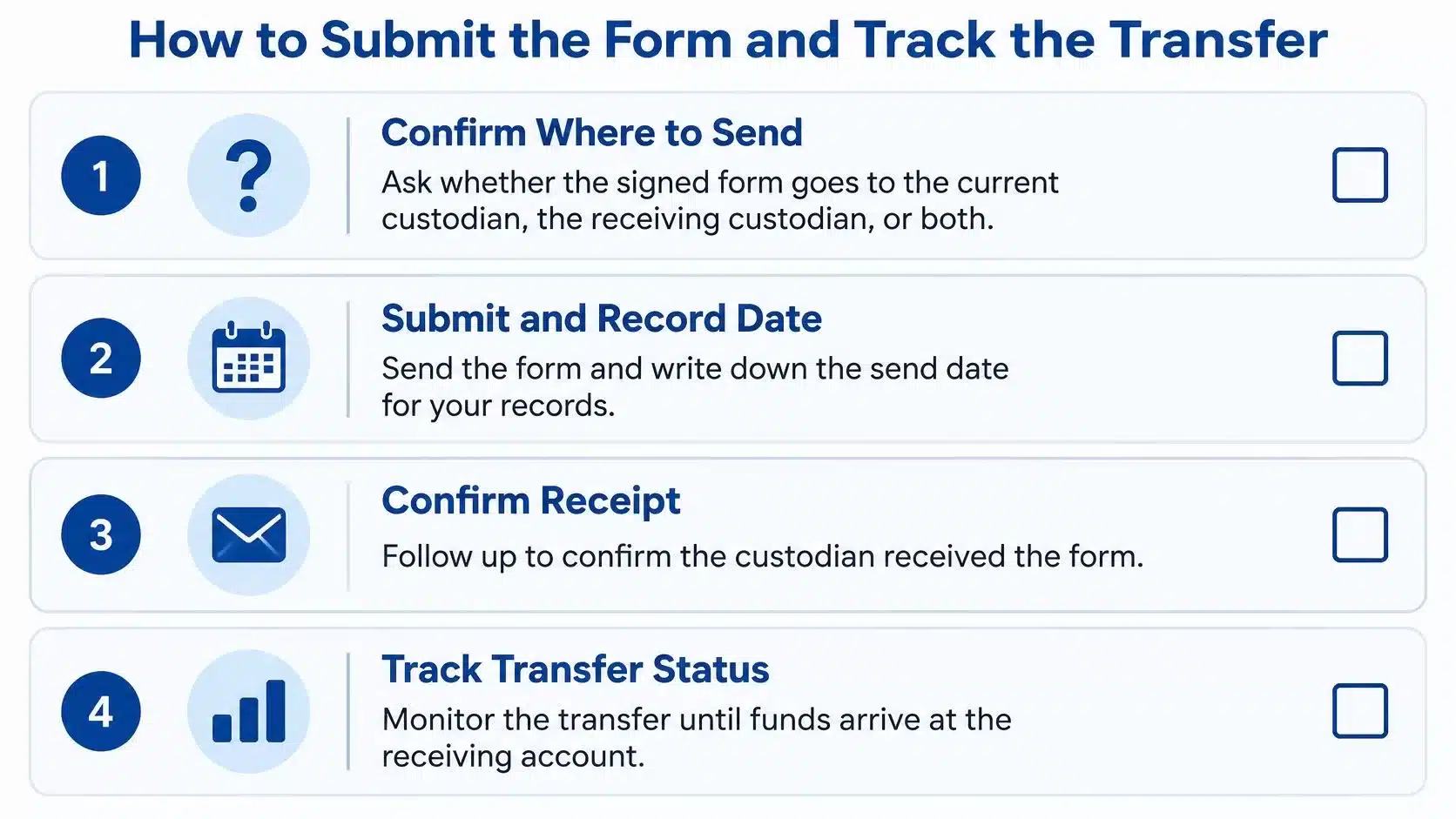
- Confirm the destination. Ask whether the signed form goes to the current custodian, the receiving custodian, or both. Some institutions want the original and a copy sent to each side.
- Submit and note the date. Record the send date and method.
- Confirm receipt. Save the confirmation number or delivery tracking record. If a custodian still accepts fax, keep the transmission record the way you'd keep a fax confirmation, because a busy week later nobody remembers whether the page went through.
- Follow the status until assets post. Check that the cash or holdings landed, not just that the request was accepted.
- Verify the coding and title. The posted registration should match the new custodian's paperwork, and the transaction should read as a trustee-to-trustee transfer, not a cash distribution.
- File both sides. Keep the confirmation number, both account numbers, the payee line and the settlement date together.
Year-end reporting is where this record earns its keep. A transfer from a traditional IRA that is not a SIMPLE IRA to another traditional IRA that is not a SIMPLE IRA generally is not reported on Form 5498 as a rollover contribution, according to the IRS instructions for Form 1099-R and Form 5498. Direct and indirect rollovers from qualified plans, 403(b) plans and governmental 457(b) plans follow different reporting, because the category depends on the source account and whether the participant was paid. A direct transfer also typically doesn't generate a taxable Form 1099-R for the owner, while the receiving trustee reports the incoming amount.
Gold IRA Association accepts questions about account rules through its online contact form, where visitors enter a name, email and a message, and aims to respond to all inquiries within 24 hours. That's useful when the reporting language on a form doesn't match what a custodian told you by phone.
Inherited and SIMPLE IRA Transfers That Need Extra Checks
What if a daughter wants to move her late father's traditional IRA to the custodian she already uses? She is not the spouse. The form looks like any other trustee-to-trustee request, and that similarity is where a quiet mistake starts. A title that drops the decedent, a payee line in her own name, or a code that treats the money as a rollover into her personal IRA can turn the move into a taxable distribution.

The nonspouse beneficiary rule
A beneficiary who inherited a traditional IRA from someone other than a spouse generally cannot treat the account as their own, make contributions to it, or roll amounts into or out of it, as IRS Publication 590-B explains. A trustee-to-trustee transfer is still permitted when the receiving account stays titled in the deceased owner's name for the beneficiary. The IRS also treats an IRA established for a nonspouse designated beneficiary that receives a direct rollover as an inherited IRA.
The inherited account works like a labeled box that has to keep the original owner's name on the outside. The assets can change custodians. They cannot be poured into the beneficiary's everyday IRA.
The beneficiary's personal IRA generally cannot receive the money. The new account title has to identify the decedent, the beneficiary, and the inherited status. Ask the receiving custodian for the registration wording and copy that wording onto the form. Required minimum distributions continue on the inherited account's own schedule rather than pausing during the move.
A surviving spouse sits in a different position and may generally treat the inherited IRA as their own, which opens options a nonspouse beneficiary doesn't have. Confirm which category applies before anyone drafts a title. A spouse election and a nonspouse inherited title are different fields, and checking the wrong box changes the tax result.
When metals custody enters the picture
Holding physical precious metals inside a self-directed IRA doesn't override inherited-IRA distribution rules. The custodian documents the beneficiary designation and holds the metals, but the inherited status still governs who can contribute, how RMDs run, and what the account may be titled. Ask the custodian to show you the proposed registration in writing before the transfer request is submitted. If that registration names the beneficiary alone, or the payee is the person rather than the receiving trustee, the request can be processed as a distribution even though the form said transfer.
The SIMPLE IRA two-year window
SIMPLE IRAs carry their own timing trap. IRS instructions identify certain transfers from a traditional SIMPLE IRA to a non-SIMPLE traditional IRA during the first two years after employer contributions begin as taxable distributions, which is why the SIMPLE IRA rollover rules deserve a read before you file. If the account type box says SIMPLE, confirm the start date of employer contributions. A direct-looking form can still be coded as a taxable distribution while that window is open.
Special-case rule: Any inherited account, and any SIMPLE IRA inside its first two years, should be reviewed by a CPA or tax professional before the form is submitted, not after the assets move.
Common Form Errors and How to Fix Them
A form can look complete and still be coded incorrectly. A mismatched account title, an incorrect account type, or an incomplete authorization can delay processing or affect how the transaction is reported. Check each field against the receiving custodian's instructions before submitting.
| Error | Likely result | Fix |
|---|---|---|
| Receiving account title does not match | Transfer delayed or rejected | Copy the receiving account title exactly from the new custodian |
| Missing or undated signature | Processing stalls | Sign and date every authorization before sending |
| Wrong account type on the form | Tax treatment may change | Match the sending account type, traditional to traditional or Roth to Roth |
| No confirmation number saved | Hard to reconcile year-end reporting | Save the confirmation and both custodians' records |
Review the paperwork and its supporting records together. Record when the form was sent, received, and processed, and keep each custodian's confirmation. IRS reporting instructions generally distinguish a trustee-to-trustee transfer with no payment to the participant from a distribution to the participant, so consistent records can help explain how the transaction was handled.
Use the documentation review checklist to check the completed form before submission. Catching a title or coding mismatch early is usually easier than correcting records after the assets have moved.
Confirm a Direct Transfer Fits Your Account Before You Submit
Before you sign, ask: Is the receiving account the same type as the sending account, will the new custodian accept the assets, and will payment go to the custodian rather than to you? These three checks help distinguish a trustee-to-trustee transfer from a distribution made to the account owner. A wrong payee or account title can change how the transaction is handled.
Get tax guidance before submitting if you are moving a nonspouse inherited IRA or a SIMPLE IRA that is still within its first two years after employer contributions began. Inherited accounts have specific titling rules, and an early SIMPLE IRA transfer to a non-SIMPLE traditional IRA may be treated as a taxable distribution. The details can depend on the account and circumstances.
If an eligible employer plan offers only a check payable to you, review the 60-day rollover rules in the previous section before accepting it. A check made out to the account owner is not the same as a direct transfer, even if the money is intended for another retirement account.
Practical test: Confirm the account type, receiving custodian's acceptance, and exact payee wording before signing. If any detail is unclear, ask the custodians or a tax professional to clarify it.
Gold IRA Association publishes educational material on account rules and provider comparisons. Readers can send a direct message for help finding that information. The website also offers articles and guides on Gold IRAs, rollovers, and retirement planning. These materials are for informational purposes, not financial, legal, or investment advice. Before making a decision, consider speaking with a qualified tax or financial professional.