


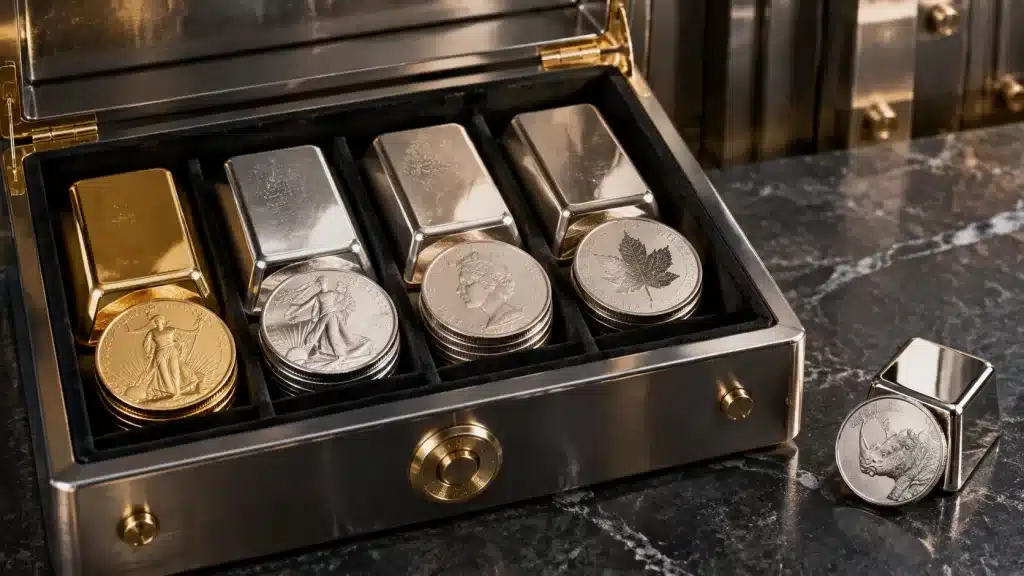
If gold, silver, platinum, palladium and rhodium are all called precious, why don't they move in price for the same reasons, and why can't every one of them go into an IRA? That gap trips up many near-retirees. The answer lies in sorting the types of precious metals by portfolio role, not by label, and checking IRA eligibility as a separate question from price behavior.
Why Precious Metals Are Not One Category
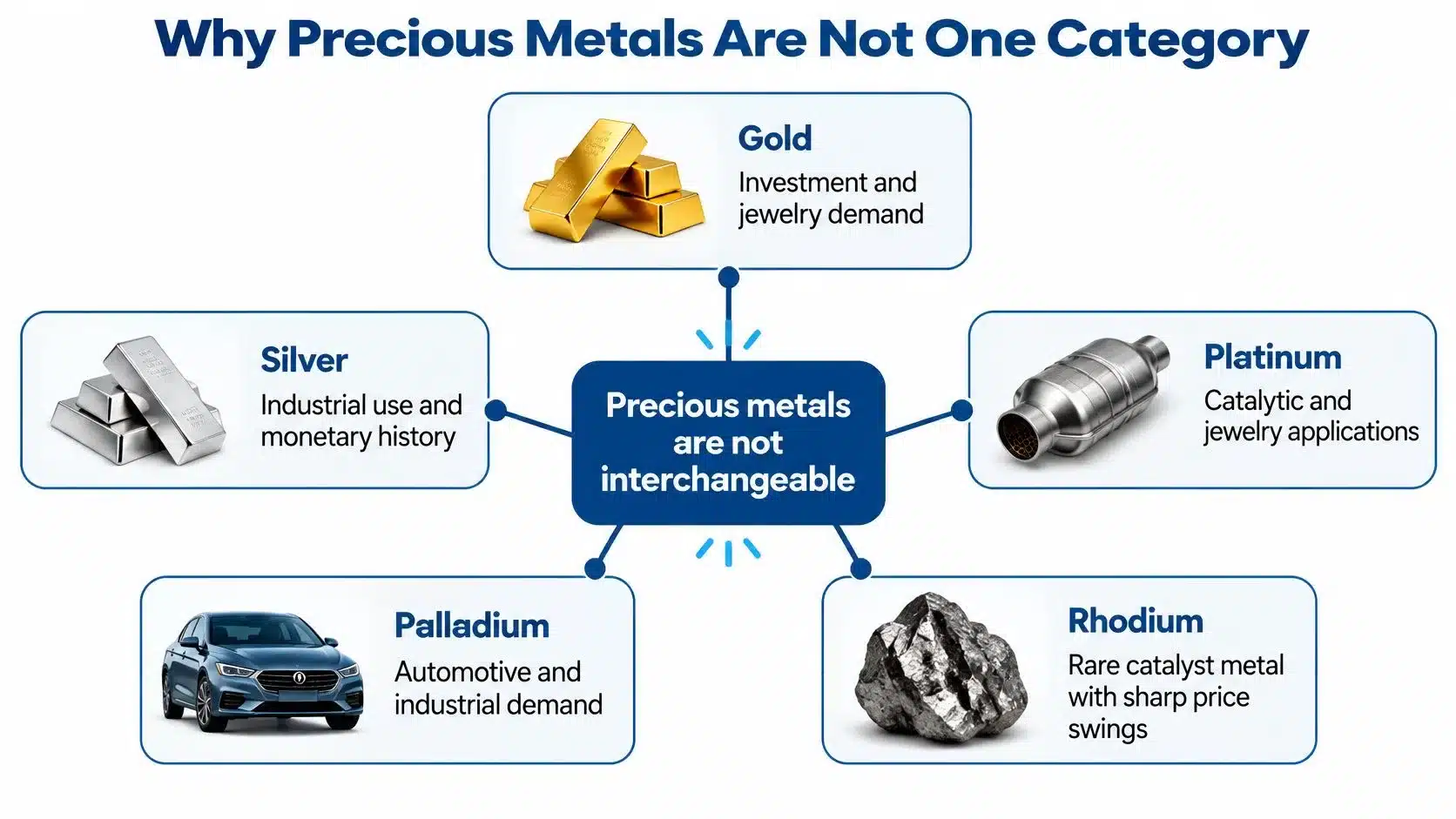
Which five metals usually appear together in discussions of precious metals? Gold, silver, platinum, palladium and rhodium are a common group, but the label describes rarity and value, not a shared role in a portfolio.
Gold and silver have long served as monetary and investment metals, while also attracting jewelry demand. Platinum, palladium and rhodium are platinum-group metals, a family of six that also includes ruthenium, iridium and osmium. Their uses are more closely tied to manufacturing, including vehicle emissions control.
Production figures show why metal roles need separate consideration. The USGS gold summary for 2026 estimates global gold mine production reached 3,300 metric tons in 2025, up from 3,280 tons in 2024. The same summary estimates U.S. gold mine output at 160 tons, valued at approximately $17 billion, with Nevada supplying about 64% and Alaska roughly 22%.
Why volume alone misleads
U.S. platinum and palladium output is reported in kilograms, rather than metric tons. Comparing production requires converting the units, and production volume alone does not show whether a metal is stable or suitable for a retirement account.
Silver occupies a different position: it is both a precious metal and a major industrial input. It is commonly recovered alongside base-metal ores, so its supply can respond to demand for other metals as well as to silver prices.
Precious describes rarity and value. Portfolio roles range from monetary stores of value to industrial inputs and catalyst metals.
For retirement investors, the distinction helps clarify what risk a holding may carry. Metals used mainly as monetary stores of value can respond differently to economic news than metals whose demand depends heavily on manufacturing or catalysts. IRA eligibility is a separate question from price behavior, so each needs its own check.
The Five Precious Metals at a Glance
Each precious metal has a different portfolio role. Gold is most closely associated with monetary demand, silver combines investment interest with industrial use, and platinum, palladium and rhodium are strongly tied to industrial applications. The table separates those roles from IRA eligibility, which depends on the specific product.
| Metal | Main Demand Driver | Common Bullion Forms | IRA-Eligible Form |
|---|---|---|---|
| Gold | Jewelry, investment, electronics and aerospace | Bars and coins such as American Eagle and Canadian Maple Leaf | Bars at 99.5% fineness or higher; certain listed coins |
| Silver | Investment, electrical and electronics, photovoltaics | Bars, rounds and coins such as American Silver Eagle | Bars and coins at 99.9% fineness or higher |
| Platinum | Automotive catalysts, chemicals, jewelry | Bars and coins such as American Platinum Eagle | Bars and coins at 99.95% fineness or higher |
| Palladium | Gasoline-engine catalysts, electronics | Bars and coins such as Canadian Palladium Maple Leaf | Bars and coins at 99.95% fineness or higher |
| Rhodium | Emissions-control catalysts, chemical processing | Small bars; mostly industrial sponge form | No standard IRA bullion route |
For gold, silver, platinum and palladium, the fineness figures shown are common minimum standards for qualifying bullion. IRA eligibility also depends on the product and applicable rules, so confirm that a specific item qualifies before purchasing it for an account.
Two patterns worth noticing
Gold and silver both attract investment demand, but silver has a larger industrial role. That means silver can respond to manufacturing activity in ways that gold may not. Its lower price per ounce does not make it a direct substitute for gold.
Platinum and palladium are both catalyst metals, yet they do not necessarily move in tandem. Their uses and market conditions differ, so comparing platinum with palladium is more useful than treating one as an automatic stand-in for the other. Rhodium is more specialized still, with industrial uses and no standard bullion route for an IRA.
A practical order can reduce confusion:
- Identify the role: Decide whether you are considering monetary exposure, industrial demand or catalyst demand.
- Check eligibility separately: A metal's portfolio role does not determine whether a particular product can be held in an IRA.
- Confirm the product: Check current requirements with a custodian or tax professional before buying.
The sequence matters because the metal, its price behavior and its account eligibility answer different questions. A product name or per-ounce price alone cannot answer all three.
Bars, Coins and Rounds Explained
Bars, coins and rounds can share a metal and similar appearance, yet differ in who produces them and how they are identified. Bars are made by refiners and sold mainly by weight and purity. Government mints issue coins with a face value, while private manufacturers produce rounds, which are not legal tender.
Fineness measures the proportion of pure metal by mass, expressed in parts per 1,000. For example, a 995 gold bar contains at least 99.5% gold. The LBMA OTC guide to wholesale bar specifications lists typical wholesale sizes:
| Metal | Typical Wholesale Bar Size |
|---|---|
| Gold | 350–430 fine troy ounces |
| Silver | 750–1,100 ounces |
| Platinum | Ingot and plate traded by stated troy ounce weight |
| Palladium | Ingot and plate traded by stated troy ounce weight |
Size changes the cost per ounce
Smaller products usually have higher premiums over spot per ounce because minting, packaging and distribution costs are spread across less metal. As a result, products with the same purity can still have different costs per ounce. For a closer look at the product-form tradeoffs, see gold bars versus gold coins.
Check the paperwork for four details: fineness, weight, refiner and assay documentation. Comparing a large and a small product made of the same metal can show how product size affects the cost of each ounce of pure metal. A lower sticker price alone may not mean a lower per-ounce cost.
What Drives the Price of Each Metal
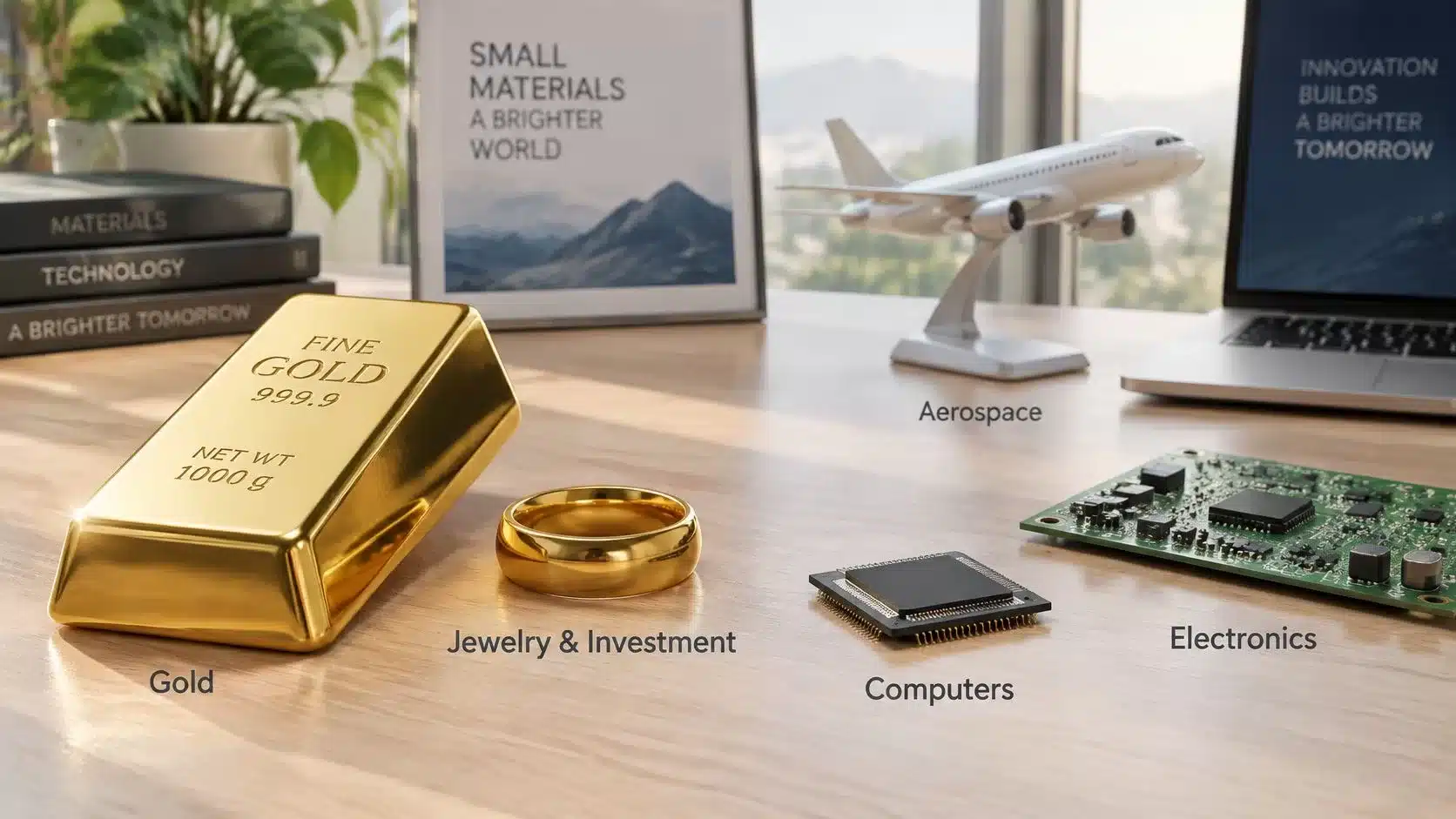
Price exposure follows end use. A metal bought mainly for jewelry and investment doesn't face the same demand shocks as a metal bought mainly for vehicle exhaust systems. Readers can see gold's overlapping uses in the image below.
Gold and silver
Gold's dominant fabrication use is jewelry, with investment demand layered on top. Its corrosion resistance and electrical performance also support electronics, aerospace, communications and computers, but that industrial layer is smaller than its monetary and jewelry roles.
Silver splits its demand. The USGS Mineral Commodity Summaries 2024 estimates that in 2023 U.S. silver use comprised 27% electrical and electronics, 10% photovoltaics, 34% physical investment bars, and 13% coins and medals. Silver is also often recovered alongside lead, zinc, copper and gold, so miners don't always increase silver supply just because silver demand rises.
That distinction matters for authentication habits too. Natural materials require identification before valuation, whether a buyer is checking bullion documentation or identifying Campo del Cielo specimens from Astro West. Origin, composition and documentation affect what an object is, not just what a seller calls it.
The short video below gives readers another plain-English walkthrough of how different end uses shape metal demand.
Platinum, palladium and rhodium
Platinum and palladium are catalyst metals. Their catalytic activity makes them central to vehicle emissions control, chemical production and petroleum refining. Platinum is especially associated with diesel catalytic systems, while palladium is heavily used in gasoline-engine converters. Auto production, emissions rules, engine technology and substitution between the two metals can therefore move demand.
Rhodium is also tied to emissions control, but its comparatively small annual production means prices can swing sharply when supply or automotive demand shifts. Concentrated demand in a small market can amplify a shock that might look modest in a larger market.
The checkable takeaway is simple. A lower-priced metal isn't automatically cheaper exposure or a safer hedge. Its price may reflect industrial demand, supply concentration or limited liquidity rather than a bargain. Identify each metal's main demand source first, then compare price history with that exposure in mind.
Which Metals Qualify for an IRA and Why
IRA eligibility starts with a collectibles rule, not with a dealer catalog. The IRS ruling on Internal Revenue Code section 408(m) explains that collectibles purchased by an IRA generally raise taxable-distribution issues, but an exception covers gold, silver, platinum, or palladium bullion meeting at least the minimum fineness required for delivery under a regulated futures contract. The bullion must also be in the physical possession of a trustee.
That exception names four metals. Rhodium isn't among them. A rhodium product can be precious, rare and expensive without gaining a standard route into an IRA through this bullion exception.
Custody is part of eligibility
Qualifying metal held at home doesn't satisfy the rule by itself. Physical possession by the IRA trustee matters. Readers sometimes focus on finding the right coin, then overlook the account structure that must hold it. Both halves count: product standard and custody.
Detailed account mechanics are covered in the guide to precious metal IRA rules, which readers should review alongside current custodian requirements before arranging a purchase or transfer.
The common misreading
A coin named after a metal isn't automatically eligible. Neither is every gold-colored, silver-colored or limited-edition product. Collectible-grade items fall outside the bullion exception, and proof finish, rarity claims or commemorative packaging don't turn a collectible into qualifying bullion.
Eligibility follows the statute, the fineness standard and trustee custody. It doesn't follow a product name.
Use a numbered check before money moves:
- Confirm the metal: Gold, silver, platinum or palladium only, for this bullion exception.
- Confirm fineness: The product meets the minimum standard tied to a regulated futures contract.
- Confirm custody: The IRA trustee takes physical possession through the account's approved arrangements.
- Confirm current rules: A custodian and CPA verify the treatment for the reader's account type and circumstances.
Say a near-retiree finds a beautifully packaged silver coin marketed for collectors. The relevant questions aren't whether it contains silver or looks official. They're whether that specific product meets the bullion rules and whether the trustee will hold it. Skipping either question can create a non-compliant purchase, even when the underlying metal is one of the four named in the exception.
Tax outcomes vary by individual circumstances, and no product list replaces current professional confirmation. That caution is especially important when an older web page, a dealer brochure or a prior-year coin list is the only source a buyer has checked.
Pros, Cons and Use Cases for Retirement Portfolios
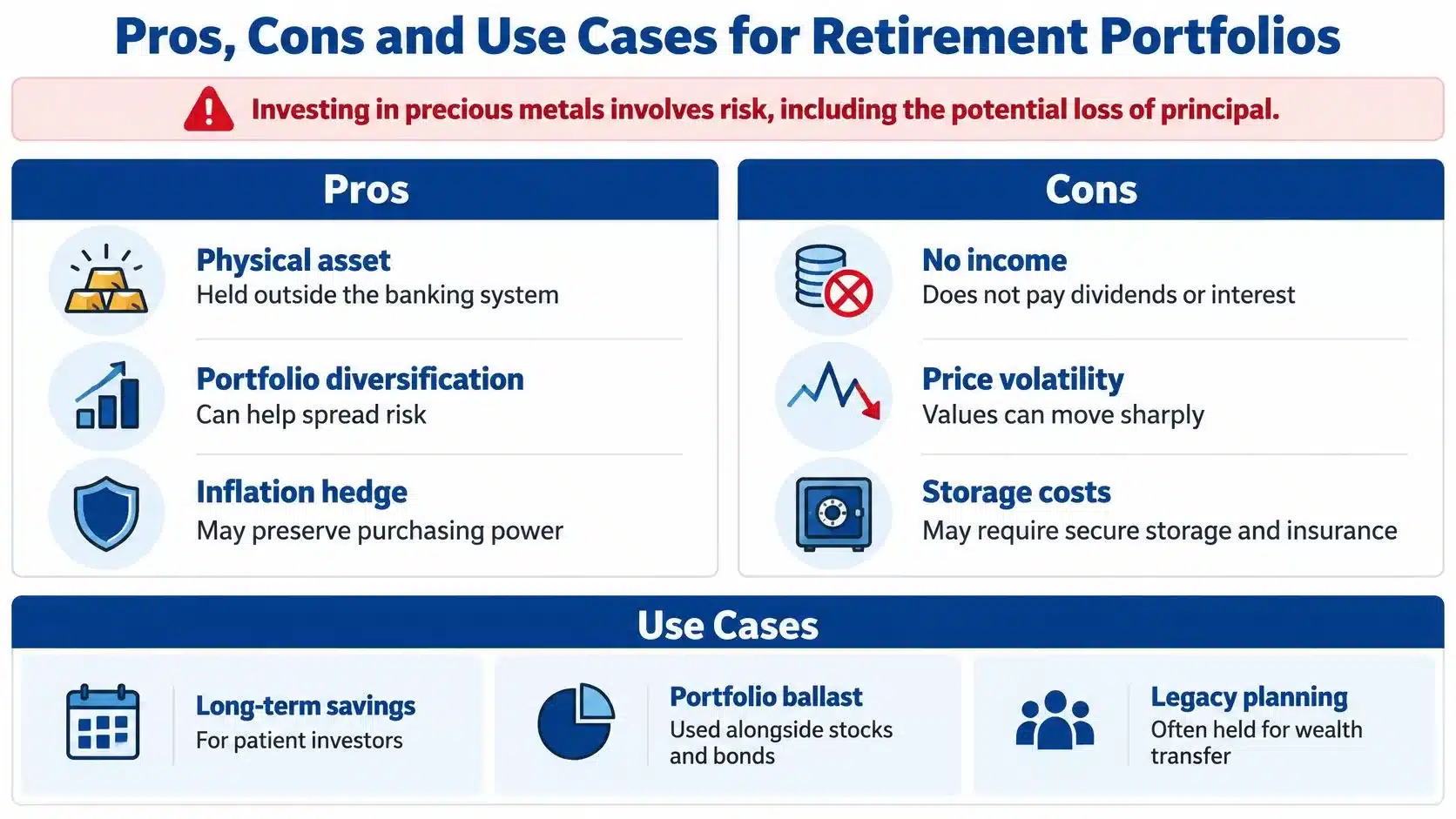
Investing in precious metals and IRAs involves risk, including the potential loss of principal. A metal's portfolio role depends on what drives demand for it: monetary demand, industrial use, or use as a catalyst. The same “precious metals” label can therefore describe assets with quite different price behavior.
Potential advantages
- Physical asset: Bullion is tangible metal held through an approved custody arrangement.
- Different demand drivers: Metals can behave differently from stocks and bonds because their prices respond to distinct monetary, industrial and manufacturing forces.
- Monetary role: Gold and silver have been used as stores of value. That history helps explain investor interest in them during periods of inflation or currency pressure, but it does not ensure their prices will rise.
Costs and limits
- No income: Metals pay no dividends or interest. Returns depend on price changes.
- Costs of ownership: Dealer premiums, custody and storage fees, and the spread between buying and selling prices can reduce what an investor receives. Compare these costs before choosing an account or product.
- Industrial exposure: Platinum and palladium prices are closely tied to automotive and manufacturing demand.
- IRA access: Rhodium lacks a standard IRA bullion route, which limits its use in retirement accounts.
For a near-retiree, gold's monetary role may make it a candidate for consideration as a store of value. Silver combines investment interest with industrial demand, so its price can respond to both. Platinum and palladium are catalyst metals: their retirement-portfolio role depends more directly on vehicle technology, catalyst demand and the possibility that manufacturers substitute other materials.
Concentration makes those differences matter more. An account holding only palladium, for example, has concentrated exposure to gasoline-engine catalyst demand, rather than broad exposure to precious metals. A metal can serve as one component of a diversified plan, but its price may fall, and it cannot guarantee protection, growth or stability. None of these examples is a personal recommendation.
Common Questions About Precious Metals IRAs
Can an existing 401(k) be rolled into a precious metals IRA
A typical situation: a saver leaves an employer or retires and wants to move an old 401(k) out of the former plan. The usual route is a direct rollover to a custodian that accepts metals, and the eligibility check in the IRA section applies to whatever bullion the account then buys. Process and tax treatment depend on account type, so a tax professional can confirm the route before funds move.
Do precious metals IRAs pay income
The costs list in the previous section gives the short answer: metals pay no interest or dividends. For a retiree who needs cash flow, that means spending money has to come from selling holdings, not collecting payouts. Results inside the account rest on price change minus costs.
What costs apply beyond the metal price
The itemized charges appear in the costs and limits list above. What this question adds is a comparison point: published fee schedules vary by provider, so one company's figures shouldn't be assumed to apply across the market. Comparing schedules side by side is the practical step.
Does a metal IRA replace a diversified portfolio
A precious metals IRA is usually described as one possible diversification piece, not a substitute for stocks, bonds or cash. Its role, size and suitability depend on retirement timing, income needs and tolerance for price swings.
Is silver simply a cheaper way to own gold exposure
Silver trades in its own market, with a price path separate from gold's. During a stretch of weak factory demand, silver can drift lower while gold holds steady on investment buying, and a strong industrial period can push silver ahead of gold. Two metals that share an IRA-eligible label can move in opposite directions over the same period, which is why each metal's role deserves its own evaluation.
Your Next Step Before Choosing a Metal
Start with eligibility. Before comparing prices, providers or products, run whatever a dealer shows you through the numbered eligibility check in the IRA section, so the fineness and custody questions get answered before any money moves.
The comparison work that follows is mostly paperwork. Ask each provider for its fee schedule in writing, covering setup, custodial, storage and transaction charges, and ask how its buyback pricing works. Confirm the fineness of the specific product and the custody arrangement the account will use, and keep copies of both answers. There is no deadline on this step: questions asked before a rollover are cheap, while the same questions asked after one can be expensive to resolve.
Investing in precious metals and IRAs involves risk, including the potential loss of principal. The materials on Gold IRA Association's website are provided for informational purposes only and are not intended as financial, legal, or investment advice, so consult a licensed financial advisor, CPA, or tax professional before acting.
Readers who want plain-English educational help with account rules or provider comparisons can send Gold IRA Association a direct message or call 888-910-8386, and the team aims to respond to inquiries within 24 hours. Clarity before commitment is the goal, especially when retirement savings are involved.
Gold IRA Association publishes plain-English guides on precious metals IRAs, rollovers, eligible products and provider comparisons for readers who want to understand the rules before choosing a metal or company. Readers can explore those educational resources and request more information at Gold IRA Association.