



What if the Self Directed IRA vs Roth IRA choice isn't a choice between two competing accounts at all? Many savers compare the labels as if picking one rules out the other, then focus only on taxes. The clearer approach separates investment access from tax treatment, then tests whether broader access justifies extra cost, paperwork and risk.
Self-Directed and Roth Describe Different Things
Two separate dials sit behind the labels in this comparison. One dial controls how wide an investment menu a custodian permits. The other controls how the IRS treats contributions and withdrawals. Self-directed sets the first dial, Roth sets the second, and each can move without changing the other.
The diagram below puts that distinction side by side before the numbers enter the picture.
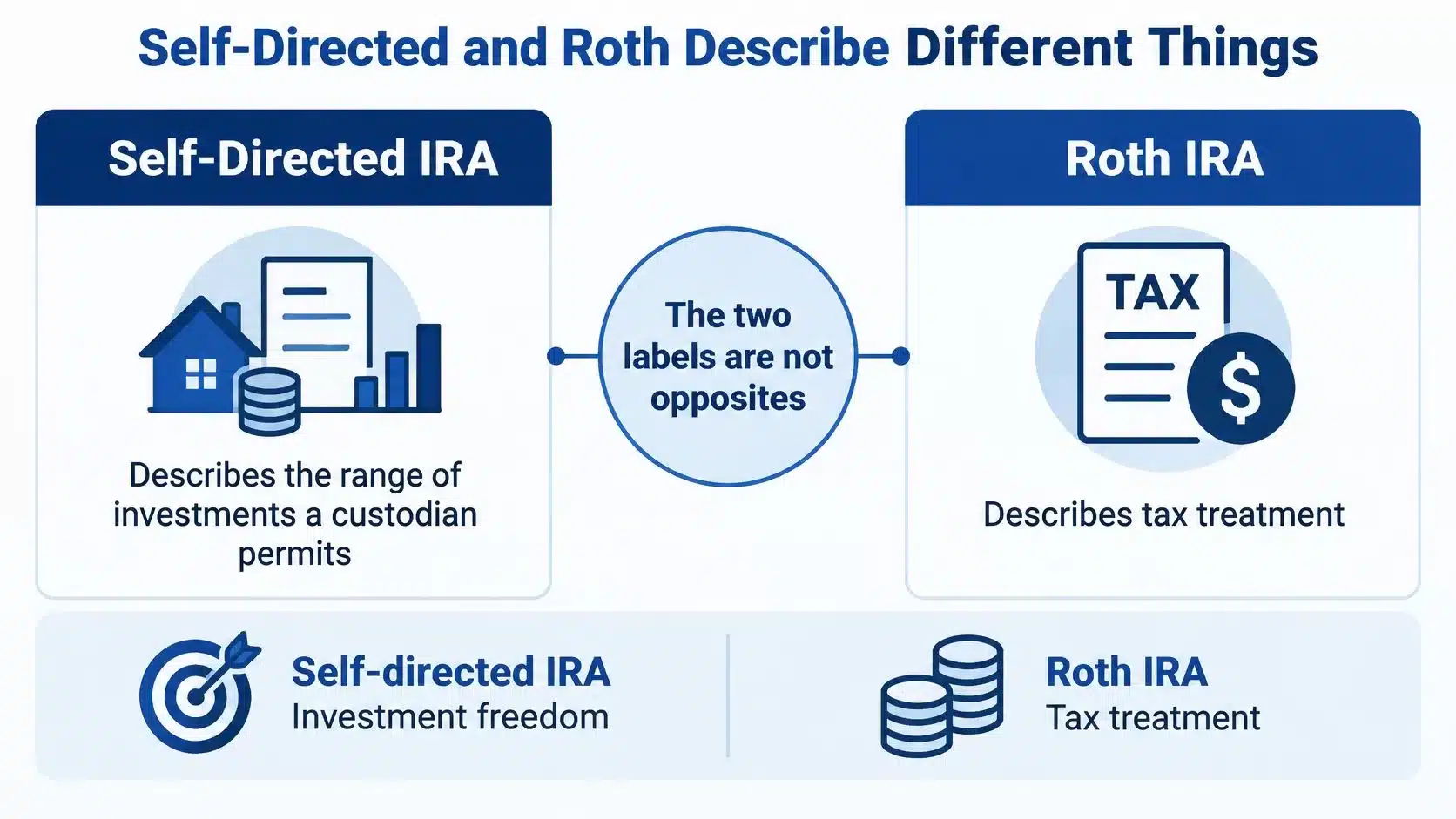
Self-directed and Roth labels at a glance
| Feature | Self-directed IRA | Standard Roth IRA |
|---|---|---|
| What the label describes | Breadth of investments the custodian permits | Tax treatment, after-tax contributions and potentially tax-free qualified withdrawals |
| Investment menu | Can include alternative assets such as real estate, private placements, or certain precious metals | Typically stocks, bonds, funds and similar brokerage holdings |
| Custodian administration | Custodian must process alternative-asset transactions, valuations and documentation | Standard brokerage or custodial processing |
| Prohibited-transaction exposure | Higher, because of nontraditional assets and closer owner involvement | Lower, though the same IRS rules still apply to every IRA |
| Main decision question | Are investments needed that a conventional account cannot hold? | Is Roth tax treatment wanted with simpler administration? |
Because the dials are independent, a self-directed IRA can be structured as traditional or Roth, and a self-directed Roth IRA combines alternative-asset flexibility with Roth tax rules, as explained in IRS Publication 590-A. That combination doesn't create a separate contribution allowance. It also carries the added administration listed above, because every alternative-asset purchase, valuation and document flows through the custodian rather than a standard brokerage order.
The decision order follows directly. Readers who want the basic mechanics first can review what a self-directed IRA is, then answer three questions: Is a broader menu needed? Is Roth treatment the right tax structure? Or are both needed together? If the answer is only Roth treatment, a standard Roth IRA is the simpler choice.
First filter: Self-direction is worth considering only when a specific alternative asset is wanted, not as a general upgrade.
How Tax Treatment Differs Between Traditional and Roth Accounts
Tax treatment follows the account's traditional or Roth status, not the asset inside it. A self-directed traditional IRA holding real estate is taxed as a traditional IRA. A self-directed Roth IRA holding the same asset is taxed as a Roth IRA. That distinction prevents a common error, assuming the investment itself changes the tax rules.
Traditional versus Roth tax treatment
| Tax feature | Traditional IRA | Roth IRA |
|---|---|---|
| Contribution tax treatment | Often deductible, depending on eligibility | Not deductible |
| Qualified withdrawals | Generally taxed as ordinary income | Tax-free if qualified |
| Early withdrawal before 59½ | Taxable, with a 10% additional tax unless an exception applies | Nonqualified earnings taxable, 10% additional tax may apply |
| Five-year holding rule | Not applicable | Applies to qualified Roth distributions |
| Required distributions during owner's life | Yes, starting at the applicable RMD age, verify the current age | No, for the original owner |
Contribution deductibility: Traditional IRA contributions may be deductible for eligible taxpayers, while Roth contributions aren't deductible under the rules summarized in the IRS comparison of traditional and Roth IRAs.
Withdrawal taxation: Traditional amounts, including earnings and gains, are generally taxed when withdrawn. Taxes are deferred, not erased.
Qualified Roth withdrawals: Earnings can be tax-free when the five-year holding rule is met and the owner is at least 59½, disabled, deceased, or using an eligible first-home exception, per the IRS overview of Roth IRAs.
Nonqualified Roth earnings: Earnings withdrawn too early or before the holding rule is met may be taxable. A 10% additional tax can also apply unless an exception fits the facts.
Required distributions: Traditional IRAs require withdrawals starting at the applicable RMD age. The original Roth owner has no lifetime requirement, so the account can stay invested longer if cash isn't needed.
Consider two savers holding the same fund. One uses a traditional account and expects tax at withdrawal. The other uses a Roth account and pays tax before contributing, aiming for qualified tax-free withdrawals later. The fund didn't drive that difference. The account label did.
RMD ages and exception lists change over time, so those details should be checked against current IRS publications before action. A CPA can confirm how deductibility, bracket changes and other income affect an individual outcome.
2026 Contribution Limits and Roth Income Cutoffs
One annual limit covers every IRA you own. The IRS treats that limit like a single bucket: contributions to a traditional IRA, a standard Roth IRA, and a self-directed Roth IRA all pour into it, and the total can't exceed the saver's taxable compensation for the year.
For 2026, the combined ceiling is higher for savers age 50 or older, because a catch-up amount sits on top of the base limit. Splitting money between a standard Roth IRA and a self-directed Roth IRA still counts toward that same ceiling, which is why account type never changes contribution room.
2026 Roth contribution limits and income phase-outs
| Category | 2026 figure | How it applies |
|---|---|---|
| Under age 50, combined limit | $7,500 | Shared across all traditional and Roth IRAs, capped at taxable compensation |
| Age 50 or older, combined limit | $8,600 | Includes the $1,100 catch-up contribution |
| Single or head of household, Roth phase-out | $153,000 to $168,000 | Reduced contribution within range, above range no direct Roth contribution |
| Married filing jointly, Roth phase-out | $242,000 to $252,000 | Reduced contribution within range, above range no direct Roth contribution |
| Married filing separately, Roth phase-out | $0 to $10,000 | Reduced contribution within range, above range no direct Roth contribution |
Each phase-out range in the table comes from the IRS notice setting the 2026 amounts. The ranges are measured by modified adjusted gross income. Income inside a range allows only a reduced contribution, and income above it generally blocks a direct Roth contribution, including a direct contribution to a self-directed Roth IRA.
A self-directed custodian cannot waive an IRS income cutoff. Account access and contribution eligibility are separate tests.
The age-50 figure works out as the base limit plus the catch-up amount, so the math never creates a second allowance. Rollovers and conversions are where savers most often confuse the rules, because neither consumes the annual contribution limit. A rollover moves existing retirement money without touching the current year's ceiling, and a Roth conversion moves existing money into Roth treatment with a tax cost that depends on the amount converted and the owner's broader tax circumstances. Treating a rollover as if it were a fresh contribution, or the reverse, leads to avoidable errors.
A conventional Roth IRA and a self-directed Roth IRA offer identical contribution room, so self-direction must earn its place through investment access, not through extra tax capacity. The IRS adjusts these dollar amounts periodically, so the figures above should be checked against current IRS publications before money moves.
Which Precious Metals Qualify and Where Compliance Risk Lies
Physical metals inside an IRA must meet IRS eligibility requirements, including minimum fineness standards for each metal, and they must be held through proper custody and approved storage. Product names alone aren't enough. A similar looking coin or bar may fall short of the fineness threshold, so eligibility should be confirmed with the custodian against current IRS guidance before any purchase.
The photo below shows the four metal categories most readers ask about.

Commonly cited IRA-eligible products
Commonly cited IRA-eligible products are grouped by metal below. Product eligibility should be verified with the custodian and current IRS guidance before purchase.
| Metal | Commonly cited examples |
|---|---|
| Gold | American Gold Eagle (22-karat exception), Canadian Maple Leaf gold, approved bars |
| Silver | American Silver Eagle, Canadian Maple Leaf silver |
| Platinum | American Eagle platinum, Canadian Maple Leaf platinum |
| Palladium | Canadian Maple Leaf palladium |
Readers comparing products can review the precious metal IRA rules before asking a custodian to confirm a specific coin or bar. That confirmation matters because the custodian, not the dealer, administers the IRA.
Where compliance risk lies
Prohibited-transaction rules carry more risk than metal selection, and they apply to every IRA, including a self-directed Roth IRA. The IRS guidance on prohibited transactions lists examples such as borrowing money from the IRA, selling property to it, pledging IRA assets as loan security, or purchasing property for present or future personal use.
Disqualified persons include the IRA owner's fiduciary and close family members such as a spouse, ancestors, lineal descendants, and spouses of lineal descendants. Transactions between the IRA and those persons need particular care.
- Don't borrow from the IRA or pledge its assets for a personal loan.
- Don't use IRA property personally, even briefly or in the future.
- Don't sell personal property to the IRA or buy IRA property for personal benefit.
- Don't pay personal expenses from the account or receive value outside proper IRA channels.
The eligibility list works like a gate that controls what enters the account. The prohibited-transaction rules govern everything the owner does with the assets afterward, and the consequence for breaking them is severe. If the owner or beneficiary engages in a prohibited transaction during a year, the IRA generally ceases to qualify as an IRA as of the first day of that year and is treated as distributing all assets at fair market value. Any amount above basis may become taxable income. Roth status doesn't remove these restrictions.
Strict separation is the safeguard. IRA assets stay in custody, transactions are documented, and personal use stays out entirely.
Choosing Self-Directed or Standard Roth by Situation
When both options are Roth accounts, tax treatment is often the same. The comparison becomes investment access, cost, liquidity and compliance capacity. The infographic below frames those four tests.
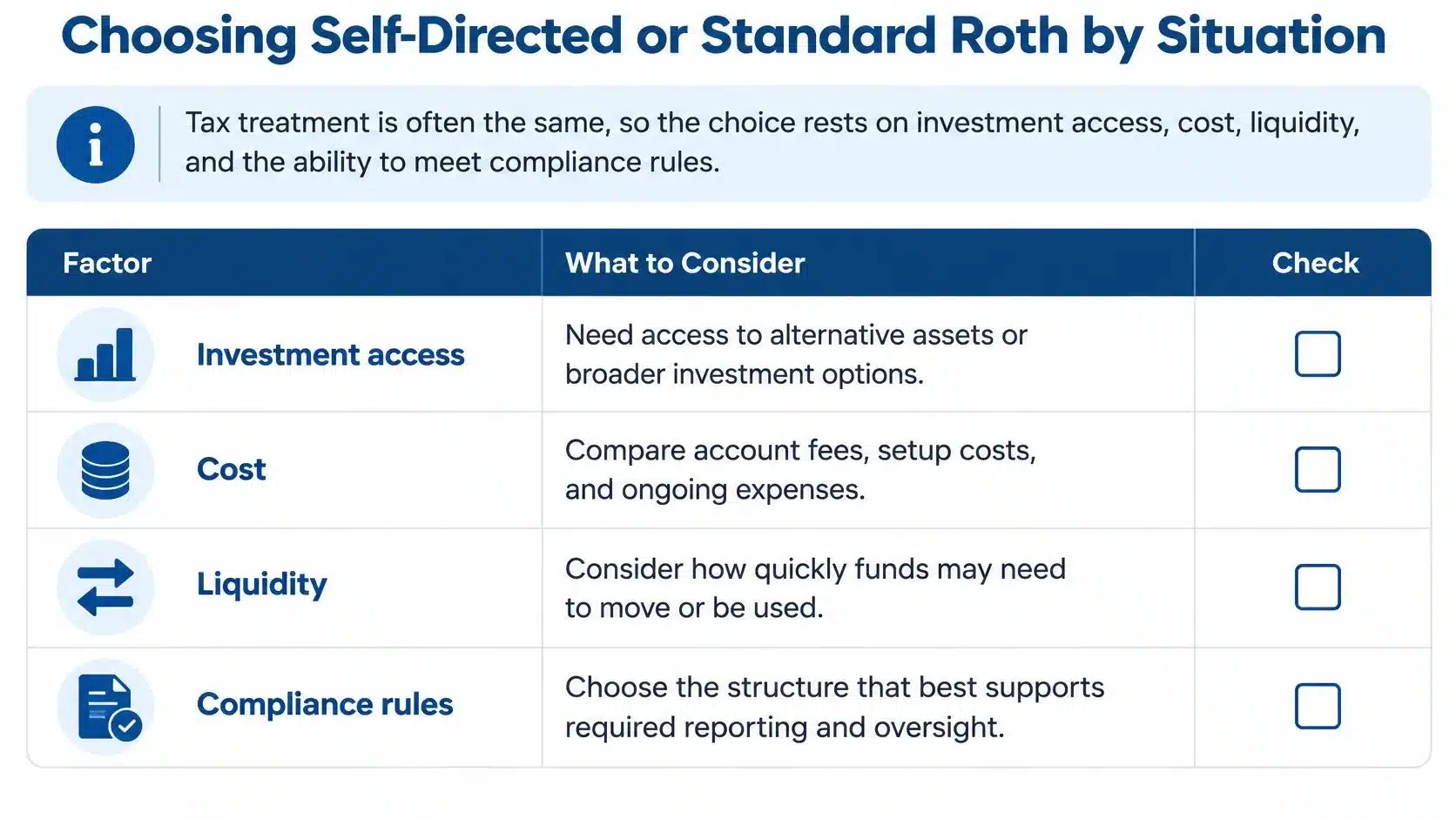
Which account tends to fit which situation
| Situation | Usually better fit | Reason |
|---|---|---|
| Roth growth in stocks, bonds and funds only | Standard Roth IRA | Same Roth tax treatment with simpler administration and usually lower costs |
| Wants metals or other alternatives inside a Roth | Self-directed Roth IRA | Broader investment menu, with added custody, valuation and compliance costs |
| May need cash within a few years | Standard Roth IRA | Liquid holdings reduce forced-sale risk |
| Long holding plan with a cash reserve for distributions | Self-directed Roth IRA, if costs are justified | Reserve covers fees and distributions without selling alternative assets |
A saver satisfied with funds gains little from self-direction. A saver who specifically wants approved physical metals inside a Roth structure has a clearer reason, provided custody and valuation costs still make sense at the account's size. Near-term cash needs point the other way, because liquid holdings can be sold quickly at a visible price.
The short video below adds a visual walkthrough of the same decision for readers who prefer that format.
Account choice also connects to wider planning, such as beneficiary designations and how retirement assets pass to family. Texas readers coordinating those pieces may find estate planning guidance for Texas retirees useful alongside custodian paperwork. Gold IRA Association's team offers personalized advice matched to an individual's retirement goals and financial situation, which can help place the account decision in that broader context.
No verdict is universal. Income, tax bracket, time horizon and willingness to manage documentation all shift the answer.
Frequently Asked Questions About Self-Directed and Roth IRAs
Can a standard IRA hold gold? A conventional brokerage IRA can often hold gold-related funds or ETFs, which provide price exposure without physical custody. Holding physical bullion inside an IRA generally requires a self-directed custodian and an approved depository. Owning a fund is a paper claim on the metal's price; owning bullion means the account holds the metal itself, with the storage and valuation obligations that come with it.
Can IRA metals be kept at home? No. IRA-owned metals must be held by the custodian in approved storage. Taking personal possession can be treated as a distribution taxed to the owner, and the prohibited-transaction rules covered above explain the rest of the risk. Marketing that promotes home storage for IRA metals deserves caution.
Do Roth beneficiaries face required distributions? The original owner has no lifetime requirement. The rules diverge after death: a surviving spouse can treat the account as their own, while most non-spouse beneficiaries must empty the account within 10 years of the owner's death under IRS guidance on IRA beneficiaries.
Is a self-directed Roth IRA a separate tax category? No. A self-directed Roth IRA is taxed the same as any Roth IRA. "Self-directed" describes the custody arrangement, meaning the custodian permits alternative assets such as approved metals. That single point resolves most confusion in the self directed IRA vs Roth IRA debate, and the situation table above shows where the practical differences begin.
Liquidity, Costs and Pre-Account Checks
A qualified Roth withdrawal can be tax-free and still be hard to pay in cash. That is the liquidity gap tax comparisons often skip. If an account holds a private placement, a property or physical metal that must be sold through a custodian, cash may not be available on the day it is needed for a distribution, a fee or a tax obligation.
Three questions expose the problem early. Can the account cover a distribution or fee without a distressed sale? How long does a sale realistically take, including finding a buyer? How do custodian processing and independent valuation affect timing and price? A vague answer to any of them is a warning sign.
Tax-free describes how a qualified withdrawal is taxed. It does not guarantee that an asset can be sold quickly at a fair price.
The SEC investor alert on self-directed IRAs warns that these accounts can involve significantly higher costs, including account-opening, annual, administrative, transaction and asset-specific fees. It also notes heightened fraud exposure and weaker legal or regulatory protections for some alternative investments. Alternative holdings may be illiquid because of restricted redemptions, limited markets or long holding periods.
Costs measured the right way
Fees should be evaluated as a percentage of assets, not only as dollar charges. A flat annual fee that looks modest on a large balance can consume a meaningful share of a small account each year, reducing compound returns before investment performance is even considered. Readers can compare line items using the guide to self-directed IRA fees and then request the same categories in writing from any custodian.
- Setup and annual fees: Charged regardless of activity.
- Transaction fees: Charged when assets are bought, sold or transferred.
- Asset-specific fees: Storage, valuation or administration tied to a particular holding.
- Exit costs: Charges and delays involved in closing or moving the account.
The prohibited-transaction rules in the compliance section apply here as well, so convenience shortcuts around proper IRA channels carry real risk. A narrower standard Roth menu can function as a risk control when predictable withdrawals and transparent pricing matter more than alternative access.
Pre-account checklist
- Confirm the tax structure: Decide whether the account will be traditional or Roth before discussing assets.
- Check current IRS figures: Verify the contribution limit and Roth income range for the relevant year.
- Request a written fee schedule: Cover setup, annual, storage, transaction and closing costs.
- Confirm accepted metals and storage: Identify eligible products and the approved depository arrangement.
- Confirm valuation and distributions: Ask how alternative assets are valued and how distribution requests are processed.
- Map a cash reserve: Plan liquid funds covering at least one year of expected withdrawals and account fees.
Gold IRA Association's team offers personalized advice for an individual's retirement goals and financial situation, and its listed phone number is 888-910-8386. The team aims to respond to all inquiries within 24 hours, so readers can send a direct message through the online contact form for help walking through the checklist before opening an account.
The materials on Gold IRA Association's website are provided for informational purposes only and are not intended as financial, legal, or investment advice. Readers can consult a professional advisor for guidance specific to their own situation. Investing in precious metals and IRAs involves risk, including the potential loss of principal.
Readers weighing a standard Roth IRA against a self-directed Roth IRA for approved metals can compare educational guides, fee explanations and provider reviews before speaking with any custodian. Gold IRA Association offers a free newsletter with news on hedging against U.S. inflation with a Gold IRA, and a qualified professional can confirm the final tax and eligibility details.