



Most adult children inheriting a parent's traditional IRA must empty the account by December 31 of the 10th calendar year after the year of death. Checking whether the parent had reached the required beginning date for required minimum distributions, or RMDs, determines whether annual withdrawals are also generally required.
Does having a final deadline really mean the account can stay untouched until then? That's the gap that makes inheriting an IRA from a parent more complicated than many beneficiaries expect, and withdrawal timing can affect both compliance and the eventual tax bill.
Inherited IRA Payout Rules by Beneficiary Type
Beneficiary classification comes before withdrawal planning. Before selecting a row in the table, the beneficiary should confirm the parent's exact year of death and whether the parent had reached the required beginning date, the IRS starting point for mandatory owner withdrawals.
The IRS Publication 590-B explains the beneficiary classifications and distribution rules summarized below, including life-expectancy treatment for eligible designated beneficiaries and the standard 10-year framework for most adult children. The table is a starting point for identifying the applicable schedule, not a substitute for confirming account-specific requirements.
| Beneficiary type | Annual withdrawals required? | Full distribution deadline |
|---|---|---|
| Surviving spouse | The spouse's selected option sets the withdrawal requirement | Follows the spouse's chosen option, not a fixed 10-year rule |
| Minor child of the owner | Yes, generally life-expectancy payouts until majority | Generally 10 years after reaching majority |
| Disabled or chronically ill beneficiary | Yes, generally life-expectancy payouts | Over the beneficiary's life expectancy |
| Adult child, parent died before RMDs began | Generally no annual payments required | December 31 of the 10th year after the year of death |
| Adult child, parent had started RMDs | Generally yes, annual payments in years 1 through 9 | December 31 of the 10th year after the year of death |
For the adult-child rows, required beginning date is the controlling distinction. A history of withdrawals alone doesn't establish that the parent had reached that date, since some owners withdraw voluntarily.
Why being the owner's child isn't enough
An eligible designated beneficiary generally includes a surviving spouse, the owner's minor child, a disabled or chronically ill individual, or someone not more than 10 years younger than the owner. Those categories can permit life-expectancy distributions rather than the standard adult-child payout timetable.
Family relationship alone doesn't create the exception. In a hypothetical example, a child aged 45 inheriting from a parent aged 70 wouldn't qualify through the close-in-age category; neither would an adult child with a 30-year age gap. A separate qualifying condition would need to apply.
A beneficiary relying on disability or chronic illness should have the custodian confirm the necessary documentation before assuming extended treatment is available. The owner's minor-child exception also shouldn't be treated as a general exception for all young relatives.
Keep estate administration separate from payout rules
Questions about who receives the IRA can arise alongside questions about withdrawing it. For Texas families sorting out that distinction, the Law Office of Bryan Fagan, PLLC resource on handling retirement assets in Texas estates provides estate-administration context.
Families reviewing future beneficiary choices can also consult the guide to leaving retirement savings to grandchildren. Different generations shouldn't be assumed to receive identical beneficiary treatment.
Year-of-Death RMDs the Beneficiary Must Still Take
A parent's final-year withdrawal obligation doesn't disappear at death. According to the IRS guidance on required minimum distributions, any RMD the owner was obligated to take for the year of death remains due if it wasn't fully distributed before death.
The beneficiary or other person responsible for the account generally must ensure that the unpaid amount is distributed. That requires checking completed transactions, not just finding the parent's original withdrawal instructions.
Reconcile the final-year amount
The following checklist helps distinguish an unpaid obligation from a distribution already completed:
- Check actual withdrawals. Review account statements to establish whether the parent received the full required amount before dying.
- Request the calculation. Ask the IRA custodian for the year-of-death RMD figure and a record of distributions already processed.
- Record the account details. Preserve the date of death, relevant account balances, and transaction confirmations.
- Identify responsibility. Confirm which beneficiary or other responsible person will arrange any remaining distribution.
- Confirm tax reporting. Have the custodian and a tax professional explain how the payment will be documented.
A standing automatic-withdrawal instruction isn't proof that the final payment occurred. The account may have been restricted after the custodian received notice of death, or the scheduled transaction may not yet have happened.
Practical rule: Reconcile the parent's unfinished withdrawal obligation before building the beneficiary's ongoing schedule.
The final-year amount is separate from later beneficiary distributions and the account's ultimate payout deadline. Written confirmation helps prevent either overlooking the unpaid amount or withdrawing it twice because family members acted independently.
Counting Down the 10-Year Window
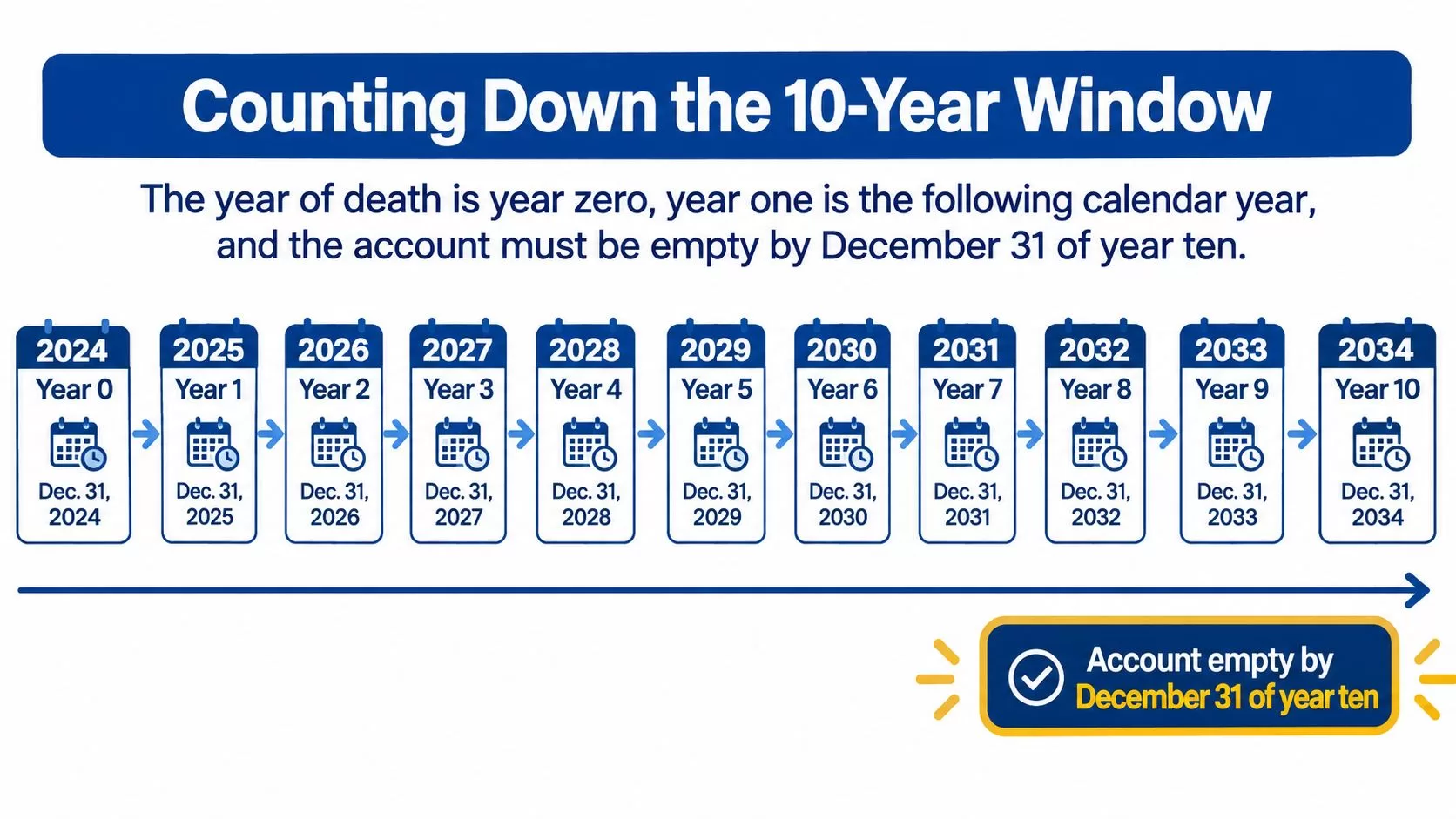
For most nonspouse beneficiaries, the year of the parent's death is year zero. The following calendar year is year one, and the account generally must be fully distributed by December 31 of year ten.
The Congressional Research Service's explanation of the SECURE Act says the law, enacted in 2019, generally applies to owners who died after December 31, 2019, and replaced lifetime stretch treatment for most nonspouse beneficiaries with a 10-year distribution requirement. For example, if a parent dies in year X, the usual deadline is December 31 of the year that is ten years after X.
Follow the calendar, not the anniversary
In a hypothetical timeline, a parent dies in year X. That year is year zero, the next calendar year is year one, and the count continues until year ten. The deadline falls on December 31 of that tenth year, not on the anniversary of the parent's death.
The deadline sets the finish line; annual minimums set the pace. Depending on the applicable rules, a beneficiary may take a lump sum, schedule withdrawals, or wait to withdraw more later. Traditional inherited IRA withdrawals generally count as taxable ordinary income, and state income tax may also apply.
A flexible schedule still needs to meet the required deadlines. The five-year rule for inherited IRAs describes a different payout framework that may apply in some circumstances.
Required Withdrawals When the Parent Had Started RMDs
If a parent had started taking required minimum distributions (RMDs), an adult child subject to the standard payout rule generally must take annual distributions in years one through nine and empty the inherited IRA by the end of year ten. The 10-year deadline is only part of the rule: the parent's RMD status determines whether annual withdrawals are required along the way.
Under the final regulations described in IRS Publication 590-B, annual-distribution requirements apply from 2025, following transition relief for 2021–2024. If the parent died before reaching the required beginning date, annual beneficiary withdrawals generally aren't required under this framework, though the final distribution deadline still applies.
Gather the facts that determine the obligation
Before calculating a withdrawal, confirm the details that shape the rules:
- Parent's age and date of death. These help establish which requirements apply.
- RMD history. Request calculations and payment records from the account custodian.
- Beneficiary category. Certain beneficiary exceptions can change the payout framework.
- Account type. Traditional and Roth inherited IRAs may have different tax treatment.
- Year of death. Applicable guidance and transition treatment depend on when the inheritance occurred.
A missed required distribution may trigger an excise tax. The IRS's RMD rules and correction guidance describes a potential 25% tax on the missed amount, potentially reduced to 10% if corrected promptly. The required annual minimum is a compliance floor, not necessarily the amount that best fits a beneficiary's tax planning.
How Withdrawal Timing Changes Your Tax Bill
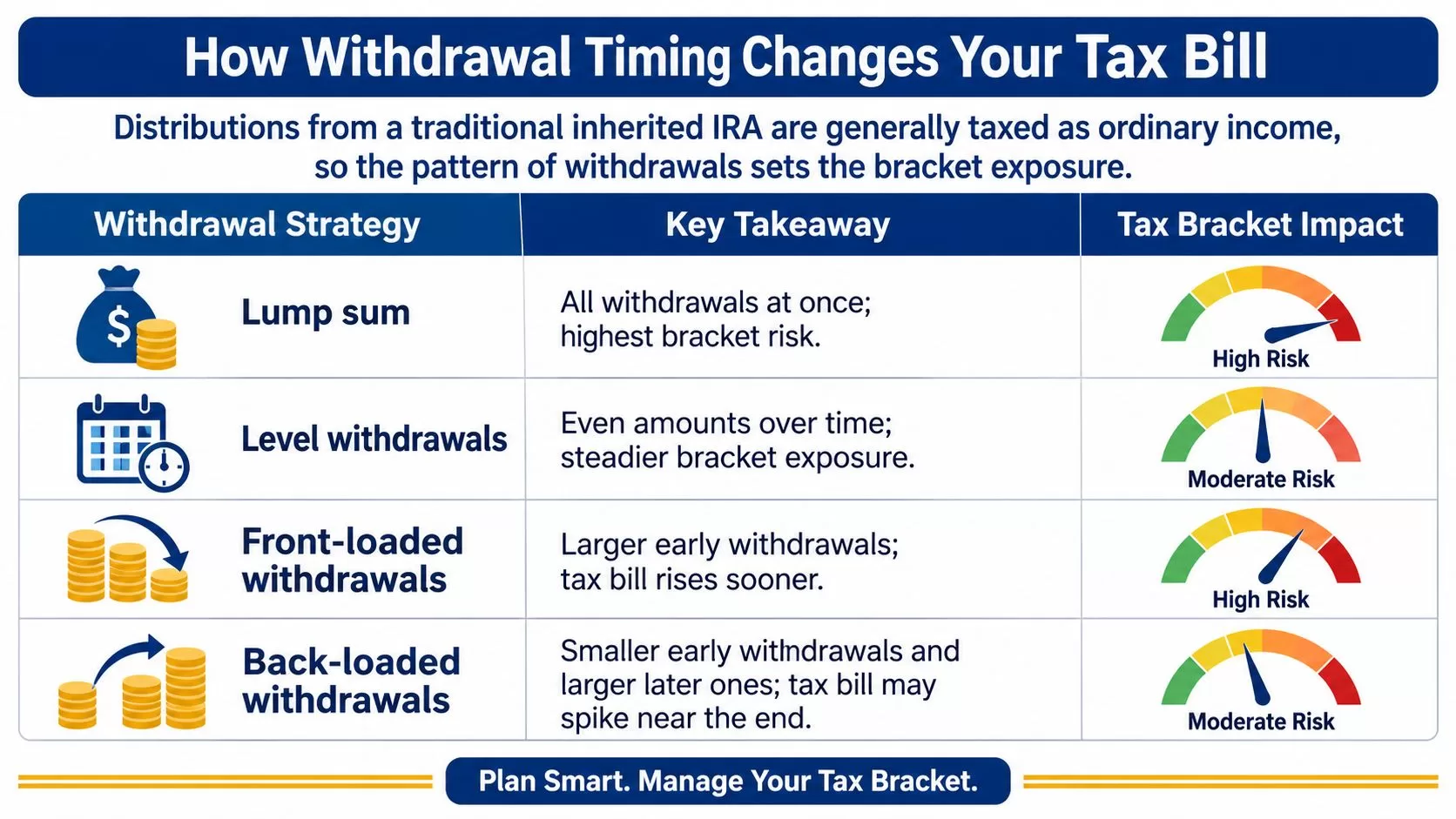
A year-ten lump sum can stack an inherited IRA distribution on top of salary income, potentially pushing some of that income into a higher marginal tax bracket. The effect depends on the account balance, other income, deductions, and applicable tax rules.
The Congressional Research Service's overview of inherited IRA distribution rules explains the timing tradeoff: taking taxable distributions earlier brings income forward, while waiting can concentrate it in a later year. Model the year-ten balance now, not in year nine.
Compare the withdrawal patterns
The comparison below assumes a traditional inherited IRA with taxable distributions. The best fit depends on the beneficiary's income pattern and applicable distribution requirements.
| Withdrawal pattern | Tax effect | Best fit |
|---|---|---|
| Lump sum in year one | Generally concentrates the taxable balance in one year and can push income into higher brackets | Worth evaluating when income is unusually low or immediate access is necessary |
| Level annual withdrawals | Spreads taxable income across years one through ten | Steady income and relatively predictable brackets |
| Single withdrawal in year ten | Preserves tax deferral, followed by a potentially large taxable year | Only when annual withdrawals aren't required and there's a credible plan for the final tax bill |
| Bracket-filling withdrawals | Targets available room within a chosen bracket each year | Variable income and beneficiaries seeking flexibility |
A simple account transaction can still create a large tax bill. A later withdrawal may coincide with salary or other taxable income, while earlier distributions bring taxable income forward.
The visual comparison highlights how concentrating or spreading withdrawals changes bracket exposure.
Match the schedule to expected income
A beneficiary with fluctuating employment income can compare a schedule that takes more in lower-income years with one that spreads distributions more evenly. Any schedule must account for required withdrawals that apply.
For a beneficiary with steady salary income, level withdrawals may be easier to budget. Yet equal annual amounts don't guarantee equal tax bills: other income, deductions, and tax rules can change.
Bracket-filling requires a full tax projection, not a glance at salary alone. A CPA can account for other taxable income, deductions, state income tax, and the inherited IRA's required distributions when estimating available bracket room.
A longer deferral can mean a larger taxable distribution later. Tax timing affects when income is reported, while the total tax depends on the beneficiary's circumstances in each year.
Revisit the projection annually. Changes in income or account value can make the original schedule harder to complete or less suitable.
Frequently Asked Questions
Can an adult child keep an inherited IRA indefinitely?
No. An adult child who is not an eligible designated beneficiary must empty the inherited IRA by the end of the applicable 10-year period. Certain eligible designated beneficiaries can qualify for different rules, so confirm the beneficiary category before relying on the 10-year deadline.
Can a parent's IRA be rolled into the child's own IRA?
A nonspouse beneficiary cannot roll inherited funds into a personal IRA. The funds must remain in an inherited account titled to identify the deceased owner and beneficiary. A surviving spouse has different options, so confirm the account registration with the custodian before transferring funds.
What happens when several children inherit the same IRA?
Each child's share can be administered separately under the rules that apply to that beneficiary. For example, the custodian may divide the parent's IRA into separate inherited IRAs, one for each child. Separate accounts help each beneficiary track distributions and plan around their own tax situation.
What if no beneficiary was named?
If the IRA is payable to the estate, the distribution rules can differ from those for an account payable directly to a child. Check the IRA agreement, the estate documents, and whether the parent had begun required minimum distributions. Those details determine which distribution timetable applies.
How does an inherited Roth IRA differ?
A Roth IRA owner has no lifetime required minimum distributions. Qualified Roth distributions are income-tax-free, but a beneficiary still faces an inherited-account payout deadline.
Check the account's qualification history and the rules that apply to its beneficiary. Those details determine whether a particular withdrawal is tax-free; the Roth label alone does not.
Set Your Withdrawal Schedule Before the Deadline
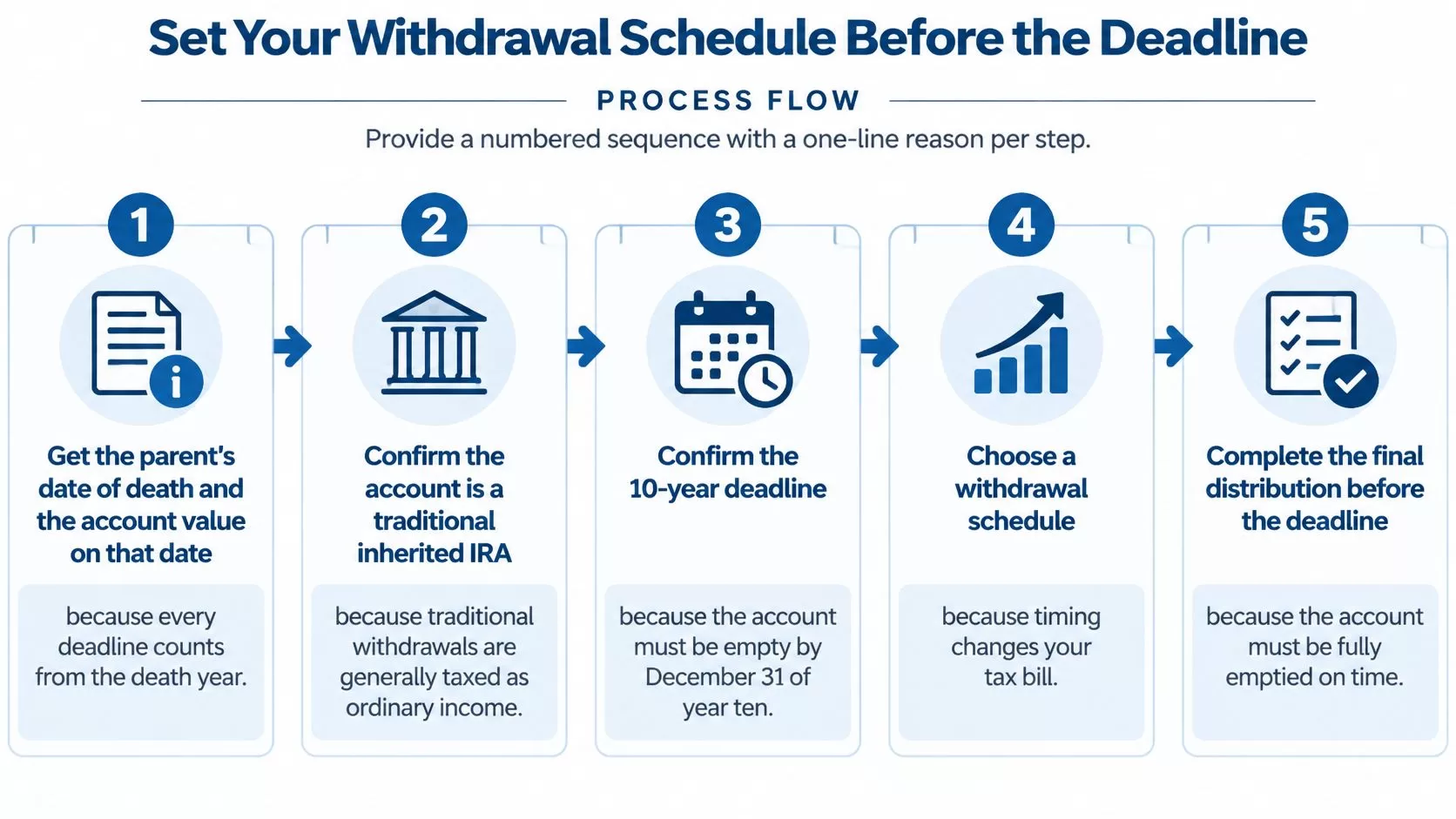
How should you set an inherited IRA withdrawal schedule without missing a required payment or taking a large taxable distribution at the last minute? Start with the deadline, then map any annual withdrawal requirements onto the years available.
The parent's RMD status shapes the schedule. If annual beneficiary withdrawals apply, the 10-year deadline is only half the picture: a beneficiary may need to take distributions each year as well as empty the account by the deadline. A late, large withdrawal could also push more taxable income into one year than a measured schedule would.
Build a documented action plan
Use the earlier RMD and beneficiary checks as your starting point. Then:
- Choose a withdrawal pattern. Compare taking more gradually with waiting until later, considering how each approach may affect taxable income.
- Set calendar reminders. Record required payment dates and the final deadline, allowing time for the custodian to process distributions.
- Keep a running record. Save confirmations and distribution records so you can track what has been withdrawn and what remains.
Separate education from individual advice
The death year and the parent's RMD status establish the framework. The withdrawal schedule determines how distributions are spread across the available years, subject to any annual requirements.
Gold IRA Association's materials are for informational purposes only, not financial, legal, or investment advice. A professional advisor can assess how the rules apply to your circumstances. Gold IRA Association offers educational guides and resources on retirement accounts and precious metals; explore them at Gold IRA Association.