


If silver's quoted price rises, does that mean its owner can sell at a profit? Not necessarily, because the dealer's buyback price, purchase premium, and holding costs determine the break-even point. Understanding how to invest in silver starts with choosing the right exposure, then checking costs, custody, and retirement-account rules before funds move.
Compare Silver Exposure Options Before You Buy
Silver exposure routes compared
| Route | Ownership | Liquidity | Storage or Custody | Best Fit |
|---|---|---|---|---|
| Physical coins and bars | Direct ownership of metal | Sold to dealers, with buy-sell spreads | Investor arranges home or depository storage | Savers seeking tangible ownership for the long term |
| Silver ETFs | Shares in a fund that holds silver | Traded on exchanges during market hours | Fund custodian holds the metal | Investors preferring brokerage-account simplicity |
| Mining company shares | Equity in silver or byproduct producers | Traded on stock exchanges | No personal metal storage | Investors accepting company and equity-market risk |
| Silver IRA | Eligible metal inside a retirement account | Sales run through the custodian | Approved depository under the custodial arrangement | Retirement savers using tax-advantaged accounts |
| Futures contracts | Contract obligation, not direct metal ownership unless delivered | Exchange-traded with margin requirements | Contract and delivery rules apply | Experienced traders only |
Physical silver provides direct ownership, but selling requires finding a buyer and accepting a quoted spread. An ETF offers trading convenience without giving shareholders metal in hand.
Mining shares add operating costs, debt, labor, and management decisions to the investment. A silver IRA is an account structure rather than a separate kind of metal, with additional custody and distribution requirements. Futures are margined contracts, not a typical retail starting point.
Silver is both a monetary metal and an industrial commodity. Its price can respond to manufacturing, solar production, and electronics demand alongside inflation, interest rates, and currencies, as explained by the Silver Institute's supply-and-demand overview.
The LBMA's full-year market report records a 154.45% low-to-high price range during 2025, illustrating why silver shouldn't be treated as a stable-return investment.
For broader inflation-diversification context, CoinHub.pro offers research-led comparisons for UK investor portfolios, although UK account considerations aren't substitutes for U.S. IRA rules.
The practical question is which objective matters: emergency liquidity, long-term diversification, inflation-related exposure, or higher-risk growth. Silver shouldn't replace readily available emergency cash.
Which Silver Products Qualify for a Silver IRA
Common silver products and typical IRA status
| Product | Typical Fineness | Typical IRA Status |
|---|---|---|
| American Silver Eagle, one ounce | .999 | Commonly listed as eligible; confirm with custodian |
| Canadian Silver Maple Leaf, one ounce | Verify exact issue specifications | Commonly listed as eligible; confirm with custodian |
| Austrian Silver Philharmonic, one ounce | .999 | Commonly listed as eligible; confirm with custodian |
| Generic one-ounce silver rounds | .999 for qualifying bullion products | Issuer and product approval required; not automatically eligible |
| Silver bars from approved refiners | .999 minimum | Eligible when applicable bullion and refiner requirements are met |
| Pre-1965 U.S. junk silver coins | Below qualifying bullion fineness | Generally not eligible |
These are screening categories, not purchase authorizations. Product specifications and eligibility must be checked against current IRS guidance and confirmed in writing by the receiving custodian before purchase.
The CFTC's precious-metals IRA guidance identifies one-ounce U.S. silver coins and bullion meeting regulated futures fineness requirements as eligible categories. For the technical bullion benchmark, the COMEX silver specifications require at least 999 fineness. That benchmark doesn't make every retail round or bar interchangeable or automatically IRA-eligible.
Complete both eligibility checks
- Check the metal. Obtain the issuer, weight, fineness, and exact product description. A familiar coin name or a dealer's eligible-product label isn't sufficient documentation.
- Check the account. Ask the custodian to approve that exact product, not just silver in general. The explanation of IRA-approved silver provides additional context for this distinction.
Collectible or numismatic coins generally aren't the right fit for a bullion-focused IRA. Nonqualified purchases can create tax and administrative problems, even when the buyer believed the metal was suitable.
Custody rule: IRA-owned silver belongs within the approved custodial and depository arrangement. Personal home possession can risk treatment as a taxable distribution.
Home storage is a separate choice for personally owned silver outside a retirement account. A dealer's home-storage pitch shouldn't replace advice from a qualified tax professional.
How to Buy Physical Silver Step by Step
A disciplined purchase starts with a budget, a recognizable product, and a complete price comparison.
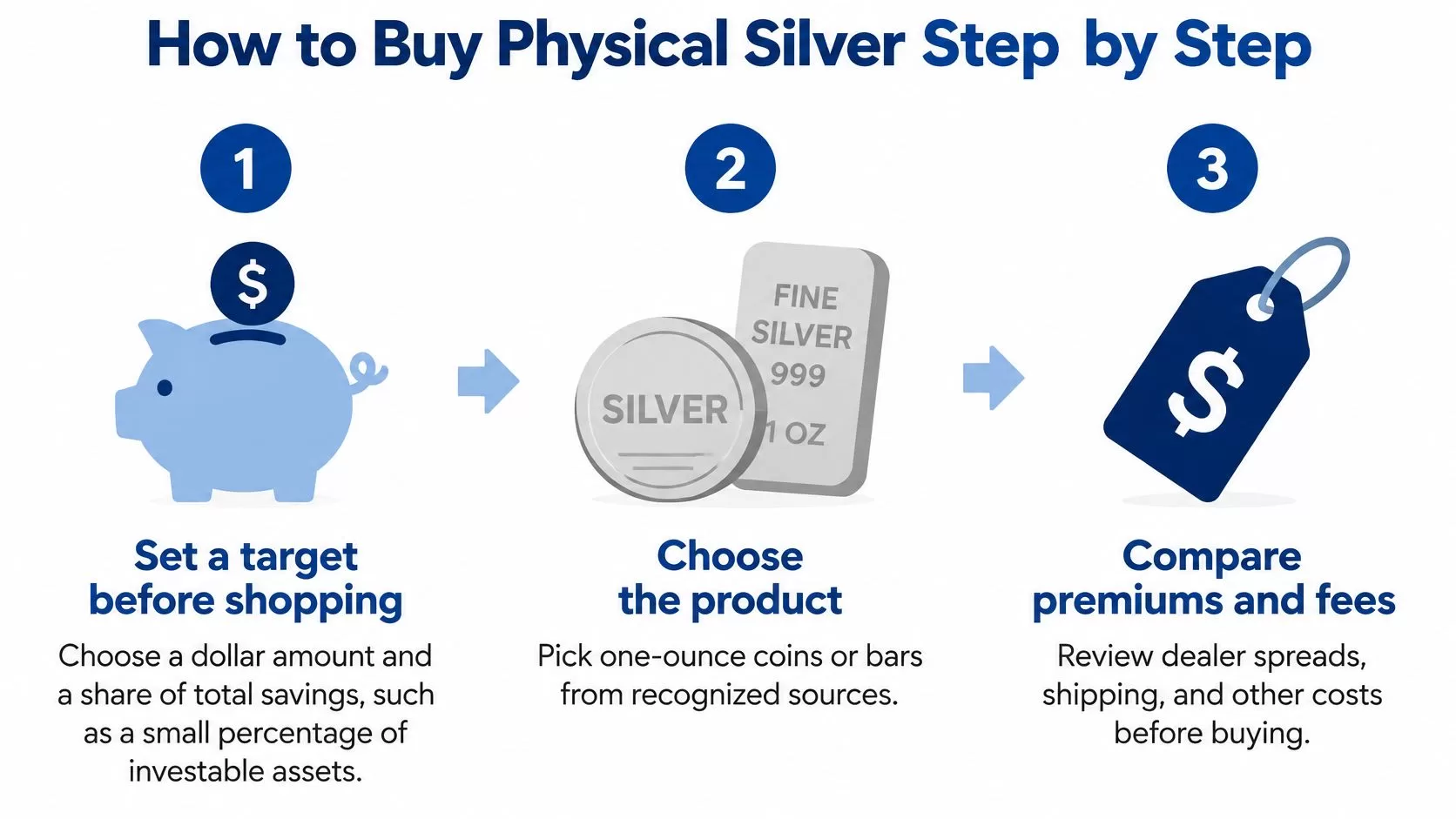
Set a target before shopping. Establish a dollar ceiling and a modest share of investable savings. This keeps a persuasive sales conversation from determining the allocation.
Choose the product. Favor recognizable bullion coins or bars with clearly documented issuer, weight, and fineness. The guide to silver coins as an investment explains considerations for coin buyers.
Compare the complete purchase price. Record the spot price alongside the dealer premium, shipping, insurance, and applicable sales tax. An attractive advertised premium may exclude meaningful charges.
Obtain the buyback quote. Request the dealer's current repurchase price for the exact product in writing. Calculate the break-even level from that quote, rather than assuming a return to the purchase-time spot price would eliminate the loss.
Verify the seller. Check business registration, independent reviews, written pricing, and return terms. Refusal to provide documentation is a reason to pause.
Arrange storage before delivery. Personally held metal requires suitable security and insurance; professional storage requires a clear custody agreement. Home storage applies only to non-IRA purchases.
Preserve the paperwork. Retain invoices, assay information, purchase dates, and bar serial numbers where available. These records support authenticity checks and later sales.
Plan the exit. Identify likely buyers and their inspection, shipping, and payment procedures. A collectible premium may not be recoverable when a buyer values the purchase only for its metal.
A sharp price rise isn't a reason to skip comparison shopping. Retail premiums can also increase during buying surges.
The accompanying video provides another format for reviewing the purchase process.
How to Roll Over Funds Into a Silver IRA
A silver IRA requires coordination among the existing plan, receiving custodian, dealer, and depository. The money's route matters as much as the metal selected.
The visual summarizes the initial account and funding checks.
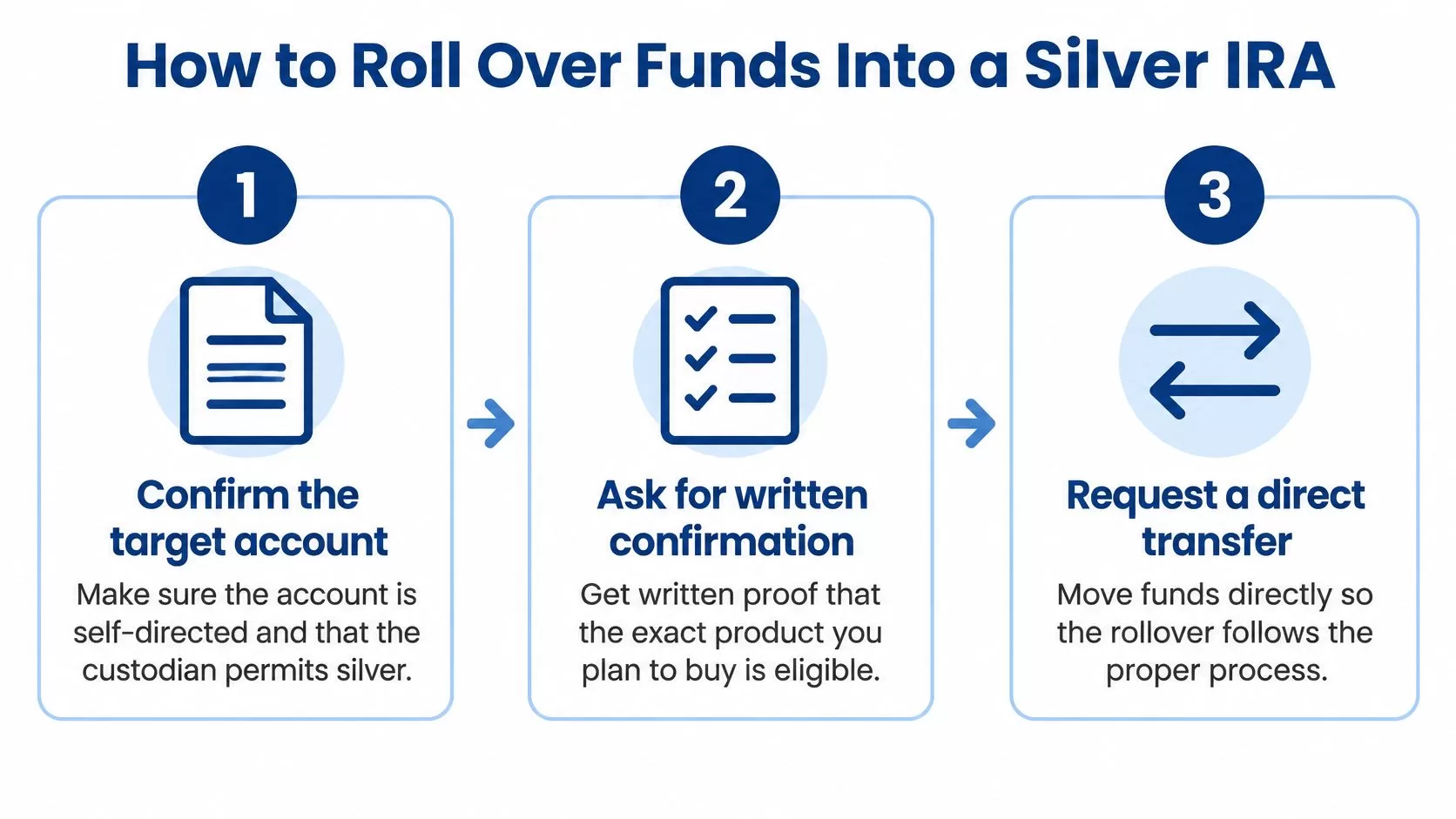
Confirm the receiving account. The account must be self-directed, and its custodian must permit physical silver. Establish who administers the account and which depository will hold the purchases before authorizing movement.
Secure product approval. Obtain written confirmation that the exact intended bullion qualifies. Dealer assurances alone don't resolve the receiving custodian's requirements.
Verify that existing funds can move. An employer plan may restrict distributions while the participant remains employed. The plan administrator should confirm whether an in-service rollover is permitted and provide the required forms.
Choose the correct direct route. For IRA-to-IRA movement, request a trustee-to-trustee transfer where available. For eligible employer-plan funds, request a direct rollover to the receiving IRA rather than a payment personally payable to the participant.
Review indirect-rollover risks before accepting a check. Payments made to the participant can introduce withholding and strict redeposit deadlines. A CPA or tax professional should confirm the current rules and explain any amount that must be replaced from other funds.
Authorize the purchase after funding. The custodian processes the approved transaction under the account arrangement and coordinates delivery to the designated depository. Personal possession isn't a substitute for custodial delivery.
Reconcile and retain records. Compare the account statement with the order's product descriptions, weights, and fineness. Preserve invoices, assay details, fee schedules, and transfer confirmations.
IRS Publication 590-B addresses IRA distributions, but the linked document is a draft, so current final guidance and account-specific instructions should be verified before acting. The silver IRA rollover guide can help organize the questions for the custodian and tax professional.
Silver IRA Costs and What to Ask Before You Pay
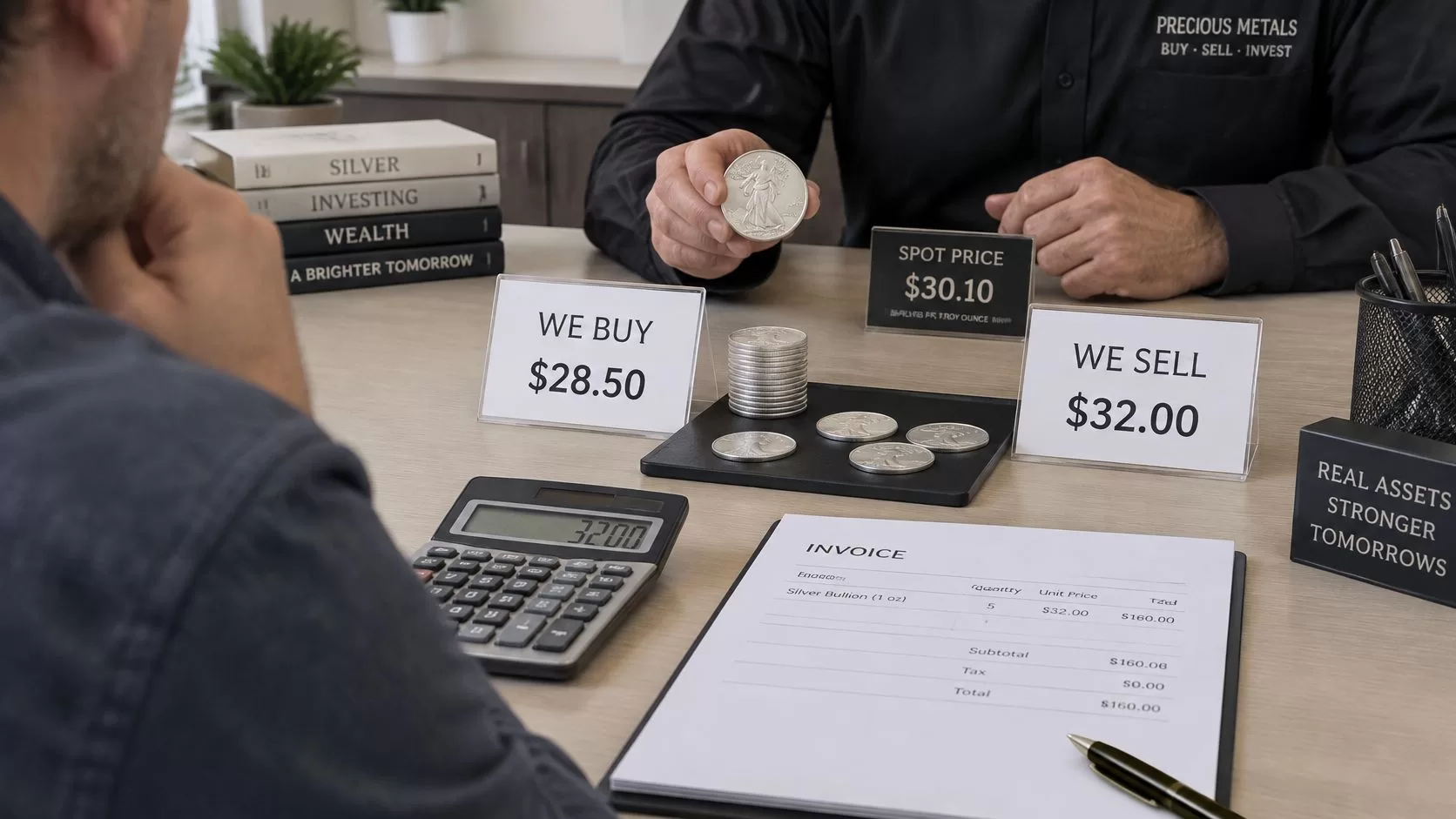
Consider a hypothetical example, not a current market quote: spot silver is $30 per ounce, the purchase price is $36, and the dealer offers $27 to buy it back. The purchase premium is 20%, while the buyback quote is 10% below spot.
If that proportional buyback discount remains unchanged, spot would need to reach $40 for the dealer's bid to reach $36. That's approximately a 33% spot-price increase just to recover the purchase price, before account or storage costs. The discount could change, so this is a scenario calculation, not a forecast.
The CFTC's precious-metals buying advisory explains that dealers generally sell above spot and buy below it, and reports that some fraudulent dealers have charged spreads exceeding 300%, while others charge less than 20%. The practical safeguard is a written purchase quote paired with a written buyback quote.
A product presentation should always be accompanied by transaction-level pricing.
Silver IRA cost categories and questions to ask
| Cost Type | What It Covers | Question to Ask in Writing |
|---|---|---|
| Account setup fee | Opening a self-directed account | Is this one-time or charged again later? |
| Annual custodial fee | Account administration | Is it flat or based on account value? |
| Storage fee | Depository holding | Is storage segregated or commingled? |
| Insurance | Coverage of stored metal | Who is insured, and up to what value? |
| Dealer spread | Purchase price versus buyback price | What is the buyback price today? |
| Liquidation or distribution fee | Selling or moving metal out | Are fees charged on sale or distribution? |
Request the complete fee schedule and model costs over the intended holding period. Compare providers using identical products, purchase amounts, and storage arrangements. The publisher doesn't set provider fees; each company establishes its own charges.
Sizing and Risk Controls for Silver Holdings
Owning a physical asset doesn't make borrowing to buy it conservative. The CFTC's leveraged precious-metals advisory describes arrangements where buyers pay only 20% to 25% of the metal's cost while a company finances the remainder, exposing them to interest charges, margin calls, account closure, and loss of funds.
Fully paying for eligible bullion through a properly structured account is materially different from financing a speculative position. A retirement allocation shouldn't require additional cash merely to keep the position open.
Set limits before prices move
- Define a maximum allocation. Establish a modest ceiling relative to total retirement savings. The limit should reflect spending needs and loss tolerance, not enthusiasm about recent performance.
- Choose a rebalancing rule. Review on a calendar schedule or when the holding moves outside a predetermined allocation band. A written rule reduces impulsive buying after sharp gains.
- Protect spending reserves. Keep emergency funds and near-term withdrawals in cash or other suitable liquid assets. This reduces the chance of selling silver at an unfavorable time.
- Review annually. Reassess the position alongside income, health expenses, beneficiaries, and planned retirement withdrawals.
For the broader principle of limiting damage before pursuing gains, Colibri Trader's guide to capital preservation offers useful context. It isn't a substitute for individualized retirement planning.
Avoid preventable ownership mistakes
A storage agreement should distinguish allocated metal from an unsecured claim against a business. Buyers should also identify whether recurring charges could make a long holding period uneconomical.
Collectible purchases, neglected spreads, and panic buying can undermine an otherwise modest allocation. Silver's volatility means it shouldn't be treated as a dependable annual-return source.
A silver position should be small enough that a large price drop wouldn't change the retirement plan.
Silver IRA Questions Investors Ask Most
Account and investment questions
Can IRA silver be kept at home?
No. IRA-owned metal must remain within the required custodial and approved-depository arrangement described earlier in this article.
Can silver ETF shares sit in an IRA?
Silver ETF shares can usually be held through a standard brokerage IRA, subject to the broker's investment menu. That arrangement differs from a self-directed IRA that purchases and stores physical bullion on the account's behalf.
How do I measure the actual cost of buying silver?
Start with the dealer's buyback price. Your break-even is the market level at which that buyback quote equals everything you paid, including the premium over spot and any applicable fees. Spot price tells you where the market sits today. The buyback price tells you where silver has to go before you recover your entry cost, so request it in writing before committing funds.
Is a rollover to a silver IRA taxable?
It depends on how the money moves. A direct trustee-to-trustee transfer, where funds pass between custodians without ever reaching you, is generally treated differently from a 60-day indirect rollover, where the check is made out to you and must reach the new custodian inside the deadline. Moving pretax dollars into a Roth account counts as a conversion and carries its own tax treatment, while a missed deadline or paperwork error can turn a planned transfer into a taxable distribution. Match the method you choose to the rollover steps outlined earlier, and have a CPA or tax professional review the transaction before any funds move.
Compare Providers and Confirm the Plan Before You Commit
A provider comparison is useful only when the quotes describe the same transaction. Obtain written fee schedules, exact-product eligibility confirmation, and current buyback prices from multiple providers before choosing.
- Confirm the economics. Compare all-in purchase and holding costs, not advertised premiums alone.
- Confirm the process. Identify the custodian, depository, funding route, and required paperwork.
- Confirm suitability. Have a licensed professional review rollover timing, tax treatment, and whether a substantial loss would disrupt retirement spending.
Gold IRA Association is an educational resource, not a financial advisor. Its materials can support preparation, but they don't replace an account-specific professional review.
This is not financial advice. Consult a licensed financial advisor, CPA, or tax professional before making investment decisions.
Gold IRA Association offers silver IRA explainers, rollover guidance, and provider comparisons to help retirement savers evaluate fees and custody arrangements. Visit Gold IRA Association to compare precious-metals IRA companies using documented costs, storage arrangements, and account minimums rather than advertised prices alone.