


A retirement account can look comforting on paper and still leave a person uneasy. The balance may be sitting there, the headlines may be loud, and the question is simple, whether silver coins as an investment make sense as a real diversifier or just another expensive distraction. For a near-retiree, the right answer starts with the all-in cost, not the shiny price tag.
Silver has stayed relevant because the physical market is still large. The Silver Institute's 2025 market-trend material ties that to broad demand, noting global silver demand reached about 1.21 billion ounces in 2024 and that investment demand remained material in the market outlook, while also pointing out that cast bars usually carry the lowest retail premiums (CoinLaw summary of silver investment statistics). That matters because coins don't compete with bars on metal content alone, they compete on recognition, liquidity, and resale ease too.
A sensible framework is to treat silver coins as one piece of a retirement plan, not the whole plan. They can help a person who wants direct ownership of a government-minted metal, but the premium spread, storage, and exit friction can change the math fast. This is not financial advice. Consult a licensed financial advisor, CPA, or tax professional before making investment decisions.
Why Silver Coins Belong on a Retiree's Radar
A lot of people reach retirement age with the same worry. They have a 401(k), a traditional IRA, or both, and they're trying to decide whether physical silver is a useful hedge or a shiny object that eats returns through fees. That question is reasonable, because the appeal of silver coins is not just the metal itself, it's the way they fit into a larger retirement picture.
The strongest case for coins is simple. They are small, portable, and widely recognized, which makes them easier to understand than some other forms of precious metal ownership. Silver has also remained a meaningful physical investment format because the market is large enough to support steady demand across jewelry, industrial uses, and investment demand, rather than feeling like a niche collector's corner (CoinLaw summary of silver investment statistics).
What silver coins can do
Silver coins can give a retiree direct ownership of a tangible asset. That matters to readers who dislike owning only paper claims or account entries. In plain English, a coin in hand is easy to identify, easy to store, and easy to explain to a spouse or heir.
What silver coins cannot do
They can't remove risk, and they don't magically outrun inflation. They also come with costs that beginners often underestimate, especially when the seller charges a premium above spot and the buyer later faces a spread on the way out. The right question is not whether silver is cheap, but whether the coin's convenience is worth the extra cost.
Practical rule: if the goal is retirement diversification, silver coins should usually be sized as a complement, not a replacement, for the rest of the portfolio.
That framing keeps expectations honest. A retiree who understands that coins are a liquid, government-recognized form of precious-metals exposure is much less likely to overbuy the wrong format. A retiree who expects them to solve every portfolio problem is setting up a disappointment.
Bullion Coins, Numismatic Coins, and Junk Silver Explained
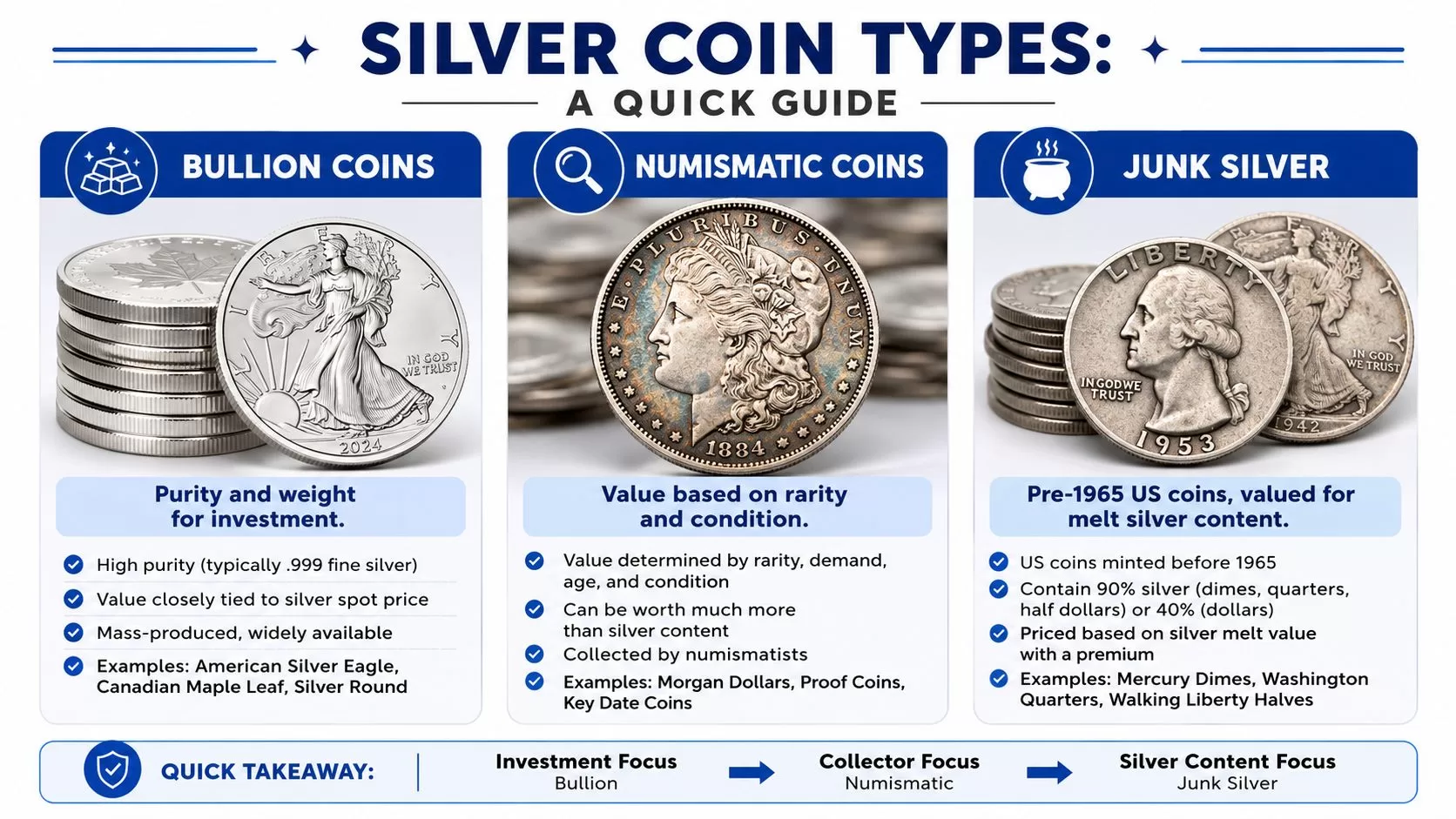
The easiest mistake for a new buyer is treating every silver coin as if it works the same way. It doesn't. A government-minted bullion coin, a collectible coin, and a pre-1965 U.S. silver coin can all contain silver, but they serve different jobs in a portfolio.
Bullion coins are built for metal exposure
Bullion coins are the straightforward choice. Their value comes mainly from the silver content, not from rarity or collector hype. Common examples include the American Silver Eagle, the Canadian Silver Maple Leaf, and the Austrian Philharmonic, all of which are widely recognized in the retirement-metal space.
Think of bullion coins like generic-brand gasoline. The point is not a collectible label, it's reliable performance and predictable content. Buyers usually choose them when they want a coin that is easy to authenticate and easy to sell later.
Numismatic coins are a different game
Numismatic, or semi-numismatic, coins are priced partly for rarity, condition, and collector demand. That means two coins with similar silver content can trade very differently if one is scarcer or better preserved. For a retiree focused on ounces per dollar, that extra collector premium may not be attractive.
A good comparison is a collector car. Yes, it has a useful function, but much of the price reflects things beyond the basic material. That's why numismatic silver is a different investment thesis, not just a fancier version of bullion.
Junk silver is about divisibility
Pre-1965 U.S. dimes, quarters, and half dollars are often called junk silver, though the nickname is misleading. They're not junk at all, they're worn coins with recognizable silver content, typically favored for small-unit flexibility and easier day-to-day divisibility. The key point is that they're generally 90% silver, which is why they're popular for private holding but commonly described as not IRA-eligible.
Simple test: if the price is driven by metal weight, you're looking at bullion. If rarity matters, it's numismatic. If small change and divisibility matter, it's junk silver.
The internal distinction matters because the wrong category can change the investment case entirely. A buyer who wants retirement liquidity usually needs bullion-style recognition, not collector complexity. Someone who wants tiny spendable units might prefer junk silver even if it doesn't deliver the lowest ounce cost.
For a quick IRA-focused reference on eligible forms, see IRA-approved silver basics.
What Actually Moves the Silver Price
Silver is not priced in a vacuum. It sits inside a market where industrial users, investors, and miners all pull on supply at the same time, which is why silver can feel more erratic than gold. A retiree who watches only headlines about "cheap silver" is missing the underlying drivers.

Industrial demand can tighten the market
Silver is heavily used in industry, so it has a built-in source of demand that many other metals don't face in the same way. That means prices can react not just to investor sentiment, but also to production needs from electronics and other manufacturing uses. When industrial users keep buying, fewer ounces are left for coin buyers and stackers.
Investor demand can push premiums higher
Investor demand matters because silver is a small, highly industrialized market. The Silver Institute's market material shows that investment positions are sizable but still much smaller than gold's in a comparable snapshot, which helps explain why silver can move sharply when buyer interest accelerates (Silver Institute investment snapshot). For coin buyers, that can mean dealer premiums widen when physical demand tightens.
Supply, futures, and backwardation tell a story
Expert commentary also emphasizes watching LBMA spot and COMEX futures, because the relationship between them can reveal stress in physical supply (guide to silver market structure). One useful term is backwardation, which happens when spot prices trade above futures. In plain English, that can signal that people want metal now more than later, and that often supports higher premiums on deliverable coins than on generic bars.
When physical metal gets tight, the coin case can get expensive faster than the futures screen suggests.
That's why retirees should read silver headlines carefully. A calm-looking chart doesn't always mean calm pricing at the dealer level. If physical demand is strong and supply feels tight, the premium on recognizable coins may move in a way that catches first-time buyers off guard.
The Real Cost of Owning Silver Coins
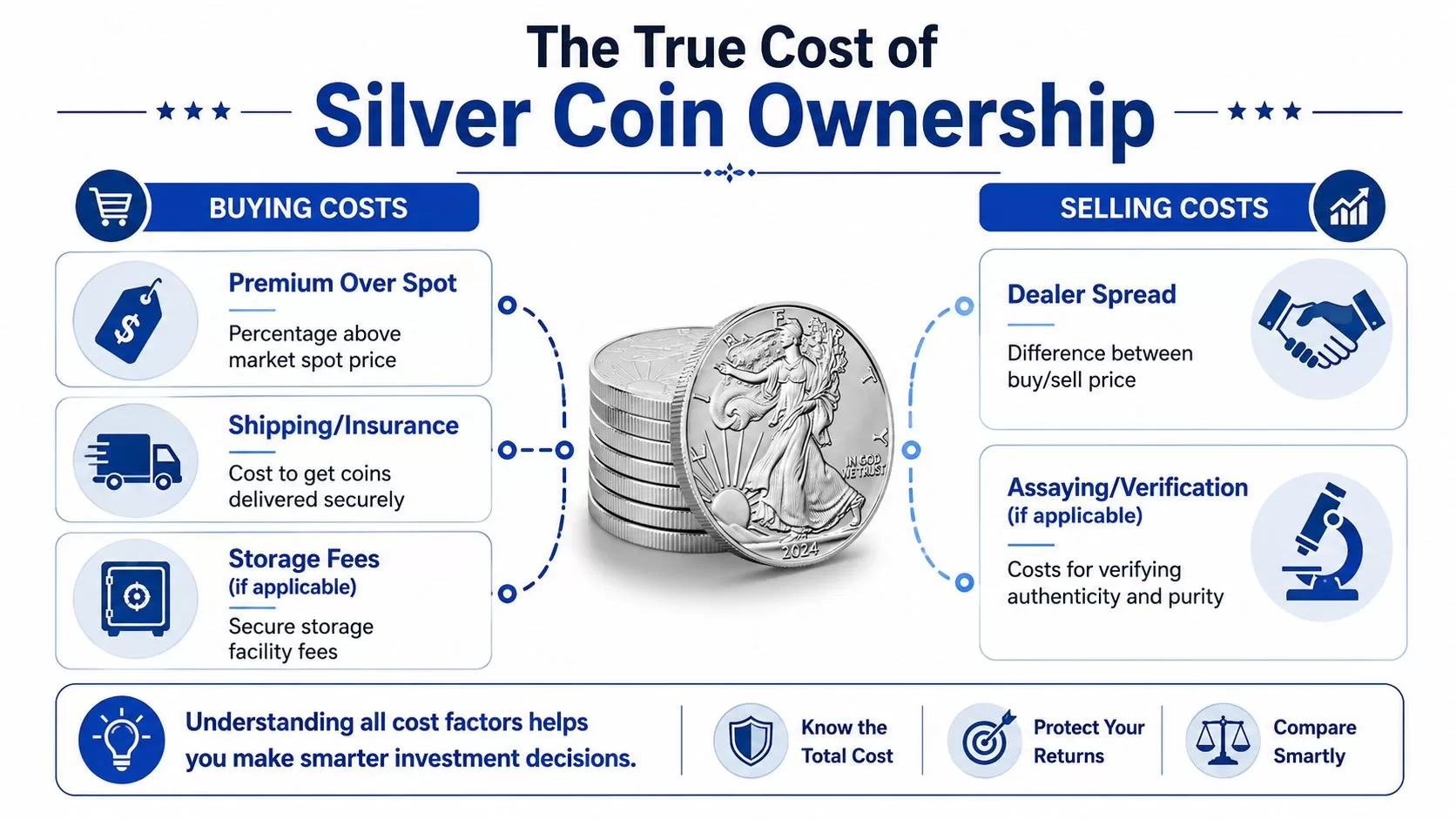
The sticker price is only the first bill. A retiree buying silver coins pays for the metal, then pays again through premium, shipping, storage, and eventually the spread on the way out. That's why the cheapest-looking option on the page can turn into the more expensive one after every layer is counted.
Buying costs show up before the coin reaches the safe
The first cost layer is the premium over spot, which is the amount added above the market value of raw silver. Then come shipping and insurance if the coins are mailed, and storage if the buyer uses a vault or other secure facility. Each one reduces the number of ounces a dollar buys.
Selling costs show up when the owner wants cash
The second layer is resale friction. Dealers usually buy at a lower price than they sell, which creates a dealer spread. Some sales may also require verification or assaying if the coins are unfamiliar or if the lot is large enough to justify extra checks.
A simple way to think about it is this, a stack of silver coins can be like carrying cash in a wallet, while a large bar is more like carrying it in a bank vault. The wallet is easier to use, but each piece costs more to move and replace. For a retiree, that difference matters because short-term liquidity can be more expensive than it looks.
Cost check: ask for the total price, the buy-back policy, and the expected spread before a single coin changes hands.
That question should come before any purchase. The point is not to avoid coins, it's to know exactly what the convenience costs. Coins often make sense when recognizability matters more than squeezing out the last ounce per dollar, but they are rarely the lowest-cost way to own silver in bulk.
Silver Coins Inside an IRA
For retirement savers, the IRA question usually comes first. The plain-English answer is that not every silver coin qualifies, and the account has its own custody rules that change the economics. That's where people get tripped up, because the metal itself may be attractive while the account structure adds extra paperwork and fees.
The basic rule is purity. IRA-compliant silver bullion typically needs a minimum fineness of 99.9% silver, and the Silver Institute states that eligible silver bullion coins and bars must meet that threshold and be held by a third-party custodian (Silver Institute IRA guidance). That means purity screening and custody compliance matter just as much as price.
IRA eligibility at a glance for common silver coins
| Coin | Typical Purity | IRA-Eligible |
|---|---|---|
| American Silver Eagle | .999 | Yes, commonly cited |
| Canadian Silver Maple Leaf | .9999 | Yes, commonly cited |
| Austrian Philharmonic | .999 | Yes, commonly cited |
| Pre-1965 U.S. junk silver | 90% | Generally no |
That table reflects the usual retirement-account framework, but individual account setup can still vary. The important part is that pre-1965 junk silver is typically not IRA-eligible, even though it remains popular for personal holding.
The account wrapper changes the decision. A silver IRA can add tax-advantaged structure, but it also introduces custodial and storage costs that a home-held coin stack doesn't have in the same way. For some retirees, that tradeoff makes sense. For others, it makes simple taxable ownership easier to understand and cheaper to run.
For a deeper breakdown of account structure, see what a Silver IRA is.
Coins, Bars, ETFs, and Mining Stocks Compared
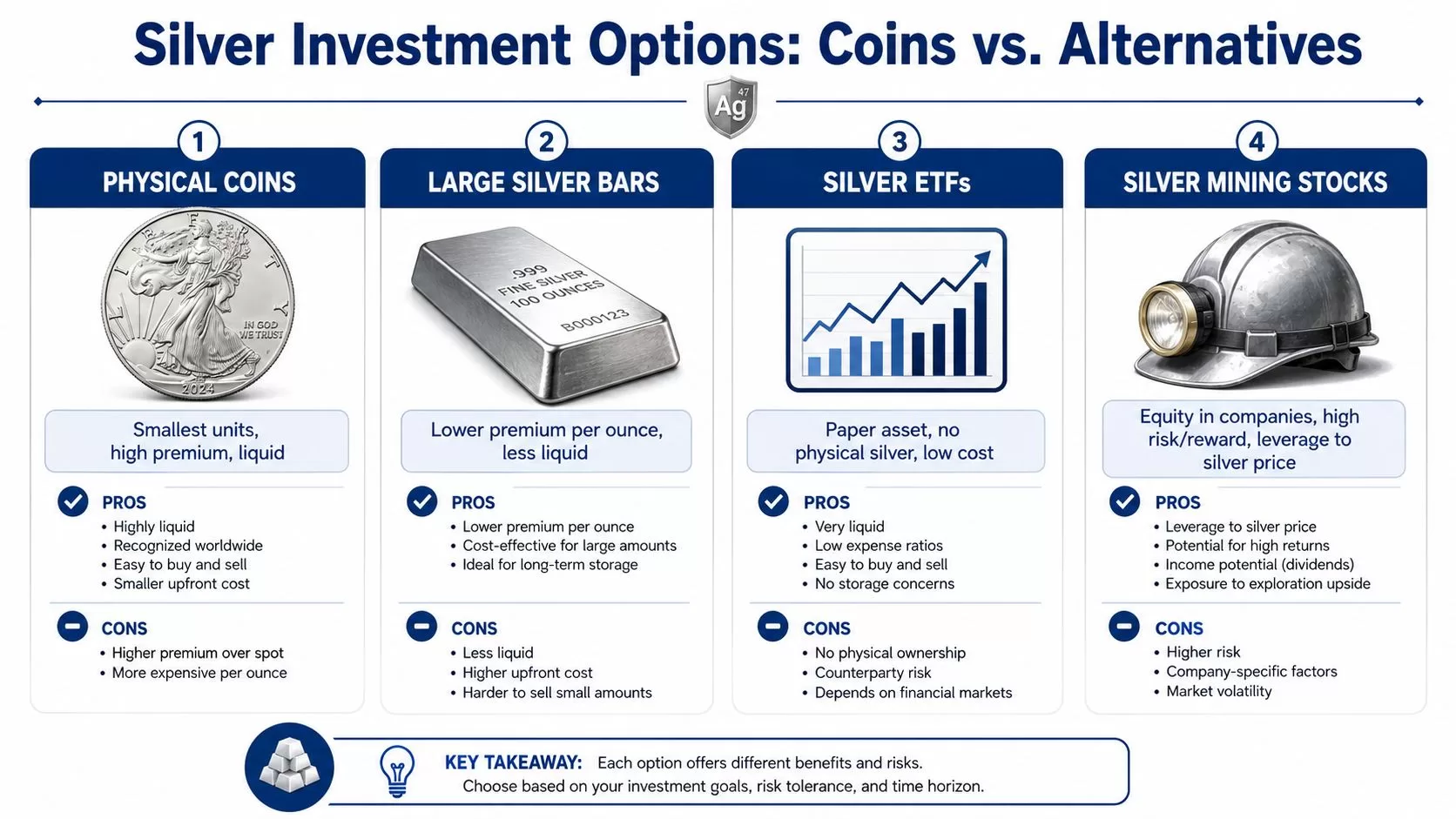
Silver coins are only one way to get silver exposure. A retiree has to decide whether direct ownership, paper exposure, or company shares better fit the goal. That choice matters because the best format for maximum ounces is not always the best format for liquidity, and neither one is automatically the best format for an IRA.
A plain-English comparison
| Format | Main strength | Main tradeoff |
|---|---|---|
| Physical coins | Easy to recognize and resell | Higher premium |
| Large silver bars | Lower premium per ounce | Less convenient to resell in small amounts |
| Silver ETFs | Simple market access | No direct metal ownership |
| Mining stocks | Company leverage to silver prices | Business risk is added on top of metal risk |
This comparison helps because each format solves a different problem. Coins are often the most practical for someone who wants a tangible asset that's easy to explain and liquidate. Bars tend to suit buyers who care most about ounces. ETFs suit people who want a brokerage-account solution, while mining stocks add equity-market risk along with silver exposure.
The academic view is also useful here. One cited portfolio rule says silver should generally be treated as a supplement to gold, with silver making up no more than 20% to 30% of a gold investment portfolio (academic chapter on silver allocation). That doesn't have to be a literal rule for every household, but it does reinforce the idea that silver is usually a supporting asset, not the center of the plan.
For retirees, the practical takeaway is straightforward. If the goal is fast resale and recognizable form, coins deserve a hard look. If the goal is cheapest ounce ownership, larger bars often look better. If the goal is simplicity in a brokerage account, ETFs may be easier. If the goal is a magnified bet on silver's direction, mining stocks carry a different kind of risk altogether.
How to Buy, Store, and Sell Silver Coins Safely
The buying process should feel boring, not exciting. A retiree who slows down long enough to verify the dealer, the storage method, and the exit route usually avoids the most common mistakes. The person who rushes because a salesperson sounds confident is the one most likely to overpay.
Start with the dealer, not the pitch
A reputable dealer should be willing to answer questions in writing, including how buy-back works and what happens if a coin arrives damaged or looks off. High-pressure calls are a warning sign. So is any reluctance to discuss premium, spread, or verification.
Decide where the coins will live before they arrive
The storage decision changes the whole experience. A home safe offers immediate access, but the owner has to think through security and insurance. A bank safe-deposit box may offer more separation from the home, but access depends on bank hours. A professional vault adds another layer of control and usually fits better with larger holdings or IRA structures.
Plan the exit before the first purchase
Selling works better when the owner already knows how the market is quoted. A coin buyer should understand that dealers often pay based on bid pricing, not the same price they advertise to sellers. Small lots also tend to be less efficient than larger ones, because the dealer's handling costs are spread over fewer ounces.
Useful habit: document each purchase, keep the invoice, and store the package separately from the coins themselves.
That habit makes resale easier and helps with authenticity questions later. It also keeps heirs from having to guess what was bought, when it was bought, or where it was stored. For a retirement-minded buyer, that paperwork is part of the asset.
For a curated look at account-oriented providers, see best Silver IRA companies.
Print this checklist before buying:
- Confirm the dealer's reputation: Look for clear terms, not pressure.
- Document every purchase: Keep invoices, dates, and product descriptions.
- Choose storage early: Decide on home, bank, or vault before the order ships.
- Plan the resale path: Know who might buy the coins back and on what terms.
- Match the coin type to the goal: Recognizability, divisibility, or lowest ounce cost.
Gold IRA Association helps retirees make sense of precious metals without the hype. If silver coins are on your radar, the next smart step is learning how IRS rules, storage choices, and total costs affect the outcome. Visit Gold IRA Association for plain-English guides that help you compare silver IRAs, coin types, and retirement-account options before you buy.