



The most familiar advice about choosing the best gold IRA custodians starts in the wrong place: compare advertising offers, read star ratings, and pick a recognizable name. Retirement investors need a more demanding test. Legal custody, account reporting, written costs, and dependable transaction handling matter more than a persuasive presentation.
Why Custodian Quality Matters More Than Advertising
A polished sales conversation doesn't establish whether the organization holding retirement assets has clear responsibilities or reliable procedures. The account documents should establish those responsibilities before an investor considers a purchase.
The distinction matters because physical precious metals in a self-directed IRA must remain under the custody of the IRA trustee or custodian rather than the account owner. The CFTC's precious-metals investor guidance also warns that metal prices fluctuate and excessive markups, commissions, or fees can materially reduce retirement savings.
Core Questions for a Gold IRA Custodian
| Question | Why It Matters | Evidence to Request |
|---|---|---|
| Who legally holds the metals? | A sales representative's role may differ from the custody role | Signed custody agreement and legal entity name |
| Who issues account statements? | Reporting needs an accountable organization | Sample statement and reporting policy |
| How are holdings valued? | Investors need an understandable valuation method | Written pricing methodology |
| Which charges continue over time? | An opening promotion isn't a complete cost comparison | Current fee schedule and promotional exclusions |
| Who handles unresolved problems? | Investors need a defined escalation route | Complaint and dispute procedures |
Treat documentation as the starting point
A useful comparison follows the retirement assets through the entire arrangement. It identifies the organization accepting instructions, the organization holding assets, the storage facility, and the party explaining purchase prices.
The following checklist highlights why operational evidence deserves more attention than advertising.
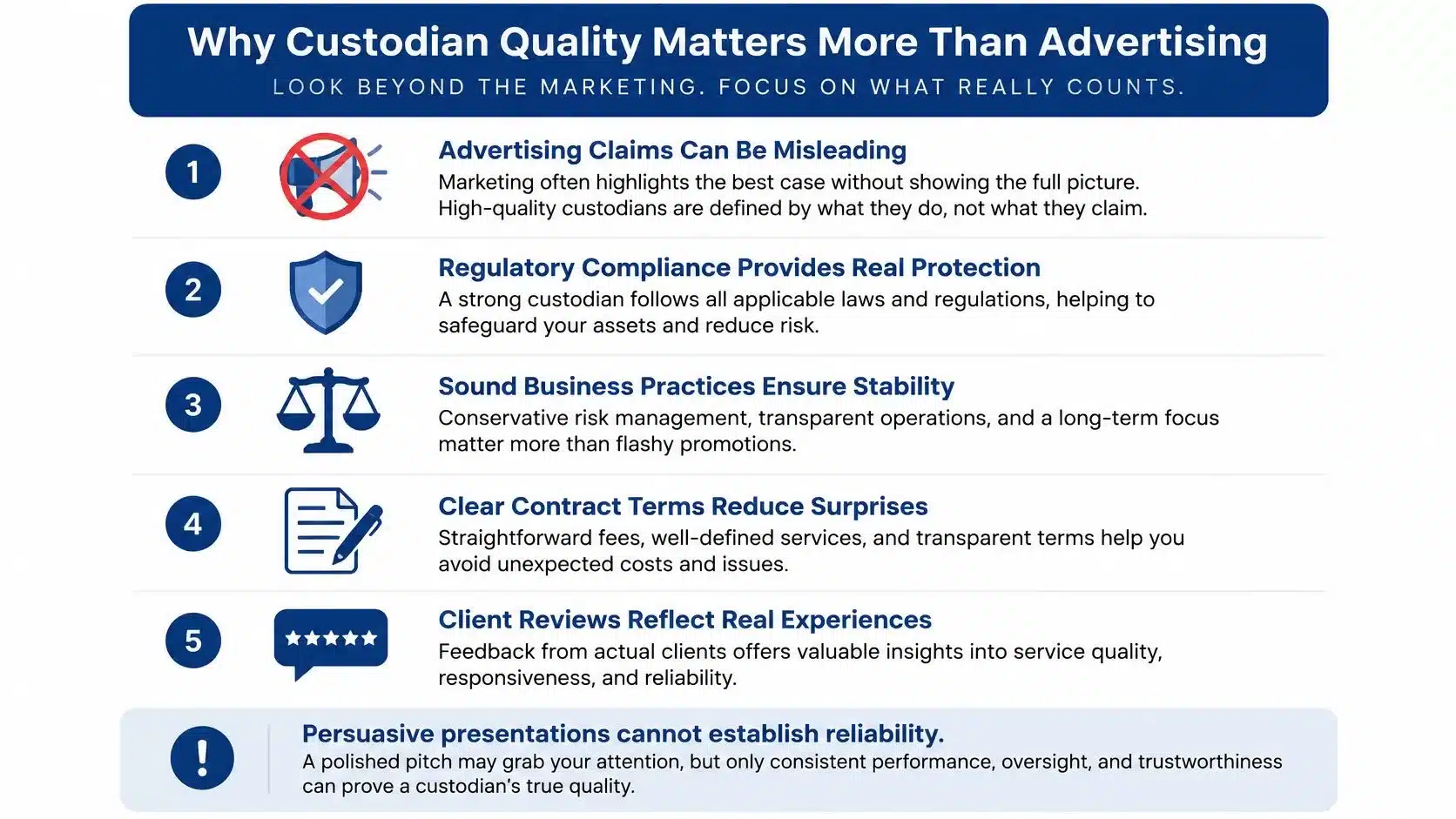
The editorial conclusion is straightforward: an unanswered custody question should outweigh an attractive opening offer. Investors shouldn't compensate for missing legal or operational information by relying on testimonials, promises of personal attention, or a familiar brand.
Practical rule: A provider deserves further consideration when its written documents explain the arrangement as clearly as its representative does.
How Gold IRA Custodians Fit Into the Account
A gold IRA comparison should distinguish the account's participants before evaluating their service. A company explaining precious metals or coordinating paperwork isn't automatically the organization legally responsible for custody.
The precise allocation of duties should come from the account agreement, not assumptions based on a company's name. The following role map is a useful reading aid, but it doesn't replace those documents.
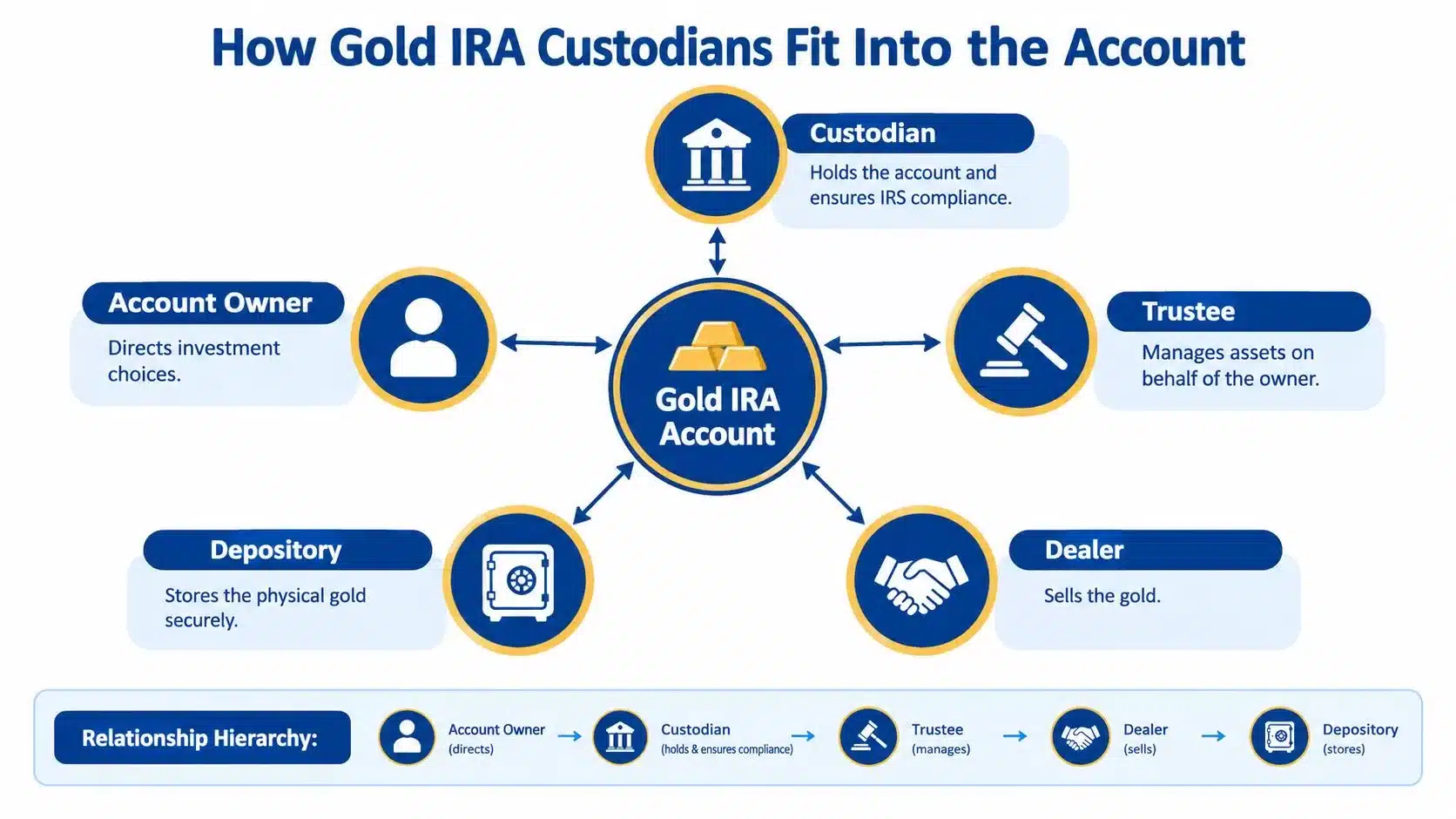
Who Does What in a Gold IRA
| Role | Primary Responsibility | Reader Verification Point |
|---|---|---|
| Custodian | Custody and account administration under the agreement | Exact legal entity and administrative duties |
| Trustee | Responsibilities assigned by the trust arrangement | Whether this is a separate entity or overlapping role |
| Dealer | The metals purchase or sale | Written product description and transaction terms |
| Depository | Physical storage under the arrangement | Facility identity and storage documentation |
| Account owner | Investment decisions and ongoing oversight | Instructions, authorizations, and retained responsibilities |
Read the agreement as a division of responsibilities
Investors should highlight who handles transaction instructions, statement corrections, distributions, and tax reporting. Where responsibility passes between organizations, the agreement should make that handoff understandable.
The distinction between gold IRA companies and the services they coordinate is especially useful when a representative offers a seemingly complete package. Convenience can be valuable, but investors still need the names and responsibilities of the underlying organizations.
A sensible document review includes:
- Account-opening terms: Identify every organization named in the agreement and its assigned role.
- Authorization language: Determine which actions require the owner's approval.
- Reporting responsibilities: Confirm who supplies statements and handles corrections.
- Distribution procedures: Locate the instructions for requesting cash or metals and resolving delays.
Most importantly, administration isn't the same as investment due diligence. The SEC's investor alert on self-directed IRA risks warns that custodians generally don't investigate an investment's underlying assets or a promoter's background, while owners face risks including limited liquidity, high fees, insufficient disclosure, and fraud.
A custody relationship isn't an endorsement of the purchase. Investors still need an independent reason for choosing the investment itself.
The Criteria Behind a Credible Comparison
A credible comparison should distinguish essential requirements from preferences. Lawful custody, understandable reporting, and written terms are essential. A broader product menu or more frequent telephone support may matter differently to different investors.
The following scorecard uses qualitative weights rather than invented numerical scores. An essential criterion acts as a gate: if the evidence remains unresolved, a favorable service feature shouldn't offset it.
Custodian Evaluation Scorecard
| Criterion | Weight | Strong Evidence | Needs Verification |
|---|---|---|---|
| Legal accountability | Essential gate | Named entity and executed custody terms | Unclear responsibility or authority |
| Written costs | Essential gate | Complete, current fee disclosures | Verbal estimates or partial schedules |
| Storage controls | Essential gate | Identified facility and documented protections | Unspecified insurance or audit arrangements |
| Valuation reporting | Essential gate | Sample statement and explained pricing policy | Unclear quantities or valuation dates |
| Transaction service | High priority | Written processing and escalation procedures | Unsupported turnaround assurances |
| Rollover coordination | High when applicable | Documented handoffs and responsible contacts | Reliance on informal promises |
| Metals selection | Preference-based | Current eligible-product documentation | Unconfirmed product availability |
| Client-review patterns | Supporting evidence | Specific, independently corroborated accounts | Isolated praise or anonymous allegations |
Judge the quality of the evidence
A signed agreement should carry more weight than a brochure. Current disclosures should take precedence over an undated summary, and an identifiable account record should carry more weight than a general description of helpful service.
A practical evidence classification is:
- Documented: Current written material answers the question directly.
- Partially documented: The material answers part of the question but leaves a meaningful gap.
- Needs confirmation: No reliable evidence establishes the answer.
- Unsuitable for the requirement: The documented arrangement doesn't meet the investor's stated need.
This method deliberately avoids treating missing information as a minor scoring deduction. Unknown isn't equivalent to acceptable. A missing insurance explanation, for example, requires clarification rather than an optimistic estimate.
The scorecard should also record advantages and drawbacks together. More personal assistance may suit an investor who wants help coordinating paperwork, while a simpler service arrangement may appeal to someone comfortable managing instructions independently. Neither preference establishes suitability until the essential requirements are satisfied.
Comparing Leading Gold IRA Companies
A useful company comparison doesn't need an unsupported winner. It needs consistent evidence fields that reveal whether the proposed arrangement matches the investor's requirements.
The provider labels below describe comparison categories, not verified claims about particular companies. No brand-specific fee schedule, current storage contract, investment minimum, or client-review record is established here, so assigning company rankings would create false precision.
The supplied visual can serve as a reminder of comparison topics, but any company-specific figures or promotional descriptions shown within it require independent confirmation.
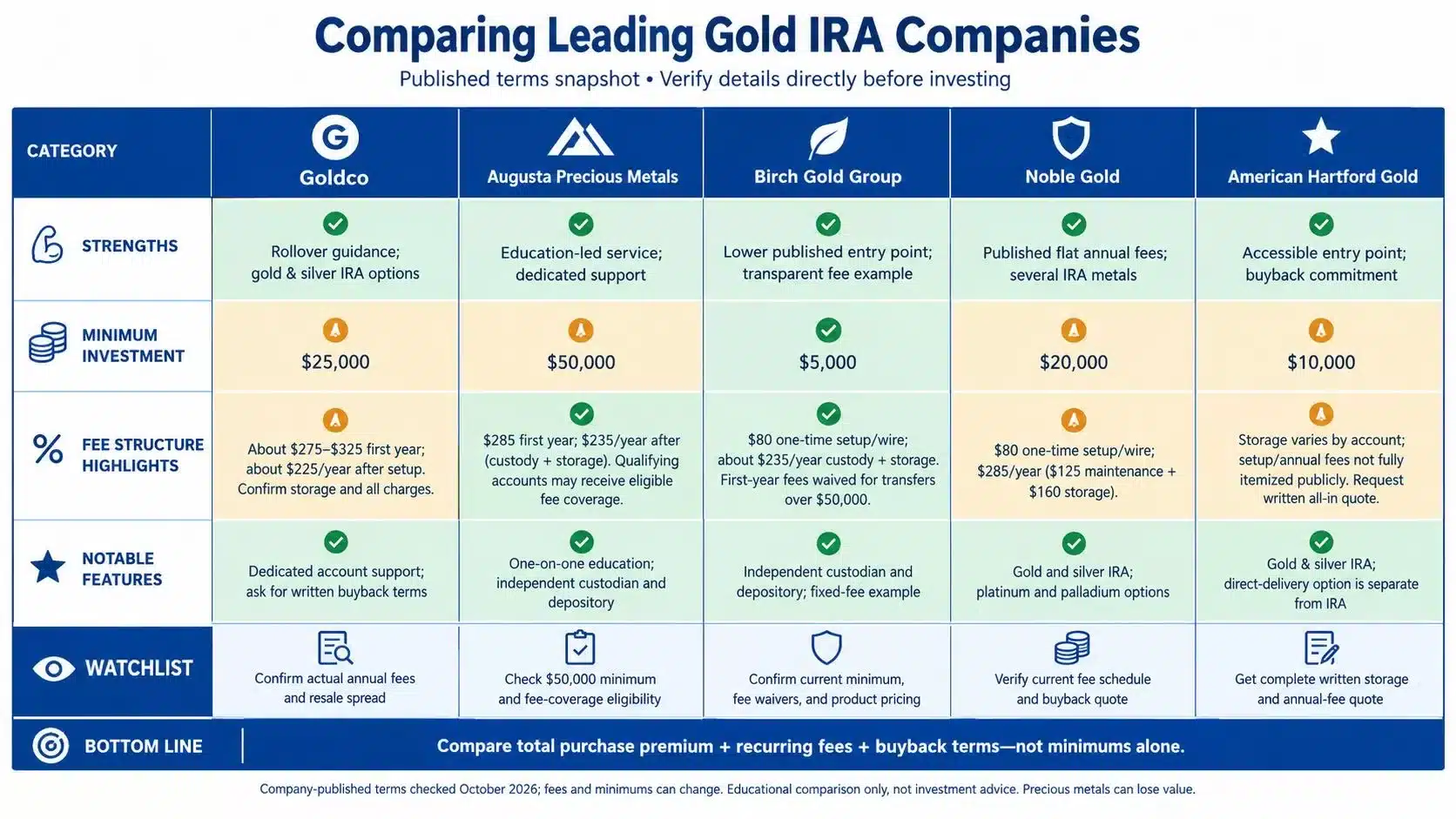
Gold IRA Provider Comparison
| Provider | Credibility Signals | Fees and Disclosures | Storage and Custody | Service Fit | Key Caution |
|---|---|---|---|---|---|
| Custody-focused candidate | Verify legal identity and account authority | Request administrative and transaction schedules | Review custody contract and facility details | Investors comfortable directing purchases | Don't assume investment advice is included |
| Coordination-focused candidate | Identify each organization involved | Separate dealer charges from account charges | Confirm the actual custodian and storage arrangement | Investors seeking paperwork assistance | A coordinator's promise may not bind another organization |
| Education-focused candidate | Compare explanations with contractual language | Request written costs before committing | Obtain original custody documents | Investors who want detailed explanations | Educational materials don't establish operational quality |
| Product-focused candidate | Verify exact products and purchase terms | Examine premiums and selling terms | Confirm acceptance under the proposed arrangement | Investors with defined metals preferences | Selection breadth doesn't resolve custody questions |
| Cost-focused candidate | Check disclosure completeness | Compare ongoing and exit costs | Examine what storage charges include | Investors prioritizing administrative economy | A low headline charge may omit other expenses |
| Watchlist candidate | Establish current operating identity first | Obtain fresh disclosures | Verify active relationships directly | Further investigation only | Previous publicity isn't current evidence |
Compare promises with deliverables
For a custody-focused candidate, the most useful evidence is a clear agreement and a readable sample statement. An impressive explanation of administration adds little if the investor can't identify who corrects a reporting error.
A coordination-focused candidate should identify the contact responsible for each handoff. Investors should ask whether that contact can resolve a stalled transaction or merely relay messages between organizations.
For an education-focused candidate, the test is consistency. The representative's explanation, written educational material, and signed terms should describe the same arrangement without changing the meaning of important qualifications.
Product-focused comparisons require a different question: does the proposed selection serve the investor's plan, or merely expand the sales conversation? A focused menu may be sufficient when the investor has a clearly defined objective.
A broader offering isn't automatically a better retirement arrangement. The relevant advantage is a documented feature the investor actually needs.
Keep a watchlist separate from a shortlist
An unfamiliar or previously reviewed candidate belongs on a watchlist until current documentation is available. Watchlist status isn't an allegation of misconduct, nor is inclusion an endorsement.
A shortlist should contain only candidates whose essential documents have been reviewed. That distinction prevents visibility, advertising frequency, or a favorable historical impression from being mistaken for current suitability.
What Credibility and Client Reviews Can Reveal
Client feedback can help an investor decide what to investigate. It shouldn't substitute for evidence about the account itself.
Document review remains the stronger starting point.

A detailed complaint about an unexplained charge is more useful as an investigation lead than a vague statement of dissatisfaction. Likewise, praise for a friendly representative doesn't establish that statements were accurate or distribution instructions were handled correctly.
Evidence Review Guide
| Signal | Stronger Evidence | Lower-Value Signal |
|---|---|---|
| Fee clarity | Disclosure matched to the investor's invoice | General claims about affordability |
| Problem resolution | Documented correction and explanation | A polite public response without an outcome |
| Account service | Specific description of an operational issue | Praise focused only on the sales call |
| Legal identity | Consistent names across executed documents | Branding without accountable entities |
| Regulatory history | Records matched to the correct entity | Unsupported statements about a clean record |
Compare recurring themes, not isolated impressions
For a coordination-focused candidate, investigate comments about handoffs and responsibility. For a cost-focused candidate, investigate whether customers describe charges that weren't explained. For a high-contact service model, examine whether support continued after the purchase.
These are questions to investigate, not findings about any particular provider. No provider-specific rating or complaint pattern is established here.
For broader context on consumer-review reading outside retirement services, Gini Help's Unclaimed Baggage reviews concern a different purchasing category. That material isn't evidence about gold IRA custody and shouldn't influence a retirement-provider ranking.
The accompanying video is supplemental material, not a substitute for current contracts or regulatory records.
The useful outcome of review research is a sharper question list. A complaint becomes decision-relevant when the investor can connect it to a documented policy, an unresolved explanation, or a verifiable account-handling issue.
Compare Fees Storage and Account Operations
Purchase cost, statement value, and eventual sale proceeds are different measurements. Comparing them requires more than reading the annual administration charge.
FINRA's guidance on buying physical gold and other metals advises obtaining fees, commissions, costs, and the agreed retail price in writing. It explains that a statement may report melt value, calculated from bullion weight and the metal's spot price, rather than the total amount paid after premiums, commissions, and other charges.
Build a complete cost worksheet
A useful worksheet separates costs by the event that triggers them. The investor should ask whether each charge is fixed, tied to account value, assessed per transaction, or subject to change.
| Cost Category | What to Record | Question to Resolve |
|---|---|---|
| Opening | Setup and initial processing charges | What remains payable after a promotion ends? |
| Administration | Recurring custody and account charges | What services are included? |
| Storage and insurance | Separate or bundled charges | What protections does the payment purchase? |
| Buying | Product premium and commissions | How does the agreed price compare with stated metal value? |
| Selling | Quoted sale terms and related charges | What deductions affect net proceeds? |
| Distribution or closure | Processing and exit charges | Which costs apply to the intended exit method? |
The gold IRA fee explanation provides a framework for organizing these categories. The decisive document remains the current schedule applicable to the proposed account.
A generic reconciliation should connect the purchase confirmation's metal description and weight with the holdings shown on the statement. The investor should then compare the statement's valuation date and pricing method with the purchase date rather than assuming any difference proves an error.
Verify what storage actually includes
Storage questions should go beyond the facility's name:
- Segregation: Ask how the agreement describes separation and identification of holdings.
- Insurance: Request coverage information, exclusions, and the process for making a claim.
- Auditability: Ask what inspection or reconciliation evidence can be supplied.
- Transferability: Establish the procedure and charges for moving holdings elsewhere.
Cost comparison insight: The relevant question isn't which opening charge is smallest. It's which documented arrangement has acceptable costs for the investor's expected holding, transaction, and exit needs.
Use Cases for Different Types of Investors
The best gold IRA custodians won't be identical for every retiree. An investor who wants help interpreting statements has a different operational priority from someone who already understands self-directed account paperwork.
Suitability should follow the investor's expected use of the account. It shouldn't follow whichever feature a representative emphasizes most confidently.
Best Fit by Investor Priority
| Investor Priority | What to Prioritize | What May Be Less Important | Key Question |
|---|---|---|---|
| Straightforward retirement administration | Readable records and a clear support route | Extensive product variety | Can the investor understand the sample documents unaided? |
| Moving existing retirement funds | Defined coordination responsibilities | Promotional extras | Who tracks outstanding paperwork? |
| Gold-focused ownership | Clear terms for the intended products | A broad additional-metals menu | Does the proposed selection match the stated objective? |
| Considering gold and silver | Documented support for both | Unrelated product categories | How will holdings and costs be presented? |
| Wider eligible-metals selection | Confirmed support for intended purchases | Sales presentation style | Which exact products will the arrangement accept? |
| Lower administrative cost | Complete recurring and exit-cost disclosures | Frequent nonessential contact | What assistance is excluded from the quoted charge? |
Match service intensity to the investor
A retiree who prefers telephone explanations should test access to the operational team, not merely the sales team. A useful pre-opening question concerns who will explain a statement discrepancy after the purchase is complete.
An investor handling an account move may place greater value on clear status updates and coordinated instructions. Someone comfortable managing paperwork independently may instead prefer fewer service layers, provided accountability remains clear.
For a metals-focused buyer, additional choice is useful only when it supports an intentional plan. It shouldn't encourage purchases the investor can't explain in plain language.
Separate portfolio decisions from provider decisions
An efficient custodian doesn't establish that a particular allocation to precious metals is appropriate. The decision to use physical metals and the decision about who administers the account require separate consideration.
The strongest fit is the provider whose documented structure matches the investor's risk tolerance, preferred level of involvement, and retirement timeline.
This distinction also limits overreliance on service quality. Responsive support can make account administration easier, but it can't remove price risk or guarantee that an investment will meet a retirement objective.
Verify a Custodian Before Moving Retirement Funds
A provider should pass a document review before receiving retirement funds. The final check should resolve outstanding questions rather than repeat the sales presentation.
Assemble the decision file
The investor's retained file should contain:
- Current disclosures: Applicable fees, promotional conditions, and purchase terms.
- Account agreements: Custody responsibilities and named legal entities.
- Storage evidence: Facility details, insurance information, and available audit documentation.
- Reporting examples: A sample statement and the written valuation procedure.
- Exit instructions: Distribution, sale, transfer, and closure policies.
- Coordination records: Responsible contacts and instructions for the proposed account movement.
Any unresolved issue should be written down with the requested evidence beside it. The gold IRA scam warning guide can support that review, but no checklist replaces verification of the actual transaction documents.
Confirm whether the movement is a transfer or rollover
When an account owner personally receives a distribution, the funds generally must reach another eligible retirement plan or IRA within 60 days; limited deadline waivers aren't automatic, according to the IRS rollover rules. The same IRS guidance states that, beginning after January 1, 2015, an individual generally may complete only one IRA-to-IRA rollover in any 12-month period, regardless of the number of IRAs owned, while direct trustee-to-trustee transfers aren't subject to that annual limitation.
The investor should have the proposed method identified before authorizing movement. Current IRS guidance and the existing account administrator's requirements should be checked before acting because the applicable treatment depends on the transaction and individual circumstances.
Frequently asked questions
Does a custodian's involvement mean the investment has been vetted?
No. As explained earlier, administrative custody doesn't establish the quality or legitimacy of the investment.
Can a low-fee provider still be suitable?
Yes, if the complete arrangement meets the investor's requirements. Low cost isn't a defect, but an incomplete quotation isn't proof of economy.
What should happen when a provider won't supply documents?
The investor should pause the decision. Missing essential evidence shouldn't be replaced with confidence in a representative's assurances.
Keep the final decision independent
This publication maintains affiliate partnerships with gold IRA providers and may receive compensation through those relationships. Commercial relationships shouldn't replace the operational verification described above.
This is not financial advice. Consult a licensed financial advisor, CPA, or tax professional before making investment decisions. Educational comparisons aren't personalized recommendations, and dependable administration doesn't guarantee investment outcomes.
Gold IRA Association provides educational guides, fee explanations, and provider comparisons to help retirement investors evaluate precious-metals account arrangements. Visit Gold IRA Association to compare the documentation questions that matter before selecting a custodian or moving retirement funds.