

A lot of near-retirees reach the same point at the same time. They've built savings in a 401(k) or a regular IRA, they're uneasy about keeping everything in plain-vanilla market assets, and they've started reading about gold, real estate, or private deals. Then the confusion hits. A self-directed IRA sounds like more control, but most guides stop right where the risk begins.
The clean answer is this. Opening a self-directed IRA isn't hard, but opening one correctly takes sequence, paperwork discipline, and a clear understanding of what the account can't do. That matters even more for readers trying to hold physical metals inside a retirement account.
What a Self-Directed IRA Actually Is
A self-directed IRA is an IRA held by a custodian that allows a broader range of investments than a standard brokerage IRA. The key point is that the tax rules don't become looser just because the investment menu gets wider. The SEC defines a self-directed IRA as an IRA held by a trustee or custodian that allows investment in a wider set of assets, but the account remains subject to ordinary IRA tax rules and legal restrictions (SEC self-directed IRA alert).

For someone trying to figure out how to open a self directed IRA, that definition clears up the first misunderstanding. This is not a do-anything retirement account. It's still an IRA. The difference is that, depending on the custodian, the account may be able to hold assets such as real estate, promissory notes, tax-lien certificates, private-placement securities, and precious metals. A regular brokerage IRA usually won't touch those assets.
What changes and what doesn't
What changes is the investment menu.
What doesn't change is the legal framework. The account still has to be administered by a trustee or custodian, and the owner still has to respect IRA rules on tax treatment, distributions, and prohibited conduct.
That's why readers who are thinking about real estate often benefit from practical tools before they ever fund an account. For example, anyone considering an IRA-owned property can browse neighborhood scores to get a grounded view of local conditions before they move from curiosity to due diligence.
Plain-English rule: A self-directed IRA gives the investor more choices, not more freedom to ignore the IRS.
The four decisions that matter first
Before any forms get signed, four decisions control the rest of the process:
- Custodian: Which firm will administer the account and hold the assets?
- Account type: Will the investor open a traditional or Roth IRA structure?
- Funding method: Will the money come from a new contribution, a transfer, or a rollover?
- First investment: What asset will the custodian be asked to purchase once cash arrives?
Readers who want the broader groundwork can review what a self-directed IRA is before comparing custodians and funding paths.
Choosing a Custodian Worth Working With
The custodian is the most important choice in the whole setup. Not the dealer. Not the shiny investment idea. The custodian.
That's because the custodian handles the administrative spine of the account. The account is still an IRA, so someone has to maintain records, process transactions, hold title correctly, and complete required reporting. The mistake many first-time investors make is assuming the custodian also vets the investment itself. That assumption causes trouble fast.
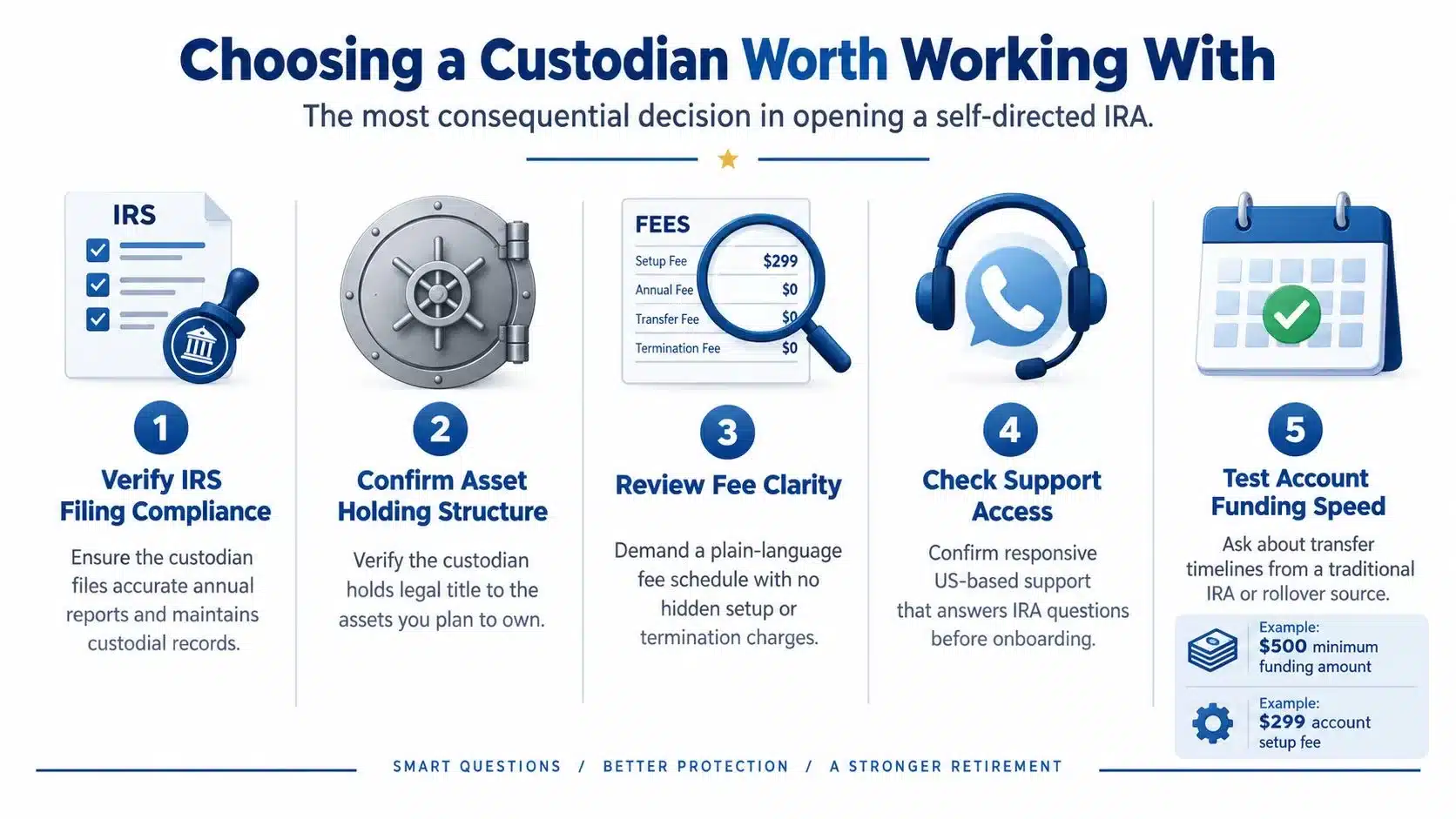
The SEC warns that a broader investment menu does not mean the custodian evaluates or guarantees the quality, legality, liquidity, or value of each investment (SEC investor alert on SDIRAs). That means the investor chooses. The custodian administers.
What to confirm before signing anything
A serious discovery call with a prospective custodian should answer these questions clearly:
- Accepted asset classes: Does the custodian administer the type of asset the investor wants, whether that's metals, real estate, notes, or private securities?
- Valuation process: How are hard-to-price assets valued for statements and reporting?
- Statement preparation: What will year-end reporting look like, and who is responsible for supplying backup documentation?
- Fee transparency: Are all charges listed plainly, including setup, annual administration, transaction, storage, insurance, and valuation-related fees?
- Administrative scope: Will the custodian only process paperwork, or does it offer transaction screening for obvious compliance issues?
A quick explainer can help readers understand the basic role before they compare options:
Fee categories to compare
| Fee component | What it usually covers | Why it matters |
|---|---|---|
| Establishment fee | Opening the account | Impacts upfront cost, but rarely tells the whole story |
| Annual administration | Ongoing account maintenance | Recurs whether the account is active or not |
| Transaction fee | Purchases, sales, wires, special processing | Adds up if the investor expects more than one move |
| Asset valuation fee | Reporting for non-public assets | Often overlooked until year-end |
| Storage or insurance | Common with physical metals | Critical for precious-metals accounts |
Lowest headline cost isn't the smartest choice if the custodian is slow, unclear, or sloppy about titling and reporting. Readers looking specifically at metal-friendly administration can compare the role of an IRA custodian for gold before making calls.
A weak custodian can turn a valid investment idea into an avoidable compliance mess.
Funding the Account the Right Way
A self-directed IRA can hold the right asset and still fail at the funding stage. The common mistake is treating every deposit as the same kind of transaction. The IRS separates new contributions, transfers, and rollovers, so choose the method before moving money.
The contribution route
A new contribution is fresh money added to an IRA and remains subject to annual limits. For 2026, total contributions to all of an individual's traditional and Roth IRAs combined are limited to the lesser of $7,500 or taxable compensation. The limit rises to $8,600 for someone age 50 or older by year-end (IRS IRA contribution limits).
That limit applies across every traditional and Roth IRA the person owns. Opening several accounts does not create a separate contribution allowance for each one.
Transfer vs rollover
A transfer generally moves assets directly between IRA custodians. A rollover usually involves money leaving an employer plan or an IRA before being redeposited into another eligible retirement account. Direct movement is the cleaner choice because the investor does not receive the funds personally.
If a rollover distribution is paid to the account owner, the money generally must reach another eligible retirement account within 60 days. Otherwise, the amount can become taxable, and an additional 10% early-distribution tax may apply when no exception covers the withdrawal (IRS late rollover guidance).
Practical rule: Use a direct path between institutions whenever one is available. Personal possession creates avoidable deadlines, withholding issues, and documentation risk.
Funding methods at a glance
| Funding method | How it works | Key IRS rule | Common mistake |
|---|---|---|---|
| Annual contribution | New money goes into the IRA | Subject to annual IRA contribution limits | Treating a rollover as a contribution |
| Trustee-to-trustee transfer | Funds move directly between IRA custodians | The owner does not receive the funds | Starting before the new account is ready |
| Rollover | Money moves from an eligible plan or IRA into another retirement account | Indirect rollovers face a 60-day deadline | Missing the deadline or including an RMD |
One more trap needs attention. A required minimum distribution can't be rolled over, and mishandling that can create a 6% excess-contribution tax exposure under rollover rules and IRS guidance. Confirm which dollars are eligible before requesting the distribution. Readers planning a move from an existing retirement account can review the mechanics of a self-directed IRA rollover before authorizing the transfer.
Paperwork, Beneficiaries, and Account Setup
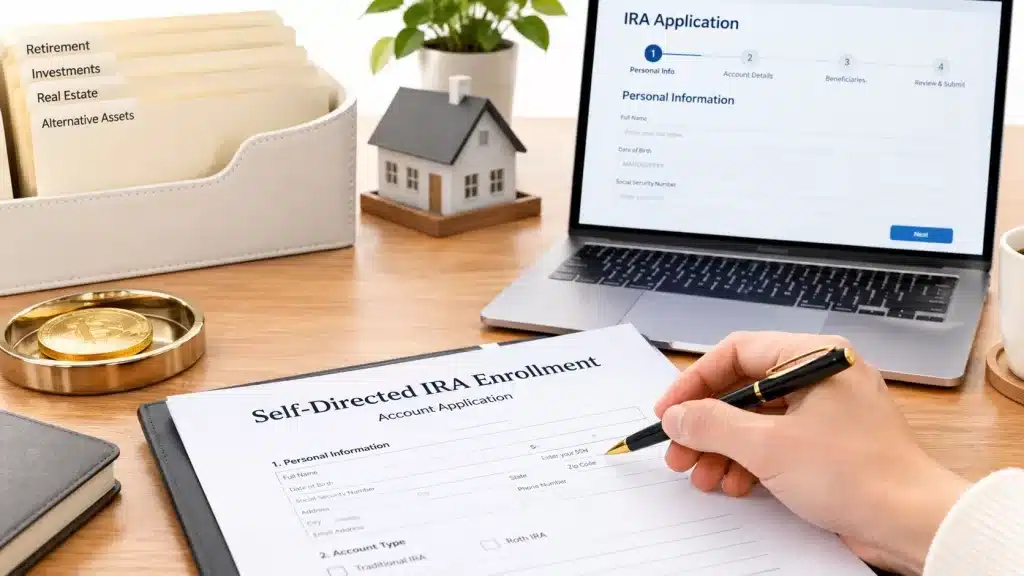
A near-retiree can lose weeks by submitting an application before deciding how the account will be funded or titled. Open a self-directed IRA in a controlled sequence: gather the records, complete the account documents, confirm beneficiaries, then arrange the transfer or rollover. The custodian should receive clear instructions, not a stack of partially completed forms.
What to gather before the application starts
Prepare these items before opening the account:
- Government-issued identification
- Current statement from the account being transferred or rolled over
- Employer plan contact information, if the money is coming from a workplace plan
- Beneficiary information
- A decision on traditional or Roth tax treatment
- Basic funding instructions, so the custodian knows whether to expect a contribution, transfer, or rollover
Open the IRA before sending money. Confirm that the receiving account is active and that the custodian has accepted the funding instructions. Once the cash arrives, direct the custodian to buy the chosen asset. That order keeps account ownership, cash movement, and investment instructions tied together.
The beneficiary form is not an afterthought
Complete the beneficiary designation during account setup, then review it after major life changes. A missing or outdated designation can create confusion for heirs and leave the custodian relying on default procedures when the account owner dies.
Titling deserves the same attention. The asset belongs inside the IRA structure, not in the investor's personal name. Check the owner name, account number, buyer information, signatures, and delivery instructions before submitting paperwork. A small mismatch can delay a purchase or force the custodian to request corrected documents.
Clean setup looks boring. That's a good sign. A routine opening file usually produces fewer avoidable delays.
One document to request before funding
Before any money moves, obtain the custodian's full fee schedule. Before funding, obtain the custodian's complete fee schedule, including establishment, annual administration, asset valuation, transaction, and storage or insurance charges, and confirm who performs valuations and tax reporting (IRS Publication 590-A account setup guidance).
Ask how often private assets are valued, which documents the custodian requires, and when charges are deducted. Tools from Gold IRA Association can help organize provider questions, rollover notes, and fee categories before the first account-opening call. Keep those records with the signed application and transfer paperwork. That file becomes your reference when reviewing statements, valuations, and future transactions.
Prohibited Transactions and the Rules That Disqualify Accounts
A self-directed IRA can hold assets that ordinary IRAs may not offer, but the owner must keep every transaction inside the IRS rules. A deal that looks convenient in personal life can disqualify the account when retirement funds are involved.
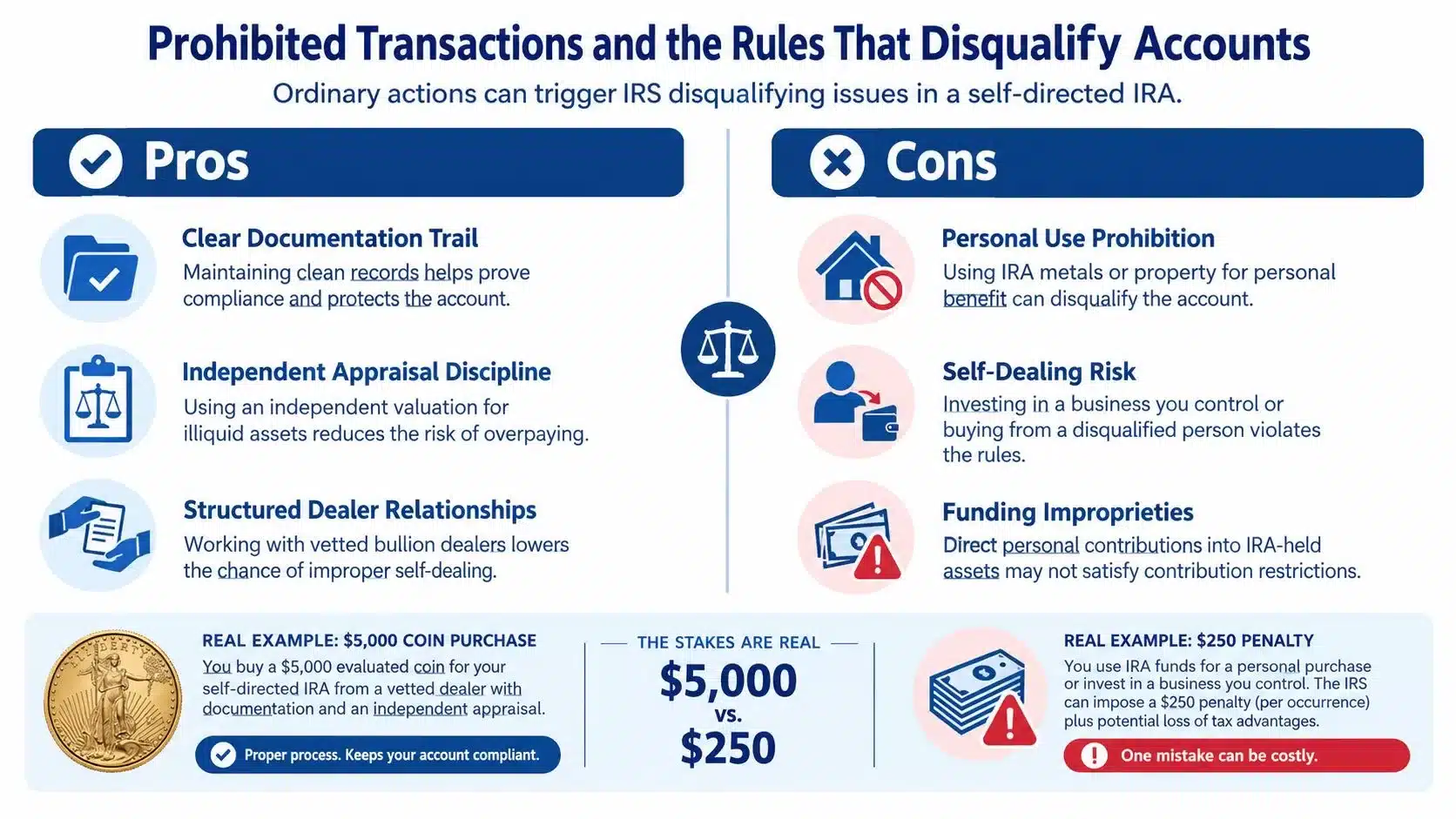
If a prohibited transaction occurs, the account can cease to qualify as an IRA and be treated as distributing its assets at fair market value at the beginning of that tax year, creating potentially large tax consequences and, for some distributions, an additional 10% early-withdrawal penalty (IRS Publication 590-A). Treat that consequence as a serious account-level risk, not a minor paperwork error.
Real-life mistakes that trigger trouble
The prohibited-transaction rules apply to ordinary decisions involving use, ownership, financing, and family relationships:
- Buying property for personal use: IRA funds cannot buy property for the owner's present or future personal use. A vacation property, residence, or other personal-use asset belongs outside the IRA.
- Selling personal property to the IRA: The owner cannot transfer an asset already owned by selling it to the account. The IRA must acquire investments through a permitted transaction.
- Borrowing from the IRA or pledging it: The owner cannot borrow from the account or use IRA assets as security for a loan.
- Mixing family relationships into the deal: The rules cover transactions with disqualified persons, including a spouse, ancestor, lineal descendant, or the spouse of a lineal descendant (IRS Publication 590-A).
- Taking personal possession of IRA assets: This creates particular risk with physical metals and informal storage arrangements. Keep custody within the approved IRA structure.
A quick self-audit before any purchase
Before the custodian executes a transaction, answer these questions:
| Checkpoint | Green light | Red flag |
|---|---|---|
| Who benefits? | Only the IRA benefits | The owner or family receives current or future personal use |
| Who is on both sides? | Independent parties | The owner, spouse, parents, children, or closely tied parties |
| Who pays expenses? | The IRA pays from IRA funds | The owner pays personally or expects reimbursement |
| Who controls custody? | The custodian administers the arrangement | Personal possession or an undocumented side arrangement |
If the investment depends on personal access, family convenience, or informal control, stop before signing. Ask the custodian to review the transaction structure and required documents first.
A self-directed IRA rewards discipline. Keep personal life, family dealings, expenses, and retirement assets in separate boxes, and preserve records showing how each purchase, payment, and custody decision was handled.
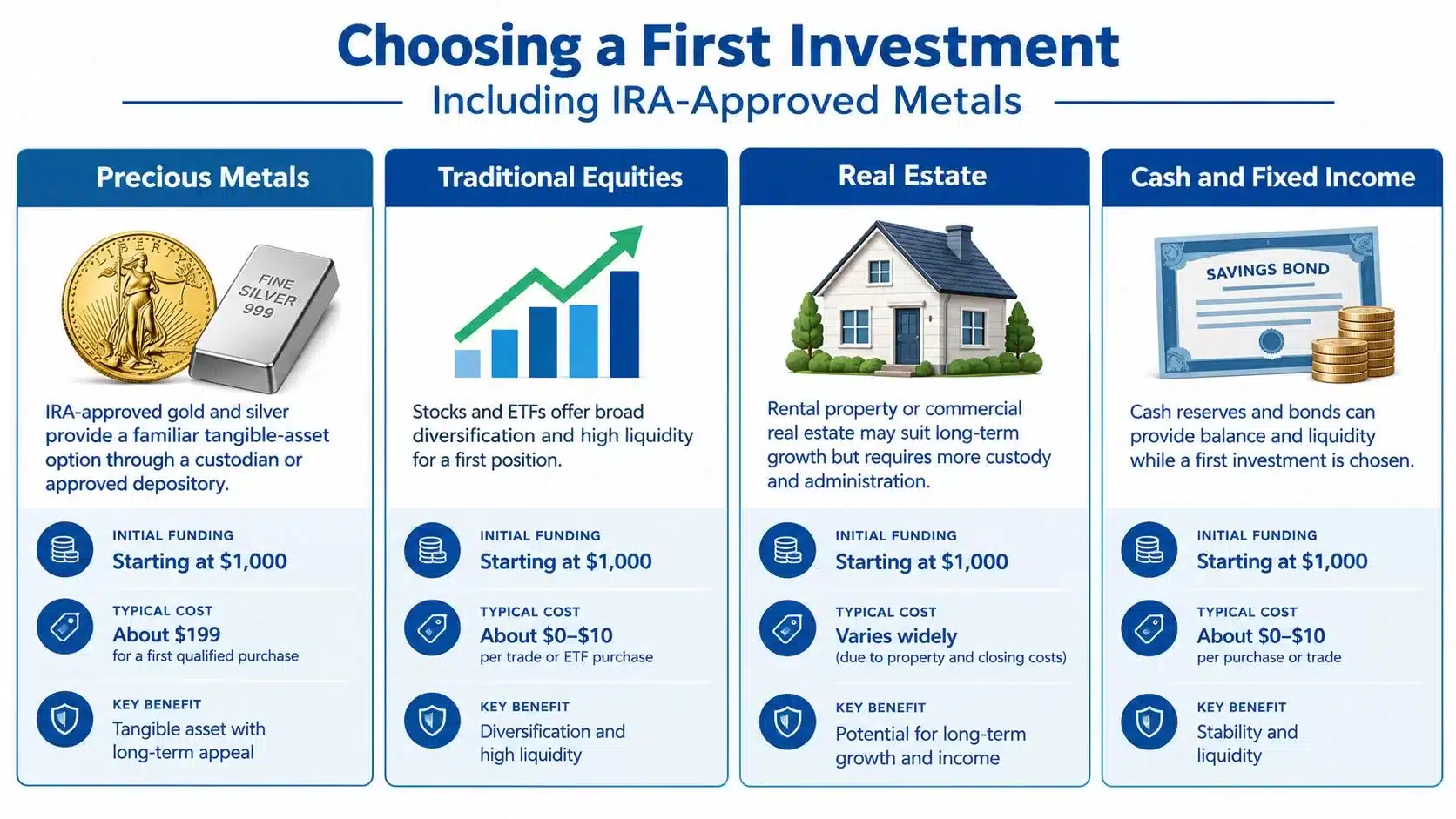
Choosing a First Investment, Including IRA-Approved Metals
Once the account is open and funded, the investor can finally make the first investment decision. For many readers, that means precious metals. Others may still be weighing real estate, private notes, or leaving some cash inside the account until they're ready.
The critical rule is ownership and custody. The IRA buys the asset through the custodian, and the asset is held for the IRA, not for the owner personally.
For metals, the IRS rule is strict. Permitted gold, silver, platinum, or palladium bullion must satisfy applicable standards and be held in the physical possession of the IRA's custodian or trustee. Personal possession by the owner or beneficiary is treated as a distribution (IRS Publication 590-B).
What that means in practice
For a metals-focused investor, “held by the custodian or trustee” usually means the custodian arranges compliant storage rather than the owner putting coins in a home safe or personal safe-deposit box. That separation is the point. Once personal possession enters the picture, the IRA wrapper can start to fall apart.
The same operational logic applies to other alternative assets. If the IRA owns real estate, the IRA should receive income and pay expenses. If the IRA owns a private note, the IRA should be the lender on paper and in practice.
Matching a first investment to a typical goal
| Reader goal | Typical starting option | Main trade-off to weigh |
|---|---|---|
| Long-term diversification with tangible assets | IRA-approved precious metals | Storage, spreads, and strict custody rules |
| Simpler first step while evaluating alternatives | Cash or fixed-income position inside the IRA | Less exposure to alternative-asset upside |
| Real-asset exposure with income potential | Real estate through a permitted structure | Higher paperwork burden and lower liquidity |
| Broader market exposure while learning the SDIRA process | Traditional equities if the custodian permits them | Less alignment with a hard-asset strategy |
Metals vs other first moves
Government-minted coins often appeal to new investors because they're easier to recognize. Bullion bars may appeal to someone focused on efficient metal exposure. Neither choice excuses sloppy storage or informal handling.
Readers drawn to gold and silver should keep one rule front and center. A self-directed IRA can hold metals, but it can't become a personal vault.
Bringing It All Together and Next Steps
The right sequence is simple, and it saves trouble.
First, confirm the account type that fits the investor's tax situation. Second, choose a custodian that supports the intended asset and explains fees, titling, and reporting clearly. Third, fund the account through the cleanest available method, which is often direct movement between institutions rather than money passing through the owner's hands. Fourth, and only then, direct the custodian to purchase an eligible asset.
Three mistakes keep showing up in failed openings. Investors try to roll over money that shouldn't be rolled over. They accept distributions personally when a direct move was available. Or they assume “approved metals” means they can store those assets themselves.
That's the wrong way to think about a self-directed IRA. The account only works when administration, custody, paperwork, and investment execution stay separated. This is not financial advice. Consult a licensed financial advisor, CPA, or tax professional before making investment decisions.
Gold IRA Association publishes plain-English guides, rollover education, and provider research for readers trying to make sense of self-directed precious-metals IRAs without the usual sales fog. If this article helped clarify how to open the account without tripping a tax rule, the next practical step is to visit Gold IRA Association and compare the educational resources on custodians, rollovers, fees, and IRA-approved metals.