



A reader may have an old 401(k), a traditional IRA, or both, and may be considering physical gold or silver for retirement diversification. The difficult part is not moving the money. A compliant self-directed IRA rollover also requires clear decisions about the custodian, the metals dealer, storage, fees, valuation, and prohibited transactions. This guide explains how the funds move and who remains responsible after they arrive.
Understanding the Self-Directed IRA Rollover
A self-directed IRA rollover moves eligible retirement assets into an IRA whose custodian supports a broader investment menu. The phrase self-directed doesn't describe a separate rollover tax category. The rollover still follows the ordinary rules for moving assets from an employer-sponsored plan or another IRA, while the receiving account may support alternatives that a conventional brokerage account doesn't offer.
The Congressional Research Service describes three principal rollover methods: direct transfers, trustee-to-trustee transfers, and 60-day rollovers. Direct and trustee-to-trustee methods generally move funds between custodians without the account owner taking possession. A 60-day rollover gives the owner the funds, who must redeposit them into another eligible retirement account within the required period. The CRS explanation of rollover methods and self-directed IRAs provides the underlying framework.
A conventional IRA provider may limit choices to publicly traded stocks, bonds, and mutual funds. A specialized self-directed custodian can support a wider range of permitted alternatives, including physical precious metals, subject to tax rules, custodial requirements, and prohibited-transaction restrictions. That broader authority creates flexibility, but it also gives the investor more responsibility for understanding what the IRA owns and how the asset is handled.
What the new account actually does
The account owner chooses the investment. The custodian holds legal title, processes instructions, maintains records, and handles required reporting. A metals dealer sells or buys the product, while an approved storage provider holds physical metals when the account structure requires third-party custody.
A custodian's willingness to accept an asset doesn't mean the custodian has verified its price, quality, liquidity, or investment merits. Readers comparing account structures can also review this guide to what a self-directed IRA is before requesting transfer paperwork.
The same principle applies beyond precious metals. Anyone researching alternative retirement assets may benefit from this practical resource on understanding alternative investment funds. The key distinction is simple: the rollover preserves the retirement account structure, while the self-directed custodian expands the investments the account may consider.
Direct Versus Indirect Rollover Methods
The safest way to fund a new self-directed IRA is generally a trustee-to-trustee transfer or direct rollover. The existing plan sends the money to the receiving custodian, so the account owner never takes possession. That reduces the chance of a missed deadline, incomplete deposit, or avoidable withholding problem.
An indirect 60-day rollover works differently. The retirement plan pays the distribution to the participant, and the participant must deposit the full eligible amount into another retirement account within 60 days. If the deadline is missed, the amount generally becomes a taxable distribution and may also face the 10% additional tax for an individual below age 59½. IRS guidance on rollovers and distributions explains the deadline and possible relief procedures.
The withholding rule creates another common trap. When an eligible employer-plan distribution is paid to the participant, the payer generally withholds 20% of the taxable amount for federal income tax. To roll over the entire original distribution, the participant generally must replace the withheld amount with other funds and deposit the full eligible amount within 60 days. A direct rollover avoids that mandatory withholding. IRS Form 1099-R instructions describe how direct rollovers are reported.
| Feature | Direct Trustee-to-Trustee | Indirect 60-Day Rollover |
|---|---|---|
| Who receives the money | The receiving custodian | The account owner |
| Deadline risk | No participant redeposit deadline | Full eligible amount generally must arrive within 60 days |
| Employer-plan withholding | Avoids mandatory 20% withholding | Generally subject to 20% withholding when paid to the participant |
| Main operational concern | Correct custodian and transfer paperwork | Replacing withheld funds and meeting the deadline |
| Best practical use | Default method for reducing execution risk | A method requiring careful timing and documentation |
Practical rule: If the funds can move directly between trustees, participant possession usually adds risk without adding a meaningful benefit.
The IRS may waive the 60-day requirement in qualifying circumstances beyond the taxpayer's control. Relief can involve an automatic waiver where applicable, self-certification, or a private letter ruling, but an intended rollover isn't automatically excused because the investor meant to complete it. The difference between a direct transfer and a rollover can help clarify which process applies before paperwork is submitted.
Executing the Transfer Paperwork
A compliant transfer starts before any precious metals are selected. The receiving custodian must confirm that it accepts the intended assets and can administer the account structure. The existing plan or IRA trustee must also permit the requested distribution or transfer.
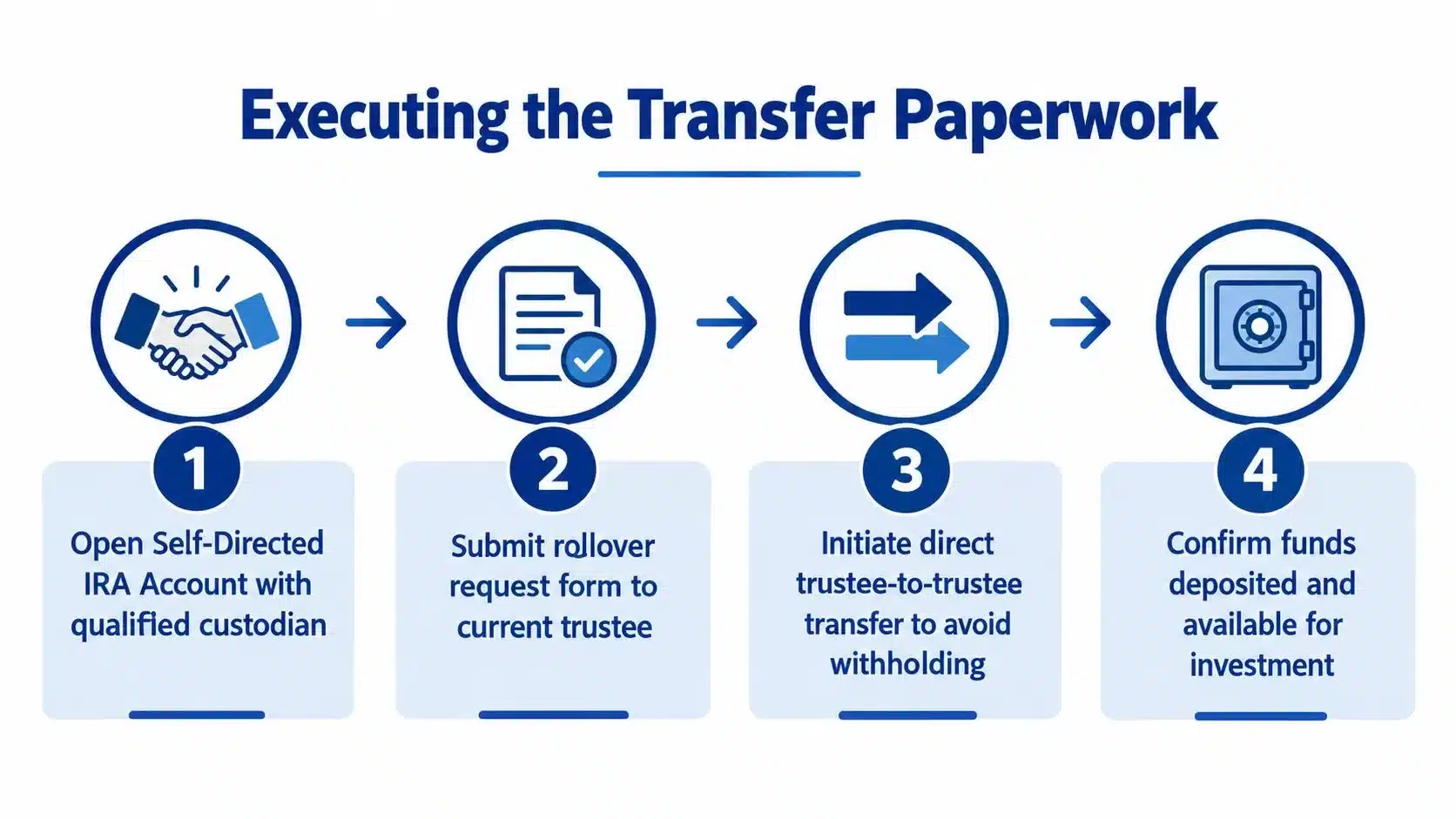
A workable sequence
Confirm the asset menu. Ask the receiving custodian, in writing, whether the account can hold the intended precious metals and whether the metals must be stored with a designated depository.
Open and title the IRA. Complete the application, select the appropriate account type, and review the custodial agreement. The IRA, not the individual, must be the named owner of the retirement assets.
Request the transfer. Submit the receiving custodian's transfer or rollover form to the existing trustee. For an employer plan, confirm whether the plan requires its own distribution request or authorization form.
Use direct instructions. Tell the existing trustee to send the funds directly to the new trustee. The check or wire should follow the receiving custodian's exact titling and delivery instructions.
Verify payment details independently. A participant should call the custodian using contact information obtained from an independently verified statement or official record. A phone number or wiring instruction arriving in an unexpected email deserves separate confirmation.
Reconcile the records. Compare the outgoing statement with the incoming statement. Confirm the amount, account title, transaction date, and any pending balance before directing a metals purchase.
The custodian's acceptance confirmation should come before the transfer request, not after it. If the intended asset, storage arrangement, or purchase process isn't supported, the money may arrive in an account that can't execute the investor's plan.
A short process video can reinforce the order of these administrative steps:
Keep copies of account statements, signed forms, delivery confirmations, purchase invoices, valuation documents, and tax forms. The IRS generally reports a direct rollover on Form 1099-R, with zero taxable income generally shown for the rolled-over amount, but the taxpayer still reports the distribution and rollover on the federal return.
Mapping Post-Rollover Responsibilities
The transfer is only the beginning of the control process. Once the funds reach the new IRA, several parties handle different parts of the transaction, and confusion about those roles can leave the investor exposed.
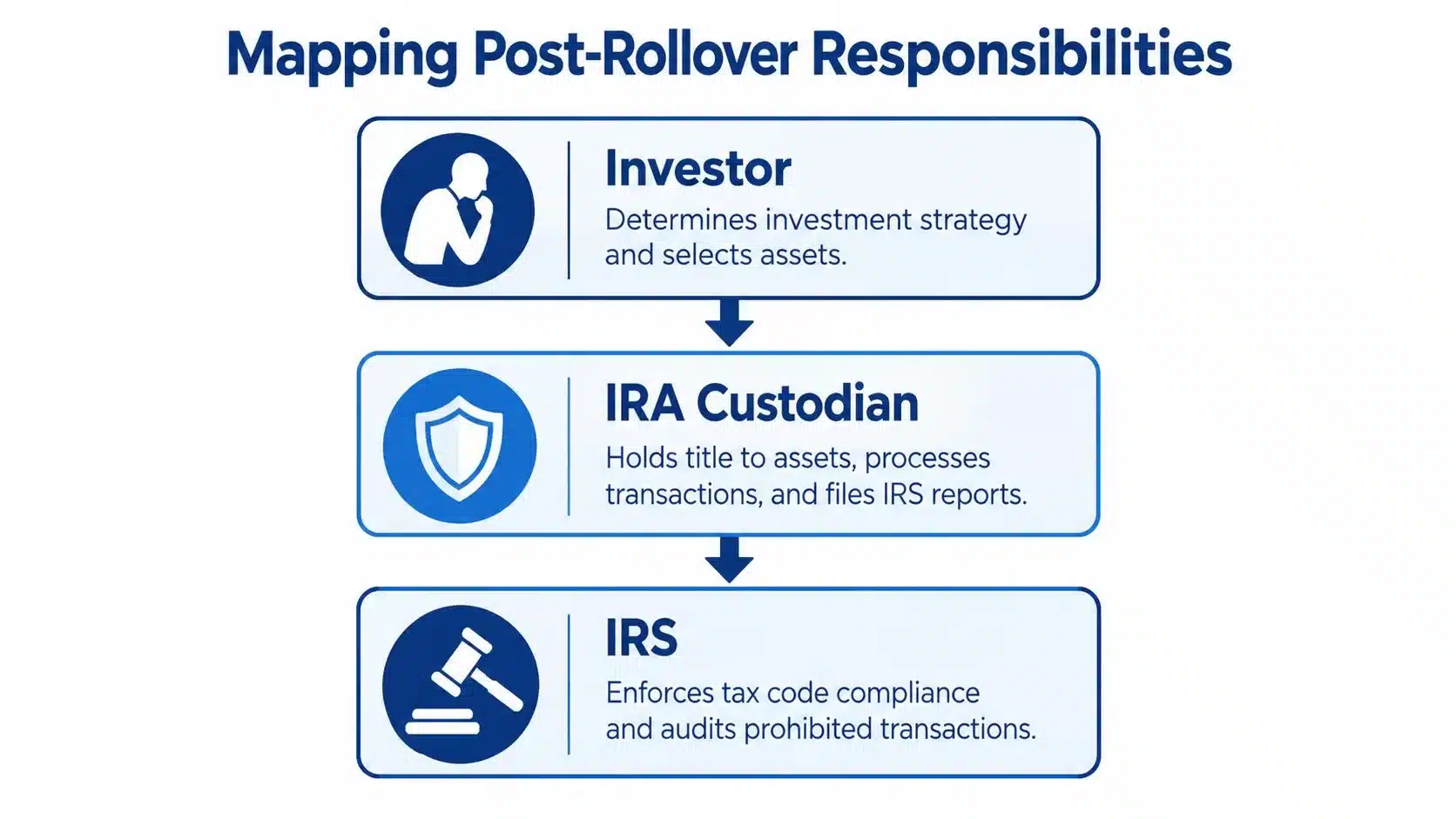
The investor chooses and monitors
The account owner decides whether precious metals fit the retirement strategy, evaluates the product and dealer, reviews pricing, and considers liquidity. The investor also needs to screen for personal use, related-party involvement, ownership problems, valuation uncertainty, and storage arrangements.
A written asset checklist should ask:
- Ownership: Is the IRA clearly the buyer and legal owner?
- Valuation: How will the asset's value be established and documented?
- Liquidity: How can the asset be sold or distributed when cash is needed?
- Custody: Where will the physical metal be held?
- Related parties: Does the transaction involve the owner, family members, or controlled entities?
- Personal benefit: Could the owner use, pledge, borrow against, or otherwise personally benefit from the asset?
The other parties have narrower roles
The custodian administers the IRA, processes authorized transactions, holds title or arranges custody, maintains records, and files required reports. It generally doesn't independently verify whether an investment is legitimate, fairly priced, or suitable. The SEC warns that self-directed custodians typically provide administration and custody rather than investment-quality verification, leaving investors exposed to fraud, high fees, and volatile performance. The SEC investor alert on self-directed IRAs explains this distinction.
The metals dealer handles the sale, product description, pricing, and any later buyback terms. The storage provider handles possession, security, inventory records, and related storage arrangements. Those responsibilities shouldn't be blended together in the investor's mind.
A custodian's acceptance of a metal confirms administrative compatibility. It doesn't certify the dealer's price or the asset's investment quality.
A prohibited transaction can cause the IRA assets to be treated as distributed on the first day of that tax year, potentially creating taxable income and early-distribution consequences. The owner therefore remains responsible for preventing personal use and related-party transactions, even when a custodian processes the paperwork.
Evaluating Total Costs and Exit Scenarios
A low annual custody fee doesn't establish that an IRA is inexpensive. The full cost can include account setup, annual administration, storage, insurance, purchase or sale charges, shipping, dealer markups, bid-ask spreads, transfer fees, and account-closing charges.
The cost structure matters most when the account needs to change direction. An investor might need cash for a distribution, want to move to a different custodian, or discover that the asset is harder to sell than expected. Continuing management or storage fees can remain payable even when little remains to manage, and an account may impose a closing charge after an investment becomes impaired or worthless. SEC material on self-directed IRA fees and exit concerns highlights why investors should review continuing and closing costs.
Build an all-in cost worksheet
Before transferring funds, request a written schedule that separates account-level costs from dealer costs. The worksheet should identify:
- Custody charges: Annual administration, transaction processing, and transfer fees.
- Storage charges: Depository, insurance, and related physical custody expenses.
- Purchase economics: Dealer markup, product spread, shipping, and other acquisition costs.
- Liquidation economics: Buyback spread, shipping, assay or handling charges, and the price basis used for a sale.
- Exit costs: Account transfer, closure, and final statement charges.
A fixed annual fee takes a larger share of a smaller balance than a larger one. That makes balance-sensitive analysis more useful than comparing one advertised fee in isolation. The investor should model a normal holding period and a forced-liquidity scenario, then ask whether the account remains workable if metals must be sold at an inconvenient time.
The self-directed IRA fees guide can help organize the questions, but provider disclosures should control the final comparison. A fee that looks modest at setup may not be modest after dealer spreads, storage, liquidation, and account-closing costs are included.
Maintaining Compliance and Avoiding Pitfalls
Ongoing compliance depends on ordinary account discipline. The investor should preserve statements, invoices, valuations, storage records, distribution documents, and correspondence with the custodian. Physical metals should remain in the required custody arrangement rather than being stored for personal access.
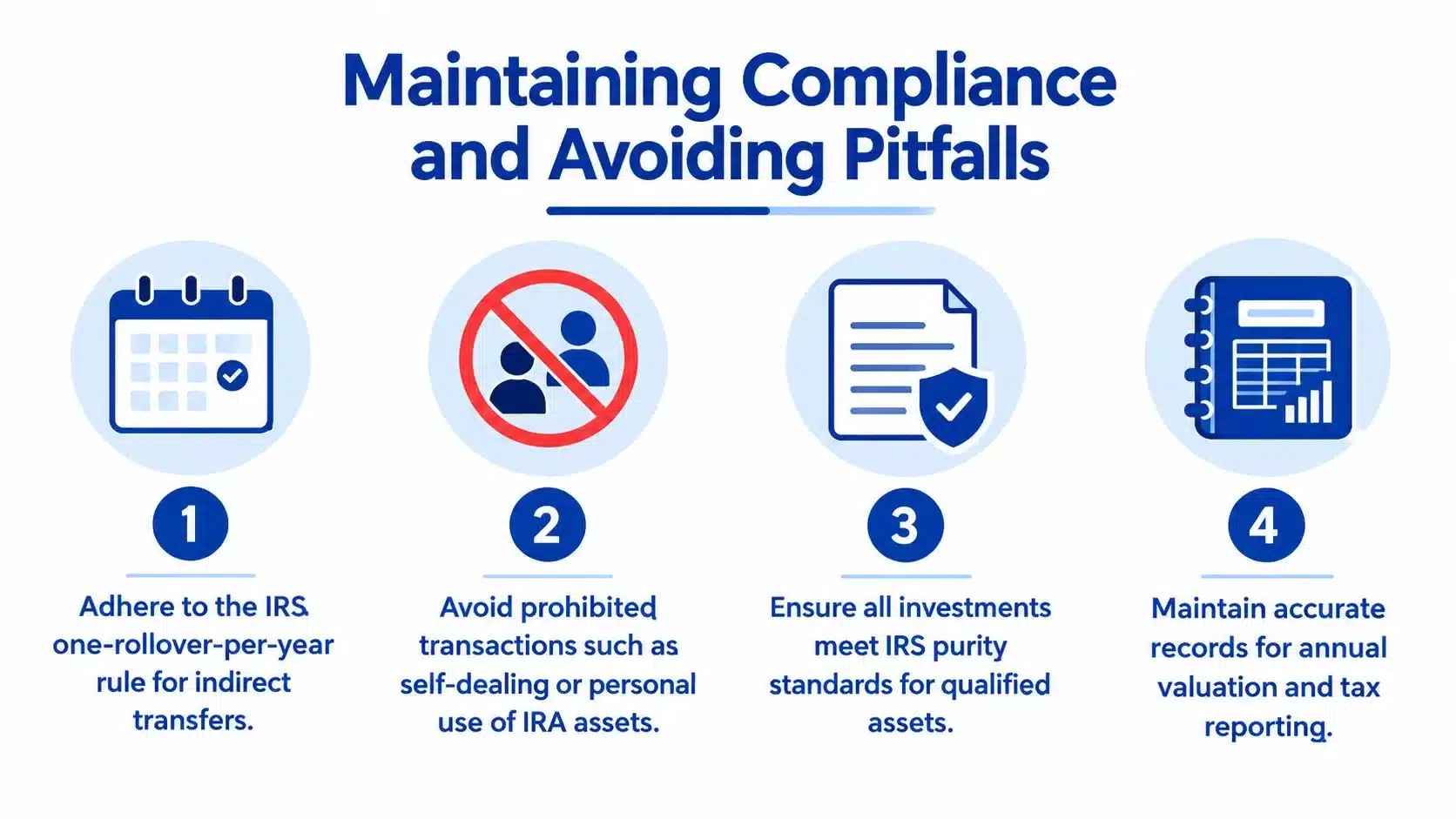
Rules worth checking before every transaction
Indirect rollover frequency: The IRS limits indirect IRA-to-IRA rollovers to one during any 12-month period, regardless of how many traditional or Roth IRAs the owner holds. The limitation applies to the rollover transaction, not to direct trustee-to-trustee transfers or direct rollovers. IRS guidance on the one-rollover-per-year rule explains the distinction.
Eligible metals: Physical gold, silver, platinum, and palladium must satisfy applicable IRS fineness and product requirements. The custodian and tax professional should confirm eligibility before purchase, because an attractive product isn't automatically an IRA-qualified asset.
Prohibited transactions: The owner must not use IRA assets for personal benefit, pledge them as loan collateral, borrow from the account, or arrange purchases for personal use. Related-party involvement requires especially careful review.
Valuation and reporting: Alternative assets need supportable annual values. Keep records that allow the custodian and tax professional to understand what the IRA owns and how the reported value was determined.
Plan for distributions before buying
Traditional self-directed IRAs eventually require distributions under the applicable rules. Physical metals may be distributed in kind, or the account may sell some holdings and distribute cash. An in-kind distribution transfers the asset out of the IRA, and its fair market value counts as the distribution. Illiquid holdings can make either approach more difficult, so liquidity planning belongs in the initial investment decision.
A direct rollover is usually the cleanest starting point, but compliance doesn't end when the funds arrive. This is not financial advice. Consult a licensed financial advisor, CPA, or tax professional before making investment decisions.
Gold IRA Association offers educational guides on precious-metals IRA structures, rollover paperwork, eligible assets, provider comparisons, and fee questions. Readers can use the Gold IRA Association resource library to prepare a document checklist and evaluate their next step without treating general information as personalized tax or investment advice.