



Silver's volatility is roughly twice gold's, so a retirement portfolio generally needs a smaller silver position to take on a comparable level of risk. Gold offers deeper liquidity and greater stability, while silver provides more industrial exposure and upside potential, but with a greater chance of sharp drawdowns.
A 58-year-old investor sits at a kitchen table with a portfolio statement, a laptop, and an uncomfortable question. Stocks and bonds already provide the core of the retirement plan, cash covers near-term needs, but would adding physical precious metals improve diversification or just add another source of cost and volatility?
The answer isn't as simple as choosing the metal with the lower price. A sound silver or gold investment decision depends on liquidity, risk tolerance, demand drivers, custody requirements, and the number of years before withdrawals begin. The comparison matters most when retirement is close, because recovering from a large loss becomes harder once portfolio withdrawals start.
Why the Silver and Gold Choice Matters Now
Inflation concerns, market volatility, and uncertainty about the purchasing power of the dollar can make precious metals seem urgent. That urgency can lead investors to focus on recent price movements instead of asking a more useful question: What role should this asset play in the retirement plan?
A pre-retiree who prioritizes capital preservation usually needs a different allocation from an investor with a long horizon and a high tolerance for price swings. Gold generally fits the first objective better. Silver can have a place for investors who accept a more cyclical holding, but treating it as a cheaper substitute for gold is a mistake.

The decision is about risk, not just price
Gold and silver behave differently because buyers use them differently. Gold has a broad investment, jewelry, and official-sector demand base, while silver has a larger industrial component. Manufacturing activity, technology demand, and economic growth can therefore affect silver more directly.
Liquidity also matters. Gold's deeper financial-market liquidity can make it more practical when an investor needs to rebalance or raise cash. Physical resale convenience is a separate issue. A recognizable coin or bar may be saleable, but the dealer spread, product premium, shipping process, and settlement time still affect the result.
Historical performance shouldn't be treated as a promise. After the United States ended dollar convertibility into gold in 1971, the annual average gold price rose from approximately US$41.97 per troy ounce in 1971 to about US$320.98 in 1979, an increase of roughly 683.5% over eight years. The period also involved unusually high inflation, monetary instability, and major volatility, so the result demonstrates what can happen under particular conditions, not what every investor should expect. The historical figures are documented in the World Gold Council's gold demand and market history research.
A practical roadmap for near-retirees
The strongest decision process has four parts:
- Define the job: Decide whether the holding is intended to reduce portfolio concentration, preserve purchasing power, provide a cyclical opportunity, or support a legacy plan.
- Size by risk: Don't allocate the same dollar amount to silver and gold automatically. Silver's higher volatility can make an equal-dollar position much more aggressive.
- Check liquidity: Compare market liquidity with the practical ease and cost of selling physical products.
- Verify account rules: A metal that looks like bullion may not automatically qualify for an IRA, and custody arrangements matter.
Readers researching possible price scenarios can also review this gold price forecast discussion for 2026, but forecasts should remain secondary to allocation discipline. The central recommendation is straightforward: gold is usually the better core precious-metals holding for a retirement portfolio, while silver is better treated as a smaller satellite position.
Comparing Gold and Silver as Investment Assets
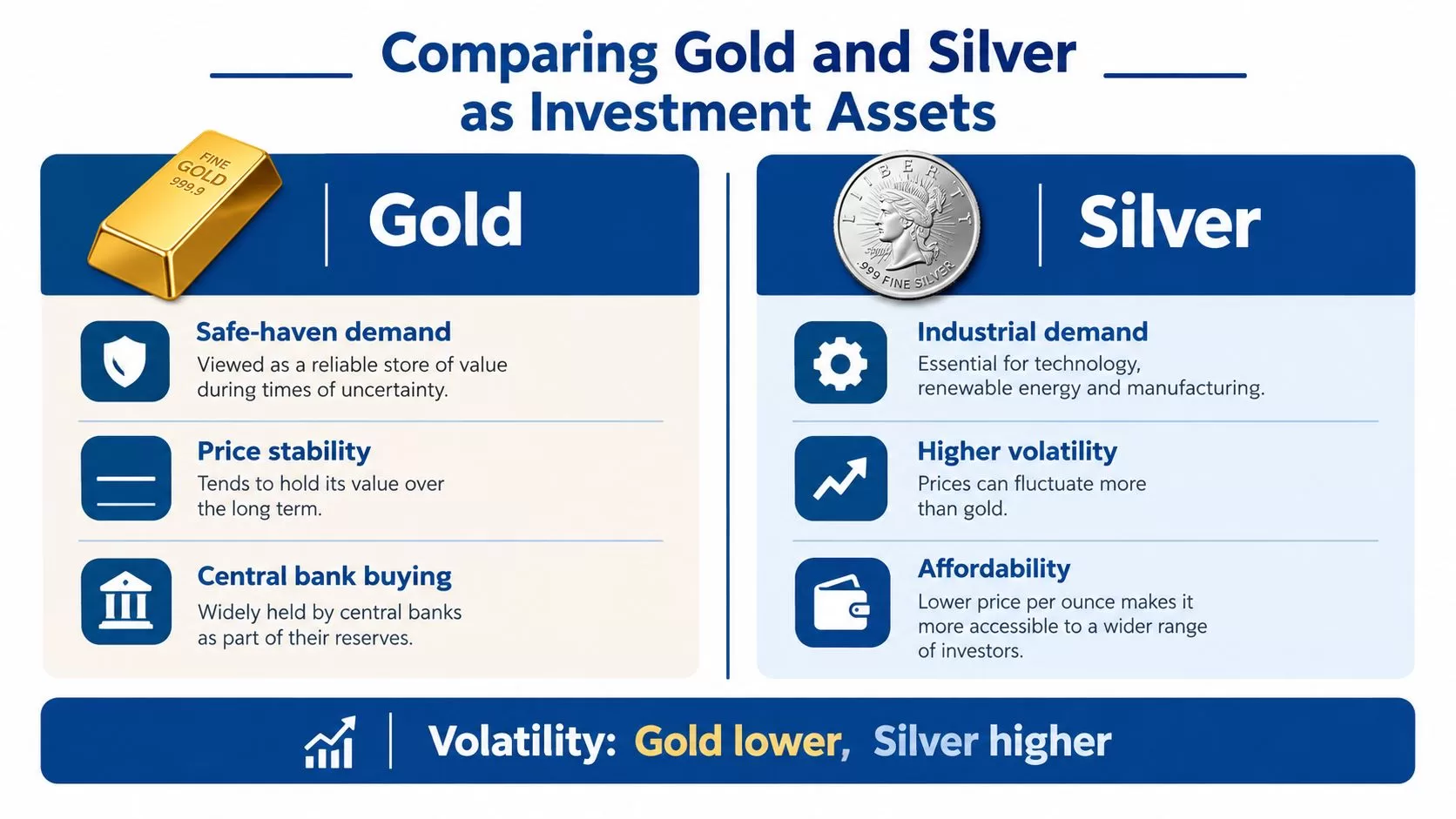
Gold and silver aren't interchangeable commodities. Gold is typically used as a defensive allocation because its demand base is more diversified and its market is more liquid. Silver combines monetary and industrial characteristics, which can create greater upside during strong manufacturing cycles and greater downside when economic activity weakens.
The World Gold Council reports that silver's volatility is roughly twice that of gold, while the average bid-ask spread is about 9 basis points for silver versus 2 basis points for gold. Those differences are important for retirees. A silver position can consume more risk budget and cost more to trade, even when the dollar value appears identical.
Gold has the stronger defensive profile
Gold's demand comes from several sources, including investment, jewelry, and official-sector activity. That breadth can reduce dependence on one economic cycle. Gold also tends to be easier to trade in large value amounts because a relatively compact physical holding can represent substantial capital.
Silver's lower unit price can make it feel more accessible, but affordability doesn't equal suitability. A retiree may be able to buy more ounces of silver, yet the larger physical volume, wider spread, and higher price fluctuation can complicate storage and rebalancing.
| Characteristic | Gold | Silver |
|---|---|---|
| Primary portfolio role | Defensive diversifier and potential store of value | Higher-volatility satellite allocation |
| Volatility | Lower relative volatility | Roughly twice gold's volatility, according to the World Gold Council comparison |
| Liquidity | Deeper financial-market liquidity | Less liquid, with a wider average bid-ask spread |
| Demand structure | Investment, jewelry, and official-sector demand | Industrial, investment, jewelry, and technology-related demand |
| Retirement suitability | Generally better suited as the core metals exposure | Better suited to a smaller position for investors who accept larger swings |
| Main risk | Long periods of weak performance and no income generation | Higher drawdown risk and stronger sensitivity to economic cycles |
Why equal-dollar comparisons mislead
Suppose two portfolios each place the same dollar amount into one metal. The comparison may look balanced, but the risk contribution won't necessarily be balanced. Since silver has historically been more volatile, that equal-dollar silver position can have a larger effect on total portfolio fluctuations.
A better framework compares three possible allocation methods:
- Equal dollars: The same amount goes into each metal. This is simple but may overweight silver's risk.
- Equal risk contribution: The silver position is reduced until its expected contribution to portfolio volatility is closer to gold's.
- Withdrawal-focused sizing: The investor gives priority to assets that can be liquidated with less disruption during retirement withdrawals.
Historical volatility isn't a guarantee of future volatility, but it remains useful for position sizing. For many pre-retirees, the practical conclusion is clear: a smaller silver allocation may provide meaningful exposure without allowing it to dominate the portfolio's drawdown behavior.
Investors considering physical products should also distinguish bullion from collectible or speculative merchandise. Dealer pressure, unrealistic return claims, unusual storage arrangements, and demands for immediate decisions are among the warning signs of metals fraud worth understanding before funds change hands. Readers focused specifically on physical silver can review the considerations in this guide to silver coins as an investment.
How Gold Can Improve Portfolio Risk-Adjusted Returns
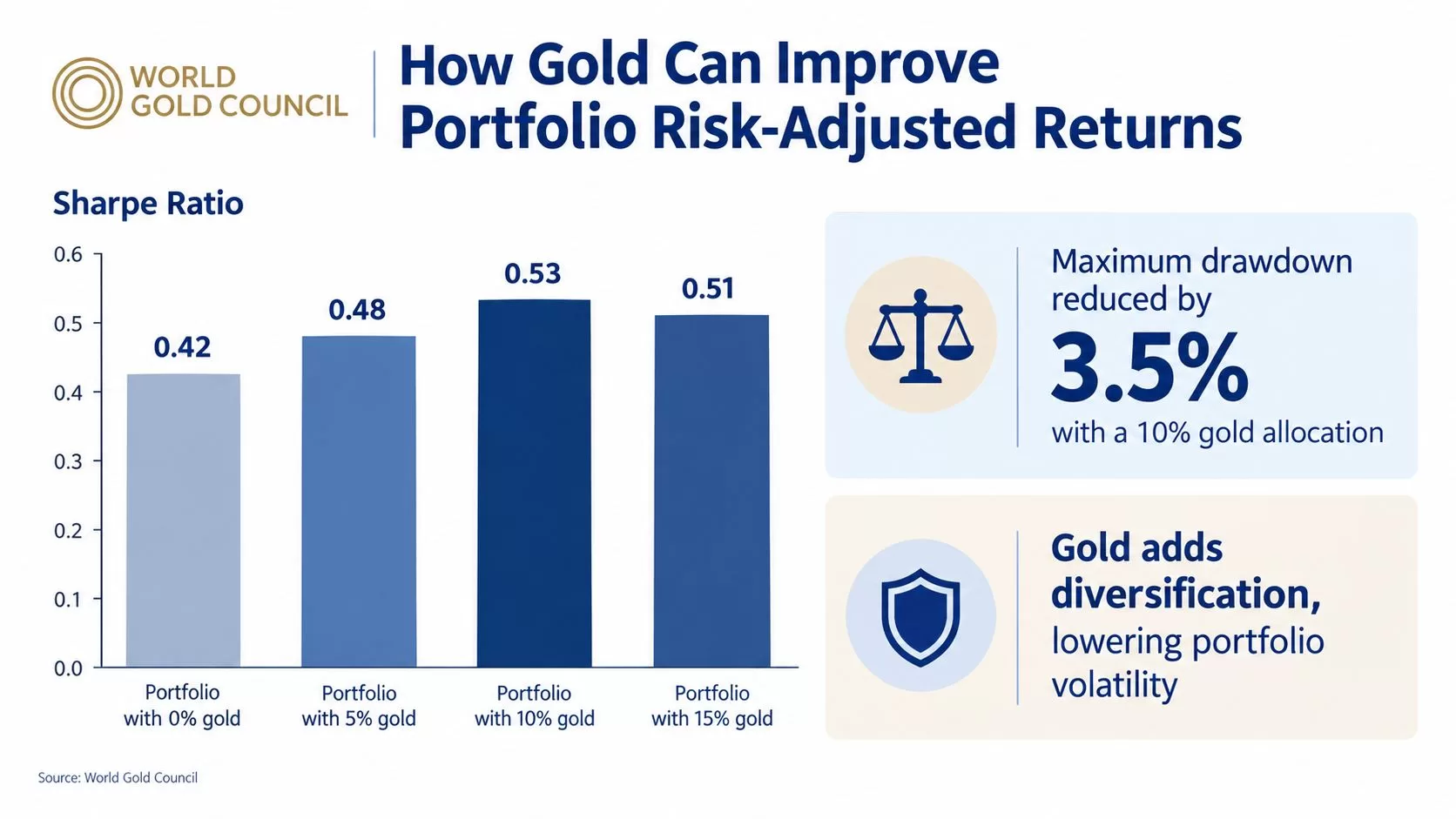
Gold's strongest argument isn't that it should replace stocks or bonds. It is that a measured allocation can improve the balance between return and risk in a diversified portfolio.
A World Gold Council hypothetical average U.S.-dollar portfolio illustrates this point. Over 20 years, adding 5% gold raised annualized returns from 6.7% to 7.0%, reduced annualized volatility from 9.9% to 9.6%, and reduced maximum drawdown from 34.9% to 32.7%. Over 10 years, the same comparison raised annualized returns from 8.0% to 8.4%, lowered volatility from 9.5% to 9.1%, and reduced maximum drawdown from 19.7% to 19.1%. These figures come from the World Gold Council's portfolio impact analysis.
The benefit comes from diversification
Those results are model-dependent. They don't guarantee that gold will improve every portfolio, and they don't establish that silver would create the same effect. The useful lesson is narrower: gold can contribute to a portfolio without requiring an all-or-nothing decision.
A modest allocation may help investors avoid relying entirely on one group of assets. That can matter during periods when stocks, bonds, or cash provide disappointing results for different reasons. Gold also doesn't produce interest or dividends in physical form, so its value in the portfolio must be judged against its costs and role, not against an income-producing asset in isolation.
Allocation rule: A retirement metals position should solve a portfolio problem. It shouldn't exist only because a recent price chart looks attractive.
Why risk-adjusted returns matter near retirement
Near-retirees often focus on headline returns, but drawdown control deserves equal attention. A portfolio that falls sharply just before withdrawals begin may force the investor to sell other assets at an unfavorable time or reduce spending.
Gold's lower volatility can make it more suitable for the defensive sleeve. Silver may still have a role, but its position should reflect the investor's capacity to tolerate larger changes in account value. A risk-sized silver allocation can be more rational than a dollar-sized allocation, particularly for an investor who already holds volatile equities.
The comparison with the S&P 500 should also remain disciplined. Precious metals can diversify a stock-heavy portfolio, but they aren't a replacement for productive businesses, bonds, or cash reserves. Readers evaluating that broader relationship can use this resource on gold versus the S&P 500 as part of a wider asset-allocation review.
Understanding IRA Rules for Precious Metals
A physical precious-metals IRA isn't a standard brokerage account with a decorative label. The IRS generally treats gold and other bullion as collectibles, but an exception allows certain highly refined bullion to be held in an IRA when the metal is in the physical possession of a bank or an IRS-approved nonbank trustee. The applicable IRS IRA FAQ explains why eligibility depends on both the product and the custody arrangement.
That means investors shouldn't assume that every gold or silver bar, coin, or round qualifies. Product eligibility, fineness, account structure, and approved custody must be confirmed before a purchase is made.
The account has three separate roles
A compliant arrangement normally separates responsibilities:
- The account custodian administers the IRA and handles reporting.
- The dealer or transaction provider sources the metal and executes the purchase.
- The approved storage facility or trustee holds the physical assets.
The IRA owner generally can't purchase qualifying bullion through the account and store it personally at home. Home storage can create a serious compliance problem because the IRS exception depends on possession by an eligible bank or trustee, not informal personal control.
Investors should request a written explanation of product eligibility, storage, insurance, transaction charges, and how the account values its holdings. Fees can reduce returns even when the metal price rises, and physical products can involve premiums and spreads that don't appear in a spot-price headline.
Transfers and rollovers aren't the same
A direct trustee-to-trustee transfer moves retirement assets from one trustee directly to another. The IRS distinguishes this from a rollover, and a direct transfer isn't subject to the one-year waiting period that applies between IRA-to-IRA rollovers. The rule is described in the IRS rollover guidance.
A rollover involves a distribution being paid from an IRA or employer plan. The owner generally must complete the rollover within 60 days after receiving the distribution. If the deadline is missed and no waiver applies, the amount generally loses tax-free rollover treatment and may be treated as a taxable distribution, as explained in IRS Publication 590-A.
Practical rule: Investors moving retirement money should ask whether a trustee-to-trustee transfer is available before requesting funds personally. Fewer handoffs usually mean less timing risk.
The administrative sequence should be deliberate:
- Confirm that the existing plan permits the intended transaction.
- Select a properly structured self-directed account and custodian.
- Verify that the chosen gold or silver product meets the applicable requirements.
- Arrange the transfer or rollover before placing the metal order.
- Obtain account records showing custody, valuation, and transaction details.
This is not financial advice. Consult a licensed financial advisor, CPA, or tax professional before making investment decisions.
What Drives Demand for Gold and Silver
Investment demand is the dominant consideration for gold, while silver combines investment demand with a more pronounced industrial role. That difference explains why the metals can respond differently to inflation concerns, investor sentiment, manufacturing activity, and economic slowdowns.
Gold's market reached an unprecedented scale in 2025. Total demand, including over-the-counter transactions, exceeded 5,000 metric tonnes for the first time, while the value of total demand reached approximately US$555 billion, a 45% increase from 2024. Gold-backed ETF holdings increased by 801 tonnes, bar and coin purchases reached a 12-year high, and prices established 53 new all-time highs during the year. The World Gold Council's 2025 investment data also reports fourth-quarter ETF inflows of 175 tonnes, bar and coin buying of 420 tonnes, and total quarterly demand of 1,303 tonnes.
Volume and value tell different stories
The 2025 figures show why investors must separate physical volume from market value. Rising prices can increase the dollar value of holdings and transactions even when the tonnage purchased grows more slowly. For a retirement investor, a larger account value doesn't remove the need to evaluate liquidity, storage, fees, and concentration risk.
Silver requires a different demand analysis. Industrial fabrication can benefit from technology and manufacturing activity, but it can also weaken when producers reduce output, substitute other materials, or use less metal per product. A supply deficit may support a long-term thesis, but it doesn't guarantee a higher price because recycling, existing inventories, investor positioning, and demand elasticity can influence the near-term market.
The Silver Institute projects that physical silver investment will rise 20% in 2026 to 227 million ounces, while total supply increases only 1.5%. At the same time, it expects industrial fabrication to decline modestly to about 650 million ounces and projects a 67-million-ounce market deficit for a sixth consecutive year. These are projections, not established outcomes, and they appear in the Silver Institute's 2026 market commentary.
A deficit can coexist with falling prices if investment demand fades or manufacturers adjust their usage. That's why silver's industrial story should be treated as a cyclical thesis, not automatic proof that the metal belongs in every retirement account.
Four demand buckets clarify the choice
Investors can evaluate each metal by separating demand into four categories:
- Industrial fabrication: Especially important for silver, this responds to manufacturing output, technology activity, substitution, and economic growth.
- Jewelry: A consumer demand source for both metals, influenced by purchasing power and cultural preferences.
- Physical investment: Bars and coins can respond to concerns about inflation, financial stability, and portfolio diversification.
- Exchange-traded products: ETF flows can add or remove substantial investment demand and can affect market sentiment.
Gold's first-quarter 2026 investment demand reached 536 tonnes, while the combined value of gold bars, coins, and ETFs reached US$84 billion, according to the World Gold Council's first-quarter investment research. This doesn't make gold risk-free. It does show why gold can remain strongly supported by investment activity even when industrial cycles are less favorable.
The right question isn't whether silver is “needed” by industry. It is whether the investor wants a defensive holding or exposure to a more cyclical combination of industrial and investment demand.
Which Metal Fits Your Retirement Strategy
For most near-retirees, gold is the better starting point. It generally offers lower volatility, deeper liquidity, and a broader demand base, making it more appropriate as the core precious-metals allocation. It can complement stocks, bonds, and cash without turning the retirement plan into a concentrated commodities bet.
Silver makes more sense as a smaller satellite position when the investor can tolerate larger account fluctuations and wants exposure to industrial demand. The lower purchase price doesn't make silver safer. Because its volatility is roughly twice gold's, the position may need to be smaller to keep the overall portfolio's risk within acceptable limits.
Practical recommendations by investor profile
- Capital-preservation priority: Favor gold. This investor needs a defensive diversifier and may have limited time to recover from a major drawdown.
- Higher risk tolerance and long horizon: Consider a measured silver allocation alongside gold, but size it by risk rather than ounces.
- Concern about physical logistics: Gold may be more practical because more value can fit into a smaller physical holding. Storage, insurance, and resale terms still require review.
- IRA rollover under consideration: Start with compliance and custody. The metal choice comes after confirming that the product and account structure meet applicable rules.
- Income-focused retiree: Neither physical gold nor physical silver generates interest or dividends. Precious metals should not replace the assets designated for regular spending needs.
A blended allocation can work, but the blend should have a clear purpose. Gold can serve as the portfolio's stabilizing metals exposure, while silver can provide a smaller cyclical position for investors who accept its higher volatility. Equal-dollar allocations aren't automatically balanced allocations.
Precious metals should complement, not replace, a diversified retirement plan. Investors should review withdrawal needs, emergency cash, tax circumstances, storage arrangements, and total account costs before committing retirement funds. This is not financial advice. Consult a licensed financial advisor, CPA, or tax professional before making investment decisions.
Gold IRA Association provides educational guides on gold and silver IRAs, IRS eligibility, rollover procedures, custody, fees, and provider comparisons. Readers evaluating a silver or gold investment can visit Gold IRA Association to review the relevant rules and prepare informed questions for a qualified specialist.