


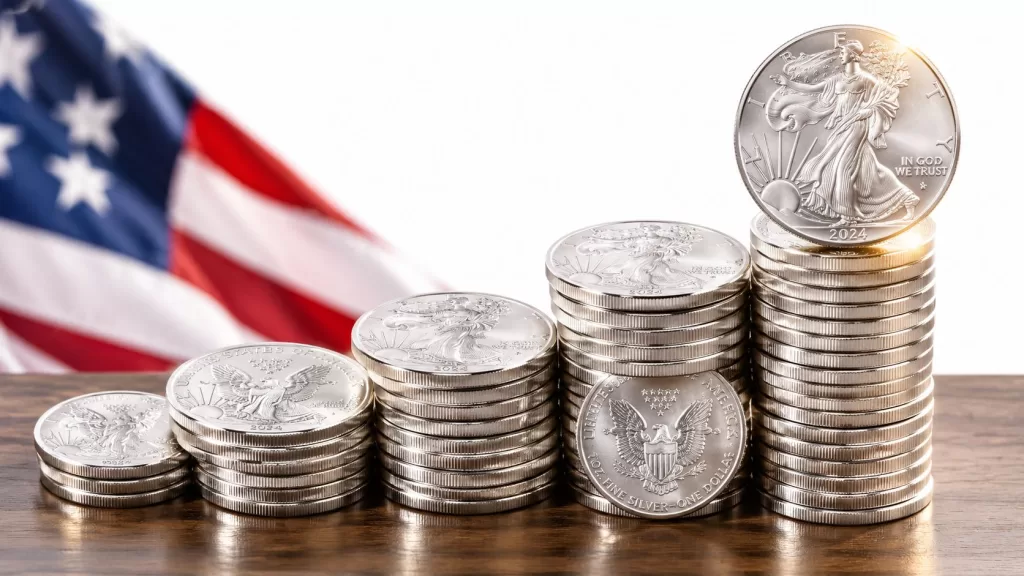
A near-retiree may want physical silver as a portfolio diversifier, yet quickly run into difficult questions. Why does one American Silver Eagle cost more than a generic silver round? Which coins qualify for an IRA? How can a buyer distinguish an authentic coin from a counterfeit, and how much of the purchase premium might be recovered at resale? Investing in American Silver Eagles can make sense for some investors, but the decision requires more than watching the silver spot price.
What to Know Before Investing in American Silver Eagles
A mature investor with a 401(k), an IRA, and cash savings may consider silver during market uncertainty. Comparing American Silver Eagles can then create a puzzle: standard bullion coins contain the same one troy ounce of silver, yet asking prices may differ widely. Premiums, product types, seller spreads, and ownership structure explain much of the gap.
American Silver Eagles combine standardized weight, U.S. government issuance, and legal-tender status. The series began on October 29, 1986. Its first-year bullion mintage reached 5,393,005 coins, while proof production reached 1,446,778. These figures help explain the series' recognition among investors and collectors, but familiarity does not make every premium reasonable. The series history and specifications are summarized here.
Practical rule: A recognizable coin may be easier to sell, but resale convenience does not prove that its purchase premium is justified.
A sound decision starts by identifying the job the silver must perform:
- Purpose: Is the purchase for silver exposure, a collectible holding, a gift, or an IRA allocation?
- Product type: Is it standard bullion, proof, burnished, or a special issue? Different versions can carry different premiums and resale audiences.
- Total cost: How much exceeds the silver value, and what dealer spread may apply when the coin is sold?
- Custody: Will the coins stay in personal possession, or will an approved retirement-account custodian hold them?
- Exit plan: Will the investor need broad dealer liquidity, or is the holding intended for long-term succession or collection?
The mintage split matters because limited or collector-focused issues can trade more like collectibles than straightforward silver exposure. A premium may be sensible when the buyer values recognition, condition, or scarcity and has a realistic resale plan. For an IRA investor seeking metal exposure, a lower-premium bar or round may leave more money invested in silver. Waiting can also be sensible if the premium appears disconnected from the underlying metal value.
Readers comparing government-issued coins with other formats may benefit from a resource discussing better value on US Mint silver. American Silver Eagles offer standardization and recognition, yet investors should assess premiums, authenticity, storage, compliance, and resale conditions before committing retirement funds.
American Silver Eagle Specifications and Purity
A standard American Silver Eagle is a one-troy-ounce coin made of .999 fine silver. It carries a $1 legal-tender face value and has been issued by the United States since 1986. It is the only U.S. silver bullion coin issued in a fixed one-troy-ounce format with that combination of legal-tender status and.999 fine silver content. The coin's specifications and launch history are documented in this series overview.
The $1 face value contributes little to an investor's expected return. Silver content and market price do the genuine work, while condition and any collector premium can affect resale. Legal-tender status still separates an Eagle from a generic round. A round may contain the same amount of silver, but it does not carry a U.S. government denomination or the same issuance framework.
Why the standard matters
A fixed one-ounce format gives buyers a familiar unit to verify, compare, and price. Dealers and custodians can identify it quickly. Bars may be just as easy to value, but their issuer, markings, packaging, and resale channels can influence how buyers assess them.
Purity adds another comparison point. Many silver products use a.999 standard, yet an American Silver Eagle also has a defined government-issued structure that may matter for retirement-account compliance. That recognition can reduce uncertainty, but it does not automatically justify paying a higher premium. Mintage splits, proof versions, and special issues may trade partly as collectibles, so their premium should be judged separately from the value of their silver.
For a focused explanation of physical content, see this American Silver Eagle weight guide. Evaluate a standard bullion Eagle mainly as a silver holding. Assess proof and special issues as products with added collector risk.
Premiums, Pricing Drivers, and Market Realities
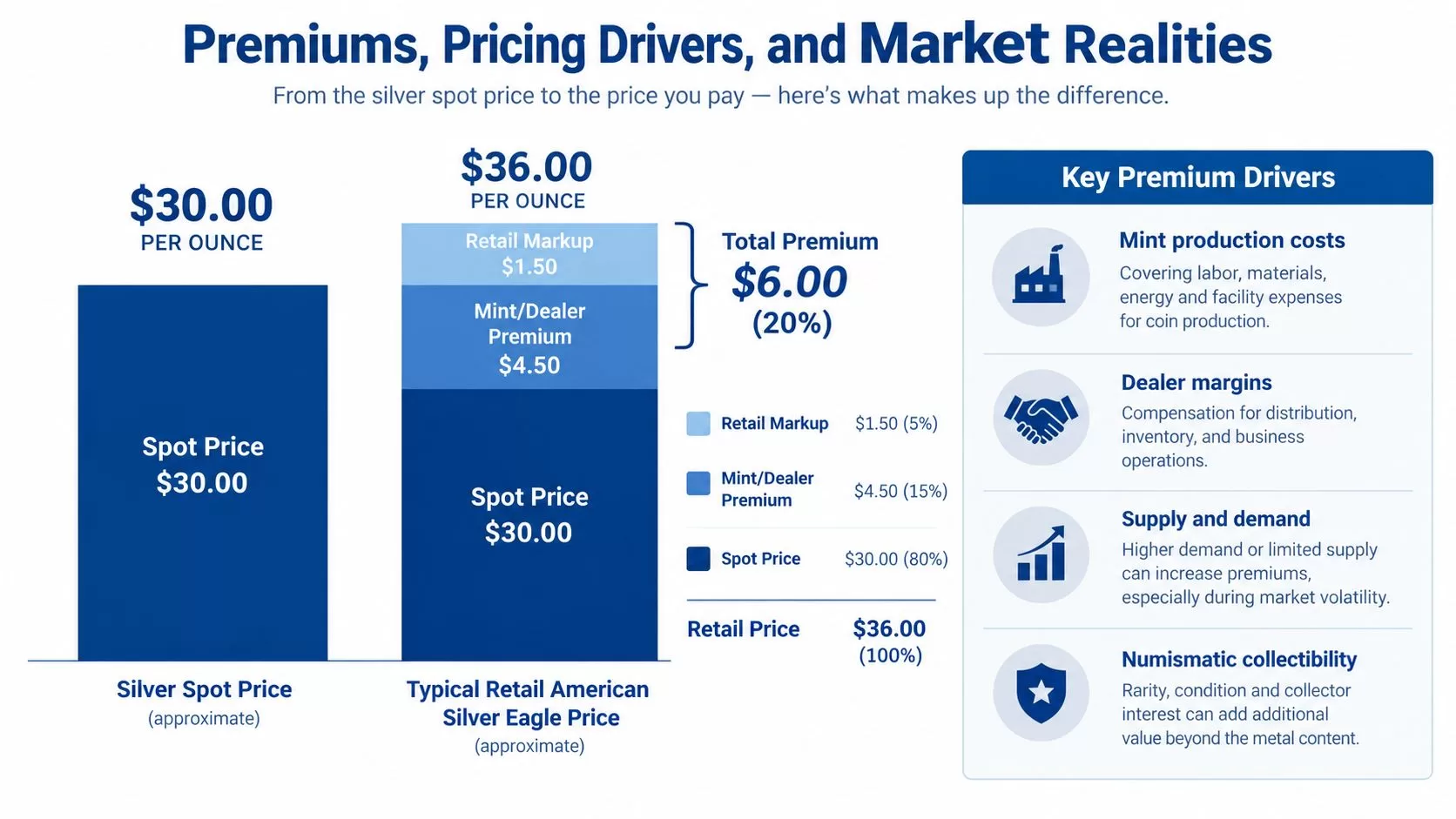
An American Silver Eagle can cost more than its silver content suggests. The purchase price has two broad components: the underlying silver value, usually described through the spot price, and a premium for minting, distribution, dealer operations, demand, product recognition, and sometimes collectibility.
Recent market data placed standard Eagles roughly 15% to 25% above spot in mid-2026, with single-coin retail premiums around $88 to $92 per ounce when silver was about $73.35. That premium context and sales discussion are provided in this market review. The spread changes with the seller, order size, available supply, and timing. Treat any quoted premium as a condition of that transaction, not as a permanent feature of the coin.
Why premiums can stay high
A weaker demand period does not guarantee an immediate price adjustment. Dealers may still be working through inventory purchased at earlier costs, while production and distribution constraints can limit supply. Lower sales totals therefore do not automatically bring retail prices close to spot.
The demand record helps explain why Eagles remain a major U.S. bullion benchmark. Cumulative U.S. Mint sales have exceeded 679 million one-ounce coins since 1986, and annual issuance reached a record 47.0 million in 2015. During the 2008 financial crisis, sales rose from about 9.9 million in 2007 to 19.6 million in 2008, then stayed above 33 million for six consecutive years. The U.S. Mint sales history and annual figures are compiled here.
That history supports recognition, but recognition and price efficiency are different benefits. A familiar coin may attract many potential buyers, yet each buyer still compares the purchase price with the dealer's later offer. The premium is an entry fee. Silver must rise enough to cover it unless a collectible or scarcity premium supports the resale value.
When alternatives may be more practical
Bars and generic rounds may suit investors whose main objective is silver quantity rather than government issuance or broad coin recognition. Their lower premium can leave more of the purchase tied to metal value, although issuer reputation, resale preferences, and IRA eligibility still require review.
For an IRA focused on silver weight, compare an Eagle with a comparable one-ounce bar or round before buying. If the Eagle premium exceeds $8 to $10 over that alternative, the bar or round is generally the more efficient choice. Paying the extra amount can make sense when government recognition may support resale liquidity or when the Eagle offers simpler IRA administration. Confirm the custodian's rules before relying on that assumption.
- Standard bullion Eagles: Suitable when recognition, one-ounce standardization, and resale familiarity justify the added cost.
- Generic rounds: Useful when silver content and a lower entry premium take priority.
- Bars: Practical for larger allocations when storage, resale, and retirement-account requirements are confirmed.
- Proof or special issues: Appropriate only for buyers who understand collector pricing and do not assume limited availability guarantees appreciation.
Premium test: If the investment thesis depends only on a higher silver spot price, a collectible-style premium deserves extra caution.
How to Authenticate American Silver Eagles
A bargain American Silver Eagle from an unknown seller can become an expensive problem if the coin is counterfeit or misrepresented. Before delivery, review the seller's business practices, product description, return policy, shipping process, and willingness to provide transaction documentation. A clear remedy matters because a low price is not a saving if the coin's origin cannot be verified.
A practical inspection process
Begin by Reviewing the description. Confirm whether the coin is bullion, proof, burnished, or a special release. Those categories can have different prices and resale audiences, so a mintage or scarcity claim should match the stated product.
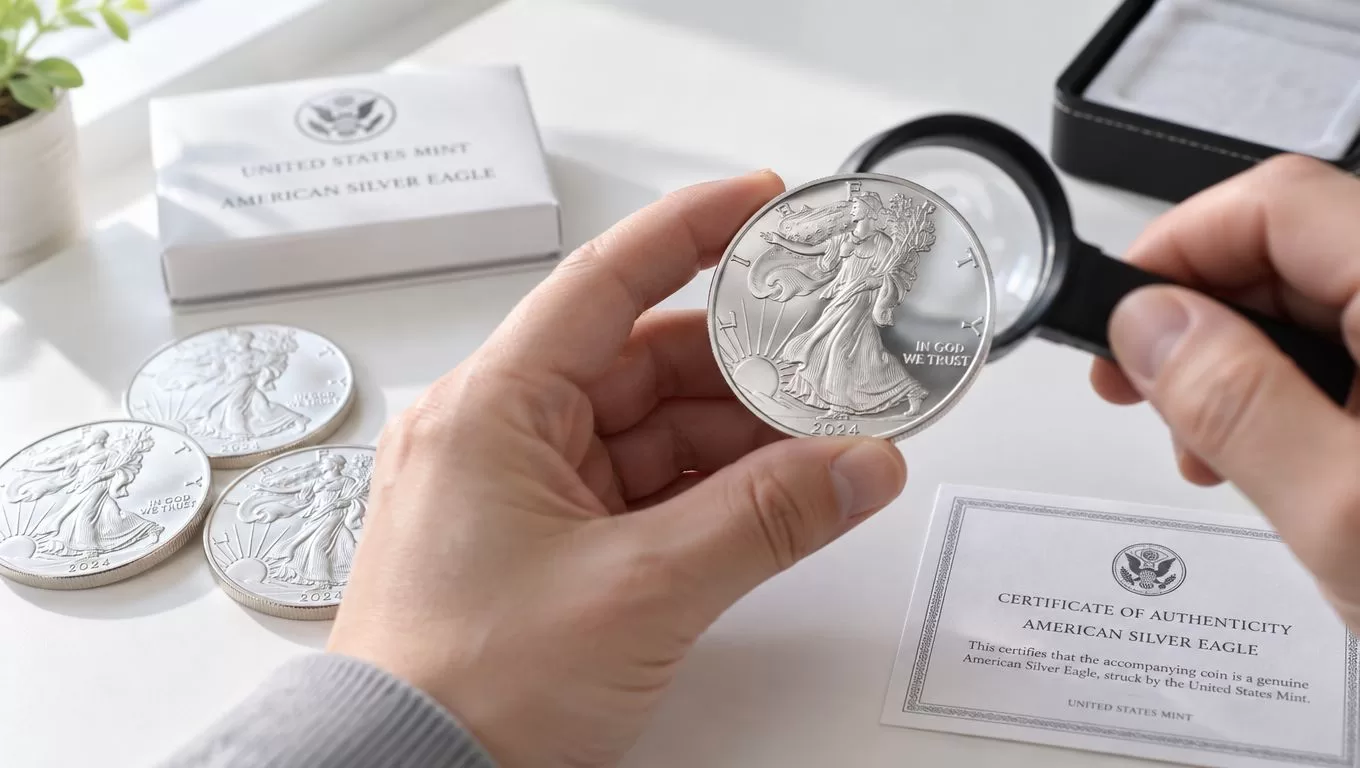
Then Inspect the design under magnification. Lettering should appear sharp, edges clean, surfaces consistent, and design details properly formed. Blurred features, uneven lettering, unusual color, or weak striking quality call for further testing.
Check the physical characteristics as a group. Compare the coin with its published specifications using a suitable scale and measuring tools. For a standard one-ounce Eagle, that comparison includes its 31.103-gram weight and 40.6-millimeter diameter, along with thickness. A counterfeit can copy one measurement while failing the combination, much like a copied key that fits one lock but not the full set.
Examine the edge as part of the same process. Newer design variants include an edge feature intended to support authentication, but it is one clue, not a substitute for weighing, measuring, and reviewing the coin's details.
For a high-value proof, unusual issue, or purchase priced around claimed scarcity, Obtain independent verification from a professional authentication or grading service. That cost may be easier to justify when the premium depends on the coin's identity or mintage rather than silver content alone. If the premium cannot be supported, waiting or choosing a bar or round may reduce risk.
Packaging and certificates can be copied. Use them as supporting evidence, never as proof by themselves.
IRA investors should confirm that the custodian accepts the exact product and that the coin enters the required account process. Personal inspection helps, while proper custody and complete documentation protect the account's compliance.
IRA Eligibility and Retirement-Account Rules
An investor choosing an American Silver Eagle for retirement savings must separate two questions: whether the coin meets IRA eligibility rules and whether the account can process the intended transaction. American Silver Eagles are explicitly recognized as IRA-eligible under IRS rules. Although many silver bullion products must meet a general.999 purity standard, a qualifying Eagle can provide a government-issued silver holding inside a self-directed precious-metals IRA. The IRA eligibility discussion is available in this silver bullion reference.
How the account structure works
A self-directed precious-metals IRA assigns different responsibilities:
- The account owner decides whether silver fits the retirement plan and risk tolerance.
- The custodian administers the IRA, processes transactions, and handles required reporting.
- The metals dealer supplies the approved product and transaction records.
- The depository receives and holds the assets through the account's approved arrangement.
The key distinction is ownership. The IRA, rather than the investor personally, owns the qualifying coins. Before funding a purchase, confirm with the custodian in writing that the exact Eagle type, such as bullion or proof, is accepted. Keep that confirmation with the invoice and account records. A coin's eligibility should be established before the transaction, not assumed from its name alone.
The Silver IRA guide explains the account concept in plain language. Use it as educational material, not as individualized financial or tax advice.
Compliance questions to resolve
Ask the custodian to document:
- Whether the exact American Silver Eagle type is eligible.
- How the purchase, valuation, and eventual distribution will be recorded.
- Which setup, administration, transaction, storage, and insurance fees apply.
- How sales and required distributions will be processed.
- Whether current IRS rules affect the proposed contribution, rollover, or distribution.
These checks also help assess the premium. An Eagle's recognizable government-issued form may justify paying more than a bar or round in some cases, but IRA eligibility alone does not make every premium sensible. If the added cost is not supported by liquidity, condition, or the investor's plan, waiting or choosing another approved format may be more prudent. Tax circumstances vary, so consult a licensed financial advisor, CPA, or tax professional before acting.
Storage, Insurance, and Safe Custody Options
Physical silver creates a custody decision that paper investments don't. Personally held coins may be accessible, but the owner must address theft, fire, damage, inventory control, and insurance. Coins held inside an IRA generally require an approved custody and storage arrangement, so personal possession isn't a substitute for depository storage.
Personal storage
A home safe may provide convenient access, but convenience brings responsibility. The investor should maintain an inventory, retain invoices and photographs, limit disclosure of the holdings, and confirm that any homeowner or standalone policy covers bullion at the required level. Coverage may have exclusions, limits, or documentation requirements.
A bank safe-deposit box offers a different trade-off. It can provide physical security, but access may be restricted, insurance treatment may differ, and the arrangement may not satisfy the custody requirements for IRA-owned metals. The account owner should confirm those details before placing retirement assets there.
Depository custody
A professional depository can centralize security, inventory records, and insurance arrangements. Investors should review whether storage is allocated or pooled, how withdrawals work, which party carries insurance, and whether the depository issues documentation that the custodian accepts.
The precious-metals storage guide provides additional background on these choices. Storage isn't merely an administrative detail. It affects access, cost, verification, succession planning, and the investor's ability to demonstrate ownership.
Storage should match ownership status. Personal silver and IRA-owned silver shouldn't be treated as interchangeable assets.
Before purchasing, the investor should request a complete fee schedule and clarify what happens if the account is closed, transferred, liquidated, or distributed. A low purchase premium can lose its advantage if storage and exit costs are poorly understood.
Tax Considerations and Resale Strategy
Resale planning should begin before the purchase. An American Silver Eagle may be widely recognized, but the seller's buyback price can still differ materially from the retail price paid. The investor needs to identify likely buyers, understand dealer spreads, preserve purchase records, and avoid assuming that a premium paid at entry will be fully recovered.
Tax treatment depends on ownership structure and personal circumstances. A taxable account, a traditional IRA, and another retirement arrangement can produce different reporting and distribution considerations. Holding period, cost basis, the form of distribution, and the investor's broader tax position may all matter. Current rules should be verified with a qualified tax professional rather than inferred from the coin's legal-tender status.
A disciplined exit framework
Start with the purpose. A bullion allocation should generally be evaluated by silver exposure, costs, liquidity, and portfolio role. A proof or special issue requires a separate collector thesis because its price may depend more heavily on mintage, finish, release limits, and buyer interest.
Track the complete cost. Keep the invoice, shipping charges, storage costs, insurance arrangements, and any transaction fees. A clear record helps the investor calculate the actual break-even point and communicate with a custodian or tax professional.
Compare the bid, not just the advertised retail price. Before selling, obtain more than one indicative bid when practical. A dealer's willingness to buy a familiar coin doesn't mean every dealer will pay the same amount for its premium.
Plan distributions carefully. IRA-owned silver may be sold inside the account or distributed according to the account rules. The timing and form of a distribution can affect taxes, so the custodian and tax professional should be involved before action is taken.
Investors seeking broader context on tax-aware portfolio decisions may review Blue Sage Tax investment insights. The useful question isn't whether American Silver Eagles are universally good or bad. It's whether the coin's recognition, compliance advantages, and possible resale liquidity justify the premium for the investor's specific purpose.
The most conservative approach is to separate bullion buying from collecting, avoid paying a scarce-issue premium without evidence of genuine scarcity, and keep enough liquidity elsewhere for near-term retirement needs. Silver can diversify a portfolio, but it doesn't eliminate market, premium, storage, tax, or timing risk.
This is not financial advice. Consult a licensed financial advisor, CPA, or tax professional before making investment decisions.
Gold IRA Association provides educational guides on silver IRAs, IRA-eligible metals, rollover mechanics, storage, fees, and provider evaluation. Readers can use the Gold IRA Association to review the relevant rules and prepare questions for a custodian, dealer, or licensed professional before investing in American Silver Eagles.