



A near-retiree moving savings into a gold or silver IRA can quickly become overwhelmed by conflicting explanations about what the IRS permits. The important question isn't only which coins or bars qualify. The bigger issue is who controls the metals, where they're stored, how retirement funds move, and what happens when a rule is missed.
This guide explains the IRS rules that govern eligibility, purity, custody, rollovers, collectibles, prohibited transactions, distributions, and correction risks. It's educational information, not financial, tax, or legal advice. Anyone considering a rollover should consult a licensed financial advisor, CPA, or tax professional.
Why IRS Rules Matter for Gold and Silver IRAs
The IRS doesn't treat a precious-metals IRA like a personal safe containing investment coins. The account is a retirement arrangement with specific rules governing eligible assets, ownership, storage, transfers, distributions, and reporting.
A retired teacher moving retirement savings into a self-directed IRA, for example, needs more than a list of attractive bullion products. She needs to know whether the metal meets the required standard, whether the transaction is a rollover or a transfer, whether a qualified custodian will hold the asset, and whether personal possession could turn the account into a taxable distribution.
Seven rule categories deserve attention:
- Statutory eligibility: The law permits only certain precious metals and forms.
- Purity: Gold, silver, platinum, and palladium must meet defined fineness standards.
- Custody: IRA-owned metals must remain with a qualified trustee or custodian.
- Storage: Physical bullion belongs in an approved depository, not a home safe.
- Rollovers: Retirement money must move under the applicable timing and transfer rules.
- Collectibles: Many coins and other collectible assets remain prohibited.
- Taxes and corrections: Improper transactions can create distributions, excise taxes, or other consequences.
The IRS's guidance on IRA contribution limits and adjustments also matters because contribution ceilings shape how savers fund and plan retirement accounts. The annual IRA limit was $1,500 in 1974 and is $7,500 in 2026, a 400% increase over the original cap, according to the IRS. The same page lists limits of $7,000 in 2024 and 2025, $6,500 in 2023, and $6,000 in 2022.
Practical rule: Treat the IRS rulebook as the controlling reference. A dealer's product list can help identify options, but it can't replace tax and custody compliance.
The Statutory Foundation of the Precious Metals IRA
Precious-metals IRA eligibility traces back to the Taxpayer Relief Act of 1997. That change opened the door for certain bullion and coins to be held inside an IRA, rather than limiting retirement accounts to more traditional paper investments.
The relevant framework is generally associated with Section 408 of the Internal Revenue Code, including the restrictions involving collectibles and precious metals. The legal permission is narrow. It doesn't mean every gold coin, silver round, or platinum product can enter a self-directed IRA.
Under current IRS guidance in Publication 590-B, permitted holdings can include:
- Certain one-, one-half-, one-quarter-, and one-tenth-ounce U.S. gold coins.
- One-ounce silver coins minted by the Treasury Department.
- Certain platinum coins.
- Certain gold, silver, palladium, and platinum bullion.
The product must satisfy more than a value test. Its metal type, purity, and permitted form all matter. A valuable coin can still be ineligible if it falls within the IRS collectible category or doesn't meet the applicable requirements.
What the statute means in plain English
A precious-metals IRA doesn't give the account owner unrestricted access to physical metals. It creates a controlled retirement-account structure in which the asset must be permitted by law and held through the required custodial arrangement.
That distinction matters because two coins can contain similar amounts of precious metal while receiving different tax treatment. The account owner should obtain the custodian's written approval before purchasing, transferring, or replacing any product. The safest process starts with eligibility confirmation, then moves to custody and funding.
Purity Standards That Define IRA-Eligible Metals
Fineness measures the proportion of precious metal in a product. For an IRA, it isn't a marketing detail. It's a threshold that helps determine whether bullion qualifies under IRS rules.
The IRS states that gold must be 99.5% pure, silver 99.9% pure, and platinum and palladium 99.95% pure in its retirement-plan investment FAQs. The same guidance explains that IRAs generally can't hold collectibles, subject to the exception for qualifying precious metals.
| Metal | Minimum Fineness | Representative Eligible Products |
|---|---|---|
| Gold | 99.5% | Certain permitted U.S. gold coins and qualifying bullion |
| Silver | 99.9% | Certain Treasury-minted silver coins and qualifying bullion |
| Platinum | 99.95% | Certain qualifying platinum coins and bullion |
| Palladium | 99.95% | Certain qualifying palladium bullion |
Examples commonly discussed in the market include American Gold Eagles, Canadian Maple Leafs, and bars produced by recognized refiners. However, a familiar name doesn't automatically establish eligibility. The exact product, form, fineness, and custodian approval still need verification. Readers can review this guide to IRA-approved gold for a broader explanation of product requirements.
Why appearance isn't enough
A coin can look like investment bullion and still be prohibited. Rare dates, collectible premiums, unusual designs, and proof versions may require closer review. The custodian's approved-product list should be treated as a screening tool, not as permission to bypass the IRS standard.
A practical purchase file should identify the product's metal, fineness, weight, mint or refiner, and form. Keeping those records helps the custodian verify the transaction before the IRA acquires the asset.
Custodian and Depository Requirements Under IRS Rules
A near-retiree may choose eligible bullion carefully, then create a separate problem by taking it home. Under IRS rules, IRA-owned precious metals must remain in the possession of a qualified trustee or custodian. The account owner generally cannot keep the metals in a personal safe or maintain direct possession while treating them as IRA assets.
Custody works like a chain of responsibility. The custodian administers the IRA, records ownership, and arranges storage with an approved depository. The depository holds the physical bullion for the retirement account. The owner receives statements and follows the custodian's distribution process rather than handling the metals personally.
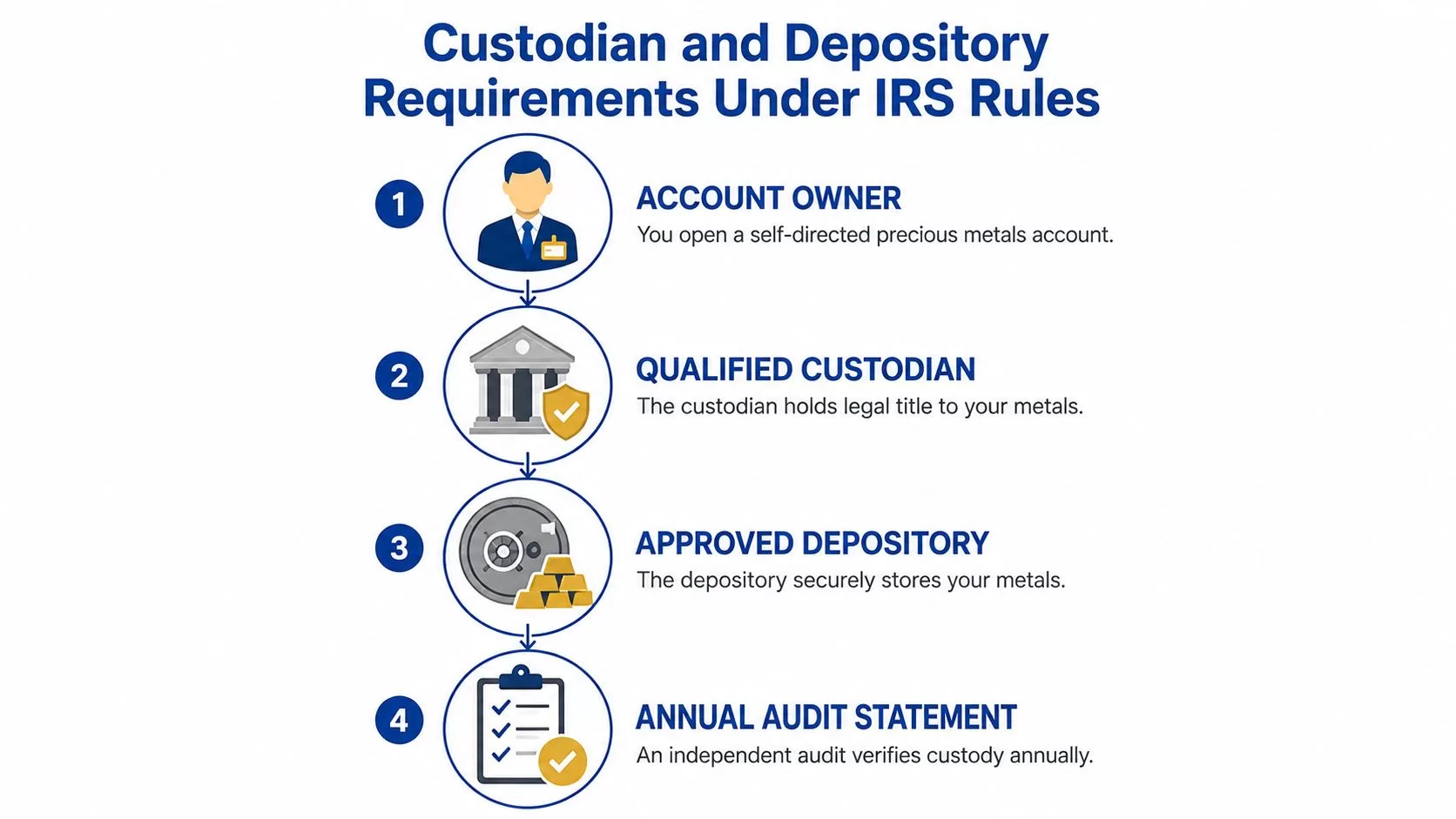
Personal possession can be treated as a distribution, creating tax consequences and possible penalties. The collectible-versus-bullion distinction is covered in detail in the later section on prohibited holdings. For the custody framework, readers can review IRS guidance on how individually directed accounts hold collectible-adjacent assets.
Questions to ask before opening an account
Request written answers to these questions:
- Custodian status: Who legally administers the IRA?
- Depository identity: Where will the metals be stored?
- Ownership records: Do the account title and asset records clearly identify IRA ownership?
- Storage method: Is storage segregated or commingled?
- Insurance and audits: What documents support coverage and inventory controls?
- Distribution process: How does the custodian handle cash and in-kind distributions?
Segregated storage keeps identified assets apart from other inventory. Commingled arrangements track the account's ownership through records rather than a dedicated compartment. The agreement should explain which arrangement applies, what the investor owns, and how the depository records it.
The IRS does not publish one universal list of approved depositories. Custodian due diligence therefore matters. Before signing, compare the proposed custody, storage, insurance, and distribution terms with this guide to an IRA custodian for gold.
Home Storage, LLCs, and the Distribution Risk Most Articles Skip
A near-retiree may place IRA-owned coins in a home safe after forming an LLC, believing the entity keeps the arrangement within the rules. The key question is not the LLC label or the type of bullion. It is who controls and possesses the metals.
An IRA-owned LLC does not automatically make personal storage acceptable. If IRA-owned metals sit in a home, office, or safe-deposit box controlled by the account owner, the arrangement may be treated as a constructive or deemed distribution. The IRS treats personal possession as a potential distribution regardless of the entity label, as this explanation of whether gold can be stored at home in an IRA discusses.
The McNulty line of analysis is often associated with personal possession and home storage. It shows why promotional claims about “checkbook control” should not replace a review of custody obligations. An LLC can organize ownership records, much like a folder can organize documents, but it does not by itself prove that an approved custodian or depository controls the assets.
Business-entity administration is a separate issue. This guide for non-resident founders from Cloud Residents may help explain general LLC administration, but LLC formation guidance does not override retirement-account tax rules.
A safer decision framework
Before accepting a home-storage proposal, request clear answers:
- Who physically possesses the metals?
- Who can access or move them without custodian approval?
- What records show that the depository holds the assets?
- How would the account report a transfer or distribution?
- What happens if the IRS treats the metals as distributed?
Possible consequences include ordinary income taxation and penalties. The tax consequences of a deemed distribution, including a possible excise tax and correction window, are covered in the next section. Home storage is therefore a custody decision, not merely a convenience choice. Obtain independent tax advice before moving assets.
Rollover Timelines and Trustee-to-Trustee Transfers
Retirement money can generally reach a precious-metals IRA through either a rollover or a direct transfer. The difference is who receives the funds during the move.
With a 60-day rollover, the account owner receives a distribution and generally has 60 days to redeposit it into another IRA or eligible plan, according to the IRS rollover guidance. Missing the deadline can make the distribution taxable. The same IRS page says an individual can generally make only one IRA-to-IRA rollover in a 12-month period across all IRAs, including traditional, Roth, SEP, and SIMPLE IRAs.
A direct trustee-to-trustee transfer sends funds from the existing custodian directly to the receiving custodian. The money doesn't pass through the account owner, which reduces exposure to missed deadlines and handling errors.
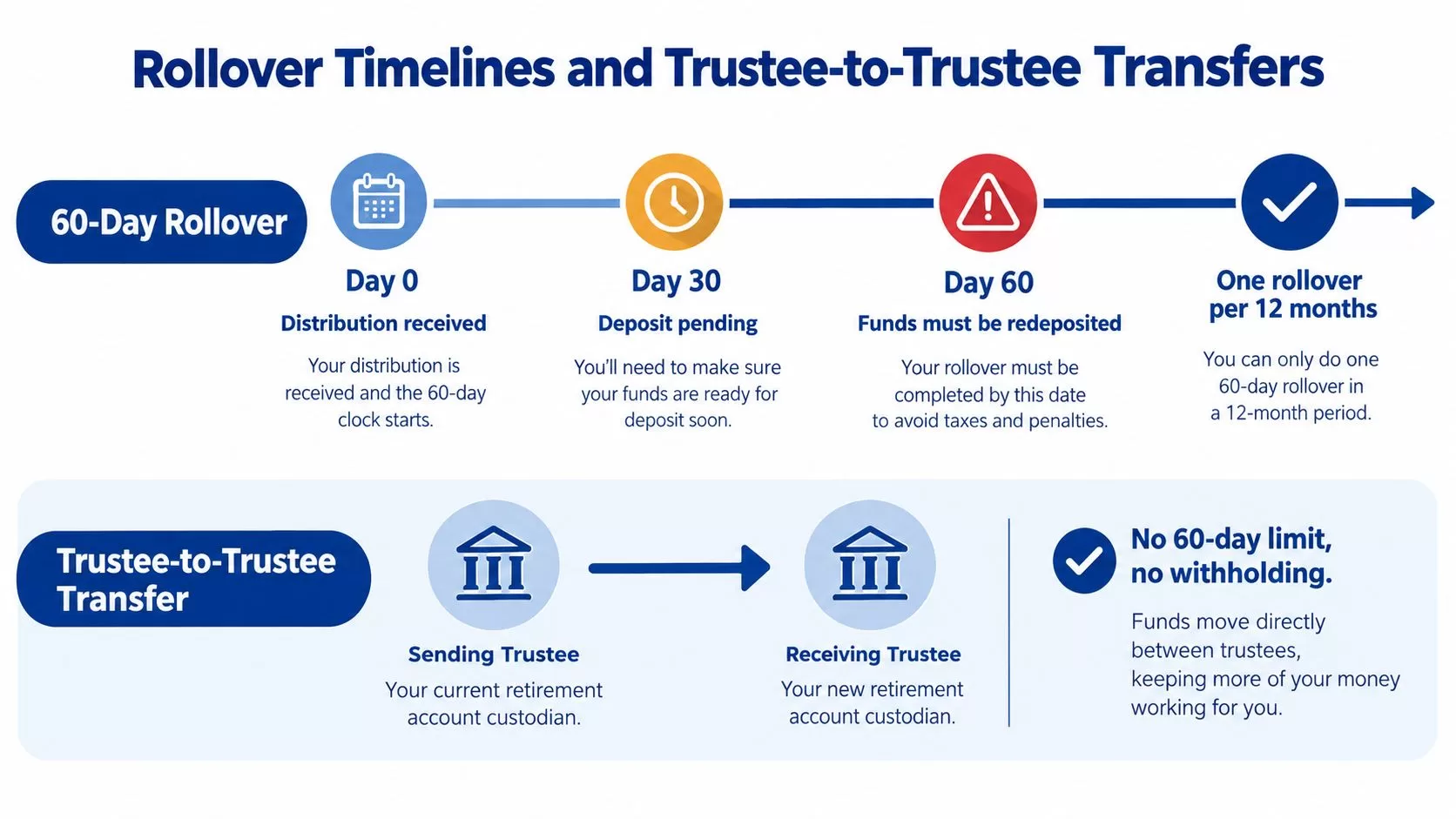
A transfer checklist
Before the metals purchase is authorized, confirm:
- Destination: The receiving account is open and correctly titled.
- Instructions: The sending custodian has the receiving custodian's transfer details.
- Timing: Any 60-day deadline is documented on a calendar.
- Tax treatment: Pretax and after-tax amounts are handled correctly.
- Completion: Both custodians confirm receipt and posting.
- Asset purchase: The new custodian, not the account owner personally, directs the IRA purchase.
The IRS explains in Tax Topic 413 that after-tax amounts generally require a direct rollover or direct trustee-to-trustee transfer so taxable and nontaxable portions are handled properly. A direct route is often easier to document, but individual circumstances still determine the correct procedure.
Collectibles, Proof Coins, and Other Prohibited Holdings
A proof coin and its bullion twin can contain identical metal and still receive different tax treatment. The distinction matters because an IRA purchase is a custody-and-control decision, not a choice of attractive bullion. A coin's form, fineness, statutory treatment, and the custodian's acceptance can determine whether it belongs in the account.
The IRS generally excludes collectibles, including art, antiques, gems, stamps, coins, alcoholic beverages, and similar property. Narrow exceptions apply to certain qualifying precious metals. The metal itself does not settle the question: a gold or silver coin may still be disallowed if its design, classification, or product form places it in a collectible category.
| Coin Type | IRA-Eligible? | Reason |
|---|---|---|
| Certain permitted bullion coins | Yes, if requirements are met | Falls within an IRS-recognized exception |
| Qualifying bullion bars | Yes, if requirements are met | Must meet applicable fineness and form standards |
| Rare collectible coins | Generally no | Treated as collectibles |
| Unapproved proof sets | Generally no | Product form or collectible status may disqualify them |
| Approved proof products | Potentially, if specifically permitted | Eligibility depends on the exact product and rules |
A proof product can carry a collector premium, while a comparable bullion product is assessed as permitted investment metal. They should not be treated as interchangeable. Before authorizing a purchase, ask the custodian to confirm the exact product and its eligibility in writing. The IRS guidance listing the collectible categories and the precious-metals exceptions identifies the governing categories. The custodian's product list is a practical check, not a replacement for those requirements.
Excise Taxes, Prohibited Transactions, and the Correction Window
Suppose a near-retiree asks the IRA to buy precious metals, then takes the coins home “temporarily.” That choice can change a custody question into a tax problem. The key issue is control, not the metal's appearance or brand.
Two rule paths must be separated. A prohibited transaction may involve self-dealing, personal use, or pledging IRA property as collateral. A custody failure may instead cause the holding or transfer to be treated as a distribution. The retirement-plan investment FAQs distinguish permitted IRA assets from collectibles and nonqualifying precious metals. Prohibited transactions such as self-dealing are governed by the excise-tax rules in IRC Section 4975, separate from the collectible-asset rules.
What happens after a mistake
Start with records, not a quick fix. Preserve purchase documents, the custody agreement, transfer confirmations, valuation statements, and communications with the custodian. Those records help establish who owned the asset, who authorized its movement, and where it was held.
The IRS may apply a 25% excise tax to a distribution that was not taken correctly. The amount may be reduced to 10% if corrected within two years, according to this industry analysis of the excise-tax correction window for precious-metals IRAs. The facts and correction method matter, so a tax professional should review the account before anyone attempts to reverse the transaction.
Compliance principle: Returning metal to a vault does not, by itself, correct the event. The owner must determine how it should be reported and whether the proposed remedy is permitted.
Private letter rulings and correction programs may matter in specific retirement-plan situations, but they do not automatically approve every Gold IRA correction. A custodian's records support the analysis; they do not replace it.
Quick Reference Checklist for Precious-Metals IRA Rules
A compliant account depends on who controls the metals, where they are held, and how each transaction is documented. Use this checklist as a bookmark and summary of the rules discussed above. It does not replace professional advice or the current IRS Publication 590-B.
Opening the account
- Choose a qualified custodian: Confirm that the IRA has an appropriate trustee or custodian.
- Read the agreement: Check storage, insurance, reporting, fees, and distribution procedures.
- Identify ownership: Account records should show that the IRA, not the individual, owns the metals.
Funding it
- Select the right method: A direct transfer generally keeps retirement funds out of the owner's hands.
- Track a 60-day rollover: Apply the timeline described in the rollover section.
- Respect the annual rollover limit: Apply the once-per-12-month rule across the owner's IRAs.
Selecting metals
- Verify gold fineness: 99.5%, as covered under Purity Standards above.
- Verify other metals: Silver, platinum, and palladium must meet their applicable standards described earlier.
- Avoid assumptions: Confirm the exact product, not only its advertised metal content, weight, or appearance.
Holding them
- Use an approved depository: Personal possession is not the normal compliant arrangement.
- Keep records: Retain invoices, custody statements, transfer confirmations, and storage records.
- Avoid personal use: IRA metals cannot serve as household property, business assets, or collateral.
Taking distributions
- Plan the method: Ask the custodian about cash or in-kind distribution procedures.
- Check traditional IRA obligations: Required minimum distributions may affect a traditional precious-metals IRA.
- Ask before acting: Get advice before unusual transfers, inherited accounts, or attempted corrections.
A useful final check is to trace the metals from purchase to storage to distribution. If the records show a clear chain of IRA ownership and custody, they help support the account's compliance review.
Frequently Asked Questions on IRS Rules for Gold IRAs
How are inherited precious-metals IRAs handled by non-spouse beneficiaries?
A non-spouse beneficiary must follow inherited-account distribution rules, including applicable timelines and reporting requirements. The treatment depends on the account type, beneficiary status, date of death, and other facts. Because inherited bullion may need to be sold or distributed in kind, the beneficiary should ask the custodian and tax professional how the account will calculate and report each distribution.
Can a Roth conversion involve a gold IRA?
A Roth conversion may be possible when an eligible traditional retirement account is converted under the applicable tax rules. The conversion doesn't eliminate the need for qualifying metals, proper custody, or accurate reporting. The taxable amount and account treatment depend on the individual's pretax and after-tax balances, so professional tax guidance is important.
How are storage and insurance fees charged?
Storage and insurance charges are normally administered through the IRA's custodial arrangement. The account agreement should explain whether the fees are deducted from cash in the account, paid through another permitted method, or reflected in account statements. Investors should review the full schedule before funding because a metal-only account may need available cash for expenses.
How do required minimum distributions work when the account holds bullion?
A traditional IRA holding bullion remains subject to applicable required minimum distribution rules. The custodian generally calculates the distribution using the account's reported value and arranges either cash or an in-kind metal distribution. The owner shouldn't remove metals independently, because possession and reporting must follow the custodian's process.
Putting the Rules Together and Your Next Step
The main lesson is simple: compliance starts with custody and control, before it starts with coin selection.
The Taxpayer Relief Act of 1997 created the statutory foundation for certain precious-metals IRA holdings. Section 408 and related IRS guidance define the permitted forms and fineness standards. Qualified custodians and depositories control possession. Rollover rules govern how retirement funds move, including the 60-day deadline and once-per-12-month IRA-to-IRA limitation. Collectibles rules exclude many coins and other property, while prohibited-transaction and distribution rules address what can happen after a custody or control failure.
Contribution planning also belongs in the review. The IRS annual IRA limit history shows why current limits should always be verified before a contribution strategy is prepared. Rollover rules and contribution rules are separate, and confusing them can lead to incorrect assumptions about how much an investor may add or move.
Before initiating a rollover, the reader should gather the existing account statement, request the receiving custodian's transfer instructions, verify the exact metals under consideration, and ask a CPA or licensed financial advisor to review the tax consequences. Gold IRA Association offers educational guides, rollover explanations, IRS-rule references, and company comparison resources to help readers prepare informed questions without replacing professional advice.
This is not financial advice. Consult a licensed financial advisor, CPA, or tax professional before making investment decisions.
Gold IRA Association provides educational resources on precious-metals IRA eligibility, rollovers, custody, fees, and provider comparisons. Visit Gold IRA Association to review the relevant guides and prepare questions for a qualified custodian or tax professional.