



A Gold IRA may support diversification and tax-advantaged ownership of eligible physical metals, but it also brings storage and custodian fees, limited liquidity, no income generation, and strict IRS compliance obligations. The right choice depends on the investor's allocation, need for accessible cash, tax situation, and existing retirement plan.
Is a Gold IRA worth those trade-offs? That's the practical question for a retiree or rollover investor deciding whether physical gold or silver deserves a place beside stocks and bonds. The answer isn't just about whether gold rises or falls. It also involves how much portfolio volatility an investor can tolerate, whether retirement income is already covered elsewhere, how quickly funds may be needed, and whether the account's rules and costs are manageable.
This guide examines eight gold IRA pros and cons through those decisions. It explains the potential role of metals in a retirement portfolio, the tax structure, storage and custodian obligations, selling restrictions, eligible products, opportunity cost, currency concerns, and operational complexity. The aim is balanced education, not a promise of returns, protection, or tax savings. This is not financial advice. Consult a licensed financial advisor, CPA, or tax professional before making investment decisions.
1. Portfolio Diversification and Inflation Hedge
A Gold IRA can add an asset that behaves differently from traditional stocks and bonds. That distinction matters most when a retiree's existing accounts are heavily concentrated in equities, fixed income, or assets tied to the U.S. dollar. Physical metals don't depend on corporate earnings or interest payments, although their market prices can still fluctuate sharply.
The diversification case has measurable support. The World Gold Council's portfolio analysis reports that adding 5% gold reduced annualized volatility from 9.5% to 9.1% over a 10-year window and from 9.9% to 9.6% over a 20-year window. The same analysis says gold increased by about 8% annualized in U.S. dollar terms since 1971. Those figures support gold as a possible stabilizing sleeve, not as a replacement for a diversified retirement portfolio.
The allocation decision matters more than the headline benefit
A retiree with substantial stock exposure may view gold differently from an investor whose retirement assets already include cash, bonds, real estate, and other diversifiers. A measured allocation can reduce dependence on one market outcome, but an oversized allocation can leave too little capital in growth-oriented assets.
The Gold IRA Association guide on gold as an inflation hedge can help readers understand the broader role of gold during purchasing-power concerns. The practical question is whether the proposed allocation solves a specific portfolio problem.
Practical rule: Gold works best when it has a defined job, such as diversification or inflation sensitivity, rather than serving as the entire retirement strategy.
Investors should compare the proposed metals allocation with their cash needs, retirement timeline, and tolerance for price declines. Rebalancing may also be necessary when gold and other holdings move in different directions.
2. Tax-Advantaged Account Structure and Tax-Deferred Growth
A Gold IRA uses a retirement-account structure rather than a regular taxable brokerage account. Depending on the account type, investment growth may be tax-deferred or withdrawals may qualify for tax-free treatment, subject to applicable rules and the investor's circumstances. The tax treatment comes from the IRA structure, not from gold itself.
A traditional Gold IRA generally defers taxation until distributions occur. A Roth structure follows different rules, and eligibility, contribution treatment, distribution requirements, and conversion consequences need individual review. Selling or exchanging eligible metals inside the account generally doesn't create the same current tax event as selling metals held personally, but distributions still require careful planning.
Rollovers can preserve the structure, but execution matters
A direct trustee-to-trustee transfer is usually less operationally fragile than sending retirement funds to the investor first. The IRS rollover guidance explains that a rollover can avoid current taxation when a distribution from one qualified retirement plan is contributed to another eligible plan or traditional IRA within 60 days. The transaction remains reportable on Form 1099-R, even when it isn't taxable.
The IRS explanation of rollover deadlines also identifies a special deadline for qualified plan loan offset amounts. Those details matter to people leaving an employer plan, especially when withholding or plan-specific procedures complicate the transfer.
A traditional account can create future distribution and income-tax planning issues. A Roth account can differ, but no account should be treated as automatically tax-free or universally superior.
A rollover is a tax-sensitive transaction, not merely a change in investment products.
Readers evaluating the tax side should review the Gold IRA tax rules guide and then speak with a CPA or tax professional who understands the investor's account type, income, planned withdrawals, and estate objectives.
3. Storage, Custodian, and Ongoing Fees
What does a Gold IRA require beyond buying eligible metal? The account adds an administrative structure that ordinary IRAs may not need. A custodian maintains the retirement account, while an approved depository stores the metals. The investor generally cannot keep IRA gold at home or in a personal safe.
IRS rules require IRA metals to be held by a bank or IRS-approved nonbank trustee in an approved depository. Personal possession can be treated as a distribution, which may create tax consequences and penalties. The IRS-approved storage rules explained by U.S. Money Reserve summarizes this custody requirement.
Fixed charges matter more in smaller accounts
Published fee schedules commonly show one-time setup charges of $50 to $300, annual custodian or administrative fees of $75 to $300, and annual storage fees of $100 to $300. Dealer premiums may also place a purchase above the spot price. Request the provider's written schedule before opening the account, because charges vary by arrangement.
Annual costs may be bundled or separated. Some schedules combine administration and storage into a flat $180 to $275, while others charge each service independently. Compare the full schedule rather than a headline rate, including setup, administration, storage, insurance, dealer premiums, spreads, and sales-related charges. The coverage of Gold IRA fees and custodian costs provides additional context on these categories.
A smaller account absorbs fixed charges less efficiently because the same dollar fee represents a larger share of its balance. Investors should also identify which party handles storage, reporting, transactions, and account administration. Reviewing guidance on an IRA custodian for gold can clarify those responsibilities before funds are transferred.
4. Limited Liquidity and Selling Restrictions
Gold is a tradable asset, but a Gold IRA isn't the same as a brokerage account with instant order execution. A sale usually requires coordination among the account holder, custodian, dealer, and depository. The investor also needs to understand when proceeds become available and whether the transaction uses a quoted buyback price, a spread, or another pricing method.
That distinction is important for retirees. A person who needs cash for an unexpected repair, medical expense, or property obligation may not want to depend on a process involving multiple parties. Physical possession doesn't solve the problem inside the IRA, because taking the metals personally is treated as a distribution under the applicable rules.
Liquidity needs should shape the account's role
A Gold IRA generally makes more sense as a long-term retirement allocation than as an emergency reserve. Cash needed for near-term expenses belongs in an accessible account outside the metals arrangement, while retirement distributions should be coordinated with the broader income plan.
The rollover investor also needs to separate selling metals from taking a distribution. Selling within the IRA can leave proceeds in the retirement account. Taking money out can create tax consequences depending on the account type, the investor's age, and other circumstances.
Access test: If a household may need the money quickly, the proposed Gold IRA allocation should be small enough that a delayed sale won't disrupt essential spending.
Before opening an account, investors should ask the custodian to describe the sale process in writing. Questions should cover how orders are placed, how pricing is determined, how proceeds are credited, and what happens when a distribution is needed for a required withdrawal.
5. IRS Compliance Requirements and Eligible Metals
Could a familiar coin or bar still fail the rules for a Gold IRA? Yes. The account's tax treatment depends on using eligible metals and following the applicable requirements, not only on owning gold, silver, platinum, or palladium.
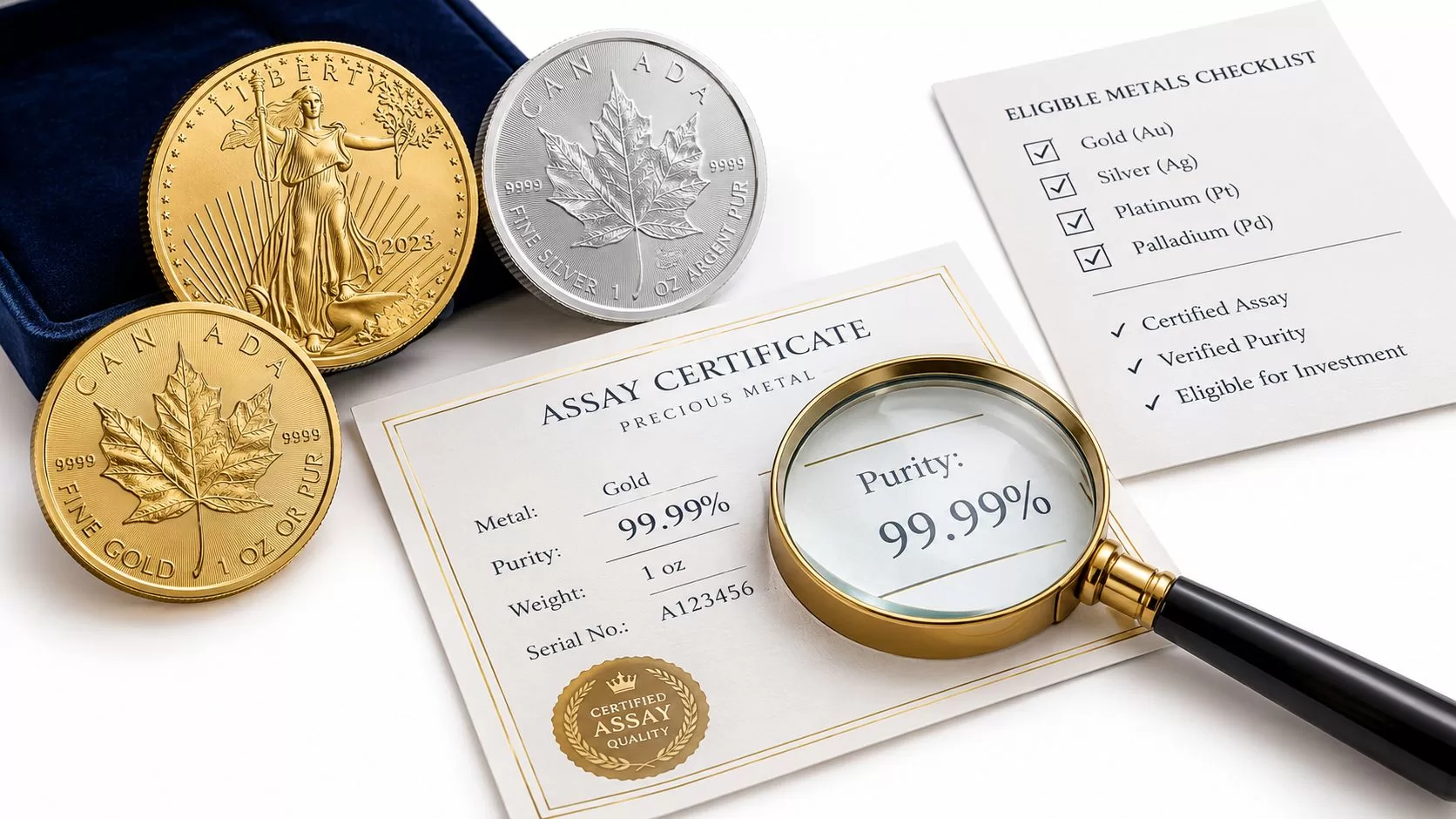
The commonly cited purity thresholds are 99.5% for gold, 99.9% for silver, and 99.95% for platinum and palladium, as set out in IRC Section 408(m) and summarized in IRS guidance on IRA-held precious metals. The American Gold Eagle is a notable exception to the 99.5% gold standard because it is permitted despite lower fineness.
Eligible products can include certain government-minted bullion coins and approved bars. Collectibles, jewelry, and metals that fail the applicable standards may not qualify. A product's familiarity or precious-metal content does not establish IRA eligibility.
The custodian's screening role matters
Before a purchase, the custodian and approved depository should verify the product, refiner, purity, documentation, and storage acceptance. Buying metals independently and attempting to place them into the IRA later can result in rejection or create a compliance issue.
Readers can also consult this 2026 IRS rules compliance guide as a general educational resource, while confirming current requirements with the custodian and a tax professional. Custodian approval does not remove the investor's responsibility to keep records and understand the transaction.
The following video provides another educational overview of the subject:
Investors should obtain written confirmation before purchasing a specific American Gold Eagle, Canadian Maple Leaf, bar, or other product. Eligibility under IRS rules is separate from whether the metal appears attractive at its current market price.
6. No Income Generation and Opportunity Cost
Gold and silver don't pay dividends, interest, or rent. The account's outcome depends primarily on changes in the metals' prices, less premiums, spreads, and account expenses. That makes a Gold IRA distinct from holdings designed to produce cash flow.
The distinction becomes more important after retirement. Someone relying on portfolio income may need bonds, dividend-paying stocks, cash reserves, or other assets that can support withdrawals without selling a non-income-producing holding. A metals allocation can diversify the portfolio, but it doesn't directly fund a monthly budget.
A portfolio role isn't the same as an income role
Investors should ask what each account is supposed to accomplish. Gold may serve as a diversification or purchasing-power sleeve, while other holdings provide growth, liquidity, and income. Treating gold as the income engine creates a mismatch between the asset and the retirement job.
Opportunity cost also works in both directions. A portfolio that holds no metals may lack exposure to an asset that can behave differently from stocks and bonds. A portfolio that holds too much metals exposure may sacrifice participation in assets that generate income or compound through business growth.
A useful planning exercise is to model withdrawals under different market conditions. The model should include taxes, account fees, selling spreads, and the possibility that gold prices are weak when cash is needed. This approach reveals whether the investor can leave the metals untouched during unfavorable periods.
Gold can diversify a retirement plan, but it can't replace a dependable income strategy.
The practical solution is usually role separation. Keep sufficient income-producing and liquid assets for spending needs, and evaluate any Gold IRA allocation as one component of the overall plan rather than as a standalone retirement solution.
7. Protection from Currency Devaluation and Systemic Economic Risk
Gold appeals to investors concerned that inflation, currency depreciation, or financial-system stress could reduce the purchasing power of conventional savings. A physical asset may feel different from a claim on a company, bank, or government. That distinction can make precious metals psychologically and strategically attractive to people approaching retirement.
The protection case still has limits. Gold can decline during periods when inflation concerns remain high, and rising interest rates or changing investor demand can affect its price. A Gold IRA may provide exposure to a potential hedge, but it doesn't guarantee stable purchasing power or protect every part of a retirement portfolio.
Separate the hedge from the prediction
A retiree doesn't need to forecast a currency crisis to consider whether a modest metals allocation fits the portfolio. The more useful question is whether the investor wants some exposure to an asset that may respond differently to monetary and market conditions.
Gold also shouldn't be confused with a complete currency-risk strategy. Someone with foreign assets, overseas property, or spending obligations in another currency may need broader planning. The resource on managing FX risk on foreign real estate addresses a different risk category and reinforces an important point: currency exposure needs to be matched to the actual financial obligation.
Near-retirees should avoid building a retirement plan around a single economic forecast. Inflation may be persistent, moderate, or unexpectedly accompanied by higher interest rates. Gold may help diversify those scenarios, but it can't determine the outcome.
Hedge, not forecast: A Gold IRA can express concern about currency risk without turning that concern into a prediction about economic collapse.
The allocation should remain consistent with spending needs and tolerance for volatility. Investors who already own foreign assets, inflation-sensitive securities, or substantial real assets may need less additional exposure than someone whose retirement savings are concentrated in nominal assets.
8. Complexity, Required Education, and Custodian Dependency
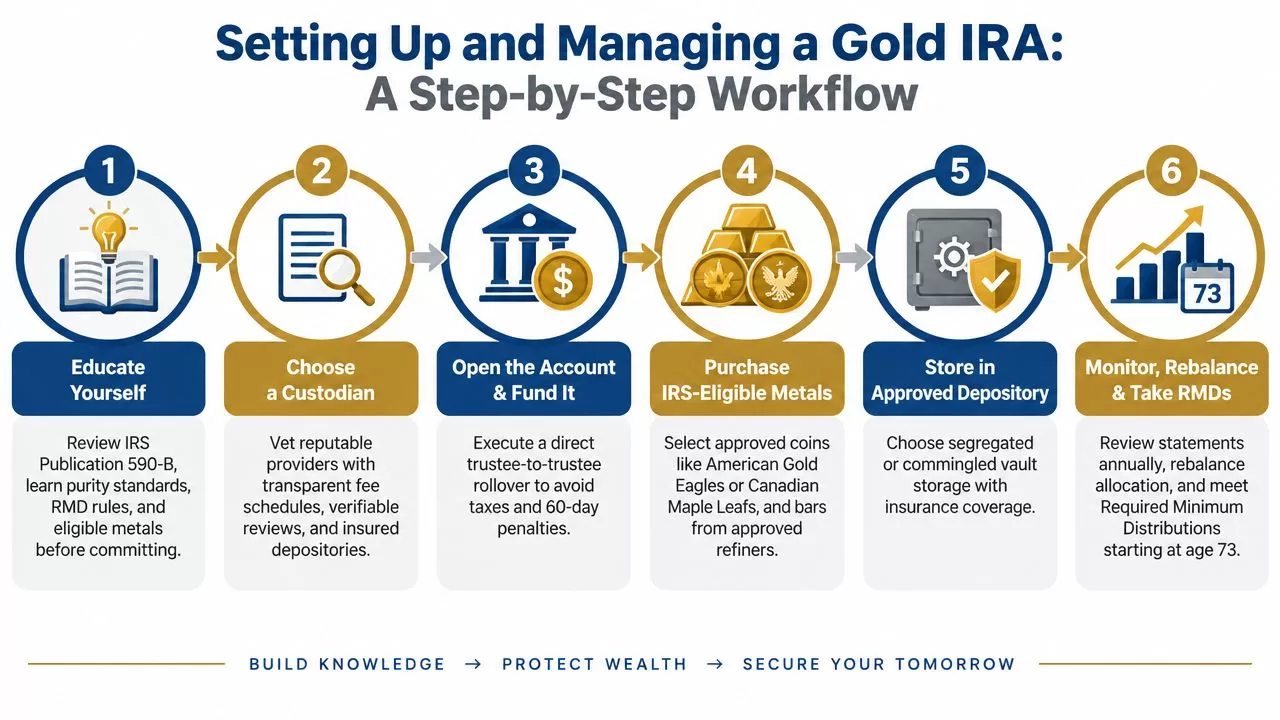
Could a retirement investor handle the added administration without weakening tax compliance or access to cash? A Gold IRA requires decisions beyond choosing an allocation. The investor must understand eligible metals, approved storage, custodian duties, fees, rollover methods, distributions, and required minimum distributions. An administrative error can affect the account's tax treatment.
Rollover method matters. If retirement funds are paid to the investor first, the money generally must be redeposited within 60 days, or the distribution may become taxable. IRS rollover guidance explains that mandatory withholding on eligible rollover distributions paid to the participant can leave a shortfall the investor must replace with other cash. That requirement can create practical pressure for someone close to retirement, particularly when liquid savings are already earmarked for spending.
Custodian dependence deserves direct questions
The custodian does not set the investor's retirement objective, but it administers many of the account's mechanics. The investor should verify how statements are issued, how metals are valued, how insurance operates, how sales are processed, and what happens if the custodian changes service providers or faces an operational disruption.
Before transferring funds, ask:
- Confirm the rollover method: Will the transfer move directly between trustees, or will the investor receive the distribution?
- Document the storage arrangement: Which depository holds the metals, and is storage segregated or commingled?
- Clarify the sale process: Who executes the sale, how are prices quoted, and when do proceeds reach the account?
- Review account records: Which tax forms, statements, purchase records, and valuation documents will the custodian provide?
Education should precede commitment. Investors can review IRS Publication 590-B and discuss required distributions with a CPA or financial advisor. A smaller initial allocation may limit the financial consequences of learning the process, though it does not remove eligibility, reporting, or custodian requirements. The account's suitability also depends on whether its fees and selling procedures fit the investor's need for accessible retirement income.
Gold IRA: 8-Point Pros & Cons Comparison
| Item | Implementation complexity | Resource requirements | Expected outcomes | Ideal use cases | Key advantages |
|---|---|---|---|---|---|
| Portfolio Diversification and Inflation Hedge | Low–Moderate (IRA setup and allocation) | Custodian, approved depository, capital (typical 5–20% allocation) | Reduced correlation with equities; potential long-term inflation protection; no income | Near-retirees/retirees or savers seeking volatility reduction and purchasing-power protection | Diversifies portfolio, tangible asset, potential inflation hedge, tax-advantaged holding possible |
| Tax-Advantaged Account Structure and Tax-Deferred Growth | Moderate (choose Traditional vs Roth; follow IRA rules) | Custodian, tax advisor/CPA, rollover paperwork | Tax-deferred or tax-free appreciation within account; distributions taxed per account type | Long-term investors seeking tax-efficient precious-metal exposure or rollovers/conversions | Defers capital gains, Roth offers tax-free growth, preserves compounding power |
| Storage, Custodian, and Ongoing Fees | Moderate (select custodian and storage option) | Recurring custodial/storage/insurance fees, setup and transaction costs | Professional security and compliance at ongoing cost; fees can erode returns for small balances | Investors who require secure insured storage and IRS compliance; larger accounts to dilute fees | Professional security/insurance, custodian handles reporting and admin |
| Limited Liquidity and Selling Restrictions | Low to execute, operationally complex to liquidate | Custodian coordination, dealer network, processing time (typically 5–10+ business days) | Illiquid holdings with delayed access to funds; physical take-possession triggers taxable distribution | Long-term holders who do not need immediate liquidity; investors who benefit from forced discipline | Discourages panic selling, reduces day-trading temptation, encourages long-term focus |
| IRS Compliance Requirements and Eligible Metals | High (technical purity and product rules) | Knowledge of eligible coins/bars, approved refiners, custodian verification, documentation | Compliance preserves IRA status; noncompliance risks disqualification and immediate taxation | Investors using government-minted bullion and approved bars; those prioritizing IRS-safe holdings | Purity standards reduce fraud risk; approved products ease acceptance by depositories |
| No Income Generation and Opportunity Cost | Low (simple concept, low admin) | Capital allocation planning; complementary income-producing assets if needed | No dividends/interest; returns solely from price appreciation; potential opportunity cost vs yield assets | Investors focused on wealth preservation rather than income; portion of diversified portfolio | Low maintenance, no dividend tax complexity, enforces buy-and-hold discipline |
| Protection from Currency Devaluation and Systemic Economic Risk | Low–Moderate (allocate and monitor macro risks) | Custodian/depository, allocation decision, macroeconomic monitoring | Potential hedge in severe inflation or currency crises; results variable and not guaranteed | Savers concerned about currency devaluation, hyperinflation, or systemic financial risk | Global acceptance, store of value, diversification from fiat and counterparty risk |
| Complexity, Required Education, and Custodian Dependency | High (multiple rules, parties, and paperwork) | Significant education, reputable custodian, CPA/advisor support, detailed documentation | Higher administrative burden; reliance on custodian competence; risk of costly errors if mismanaged | Sophisticated self-directed investors or those who vet custodians carefully | Enables self-directed allocation choices; custodian oversight can reduce fraud if provider is trustworthy |
Match the Account to the Retirement Job
The strongest case for a Gold IRA is measured, not absolute. Eligible physical metals may diversify a retirement portfolio and provide exposure to an asset that has historically served as a long-run store of value. The World Gold Council's analysis supports the idea that a modest gold allocation can reduce portfolio volatility, but that evidence doesn't establish a suitable allocation for every investor or guarantee protection in a particular downturn.
The disadvantages are practical rather than theoretical. A Gold IRA requires a custodian and approved depository, creates setup and recurring costs, restricts the metals that may be held, and can take more coordination to sell than conventional marketable securities. Gold also produces no dividends or interest, so it can't replace the assets that support regular retirement income.
The account's tax structure deserves equal care. Traditional and Roth accounts have different tax characteristics, and a rollover can become taxable when funds are paid to the investor and not redeposited within the applicable deadline. Even a correctly completed rollover remains reportable, and required distributions still need to be planned. A tax professional can help distinguish a direct transfer from a distribution and assess how the transaction fits the investor's broader tax position.
The decision should begin with the retirement job, not the metal. Investors should ask:
- What problem needs solving? Is the concern concentration, inflation sensitivity, market volatility, or a desire for tangible assets?
- How much liquidity is required? Can the household meet emergencies and planned expenses without relying on a metals sale?
- Where will income come from? Are bonds, cash, dividends, pensions, or other sources available for regular spending?
- What costs are acceptable? Has the investor compared setup charges, administration, storage, premiums, spreads, and liquidation costs?
- Who will administer the account? Has the custodian explained storage, insurance, valuation, distributions, and rollover procedures?
A sensible next step is to request written fee schedules and storage details from providers, confirm the eligibility process for specific metals, and ask for a clear explanation of liquidation timelines. A licensed financial advisor, CPA, or tax professional can then evaluate the proposed allocation and rollover method in light of the investor's complete situation.
This is not financial advice. Consult a licensed financial advisor, CPA, or tax professional before making investment decisions. Gold IRA Association provides educational articles, rollover materials, fee explanations, eligible-metal guidance, and comparative reviews to help readers organize that research.
Gold IRA Association offers educational resources on Gold and Silver IRAs, IRS compliance, rollover procedures, eligible metals, fees, and provider comparisons. Readers evaluating the trade-offs can use the site to compare the questions and documents that matter before speaking with a professional. Visit Gold IRA Association to continue the research.