



A lot of near-retirees arrive at the same frustrating moment. They learn that silver can go inside an IRA, then assume any silver coin from a local shop should work, only to find out the rules are much narrower than expected.
That confusion matters because one wrong purchase, one sloppy rollover, or one storage mistake can undo the tax advantages that made the account appealing in the first place. For readers considering IRA silver coins, the job isn't just finding eligible products. It's understanding which coins qualify, what the purity rules mean, how the purchase happens inside a self-directed IRA, and whether coins are the most efficient way to own silver compared with bars.
Why IRA Silver Coins Confuse So Many Investors
Silver feels simple until retirement-account rules enter the picture. Outside an IRA, a buyer can walk into a coin shop and choose from old U.S. silver, sterling rounds, commemoratives, proof sets, and modern bullion. Inside an IRA, that broad menu shrinks fast.
Most confusion starts with one false assumption. Investors often think silver content alone is enough. It isn't. In a retirement account, the coin has to satisfy specific bullion standards, and the account itself has to follow custody and transaction rules that don't apply to a personal purchase.
The four checkpoints that matter most
A practical way to think about IRA silver coins is to treat each rule as a checkpoint.
- Eligibility checkpoint: Is the coin the kind of bullion a custodian will accept for an IRA?
- Purity checkpoint: Does it meet the required silver standard, or fall under a specific exception?
- Purchase checkpoint: Is the coin being bought through the IRA structure correctly, rather than personally and then moved in?
- Compliance checkpoint: Will storage, rollover timing, and account mechanics hold up if the IRS ever looks closely?
Practical rule: If a coin is popular with collectors, older than modern bullion programs, or priced mainly for rarity instead of metal content, it deserves extra scrutiny before it goes anywhere near an IRA.
Another reason investors get tripped up is that the conversation usually stops at “what qualifies.” That's only half the decision. A retiree also has to ask whether silver coins are the smartest format for a retirement account, since coins and bars can differ in premiums, recognition, and ease of sale later on.
That second question matters more than many guides admit. A coin can be fully eligible and still be a clumsy choice for someone who wants the most ounces for the money.
The.999 Purity Rule and the American Silver Eagle Exception
A lot of IRA confusion starts with one simple mistake. Investors hear “silver is silver,” then assume any recognizable coin should fit inside a retirement account. The IRS standard is narrower than that.
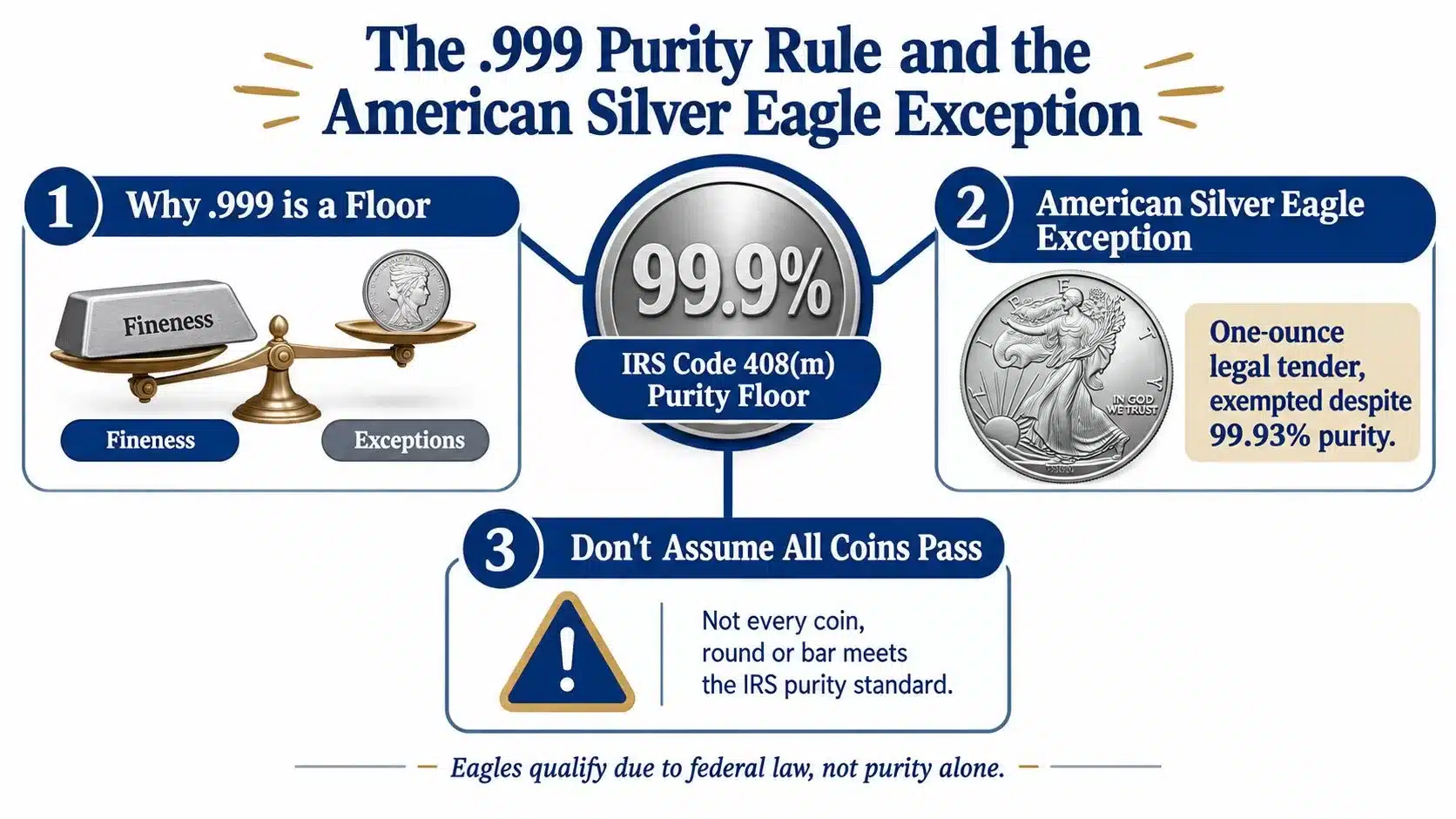
For silver bullion, the general rule is .999 fineness, or 99.9% pure silver, as summarized in this silver IRA purity overview. Treat that number as a checkpoint. If a coin or bar clears it, it may be eligible. If it falls below it, the answer is usually no unless a specific exception applies.
Why.999 is a floor
The easiest way to read the rule is as a minimum standard. A product does not become disqualified because it is purer than.999. It only needs to meet or exceed that floor.
That distinction clears up a common misunderstanding. A.999 coin qualifies under the general rule. A.9999 bar can also qualify because it is above the minimum. A sterling silver piece at.925 does not qualify under that standard. Older U.S. silver coins made with 90% silver usually do not qualify either.
Purity alone also does not answer the practical question of what to buy. Two products can both be eligible and still differ in cost efficiency. Coins often carry higher premiums than bars, so meeting the IRS rule is only the first checkpoint. The second is whether the format gives you a reasonable amount of silver for the dollars going into the IRA.
The American Silver Eagle exception
This is the part that trips up near-retirees most often.
The American Silver Eagle is widely discussed because it is specifically accepted for IRA use, and readers often want to confirm its exact specifications before buying. If you want those details, this Silver Eagle weight guide walks through the coin's measurements and silver content.
The lesson is narrow but important. The Silver Eagle should not be treated as permission to buy any silver coin that seems close enough on purity. IRS exceptions apply to specific coins recognized under the rules, not to broad categories such as “older silver” or “collectible pieces with bullion value.”
A practical way to picture it is a locked door with one named key. The.999 rule opens the door for most modern bullion. The American Silver Eagle gets through because it is a specifically accepted coin, not because exceptions are loose or flexible.
That matters for portfolio efficiency too. Some investors gravitate to Silver Eagles because they are familiar and easy to recognize. Familiarity can help with future resale, but inside an IRA it may come with a higher premium than other eligible silver products. So the right question is not only, “Does this coin qualify?” It is also, “Am I paying extra for the coin format when a lower-premium silver product could give me more metal exposure inside the same account?”
Commonly Accepted IRA-Eligible Silver Coins
Once the purity rule is clear, the shopping list gets much easier. In practice, custodians and dealers tend to favor modern, widely recognized bullion programs because they're easier to identify, easier to price, and easier to liquidate later.
That last point matters. Retirement accounts eventually force distribution decisions, especially in traditional accounts, so recognition and resale demand usually matter more than novelty.
Comparison of commonly accepted coins
| Coin | Country | Fineness | Troy Ounces | Standout Feature |
|---|---|---|---|---|
| American Silver Eagle | United States | .999 | 1 | Deep recognition in the U.S. bullion and IRA market |
| Canadian Silver Maple Leaf | Canada | .9999 | 1 | Higher-than-minimum fineness and broad global recognition |
| Austrian Silver Philharmonic | Austria | .999 | 1 | Well-known European government bullion coin |
| British Silver Britannia (from 2013 onward) | United Kingdom | .999 | 1 | Government-issued bullion with strong name recognition |
| Australian Silver Kangaroo | Australia | .9999 | 1 | Modern sovereign bullion issue with high purity |
| Chinese Silver Panda | China | .999 | 1 | Popular bullion program with changing annual designs |
| Mexican Silver Libertad | Mexico | .999 | 1 | Widely recognized sovereign silver bullion coin |
| American Silver Eagle exception reference | United States | Recognized exception | 1 | Frequently discussed because of its special IRA treatment |
What makes these coins practical inside an IRA
These coins tend to show up repeatedly in IRA discussions for a reason.
- Government backing: Each comes from a national mint or issuing authority, which helps with market confidence.
- Standardized weight: The one-troy-ounce format makes pricing and liquidation more straightforward.
- Bullion focus: They trade primarily as precious-metals products rather than as niche collectibles.
- Familiarity: Dealers and custodians usually know exactly what they are looking at.
A buyer comparing these coins shouldn't get distracted by design preference alone. Inside an IRA, the cleaner question is usually, “Will this still be easy to value and sell later?”
Coins with the strongest recognition often make retirement-account administration simpler, even if they aren't the cheapest way to buy silver.
That distinction also helps explain why random silver rounds and novelty pieces don't belong in the same conversation. Some investors mix up sovereign bullion coins with privately produced rounds, including products discussed in guides about a Buffalo silver round. The two may look similar in metal form, but recognition, acceptance, and IRA treatment can differ.
Recognition often beats rarity
For a personal safe, a collector might enjoy unusual pieces. For an IRA, a retiree usually benefits more from standard bullion that a future buyer can identify quickly. That's especially true if the account owner may need to sell metal in stages or satisfy later distribution requirements without debate over what the item is worth.
Silver Coins Versus Silver Bars Inside an IRA
Eligibility answers what can go into the account. Economics answers whether it should.
Coins and bars can both fit inside a silver IRA if they meet the account rules. The tradeoff is usually premium versus liquidity. Coins often cost more over the silver price, while bars usually deliver more metal for the same money.
Silver coins vs. silver bars in an IRA
| Feature | IRA-Eligible Coins | IRA-Eligible Bars |
|---|---|---|
| Recognition | Often higher, especially for major sovereign bullion coins | Depends heavily on refiner and bar format |
| Premiums | Usually higher than bars | Usually lower than coins |
| Ease of resale | Often simpler because many buyers recognize them immediately | Can be straightforward, but may depend more on refiner reputation and verification |
| Authentication comfort | Familiar government-mint products may feel easier for some buyers | Some buyers may want more verification, especially on larger bars |
| Divisibility | Small units can make partial sales easier | Larger bars can be less flexible for partial liquidation |
| Ounces per dollar | Often lower because of added premium | Often higher because premiums tend to be lower |
For many retirees, that turns into a personality test as much as an investment decision. Some want the comfort of highly recognizable coins, even if they pay more. Others care most about maximizing silver ounces.
Why market conditions can change the answer
Recent demand patterns show why this decision isn't static. The Silver Institute reported that net inflows into silver ETPs reached 95 million ounces in the first half of 2025, while newly minted bars and coins were expected to hit a seven-year low in 2025, and another industry report said global coin-and-bar demand was still projected to rise in 2026, according to this silver investment demand report.
That combination points to a market where retail interest in silver hasn't vanished, but the form of demand is shifting. In plain English, physical products can become less efficient when supply tightens and investor demand clusters around a small group of well-known coins.
A retiree who wants quick recognition later may still prefer coins. A retiree who wants more silver exposure per dollar may lean toward bars. Readers weighing that tradeoff can compare the practical differences in this guide to silver coins vs. silver bars.
How to Buy Silver Coins Through a Self-Directed IRA
Many investors picture this the wrong way. They think they'll open an IRA, buy coins personally, and then place those coins into the account. That isn't how a compliant setup works.
The account has to be structured first. Then the transaction has to happen through the IRA framework, with the custodian and approved dealer handling the purchase and delivery.
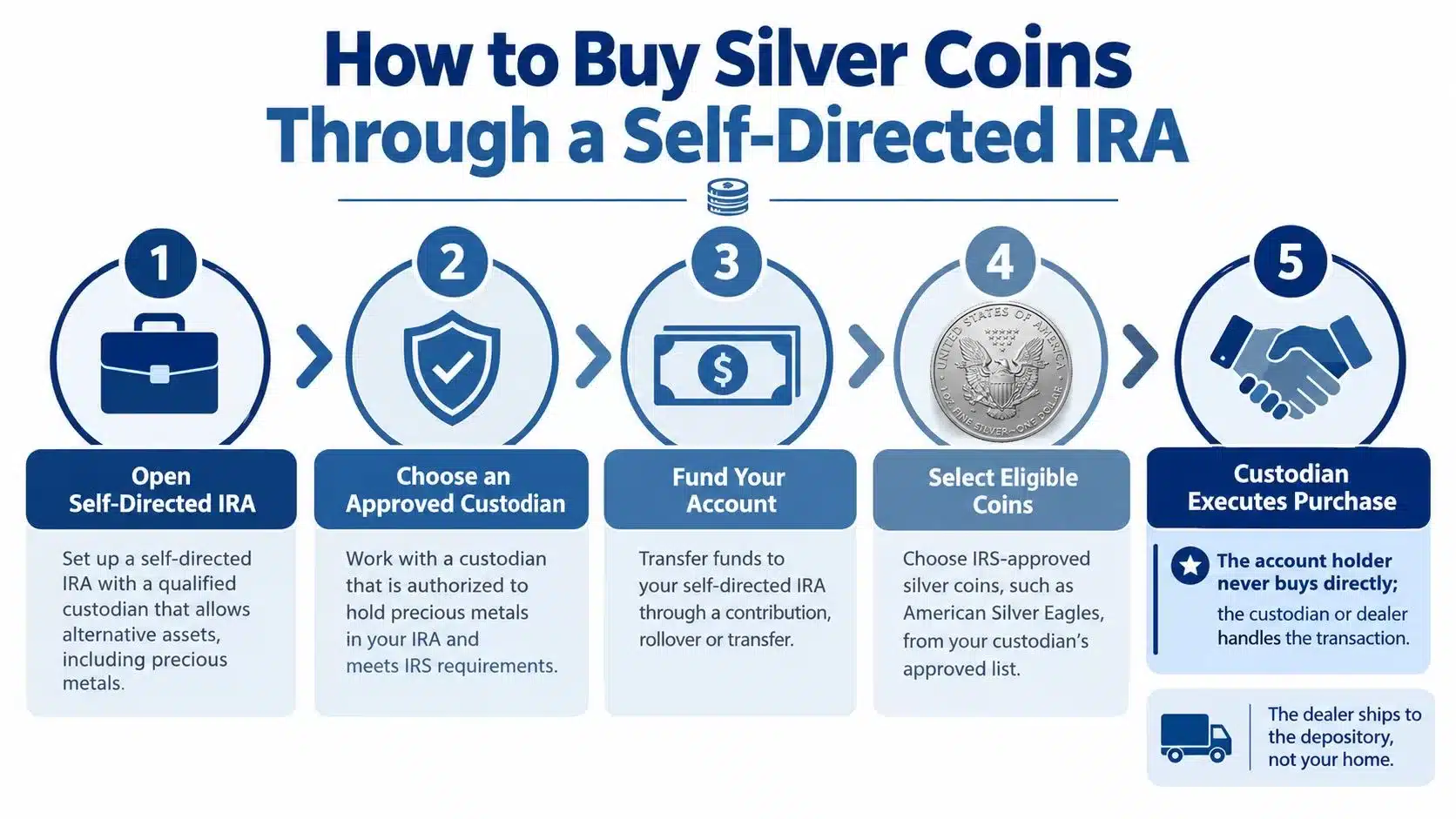
The basic purchase flow
- Open a self-directed IRA with a custodian that allows precious metals.
- Fund the account through a contribution, transfer, or rollover.
- Choose eligible silver products that fit the custodian's rules.
- Authorize the transaction through the IRA structure.
- Send the metal to an approved depository, not to the account holder's home.
The key point is simple. The account holder chooses within the rules, but the custodian or dealer executes the transaction on behalf of the IRA.
Where contribution and rollover rules matter
This is also the stage where funding rules become very real. For 2026, the annual contribution limit for a Silver IRA is reported as $7,000 for investors under 50 and $8,000 for investors age 50 and older, according to this Silver IRA rules page. Those limits apply to new annual contributions, not to properly handled rollover money from another retirement account.
The rollover side has its own trapdoor. If an investor uses an indirect rollover, the money must be redeposited into another eligible retirement account within 60 calendar days or the distribution can become taxable, as explained in this IRA rollover rules guide.
A direct trustee-to-trustee transfer is usually simpler because the account holder never takes possession of the funds. That lowers the chance of a deadline mistake.
For readers who want a broader framework before choosing a metals format, this TD metal buying guide for investors gives useful context on how many buyers compare physical precious-metals options in the first place.
A visual walkthrough can also help clarify the buying sequence:
What never happens in a clean setup
A compliant purchase does not look like this:
- Personal purchase first: Buying silver personally and trying to “contribute” the coins later
- Home delivery: Having the dealer ship IRA metal to a residence
- Informal storage: Putting the coins in a personal safe while the paperwork catches up
Gold IRA Association publishes educational checklists and rollover guides that help readers map these steps before opening an account, which can reduce avoidable process errors.
Compliance Pitfalls Worth Knowing Before You Buy
The biggest silver IRA mistakes usually begin with confidence. A buyer feels familiar with coins, assumes the rules are common sense, and then stumbles into an IRA rule that works very differently from an ordinary bullion purchase.
That's why it helps to challenge a few popular assumptions directly.
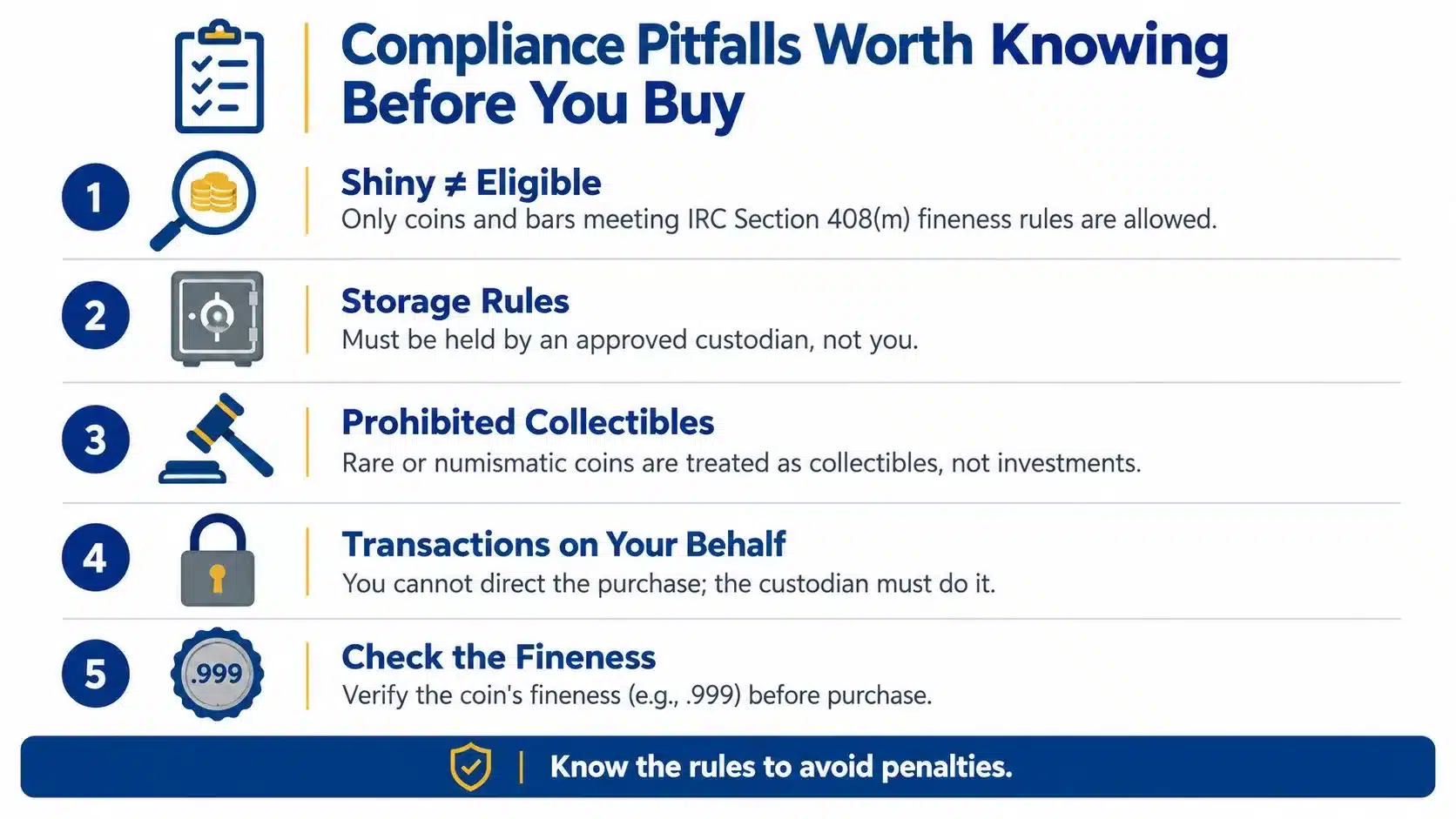
Assumptions that get investors in trouble
- “Any real silver coin should work.” IRA rules are narrower than ordinary bullion buying. Many older silver coins and collectible issues fall outside the accepted standard.
- “If a coin is expensive, it must be better.” A high numismatic premium can be a warning sign inside an IRA, not an advantage.
- “One rollover per account means I'm fine.” That's not how the rule works for indirect IRA rollovers.
- “I can hold the metal briefly while the account is being set up.” Personal possession can create serious tax problems.
- “Storage is just a practical detail.” In an IRA, storage is part of the compliance structure.
The rollover rule many people miss
The one-rollover-per-year rule applies across all of a taxpayer's IRAs combined, not per account, so only one indirect 60-day rollover is allowed in any 12-month period. Trustee-to-trustee transfers don't count toward that limit because the account holder never takes possession of the funds, according to this 60-day rollover explanation.
That catches people who recently moved money from one IRA to another and assume they can repeat the process for a silver IRA right away.
If an investor has already used an indirect rollover recently, the safer path is often to ask whether a direct transfer is available instead of trying to force another 60-day rollover.
Storage and distribution issues
Storage mistakes are just as serious. IRA-held silver belongs in an approved depository under the retirement-account structure. Home storage, or even temporary personal possession, can undermine the account's tax treatment.
Traditional silver IRAs also create a practical issue later in retirement. Required minimum distributions may force the account owner to either sell enough metal to generate the needed cash amount or take metal out as an in-kind distribution. Either way, the taxable value still matters.
Frequently Asked Questions About Silver in an IRA
Can IRA silver coins be stored at home?
No. IRA silver coins are generally held through an approved custodian and stored in an approved depository or similar authorized arrangement under the IRA structure. A home safe may feel secure, but from a retirement-account standpoint it can create the same kind of problem as taking a distribution.
The reason is simple. The tax benefits of the IRA depend on proper custody, not just on owning qualifying silver.
How do required minimum distributions work with silver?
Silver doesn't pay interest or dividends, and it doesn't naturally produce cash inside the account. That means when required minimum distributions apply in a traditional IRA, the custodian usually has to help facilitate either a sale of enough metal to meet the distribution amount or an in-kind distribution of silver.
For many retirees, that turns RMD planning into a logistics issue as much as a tax issue. The account may need enough flexibility to avoid selling coins at an inconvenient moment.
Can heirs receive the physical silver?
In many cases, heirs can inherit the account and then make decisions under inherited-IRA rules. A surviving spouse may have options to roll the assets into their own retirement account, while other beneficiaries may instead take distributions under the inherited account structure.
The practical point is that physical metal doesn't stay trapped forever in depository form. It can eventually move through estate and distribution channels, but those steps should be coordinated carefully with the custodian and a qualified tax professional.
Are silver coins always better than silver bars in an IRA?
Not always. Coins may offer easier recognition and resale familiarity, while bars may offer more silver exposure per dollar because their premiums are often lower. The better choice depends on whether the investor values flexibility and recognition more than ounce efficiency.
Is this financial advice?
No. This is not financial advice. Readers should consult a licensed financial advisor, CPA, or tax professional before making investment decisions involving IRA silver coins, rollovers, or distributions.
Gold IRA Association publishes plain-English guides for readers comparing precious-metals IRAs, eligible silver products, and rollover rules. For anyone still deciding whether IRA silver coins or silver bars make more sense, it's a useful next step for reviewing educational articles, checklists, and provider comparisons before opening an account.