


A self-directed IRA is an individual retirement account that lets the owner choose alternative investments such as real estate, private lending, or physical precious metals, while a specialized custodian handles the paperwork and storage. In 2015, 488,333 self-directed retirement accounts held nearly $50 billion in assets, showing that these accounts are established but remain a small part of the broader retirement market.
But does greater investment freedom also mean greater legal responsibility? That's the question many conventional explainers leave unanswered. A self-directed IRA can widen the menu of retirement assets, yet the owner must investigate the investment, understand its value, avoid prohibited transactions, and plan for an exit that may be difficult or slow.
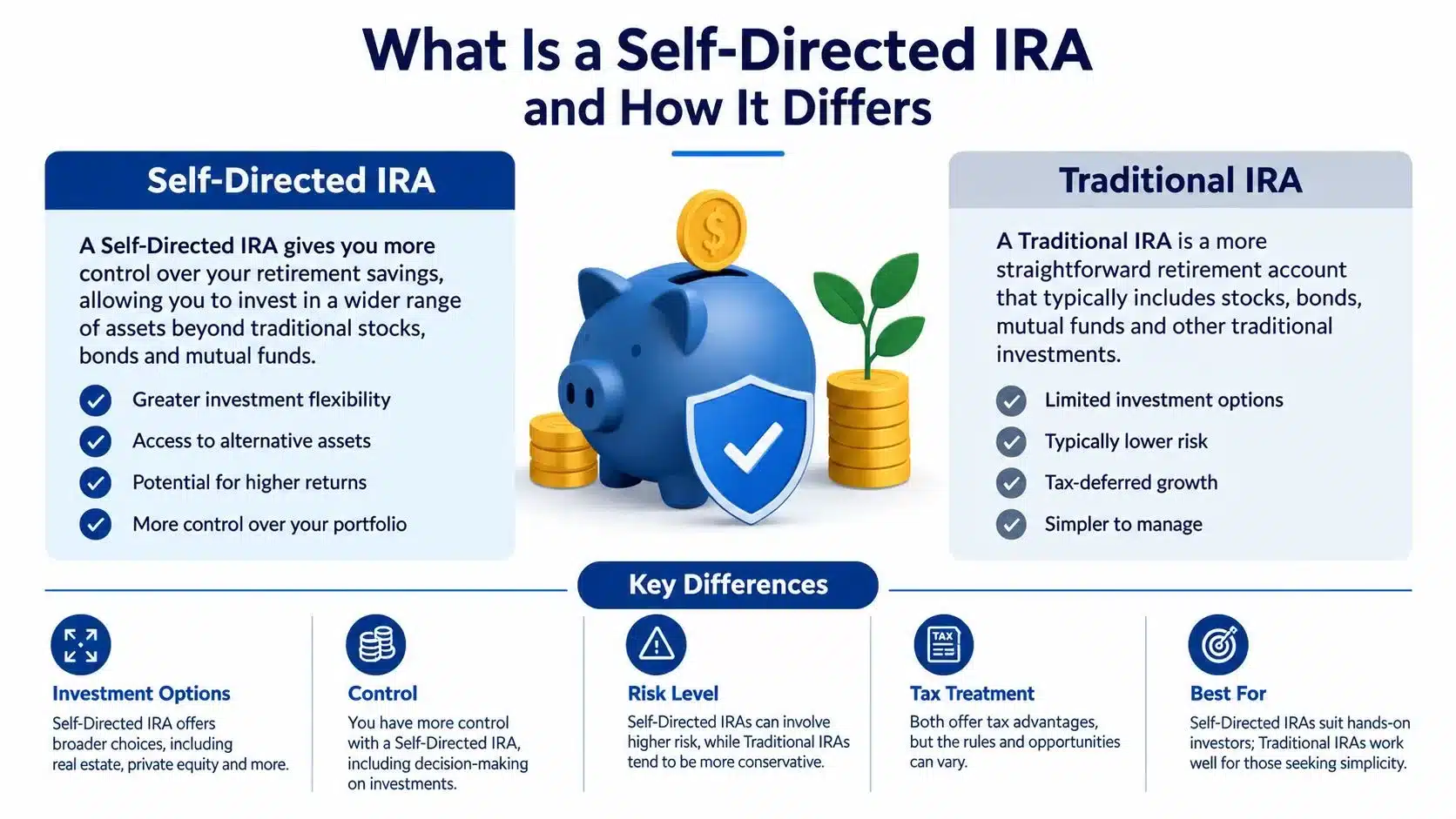
What Is a Self-Directed IRA and How It Differs
A self-directed IRA, or SDIRA, is not a separate tax code category. It's an IRA administered by a custodian that allows the account owner to select investments beyond the publicly traded securities commonly offered by banks and brokerages. The tax treatment still depends on the underlying IRA type, such as Traditional or Roth, and ordinary IRA rules continue to apply.
A conventional brokerage IRA usually offers a defined menu of stocks, bonds, mutual funds, exchange-traded funds, and certificates of deposit. An SDIRA may allow investments such as rental real estate, private lending arrangements, private-company interests, and IRS-approved physical precious metals. The custodian provides administration, reporting, and transaction processing, but the owner chooses the asset.
A useful analogy is a cafeteria compared with a full kitchen. A brokerage IRA offers a fixed menu selected by the institution. An SDIRA gives the investor a larger kitchen, but the investor must follow strict rules about which ingredients can be used, who can handle them, and how the finished meal is documented.
The three practical differences
- Investment flexibility: The owner can consider alternative assets that a conventional account may not offer.
- Custody responsibilities: A specialized custodian holds the account and processes transactions. It doesn't become the investment adviser or asset manager.
- Due diligence: The owner must evaluate the investment, sponsor, valuation, fees, liquidity, and legal structure.
The distinction became especially important after the Taxpayer Relief Act of 1997, which expanded IRA investing by permitting certain precious metals inside retirement accounts and helped formalize the modern self-directed and precious-metals IRA framework. The IRS explains IRA rules through Publication 590-A and Publication 590-B, while the broader retirement market shows the scale in which SDIRAs operate. GAO data listed 13,556 IRA financial assets in 2023 worth $10,462.8 billion, compared with $11,950 billion in 2022, a change associated with the 2022 market decline (GAO report).
Readers building a broader retirement strategy can also browse retirement planning resources for background on account structures, income planning, and diversification.
Eligible and Ineligible Assets You Can Hold
The phrase “self-directed” doesn't mean an IRA can own anything the account holder wants. The IRS permits a broad range of alternative investments, but the asset must fit within the rules, and the transaction must avoid prohibited conduct.
Common eligible categories include:
| Eligible Assets | Ineligible Assets |
|---|---|
| Real estate, including rental property and certain commercial property | Life insurance |
| Private mortgages, promissory notes, and other private lending arrangements | Collectibles such as art, rugs, antiques, and most alcoholic beverages |
| Stock in qualifying LLCs and C corporations | Gems and stamps |
| Limited partnerships | S corporation stock |
| Tax liens | Personal-use property |
| IRS-approved gold, silver, platinum, and palladium | Any asset involved in a prohibited transaction |
Physical precious metals illustrate why eligibility requires more than a sales brochure. Gold generally must meet a 99.5% fineness standard, while silver generally must meet a 99.9% fineness standard. Eligible coins must also have legal-tender status from the mint of origin. The specific product, form, purity, custody arrangement, and storage method all matter.
Eligibility is only the first test
An investment can be an eligible category and still create a compliance problem. For example, an IRA may be permitted to own real estate, but the owner can't treat that property as a personal vacation home. Likewise, an account may hold private-company stock, but the investment can't be structured to benefit the owner or another disqualified person improperly.
The practical lesson is simple: asset eligibility and transaction compliance are separate questions. Aggressive marketing may focus on the first while overlooking the second. Before committing retirement funds, the account owner should ask the custodian to confirm whether it accepts the planned asset and should obtain professional tax or legal guidance for unusual arrangements.
How Custodians, Dealers, and Storage Actually Work
Every SDIRA transaction involves separate roles. Confusion among those roles creates avoidable risk, especially when a dealer's sales presentation makes it sound as though the custodian has independently approved the investment.
The three parties
The account owner makes the investment decision. This person chooses the asset, reviews the offering or purchase terms, and directs the custodian to complete the transaction.
The custodian or administrator establishes the account, processes paperwork, maintains records, handles required reporting, and holds the account assets. Depending on the transaction, reporting can include IRS Forms 5498 and 1099-R.
The dealer, sponsor, seller, or investment promoter provides the asset or offering and communicates its price, terms, and expected transaction process. That party isn't the same as the custodian and may have a financial interest in completing the sale.
The SEC warns that SDIRA custodians generally don't research, investigate, or recommend investments. They also may not verify investor-provided information, ensure complete disclosure, or hold the underlying investment funds or assets themselves (SEC investor guidance).
Practical rule: Custody confirms that a transaction can be administered. It doesn't confirm that the investment is sound, fairly priced, or suitable.
The normal transaction flow
- Select a custodian that administers the intended asset class.
- Complete the account application and beneficiary designations.
- Fund the IRA through a contribution, transfer, or rollover.
- Wait for the funds to clear.
- Direct the custodian to send funds to the dealer, seller, escrow account, or investment sponsor.
- Arrange approved custody and storage for tangible assets.
Physical metals generally need an IRS-compliant depository or vault. Keeping IRA-owned metals in a personal home safe can create a serious tax and compliance issue because the account, not the individual, must own and control the asset through the required structure.
A custodian's capabilities matter, so readers comparing providers can review this guide to an IRA custodian for gold before opening an account. No party in the chain should be treated as a substitute for independent due diligence.

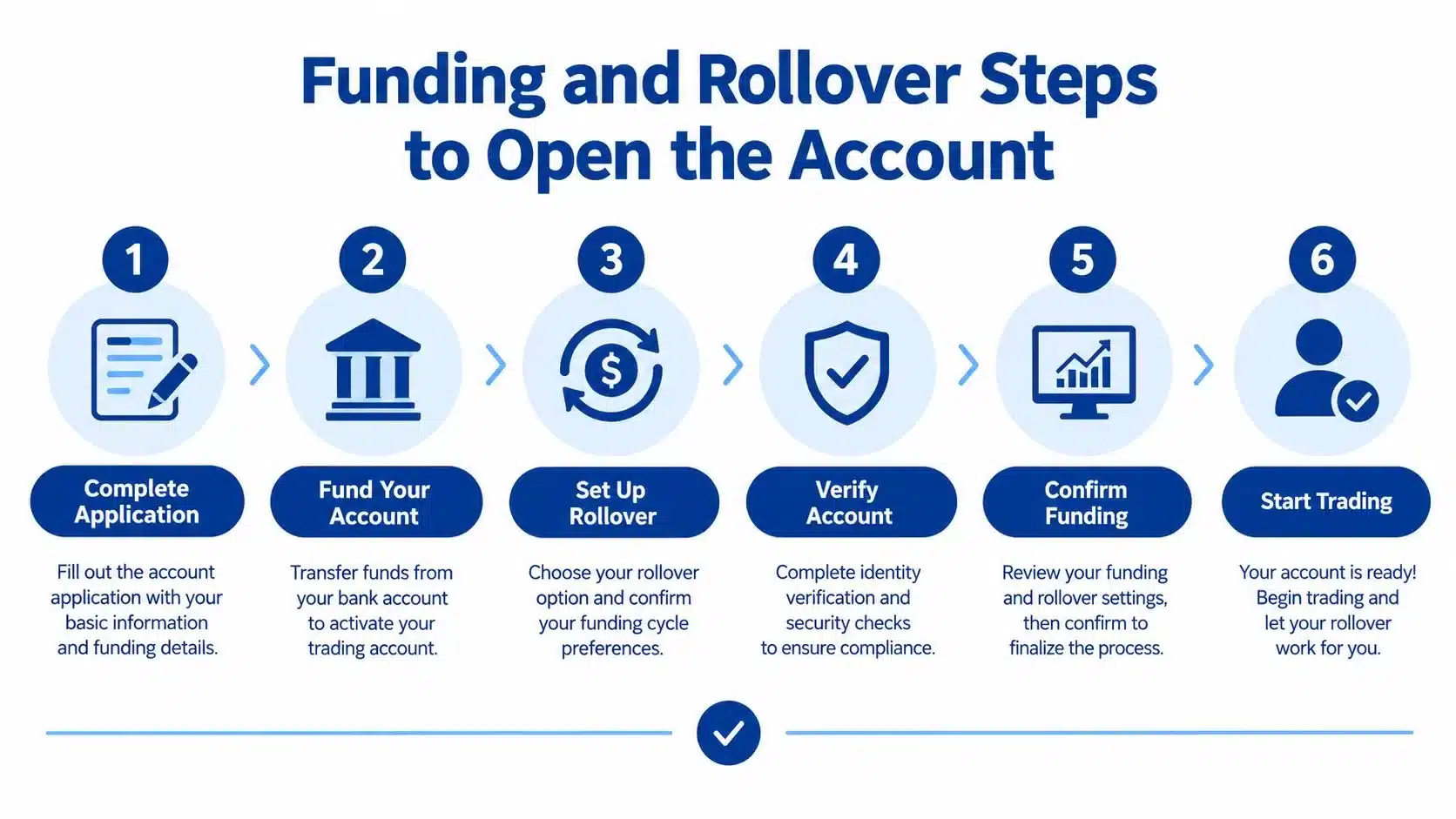
Funding and Rollover Steps to Open the Account
Most investors reach an SDIRA through one of three routes. The account's self-directed feature doesn't create a new contribution limit. The applicable limits and eligibility requirements depend on whether the account is Traditional, Roth, SEP, SIMPLE, or another permitted arrangement, and current IRS rules should be checked before money moves.
Three ways to fund the account
Annual contributions add new money directly to the IRA, subject to the applicable contribution rules and income requirements. Traditional and Roth contributions have different tax characteristics, so a tax professional should review deductibility, eligibility, and the investor's existing basis.
A direct transfer moves funds from one IRA custodian to another. The money travels between institutions, which generally reduces the risk of the investor accidentally receiving the distribution.
A rollover moves eligible retirement money from an employer plan or another retirement account into the SDIRA. A former employer's 401(k) or 403(b) may be a source, although plan rules and employment status affect what's available.
A careful sequence
- Choose the custodian: Confirm that it accepts the planned investment.
- Open the account: Complete the application and beneficiary paperwork.
- Fund first: Wait until the custodian confirms that funds have cleared.
- Direct the purchase: The IRA, not the individual, should make the payment.
- Document everything: Keep statements, invoices, valuation records, and transaction instructions.
Indirect rollovers require particular care. The 60-day rule, the once-per-year limit for certain IRA-to-IRA rollovers, and 20% mandatory withholding on some 401(k) distributions can create tax consequences if the investor doesn't replace withheld amounts or complete the process correctly. After-tax dollars can also create a taxable basis issue that deserves professional review.
The custodian usually handles much of the administration after the paperwork is complete, but it can't correct every personal tax mistake. Readers considering the mechanics of moving retirement money can review direct transfer versus rollover before selecting a path.
A visual walkthrough can help readers distinguish an institution-to-institution transfer from an indirect rollover:
Prohibited Transactions and IRS Compliance Risks
A self-directed IRA isn't a personal brokerage account with a wider investment menu. The account owner can direct investments, but retirement money and IRA-owned property must remain separate from personal finances.
The IRS prohibits actions such as borrowing from the IRA, selling property to it, lending to it, or using IRA assets as collateral for another debt. A transaction that looks ordinary or occurs at fair market value can still be prohibited if it involves a disqualified person or creates indirect self-dealing.
Who counts as a disqualified person
The account owner is a disqualified person and fiduciary. The category also generally reaches the owner's spouse, lineal ascendants and descendants, and entities controlled by those persons. The relationship matters even when the proposed deal seems commercially reasonable.
| Action | Status | Typical IRS Consequence |
|---|---|---|
| Borrowing from the IRA | Prohibited | Loss of tax-favored treatment and potential taxable distribution |
| Selling personal property to the IRA | Prohibited | Possible disqualification of the account |
| Using IRA assets as loan collateral | Prohibited | Tax and compliance consequences |
| Allowing personal use of IRA-owned property | Prohibited | Potential account disqualification |
| Conducting an investment with an unrelated party under documented terms | Potentially permissible | Requires proper records and ongoing compliance |
The IRS states that an improper use can cause the IRA to lose its tax-favored status, effectively treating it as a taxable distribution in the year of the violation (IRS prohibited-transaction guidance). The SEC also emphasizes that the investor bears responsibility for evaluating the investment and understanding the risks of limited disclosure, higher fees, fake custodians, and complicated tax rules.
Some commentary describes a single prohibited transaction as capable of treating the entire IRA as distributed, rather than merely unwinding the specific deal. That outcome can be far more severe than a first-time investor expects. Certain debt-financed alternative investments can also raise unrelated business income tax questions, while nonpublic assets require credible fair-market-value reporting.
The safest assumption is that personal benefit and IRA ownership must never overlap.
Readers who want a broader plain-English reference on legal use restrictions can use it as background, but unusual IRA transactions should be reviewed with a qualified tax or legal professional. A focused explanation of self-directed IRA disqualified persons can help identify relationships that investors often overlook.
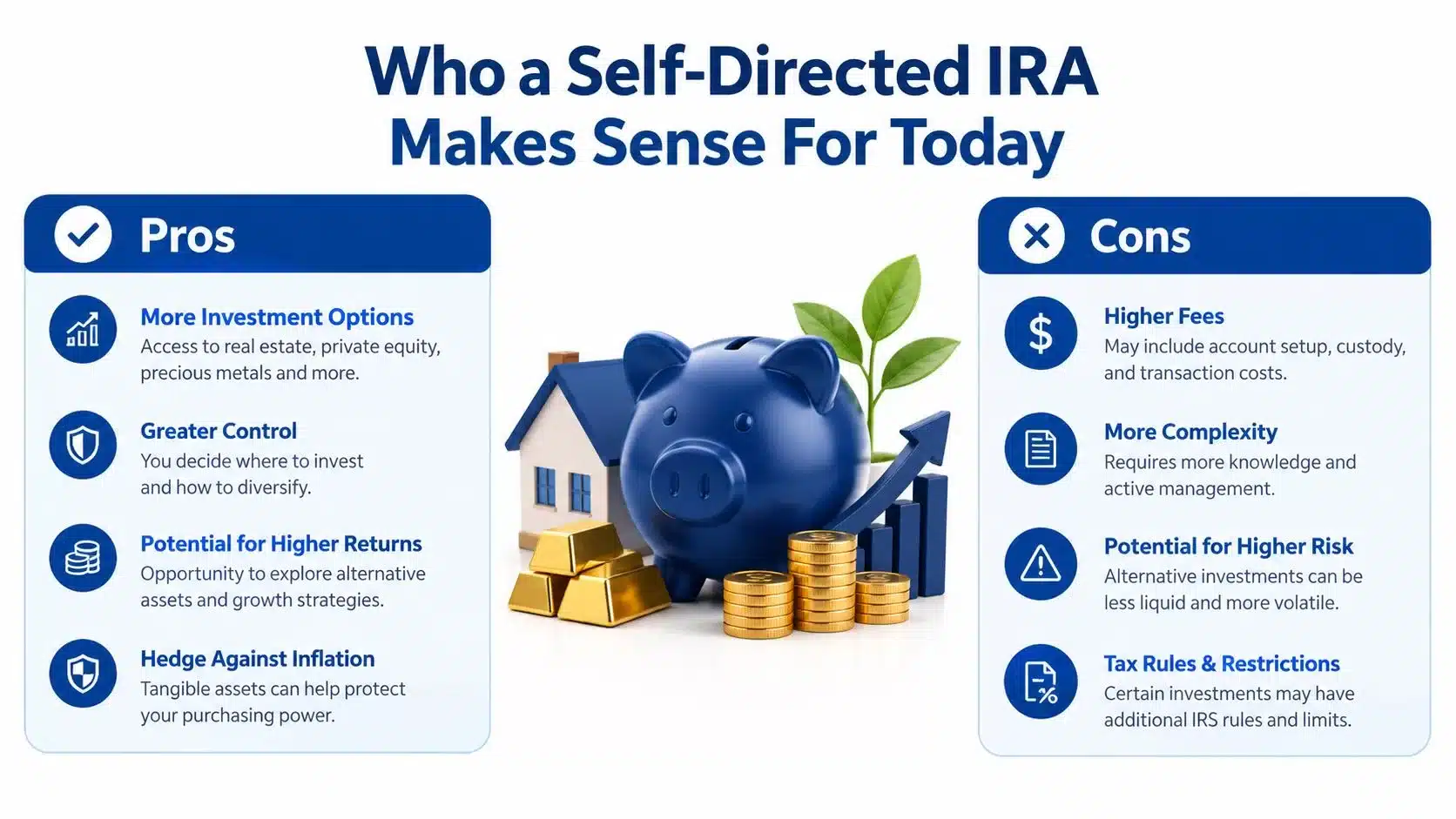
Who a Self-Directed IRA Makes Sense For Today
An SDIRA suits a narrower group of investors than promotional material may suggest. The strongest candidates usually have a specific alternative asset in mind, understand why they want it, and can investigate it without assuming the custodian has performed that work.
A near-retiree considering a modest allocation to eligible precious metals may value the ability to hold physical assets inside a retirement account. A landlord with experience screening tenants, maintaining property, and reviewing operating statements may understand the demands of IRA-owned real estate better than a passive investor. An accredited investor with verifiable experience evaluating private deals may also be equipped to review sponsor risk, liquidity restrictions, and valuation terms.
Small-business owners require extra caution. Funding a venture connected to the owner or family can create prohibited-transaction problems, even when the business is legitimate. A qualified professional should review the structure before retirement money is committed.
The tradeoff behind flexibility
The SDIRA investor accepts more friction in exchange for a wider investment menu:
- Liquidity: Private assets and property may take time to sell.
- Valuation: Nonpublic investments can be difficult to price objectively.
- Administration: Transactions require paperwork, records, and coordination.
- Costs: Custodial, storage, valuation, transaction, and professional fees can reduce net results.
- Risk review: The owner must investigate counterparties, contracts, debt, insurance, and exit options.
Investor concerns reflect that tradeoff. In the 2025 STRATA SDIRA Investor Survey, 38% cited overall investment risk as the biggest influence on strategy, up from 30% in 2023 (survey discussion). Regulators and state securities authorities also warn that alternative assets can be illiquid, difficult to value, and more exposed to fraud or misleading custodial claims.
A basic brokerage IRA may be more appropriate for a passive investor who wants daily liquidity, simple statements, and a familiar investment menu. The same may be true for someone uncomfortable tracking compliance or for a saver whose retirement balance is concentrated in employer stock and needs a more immediate diversification and liquidity review. General risk advice from Professional Insurance Advisors can provide useful context, but it can't replace individualized retirement guidance.
Key Takeaways and a Clear Next Step
The answer to what is a self-directed IRA becomes clearer when the account is viewed as a structure rather than a promise. It's an IRA that gives the owner control over a broader set of permitted investments, while a specialized custodian administers the account. That flexibility can support diversification, including exposure to eligible precious metals, real estate, private lending, or other alternatives.
The flexibility also transfers work to the investor. The custodian generally doesn't verify the investment's quality, independently confirm every representation, or recommend whether the asset belongs in the retirement plan. The owner must review the investment, understand its valuation, assess liquidity, investigate the counterparty, and keep the transaction separate from personal use.
A practical decision framework
An SDIRA may deserve consideration when all of the following are true:
- A specific asset exists: The investor can explain what they want to buy and why.
- Liquidity is acceptable: The retirement plan can tolerate an asset that may be difficult to sell.
- Due diligence is realistic: The owner has the time and knowledge to review documents and counterparties.
- Compliance is manageable: The owner understands disqualified-person rules and will avoid personal benefit.
- Costs are visible: The custodian has disclosed setup, administration, transaction, storage, and valuation charges.
Many investors may be better served by treating an SDIRA as an optional satellite account rather than replacing a core retirement account. Concentrating all retirement savings in one private deal, one property, or one metal category can create a different risk from the one the investor hoped to solve.
A sensible next step this week is research, not a rollover. Pull the latest IRA and employer-plan statements, confirm balances and custodians, write down the alternative asset under consideration, and request a complete fee schedule and prohibited-transaction list from two self-directed custodians before funding anything. Ask who stores physical assets, who performs valuation reporting, what happens when an asset must be sold, and which professionals handle tax questions.
This is not financial advice. Consult a licensed financial advisor, CPA, or tax professional before making investment decisions. Retirement rules vary by account type and individual circumstances, and current IRS guidance should be checked before contributions, transfers, rollovers, or purchases.
Gold IRA Association publishes educational guides on self-directed precious-metals accounts, rollover procedures, eligible metals, custodian responsibilities, fees, and provider comparisons. Visit Gold IRA Association to continue researching the structure and prepare questions before speaking with a custodian or specialist.