



A former employer's 401(k) is still sitting in an old plan, a traditional IRA no longer fits the desired strategy, and physical gold or silver has started to look like a possible diversification tool. The confusing part isn't usually the investment decision. It's choosing the correct way to move the retirement money. In the direct transfer vs rollover question, the safest default for most Gold or Silver IRA funding is to keep the money out of the account owner's hands entirely.
Why This Choice Matters for Your Retirement Move
A retirement move can go wrong before the money reaches the new account. The deciding detail is who receives the funds first. The IRS separates a direct transfer, a direct movement between trustees or custodians, from an indirect rollover, where the distribution reaches the saver and must be redeposited.
That distinction controls the compliance risk. A direct transfer between traditional IRA trustees does not put the money in the account owner's hands and generally avoids both the 60-day deadline and the once-per-12-month IRA rollover limit, as explained in IRS guidance on rollovers of retirement-plan and IRA distributions. A direct rollover from an employer plan into an IRA also keeps the funds away from the participant, although the IRS uses “rollover” for that plan-to-IRA move.
An indirect rollover starts when the plan or IRA pays the individual. The saver then has 60 days to deposit the eligible amount into another retirement account unless a waiver applies. For eligible employer-plan distributions paid to the participant, the plan generally withholds 20% for federal taxes. To roll over the full pre-tax balance, the saver must replace that withheld amount from another source. Topic 413, rollovers from retirement plans explains this treatment.
Practical rule: Choose the movement method before signing distribution paperwork. Once a check is payable to you, the deadline, deposit, and tax consequences are yours to manage.
| High-level question | Direct transfer or direct rollover | Indirect rollover |
|---|---|---|
| Who receives the money first? | The receiving trustee or custodian | The account owner |
| Does a personal redeposit clock begin? | No | Yes, generally 60 days |
| Is the saver responsible for replacing withheld funds? | Generally no | Yes, when plan withholding applies |
| Does the once-per-12-month limit normally control? | No | It can apply to IRA-to-IRA rollovers |
| Default choice for Gold or Silver IRA funding | Yes | Use only for a specific reason |
For a Gold or Silver IRA, make the direct route the default. Open the receiving account, confirm that both custodians have the correct instructions, and have the institutions move the money directly. Do not accept a check personally unless a CPA has reviewed the tax and timing consequences for your situation. A late deposit can turn a retirement transfer into taxable income, and fixing that mistake is harder than choosing the safer path at the start.
What the IRS Means by Transfer and Rollover
The IRS draws a sharper line than many retirement explainers do. A trustee-to-trustee transfer moves money directly between IRA trustees or custodians. Because the funds aren't distributed to the account owner, the transaction isn't treated as a rollover and generally avoids the rollover deadline.
A direct rollover usually describes money moving from a qualified employer plan, such as a 401(k), directly into an IRA. The account owner doesn't receive the funds, but the transaction is still a rollover in the technical sense because the money is leaving one type of retirement arrangement and entering another. Readers comparing account options can review the broader mechanics in this Gold IRA rollover guide.
An indirect rollover is different. The plan or IRA distributes money to the individual, and the individual must place it into another eligible retirement account within 60 days. The transaction can remain tax-deferred if completed correctly, but missing the deadline can turn the distribution into taxable income. The IRS states that the direct trustee-to-trustee route avoids this timing issue because no distribution reaches the owner.
Why the paperwork differs
Direct transactions and rollovers create different documentation trails. Industry retirement-account guidance explains that transfers generally aren't reported as rollovers, while rollovers are reported through forms such as 1099-R and 5498, creating a separate recordkeeping obligation. That distinction is summarized in this explanation of how transfers and rollovers differ.
The critical concept is constructive receipt. If the individual can receive and control the check, the IRS treats the transaction as a distribution followed by a possible rollover. If the check is payable to the receiving trustee for the benefit of the account owner, the money stays within the retirement-account system.
Gold and Silver IRA custodians commonly prefer or require the direct route because physical-metals purchases must be funded through the properly titled retirement account. A check made payable to the individual creates avoidable questions about timing, withholding, and redeposit. A check payable to the new trustee keeps the transaction aligned with the intended account-to-account movement.
Direct Transfer vs Rollover Side by Side
A direct transfer keeps the custodians in control of the money. An indirect rollover puts the account owner between them, which creates more work and more chances for an expensive mistake. The IRS distinction matters because the transaction type determines who handles the funds, how the movement is reported, and where operational risk sits.
| Feature | Direct Transfer | Indirect Rollover |
|---|---|---|
| IRS reporting | The custodians report the account-to-account movement under the applicable retirement-plan rules, generally identifying it as a transfer rather than a participant distribution. | The distribution and subsequent deposit create a reporting trail that commonly involves Forms 1099-R and 5498. |
| Control of funds | The sending institution delivers the money to the receiving trustee or custodian for the benefit of the account owner. | The account owner receives the distribution, holds the funds, and must complete the redeposit correctly. |
| Operational risk | Lower. The institutions coordinate the movement, reducing the chance of a missed deadline or misdirected payment. | Higher. The saver must track the check, satisfy the redeposit requirements, and resolve any withholding or paperwork problem. |
The paperwork tells you what happened
Direct transactions and rollovers leave different records. Transfers generally stay within the trustee-to-trustee process, while rollovers are documented as a distribution followed by a deposit into another retirement account. This distinction is summarized in this explanation of how transfers and rollovers differ.
The key issue is constructive receipt. If the account owner can receive and control the check, the IRS treats the event as a distribution that may then qualify for rollover treatment. If the check is payable to the receiving trustee for the benefit of the owner, the funds remain inside the retirement-account system.
A direct transfer also gives the custodian a cleaner audit trail. That matters for a Gold or Silver IRA, where the receiving account must be properly titled before money is used to buy physical metals. A check payable to the individual can create questions about whether the funds arrived on time, whether the deposit was complete, and whether the account owner handled the money personally.
The clean recommendation
Use a direct transfer or direct rollover as the default for Gold and Silver IRA funding. It keeps the institutions responsible for the movement and avoids making the saver the temporary holder of retirement funds.
Choose an indirect rollover only for a specific operational reason, such as an institution refusing to send the funds directly. Before accepting a check payable to you, ask why the custodian cannot make the payment to the receiving trustee. If the explanation involves unusual tax treatment, mixed account types, inherited assets, or a large distribution, involve a CPA before depositing or spending the funds.
Doing a Direct Transfer Into a Gold or Silver IRA
A direct transfer into a precious-metals IRA is mostly a coordination exercise. The new custodian, old custodian, account owner, and metals dealer each have a defined role. The account owner should keep the money moving between custodians and avoid becoming the middleman.
The funding sequence
Open the receiving account. Select a self-directed IRA custodian that permits physical precious metals and confirm whether the new account is traditional or Roth.
Complete the transfer paperwork. The receiving custodian normally provides a form identifying the existing account, the sending institution, and the new IRA.
Direct the payment correctly. The current custodian sends funds electronically or issues a check payable to the receiving custodian for the benefit of the account owner. It shouldn't be payable to the individual.
Confirm arrival. The new custodian records the incoming funds in the IRA. This is the point at which the account is ready for an investment instruction, subject to the custodian's procedures.
Select an approved depository and eligible metals. Physical bullion must be handled through the retirement-account structure. The custodian, not the account owner personally, should coordinate storage.
Authorize the purchase. After the dealer confirms the product and price, the custodian sends payment from the IRA. The depository then takes delivery and records the holdings under the retirement account.
Use the guide to choosing an IRA custodian for gold to evaluate account administration, storage arrangements, and transaction procedures before opening the account.
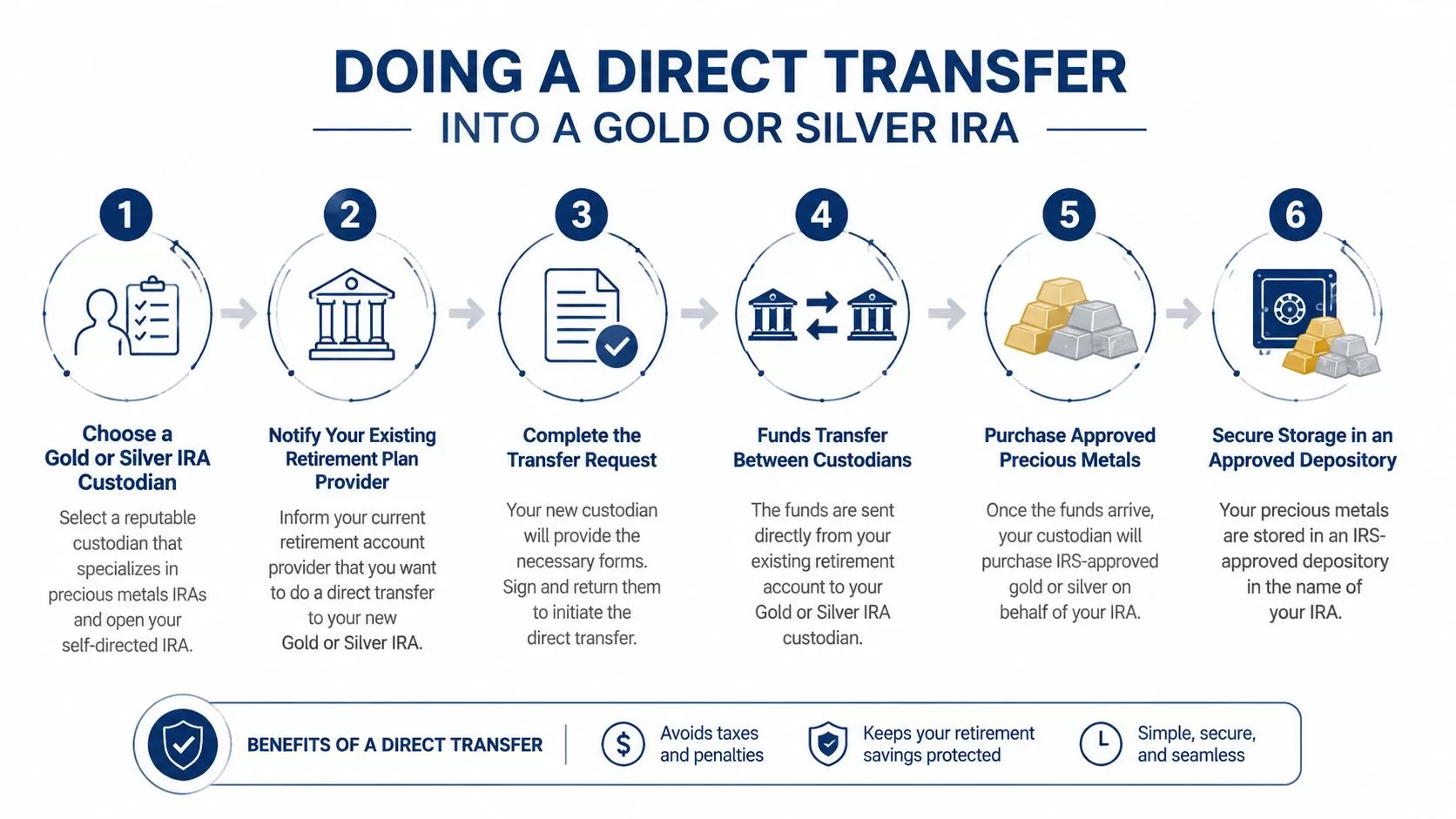
The full process may take 5 to 14 business days, depending on the institutions and paperwork, as specified in the process guidance for this move. The depository's delivery confirmation should identify the retirement account, not the individual's personal name as the owner of the metals.
A direct movement is operationally cleaner because the account owner never has to replace withheld money or monitor a personal bank deposit. The custodian-to-custodian design also keeps the 60-day rollover clock from starting.
When an Indirect Rollover Still Makes Sense
An indirect rollover isn't automatically wrong. It's the path with more responsibility and more ways to miss a requirement. The saver receives the funds, must track the distribution date, and must complete the redeposit within 60 days.
There are limited reasons to use it. The sending plan might refuse a direct movement, an institution might be unable to meet an immediate transaction requirement, or the saver might need temporary access to the money before redepositing it. Those circumstances should be documented before the distribution request is submitted.
The amount that must be restored
For an eligible employer-plan distribution paid to the participant, 20% federal withholding applies. The saver must redeposit the full pre-tax distribution, including the withheld amount, to avoid treating the shortfall as taxable. The withheld funds may not be sitting in the check, so personal cash may be needed to complete the rollover.
Good intentions can turn into an unexpected tax bill. A saver who deposits only the amount received has not necessarily rolled over the entire distribution. The IRS explains the timing consequences and redeposit requirement in its rollover tax guidance.
Treat the rollover as an exception
The once-per-12-month rule can apply to an indirect IRA-to-IRA rollover, while direct transfers aren't affected by that limit. The limit applies to the individual's IRA rollover activity, so multiple IRA accounts don't create separate opportunities to ignore the rule.
A rollover can be a useful tool, but it shouldn't be the routine funding method for a Gold or Silver IRA. If a direct path is available, it removes the personal check-handling problem, the withholding shortfall, and the deadline anxiety in one decision.
Special Cases Worth Knowing Before You Move Money
Some retirement movements don't fit the simple “old account to new account” description. Account ownership, plan type, marital status, and tax character can change the correct procedure. These cases deserve attention before any distribution is requested.
Scenarios that change the answer
| Scenario | Recommended Path | Key Rule to Remember |
|---|---|---|
| Non-spouse inherited IRA | Trustee-to-trustee transfer to a properly titled inherited IRA | The IRS says the 60-day rollover exception doesn't apply to non-spouse inherited accounts. |
| Former employer 401(k) | Direct rollover to an IRA, when permitted | This is generally a rollover from an employer plan, not an IRA transfer. |
| Current employer 401(k) | Review the plan's in-service distribution rules | Access may depend on whether the plan permits an in-service distribution. |
| Spousal beneficiary | Confirm the beneficiary election and account titling before movement | Spousal treatment can differ from non-spouse inherited-account treatment. |
| Divorce-related movement | Follow the applicable domestic-relations order and custodian process | A transfer connected to divorce needs specialized paperwork. |
| Roth-to-Roth movement | Use a properly titled Roth IRA transfer or direct rollover | Roth assets shouldn't be sent into a traditional account without tax analysis. |
Inherited IRAs deserve particular caution. The IRS treatment described in this technical analysis of trustee-to-trustee transfers involving inherited IRAs shows why the label matters. A non-spouse beneficiary generally can't treat inherited assets like the beneficiary's own IRA, and incorrect titling can create consequences that a standard transfer form won't fix.
A former employer's 401(k) can often move into a self-directed Gold IRA through a direct rollover. Current employees need to check the plan's rules because access may depend on separation from service or an available in-service distribution feature. That question belongs with the plan administrator before the account owner chooses a receiving custodian.
A Roth conversion is a separate tax decision, not a routine transfer. Moving pre-tax money into a Roth account can create taxable income, so a CPA should review the conversion alongside any precious-metals funding plan.
If a 60-day deadline is at risk, don't wait for the deadline to pass. The IRS may provide relief in limited circumstances, including certain waivers or disaster-related relief, but a private letter ruling isn't guaranteed. A CPA should be involved before the distribution, especially where inherited assets, after-tax contributions, divorce paperwork, or several accounts are involved.
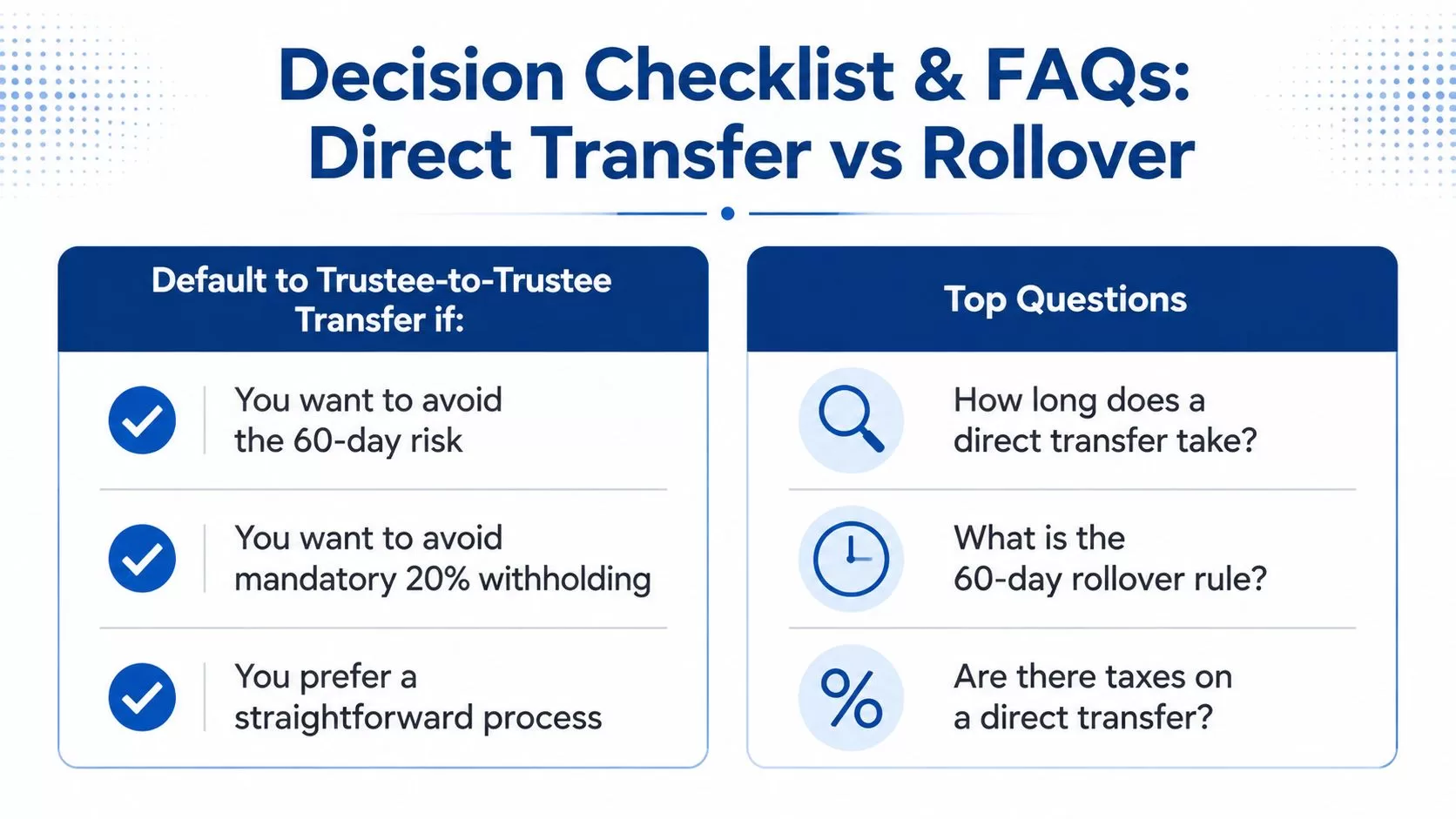
Decision Checklist and Common Questions
The safest decision usually follows a short sequence. The account owner should identify the current account, identify the receiving account, and ask whether the funds can move without personal receipt.
A practical decision checklist
- Match the account types: Confirm whether the movement involves a traditional IRA, Roth IRA, inherited IRA, or employer plan.
- Open the receiving account first: The new custodian needs an active account before it can accept incoming funds.
- Use the correct language: Ask for a trustee-to-trustee transfer or direct rollover, not a check payable to the individual.
- Confirm the payee: A check should generally be payable to the receiving custodian for the benefit of the account owner.
- Coordinate both institutions: Ask the sending and receiving custodians to confirm the delivery method and status.
- Keep the records: Save transfer forms, confirmation notices, account statements, and purchase instructions.
- Escalate unusual cases: Ask a CPA to review non-spouse inheritance, after-tax contributions, Roth conversions, divorce transfers, and multi-account coordination.
Questions readers ask after choosing a path
Can a 401(k) move straight into a Gold IRA?
Usually, the movement is structured as a direct rollover from the employer plan to the self-directed IRA. The plan administrator must confirm eligibility, especially if the person still works for the employer.
What happens if the check arrives late?
If the check is payable to the account owner, the 60-day period still matters. Contact the receiving custodian and a CPA immediately. Missing the deadline can make the distribution taxable unless a valid waiver or relief applies.
Does the once-per-12-month rule apply to a direct transfer?
No. A direct trustee-to-trustee transfer isn't treated as a rollover, so the once-per-12-month IRA rollover limit doesn't apply.
How does a Roth conversion fit in?
A Roth conversion changes the tax character of the assets and should be reviewed separately. It isn't a tax-free transfer from one matching IRA to another.
What paperwork will the new custodian need?
Expect account-opening documents, identity information, the existing account details, transfer or rollover forms, and instructions for the receiving account. Exact requirements vary by custodian.
The calm next step is simple: confirm that the account types match, call the sending institution, and ask both custodians to coordinate the wire or check so the 60-day clock never starts. This is not financial advice. Consult a licensed financial advisor, CPA, or tax professional before making investment decisions.
Gold IRA Association provides educational guides, rollover explanations, custodian information, and comparisons to help retirement savers understand the mechanics before moving money. Visit Gold IRA Association to review the direct-transfer process and prepare questions for the custodians and tax professionals involved.