



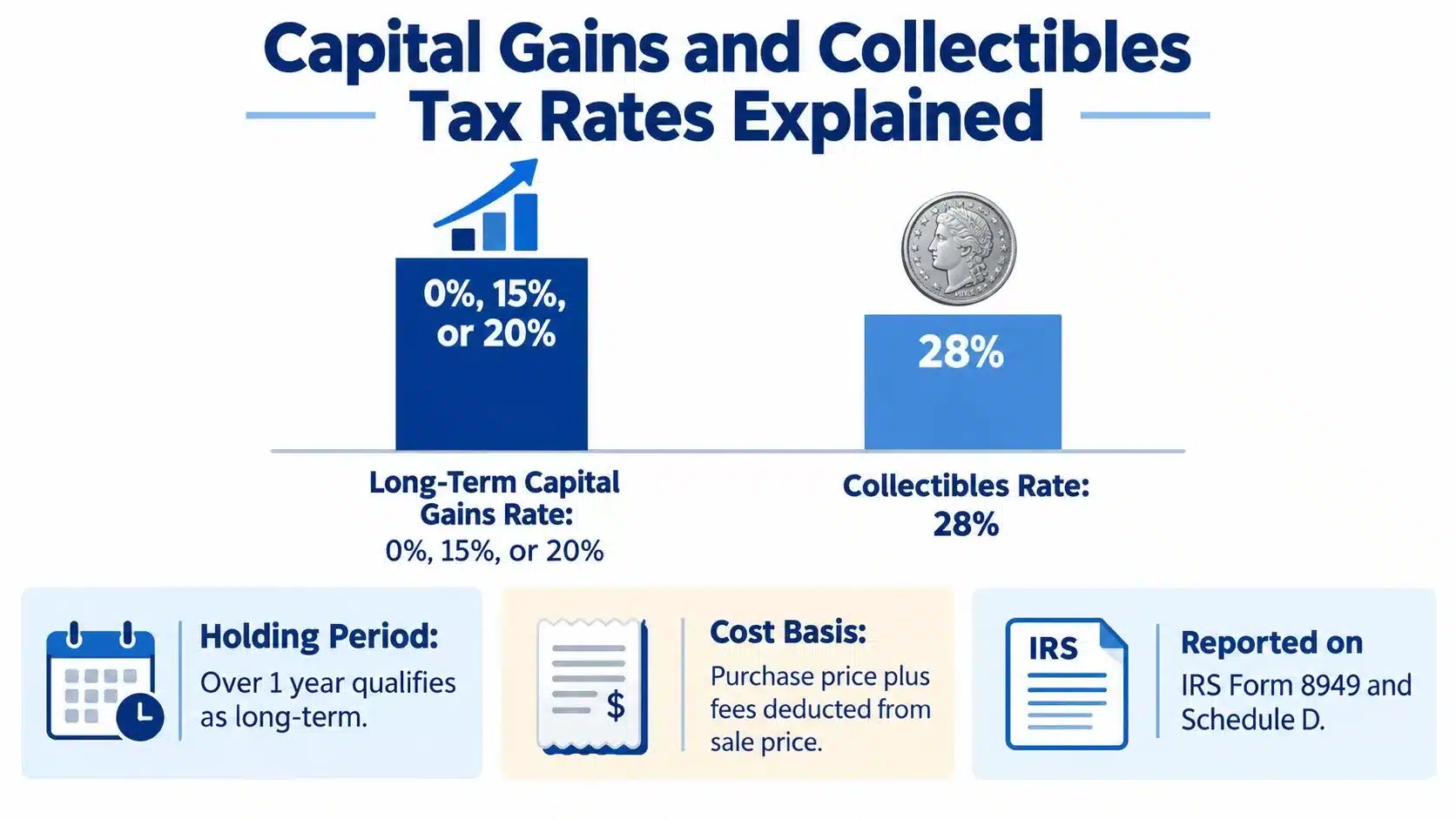
Physical silver is classified by the IRS as a collectible, so long-term gains face a maximum federal rate of 28%, not the standard 20% capital-gains rate. Owning silver generally isn't the taxable event, but selling it at a profit can create a federal tax bill, along with possible state taxes.
A near-retiree may hold coins or bars for years, then discover that the tax treatment differs from a stock or bond fund. The result depends on the holding period, adjusted basis, account type, sale reporting, and the state where the purchase is delivered. The rules become easier to manage when each tax layer is considered separately.
Understanding the Tax on Silver Basics
The most important starting point is the IRS classification. Physical precious metals, including silver coins, rounds, bars, and ingots, are treated as collectibles rather than ordinary investment securities. That classification affects the federal rate applied to a profitable sale, as summarized in this overview of silver and other metals taxation.
Ownership is different from selling
Buying and holding physical silver generally doesn't create a federal capital-gains event. The key event is usually the taxable sale. If the sale produces no profit, there generally isn't a capital gain to tax. If the sale produces a gain, the investor calculates that gain using the proceeds and the silver's adjusted basis.
Adjusted basis generally starts with the purchase price and can include eligible transaction costs. In practical terms, a receipt isn't just proof of ownership. It can help establish how much the investment cost and therefore how much of the eventual proceeds represent taxable profit.
The holding period then determines which federal framework applies:
- Held for one year or less: A gain is generally short-term and taxed at ordinary-income rates.
- Held longer than one year: The gain remains subject to the collectibles regime, with a federal rate capped at 28%.
- No gain: A sale that doesn't exceed adjusted basis doesn't create a taxable gain, although other reporting considerations may still apply.
Practical rule: Treat every invoice, dealer fee, acquisition date, and sale statement as part of the investment record.
This distinction prevents a common mistake. An investor may assume that silver automatically receives the same long-term rate available to many securities. Physical silver doesn't receive that standard treatment just because it was held for more than a year.
Why history still matters
The federal government has treated silver as a policy-sensitive asset before. The Silver Purchase Act of June 19, 1934 imposed a targeted levy equal to 50% of the profit on transferring an interest in silver bullion. The taxable amount was the transfer price above the seller's cost plus permitted expenses, and the levy didn't apply to a transaction that produced no profit. Payment used stamps attached to the sale memorandum, creating the distinctive silver tax stamp system. The law also reached certain transfers made on or after May 15, 1934, before enactment.
In United States v. Hudson, decided in 1937, the Supreme Court described the provision as a special income tax and upheld its application to qualifying profits. The episode shows why silver taxation shouldn't be viewed only as a routine sales charge. Governments have also used tax rules to discourage speculation and support commodity-management policy during monetary stress. The Supreme Court's decision is available in the United States v. Hudson opinion.
Capital Gains and Collectibles Tax Rates Explained
The tax calculation begins with a simple subtraction:
Sale proceeds minus adjusted basis equals taxable gain.
Adjusted basis can include the purchase price and eligible transaction costs. A person who paid dealer fees at purchase should preserve those records because transaction costs may affect the amount of gain. The same recordkeeping principle applies to other asset sales, and a resource explaining adjusted basis on rental sales can help illustrate why original cost records matter across different types of property.
Short-term and long-term treatment
Suppose a high-income investor sells silver after holding it for one year or less. The gain is generally taxed at the investor's ordinary-income rate. If that investor is in a 37% ordinary-income bracket, a short-term gain could be taxed at that rate under the stated example.
If the same investor holds the silver longer than one year, the gain remains within the collectibles regime, but the applicable federal rate is capped at 28%. In a simplified example involving a $10,000 gain, a 37% rate would produce $3,700 of federal tax, while a 28% rate would produce $2,800, before considering deductions, credits, state taxes, or the investor's complete tax situation. The difference in this example is $900.
That comparison doesn't mean every investor should hold silver longer. Market conditions, liquidity needs, portfolio risk, and personal circumstances still matter. It does show why the holding period should be recorded carefully rather than estimated from memory.
A calculation checklist
Before reporting a sale, the investor should gather:
- Acquisition date: Establish whether the silver was held for one year or less, or longer than one year.
- Original cost: Locate the purchase invoice and identify the amount paid.
- Eligible expenses: Add transaction costs that belong in adjusted basis.
- Sale proceeds: Use the final amount received, accounting for selling costs where applicable.
- Ownership records: Separate lots when silver was purchased at different times or prices.
A short-term sale isn't automatically wrong, and a long-term sale isn't automatically advantageous. The tax result is one factor in a broader decision. A retiree who needs cash may reasonably sell despite a higher ordinary-income rate, while another investor may have more flexibility to wait.
The collectibles cap also isn't a promise that the final bill will always equal 28%. It is a federal ceiling for the applicable collectibles rate. State income taxes may add to the liability, and the investor's overall filing circumstances can change the result.
Silver in Tax-Advantaged Retirement Accounts
Silver held in a taxable account and silver held inside an IRA follow different tax paths. In a taxable account, a profitable sale can create the collectibles-related capital-gains issue described above. In a traditional IRA, qualifying earnings and gains generally aren't taxed when the silver appreciates or is sold inside the account. Tax generally becomes relevant when money or property is distributed.
The IRS exception is narrow. IRS Publication 590-B identifies one-ounce U.S. silver coins minted by the Treasury Department and certain highly refined silver bullion as permissible IRA investments. The account structure creates tax deferral, not a universal exemption. A traditional IRA generally postpones taxation until distribution, when the withdrawal is generally treated under the account's distribution rules. Eligibility and reporting depend on the facts.
Taxable account compared with an IRA
| Location of silver | Main tax timing | Main issue |
|---|---|---|
| Taxable account | Usually when a profitable sale occurs | Collectibles treatment and adjusted basis |
| Traditional IRA | Generally at distribution | Product eligibility and compliant custody |
| Roth IRA | Depends on qualified distribution rules | Individual eligibility and account requirements |
A Roth IRA can provide a different outcome for qualified withdrawals, but readers shouldn't assume that placing any silver in any retirement account automatically creates tax-free treatment. The account type, contribution history, distribution circumstances, product eligibility, and custody arrangement all matter.
For readers reviewing broader retirement planning changes, a plain-language resource on tax changes for retirees explained may provide useful context. The central point remains that the tax treatment comes from the retirement-account structure and the distribution rules, not from silver alone.
Investors considering an IRA purchase should review the eligibility requirements before placing an order. The guide to buying silver for an IRA can help organize questions about eligible products, account setup, and documentation.
Silver inside an IRA isn't a shortcut around tax rules. It's a different tax container with its own product and custody requirements.
IRS Rules for IRA-Owned Silver and Custody
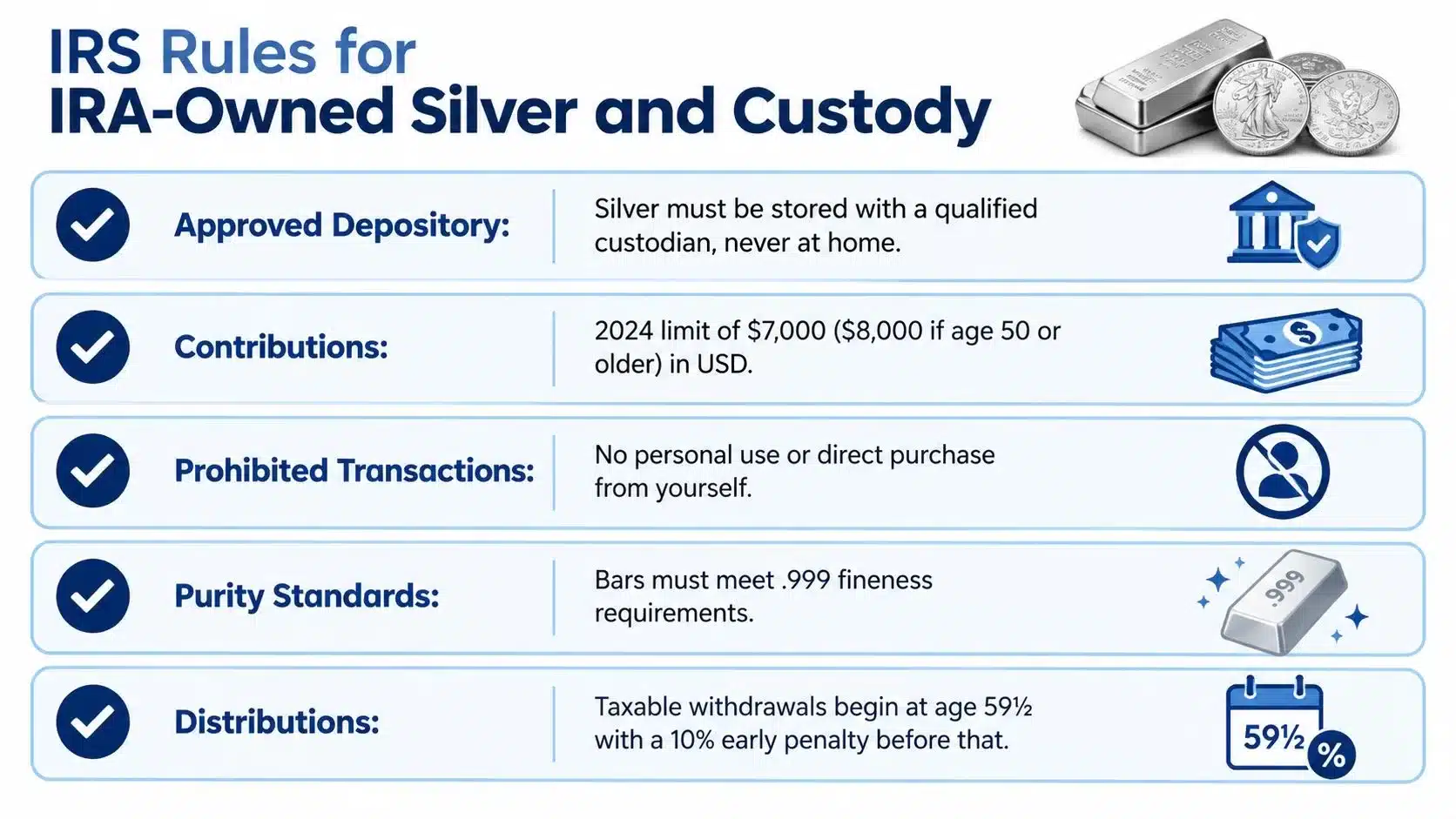
The account's legal structure matters as much as the metal itself. IRA-owned silver must remain in the physical possession of the IRA custodian or trustee, typically a bank or an IRS-approved nonbank trustee. The account owner generally can't take the silver home, store it in a personal safe, or treat it as personal property while continuing to claim that it remains inside the IRA.
Custody is a tax requirement
Taking personal possession can cause the amount to be treated as distributed in the year of the transaction. That distribution may create ordinary income, and an early distribution may also trigger the 10% additional tax described in the applicable rules. The issue isn't merely where the investor prefers to store the metal. It is whether the IRA continues to satisfy the custody arrangement required for deferred treatment.
A compliant process generally includes:
- Select an eligible custodian: Confirm that the institution can administer a self-directed precious-metals IRA.
- Verify the product: Check the coin or bullion specifications before purchase.
- Direct the transaction through the IRA: The account, rather than the individual, should purchase the approved silver.
- Confirm depository custody: Obtain records showing where the custodian holds the metal.
- Review distribution procedures: Understand how an eventual cash or in-kind distribution will be reported.
The IRS identifies one-ounce U.S. Treasury-minted silver coins and certain highly refined silver bullion as permissible categories. That doesn't mean every round, collectible coin, bar, or specialty product qualifies. A product can be made of silver and still fail the relevant IRA requirements.
Questions to ask before funding
Investors should request written answers to practical questions:
- Product eligibility: Does the specific coin or bar meet the applicable requirements?
- Fineness documentation: What records confirm the metal's required refinement?
- Custody: Which trustee or custodian holds the silver?
- Distribution reporting: How will a future distribution be valued and reported?
- Personal possession: Does any proposed arrangement allow the account owner to take the metal home?
The precious-metal IRA rules guide offers another way to organize this due diligence. A careful investor should also ask a tax professional to review unusual arrangements before funds move, because correcting a custody error after the fact can be difficult.
Reporting Requirements and Form 1099-B
A missing Form 1099-B doesn't mean a silver sale is tax-free. Form 1099-B is an information return that brokers and barter exchanges use to report proceeds, and sometimes basis, to the taxpayer and the IRS. Whether a broker must issue it for silver depends on specific reporting exceptions.
The IRS says a broker's sale of precious metal, including silver, isn't automatically reportable when the form of metal isn't approved by the Commodity Futures Trading Commission for trading by a regulated futures contract. Even an approved form can fall within an exception when the quantity is below the minimum amount required for the relevant CFTC-approved futures contract. The IRS instructions for Form 1099-B describe those conditions.
Reporting by the broker versus reporting by the seller
These are separate responsibilities:
- Broker information reporting: The broker may or may not issue Form 1099-B under the precious-metals exceptions.
- Investor tax reporting: The seller still needs to calculate any taxable gain or loss.
- Record support: The seller needs purchase, sale, cost, date, and ownership records.
The IRS also requires sales for one customer during a single 24-hour period to be aggregated when applying the exception. Dividing a sale into smaller transactions during that period doesn't necessarily prevent reporting. The exception also can't be used to evade information reporting when the broker knows or has reason to know that a customer, alone or with a related person, is structuring transactions to avoid reporting.
Reporting warning: Form 1099-B tells the IRS about a transaction when required. It doesn't decide whether the transaction created taxable income.
A seller should therefore prepare the tax records even when no form arrives. The investor may need to report the sale using the applicable tax forms and schedules, based on the nature of the transaction and the individual's filing situation. A practical overview of bullion reporting requirements can help readers identify questions before tax filing begins.
State Sales Tax and Purchase Considerations
Federal income tax and state sales tax apply at different moments. Federal capital-gains rules generally matter when an investor sells for a profit. State sales or use tax can matter when the investor buys or receives the silver, even though the investor hasn't sold anything and hasn't realized an investment gain.
State treatment can depend on the buyer's location, the delivery address, the transaction size, the product classification, and whether an online seller has collection obligations in that jurisdiction. A purchase made at a local event, an online order shipped to the investor, and silver stored in another state may raise different questions.
Why state rules change the calculation
A 2025 Florida legislative analysis states that gold, silver, and platinum bullion became exempt from sales tax when a single transaction exceeds $500. At the same time, reporting on Maryland and Washington describes 2025 changes that narrowed or repealed previous bullion exemptions. The Florida analysis is available in this state legislative document on bullion taxation.
That contrast makes nationwide claims such as “silver is tax-free” unreliable. A buyer may face no sales tax in one qualifying transaction, taxable treatment below a state threshold, or a use-tax obligation when another jurisdiction applies its rules. State legislation can change independently of federal IRA rules.
A purchase-tax verification list
Before placing an order, the buyer should ask:
- Which state controls delivery: Is tax determined by the shipping destination rather than the buyer's home address?
- What threshold applies: Does the exemption depend on the total value of one transaction?
- Which products qualify: Are coins, rounds, bars, and collectible pieces treated alike?
- Who collects the tax: Does the seller collect it, or must the buyer evaluate a use-tax obligation?
- What proves exemption: Is an invoice showing the product, amount, delivery address, and tax treatment available?
Shipping and marketplace collection rules can affect the final amount, so the buyer should keep the order confirmation, invoice, shipping record, and any exemption documentation. For a broader compliance perspective involving tax-sensitive transactions, this Cloudvara compliance guide may help frame the importance of retaining supporting records.
The practical conclusion is simple: “Tax-free silver” isn't a universal category. The buyer should verify the exact state, product, transaction size, and delivery arrangement before purchasing, then preserve the evidence that supports the treatment.
This is not financial advice. Consult a licensed financial advisor, CPA, or tax professional before making investment decisions.
Gold IRA Association provides educational guides on silver IRAs, IRS-approved metals, custody, rollovers, and provider comparisons. Visit Gold IRA Association to review the relevant silver IRA resources and prepare questions for a qualified tax or financial professional before acting.