


A reader researching buying silver for an IRA may find an attractive coin or bar, then discover that the product, storage arrangement, rollover method, or annual cost doesn't fit IRS requirements. Physical silver can provide diversification, but an IRA adds compliance rules and expenses that ordinary silver ownership doesn't. This guide explains eligibility, approved products, custodians, transfers, rollovers, total costs, and the circumstances in which a silver IRA may or may not make sense.
Understanding Silver IRA Eligibility Requirements
The first question isn't which silver coin looks appealing. It's whether the product qualifies for tax-advantaged retirement treatment at all. A silver item can be genuine bullion and still fail the standard required for a self-directed IRA.
For silver, the central purity requirement is 99.9% pure, or.999 fine silver. The rule separates eligible bullion from many collectible or lower-purity products. A product that falls below that threshold may be treated as a collectible rather than an IRA asset, even if it contains substantial silver. The IRS precious-metals IRA rules explained by Gold IRA Association provide additional context on how these accounts are structured.
The requirement exists because retirement accounts receive special tax treatment. The account cannot hold just any silver object selected by the owner. Product eligibility, approved custody, and proper recordkeeping work together to preserve the account's legal structure.
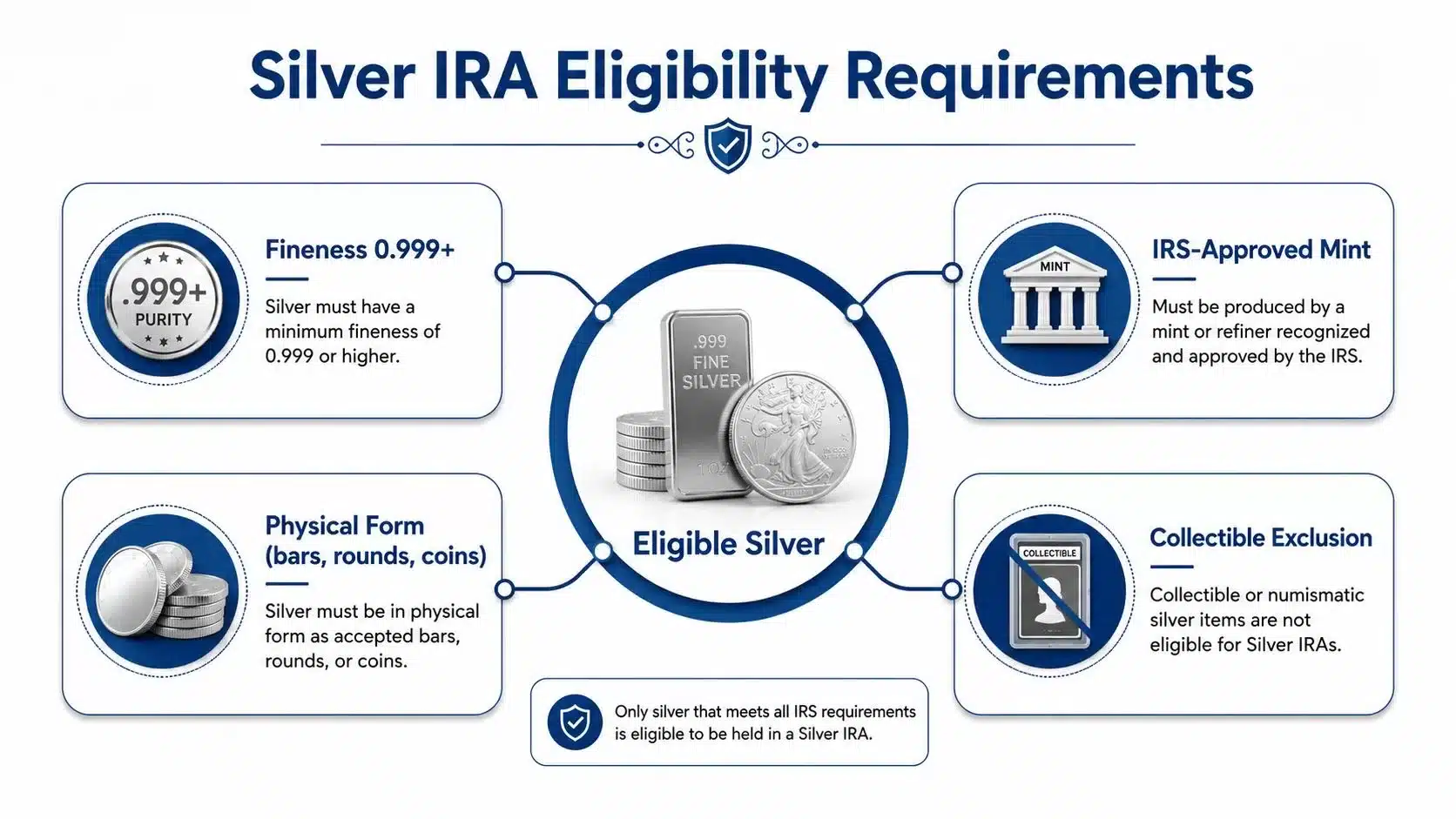
The four checks that matter
Before placing an order, an investor should verify:
- Fineness: The silver meets the .999 purity threshold, as described in this guide to silver IRA-approved fineness.
- Product identity: The coin, round, or bar appears on the custodian's accepted product list.
- Custody: The metal remains with an approved custodian or trustee and is stored in a qualified depository, rather than at the investor's home.
- Documentation: Purchase records, valuations, storage records, and account statements remain connected to the IRA.
Personal possession creates a separate problem. An investor can't buy qualifying silver with IRA funds and then place it in a private safe while treating it as though the custodian still holds it. The account needs an approved custody arrangement from purchase through storage and eventual distribution.
Practical rule: Confirm eligibility with the custodian before buying. A dealer's description alone doesn't replace the custodian's compliance review.
IRS-Approved Silver Products for Retirement Accounts
The purity test becomes easier to apply when the product is examined line by line. Commonly accepted examples include American Silver Eagles, Canadian Silver Maple Leafs, and.999 silver bars, provided the custodian accepts the specific product and the transaction follows the account's custody rules. Government-minted bullion is often familiar to custodians, while privately produced bars or rounds require closer verification of fineness, refiner, and acceptance.
By contrast, common 90% pre-1965 U.S. silver coins generally fail the.999 standard and typically aren't eligible for a silver IRA, as explained in this silver eligibility overview. Their historical importance or silver content doesn't overcome the purity requirement.
| Product Type | Purity Level | IRA Eligible |
|---|---|---|
| American Silver Eagle | .999 fine silver | Generally accepted, subject to custodian approval |
| Canadian Silver Maple Leaf | .999 fine silver | Generally accepted, subject to custodian approval |
| Silver bar from an accepted refiner | .999 fine silver | May qualify, subject to custodian approval |
| Private-mint silver round | Must meet.999 standard | Depends on the mint and custodian |
| Common pre-1965 U.S. silver coins | 90% silver | Typically not eligible |
How to check a product before purchase
Ask for the exact product name, weight, fineness, mint or refiner, and any identifying markings. Then send that information to the proposed custodian. This simple sequence helps prevent a dealer from selling a product that belongs in a taxable personal collection instead of a retirement account.
A product's lower purchase price isn't automatically an advantage. If it has uncertain acceptance or limited resale recognition, the investor may face more friction when selling or transferring the holding. Readers comparing broader custody arrangements can also compare TD metal storage options while evaluating how storage fits into the overall account structure.
The key distinction is straightforward: silver content alone doesn't establish IRA eligibility. The product must satisfy the fineness rule and the custodian's operational requirements.
Choosing a Self-Directed IRA Custodian
A custodian is more than a company that opens an account. The custodian maintains the IRA structure, processes contributions or transfers, coordinates with an approved depository, keeps records, and helps document purchases and sales. That administrative role is why a regular brokerage account generally can't add physical silver to its investment menu.
The selection process should begin with questions, not promotional materials. A prospective custodian should explain its setup process, annual charges, storage arrangements, transaction procedures, distribution rules, and accepted products in plain language.
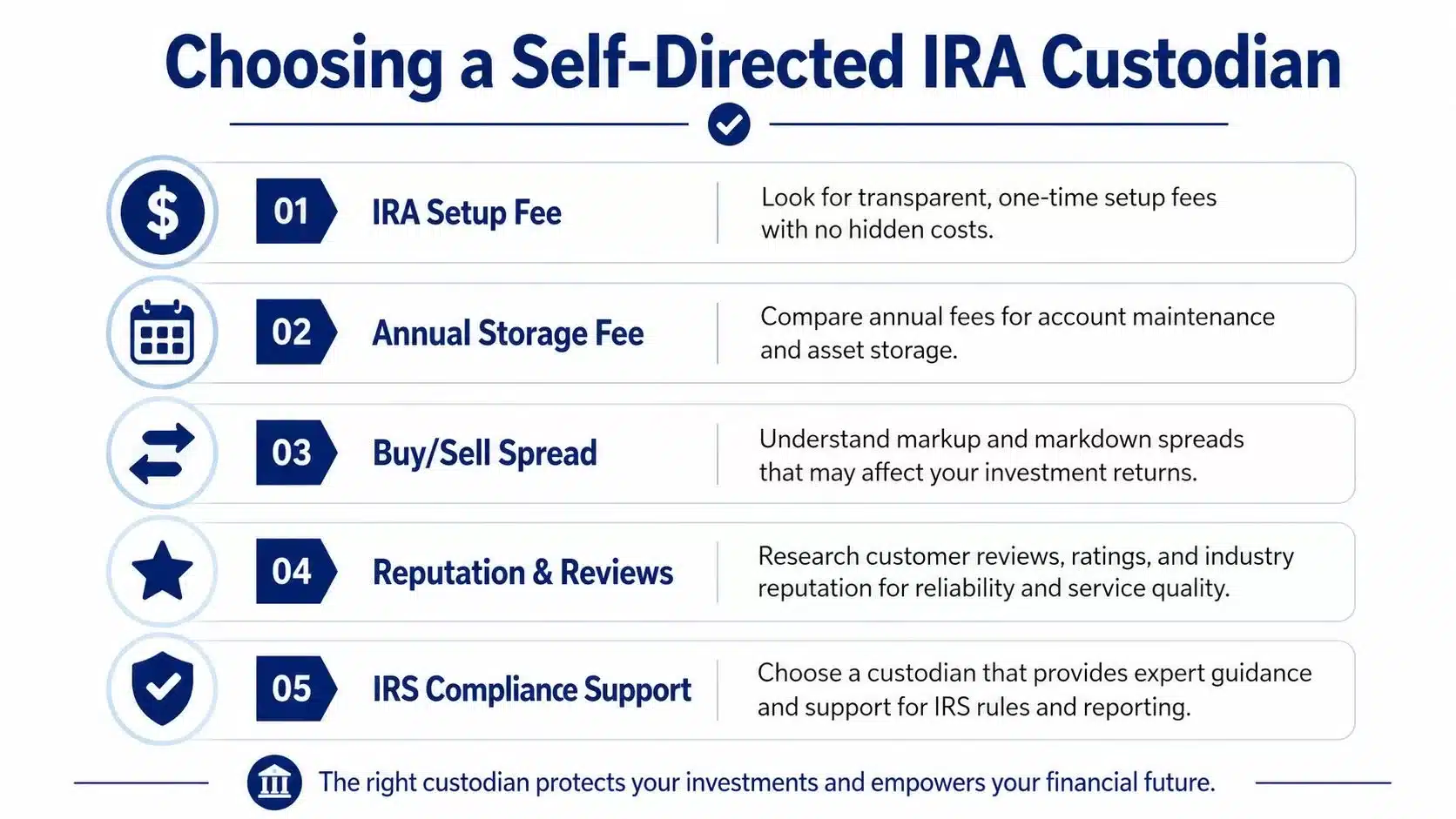
What to ask before opening the account
- Fee disclosure: Request a complete schedule covering setup, administration, storage, buying, selling, and distribution-related charges.
- Precious-metals experience: Ask how the custodian handles silver products specifically, not just self-directed accounts generally.
- Depository arrangements: Confirm where the metal will be stored and whether storage is commingled or segregated.
- Product approval: Obtain the accepted-product list before choosing coins, bars, or rounds.
- Service responsiveness: Ask who handles compliance questions when a transfer, sale, or distribution needs attention.
A custodian should distinguish clearly between its own fee and a dealer's markup. If an explanation combines all costs into one vague figure, the investor can't assess the true economics of the account.
Warning signs
Be cautious when a provider pressures an investor to choose a product before explaining eligibility, avoids written fee disclosures, or suggests that home storage is a routine substitute for qualified depository storage. The same applies when a representative promises a tax result without asking about the investor's account type and circumstances.
The custodian, dealer, and depository perform different jobs. Understanding those roles helps an investor identify who is responsible for pricing, custody, documentation, and compliance at each stage.
Funding Your Silver IRA Through Rollovers and Transfers
Moving retirement funds is often the most technically sensitive part of the process. A direct trustee-to-trustee transfer sends money from the existing retirement account to the new custodian without paying the funds to the investor. This approach avoids the 60-day deadline and isn't subject to the one-rollover-per-year restriction that applies to IRA-to-IRA 60-day rollovers, as explained in this overview of the IRA rollover rule.
An indirect rollover works differently. The investor receives the distribution and must place the funds into another eligible retirement plan or IRA within 60 days, according to IRS Topic 413. Missing that deadline generally makes the distribution taxable, although the IRS describes limited relief through automatic waiver or self-certification procedures.
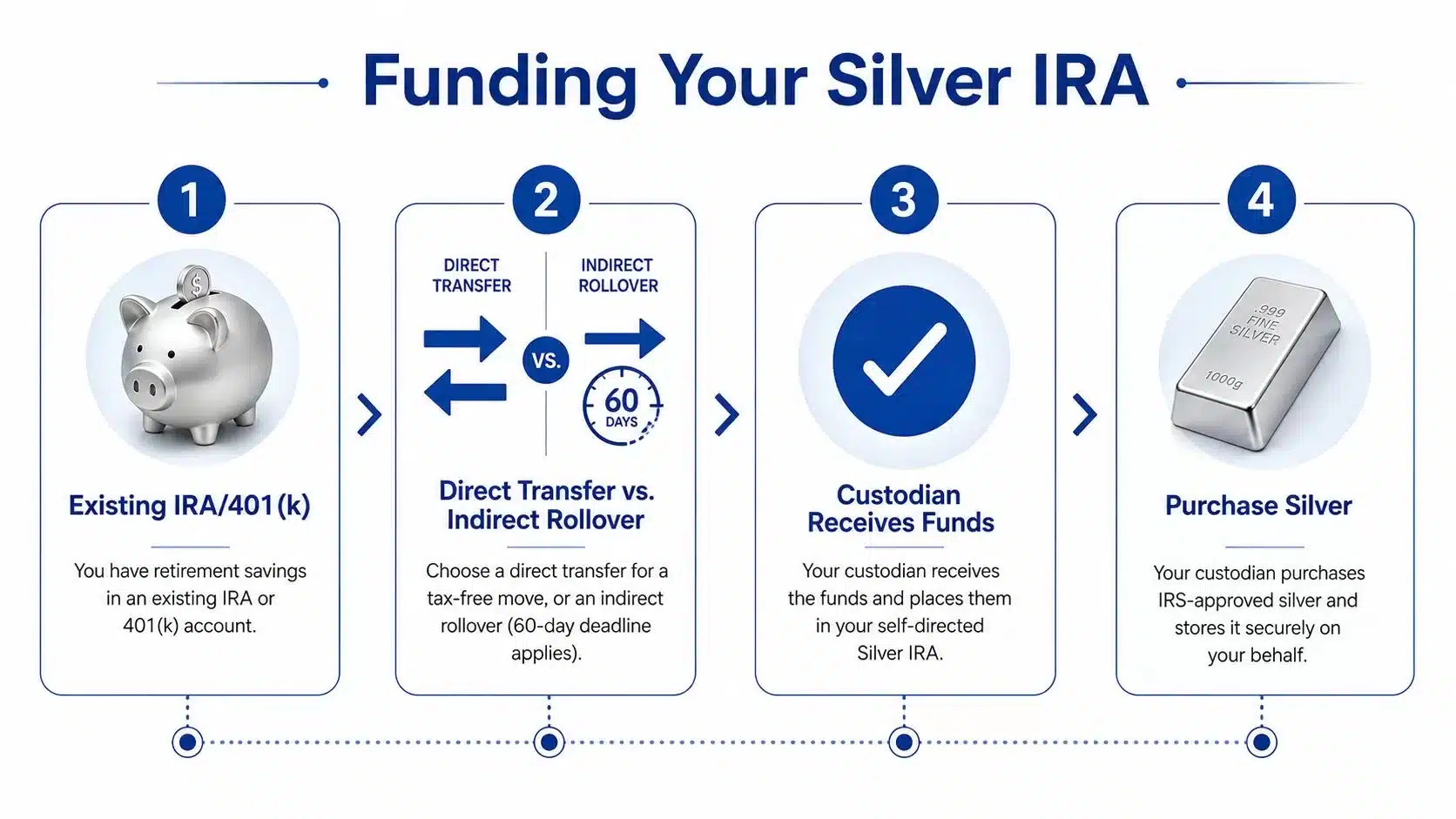
Direct transfer versus indirect rollover
| Method | How funds move | Main concern |
|---|---|---|
| Direct transfer | Existing custodian sends funds to the new custodian | Requires correct receiving-account information |
| Indirect rollover | Investor receives funds and redeposits them | 60-day deadline and rollover restrictions |
The IRS permits only one IRA-to-IRA 60-day rollover per 365-day period across all IRAs, while direct trustee-to-trustee transfers remain outside that limit. That distinction is easy to miss when an investor uses the word “rollover” for both methods.
A careful workflow looks like this:
- Open the self-directed IRA.
- Confirm the silver product meets the.999 fineness standard.
- Request a direct transfer whenever practical.
- Have the new custodian receive and document the funds.
- Authorize the purchase through the custodian.
- Route the silver to the approved depository.
Investors moving funds from a workplace plan should ask the current plan administrator whether the account permits the intended distribution or rollover. The new custodian, existing provider, and dealer should all use matching account information.
The guide to an IRA rollover from a 401(k) can help readers organize the questions and paperwork before contacting their current plan administrator.
Understanding Total Costs and Fee Structures
A silver IRA's economic result depends on more than the silver price. The investor may pay an account setup charge, an ongoing custodial fee, storage charges, dealer markups, and transaction costs when buying or selling. The total should be evaluated before funds move.
Public fee guides indicate that storage alone can run roughly $100 to $300 per year for common bullion, with segregated storage costing more, as outlined in this silver IRA fee explanation. That fixed cost can weigh heavily on a smaller account because the same annual charge represents a larger share of its value.
Build the full cost picture
A written quote should separate:
- Account charges: Setup and annual administration costs.
- Storage charges: The amount for holding metal and whether segregation changes the price.
- Purchase markup: The amount added above the underlying silver value.
- Sell-side spread: The difference between the dealer's purchase price and expected resale bid.
- Transaction expenses: Charges connected to buying, selling, shipping, or distributing metal.
The buy price alone can mislead. A lower-premium product may be less recognizable at resale, while a more familiar product may carry a higher initial markup but offer a broader buyer base. Neither outcome is guaranteed, so the investor should request current buy and sell figures for the exact product.
Test whether the account size supports the structure
The break-even calculation is simple in principle. Add setup costs, recurring custody and storage costs, purchase markup, and expected selling expenses. Then compare that total with the account value and the return required before the investor reaches the starting point.
For a small or mid-sized account, fixed charges can consume more of the potential result than they would in a larger account. That doesn't automatically disqualify a silver IRA, but it makes fee transparency essential. Investors should also compare the physical-metal structure with simpler silver exposure available outside a self-directed IRA, while remembering that the tax treatment and ownership experience differ.
Ask for projected costs over the intended holding period, not just the first invoice. A provider that can't explain how charges accumulate should not receive retirement funds until the economics are clear.
Making the Decision Is a Silver IRA Right for You
Silver can serve as a niche diversification sleeve, but it shouldn't be treated as an automatic replacement for stocks, bonds, cash, gold, or inflation-protected assets. Silver has both precious-metals demand and substantial industrial demand. Global silver demand reached 1,164 million ounces in 2024, after easing 3% year over year, according to the World Silver Survey 2025 launch materials. That industrial connection can make silver more sensitive to manufacturing conditions than a purely monetary asset.
The Silver Institute expects global demand to fall 4% year over year to 1.12 billion ounces in 2025, while investment interest remains strong and coin-and-bar demand had jumped 14% in the prior year, according to its 2025 silver market commentary. The same source notes that silver had surged about 25% year to date in 2025, illustrating why high prices and volatility deserve careful portfolio sizing rather than automatic enthusiasm.

A practical decision test
Silver IRA exposure may fit an investor who:
- Can tolerate price volatility and doesn't need immediate access to the funds.
- Understands that physical silver is less convenient to sell than a conventional liquid investment.
- Has reviewed the complete fee schedule against the account size.
- Wants diversification and accepts that silver won't produce interest or dividends.
- Has confirmed product eligibility, custody, and transfer procedures in writing.
A simpler alternative may be more suitable when fixed fees are disproportionate, liquidity is a priority, or the existing portfolio already has substantial exposure to commodities. The next step should be a written comparison of product costs, custodian charges, storage terms, and transfer instructions. This is not financial advice. Consult a licensed financial advisor, CPA, or tax professional before making investment decisions.
Gold IRA Association offers educational guides on silver IRA eligibility, rollover procedures, custodians, storage, and fee evaluation. Visit Gold IRA Association to review those resources and compare the questions a prospective provider should answer before retirement funds are moved.