



A near-retiree with a 401(k) or IRA concentrated in stocks, bonds, and mutual funds may start questioning whether traditional paper assets provide enough diversification after several market cycles. Silver IRA advertisements often promise a simple solution, but the decision involves more than choosing a metal. Investors need to understand the IRS purity rule, approved custody, rollover mechanics, product eligibility, market risk, and the fees that can make a small account inefficient.
What a Silver IRA Is and Why Investors Consider One
A silver IRA is a self-directed individual retirement account that holds approved physical silver bullion instead of the securities commonly available through a standard brokerage account. The account can follow the tax structure of a traditional IRA or Roth IRA. The important difference is the underlying asset, not the basic retirement-account framework.
Investors often consider silver because it has two distinct sources of demand. It functions as a precious metal used for investment and wealth diversification, while also serving as an industrial input in areas such as solar technology, electronics, and electrification. That combination can make silver behave differently from stocks, bonds, and gold, but it can also produce sharper price movements.
Recent market data illustrate both sides of the argument. Silver's annual average price rose 42% in 2025, while global demand reached about 1.13 billion ounces, down 2% from the prior year. Coin and bar demand increased 14%, and industrial demand reached about 657.4 million ounces, approximately 59% of total global demand, according to the Silver Institute's 2025 market coverage.
The question behind the investment
The central issue isn't whether silver can rise. No retirement asset comes with that guarantee. The more useful question is whether a small satellite allocation can improve diversification without allowing storage, administration, and purchase premiums to consume too much of the account.
A careful silver IRA investment review should answer six practical questions:
- What purity does the IRS require?
- How does a self-directed account differ from a brokerage IRA?
- How does silver compare with gold and paper silver?
- Which coins and bars qualify?
- How should a rollover be completed?
- At what balance do fees become difficult to justify?
Investors researching a broader range of tangible assets can also explore non-traditional investments before deciding whether physical silver belongs in a retirement portfolio. Silver may have a role, but it shouldn't automatically become the center of one.
How a Self-Directed Silver IRA Actually Works
Suppose a near-retiree wants physical silver inside a retirement account rather than a silver fund. The account needs two separate pieces in place: an eligible custodian or trustee, and silver that meets IRS rules. A standard brokerage IRA generally is not set up to hold physical bullion, so the investor must choose a self-directed IRA provider that supports alternative assets.
The metal must meet the IRS minimum fineness of 99.9%, or 0.999. It must also remain with an approved depository. These requirements work together. Buying an eligible product through the wrong custody arrangement can still create a compliance problem. The approved depository requirement for physical silver explains why both the product and its chain of custody matter.
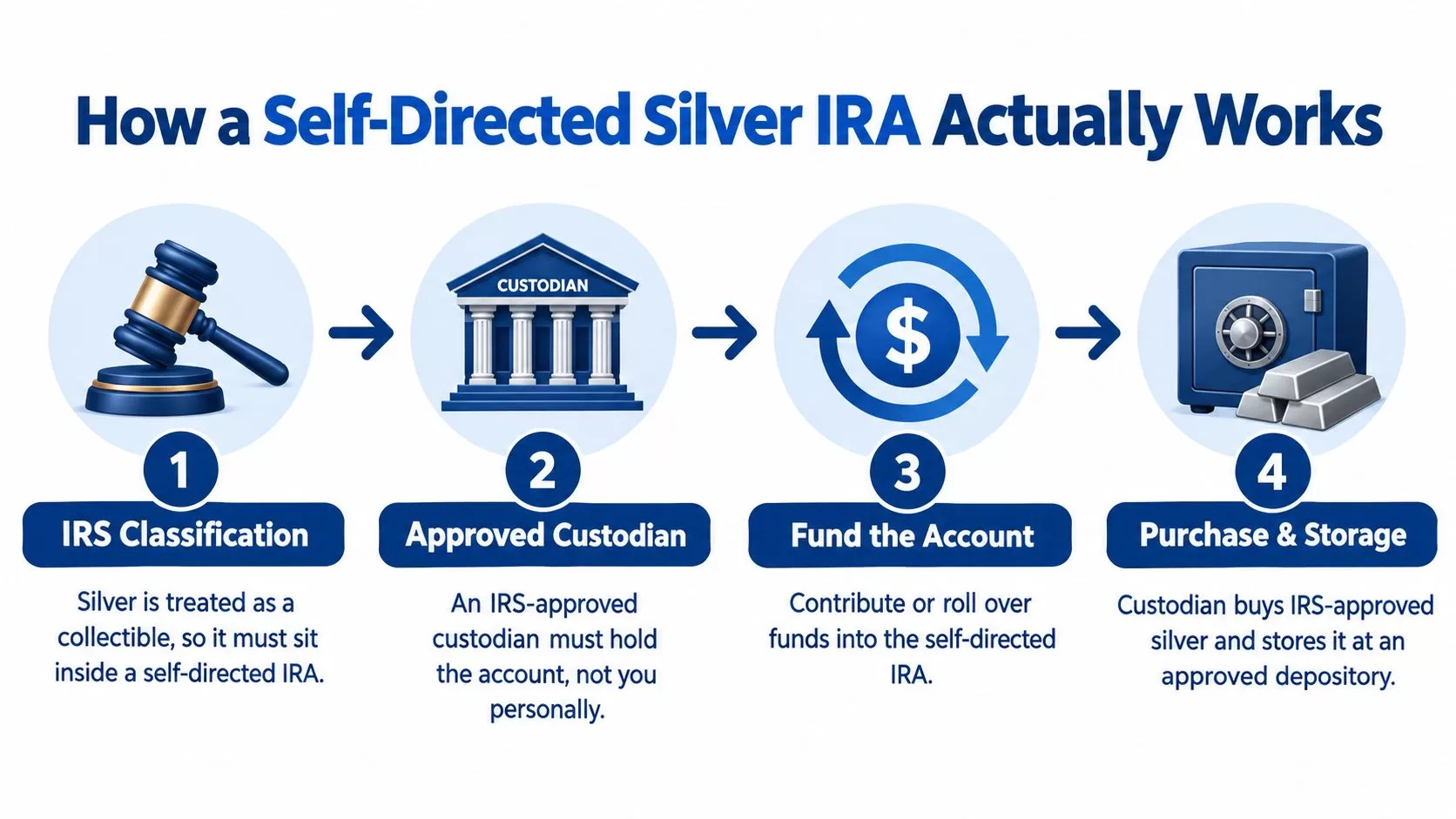
From account opening to storage
The investor first opens a self-directed IRA with a custodian that permits physical bullion. Funding then arrives through a contribution, eligible transfer, or rollover. The investor instructs the custodian to purchase qualifying silver, rather than taking possession or placing an order outside the account.
The custodian coordinates delivery to an approved depository, where the silver is stored and insured under the account's arrangement. Account records should show the purchase, valuation, storage details, and any later distribution.
The investor does not personally receive the silver while it remains inside the IRA. If the account distributes physical metal later, the applicable tax treatment depends on the IRA type and the investor's circumstances.
This structure has more moving parts than buying a silver fund in a brokerage account. Custody, insurance, recordkeeping, and vaulting can create expenses that paper investments may avoid. That difference matters most for a smaller balance, because recurring account costs and purchase premiums consume a larger share of the investment before the silver has had time to perform.
Silver Versus Gold and Paper Silver in a Retirement Portfolio
Silver deserves separate analysis because its industrial role is much larger than gold's. More than half of silver demand comes from industrial applications, and silver has historically shown substantially greater volatility than gold. One industry portfolio study reports that silver's annualized volatility has been up to twice gold's over the past 20 years. Investors can review the underlying discussion in the Silver Institute portfolio study.
That difference changes how a near-retiree might use the metal. Gold is often treated as the steadier precious-metals exposure, while silver can act more like a cyclical satellite asset. During industrial slowdowns, silver may face pressure from reduced manufacturing demand even when investors still view precious metals as a store of value.
Four ways to obtain silver exposure
| Attribute | Physical Silver IRA | Physical Gold IRA | Paper Silver | Silver Miners ETF |
|---|---|---|---|---|
| Main exposure | Bullion held for the IRA | Gold bullion held for the IRA | Fund or trust interest linked to silver | Shares of mining companies |
| Industrial sensitivity | High | Lower than silver | Depends on the underlying silver market | High, plus company and equity-market risk |
| Storage | Approved depository required | Approved depository required | Fund-level custody | No personal metal storage |
| Counterparty considerations | Custodian and depository chain | Custodian and depository chain | Fund sponsor, custodian, and redemption structure | Mining management, financing, and market conditions |
| Retirement-account structure | Self-directed IRA | Self-directed IRA | Often available through a regular brokerage account | Often available through a regular brokerage account |
Paper silver products can be easier to trade, but they don't give the IRA direct ownership of specific coins or bars. Mining shares add another layer of risk because operating costs, financing, management decisions, and broader equity-market conditions affect the investment.
Practical rule: Silver usually makes more sense as a measured satellite holding than as the core of a near-retiree's retirement portfolio.
The appropriate allocation depends on age, withdrawal needs, existing investments, and tolerance for drawdowns. Investors shouldn't choose a percentage merely because a marketing page recommends it. A written risk budget and an annual rebalancing policy provide a more disciplined framework.
IRS-Eligible Silver Products Worth Knowing
The starting test is simple: IRA-eligible silver must generally meet the 99.9% fineness standard. That requirement separates qualifying bullion from many collectible, decorative, and lower-purity products.
Common products investors may ask a custodian to review include:
- American Silver Eagles
- Austrian Philharmonics
- Canadian Maple Leafs
- British Britannias
- Chinese Pandas
- .999 silver bars from recognized refiners, including PAMP Suisse, the Royal Canadian Mint, and Sunshine Mint
The product name alone isn't enough. The custodian should verify the fineness, manufacturer or mint, documentation, and the account's own purchasing policy before the transaction is completed. Investors can use this guide to IRA silver coins as a starting point for product questions, but the custodian remains responsible for approving the purchase within the account.
| Product Type | Fineness | IRA-Eligible | Notes |
|---|---|---|---|
| Standard qualifying bullion | 99.9% or higher | Generally, if custody requirements are met | Confirm the mint, refiner, and documentation |
| Pre-1965 U.S. junk silver | Typically around 90% | No | Below the required silver standard, as explained in current silver eligibility guidance |
| Sterling silver items | Below the required bullion standard | No | Jewelry and household objects aren't qualifying bullion |
| Uncertified silver rounds | Unclear | Not automatically | Fineness and refiner accreditation must be verified |
| Proof or burnished qualifying coins | Product-specific | Potentially | The underlying purity and account rules still control |
| Graded or encapsulated coins | Product-specific | Potentially | Packaging and eligibility should be confirmed before purchase |
Proof, burnished, or graded versions don't automatically receive special tax treatment. A collectible premium also doesn't create an additional IRA benefit. Rare-date products can be harder to value and liquidate, so many retirement investors prefer widely recognized bullion with transparent specifications.
Rolling Over a 401(k) or IRA into Silver
A near-retiree moving an old 401(k) into silver must solve two separate problems: transfer the retirement money correctly and confirm that the new account's costs make sense for the balance. A compliant rollover can still be an uneconomic choice if administration, storage, and trading expenses consume too much of the account's potential benefit.
The cleanest route is usually a direct trustee-to-trustee transfer. The existing plan sends the assets directly to the self-directed IRA custodian, so the account holder never receives the money personally. That keeps the transfer between institutions and avoids the timing risk attached to personal receipt.
An indirect rollover follows a different path. The plan pays the funds to the account holder, who must redeposit them within 60 days. The IRS rollover guidance explains that this deadline applies to distributions being rolled over and that limited waivers may apply when circumstances outside the taxpayer's control cause a delay.
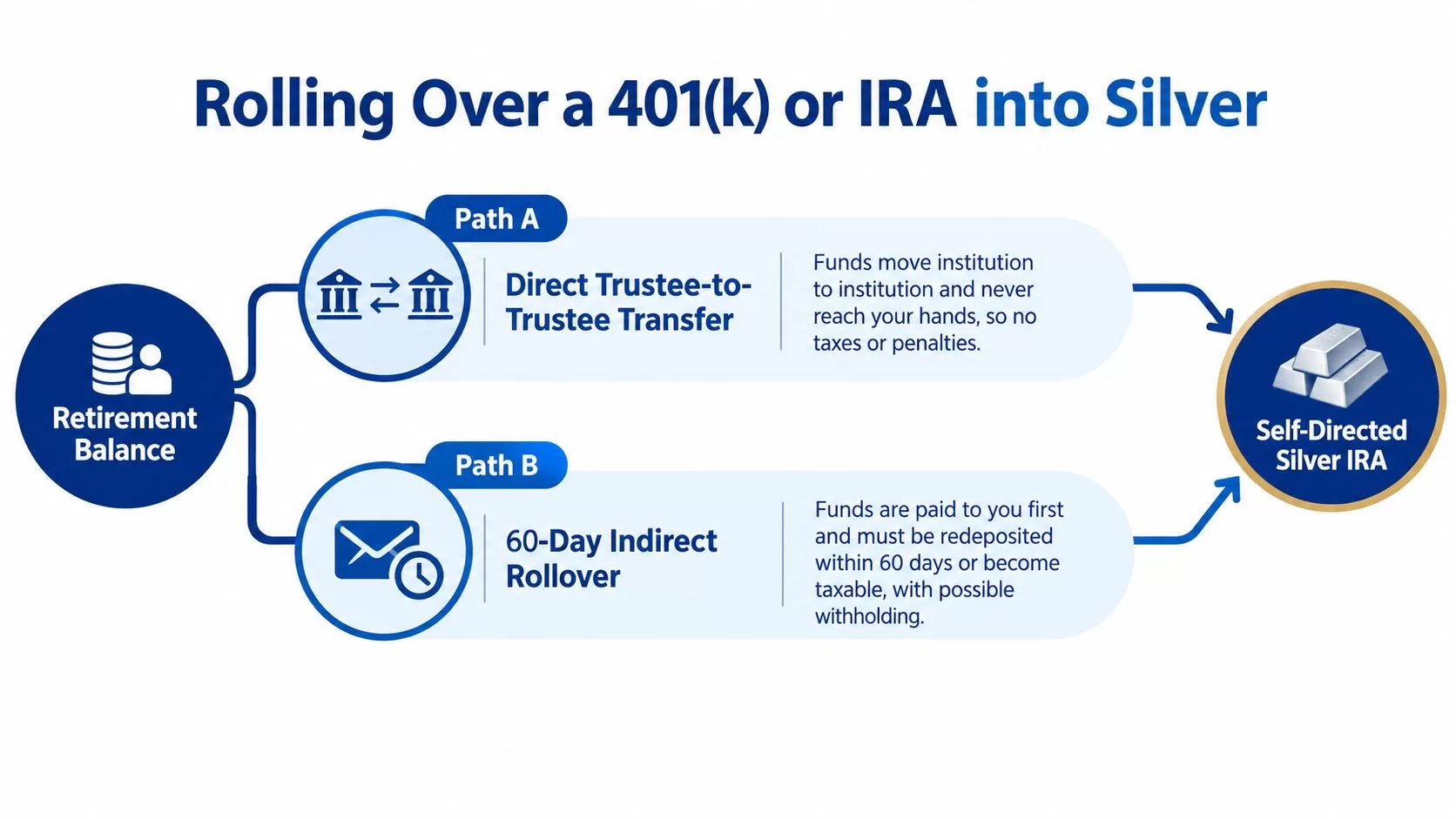
Check the route before the money moves
A direct transfer usually reduces paperwork. An indirect rollover puts the deadline, redeposit, and supporting records on the account holder. Missing the deadline can make the amount taxable, and an early-distribution penalty may apply when the relevant conditions are present.
Before requesting the transfer, collect recent statements to identify the existing plan type and balance. Complete the receiving custodian's application and transfer instructions, review beneficiary designations rather than copying them automatically, and prepare current government-issued identification if requested. Also confirm whether a current employer's plan restricts distributions or allows them only in specific circumstances.
The once-per-12-month limitation applies to certain indirect IRA-to-IRA rollovers. Direct trustee-to-trustee movements are treated differently, so the receiving custodian and existing plan administrator should confirm the route before funds leave the original account.
After the account opens, the practical sequence is to complete the transfer, authorize the bullion purchase, and confirm delivery to an approved depository. Investors seeking a process overview can consult this silver IRA rollover guide, then compare the expected account costs with the balance being transferred.
Fees, Premiums, and the Account-Size Break-Even
A near-retiree can choose eligible silver, complete the rollover, and still overlook the cost of holding it. The account may appear diversified, yet fixed charges and the purchase premium can absorb part of that benefit. Model the full cost before deciding how much of a retirement balance belongs in physical silver.
The bill may include account setup, annual administration, storage, insurance, transaction charges, and the amount paid above silver's spot price. A fee analysis places total ongoing costs around $200 to $500 per year in many silver IRA arrangements. For smaller accounts using segregated storage, the annual burden can approach 0.9% to 1.2% of account value. Because silver stores less value in the same physical space, storage can cost more per dollar of metal than comparable gold storage. Popular IRA-eligible silver coins may carry premiums of 12% to 25% above spot, according to this silver IRA fee analysis.
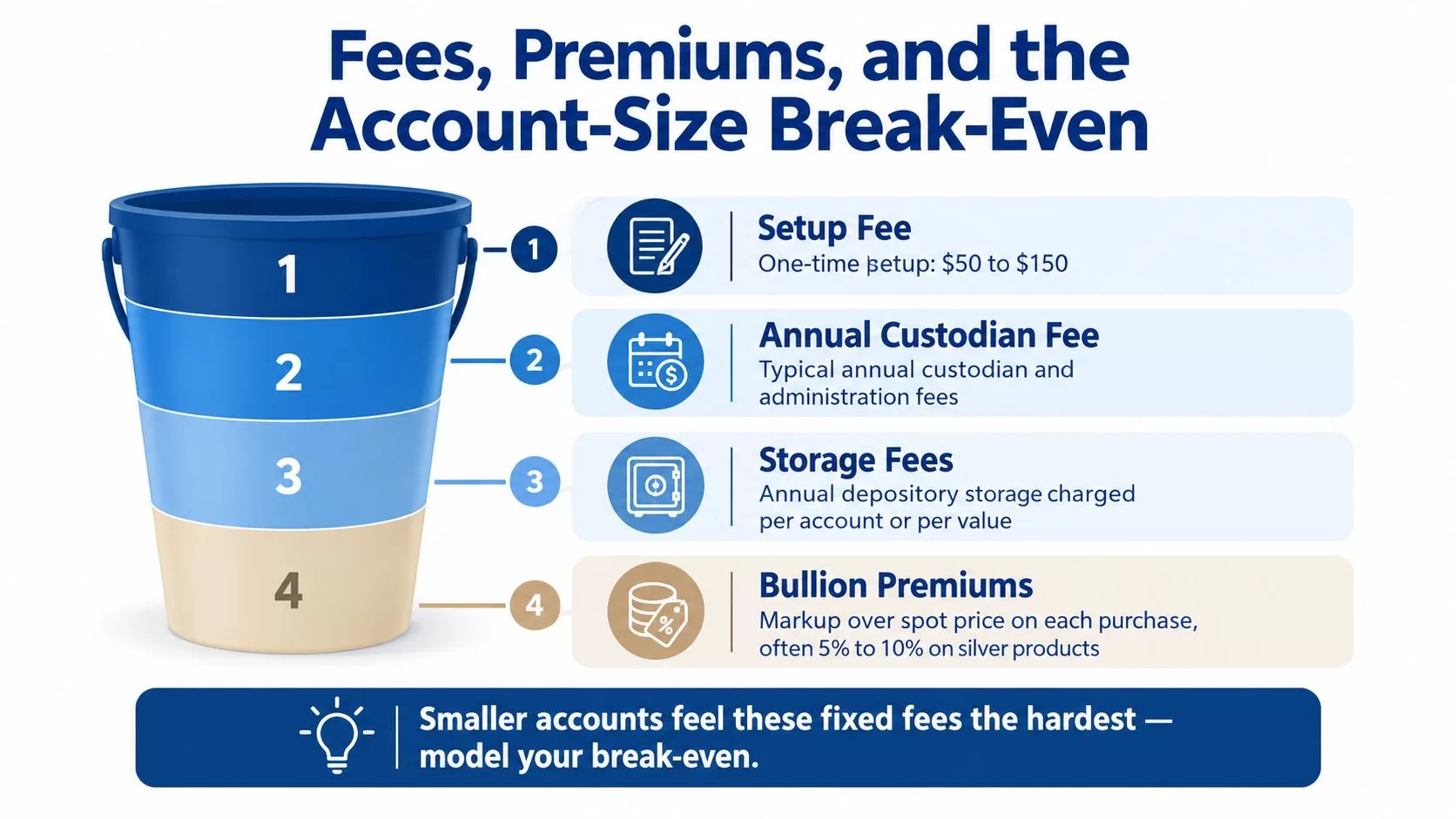
Why balance size changes the calculation
Fixed fees work like a cover charge. The same dollar amount takes a larger share from a smaller account, leaving less of the balance exposed to silver's potential diversification role. A larger account spreads those charges across more assets, although storage rates tied to value, purchase premiums, and selling costs still affect the result.
For a smaller portfolio, annual administration and storage can represent a substantial portion of the balance. A high purchase premium also creates a hurdle: silver must rise enough to recover that initial cost before the position reaches its starting value.
A larger portfolio usually absorbs fixed administration charges more easily. The investor must still review storage pricing, product premiums, and the terms for selling or taking a distribution. At any account size, a low annual fee can give a misleading impression if the dealer premium is high or the buyback spread is unclear.
The practical break-even point depends on the written fee schedule, storage method, product choice, and intended holding period. There is no useful generic threshold. Separate the first-year purchase cost from recurring charges, then compare the combined amount with the role silver is expected to play in the retirement plan.
Cost test: Fund the account only after the provider shows the annual charges, purchase premium, storage arrangement, and liquidation spread in writing.
Choosing a Silver IRA Provider Without Overpaying
Provider selection should begin with documentation rather than a sales pitch. A specialist firm may coordinate bullion purchases and storage, while a self-directed custodian handles account administration. The investor needs to understand which company performs each function and which charges are bundled or passed through separately.
A side-by-side review should cover at least three providers and ask the same questions each time. The purpose isn't to find the most persuasive salesperson. It's to identify the arrangement with the clearest custody chain and the most predictable all-in cost.
| Criterion | What to Verify | Red Flag |
|---|---|---|
| Custody and compliance | The legal custodian, account structure, and depository relationship | Unclear responsibility for the IRA or vault |
| Fee transparency | Setup, administration, storage, insurance, transaction, and liquidation charges | “Free” language without a written schedule |
| Product selection | Eligible coins and bars, fineness documentation, and pricing method | Pressure to buy rare or collectible products |
| Storage options | Segregated or commingled storage and related costs | Vague answers about where the metal is held |
| Buyback process | How the investor requests a sale or distribution and how pricing is determined | No written explanation of the exit process |
| Communication | Clear paperwork and time to review it | High-pressure calls, unsolicited promotions, or manufactured urgency |
Questions that deserve written answers
Investors should ask who holds legal custody, whether the depository is approved for the arrangement, how the account values the bullion, and whether insurance is included in storage charges. They should also request the dealer's purchase premium and the expected spread when the silver is sold.
Provider comparisons can be supplemented with the silver IRA company comparison resource, but each investor should still verify current terms directly. Fees, storage arrangements, and product inventories can change.
Gold IRA Association offers educational guides and comparisons covering silver IRA eligibility, rollover procedures, fees, and provider questions. Those materials can help a reader prepare for a conversation, but they don't replace independent tax, legal, or investment advice.
Bringing It All Together and Next Steps
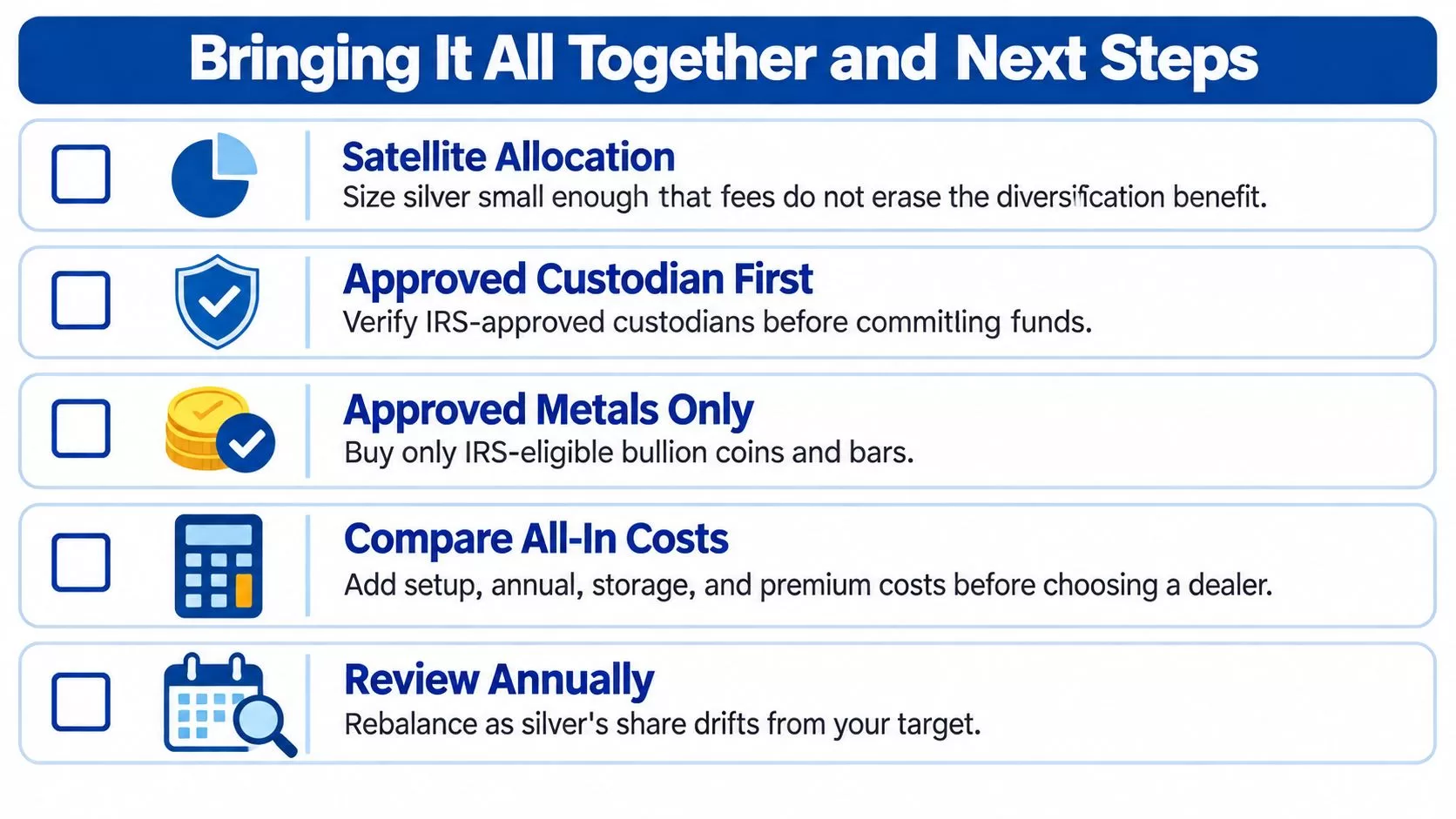
A silver IRA can earn a place in a retirement plan when its role is clearly defined. The strongest case is usually a measured satellite allocation, held through an approved custodian, invested only in qualifying bullion, and supported by a fee schedule that doesn't overwhelm the account.
The decision can be reduced to six checkpoints:
- Eligibility: Confirm that the account structure supports physical silver.
- Custody: Verify the custodian and approved depository before moving funds.
- Position size: Match the allocation to silver's greater volatility and the investor's withdrawal horizon.
- Product purity: Purchase only bullion that meets the 99.9% fineness standard.
- Rollover method: Prefer a direct institution-to-institution movement when available.
- Provider due diligence: Compare the complete cost, storage arrangement, and liquidation process.
Silver's industrial demand makes it different from gold. That can add diversification, but it also exposes the metal to manufacturing cycles and broader economic weakness. A near-retiree who expects to withdraw assets soon may need a smaller allocation than an investor with a longer horizon and greater capacity to tolerate drawdowns.
The next practical step is to request a written fee schedule and custodian disclosure from one shortlisted provider before initiating any rollover. This is not financial advice. Investors should consult a licensed financial advisor, CPA, or tax professional before making investment decisions.
Gold IRA Association provides educational guides, rollover materials, fee explanations, and provider comparisons for readers evaluating precious-metals retirement accounts. Visit Gold IRA Association to review the relevant silver IRA resources and prepare specific questions before committing retirement funds.