



A near-retiree watches another sharp market swing while everyday costs continue to rise. The question is understandable: could physical gold or silver add useful diversification to a retirement plan, or would a precious metal IRA just add fees, paperwork, and restrictions? This guide explains how these accounts work, which metals qualify, how rollovers are handled, and when the all-in cost may outweigh the potential benefit.
What a Precious Metal IRA Is and Who It Serves
A precious metal IRA is a self-directed traditional or Roth IRA that can hold certain physical gold, silver, platinum, or palladium. It isn't a completely separate tax category. The account still operates as an IRA, but it uses a specialized custodian and an approved depository because the account owns physical assets rather than only conventional market investments.

Consider someone within several years of retirement who already holds a 401(k) or IRA invested in stocks and bonds. That person may be looking for an asset with different market behavior and may value direct ownership of an approved physical product. A precious metal IRA can provide one possible route, but it shouldn't automatically replace the rest of a retirement portfolio.
Who may find the structure useful
This account structure generally attracts:
- Near-retirees seeking diversification: Physical metals may serve as a supporting allocation alongside traditional investments.
- Investors concerned about purchasing power: Gold and other metals are often considered as a possible hedge against currency weakness and inflation, although they don't guarantee a particular outcome.
- Retirement savers changing employers: A rollover from an eligible retirement plan may create an opportunity to consider a self-directed account.
- Investors who value tangible assets: Some people prefer owning an asset they can identify physically, even though IRA rules prevent personal possession while the account remains active.
The trade-off is complexity. The custodian must approve the transaction, record ownership to the IRA, and send the metal to approved storage. Readers comparing physical products outside a retirement account can also review these top precious metals picks for broader educational context, while remembering that IRA eligibility follows separate tax rules.
Practical rule: A precious metal IRA usually makes more sense as one part of a retirement strategy than as a replacement for every liquid investment.
How the Precious Metal IRA Framework Was Created
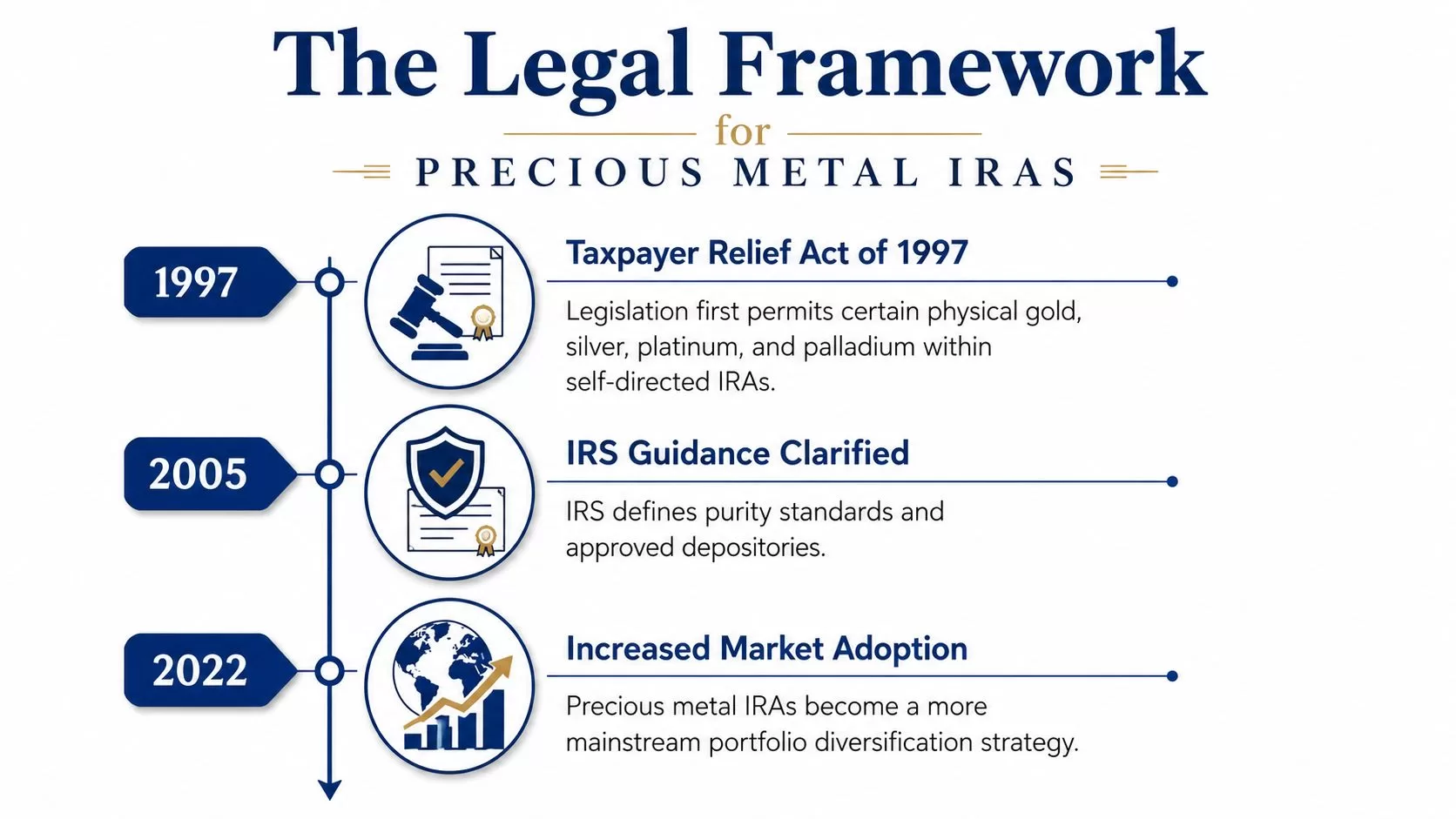
The modern U.S. precious metal IRA framework dates to the Taxpayer Relief Act of 1997, which added Internal Revenue Code Section 408(m)(3) and created the first legal path for holding certain physical metals in an IRA. IRS Publication 590 shows the rule taking effect beginning in 1998. The statute expanded eligibility to certain U.S.-minted coins and bullion that meet specific fineness requirements. The statutory framework and its fineness standards are summarized here.
The law didn't make every gold coin or silver bar acceptable. Instead, it created a product filter. The metal must fit an approved category, meet the applicable standard unless a named exception applies, and remain under the control of an eligible trustee or custodian.
The account process in plain English
- The investor chooses an account structure. The account may be a traditional or Roth IRA, depending on eligibility and tax planning.
- A specialized custodian opens the account. The custodian handles records, instructions, reporting, and transactions involving alternative assets.
- The account receives funds. Money may come from a contribution or an eligible transfer or rollover.
- The investor selects qualifying metals. A dealer supplies products that meet the account's requirements.
- The custodian completes the purchase. The transaction is recorded in the IRA's name rather than the investor's personal name.
- The metal moves directly to approved storage. The investor doesn't take the coins or bars home while the IRA owns them.
That final step is central. IRA-owned metals must remain with a qualified trustee or custodian or in an IRS-approved depository. The investor never has personal possession during the active account period, which supports clearer records and reduces personal storage risk, but it also introduces custodial, storage, and transaction expenses. The custody and storage mechanics are explained in this guide to precious metals in an IRA.
Taking possession can be treated as a distribution, which may create tax consequences. The framework therefore combines retirement-account tax treatment with strict custody, product, and reporting rules.
IRS Purity Rules and Approved Coins and Bars
A retirement account cannot hold every gold coin or silver bar sold as bullion. The exact product must meet the applicable fineness standard, meaning the required purity level, or qualify under a specific statutory exception. The usual thresholds are 99.5% for gold, 99.9% for silver, and 99.95% for both platinum and palladium. A current overview of IRA-approved precious-metal rules explains these product standards.
The American Gold Eagle shows why a product's name and legal status matter. It is 91.67% pure, yet Congress specifically authorized it for IRA ownership through a statutory exception. A coin can therefore fall below the general gold-purity threshold and still qualify when the law expressly permits it. The American Gold Eagle exception is described in this explanation of approved precious metals.
| Metal | Minimum Purity | Approved Examples | Common Ineligible Items |
|---|---|---|---|
| Gold | 99.5% (.995), subject to named exceptions | Certain sovereign coins and qualifying bars | Many collectible, numismatic, and lower-purity products |
| Silver | 99.9% (.999) | Qualifying sovereign coins and bullion bars | Jewelry, collectibles, and lower-purity bullion |
| Platinum | 99.95% (.9995) | Qualifying coins and bars | Products that fail the fineness standard |
| Palladium | 99.95% (.9995) | Qualifying coins and bars | Products that fail the fineness standard |
What Investors Should Verify
A product can satisfy the metal category and still require closer review. Commonly marketed examples include government-issued bullion coins and qualifying bars from recognized refiners, but the custodian should confirm the exact product before funds are committed. The bar's refiner, weight, documentation, and assay may matter as much as the metal itself.
Some familiar coins, including South African Krugerrands and pre-1933 U.S. gold coins, may be ineligible under the applicable rules. Collectibles, numismatic pieces, and jewelry generally fall outside permitted categories. Ask for written confirmation that the specific coin or bar can enter the IRA. This check can prevent a purchase that must be replaced, delayed, or treated as a distribution.
The IRA-approved gold coins guide can help organize product questions before speaking with a custodian. Eligibility is only the first filter. A qualifying item may still carry dealer markups, shipping charges, storage costs, and selling spreads, so compare the full cost with the potential benefit of holding physical metal. If the custodian rejects an item after purchase, the investor may face delays and possible tax complications. Verify first, then place the order.
How a Precious Metal IRA Rollover Works
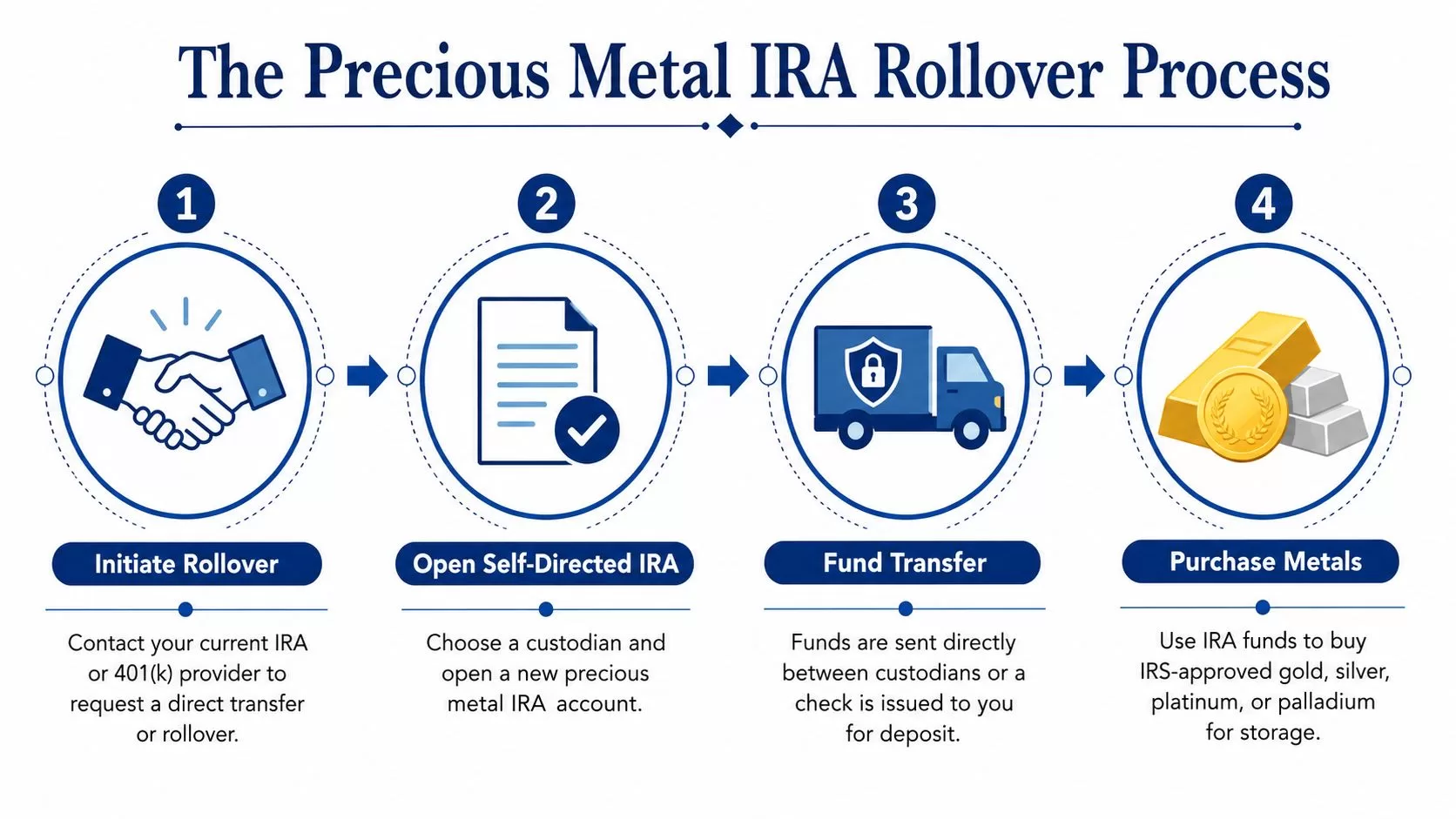
A rollover usually starts with an existing retirement account, such as a 401(k), traditional IRA, or eligible plan. The cleanest route is generally a direct trustee-to-trustee transfer, where the current provider sends funds directly to the new custodian. An indirect rollover works differently because the investor receives the distribution first and must redeposit it within the permitted period.
The safer sequence
- Select the custodian: Confirm that the provider supports self-directed precious metal IRAs and can coordinate approved storage.
- Open the account: Complete the application and establish the receiving IRA before requesting movement of funds.
- Request the transfer: Ask the current plan administrator whether its process is a direct transfer, a direct rollover, or an indirect rollover.
- Wait for cleared funds: The new custodian should confirm receipt before metals are ordered.
- Approve the purchase: Select only products that satisfy the applicable IRS requirements.
- Confirm vault delivery: The dealer should ship directly to the approved depository, not to the investor's home.
The IRS states that an owner who receives an IRA or retirement-plan distribution generally has 60 days from receipt to roll it into another IRA or plan without immediate taxation. Beginning after January 1, 2015, the IRS also limits a person to one IRA-to-IRA rollover in any 12-month period, regardless of how many IRAs that person owns. The IRS rollover rules explain both the 60-day deadline and the once-per-12-month limitation.
A direct transfer removes the investor from the middle of the payment process. That usually makes the paperwork easier to control, but the current plan administrator still determines what forms and approvals are required.
An indirect rollover can become taxable if the funds aren't redeposited on time or if the transaction violates the applicable rollover limitation. An early distribution may also trigger an additional tax, depending on the investor's circumstances. Roth conversions involve a separate tax analysis because moving pretax money into a Roth account can create taxable income. Employer plans may also require additional paperwork or spousal consent.
Readers who want a dedicated process reference can review the precious metals IRA rollover guide before contacting either administrator.
Understanding the Full Cost of a Precious Metal IRA
The quoted price of a coin or bar is only the starting point. A precious metal IRA can include account setup, custodial administration, depository storage, dealer markups, and liquidation expenses. Common annual costs are around $200 to $500. Setup may range from $0 to $150, custodian fees from $75 to $300, storage from $100 to $300, and dealer markups from 3% to 10% over spot. The fee categories and account-size considerations are discussed in this coverage of precious metal IRAs.
| Fee Category | Typical Range | Notes |
|---|---|---|
| Setup | $0 to $150 | May be charged when the account opens |
| Custodian | $75 to $300 annually | Covers administration and account records |
| Storage | $100 to $300 annually | Pricing can vary by storage arrangement |
| Dealer markup | 3% to 10% over spot | Usually applies when metals are purchased |
| Total annual costs | Around $200 to $500 | Doesn't include every possible transaction or liquidation charge |
Why account size changes the outcome
Flat fees take a larger bite from smaller balances. A $200 annual charge represents more of a $50,000 account than of a $250,000 account, even before the purchase premium is included. Percentage-based storage can create a different result for larger balances, while segregated storage may cost more than commingled storage.
The same fee schedule can therefore make sense for one investor and weaken the case for another. A break-even review should use the actual balance and expected holding period. Add setup charges, recurring administration, storage, purchase markups, selling spreads, wire charges, and account-closure fees instead of judging each expense separately.
Cost checkpoint: Ask, “What must the metal earn before the account merely breaks even?” Include the initial purchase premium and every recurring charge in the answer.
Liquidation creates another cost. Dealer buyback spreads can run around 1% to 5%, in addition to custodian fees, reducing the proceeds available when an investor rebalances or takes a distribution. This discussion of gold IRA costs and liquidation explains the effect of buyback spreads.
A conventional investment option may offer simpler pricing and easier access to cash. That does not automatically make it better for every investor, but it belongs in the comparison. Physical metals inside an IRA should improve the overall plan enough to justify their purchase premiums, ongoing charges, and selling friction. If the expected benefit cannot cover those costs over the intended holding period, the account may add complexity without improving retirement outcomes.
Pros and Cons of Holding Precious Metals in an IRA
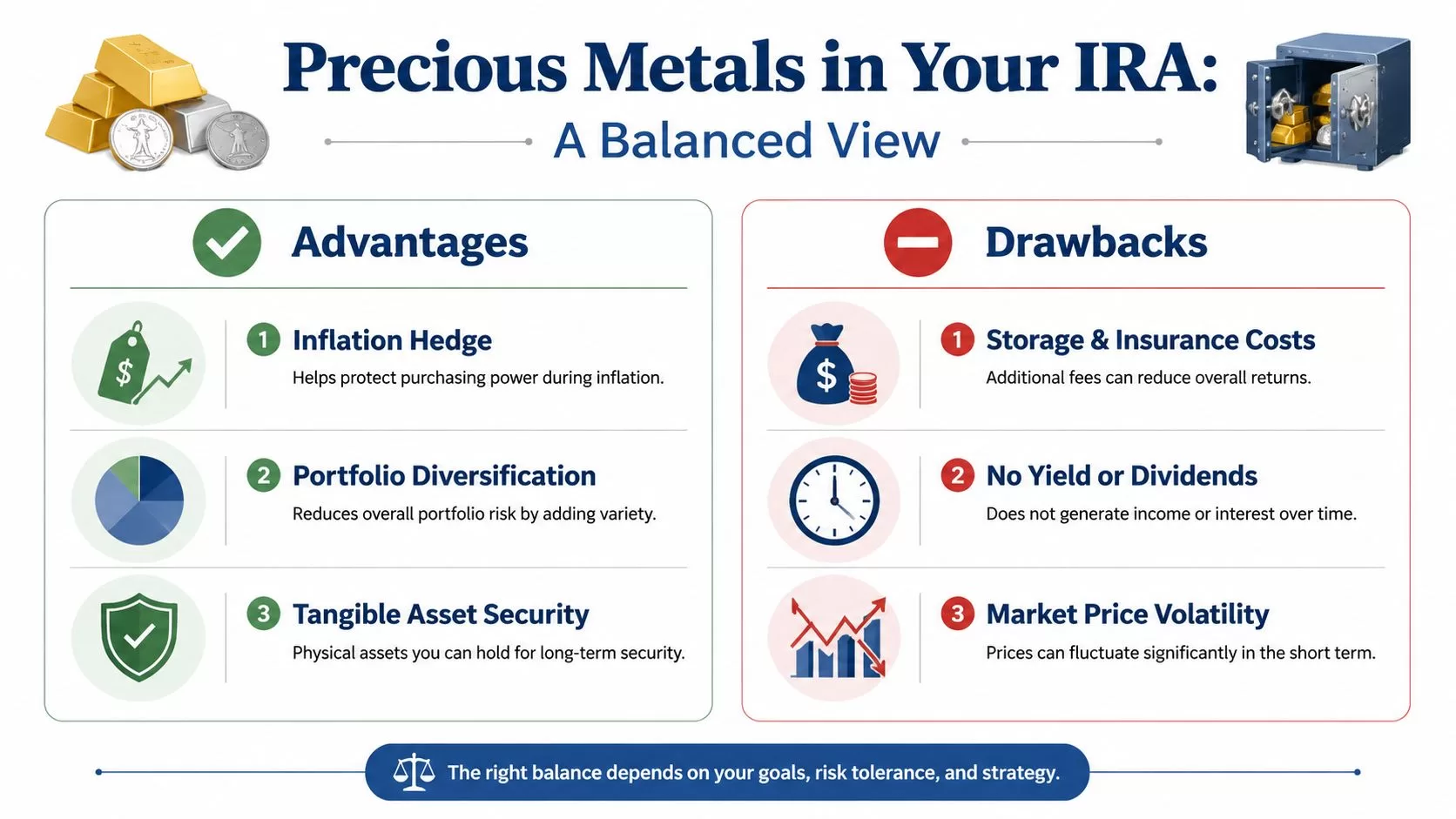
Physical metals can offer a different source of portfolio exposure, but the account structure creates meaningful compromises. Gold, silver, platinum, and palladium don't pay dividends or interest, so the investor relies primarily on price movement for potential appreciation. The account also requires specialized handling that a standard brokerage IRA generally doesn't need.
Potential advantages
- Diversification: Metals may behave differently from stocks and bonds, which can reduce reliance on one asset group.
- Possible inflation hedge: Some investors use precious metals as a partial hedge against declining purchasing power, though the hedge isn't guaranteed.
- Tangible ownership: A qualifying bar or coin represents a physical asset, even though the IRA's custodian controls its storage.
- Tax-advantaged structure: Traditional and Roth IRAs may provide their respective tax treatment, subject to the investor's circumstances and applicable rules.
- Behavioral comfort: A tangible allocation may help some savers stay committed to a broader long-term plan during market stress.
Costs and opportunity trade-offs
The disadvantages are just as practical. Metals can be less liquid than publicly traded securities, and selling may involve a dealer spread, processing time, and custodian coordination. Storage and administration charges continue even when the metal's price is flat, while a purchase premium must be recovered before the investment reaches its starting economic value.
There's also opportunity cost. Money held in metals isn't simultaneously invested in productive businesses or interest-bearing assets. During a strong equity market, a metals allocation could lag a diversified stock-and-bond portfolio. A gold-backed exchange-traded product in a standard brokerage IRA may offer simpler trading, although it doesn't provide the same structure as personally owning approved physical metals through a depository.
No universal allocation fits every retirement plan. A saver with substantial assets and sufficient liquid reserves may be able to consider a partial metals allocation without disrupting income needs. Someone with a smaller balance, immediate cash requirements, or a short retirement runway may find the fixed costs and transaction friction harder to absorb.
Estate planning adds another separate question. Investors organizing retirement and inheritance documents may benefit from reviewing broader educational material on non-probate assets for Texas families, while obtaining state-specific advice for their own situation.
How to Evaluate Custodians and Providers
The dealer sells the metal, while the custodian administers the IRA and the depository stores the assets. Those roles may involve different companies, and the investor should understand who is responsible for each task before signing paperwork.
Four checks that deserve written answers
- Regulatory standing and reputation: Review available registration information, complaint history, and independent business records. A polished website isn't a substitute for verifiable credentials.
- Complete fee disclosure: Request a written schedule covering setup, annual administration, storage, purchases, sales, wires, transfers, and account closure.
- Storage arrangements: Confirm the depository's approval status, whether storage is segregated or commingled, and how insurance applies to the account's holdings.
- Buyback policy: Ask whether the dealer buys metals back, how its spread is calculated, and whether the policy is a promise to make an offer rather than a guarantee of a particular price.
A provider should explain risks as clearly as it explains benefits. High-pressure calls, guaranteed-return language, “free storage” offers paired with unclear premiums, and vague answers about custody deserve caution. The company should also identify the actual custodian and storage location instead of blending every role into one sales pitch.
Compare before committing
At least three written proposals make differences easier to see. Compare the same metal category, the same storage type, the same account balance, and the same expected transaction pattern. Otherwise, a low setup charge may conceal a larger purchase premium or a costly liquidation process.
A household's financial records should also remain organized. A general Family Folder financial guide can provide useful context for document organization, while the retirement account itself should be evaluated through its custodian, tax professional, and financial planning process.
For readers assessing the custodian's role specifically, the IRA custodian for gold guide offers a focused set of questions. This is not financial advice. Consult a licensed financial advisor, CPA, or tax professional before making investment decisions.
Your Next Steps and Actionable Checklist
A sound decision begins with fit, not a sales call. The investor should ask whether a physical metals allocation matches the retirement timeline, cash-flow needs, risk tolerance, and existing mix of stocks, bonds, cash, and other assets.
Use this sequence:
- Define the purpose: Decide whether the goal is diversification, a possible inflation hedge, tangible ownership, or something else.
- Calculate the all-in cost: Apply every setup, custodial, storage, purchase, and selling charge to the actual account balance.
- Seek independent advice: Consult a fee-only financial advisor who doesn't receive a commission from the transaction.
- Request three proposals: Obtain written fee schedules, storage details, product lists, and buyback terms from at least three custodians or providers.
- Verify each product: Confirm the exact coin or bar's eligibility before placing an order.
- Check the rollover path: Prefer direct movement of funds when appropriate, and understand the 60-day and one-rollover-per-year rules before receiving money personally.
- Use primary resources: Review IRS Publication 590 for official IRA guidance and use the FINRA BrokerCheck tool and the Industry Council for Tangible Assets for additional due diligence and market education.
Opening a precious metal IRA isn't a decision to rush. The strongest process combines personal research, written disclosures, and advice specific to the investor's tax and retirement circumstances.
This is not financial advice. Consult a licensed financial advisor, CPA, or tax professional before making investment decisions.
Gold IRA Association provides educational guides on IRA-approved metals, rollover mechanics, custodian questions, fees, and provider comparisons. Visit Gold IRA Association to review the relevant checklists and compare your options before requesting account paperwork.