



The federal long-term capital gains tax on physical gold is capped at 28%, but that is a ceiling, not a flat tax. Gold held for one year or less is generally taxed as ordinary income, so the actual result depends on the holding period, adjusted basis, account type, and tax situation.
A near-retiree may own bullion in a safe, shares in a gold fund, or precious metals inside an IRA and still be unsure what happens at sale or distribution. The key question isn't only whether gold went up. It's which tax rule applies to the gain, and whether the account wrapper changes when that tax becomes due.
Why Gold's Tax Treatment Matters at Retirement
Retirement changes the way a gold sale can affect a household budget. A worker may have accumulated gold over several purchase dates, while a retiree may need to sell part of the holding for living expenses, rebalance a portfolio, or make a required withdrawal. The sale price is only the starting point. The holding period, adjusted basis, selling costs, account structure, and state of residence all matter.
Three questions usually determine the outcome:
- What rate applies? A short-term gain generally follows ordinary-income tax rules, while a long-term gain on qualifying physical gold falls under the collectibles framework.
- What amount is taxable? Tax applies to the gain, not automatically to the entire sale proceeds.
- Does the account wrapper change the timing? A taxable brokerage account, traditional Gold IRA, and Roth Gold IRA can produce very different tax events.
The often-repeated statement that “gold is taxed at 28%” leaves out these distinctions. The 28% federal figure is a maximum long-term collectibles rate, not an automatic bill for every seller. A taxpayer whose applicable rate is lower may owe less, while a high-income taxpayer may face additional federal or state tax.
Practical rule: Keep the purchase date, cost, sale proceeds, and expenses for every lot of gold. Good records can matter as much as the market price when a tax return is prepared.
Readers who are still deciding whether direct bullion, a fund, or an IRA fits their retirement plan may benefit from this practical guide to precious metals. Gold IRA Association publishes educational material rather than personalized tax advice, so an investor with inherited metal, unclear records, or a planned large sale should also consult a CPA or tax professional.
How the IRS Classifies Gold and What That Means for the Tax Rate
For U.S. federal tax purposes, physical gold is generally treated as a collectible, rather than receiving the same preferential long-term rate structure that applies to most stocks and bonds. The long-term collectibles rate is capped at 28%, compared with a maximum long-term rate of 20% for most non-collectible investments, and the 28% figure is a ceiling rather than an automatic flat rate. (Nasdaq's guide to U.S. capital gains tax for gold and silver investors)
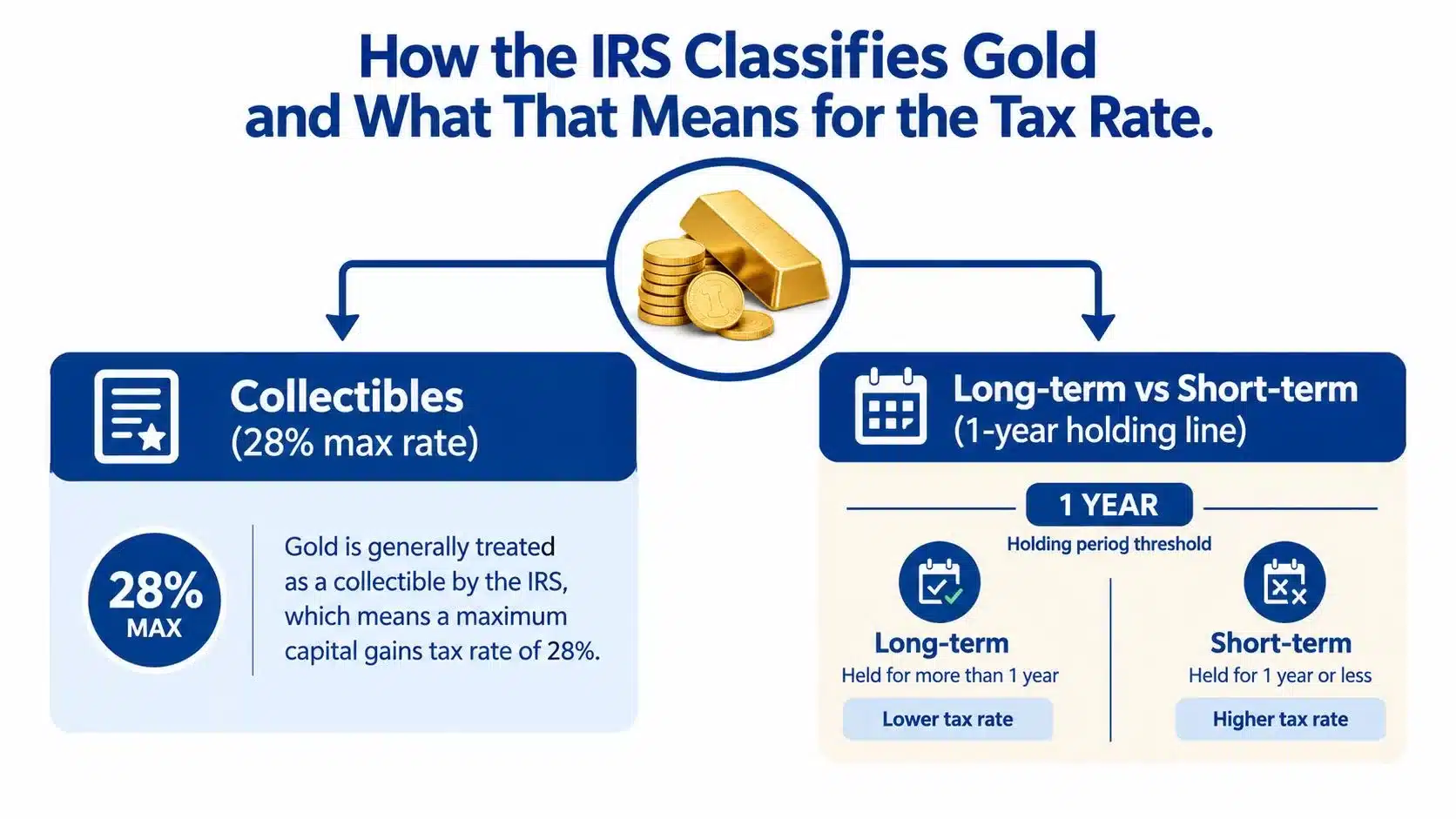
The holding-period line is decisive:
- Held one year or less: The gain is generally short term and taxed at the seller's ordinary-income rate.
- Held more than one year: The gain generally enters the long-term collectibles regime, subject to the federal ceiling.
- Applicable rate below 28%: The taxpayer generally pays the lower applicable rate rather than automatically paying 28%.
That distinction can make a sale after eleven months materially different from a sale after more than twelve months. The taxpayer's adjusted basis still determines the size of the gain, so the holding period doesn't operate by itself.
Which gold products need closer review
Coins and bullion generally fit the physical-gold collectibles discussion. Some physically backed exchange-traded funds can receive collectibles treatment, but the result can depend on the fund's legal structure. Mining shares, futures, and other securities may follow different rules because the investor owns a financial instrument rather than the metal itself.
High-income taxpayers may also owe the 3.8% Net Investment Income Tax in addition to the applicable collectibles rate. State income taxes can apply separately, so the federal ceiling shouldn't be treated as the total possible liability. Investors comparing physical holdings with funds should review the product documents and tax reporting information rather than assuming every gold-related investment is identical. The broader differences among products are also relevant to tax rules for silver.
Calculating the Actual Gain You Will Be Taxed On
The taxable amount usually begins with a straightforward formula:
Taxable gain = net sale proceeds minus adjusted basis
Net sale proceeds generally means the amount realized after allowable selling expenses. Adjusted basis starts with what the investor paid and may include qualifying acquisition costs. The documentation should show how the figure was built, rather than relying on memory or a rounded account balance. (Gold ETF and collectibles tax guidance)
For example, suppose a taxpayer sells gold for $100,000 and has an adjusted basis of $70,000, with $1,000 in allowable selling expenses. The taxable gain would generally be $29,000, not $100,000. The tax rate is applied to that gain after the basis and costs are considered.
The basis can differ from one purchase lot to another. A retiree who bought coins at different times may have separate acquisition dates, prices, dealer premiums, and expenses. Selling only part of the collection can therefore require identifying which lots were sold, rather than averaging every purchase into one unsupported figure.
Records worth preserving
- Purchase documents: Keep invoices, receipts, and confirmation of the amount of gold acquired.
- Acquisition dates: Record the date for each lot, because the one-year holding line depends on timing.
- Dealer premiums: Preserve evidence of premiums included in the acquisition cost.
- Selling expenses: Keep invoices showing commissions, fees, or other allowable costs tied to the sale.
- Storage and insurance records: Retain documentation so a tax professional can determine whether a cost affects basis or is treated separately.
- Lot details: Maintain a running log for coins, bars, weights, and serial or identification information where available.
An investor comparing international approaches to basis and capital gains can also review this explanation of capital gains tax discount treatment, while remembering that U.S. rules and filing requirements are different.
A large sale price doesn't automatically mean a large taxable gain. The calculation starts with profit after basis and allowable costs.
Taxable Account vs Traditional and Roth Gold IRA Wrappers
The same gold can produce different tax timing depending on where it is held. In a taxable account, selling physical gold generally creates a capital-gains transaction. Inside a traditional IRA, selling the metal within the account normally doesn't create a separate current-year collectibles tax event for the owner. The account generally defers taxation until distribution, when the taxable amount is ordinarily treated as income.
A Roth IRA works differently. Qualified Roth distributions can be tax-free if the applicable Roth requirements are satisfied. That doesn't mean every withdrawal is automatically tax-free, and the account owner still has to follow distribution rules.
The compliance boundary
IRA-owned gold must meet statutory eligibility requirements, including generally 99.5% fineness, and it must remain in the physical custody of a qualified trustee or custodian. Personal possession can be treated as a distribution rather than a compliant IRA holding. That distribution may create current income tax and, for someone below age 59½, a 10% additional tax.
The wrapper can defer or change taxation, but it doesn't erase compliance requirements. A custodian, trustee, or tax professional should review the transaction before the investor moves metal or takes delivery.
| Trigger | Taxable Brokerage | Traditional Gold IRA | Roth Gold IRA |
|---|---|---|---|
| Gold appreciates while held | No tax until a taxable sale, subject to account rules | No separate capital-gains tax event inside the account | No separate capital-gains tax event inside the account |
| Metal is sold inside the account | Gain is generally reported under applicable capital-gains rules | Tax is generally deferred until distribution | Qualified distributions can be tax-free |
| Cash or metal is distributed | Sale or distribution rules apply based on the transaction | Generally taxed as ordinary income when distributed | Tax treatment depends on whether the distribution is qualified |
| Owner takes personal possession | The account owner reports the taxable sale or distribution as applicable | May be treated as a distribution, with possible additional tax | May be treated as a distribution, with possible additional tax |
A detailed overview of Gold IRA tax rules can help readers distinguish tax timing from eligibility and custody requirements.
Worked Examples for Common Retiree Scenarios
A dollar example makes the difference between the headline rate and the actual calculation easier to see.

Example one, bullion in a taxable account
A retiree sells bullion for $150,000 after holding it for three years. The adjusted basis is $90,000, so the long-term gain is $60,000 before any additional allowable adjustments.
At the 28% federal ceiling, the federal tax on that gain could be $16,800, before losses, deductions, state taxes, or other adjustments. The ceiling doesn't mean every taxpayer owes $16,800. If the taxpayer's applicable rate is below 28%, the federal liability may be lower. A high-income taxpayer may also face the 3.8% Net Investment Income Tax, if applicable.
For a separate illustration, a $100,000 long-term gain could create federal tax of up to $28,000 before basis adjustments, losses, deductions, or state taxes. The tax applies to the gain, not to the full sale proceeds.
The following video may help readers visualize the planning questions involved in a gold sale:
Example two, an in-kind traditional IRA distribution
An investor takes physical gold from a traditional Gold IRA instead of selling it for cash. The fair-market value assigned to the distributed metal generally becomes the reported distribution amount. The custodian reports the distribution on Form 1099-R, and the taxable amount is generally included in ordinary income for the year.
If the investor is below age 59½, the 10% additional tax may apply unless an exception covers the distribution. The exact tax bill depends on the investor's broader income and circumstances, so a dollar amount can't be determined from the metal's value alone.
A qualified Roth distribution can produce a different result. If Roth requirements are satisfied, the distributed metal or cash can come out tax-free, but the contribution source, holding requirements, and distribution conditions still need review.
Reporting and Forms the IRS Expects to See
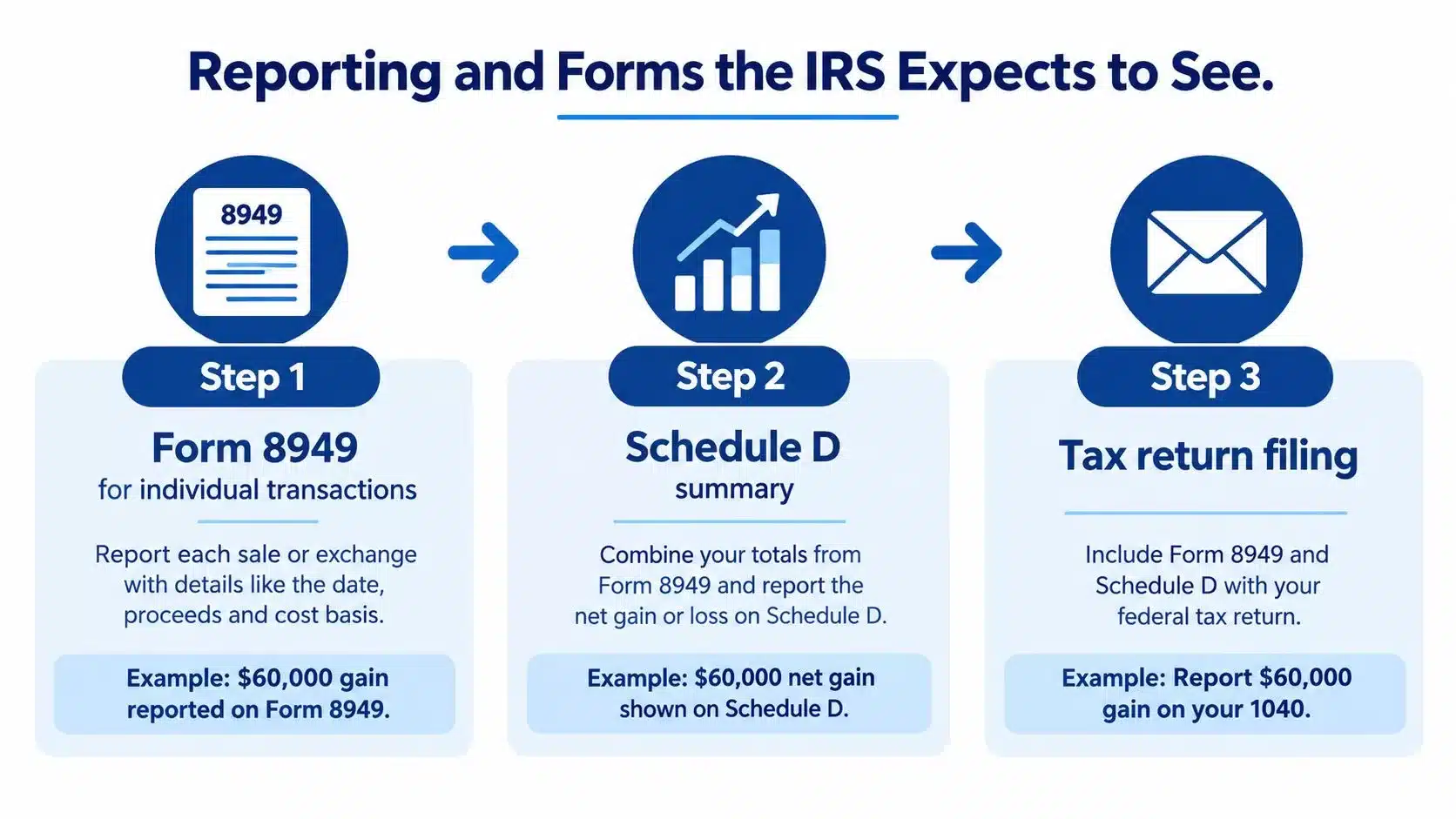
A taxable-account sale generally follows the capital-gains reporting chain. The investor reports individual transactions on Form 8949, summarizes the result on Schedule D, and carries the appropriate amount to the federal tax return. The records should support the proceeds, basis, dates, and expenses used in the calculation.
An IRA distribution uses a different reporting path. Retirement-account custodians generally must report IRA distributions of $10 or more on Form 1099-R. For a traditional IRA, the payer generally reports the distribution in Box 1 and Box 2a, while Box 7 identifies the distribution type and Box 4 records federal income tax withheld. (IRS Form 1099-R instructions and form details)
What the boxes mean
- Box 1: The gross distribution reported by the custodian.
- Box 2a: The taxable amount reported or determined for the distribution.
- Box 4: Federal income tax withheld from the distribution.
- Box 7: A code identifying the distribution type.
For an in-kind distribution, the fair-market value assigned to the bullion is generally treated as the distribution amount, even though the investor receives metal rather than cash. The custodian may not determine the full taxable amount for a traditional IRA, so the account owner should compare the form with personal records and tax guidance.
Withholding isn't the final bill
A nonperiodic IRA distribution that isn't an eligible rollover distribution generally has 10% withholding on the taxable portion by default, unless the recipient elects different treatment where permitted. An eligible rollover distribution paid directly to the recipient from an employer plan generally has 20% mandatory withholding, while that 20% rule doesn't generally apply to IRA distributions. (IRS Form 1099-R instructions for withholding)
Withheld tax is a credit on the tax return, not necessarily the final liability. Readers preparing a sale or distribution can also consult this guide to gold bullion reporting requirements.
Common Myths and Edge Cases That Catch Retirees Off Guard
The biggest myth is that every gold seller pays a flat 28% federal tax. The rate is a ceiling for qualifying long-term collectibles gains. The actual result depends on the taxpayer's applicable rate, adjusted basis, holding period, possible 3.8% Net Investment Income Tax, state taxes, and other items on the return. (Gold investment tax treatment and common distinctions)
Several situations deserve special care:
- Inherited gold: The basis may be adjusted under inheritance rules, which can materially change the gain when the beneficiary sells.
- Gifted gold: A recipient may need to examine the donor's basis and the relevant gift records rather than assuming the value on the transfer date is the basis.
- Dealer spreads: A spread between the quoted market price and the dealer's purchase offer can reduce the proceeds received.
- Multiple lots: Combining lots with different dates and costs can produce the wrong holding period and gain.
- Physically backed funds: Collectibles treatment can depend on the fund's legal structure, so the product's tax documents matter.
- IRA possession: Taking personal possession of IRA-owned metal can create a distribution and possible additional tax.
- Ineligible assets: A non-eligible coin or bar can create an account-compliance problem rather than a normal investment transaction.
- Rollover method: Moving retirement funds into a precious metals IRA without using an eligible rollover process can create an unintended taxable distribution.
A sale before the one-year holding line is generally taxed at ordinary-income rates, not at the 28% collectibles ceiling. That makes acquisition-date records particularly important when a retiree sells only part of a collection.
Answers to the Questions Readers Ask Next
How is inherited gold taxed when it is sold?
Inherited property may receive a basis adjustment under applicable inheritance rules. The beneficiary should establish the relevant basis before calculating a gain, because using the deceased owner's original purchase price without checking the rules can overstate the taxable profit. A tax professional can help when estate records are incomplete.
Do gold ETFs receive the same treatment as physical bullion?
Not necessarily. A fund's legal structure and what it owns can affect the tax treatment. Investors should review the fund's prospectus, tax reporting information, and annual tax documents instead of assuming that every gold-related security follows the physical-bullion collectibles rule.
Can physical gold be moved from a taxable account into an IRA without tax?
Usually, not in kind. An IRA contribution and a transfer of personally owned bullion are different transactions, and moving metal directly into an IRA can create valuation, eligibility, contribution-limit, or distribution issues. A custodian and tax professional should review the proposed transaction before any delivery takes place.
How is a Roth conversion of Gold IRA holdings taxed?
A Roth conversion is generally analyzed based on the value converted, not on whether the asset is metal or cash. The converted amount can be included in taxable income under applicable rules, while later qualified Roth distributions may be tax-free. The account owner should obtain the valuation and confirm the tax treatment before authorizing the conversion.
Gold IRA Association provides educational guides on IRA rules, rollover procedures, eligible metals, reporting, and provider comparisons. Readers can visit Gold IRA Association to review those resources and prepare questions for a qualified financial advisor, CPA, or tax professional.
This is not financial advice. Consult a licensed financial advisor, CPA, or tax professional before making investment decisions.