



Most retirement articles oversell gold as if it automatically beats inflation. It doesn't. Gold as an inflation hedge is real in some regimes and weak in others, and the difference matters a lot more than the hype suggests.
For a near-retiree, that nuance isn't academic. If gold is going to sit inside a retirement portfolio, it needs to earn its place by helping in the conditions that show up, not just in the headline moments people remember.
Why Gold Does Not Always Hedge Inflation
The popular version of the story is too simple. Gold isn't a permanent inflation machine, and it doesn't move in a straight line with consumer prices. The cleaner way to think about it is this, gold can help when inflation is disrupting confidence, but it can also lag when rates, currency trends, or market structure work against it.
That's not a minor detail. The World Gold Council says that since 1971, only 16% of the variation in gold prices can be explained by changes in U.S. CPI inflation, and it describes the relationship as inconsistent and time-varying rather than stable (World Gold Council research). That alone should make any retiree skeptical of blanket promises.
The better framing is the threshold problem. Gold can behave like an inflation hedge in one regime and fail in another, which is why a constant allocation deserves scrutiny. For a plain-English comparison of why gold's value often gets confused with money itself, see this explanation of gold versus money.
Practical rule: Gold should be treated as a conditional hedge, not a default substitute for cash, bonds, or a retirement income plan.
The Economic Mechanisms Behind Gold and Inflation
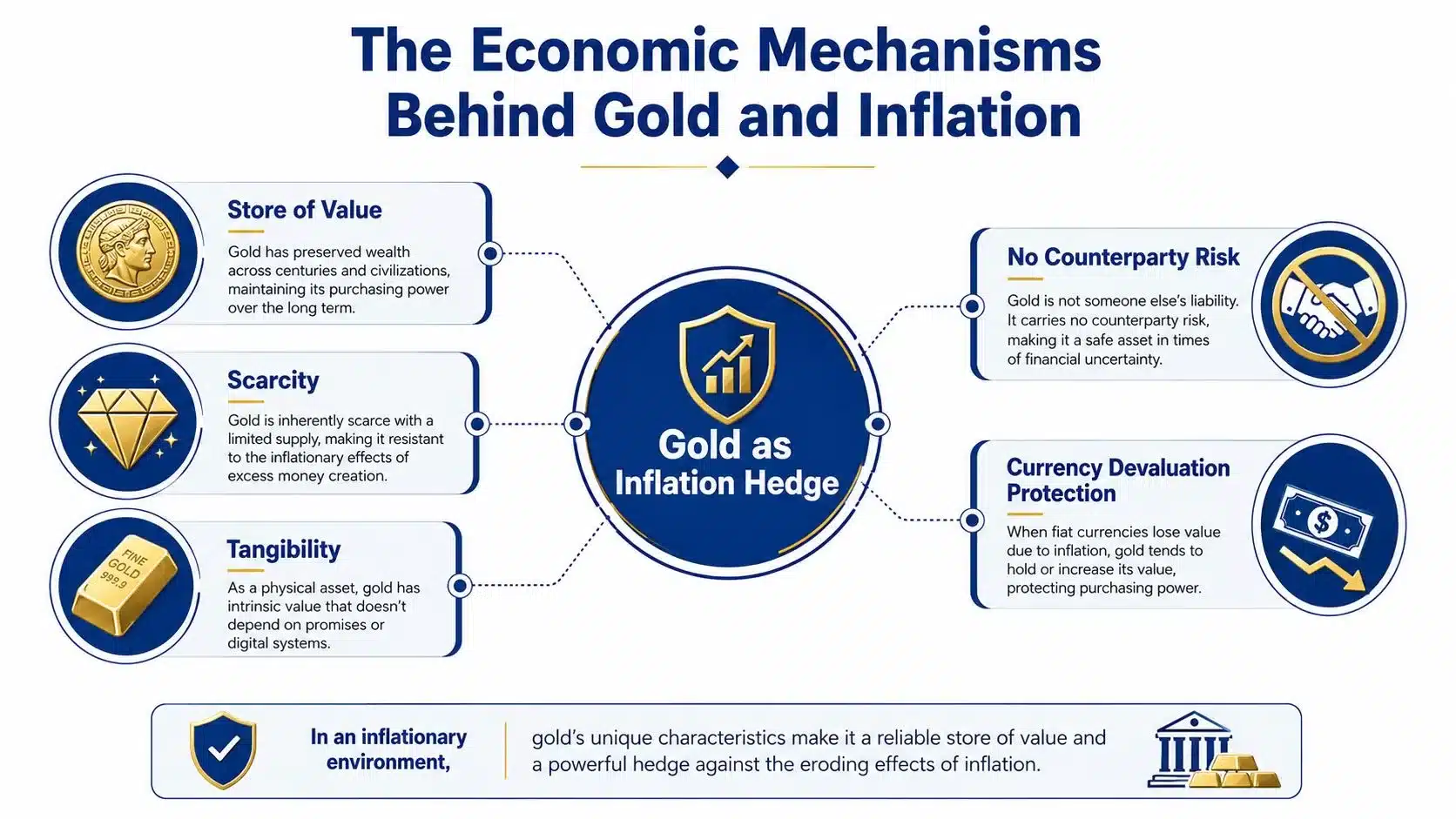
Gold matters because people trust it when they lose trust in paper claims. It is scarce, tangible, and not someone else's liability, so it often attracts demand when buyers worry that currency purchasing power is slipping. That's the core reason it has held a place in retirement portfolios for generations.
The market mechanics are more important than the slogan. Gold tends to respond not just to inflation, but to real interest rates, which are nominal rates after inflation is taken into account. When real yields fall, the opportunity cost of holding gold drops, and that can support demand even when CPI itself isn't the main driver.
There's also a psychology layer. Inflation scares savers because it threatens the future buying power of fixed income and idle cash. When that fear spreads, gold often benefits from the search for a store of value, especially in liquid markets where price discovery happens quickly.
Gold's edge is not that it pays income. Its edge is that it can hold attention when confidence in money, policy, or rates starts to crack.
For readers who want a cautious view of where prices may be headed, the gold price forecast discussion for 2026 is useful context, but the key point remains the same, gold responds to conditions, not slogans.
Historical Evidence From Major Inflation Periods
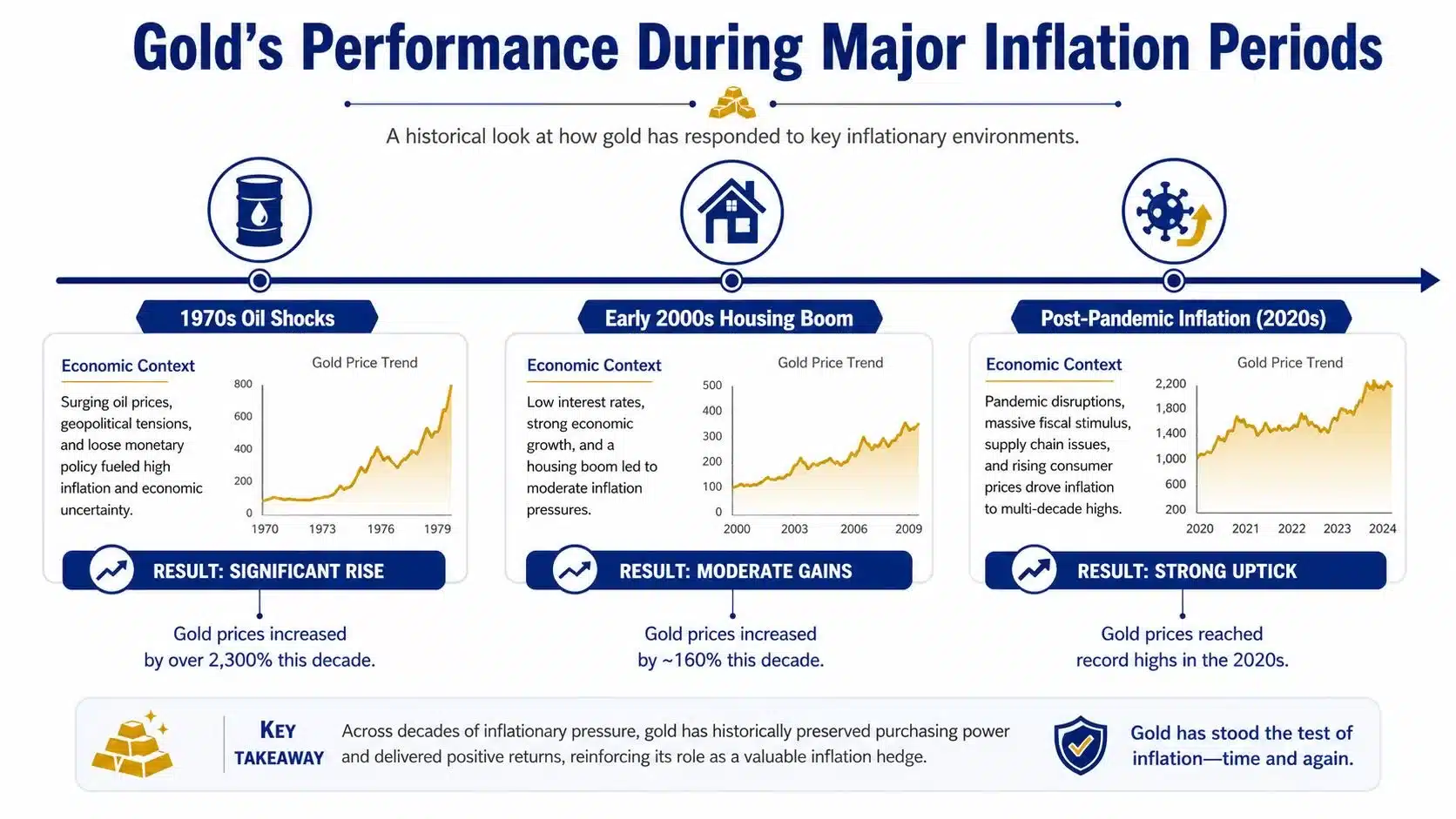
The strongest historical case for gold came during the 1973 to 1979 inflation shock, when average U.S. inflation was about 8.8% per year and gold returned roughly 35% annually (CNBC historical review). That period is still cited for a reason, it was one of the clearest stretches where gold rewarded owners while price pressures stayed hot.
That said, history doesn't give retirees a simple rule. A two-century perspective found that gold can fully hedge headline, expected, and core CPI in the long run, and that the effect is stronger in the U.S. than in the U.K. (long-run study). At the same time, a large cross-country nonlinear study found gold is not a long-run inflation hedge overall, even though it does act as a short-run hedge in the UK, the USA, and India (nonlinear ARDL study).
That split matters. Gold can look excellent in a crisis and unhelpful in ordinary inflation, which is why retirees should stop asking whether gold “always” works. The pertinent question is whether the current inflation regime resembles the episodes where gold has historically helped.
For another long-horizon perspective on how gold behaves across cycles, the return on gold discussion is worth reading alongside this evidence.
When Gold Actually Works as Inflation Protection
The most useful research for retirees is the one that defines the turning point. A threshold-regression study on U.S. monthly data from January 1969 to March 2021 found that gold's inflation sensitivity becomes statistically significant only when monthly U.S. inflation exceeds 0.55%, which is about 6.8% annualized (threshold study). That's the answer most articles avoid. Gold appears to work best when inflation is high enough to be uncomfortable, not just present.
The real-rate test
That threshold fits the rate story. Recent commentary from CFA Institute argues headline PCE inflation has little meaningful average correlation with gold, while gold's stronger driver is often falling yields and credibility shocks in policy (CFA Institute analysis). In plain English, gold can disappoint during high inflation if nominal rates rise even faster.
This is the practical filter. If inflation is high but real rates are still positive and central banks are keeping pace, gold may not do much. If inflation is pressuring real yields downward and policy trust is weakening, gold becomes far more defensible.
Bottom line: Gold is most credible as a tactical hedge in higher-inflation episodes, not as a monthly CPI mirror.
The right question for a retiree is not “Is inflation up?” It's “Are real yields falling, and is inflation high enough to change behavior?” That's the difference between owning a useful hedge and owning a costly ornament.
Gold IRA Rules and Allocation Guidance for Retirees
A Gold IRA only makes sense if the implementation is clean. For IRA eligibility, gold generally needs to meet the 99.5% purity standard, and the account has to hold approved coins or bars through a qualified custodian with proper storage. If the setup is sloppy, the tax benefits can evaporate fast.
What retirees should verify first
- Purity and eligibility: Confirm the metal meets IRA rules before any purchase.
- Custodian structure: The IRA must be held by a qualified custodian, not informally by the account owner.
- Storage rules: Approved metals need approved storage, not a home drawer or safe.
- Rollover handling: 401(k) and IRA rollovers need to be processed correctly to avoid taxes or penalties.
- Documentation: Keep every statement and transfer record organized before and after funding.
The cost side matters just as much as the metal itself. Gold IRAs can involve setup charges, annual custodial fees, storage fees, and transaction costs. Retirees should ask for a full fee schedule before moving money, because the all-in drag can matter more than people expect.
| Gold IRA Costs and Requirements | ||
|---|---|---|
| Category | Typical Range | Notes |
| Setup | Varies by provider | Verify before funding |
| Custodial fees | Varies annually | Depends on account size and service level |
| Storage | Varies annually | Often charged by the depository |
| Transaction fees | Varies by trade | Applies when buying or selling metals |
| Gold purity | 99.5% | Standard for IRA-eligible gold |
As for allocation, a measured position is more sensible than a large permanent bet. For most retirees, the discussion usually stays in the 5% to 15% range, but that is a planning framework, not a rule. The right size depends on how much inflation risk already exists in the rest of the portfolio, how close retirement income is, and how much volatility the household can tolerate.
This is not financial advice. Consult a licensed financial advisor, CPA, or tax professional before making investment decisions.
Comparing Gold to Other Inflation Protection Options
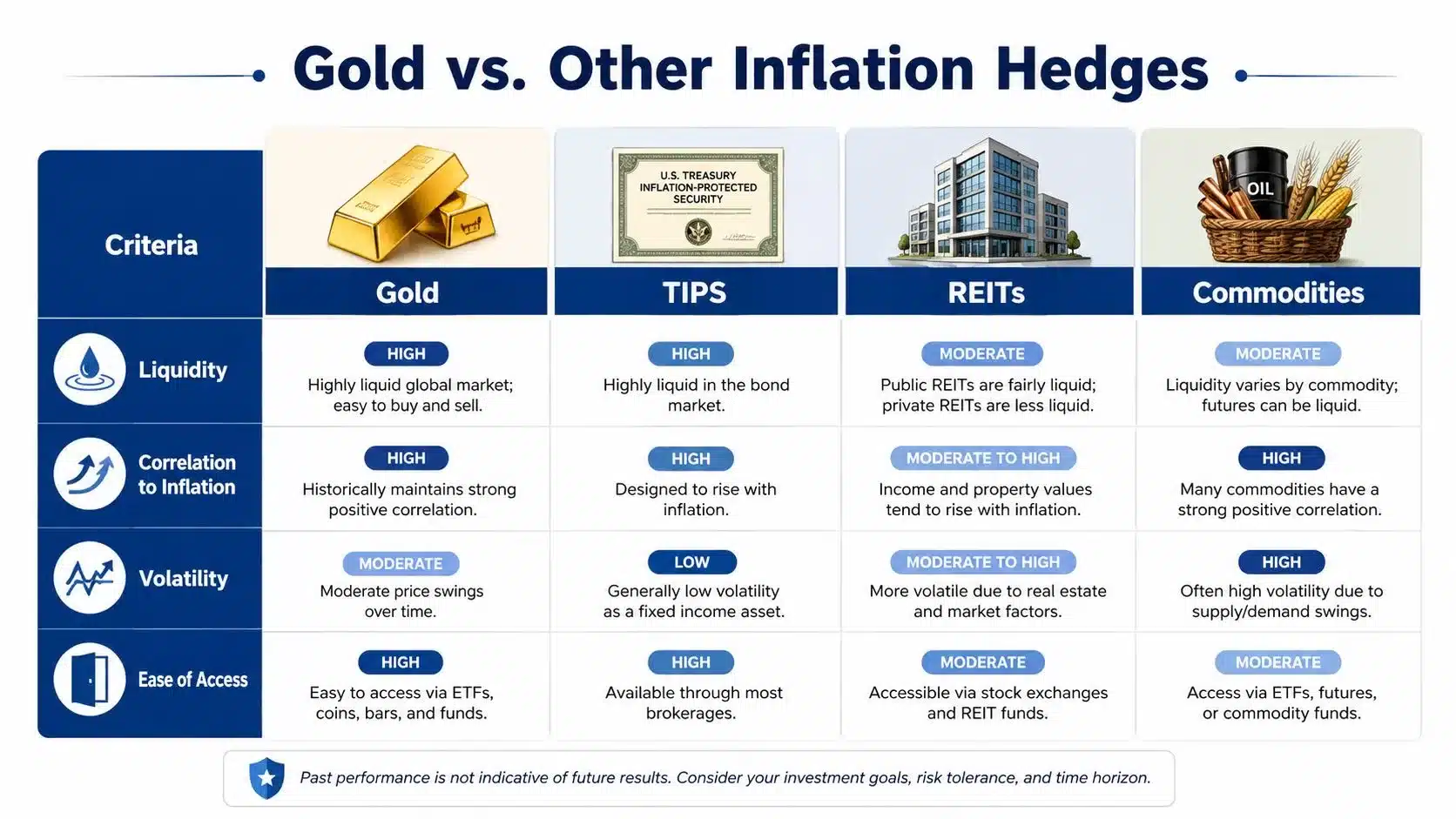
Gold is not the only tool in the toolbox, and it's usually not the best one for every job. TIPS are more directly tied to inflation outcomes, REITs can help when real assets reprice, commodities can respond quickly to supply shocks, and dividend-growing stocks can add income if earnings stay resilient. The right answer depends on whether the retiree needs direct inflation linkage, liquidity, or portfolio ballast.
How gold differs
Gold's main strength is its lack of counterparty risk. That is a real advantage when trust in financial promises is the issue. Its weakness is also obvious, it produces no income and can be costly to store, which is why it works better as a diversifier than as a full substitute for inflation-linked income assets.
A useful way to think about the comparison is by role, not by brand. A retiree who wants direct CPI linkage may prefer one answer, while a retiree worried about policy credibility may prefer another. For a broader framework on nontraditional diversifiers, this guide to alternative assets is a helpful supplement.
Gold is the blunt instrument. It can be powerful when confidence breaks, but it's not the cleanest inflation solution on every spreadsheet.
The practical takeaway is simple. Gold belongs beside other hedges, not in place of them. A balanced retirement plan can use more than one inflation defense, and that's usually smarter than betting everything on a single metal.
Building a Measured Gold Allocation Strategy
The strongest case for gold is tactical, not maximalist. Retirees should think in terms of regime protection, meaning gold is most useful when inflation is running hot enough to matter and real yields are being squeezed. That points toward a modest allocation that can be raised or reduced as conditions change, rather than a permanent oversized position.
A sensible decision framework
- Check inflation pressure: Gold becomes more credible when inflation is persistent, not just noisy.
- Watch real yields: Falling real rates are a better signal than CPI headlines alone.
- Match the time horizon: Near-retirees should care more about protection during drawdown years than about long-run theory.
- Respect portfolio balance: If the portfolio already has plenty of inflation sensitivity, gold may add less than expected.
- Keep allocation modest: A measured position is easier to live with than an all-in bet.
The right Gold IRA decision is also operational. If a rollover is being considered, the owner should verify eligibility rules, fee schedules, storage arrangements, and transfer steps before moving a dollar. That discipline protects the retirement account from avoidable mistakes and keeps the decision grounded in facts instead of fear.
Gold should not be treated as a guarantee. It can help when inflation and policy stress line up, but it can also underwhelm when rates rise faster than prices or when markets already expect the inflation burst. Retirees who understand that trade-off are much less likely to overbuy at the wrong time.
For readers who want a clearer way to compare allocation ideas, fees, and account setup basics, Gold IRA Association keeps the focus on education first. Visit Gold IRA Association to review practical guides on Gold IRAs, rollover rules, and precious-metals retirement planning, then use that information to have a sharper conversation with a licensed financial advisor or tax professional.