


A 62-year-old saver can stare at a brokerage statement, see gold headlines arguing over $4,000, $5,400, or $6,300, and still not know what to do with a 401(k) or traditional IRA. The honest answer is that a gold price forecast 2026 needs to be treated as a range, not a single number, because Wall Street is still spread out on the outcome. This is educational, not personalized advice, and the right move for any retiree still depends on taxes, fees, and account rules.
What Retirees Are Asking About the 2026 Gold Outlook
A practical question keeps coming up for near-retirees, what should a person do when gold forecasts are all over the map? Start by ignoring the urge to hit a perfect price target. If the goal is retirement protection, gold belongs, if at all, in a small, deliberate allocation inside the overall plan.

That matters because the 2026 forecast is not a neat consensus number. Analysts keep landing in different places, which is exactly why a retiree should think in bands instead of headlines.
Practical rule: if a forecast only makes sense when one exact price is hit, it is too fragile to guide a retirement decision.
A Gold IRA rollover can make sense for some savers, but only after the account holder checks whether the move is really about diversification, not chasing a number. Gold has a place when a portfolio needs a non-correlated asset, but it should never be treated like a shortcut to better retirement math.
The 2026 Forecast Range From Major Banks and the World Gold Council
A retiree reading the gold price forecast 2026 should focus on the spread, not the loudest target. The World Gold Council's working base case puts gold within about ±5% around US$4,100 per ounce in the second half of 2026, which points to roughly US$3,895 to US$4,305 per ounce. That is a tight enough band to matter, but wide enough to remind savers that gold is still reacting to macro pressure, not following a fixed path.
Its broader 2026 outlook says gold could rise 5% to 15% from current levels, with the outcome tied to the severity of an economic slowdown and the speed and magnitude of rate cuts. For a retirement saver, that is the right frame. Gold is a hedge asset first, a return target second.
Where the banks land
Reuters reported a February 2026 survey with a median forecast of $4,746.50 per ounce, J.P. Morgan at $6,000 per ounce in 4Q 2026, and Goldman Sachs holding a $5,400 year-end target after a March 2026 drop of more than 10%, the steepest monthly fall since June 2013 (Reuters). Reuters also reported that in February 2026, J.P. Morgan raised its long-term forecast to $4,500 per ounce while keeping its end-of-2026 view at $6,300, and Macquarie lifted its 1Q 2026 average to $4,590 from $4,300 (Reuters).
That spread is the point. A retiree should not build a Gold IRA decision around one bank's ceiling price. The useful question is whether gold deserves a measured place in the portfolio as protection against a bad macro turn, and whether that allocation fits the rest of the retirement plan. If you are comparing gold to stock exposure, the framework in the discussion of gold versus the S&P 500 is the cleaner way to judge how it behaves inside a portfolio.
Tax mechanics also belong in the decision. If an allocation change means moving money from a retirement account into gold, the transfer has to be set up cleanly, or the account holder can create avoidable tax problems. For readers who need a plain-English check on rollover timing and account handling, this inflation and tax debt guidance is the kind of background that should be reviewed before any move is made.
The Macro Drivers That Decide Which End of the Range Wins
Gold moves when the real-rate backdrop, the U.S. dollar, inflation pressure, and central-bank policy all point the same way. Retirees should care about that mix more than any single price target, because it tells you whether gold is being supported by durable demand or just by short-lived worry.
Real rates and the dollar matter first
Real interest rates are the inflation-adjusted return on safe bonds. When those rates fall, gold gives up less opportunity cost, so it looks more attractive as a store of value. The dollar matters for the same reason. Gold is priced globally in dollars, so a weaker dollar tends to support the metal, while a stronger one usually weighs on it.
That is the first filter a retiree should use. If you are watching the 2026 gold range and asking which end is more likely, start with the rate trend and the dollar trend before you look at headlines.
Inflation expectations and policy shifts
Inflation expectations move quickly because savers do not wait long to protect purchasing power when paper assets start looking weaker. Rate cuts matter for the same reason. They change the interest-rate setup fast, even before the broader economy fully reacts.
For a retirement saver, that matters because gold usually does better when policy is getting easier and cash yields are losing appeal. If you also need the retirement-account angle, the plain-English inflation and tax debt guidance is worth reading before you shift assets.
The right portfolio question is whether gold deserves a measured role as a hedge, not whether it can hit some flashy upside number. For that decision, our gold versus S&P 500 comparison is the cleaner framework, because it shows how gold behaves inside a retirement mix instead of treating it like a standalone bet.
If real rates fall, the dollar weakens, and cuts come faster than expected, gold can move toward the high end. If rates stay higher for longer and the dollar firms up, the lower end of the range becomes more believable.
Demand and Supply Forces Behind the Structural Bid
The bullish case for gold in 2026 isn't just about macro fear. It also rests on a real demand base that has stayed firm even when the price has pulled back.

Who keeps buying
Goldman Sachs's 2026 outlook cited projected central-bank buying of about 60 tonnes per month, roughly 500 tonnes of inflows into Western gold ETFs since early 2025, and China buying gold for 15 consecutive months as of January 2026 (TheStreet). That combination matters because official-sector demand is slower-moving and less reactive than retail sentiment.
Why the floor looks firmer than in past cycles
Jewelry and industrial demand still matter, but they're not the main event here. Mine supply is slow to respond, because new production takes time, permitting, and capital, so the supply side doesn't quickly neutralize a demand wave. That's why a retiree should think of gold as having a firmer structural floor than many other commodity-like assets.
For readers exploring digital forms of exposure, the background on how tokenized gold works is worth a look, even though physical holdings inside a retirement account follow a different rule set. The broader point is simple, persistent demand can support gold even when short-term price action gets ugly.
A single quarter can still disappoint, but a market with official buying and steady ETF demand is harder to break than one driven only by momentum.
For physical ownership basics, the internal guide on https://goldiraassociation.com/what-is-a-bullion/ is the right companion read.
Bull, Base, and Bear Scenarios for 2026
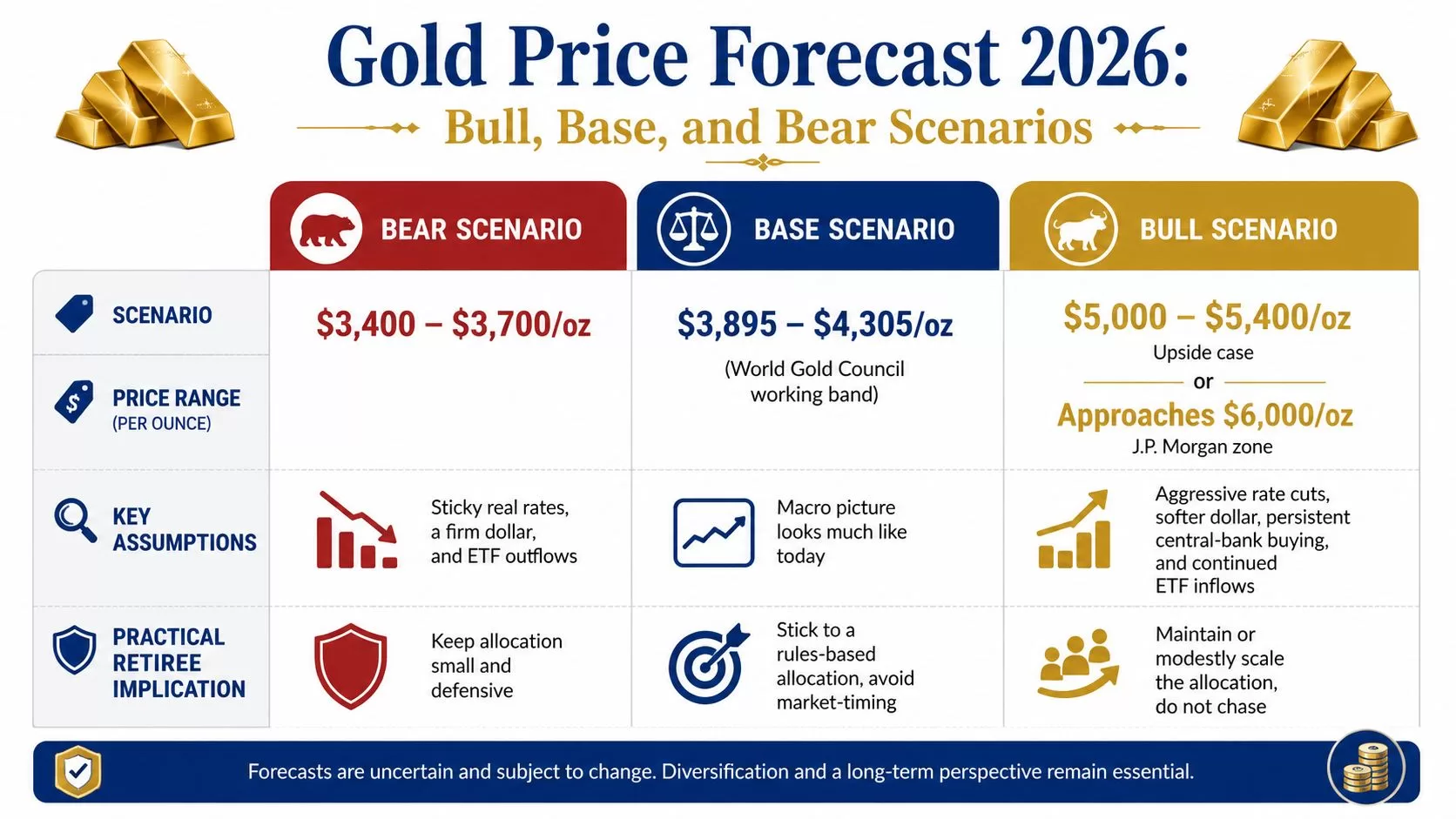
A retiree does not need a perfect forecast. A retiree needs a decision frame. The cleanest way to use the 2026 outlook is to sort it into three scenarios and tie each one to a sensible allocation posture.
| Scenario | 2026 Price Range per ounce | Key Assumptions | Implication for Retirement Allocation |
|---|---|---|---|
| Bear | Roughly $3,400 to $3,700 | Sticky real rates, firm dollar, ETF outflows | Keep the allocation small and defensive |
| Base | Roughly $3,895 to $4,305 | Macro picture stays close to today | Use a rules-based allocation, not market timing |
| Bull | Roughly $5,000 to $5,400, with room toward $6,000 in a stronger demand shock | Aggressive cuts, softer dollar, persistent central-bank buying, continued ETF inflows | Maintain or modestly scale the allocation, but do not chase |
The point of the table is not to pretend one number will be right. It is to show how quickly the setup changes once real rates, the dollar, and investor demand move in the same direction. That is why the bear case deserves respect, but not a big bet. If prices sit in that lower band, gold still serves as ballast, just with less upside than the crowd expects.
The bull case is the one that tempts retirees into overcommitting. A sharp rally can happen if policy eases, the dollar softens, and official buying keeps absorbing supply. That setup can justify a larger gold sleeve inside a portfolio, but only if the rest of the retirement plan already covers income, cash needs, and bond duration. Gold is the diversifier, not the engine.
For allocation work, the right question is not whether gold can hit the top of the range. It is whether a retiree can live with the position if the market only reaches the middle of the range. That is why a staged approach usually beats a lump-sum decision. A planned Gold IRA rollover guide is the better starting point than a rushed move, because rollover timing, account rules, and tax handling should be settled before any metal is bought.
The base case is the most useful planning case, because it keeps expectations grounded. If the market spends much of 2026 near that middle band, a retiree who sized the position modestly will be fine. A retiree who treated gold like a growth trade may not be.
That is the key takeaway. Use the scenario range to set position size, set rollover timing, and avoid making the account depend on a single outcome.
What the 2026 Outlook Means for Gold IRA Investors
A gold forecast only matters if it changes behavior. For a saver near retirement, the central question is whether gold belongs inside a self-directed Gold IRA as a diversifier, with the rollover handled before the metal is bought.
How to think about allocation
A 2026 forecast range is wide enough to matter and wide enough to punish overconfidence. That points to a modest gold sleeve, not a large wager. A retiree who already has equity, cash, and bond exposure usually needs gold for balance, not for maximum upside.
Why timing the rollover is tricky
A wide forecast band argues against chasing a perfect entry point. It also argues against rushing a rollover before the tax treatment, RMD impact, and fee stack are clear. The practical move is to treat the rollover as a process decision, then stage the allocation if the account setup and market price do not line up neatly.
Gold IRA rules are strict. The IRS only allows certain coins and bars that meet purity standards, and the assets must be held by an approved custodian in an approved depository. Rollover rules, contribution limits, and RMD ages can change, so those details need to be checked against current IRS guidance before any transfer is made. If the account is not in good order, start with restoring IRS good standing before any metals move.
For the mechanics of moving retirement money into metals, the internal Gold IRA rollover guide is the right next step.
A gold allocation should serve as portfolio insurance rather than a speculative trade.
Key Risks, Tax Checkpoints, and a Practical Checklist
Gold's 2026 path can still break lower if the macro tape changes. A sharper real-rate spike, a sudden ETF unwind, a pause in central-bank buying, or policy news that strengthens the dollar would all weaken the case for a bull run. That is a reason to keep the allocation conservative and tied to a real plan.
What to check before any rollover
Start with the rollover mechanics, because sloppy paperwork creates the biggest avoidable problems.
- Direct vs. indirect rollover: A direct transfer keeps the money moving between qualified accounts more cleanly, while an indirect rollover can create avoidable handling risk.
- The sixty-day window: If the rollover is indirect, the clock matters, and missing that window can create tax trouble.
- Traditional vs. Roth treatment: The account type changes the tax result, so the source account should be identified before any paperwork starts.
- Required Minimum Distributions: Metals held in an IRA still sit inside the rules governing distributions, so the account owner needs to know how RMDs affect the timing.
- Custodian and depository: The account must stay with an approved custodian and approved storage, not at home.
- All-in costs: Setup, custodial, storage, and transaction fees should all be reviewed together, not one by one.
If filing problems are already part of the picture, start with restoring IRS good standing before opening a retirement account or moving metal. Cleanup comes first, because unresolved tax issues can complicate the whole rollover.
J.P. Morgan's repeated upward revisions, including the move to $4,500 long-term and $6,300 at end-2026, show how quickly targets can shift, and Macquarie's lift to $4,590 for 1Q 2026 points the same way. That is useful context, but it does not change the job in front of a retiree.
If you're weighing a Gold IRA, keep the position modest, verify the tax rules, and compare the full cost stack before moving money. This is not financial advice. Consult a licensed financial advisor, CPA, or tax professional before making investment decisions.
The right response is disciplined positioning rather than reactive urgency.