


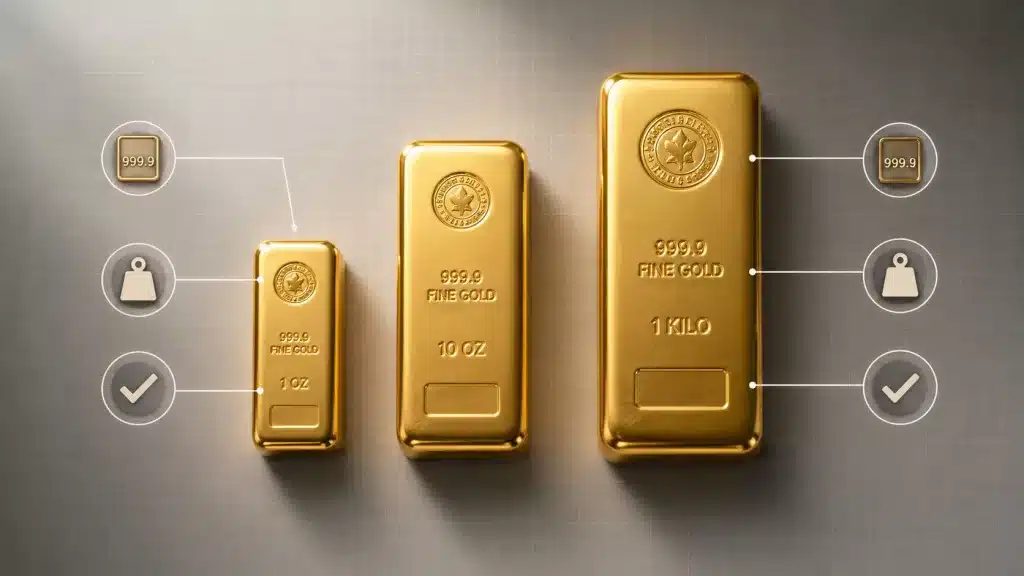
IRA-approved gold bars must meet a minimum fineness of 99.5% pure gold, or 0.995, and they also have to come from an approved refiner or mint. If either piece is missing, the bar is a compliance problem, not a retirement asset.
That's the part most buyers miss. A gold bar can look perfect, test pure, and still fail IRA standards if the producer isn't recognized, the paperwork is thin, or the storage chain breaks the rules. For retirement investors, that's not a small detail, it's the difference between a clean purchase and a costly mistake.
Understanding IRA Gold Bar Eligibility Requirements
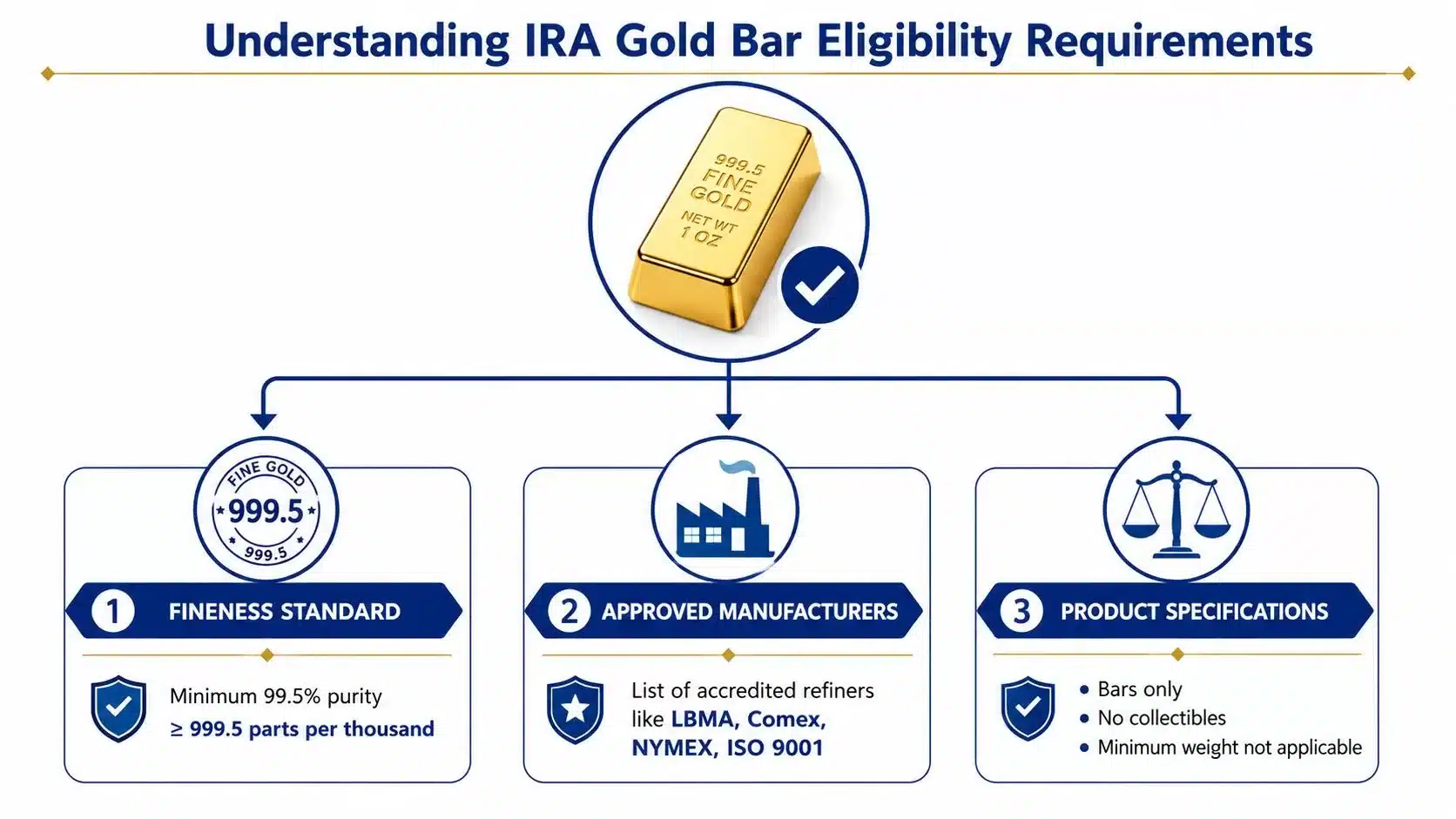
A gold bar can pass a quick visual check and still fail IRA rules. The test is three-part, purity, approved producer status, and IRS-approved storage. If a bar misses one of those, it does not belong in a retirement account.
The three rules that matter
Start with the fineness stamp. IRA guidance points to 99.5% fineness as the baseline for gold bars, and that mark has to appear on the bar itself. Purity alone is not enough, but without it the bar fails the first test outright (ConsumerAffairs).
Next comes the producer. The bar has to come from a recognized refiner or assayer, not a private source with no accepted status. In practice, that means checking the brand against approved lists and confirming the hallmark matches the refiner named by the seller.
Storage is the final gate. IRA-owned bullion belongs in an IRS-approved custodian or depository, not in a home safe or personal vault. That requirement is part of the compliance chain, and it is spelled out in standard guidance on precious metal IRA rules, JM Bullion, and Fidelity.
Practical rule: Verify the fineness stamp, confirm the refiner's name and hallmark, then make sure the custodian will send the bar only to an approved depository. A dealer's claim is not enough.
A clean way to check eligibility is to separate the three questions. What is the bar made of? Who made it? Where will it be stored? If the answer to any one of those is weak, the bar may be acceptable bullion but it is not IRA-compliant.
For a broader rules overview, Gold IRA Association keeps a dedicated reference on precious metal IRA rules.
Purity Standards and Approved Refiner Requirements
A gold bar's fineness stamp is the first detail to inspect, but it does not finish the job. For IRA purposes, the bar has to meet the 99.5% pure gold, or 0.995 fineness standard, and the producer has to satisfy IRA acceptance rules as well.
What the purity mark should show
A compliant bar should display the fineness stamp, the weight marking, and the refiner hallmark. Many bars also carry a serial number or an assay certificate, which helps the custodian and depository verify authenticity when the bar arrives.
That paperwork is part of the verification trail. An IRA custodian should be able to match the markings on the bar with the documents from the seller and the refiner, because physical purity alone does not solve a weak documentation problem.
Approved producer status is a separate test
Purity and producer approval are two separate tests the IRS applies to IRA gold bars. A bar from an unapproved private source can miss eligibility even if the gold content is correct. Major industry references tie accepted production to recognized lists and frameworks such as LBMA and COMEX/NYMEX style approval systems, and the practical check starts with the refiner name stamped on the bar plus the published approval list behind it.
Buyers make mistakes here when they trust appearance alone. A polished bar with a familiar logo still needs confirmation against an approved list, and the hallmark should match the refiner or assayer named by the seller. That is the verification workflow that protects an IRA purchase from avoidable rejection.
The standard also explains why some products get special treatment. American Gold Eagles are frequently cited as an exception to the usual fineness rule in IRA discussions, which is one reason product-specific review matters instead of blanket assumptions.
For a clearer technical explanation of the approval test, review what IRA-approved gold means in practice. That is the level of checking that separates a compliant purchase from a paperwork problem.
Common IRA-Approved Gold Bar Weights and Formats
Gold bars enter an IRA in a few practical sizes, but the right choice depends on how much flexibility you want later. The formats that matter most are 1 oz, 10 oz, and 1 kilo, with the 400-ounce London Good Delivery bar serving as the institutional benchmark for bulk metal rather than the usual retirement-account purchase.
Bar size affects more than storage. It changes how easily you can allocate funds, verify inventory, and sell part of a position without disturbing the rest. The same ounce count can also mean different tradeoffs in premium and handling, so the bar's marked weight should be read carefully against a troy ounce reference, not a regular ounce, as explained in this guide to troy ounces versus regular ounces.
IRA-Approved Gold Bar Weight Comparison
| Weight | Troy Ounces | Liquidity | Best Use Case | Typical Premium |
|---|---|---|---|---|
| 1 oz | 1 | High | Small, flexible positions | Highest per ounce |
| 10 oz | 10 | High | Balanced accumulation | Moderate per ounce |
| 1 kilo | 32.15 | Moderate | Bulk buying with lower fabrication cost | Lower per ounce |
| 400 oz | 400 | Low for most retirees | Institutional storage standard | Lowest per ounce |
Smaller bars usually make more sense inside an IRA because they are easier to split up later. If an account owner needs to rebalance, raise cash, or take a partial distribution, several smaller bars are easier to work with than one large block of metal.
Larger bars still have a real advantage. They usually carry a lower fabrication burden per ounce, which is why bulk buyers prefer them. That cost efficiency comes with a tradeoff, though, because bigger bars are harder to divide and less practical for retirees who may need more control over timing and liquidity.
Bottom line: Pick the smallest bar size that still matches the allocation plan. That keeps future selling, storage, and distribution decisions cleaner.
For investors rolling retirement funds into metals, the simplified TSP to IRA process often leads to the same size decision, because custody rules and future distribution needs should be set before any bar is purchased.
How to Verify Gold Bar Eligibility Before Purchase
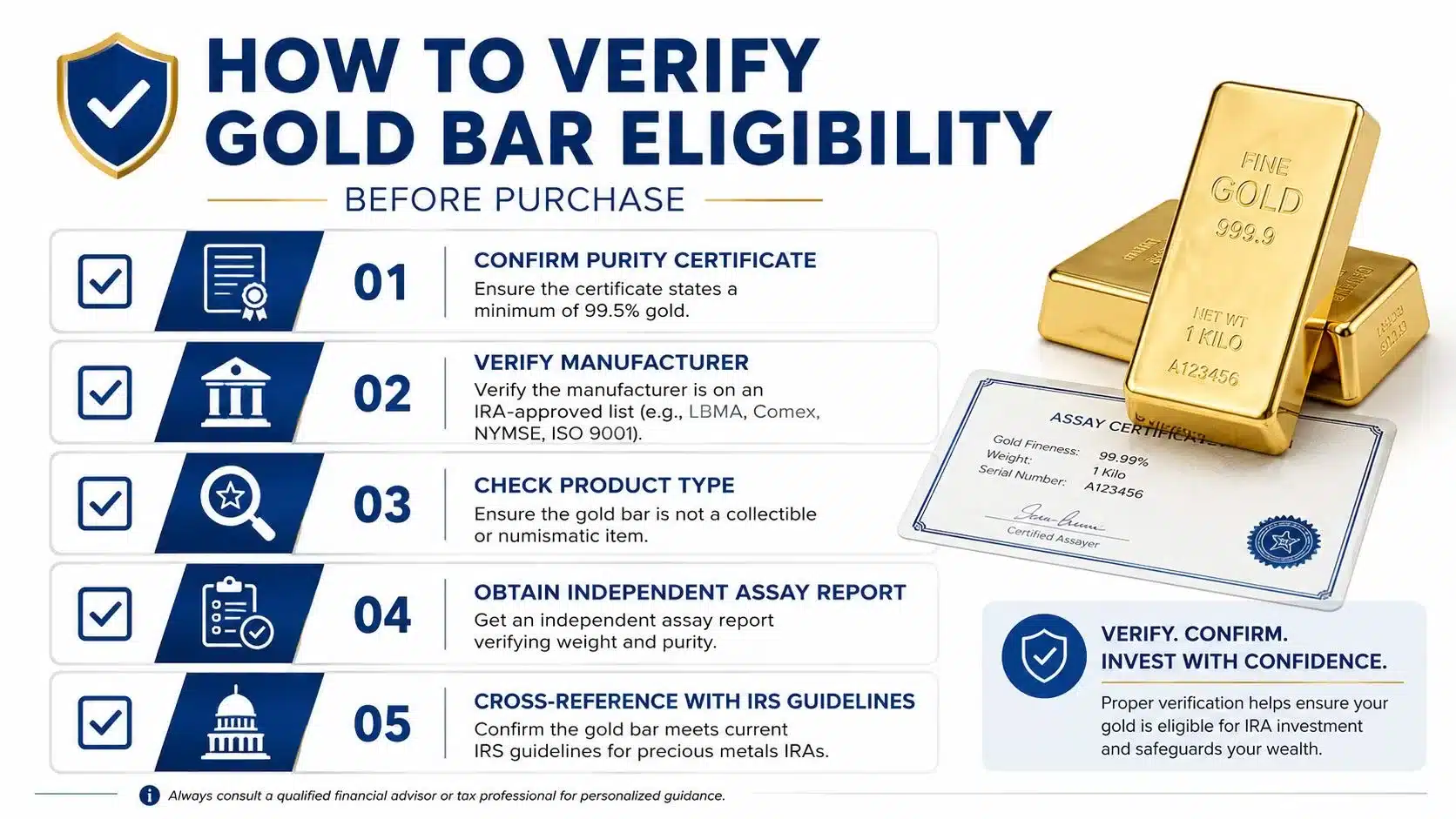
The right way to buy an IRA bar is to verify it before payment, not after shipping. Dealers can be wrong, paperwork can be incomplete, and a pretty bar can still fail custody review. The safest workflow is physical inspection first, document check second, and approved-list confirmation third.
The verification steps that actually protect the buyer
Start with the bar itself. Read the hallmark, weight marking, and fineness stamp. If the bar doesn't clearly show 0.995 or equivalent purity language, that's already a warning sign.
Next, check the paperwork. An assay card or certificate should match the bar's identity, especially any serial number. If the seller can't provide a matching document trail, the custodian may have no reason to accept the metal.
Then confirm the producer. The refiner or mint should appear on a recognized approved list. Buyers shouldn't rely on a verbal promise that “it's approved,” because that is exactly how mistakes get made.
Practical rule: If the paperwork and the metal disagree, trust the paperwork trail only after it's cross-checked against the bar itself.
The final check is custodial compatibility. The IRA custodian or depository needs to accept that specific product, not just that general type of bar. That's why a purchase process for retirement metal is not the same as buying bullion for personal storage.
For investors who are also handling account moves, a useful companion resource is the simplified TSP to IRA process, because funding and metal selection often happen in the same transaction window.
A clean purchase file should include the bar photo, the serial number, the assay document, and the seller invoice. Keep those records together. If a custodian asks for proof, fast access to the file can prevent delays.
Gold Bars Versus Coins for IRA Investment Strategy
Bars and coins are both eligible in the right IRA setting, but they do different jobs. Bars fit investors who want to accumulate metal efficiently. Coins fit investors who want easier selling, cleaner partial distributions, and more control over position sizing.
Where bars tend to work better
Bars usually make more sense for larger purchases and steady accumulation. They are straightforward to store and usually carry less fabrication cost than coins. That lower premium can matter when the goal is to maximize the amount of metal inside the account.
The trade-off is liquidity by unit. A larger bar is harder to liquidate in pieces, so an investor who may need partial sales during a rebalance should think carefully before choosing oversized bars. That is a practical issue, not a theoretical one. It affects how much control you keep when account values shift.
Storage costs can also tilt the decision. A depository may charge based on space, handling, or the specific form of metal held, so a compact bar position can be efficient, but not automatically cheaper in every custody setup. Ask the custodian how the storage fee structure treats bars before you buy, because the cost difference can erase the premium advantage if the account holds awkward sizes or a mixed inventory.
Where coins tend to work better
Coins are easier to divide into smaller sale amounts, and that makes them better for distributions that need precision. They are also easier for many investors to recognize at a glance, which reduces confusion during liquidation or transfer. For retirement holders who value flexibility, that matters more than saving a small amount on fabrication.
The product rules still have to be checked against IRS standards, but the form of the asset changes the experience. The American Gold Eagle exception is a reminder that coin eligibility can have product-specific treatment, so buyers should verify each coin against the governing rules instead of assuming all precious metals are treated the same.
Investor takeaway: Bars work best for accumulating metal. Coins work best for controlling sales and distributions later.
Gold IRA Association also publishes a broader resource on how physical precious metals fit inside retirement accounts, and the decision usually comes down to how much flexibility the account holder wants once it is time to sell or take metal out of the IRA.
Complete Eligibility Checklist for Gold Bar Purchases
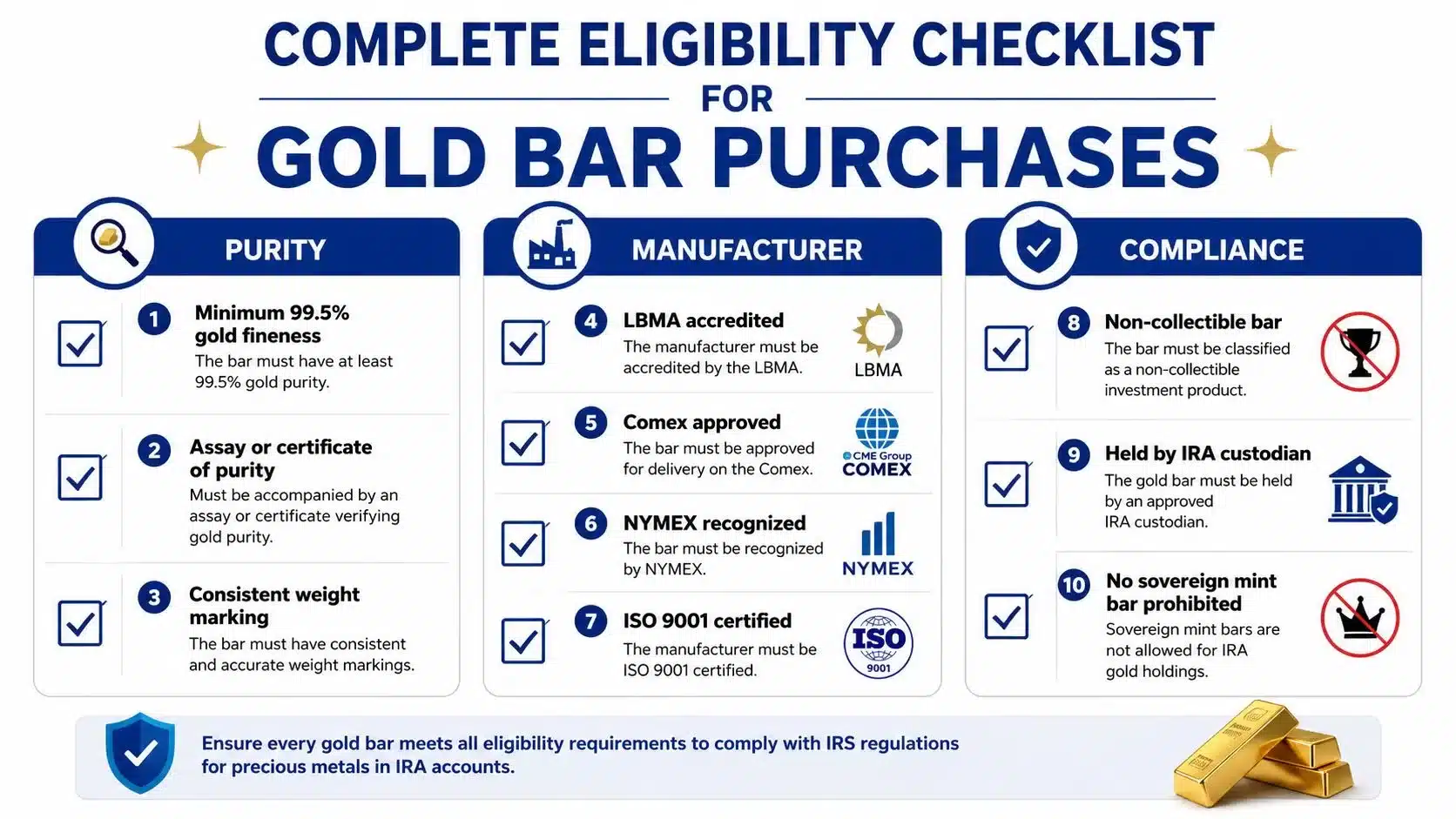
A serious buyer should treat every gold bar purchase like a compliance file. The goal is not just to buy gold. The goal is to buy a bar that a custodian can accept without second-guessing.
What to verify before money leaves the account
- Fineness stamp present: The bar should show 99.5% purity, or 0.995, in a visible and legible format.
- Refiner or mint identified: The hallmark should identify the producer, not leave the source vague.
- Assay card or certificate attached: The certificate should match the bar details and serial number, if one is present.
- Weight marking clear: The bar's exact weight should be stamped and easy to read.
- Approved production source: The refiner should align with recognized approval lists used by custodians.
- No collectible framing: The product should be presented as bullion, not as a collectible-style item.
- Custodian acceptance confirmed: The IRA custodian should approve the exact bar type before purchase.
- Depository compatibility verified: The storage partner must accept the product without special exception.
- Documentation saved: Keep invoice, photos, certificate, and serial data together.
- Chain of custody intact: The bar should arrive through a traceable, IRA-compliant route.
The fastest way to fail this checklist is to assume the seller has already done it. Sellers sometimes speak in generalities. Custodians need specifics.
That is why the file matters. A buyer who saves the paperwork can answer questions later without scrambling for proof. The bar itself may be simple, but the compliance trail should be exact.
IRA Contribution Limits and Gold Bar Investment Context
Gold bars still sit inside the IRA system, so funding limits remain part of the decision. For 2024, the contribution ceiling is $7,000 for investors under 50 and $8,000 for those 50 or older, which gives investors a practical ceiling for how much fresh money can be directed into a gold IRA each year.
That does not mean gold exposure has to come only from new contributions. Rollovers from existing retirement accounts are often the more realistic funding source when an investor wants meaningful metal exposure. Once the money lands in the IRA, the account still has to follow IRA rules, and the bar has to be eligible before the custodian accepts it.
Gold also dominates this niche. One 2026 industry snapshot says gold represents about 80% of precious-metals IRA value, which shows how much of the category is driven by gold rather than silver or platinum. That makes product verification a serious step, not a box-checking exercise. Use the approved list, confirm the refiner, and check the bar's hallmarks before you assume a seller's description is enough.
What that means for planning
A bar purchase should match the investor's funding path. A small annual contribution may support a compact bar position, while a rollover may support a more deliberate bar strategy built around storage and liquidity. The bar size should follow the money source, not the other way around.
Storage still sits at the center of the process. The approved custodian or depository is part of the asset's qualification from day one, and the account fails if the metal is not placed where the IRS requires it.
Simple planning rule: Choose the bar size after the funding path is clear, not before it.
Gold IRA Association can still be used as an editorial reference point because it groups retirement-account education around compliance, rollover mechanics, and eligible metals. The point is not to buy gold for its own sake. The point is to keep the account compliant while the allocation is being built.
Frequently Asked Questions About IRA Gold Bars
Can gold bars be stored at home in an IRA? No. IRA-owned gold must stay with an IRS-approved custodian or depository, because the account depends on third-party control and documented storage, not personal possession.
What should a buyer do if a bar does not match IRA requirements? Stop the purchase before the transaction is funded. Check the hallmarks, confirm the refiner against an approved list, and get written verification from the custodian before money moves.
Can different approved gold bars be mixed in the same IRA? Yes, if each bar is eligible and the records stay clean. The issue is traceability, so the account should show exactly what was bought, where it came from, and how it is stored.
How should required minimum distributions be handled if the IRA holds physical gold? The account holder usually has to satisfy the distribution through a sale or an in-kind distribution, depending on the account setup and tax situation. The right choice depends on whether the investor wants to keep exposure to the metal or turn the holding into cash.
Can inherited gold bars be placed into an IRA? Not automatically. Inheritance rules and IRA contribution rules are separate, so the bars have to be reviewed in the context of the receiving account and the custodian's acceptance standards.
What if my custodian rejects a bar I already purchased? Treat the rejection as a verification failure, not a paperwork annoyance. Ask for the specific reason, then check whether the problem is purity, refiner status, missing hallmarks, or a storage issue. If the bar cannot be placed into the IRA as purchased, the safer move is to correct the mismatch outside the account rather than forcing a non-compliant deposit.
The best habit is simple. Verify before purchase, document every step, and treat the dealer's description as only one part of the review. Gold IRA Association's educational resources can help you compare eligible metals, review rollover basics, and keep the account aligned with the IRS rules, but the final check still belongs to the custodian and the product itself.