



A 55-year-old saver doesn't usually ask whether gold or the S&P 500 is “better” in the abstract. The core question is simpler, and more urgent, whether the retirement account can keep growing without taking on a level of volatility that feels hard to live with. For many near-retirees, that means comparing growth, drawdown control, inflation exposure, and the rules that come with holding gold inside an IRA.
| Asset | Long-run tendency | What it's good at | Main limitation |
|---|---|---|---|
| Gold | Strong long-term appreciation, but slower compounding than stocks | Diversification, inflation-sensitive periods, drawdown control | No cash flow, and it can lag equities for long stretches |
| S&P 500 | Faster compounding over very long periods | Wealth growth, dividend-driven compounding, retirement balance-sheet expansion | Larger equity drawdowns and more sequence risk near retirement |
The hard part is that both assets can be useful, but they do different jobs. A retirement portfolio usually needs both growth and resilience, and the right mix depends on how much risk a household can sit with while living off the account.
Why Compare Gold vs S&P 500 for Retirement
A pre-retiree often gets to this question after one ugly market week too many. The nest egg may still be intact on paper, but the emotional cost of a large equity drop starts to matter when retirement is only a few years away. In that situation, comparing gold vs S&P 500 is really a comparison between two different ways to protect future income, not just two return streams.
Gold IRA Association's guide on why gold gets included in retirement accounts fits that decision point because gold is usually discussed as a diversifier, not a replacement for stocks. The useful question is whether a small allocation can improve the path of a portfolio without giving up too much long-term growth.
Practical rule: retirement investors usually need to think in terms of tradeoffs, not absolutes. Stocks have historically rewarded patience, while gold has tended to matter most when inflation, policy uncertainty, or portfolio stress makes simple stock-only thinking less comfortable.
That's why the comparison has to go beyond “which one returned more.” A retirement account has to survive market cycles, taxes, withdrawal timing, and the possibility that the next decade doesn't look like the last one. The best decision is usually the one that matches the portfolio to the investor's spending horizon, not the one that wins the cleanest chart contest.
Historical Performance of Gold and S&P 500
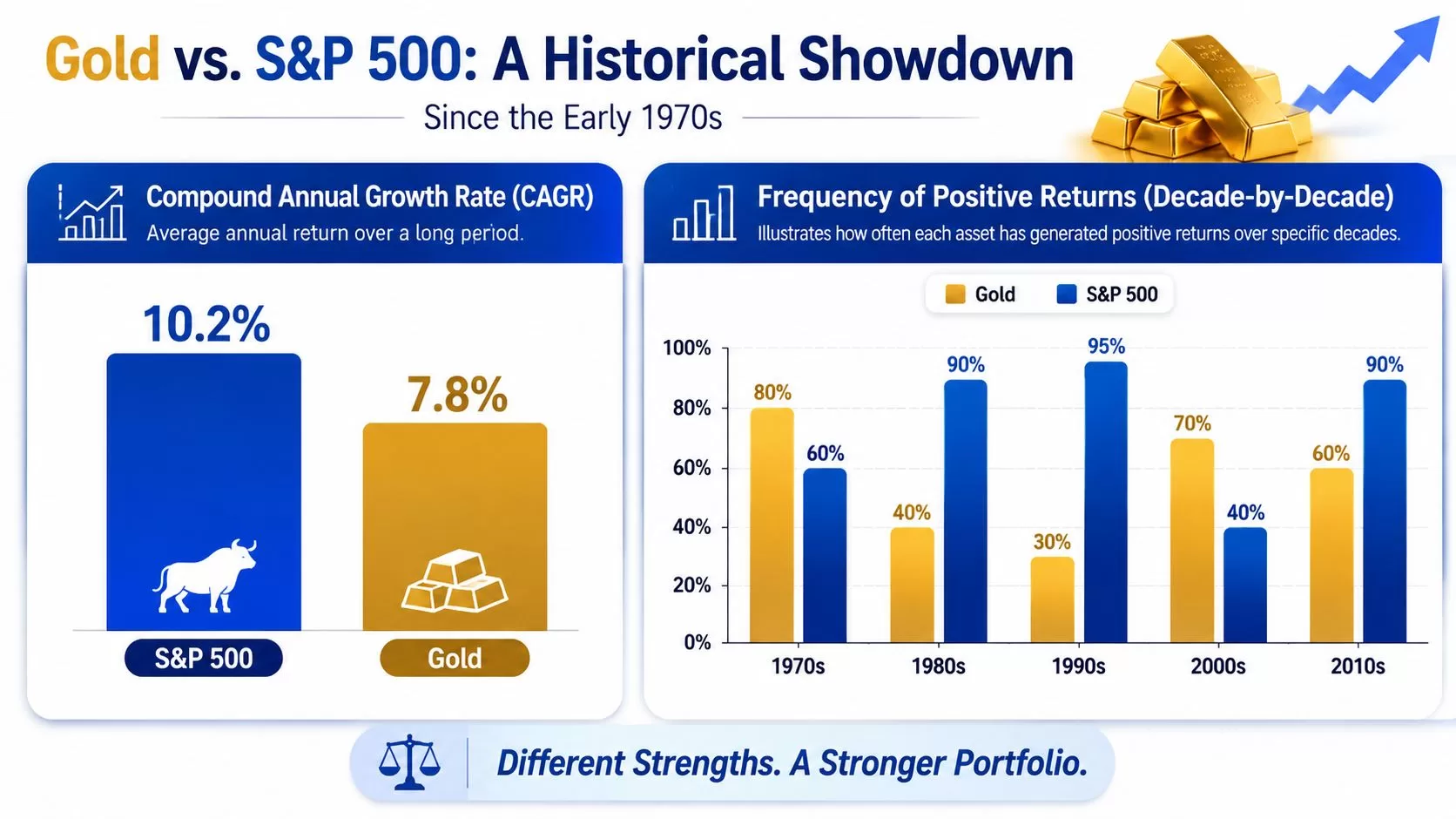
The long-run record is clear, but it's not a one-sided story. From 1971 through the period analyzed by Monetary Metals, the S&P 500 outperformed gold in 31 of 54 years, while gold led in 23 of 54 years. Gold's winning years were often strong, with an average margin of 28.8%, while the S&P 500's winning years averaged 20.5%. Over the full period, gold compounded at 8.19% versus 11.52% for the S&P 500, and $100 became about $7,023.46 in gold versus about $36,104.55 in the S&P 500, according to Monetary Metals.
What the long run really says
The obvious takeaway is that equities have usually compounded faster. That matters because retirement wealth is built over decades, and compounding advantage becomes enormous when dividend reinvestment is part of the picture.
A second takeaway matters just as much. Gold's weaker average growth doesn't mean it was useless. It won in nearly half of the analyzed calendar years, and when it did win, its outperformance was often larger than people expect. That creates a very different role than a simple “safe” asset.
A separate long-run comparison from Curvo reports average annualized returns of 10.5% for gold versus 12.0% for the S&P 500 over 20 years, which reinforces the same pattern, stocks generally compound faster, but gold still delivered substantial appreciation over time, Curvo's backtest. The point for retirees isn't to pick the winner in every regime. It's to understand that the performance gap is real, but it's not so large that gold can't earn a place as a small portfolio sleeve when other risks are rising.
Gold has not been the better long-term compounder, but it has repeatedly shown that it can matter in the years when the rest of the portfolio is under stress.
Volatility and Correlation in Retirement Portfolios
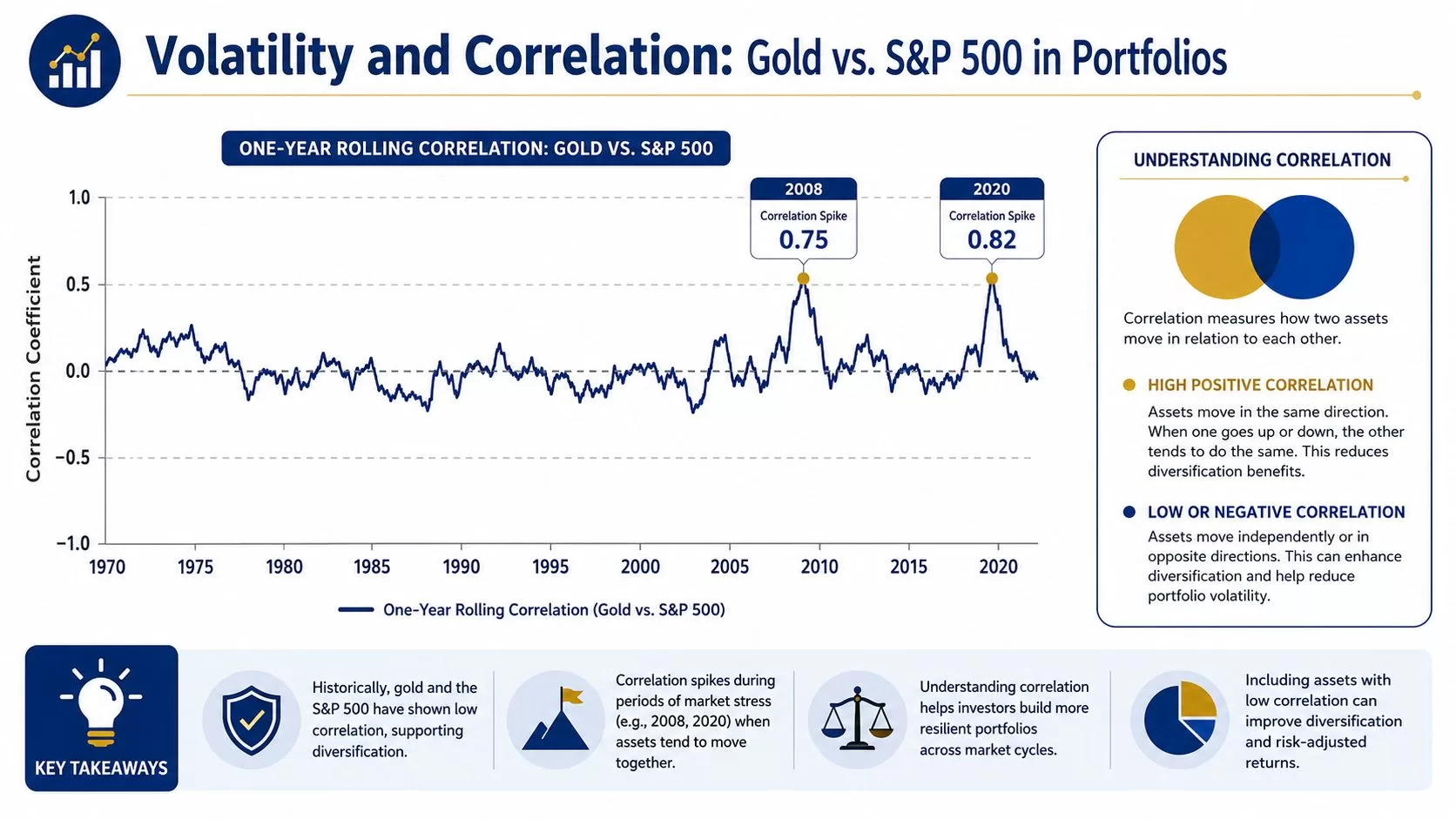
Gold's role in retirement planning becomes clearer once the focus moves from return alone to co-movement. A 2026 analysis found that the one-year rolling correlation between gold and the S&P 500 was near 0.82, which means the two assets were moving together far more often than many investors would expect during stressed periods, Binance Square analysis. That does not make gold irrelevant. It shows that gold should not be treated as a perfect opposite bet.
Why correlation matters more near retirement
When a portfolio is still in the accumulation phase, short-term swings are annoying but usually manageable. Near retirement, the same swing can affect withdrawal timing, force spending cuts, or lead an investor to sell after a decline. Higher correlation weakens the benefit of holding two assets, because they can rise or fall for the same broad reason.
Gold's job in an IRA is therefore less about acting as a mirror-image hedge and more about providing a different return pattern when market narratives shift. The same 2026 analysis reported that gold outperformed stocks in 88% of years when the S&P 500 fell, yet equity moves explained only about 24% of gold's volatility. Together, those findings point to a practical conclusion. Gold can help in weak equity years, but the relationship is not steady enough to promise offsetting every stock decline, Binance Square analysis.
For retirement savers, the takeaway is direct. Gold can still help diversify a 401(k) or IRA, but the diversification benefit depends on the market setting. That is why a review of whether gold makes sense for stability and growth matters before deciding on an allocation. It works best as part of a broader risk-management plan, especially for retirees who care as much about drawdown control and income stability as they do about long-run growth.
Inflation Protection and Diversification Benefits
A retiree who watches inflation erode purchasing power has a different problem than a younger investor focused only on growth. Gold is often used in that setting because it has a long history as a store of value, and one market summary noted gold's 30-year annualized total return of 7.96% while saying advisors typically keep gold exposure in the single digits, CNBC summary. That is a useful fit for retirement planning, because the objective is usually to steady the portfolio without letting gold overwhelm the parts of the account that still need to grow.

Inflation-sensitive periods also show why gold stays in the conversation. In 2025, the same market summary said gold rose about 51.6% year to date and pushed the S&P 500-to-gold ratio near 1.66, its lowest since early 2020, CNBC summary. That does not mean gold will repeat that pattern, but it does show that stock leadership can weaken when policy uncertainty and inflation pressure take center stage.
What that means for a retirement account
A gold allocation does not need to be large to change portfolio behavior. Even a modest position can soften the experience of a market correction, especially when withdrawals are close or already underway. The main value is not excitement, it is reducing the chance that the entire account moves in the same direction at once.
For pre-retirees, the better question is whether the current mix depends too heavily on stock-market timing. If it does, gold can help as one part of a broader allocation plan, especially when retirement income needs make drawdown control more important. For readers comparing that tradeoff, Gold IRA Association's discussion of whether gold is worth it for stability and growth adds useful context for deciding how much gold, if any, belongs in the account.
IRA Suitability Costs and Tax Implications
Gold can only play this role inside retirement accounts if the account setup stays compliant. That means the investor has to focus on eligible metals, custodial structure, storage rules, and the practical cost of maintaining a self-directed precious metals IRA. The account is not just about buying gold, it's about buying the right type of gold, in the right wrapper, with the right records.
The basics that matter most
A retirement investor usually has to think through a few categories at the same time:
- Eligibility: only IRS-approved metals and product forms belong in the account.
- Storage: the gold is generally held by a qualified custodian, not kept at home.
- Fees: setup, custody, and storage costs can affect the net outcome.
- Tax treatment: the account type, Traditional or Roth, changes how taxes are handled later.
The long-run return comparison helps explain why these details matter. On a long-run annualized basis since 1971, the S&P 500 with dividends reinvested returned about 11% per year, while gold returned about 8.5% per year. Excluding dividends, the S&P 500 price return is much closer to gold at roughly 8.1% versus 8.5%, Minted Metal's analysis. That means fees can matter a lot more in a gold IRA than many investors first assume, because the margin for error isn't huge.
Gold IRA Association's guide on how much Gold IRA fees can be is relevant here because cost drag can offset part of gold's diversification value if the account is used carelessly. The key point is simple, the account has to be set up for long-term holding, not frequent trading.
A gold IRA should be treated as a retirement structure first and an investment second. If the account rules or expenses feel too complicated, the simpler choice may be to keep the gold allocation outside the IRA conversation.
Sample Allocation Scenarios for Pre Retirees
The right mix depends on what the account needs to do. A 20-year history from Curvo reports average annualized returns of 10.5% for gold and 12.0% for the S&P 500, which is enough to show that stocks usually lead on pure growth, but not so much that gold becomes irrelevant in a blended portfolio, Curvo's backtest. For a retirement investor, the better question is how much growth can be traded away in exchange for a smoother ride.
Allocation Scenario Comparison
| Allocation | Expected Annual Return | Max Drawdown | Inflation Hedge Score |
|---|---|---|---|
| 90/10 equities/gold | Highest growth among the three mixes | Lowest protection of the three | Modest |
| 80/20 equities/gold | Strong growth with more balance | Better control than 90/10 | Moderate |
| 60/40 equities/gold | More defensive, less growth | Strongest control of the three | Highest |
How to read the table
A mostly equity mix still makes sense for investors who have years before withdrawals and can tolerate a larger paper loss. The small gold sleeve can help with diversification, but the portfolio still behaves mostly like a stock portfolio.
The 80/20 blend is often the most practical middle ground for pre-retirees who want a real hedge without giving up the long-run engine of equities. It doesn't try to make gold do everything, it just gives the portfolio another source of return when the equity side gets hit.
The 60/40 version pushes harder toward stability. That may suit a household already drawing income, or one that knows a deep equity drawdown would force bad selling decisions. It's also the most natural fit for someone who cares more about sequence-of-returns risk than squeezing every last bit of upside from the account.
Decision rule: the closer retirement cash flow is, the more useful drawdown control becomes relative to raw return.
For many investors, the answer isn't “gold or stocks.” It's “how much of each can the retirement plan withstand without turning the account into a source of stress?” That's the better lens for judging whether gold belongs in the mix at all.
Conclusion and Next Steps
A retirement portfolio does not need to choose between growth and drawdown control. Gold has not outcompounded the S&P 500 over the long run, but it behaves differently when markets are under pressure, and that difference can matter more as withdrawals begin. Stocks usually lead on growth. Gold can add inflation sensitivity and diversification, and its usefulness depends on allocation size, fees, and how close the household is to taking income from the account.
That tradeoff is why a small gold allocation can make sense inside a retirement plan, especially for pre-retirees who want less reliance on a single source of return. In an IRA, the constraints are practical as well as strategic. Fees, storage rules, and account structure can reduce the benefit if the position is too large or too expensive, while a modest sleeve may improve drawdown control without giving up too much upside. A central question is whether the portfolio can absorb a stock decline without forcing an untimely sale.
For readers considering a gold IRA or a limited gold sleeve in a retirement strategy, the next step is simple. Request a free Gold IRA kit or talk to a Gold IRA specialist at 888-910-8386, then confirm the rules with a licensed financial advisor, CPA, or tax professional before making any changes.
This is not financial advice. Consult a licensed financial advisor, CPA, or tax professional before making investment decisions.
A CTA for Gold IRA Association.