



Leaving a job or changing retirement providers can create a deceptively simple question: How long does a person have to complete a 401k rollover? The answer depends on whether the money is sent directly between financial institutions or paid to the account holder first. For most retirees and pre-retirees, choosing the direct path is the clearest way to avoid a missed deadline, unexpected withholding, and an avoidable tax bill.
The Critical 60-Day Indirect Rollover Rule
An indirect rollover happens when a former 401(k) plan distributes the money to the participant instead of sending it directly to another eligible retirement plan or IRA. The participant then has to deposit the rollover funds into the receiving account within the applicable window.
The core rule is strict. The IRS gives the participant exactly 60 days from the date the distribution is received to redeposit the funds into another eligible retirement plan or IRA, as explained in the IRS guidance on rollovers of retirement plan and IRA distributions. The clock is tied to receipt of the money, not the date the participant requests the distribution, and not necessarily the date the old plan processes or mails the payment.
That distinction matters because administrative delays consume part of the practical window. A participant who waits to identify the receiving account, deposits the check late, or misunderstands when receipt occurred may discover that the funds no longer qualify for tax-deferred rollover treatment.

What happens if the deadline is missed
If the participant doesn't complete the rollover within the required period, the distribution generally becomes taxable income for the year. For a younger taxpayer, the taxable amount can also trigger an additional 10% early-withdrawal penalty, as the IRS explains in its rollover guidance linked above.
The consequence isn't limited to losing the ability to move the funds. The participant may owe ordinary income tax on money that was intended to remain inside a retirement account, and the missed deadline can permanently change the nature of the transaction.
Practical rule: Treat the date the funds arrive as the starting point. Don't use the request date or mailing date as the beginning of the countdown.
Anyone comparing account types or considering a move into a self-directed retirement account should also review the broader IRA rollover rules. The safest administrative practice is to establish the receiving account first, confirm its eligibility, and avoid requesting a participant-paid distribution unless there's a specific reason to do so.
Direct vs Indirect Rollovers Your Safest Path
The most important rollover decision is usually made before the money leaves the former 401(k). A direct rollover, also called a trustee-to-trustee rollover, sends the funds from the old plan directly to the new retirement account. An indirect rollover sends the funds to the participant, who then has to complete the transfer personally.
The IRS identifies the 60-day window as the rule for indirect rollovers and recognizes that direct trustee-to-trustee rollovers don't have that same deadline, as described in its retirement plan rollover topic.
| Feature | Direct Rollover, Trustee-to-Trustee | Indirect Rollover, 60-Day Rule |
|---|---|---|
| Who receives the funds first | The receiving retirement account or its custodian | The participant |
| Deadline | No 60-day participant receipt deadline applies | Funds must generally be redeposited within 60 days of receipt |
| Federal withholding | The funds move directly without the mandatory participant-paid distribution withholding described for indirect transfers | The taxable portion is subject to mandatory federal withholding |
| Administrative burden | The institutions coordinate the transfer | The participant must track the funds, deadline, deposit, and documentation |
| Main risk | Processing or account-setup errors still require attention | A missed deadline or incomplete deposit can create taxable income |
| Best general use | Default choice when the receiving account is ready | A less attractive choice requiring careful coordination |
Why direct usually wins
With a direct rollover, the participant doesn't take possession of the retirement money. That removes the central timing hazard because the participant isn't holding a check or cash while the deadline approaches. It also reduces the chance that ordinary spending, misplaced paperwork, or a banking delay will turn retirement assets into a taxable distribution.
A direct transfer is especially practical when the destination is a traditional IRA, a new employer plan that accepts rollovers, or an eligible self-directed retirement account. The participant should confirm the destination account's eligibility and provide the old plan with the receiving institution's instructions before authorizing the transfer.
An indirect rollover may still arise when a plan pays the participant directly or when circumstances require personal handling. Even then, the participant needs a written timetable, a confirmed receiving account, and a plan for replacing any withheld amount. A detailed comparison of the mechanics appears in this guide to direct transfer versus rollover.
The Mandatory 20% Withholding Trap
Indirect rollovers contain a second complication that surprises many account holders. When a taxable 401(k) distribution is paid to the participant, the IRS requires 20% federal income tax withholding on the taxable portion, even when the participant intends to roll the money over later, according to the IRS 401(k) distribution rules for plan participants.

Suppose a participant requests an indirect distribution of $100,000. A mandatory 20% withholding would leave the participant with $80,000 in hand, while the plan would withhold $20,000 for federal income tax. Those figures illustrate the mechanics of the withholding rule, not a prediction of the participant's final tax bill.
To roll over the full original distribution, the participant generally has to deposit the entire $100,000 into the receiving retirement account. That means finding another $20,000 to replace the withheld amount. If the participant deposits only the $80,000 received, the remaining $20,000 may be treated as a distribution rather than part of the rollover.
The withheld amount is reported for tax purposes and may be credited against the participant's tax liability, but that doesn't make the shortfall disappear at the time of the rollover. The participant still needs enough outside cash to complete the full transfer if preserving the entire tax-deferred amount is the objective.
A direct rollover avoids this particular trap because the funds go from the old plan to the new retirement account without passing through the participant. Readers evaluating the tax side of a proposed transaction can review the discussion of IRA rollover taxes and should obtain personal tax guidance before moving funds.
The following video can provide another visual explanation of rollover mechanics:
Exceptions and Waivers for Missed Deadlines
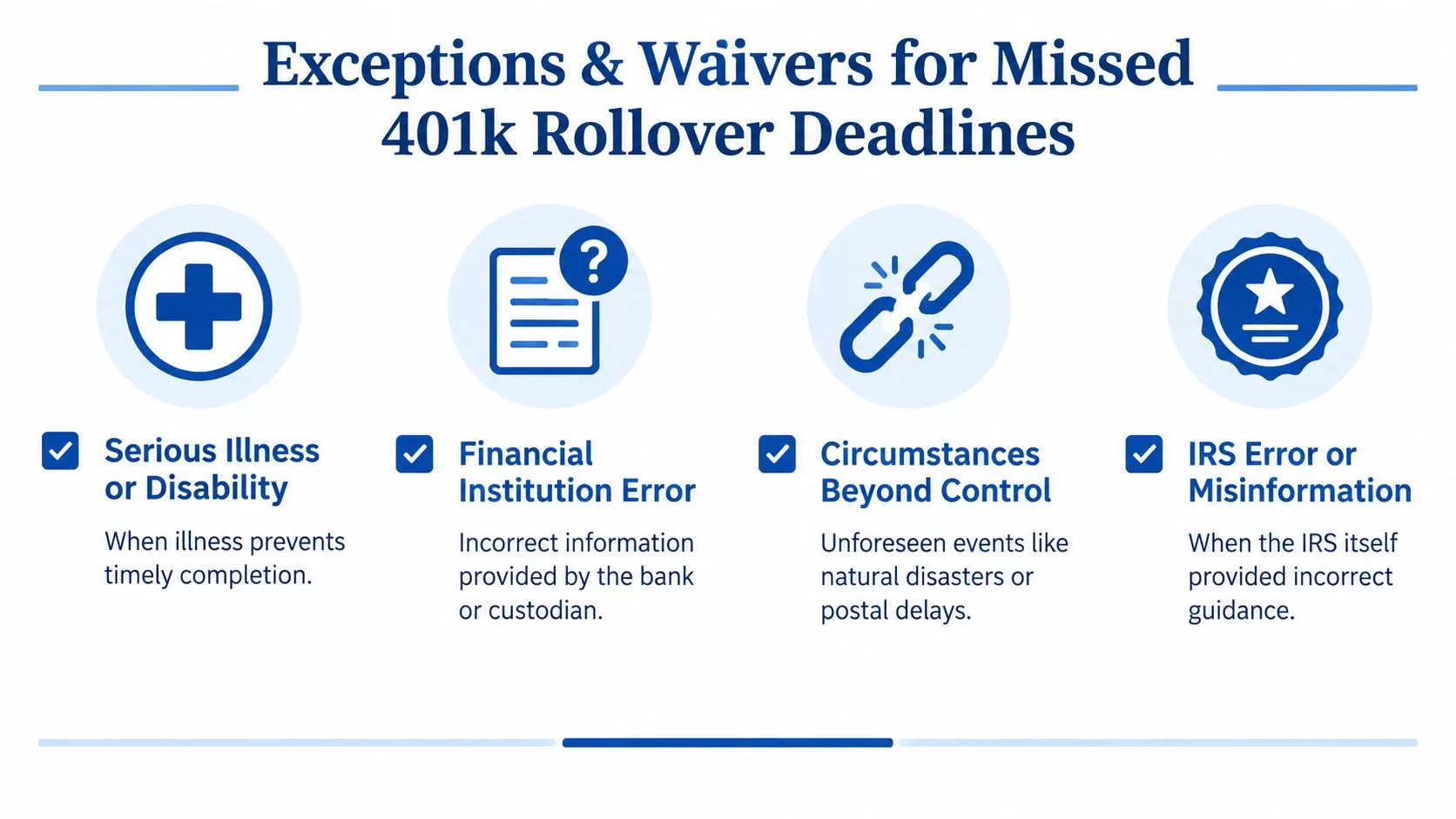
The IRS doesn't treat every missed rollover deadline as hopeless, but relief is limited. Federal guidance recognizes waivers for certain disasters and other events beyond the taxpayer's reasonable control. These provisions are safety nets for exceptional circumstances, not routine extensions for poor planning.
Circumstances that may support relief
Potentially relevant circumstances can include a serious illness, a natural disaster, or another event that prevented timely completion and was outside the participant's reasonable control. An administrative error by a financial institution may also be important, particularly when the participant took the required steps but the institution mishandled the transfer.
The participant should preserve documents that establish the timeline and explain the delay. Useful records may include distribution notices, account statements, correspondence, delivery records, medical documentation, and evidence of an institutional mistake.
Self-certification isn't guaranteed approval
In some situations, a taxpayer may provide written self-certification to the receiving retirement plan explaining why the rollover was late. That certification can help the receiving institution evaluate whether it can accept the contribution, but it isn't the same as an IRS guarantee that the distribution will ultimately receive favorable tax treatment.
The IRS can examine the circumstances later, so the explanation should be accurate, specific, and supported by available records. A taxpayer shouldn't use self-certification as a way to excuse indecision, lack of funds, or ordinary administrative neglect.
A waiver request should be treated as a last resort. The better strategy is to prevent the missed deadline by using a direct rollover whenever the plan and receiving account permit it.
Anyone who has already missed the deadline should avoid moving the money again without professional guidance. A CPA or tax professional can assess whether a waiver, correction, or other reporting treatment may apply to the individual's facts.
Special Considerations for IRA Rollovers
A 401(k) rollover and an IRA-to-IRA rollover aren't governed by identical procedures. The distinction becomes important when a retirement portfolio includes both a former workplace plan and one or more IRAs.
The once-per-year rule limits IRA-to-IRA 60-day rollovers. An individual may complete only one tax-free 60-day rollover between IRAs during any 12-month period, a restriction associated with Internal Revenue Code section 408(d)(3)(B), as summarized in this explanation of the one-rollover-per-year rule.
Why the account type matters
A participant shouldn't assume that a rule learned during a 401(k) transfer applies automatically to every IRA transaction. The one-per-year limitation concerns indirect IRA-to-IRA rollovers, so repeatedly receiving IRA funds and redepositing them can create a compliance problem even when each individual transfer appears familiar.
Direct trustee-to-trustee IRA transfers are handled differently because the account holder doesn't receive the distribution personally. The safest first step is to identify whether the transaction is a transfer between custodians, a direct rollover, or an indirect distribution followed by a deposit.
Before initiating an IRA movement, the account holder should ask both institutions to describe the transaction in writing. Clear terminology can prevent a participant from treating a custodian-to-custodian transfer as though it were a personal 60-day rollover, or vice versa.
Frequently Asked Questions About 401k Rollovers
Can someone roll over a 401(k) while still employed?
Possibly, but the answer depends on the employer plan's terms and whether the participant meets the plan's requirements for an in-service distribution. Employment status alone doesn't establish eligibility. The participant should ask the plan administrator whether an in-service rollover is permitted, which assets qualify, and whether the destination account can accept them.
Plan design can be difficult for employees to interpret, so a general overview of Benely's employee benefits 401k can help explain common workplace-plan concepts. The controlling document, however, remains the participant's own plan materials.
Does a Roth 401(k) follow the same rollover process?
A Roth 401(k) can generally be moved only to an eligible destination that can properly account for Roth retirement assets. The tax treatment can depend on whether the distribution includes contributions, earnings, or other components and whether the receiving account is structured to accept them.
Because a Roth transaction can involve different tax characteristics from a traditional pre-tax 401(k), the participant shouldn't rely on a generic rollover form. The plan administrator and a qualified tax professional should confirm the correct destination and reporting before the distribution is issued.
Can a 401(k) be rolled into a Gold IRA?
A 401(k) may be eligible for a rollover into a self-directed IRA that permits approved precious-metals investments, but eligibility depends on the plan's distribution rules and the receiving custodian's requirements. The account holder should establish the destination account first and request a direct rollover whenever possible.
The rollover itself doesn't guarantee that a particular metal, coin, or bar is eligible for retirement-account ownership. Product eligibility, custody, storage, fees, and investment risk all require separate review. Physical precious metals can be one diversification option, but they don't guarantee gains or eliminate portfolio risk.
What should happen before the funds leave the old plan?
The participant should confirm the receiving account, obtain precise transfer instructions, ask whether the old plan sends the payment directly, and retain all records. If the plan issues the funds to the participant, the receipt date should be recorded immediately and the deposit should be arranged without delay.
This is not financial advice. Consult a licensed financial advisor, CPA, or tax professional before making investment decisions.
Gold IRA Association provides educational guides on 401(k) rollovers, IRA rules, precious-metals account structures, fees, and provider comparisons. Visit Gold IRA Association to review rollover resources and compare the questions to ask before selecting a retirement-account provider.