



Approaching retirement often raises a practical question: when can money come out of a self-directed IRA without creating an unexpected tax bill, penalty, or paperwork problem? The answer depends on the account's tax treatment, the owner's age, the type of distribution, and how the custodian handles the transaction. Physical metals add another layer because the owner may receive cash or the metals themselves.
Introduction to Self Directed IRA Withdrawal Rules
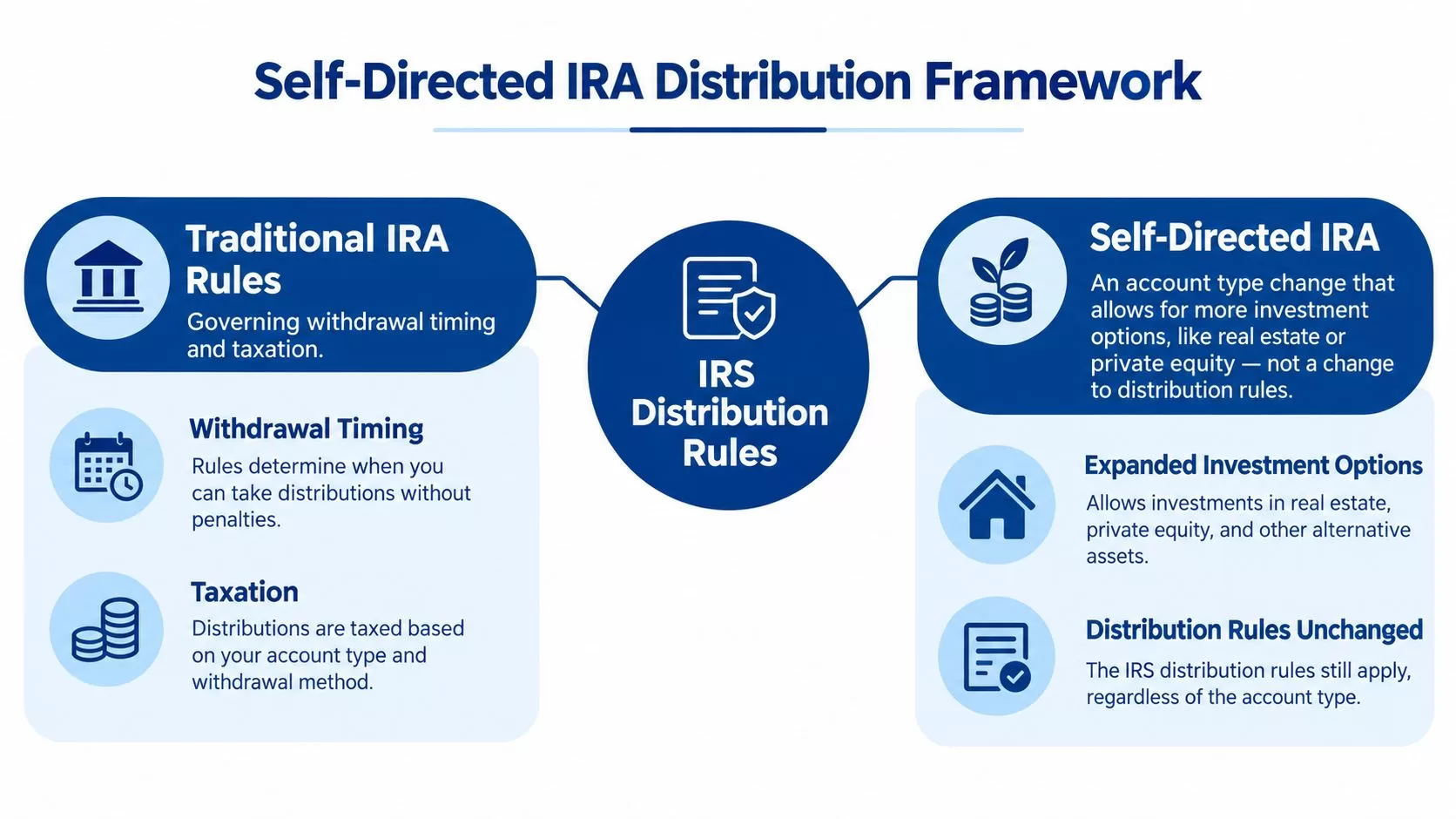
The most important starting point is simple: a self-directed IRA follows the same federal distribution framework as a traditional IRA. The self-directed label changes the investments the account may hold, such as precious metals or other permitted alternative assets. It doesn't create a separate set of age thresholds or eliminate ordinary IRA tax rules. The IRS guidance on IRA distributions establishes the central milestones, including age 59½ for avoiding the early-withdrawal penalty and age 73 for the beginning of required minimum distributions.
A reader who needs money before retirement should first determine whether the distribution is voluntary or required. A voluntary withdrawal may be requested at any time, but an amount taken from a traditional IRA before age 59½ is generally taxable and may also face the additional tax. A later-life withdrawal may avoid that early-distribution tax while still creating ordinary income tax on taxable amounts.
RMDs work differently. Once the owner reaches age 73, a traditional self-directed IRA generally must distribute a calculated amount each year. The first RMD is generally due by April 1 of the year after the owner turns 73, while later annual RMDs are due by December 31, according to the IRS explanation of required minimum distributions.
This guide is designed as a reference. Readers can use the early-withdrawal discussion for penalty questions, the RMD discussion for mandatory distributions, and the metals sections for in-kind delivery, liquidation, storage, and custodian paperwork. The same framework also helps distinguish a distribution from a rollover, which is important because the deadlines and reporting treatment differ.
Practical rule: Before requesting money or metals, confirm the distribution type with the custodian and ask a tax professional how the taxable portion will be reported.
This is not financial advice. Consult a licensed financial advisor, CPA, or tax professional before making investment decisions.
How Self Directed IRAs Fit Within IRS Distribution Framework
A self-directed IRA doesn't sit outside the normal IRA system. The account gives the owner broader investment direction, but the withdrawal rules still depend on whether the account is traditional or Roth, whether the distribution is taxable, and whether an IRS exception applies.
The custodian remains central to the process. IRS-linked guidance explains that every self-directed IRA must be held by a qualified custodian, such as a bank, trust company, or IRS-approved institution. That custodian holds the account assets, processes investment directions, and handles required IRS reporting. The owner directs eligible investments, but the owner doesn't personally hold or manage IRA property as though it were an ordinary personal account.
Why the custodian matters
For a precious-metals self-directed IRA, the custodian coordinates the movement of metals and documents the distribution. If the owner requests cash, the custodian may arrange a sale within the account before sending the proceeds. If the owner requests an in-kind distribution, the custodian records the value and transfers the physical asset according to its procedures.
That distinction explains why personal possession before an approved distribution can create a serious compliance concern. The owner shouldn't remove IRA metals from approved custody, store them at home, or treat them as personal property while they remain inside the IRA. The asset's form doesn't override the account's legal structure.
The custodian also supplies forms and reporting records. Those records help establish whether the transaction was a distribution, a direct transfer, or an indirect rollover. Readers should keep copies of the request, valuation information, delivery confirmation, and tax forms.
The practical conclusion is straightforward. The investment menu may be different, but the distribution framework isn't. The custodian manages the operational path, while the owner remains responsible for reviewing the transaction and obtaining individualized tax guidance.
Distribution Types and Tax Treatment at a Glance
A distribution is money or property leaving the IRA. The tax result depends primarily on the account type and the taxable portion, not on whether the account holds cash, securities, or precious metals.
For a traditional self-directed IRA funded with pre-tax assets, taxable distributions are generally included in ordinary income. If the account contains after-tax amounts, the tax treatment may differ, so the owner should review basis records before requesting a withdrawal. A partial cash distribution and an in-kind metals distribution can therefore have the same basic tax character if they come from the same traditional IRA balance.
Consider two examples:
- Cash distribution: The custodian sells part of the metals held in the IRA and sends the proceeds to the owner. The distribution is reported according to the IRA's tax treatment.
- In-kind distribution: The custodian transfers IRA-held coins or bars to the owner rather than selling them first. The owner receives property, but the transaction is still a distribution and must be valued and reported properly.
The IRS allows traditional IRA assets to be withdrawn at any time. That flexibility doesn't mean every withdrawal is tax-free. Before age 59½, the taxable portion generally faces ordinary income tax and may trigger the additional tax described in the next section. After that age, the early-withdrawal penalty generally no longer applies, but taxable amounts may still be income.
Common categories
Normal distributions are voluntary withdrawals taken after the early-distribution threshold. They may avoid the additional early-withdrawal tax, but traditional IRA taxable amounts can still count as ordinary income.
Early distributions occur before age 59½. They require careful review of both taxation and possible exceptions.
RMDs are mandatory distributions from a traditional IRA beginning at age 73. The owner can't leave the required amount in the account because the asset is inconvenient to sell.
Roth distributions follow different qualification rules. Readers shouldn't assume that traditional IRA treatment automatically applies to a Roth self-directed IRA. The custodian and tax professional should confirm the applicable rules before a withdrawal.
For readers sorting through distribution records, a specialized finance OCR for 1099s may help organize information from tax documents. It doesn't replace professional tax review, but clearer records can make it easier to reconcile the custodian's reporting with the owner's return.
Early Withdrawal Rules and the Age 59½ Threshold
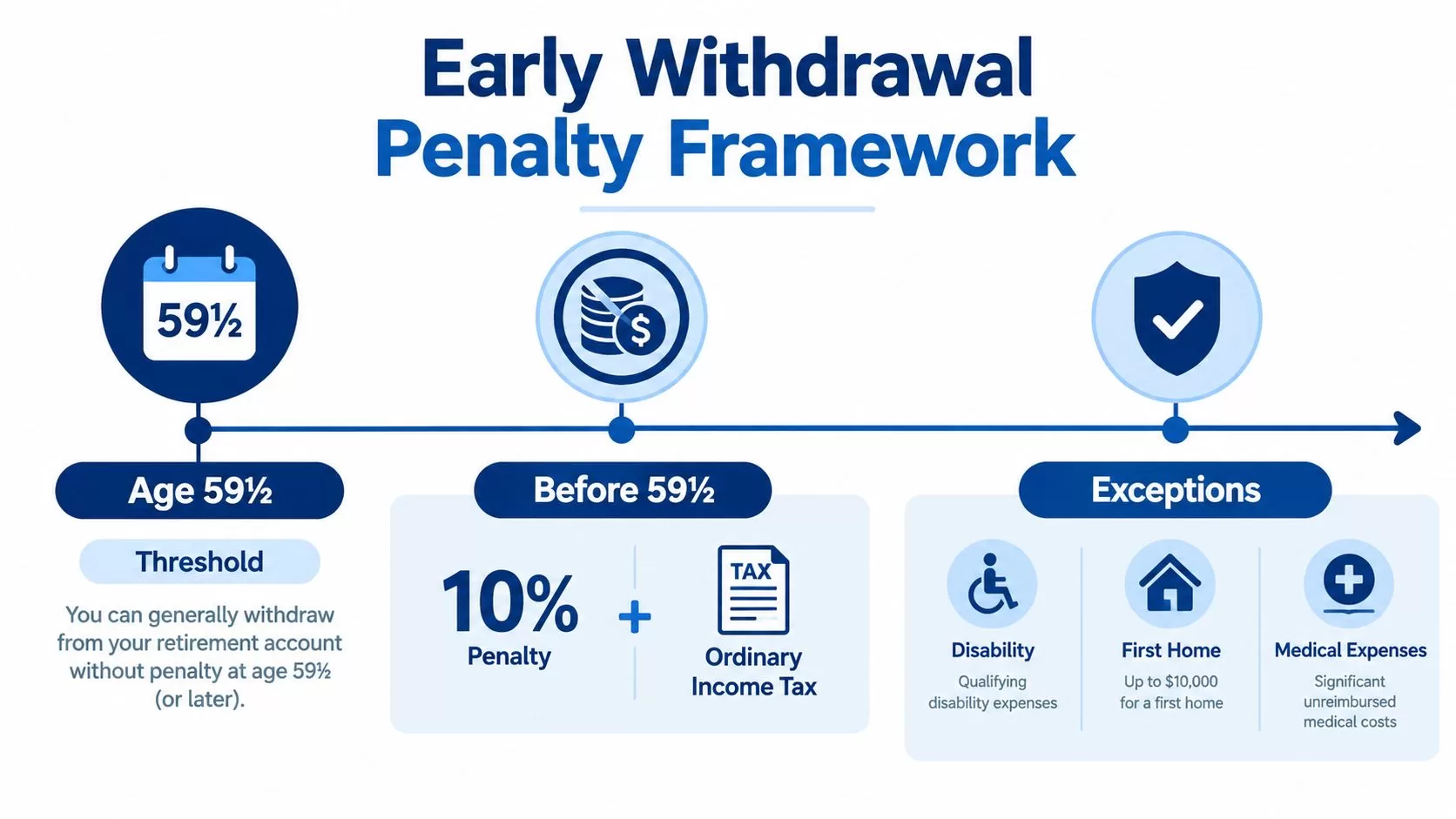
The age 59½ threshold is the main dividing line for traditional IRA early-distribution treatment. Under IRS rules for IRA withdrawals, a withdrawal before age 59½ is generally included in taxable income and may be subject to a 10% additional tax on the taxable portion, unless an IRS exception applies.
The rule applies to a self-directed IRA even when the account holds physical gold or silver. Selling metals first and withdrawing cash doesn't change the age analysis. Receiving the metals directly instead of cash doesn't change it either. The account owner has taken a distribution, and the taxable portion must be evaluated.
Exceptions require documentation
The IRS recognizes exceptions to the additional tax in specific circumstances. Examples commonly associated with IRA rules include disability, certain unreimbursed medical expenses, and qualified first-home expenses. The precise requirements matter, and a general financial hardship doesn't automatically remove the additional tax.
When an exception applies, the owner needs supporting records. The IRS Form 5329 instructions and retirement-plan guidance explain how additional taxes and exceptions are handled. Form 5329 may be required when the additional tax is due, and it can also be relevant when the owner is claiming an exception.
Documentation matters: A custodian can process the distribution, but the owner must make sure the claimed exception is valid and supported by records.
The phrase “hardship withdrawal” can cause confusion because most pre-59½ IRA withdrawals are treated as taxable distributions rather than automatically approved hardship events. The owner should identify the exception before submitting the request, not after receiving a tax form.
Some readers explore a series of substantially equal periodic payments under the rule often called 72(t). That approach has detailed conditions and can create long-term obligations, so an explanation such as Kons Law on 72t distributions can provide general background. A tax professional should evaluate whether the method fits the owner's circumstances.
Required Minimum Distributions for Self Directed IRAs
Traditional self-directed IRAs generally require RMDs once the owner reaches age 73. The first RMD is generally due by April 1 of the year after the year the owner turns 73. Every later annual RMD is generally due by December 31.
The calculation uses the prior December 31 account balance divided by the applicable IRS life-expectancy factor from the Uniform Lifetime Table. A different table may apply when a spouse is more than 10 years younger and is the sole beneficiary. The owner should confirm the correct table and beneficiary facts with the custodian or tax professional.
A simple calculation example
Suppose the custodian reports a prior December 31 balance of $200,000 and the applicable life-expectancy factor is 25. The calculation would be:
$200,000 ÷ 25 = $8,000
That example illustrates the method only. The actual factor depends on the applicable IRS table and the owner's circumstances, and the account value must be confirmed by the custodian.
Physical metals make the deadline more operationally demanding. A custodian may need to arrange either an in-kind transfer of sufficient value or a sale of metals followed by a cash distribution. Both routes require time for valuation, approval, paperwork, and delivery. Owners shouldn't wait until the deadline is close to ask whether the custodian can support the selected method.
The IRS states that failing to withdraw the full RMD can result in an excise tax. That makes liquidity and scheduling part of compliance planning, not merely administrative details. A metals owner should ask how the custodian values an in-kind distribution, how partial liquidation works, and when the request must be submitted.
Further guidance on required minimum distribution rules can help readers review the broader RMD framework. A short educational video may also help clarify the sequence:
In Kind Distributions Prohibited Transactions and Metals Handling
A precious-metals self-directed IRA generally gives the owner two practical distribution routes. The custodian can sell metals inside the IRA and distribute cash, or the custodian can transfer eligible metals directly to the owner as an in-kind distribution.
The cash route is often easier to document because the distribution amount is tied to the cash proceeds. The in-kind route preserves ownership of the physical coins or bars outside the IRA, but it requires a valuation and an appropriate transfer process. The value of the property distributed becomes important for reporting and tax review.

Cash and metals compared
Cash liquidation involves several steps. The custodian confirms the requested amount, arranges the sale under the account's procedures, records the proceeds, and sends the distribution. The owner receives money rather than metal, and the transaction remains subject to the normal age and tax rules.
In-kind delivery moves the asset itself. The custodian confirms the property's value, completes the distribution paperwork, and arranges delivery to the owner. The owner then owns the metals personally and can no longer treat them as IRA assets.
The dangerous mistake is informal possession. An owner shouldn't take IRA metals home “temporarily,” place them in a personal safe, or use them for personal purposes before the custodian approves and records a distribution. Personal use, improper storage, or transactions involving disqualified parties can raise prohibited-transaction concerns.
The custodian should explain:
- Valuation: How the metals' distribution value will be determined.
- Inventory: Which coins or bars will leave the account.
- Delivery: How shipment, receipt, and insurance are documented.
- Reporting: Which tax forms will reflect the distribution.
- Timing: When the request must be submitted for a voluntary withdrawal or RMD.
Readers considering physical custody should also review guidance on precious-metals storage. The central boundary remains clear: while metals are IRA assets, the qualified custodian controls custody and processing. Once a properly documented distribution occurs, the owner can handle the metals as personal property, subject to the resulting tax consequences.
Custodian Processes Documentation and the 60 Day Rollover Rule
A compliant withdrawal starts with the custodian, not with a shipment, sale, or personal transfer. The owner should first identify whether the request is a normal distribution, an early distribution, an RMD, or a rollover. Each category can require different forms, timing, tax withholding choices, and supporting records.
A practical workflow looks like this:
- Confirm the account details. Determine whether the IRA is traditional or Roth and whether the requested assets are cash or physical metals.
- Ask for the custodian's distribution form. The form should identify the amount, delivery method, recipient, and any withholding election.
- Verify valuation. For an in-kind distribution, ask how the custodian will establish the value of the metals.
- Review tax treatment. Confirm which portion may be taxable and whether an early-distribution exception is being claimed.
- Retain records. Keep the request, approval, valuation, delivery confirmation, and tax reporting documents together.
The custodian handles required IRS reporting, but the owner should still review every document. A mistake in a name, account number, distribution category, or delivery instruction can delay the transaction or create confusion at tax time.
The 60-day indirect rollover rule
An indirect rollover is different from a distribution intended for spending. When retirement funds are paid directly to the owner, the owner generally must redeposit them into another IRA or eligible retirement plan within 60 days, as described by the IRS rollover rules. The IRS may waive the deadline only in limited circumstances beyond the taxpayer's control.
For example, an owner receives funds, intends to place them into another eligible account, and misses the 60-day deadline. Unless a valid waiver or other exception applies, the transaction may fail to qualify as a rollover. The owner could then face taxation and, if under age 59½, possible additional tax.
A direct transfer is usually operationally different because the funds move between custodians rather than passing through the owner. Readers comparing these routes can review direct transfer versus rollover before authorizing movement.
Calendar the receipt date: For an indirect rollover, the day the owner receives the funds starts the compliance clock.
Quick Reference for Withdrawal Decisions and Compliance Checks
The table below offers a compact way to sort the main age-based questions. It summarizes general treatment for a traditional self-directed IRA. Individual facts, including taxable basis and valid IRS exceptions, can change the result.
| Age Band | Penalty Applies | Tax Treatment | RMD Required |
|---|---|---|---|
| Before 59½ | Generally, the 10% additional tax may apply to the taxable portion unless an exception applies | Taxable amounts are generally included in ordinary income | No age-based RMD requirement yet |
| 59½ to 73 | The early-withdrawal penalty generally no longer applies | Taxable amounts may still be included in ordinary income | Generally no, unless another rule applies |
| 73 and older | The early-withdrawal penalty generally no longer applies | Taxable RMD and other taxable amounts may be included in ordinary income | Yes, for traditional IRAs, subject to the applicable RMD rules |
Before submitting a request, the owner should complete a short compliance check:
- Confirm age: Identify whether the owner is before 59½, between 59½ and 73, or at least 73.
- Classify the transaction: Decide whether it's a distribution, RMD, direct transfer, or indirect rollover.
- Check the asset route: Choose cash liquidation or in-kind delivery and ask how valuation will work.
- Review the custodian's approval: Confirm that the custodian has accepted the request and provided the required forms.
- Check tax treatment: Ask a CPA or tax professional how pre-tax and after-tax balances affect the taxable amount.
- Verify RMD completion: If an RMD is due, confirm that the full required amount will leave the IRA by the applicable deadline.
- Preserve records: Save all forms, dates, valuations, delivery confirmations, and tax documents.
Gold IRA Association provides educational material on precious-metals IRAs, rollover procedures, fees, eligible metals, and provider evaluation. Readers can use those resources to prepare questions, then consult a licensed financial advisor, CPA, or tax professional before acting.
Gold IRA Association offers educational guides and comparison resources that help readers understand self-directed IRA withdrawals, custodian procedures, rollovers, fees, and precious-metals ownership. Visit Gold IRA Association to review the relevant materials and prepare informed questions for a qualified professional.