



A Gold IRA's first-year cost can include a one-time setup charge of about $50 to $300, annual custodial or administrative fees of $75 to $300, annual storage of roughly $100 to $300, and a dealer markup on the metal itself. Wire or transfer charges may add about $25 to $50 per movement of funds, while transaction pricing and dealer spreads can affect the amount paid or received.
That layered structure surprises many near-retirees who are comparing a physical-metals IRA with a familiar brokerage account. The right question isn't “What's the annual fee?” It's, “What does every line item pay for, how often does it apply, and what will it cost at the account balance being considered?” This guide walks through gold IRA fees as a whiteboard exercise, using verified ranges and clearly labeled examples so a reader can turn a provider quote into a practical year-one and ongoing estimate.
Why Gold IRA Fees Catch Investors Off Guard
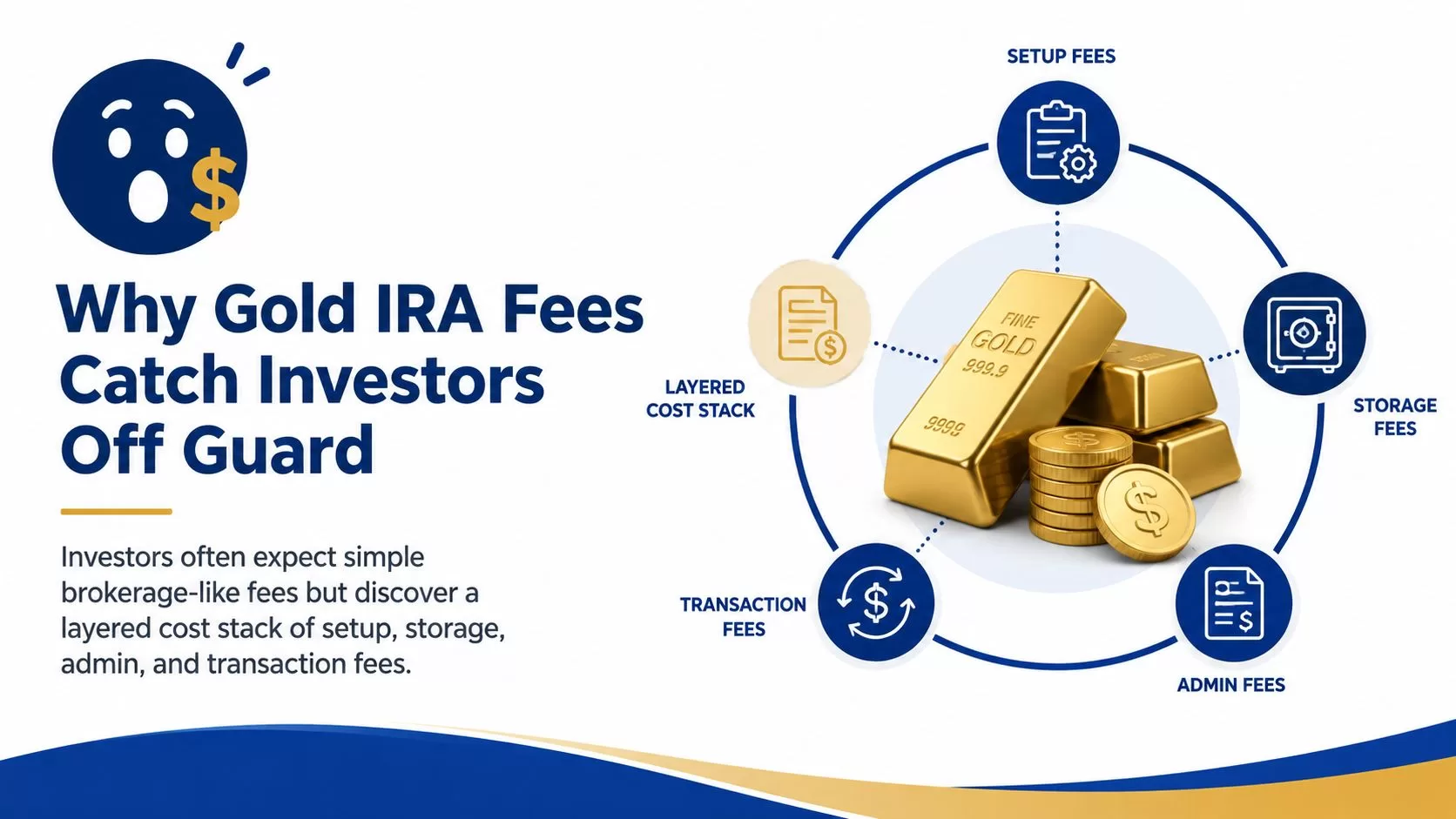
A 62-year-old moving $80,000 from a rollover IRA into physical gold may expect to budget for vault storage and little else. Instead, the quote sheet can include account setup, custodial administration, storage, dealer pricing above the metal's market price, and wire or transaction charges. The surprise usually comes from seeing several different companies involved, each responsible for a separate part of the account.
The basic stack has four principal layers:
- Setup: A one-time charge for establishing the account and completing initial paperwork.
- Custody and administration: An annual charge for recordkeeping, account servicing, and required reporting.
- Storage: A recurring depository charge for holding the physical metals under the IRA's custody arrangement.
- Dealer pricing: A markup or spread built into the purchase and sale prices, rather than always appearing as a separate fee.
Wire, transfer, liquidation, shipping, or other transaction charges may sit on top of those layers. Major-market reporting identifies setup, administration, storage, dealer markup, and movement-of-funds charges as separate parts of the total cost structure, with setup commonly around $50 to $300, annual administration around $75 to $300, storage around $100 to $300, and wires or transfers around $25 to $50 per movement (ConsumerAffairs' explanation of Gold IRA fees).
The practical way to read a quote
Write the quote on a page with three columns: one-time, recurring, and transaction-related. Then add the metal purchase price separately, because a dealer markup can materially change the amount invested even when the custodian's fee schedule looks modest.
A year-one estimate should include every charge expected before the account is funded and every recurring charge expected during the first year. An ongoing estimate should remove one-time setup costs, but it should still include annual administration, storage, and any transactions the investor expects to make.
Practical rule: A low annual fee doesn't necessarily mean a low-cost account. The full comparison requires the custodian, depository, dealer, and transaction terms on the same worksheet.
One-Time Setup and Annual Custodial Fees
Setup and custodial charges form the flat-dollar foundation of many gold IRA fees. Unlike a percentage-based storage charge, a flat fee generally doesn't change because the account balance changes. That makes the charge easy to forecast, but it can represent a much larger share of a smaller account.
A one-time setup charge commonly covers the administrative work required to establish the self-directed IRA. Depending on the provider, that work can include opening the account, registering beneficiaries, preparing documents, and establishing reporting procedures. Verified fee reporting places common setup charges in a broad range of about $50 to $300, while annual administrative or maintenance fees often fall between $75 and $300 (ConsumerAffairs).
Annual custodial administration pays for continuing account services. The custodian may maintain records, prepare statements, coordinate reporting, process instructions, and support retirement-account administration. A reader considering a rollover should also ask how the provider handles distribution requests and required minimum distribution coordination, because those services may be included, separately billed, or subject to transaction charges.
| Fee Type | Typical Range | What It Pays For | How Often |
|---|---|---|---|
| Setup charge | $50 to $300 | Account establishment and initial paperwork | One time |
| Custodial or administrative fee | $75 to $300 | Recordkeeping, statements, reporting, and account servicing | Annual |
| Wire or transfer charge | $25 to $50 | Movement of funds between accounts or institutions | Per movement |
These figures are broad benchmarks, not promises of a particular provider's schedule. A Gold IRA custodian guide can help readers understand the custodian's role before comparing actual disclosures.
How to question a bundled quote
Some quote sheets combine setup and first-year administration under a label such as “first-year account fee.” That presentation isn't automatically misleading, but it makes comparison difficult. Ask for the separate setup charge, annual fee, storage fee, and any conditions attached to a waiver.
A provider may waive setup costs for a transfer above a stated threshold. The threshold and waiver terms must be confirmed in writing, because a promotional waiver may apply only to the initial year or only to particular funding methods.
The effective burden is especially important on smaller balances. A fixed annual charge consumes a larger portion of a small account than of a larger one, even when the dollar fee is identical. That's why the quote should always be reviewed against the planned account size, not in isolation.
Storage Fees and How Structure Changes the Bill
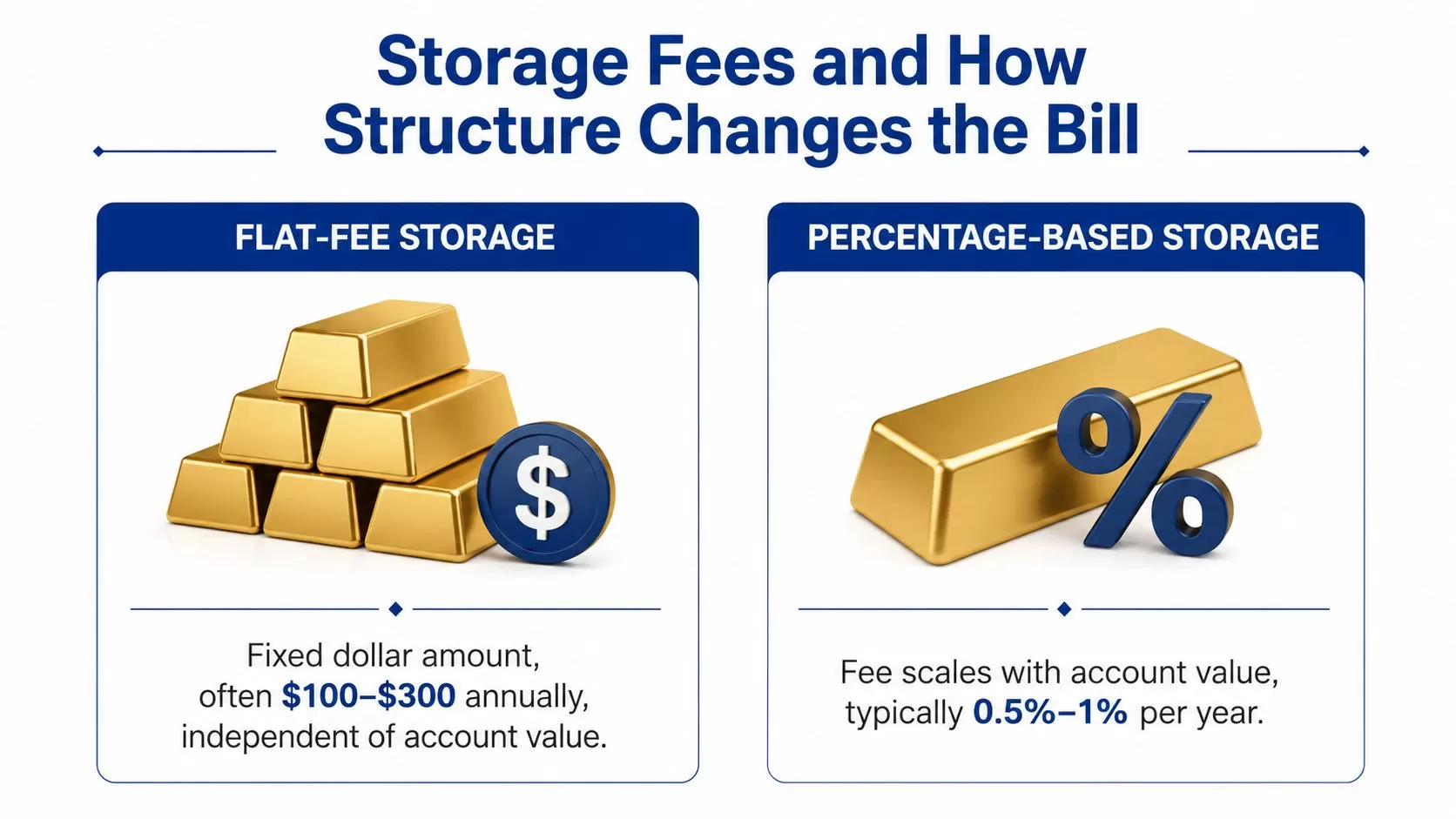
Physical metals require a qualified custody and storage arrangement, so storage is a central part of gold IRA fees. Depositories generally use either a flat-dollar model or an asset-value-based model. Independent fee guides commonly place annual storage around $100 to $300, or about 0.15% to 0.50% in percentage-based arrangements, while other reporting describes percentage pricing around 0.5% to 1.0% depending on the depository and arrangement (IRA Club's fee overview, U.S. Money Reserve's custodian-cost discussion).
Flat versus percentage pricing
A flat fee is predictable. A quoted $150 annual storage fee, for example, remains $150 as the account value changes, assuming the provider's schedule doesn't change. Percentage pricing moves with the metal value, so the dollar charge rises as the balance rises and falls when the balance falls.
The break-even calculation is straightforward:
Flat storage fee ÷ percentage storage rate = approximate break-even balance.
Using the modeling assumptions later in this article, $150 ÷ 0.006 equals $25,000, so the two storage methods are equal at that balance. That result is specific to the example assumptions, not a universal market threshold. A reader should substitute the exact flat fee and percentage quoted by the depository.
Storage structure also affects the service being purchased. Commingled storage records ownership in a shared pool of comparable metals, while segregated storage keeps a client's holdings separately identified. Segregated arrangements usually cost more because the depository performs additional inventory control and maintains dedicated allocation. Published fee guidance describes segregated storage as often adding about $50 to $100 per year compared with pooled storage (IRA Club).
Readers can review the operational distinction in this guide to precious-metals storage. The key choice isn't “cheaper or more expensive.” It's whether the account needs separately identified holdings and whether the added cost fits the retirement plan.
Dealer Markups, Buyback Spreads, and Transaction Costs
The dealer's price is often the least visible part of gold IRA fees. Custodial and storage charges usually appear as labeled lines, but a dealer markup may be embedded in the quoted price of each coin or bar. The investor pays more than the metal's spot price, and the difference may not be presented as a separate “fee.”
The calculation is simple:
Effective markup percentage = (quoted purchase price minus spot price) ÷ spot price.
For example, if a dealer quotes a product at a price above the current spot value, the difference represents the premium or markup that should be examined. The reader doesn't need to accept a verbal description such as “competitive pricing.” The quote should show the product, quantity, spot reference, premium, and total purchase amount.
The supplied research describes dealer markups, bid-ask spreads, and processing fees as variable costs that depend on the dealer and product. Because no verified data establishes product-specific markup ranges for this article, readers should request the exact premium rather than rely on a generalized percentage.
| Product Type | Typical Markup Over Spot | Liquidity at Buyback |
|---|---|---|
| Common bullion products | Varies by quote and market conditions | Ask for the dealer's written buyback terms |
| Specialty or proof products | May differ materially from standard bullion | Confirm the prospective buyer before purchase |
| Bars and coins | Pricing depends on product, size, and availability | Compare the stated bid with the expected sale value |
The exit cost deserves equal attention
A buyback spread is the difference between the dealer's selling price to the investor and the dealer's purchase price when the investor exits. A favorable entry price doesn't guarantee a favorable exit price, so both sides should be requested before funding.
Wire and transfer charges can apply when money moves into or out of the account. A sale or distribution may also involve liquidation, processing, shipping, or other charges under the written schedule. These costs matter most when the investor expects multiple purchases, rebalances, or partial distributions.
Before signing: Ask for the purchase premium, expected buyback pricing method, wire charges, transfer charges, and liquidation costs in writing.
A reader comparing providers can use this Gold IRA comparison resource to organize questions without treating any single fee schedule as universal.
Modeling All-In Costs at Three Account Sizes
A worked model makes the relationship between flat and percentage charges easier to see. The following scenarios use a $50 setup fee, an $80 annual custodial fee, either $150 flat storage or 0.60% percentage storage, a 5% dealer markup on purchase, and a 3% effective round-trip drag on sale. The dealer assumptions are modeling inputs, not universal fee benchmarks, and the sale drag is shown separately from account administration and storage.
For clarity, the table's year-one and ongoing figures include setup, custodial administration, storage, and the 5% purchase markup. The ongoing annual figures exclude the one-time setup charge and purchase markup. They also exclude the modeled sale drag, because an exit occurs only when the investor sells. That separation prevents a transaction cost from being mistaken for an annual holding expense.
| Account Size | Year 1 Flat Storage | Year 1 % Storage | Ongoing Flat/Yr | Ongoing %/Yr |
|---|---|---|---|---|
| $25,000 | $1,500 | $1,612.50 | $230 | $230 |
| $100,000 | $5,250 | $5,550 | $280 | $680 |
| $250,000 | $12,750 | $13,200 | $280 | $1,580 |
The purchase markup drives most of the year-one difference in these illustrations. The storage comparison itself is clearer in the ongoing columns. At $25,000, both storage methods produce the same modeled storage charge, while at $100,000 and $250,000, the percentage model is more expensive because the balance has moved above the example's break-even point.
The transition point in this model is $25,000, calculated by dividing $150 by 0.60%. A provider with different inputs could produce a different result, so the reader should recalculate the threshold from the actual quote.
A spreadsheet can make this exercise easier, especially for readers who want to test several balances, storage options, or rebalance assumptions. A resource for those comparing estimate Excel-to-web app costs can help clarify the difference between a basic worksheet and a more structured calculator.
What the model leaves out
The table doesn't predict gold prices, investment returns, taxes, or future account values. It also doesn't assume a particular number of transactions. A sale, transfer, wire, or liquidation can add a separate charge, and the 3% modeled round-trip sale drag should be applied only when analyzing the planned exit.
The useful lesson is structural: flat fees dominate smaller balances, while percentage storage becomes more expensive as the balance grows. The quote sheet determines the actual result.
Forecasting Your Total Expense Before You Sign
A defensible forecast starts with the written fee schedule, not a sales conversation. The reader should ask the custodian, depository, and dealer for the terms that apply to the exact account structure and metal products under consideration.
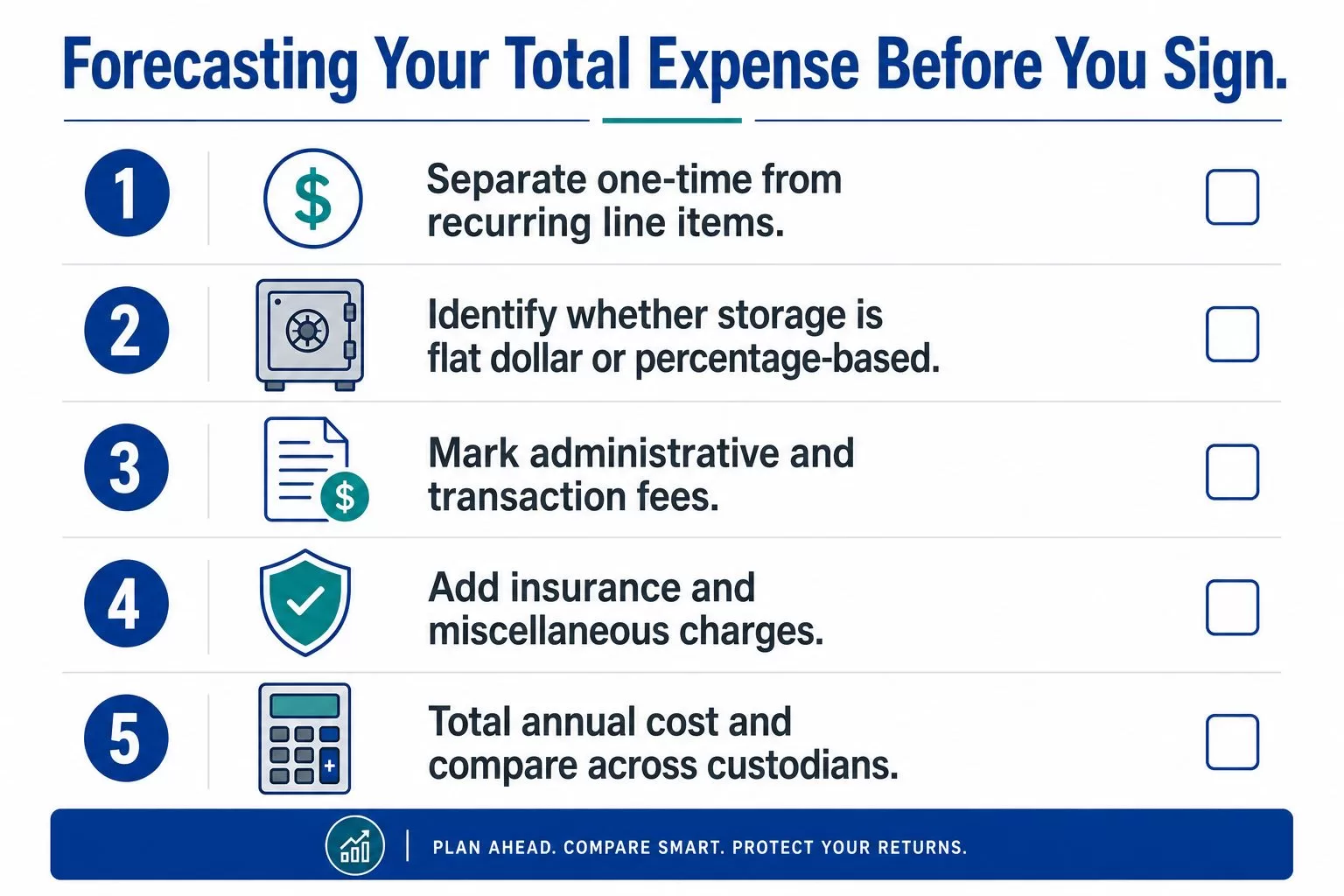
Five checks for the fee sheet
Separate one-time and recurring charges. Put setup, account opening, and initial paperwork in one column. Put annual administration and storage in another. The year-one formula is:
Year-one total = one-time charges + recurring charges + planned purchase costs + anticipated transaction charges.Identify the storage model. Mark whether storage is flat-dollar or percentage-based. For percentage storage, calculate:
Annual storage = account value × quoted storage rate.
For flat storage, use the stated annual amount and check whether segregated storage changes it.Request the product premium. Ask the dealer to show spot price, quoted price, and the difference for each product. The markup formula is:
Markup = quoted metal price minus spot price.
Divide that difference by spot to express the premium as a percentage.Add movement and exit costs. List wire, transfer, liquidation, shipping, and distribution charges. Include the dealer's buyback method and expected spread. A cost that appears only during a sale still belongs in the long-term forecast.
Calculate multiple time horizons. Prepare a year-one figure, a year-two recurring figure, and a five-year estimate. The five-year version should include at least one planned rebalance if the retirement strategy anticipates one.
Questions that belong in writing
Ask whether the setup fee is waived, whether annual administration changes with account size, whether storage is segregated or commingled, and whether the depository charges a minimum. Ask how often the provider can change its schedule and whether the quoted dealer premium includes all processing costs.
The investor should also confirm which metals are eligible before comparing their prices. IRS-linked guidance identifies minimum fineness standards of 99.5% for gold, 99.9% for silver, and 99.95% for platinum and palladium (precious-metals IRA purity guidance). American Gold Eagle coins receive a specific exception and are permitted at 91.67% fineness, despite not meeting the general gold threshold (American Gold Eagle exception guidance).
Contribution planning matters too. The IRS states that 2026 annual contributions are capped at $7,500 across traditional and Roth IRAs, or $8,600 for people age 50 or older (IRS IRA contribution limits). A rollover is a different funding event, but the distinction should be reviewed with a qualified tax professional.
What Smart Fee Awareness Really Buys You
Fee literacy doesn't make gold automatically suitable for a retirement portfolio. It clarifies the price of using a particular tool. A Gold IRA holds physical precious metals under a custody and storage structure, so it may serve as one diversification choice for an investor who accepts the added administration and transaction complexity. It shouldn't be treated as a default cash account or as a guaranteed shield against loss.
The most useful decision is a stress test. First, calculate the account value at which the quoted storage charge falls below the investor's chosen annual cost threshold. Next, set a markup ceiling that still leaves room for a future liquidity event. Finally, compare the expected holding period with the recurring administrative and storage drag, while keeping taxes and personal circumstances separate from the fee math.
Those questions shift the conversation from “Can the investor afford gold?” to “Does the total insurance premium fit the retirement plan?” The answer depends on the account's purpose, balance, expected activity, storage preference, and tolerance for physical-metal pricing.
A disciplined final comparison
Pull three no-obligation fee sheets and enter each into the same worksheet. Use identical assumptions for account size, storage structure, planned purchases, possible rebalancing, and exit timing. Then compare the full cost rather than the most attractive headline number.
The Gold IRA Association offers educational guides, rollover materials, IRS-rule explanations, fee resources, and company comparison content to help readers organize that review. This is not financial advice. Consult a licensed financial advisor, CPA, or tax professional before making investment decisions.

If a written fee sheet still leaves questions, visit Gold IRA Association to review the educational fee guides and comparison resources. Bring the provider's complete schedule, including storage and dealer pricing, and use the same worksheet to decide whether a Gold IRA belongs in the retirement plan.