



A retiree can do everything right, build a diversified account, avoid reckless investments, and still watch everyday purchasing power shrink. Groceries, medical premiums, insurance, and property taxes rarely rise in a neat line with an investment portfolio. The practical question isn't whether one asset can defeat inflation forever. It's which combination can help a retirement plan absorb unexpected price increases without sacrificing too much income, liquidity, or tax efficiency.
What It Really Means to Hedge on Inflation
To hedge on inflation means positioning part of a portfolio so its purchasing power has a chance to hold up as prices rise. That definition sounds simple, but it rules out many popular assumptions. An asset that merely rises alongside prices over a long period may still fail when inflation surprises arrive and retirees need to pay current bills.
Expected inflation is usually reflected in market prices, wage decisions, and bond yields. Unexpected inflation is the more painful risk for households living on fixed income. A sudden increase in food, healthcare, utilities, or housing costs can reduce spending power before a pension or portfolio withdrawal strategy adjusts.
A useful inflation hedge should pass three tests:
- Positive real return: The investment should have a reasonable chance of growing faster than inflation over the relevant holding period.
- Diversification during stress: It shouldn't move in lockstep with stocks and bonds when inflation damages both.
- Shock protection: It should respond, at least potentially, when inflation rises faster than markets anticipated.
No asset passes all three tests in every environment. Cash provides liquidity but loses purchasing power when prices rise. Stocks may offer long-term growth, but they can struggle during stagflation. Precious metals can diversify a retirement account, yet their prices respond to interest rates, currency conditions, and investor confidence rather than CPI alone.
Practical rule: A hedge should be judged by the inflation problem it solves, not by its label.
The strongest evidence supports a portfolio approach. Gold may help when inflation expectations rise and real yields fall. Inflation-linked bonds are designed to respond to realized inflation. Equities and real assets can support long-term growth. The right mix depends on the retiree's time horizon, spending needs, tax position, and tolerance for volatility.
Comparing the Main Inflation Hedges
Retirees usually consider several ways to protect purchasing power, and each one solves a different problem. Cash and high-yield savings accounts are the simplest tools. They preserve nominal value and offer immediate access, but they generally lose real value when inflation exceeds the interest earned. Their failure mode is gradual purchasing-power erosion.
Series I Savings Bonds adjust through a formula tied to inflation and offer government backing, but they come with ownership and redemption restrictions. They can serve as a conservative reserve, though they aren't a complete retirement-income strategy.
Treasury Inflation-Protected Securities, or TIPS, adjust principal based on changes in CPI. They're useful for matching future liabilities and can provide more direct inflation sensitivity than nominal bonds. Their trade-off is that market prices can still fluctuate when real interest rates change, and their upside is tied to the inflation-adjustment structure rather than unlimited asset appreciation.
Broad equities provide the growth engine many retirement portfolios need. Companies can raise prices, grow revenue, and maintain dividends over long periods, but stocks may fall during an inflation shock if rising rates compress valuations or higher input costs weaken profits.
REITs and rental real estate can benefit from higher rents and property values, but they're sensitive to financing costs, local conditions, vacancies, taxes, and maintenance. Real estate may hedge some forms of inflation while creating serious liquidity problems for someone who needs cash quickly.
A diversified commodity basket has a more direct connection to input prices. Energy, agricultural, and industrial commodities have shown strong inflation-hedging properties over four- to eight-year horizons, according to a 2026 study using monthly data from July 1959 through December 2025. The same study found weak contemporaneous hedging for precious metals, which is a useful warning against assuming that every commodity behaves like gold. The study's findings are available through RePEc.
Physical gold and silver can diversify a portfolio, but they don't produce interest or dividends. Gold tends to respond more to real interest rates, inflation expectations, and dollar strength than to each CPI release. Silver adds industrial exposure, which can help during reflation but hurt when manufacturing demand weakens.
Inflation Hedge Comparison at a Glance
| Asset | How It Hedges | Real Return in High CPI | Equity Correlation | Liquidity | Main Risk |
|---|---|---|---|---|---|
| Cash and savings | Immediate spending access | Usually weak when inflation exceeds yield | Low | High | Purchasing-power loss |
| Series I Bonds | Inflation-linked government savings structure | Designed to adjust with inflation | Low | Moderate | Ownership and redemption restrictions |
| TIPS | Principal adjusts with CPI | Direct CPI exposure | Low to moderate | High in market form | Real-rate volatility |
| Broad equities | Pricing power and long-term growth | Potentially positive over long periods | High | High | Stagflation and valuation declines |
| REITs and real estate | Rents and property values may rise | Varies by property and financing | Moderate | Low to moderate | Rate spikes and illiquidity |
| Commodity basket | Direct exposure to input prices | Stronger across some longer horizons | Variable | High through market vehicles | Whipsaw and roll costs |
| Gold and silver | Monetary diversification and real-asset exposure | Uneven and regime-dependent | Often useful for diversification | High for traded products, lower for physical sales | Volatility and no income |
What the Evidence Shows About Gold and Commodities
Gold's inflation record is more complicated than the usual “buy gold when prices rise” message. Since 1971, CPI inflation explained only 16% of the variation in gold prices, according to the World Gold Council's review of gold as a strategic inflation hedge. That doesn't make gold useless. It shows that gold and inflation aren't mechanically linked. The World Gold Council reviews the evidence on gold and inflation.
The same research stream finds that gold may act as a short-run hedge in major markets such as the United Kingdom, the United States, and India, while other long-run research covering nearly two centuries found stronger evidence that gold can hedge headline, expected, and core CPI over extended periods. The effect varies by country, inflation regime, and holding period.
Interest rates help explain the difference. Research from the Federal Reserve Bank of Chicago found that a one percentage point rise in the long-term interest rate lowered the gold price by 13.1%, while a one percentage point rise in 10-year expected inflation increased the gold price by about 37%. Gold often has its best environment when inflation expectations rise faster than nominal yields, pushing yields lower. The Chicago Fed explains gold's relationship with real rates and inflation expectations.

Gold's response also appears stronger during severe inflation shocks. Goldman Sachs Research reported that a one percentage point surprise increase in U.S. inflation produced, on average, a seven percentage point gain in real commodity returns, while stocks and bonds fell three and four percentage points, respectively. The analysis described gold as a better hedge during very high inflation and when central-bank credibility weakens, not as a perfect hedge in ordinary inflation. Goldman Sachs Research discusses commodities and inflation surprises.
For retirees, the conclusion is straightforward. Precious metals are best treated as crisis diversifiers, not income substitutes. A diversified commodity allocation may respond more directly to some inflation shocks, while gold can provide monetary and portfolio diversification. Neither removes volatility, and neither should replace the assets needed for cash flow.
Gold IRAs and the IRS Rules You Must Know
A Gold IRA is a self-directed individual retirement account that holds approved physical precious metals instead of relying solely on traditional paper assets. The account still needs an eligible custodian, and the metals must remain with an approved depository. A home safe doesn't satisfy that custody structure. Personal possession of IRA-owned bullion can be treated as a distribution.
The IRS fineness rules are strict:
- Gold: At least 99.5% pure
- Silver: At least 99.9% pure
- Platinum: At least 99.95% pure
- Palladium: At least 99.95% pure
The specific bars or coins also need to meet applicable approval requirements, including production by an approved refiner or minting by the U.S. government. Collectible pieces and attractive proof coins can carry markups without providing the same practical exposure as standard IRA-eligible bullion. This guide explains precious-metal IRA purity requirements.
A qualified custodian administers the account, handles records, and coordinates purchases. The depository stores and insures the metals. The investor owns the IRA, not a box of coins at home.
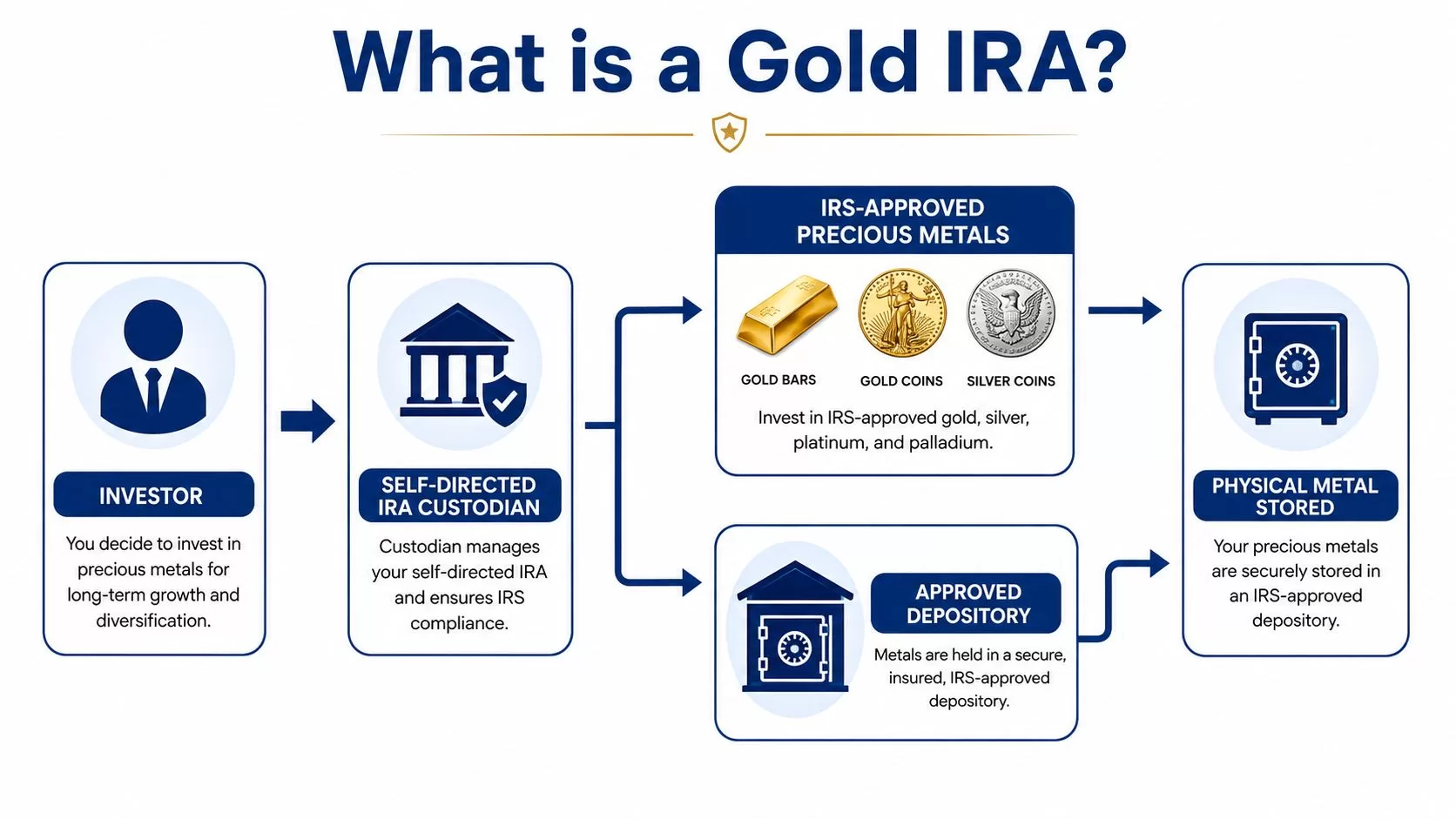
Funding can come from new contributions, an IRA transfer, or a rollover from another eligible retirement account. A direct transfer generally avoids the account holder receiving the money. With an indirect rollover, the account holder receives the distribution and must redeposit it within 60 days of actual receipt, not 60 days from the request or check date. The IRS explains the 60-day rollover rule.
An indirect 401(k) rollover can also involve mandatory 20% withholding. The full original amount generally must be redeposited, so outside funds may be needed to replace the withheld amount. Missing the deadline can make the distribution taxable and may create an additional 10% penalty when the taxpayer is under age 59½. This rollover guidance explains withholding and redeposit requirements.
Traditional accounts generally defer taxes until withdrawals, while qualified Roth withdrawals are generally tax-free. Rules around eligibility, withdrawals, beneficiaries, and required distributions depend on the account and the individual. Readers should review precious-metal IRA rules before moving retirement funds.
Fees and Costs That Erode Returns
Gold IRA fees deserve the same scrutiny as investment performance. An account-opening charge may look manageable, while administration, storage, insurance, trading, wire, spread, or liquidation costs reduce what remains invested.
The fee ranges supplied for this comparison are:
| Fee Type | Typical Range | How Often Charged | Impact on Returns |
|---|---|---|---|
| Setup fee | $50 to $300 | One time | Reduces starting balance |
| Custodian administration | $75 to $300 | Annual | Recurring account drag |
| Storage | $100 to $300 | Annual | Pays for custody and protection |
| Transaction or wire fee | $25 to $40 | Per transaction | Raises trading cost |
These figures come from the provided fee guidance. Verify every charge in writing. Pricing can vary by account size, storage arrangement, metal, and provider. Segregated storage may cost more than commingled storage, and premium coins can have a wider bid-ask spread than standard bullion.
Cost discipline: Ask for the total dollar cost in the first year and the recurring annual cost after that. A percentage alone can hide the burden on a smaller account.
Less obvious expenses can matter just as much. Collectible or proof-coin markups may raise the purchase price, inactivity charges may apply when an account sits untouched, and liquidation fees may reduce the cash available when funds are needed. A small 1.5% annual all-in drag, if applicable, can consume a meaningful share of long-term gains. The Gold IRA fee guide explains common account costs.
Model the account at realistic purchase sizes over five and ten years before signing. Include setup charges, annual administration, storage, transaction costs, spreads, and any exit fees. The purpose is not to predict gold's price. It is to calculate how much return the investment must earn to cover fixed charges and percentage-based costs, then compare that hurdle with the role gold plays in the broader retirement plan.
Building an Inflation-Resilient Retirement Portfolio
Gold should sit inside a retirement plan, not replace one. A sensible structure usually begins with broad equities for growth and nominal bonds or cash for planned spending. TIPS can help match liabilities tied to consumer prices, while a modest precious-metals sleeve can provide diversification when inflation shocks damage conventional assets.
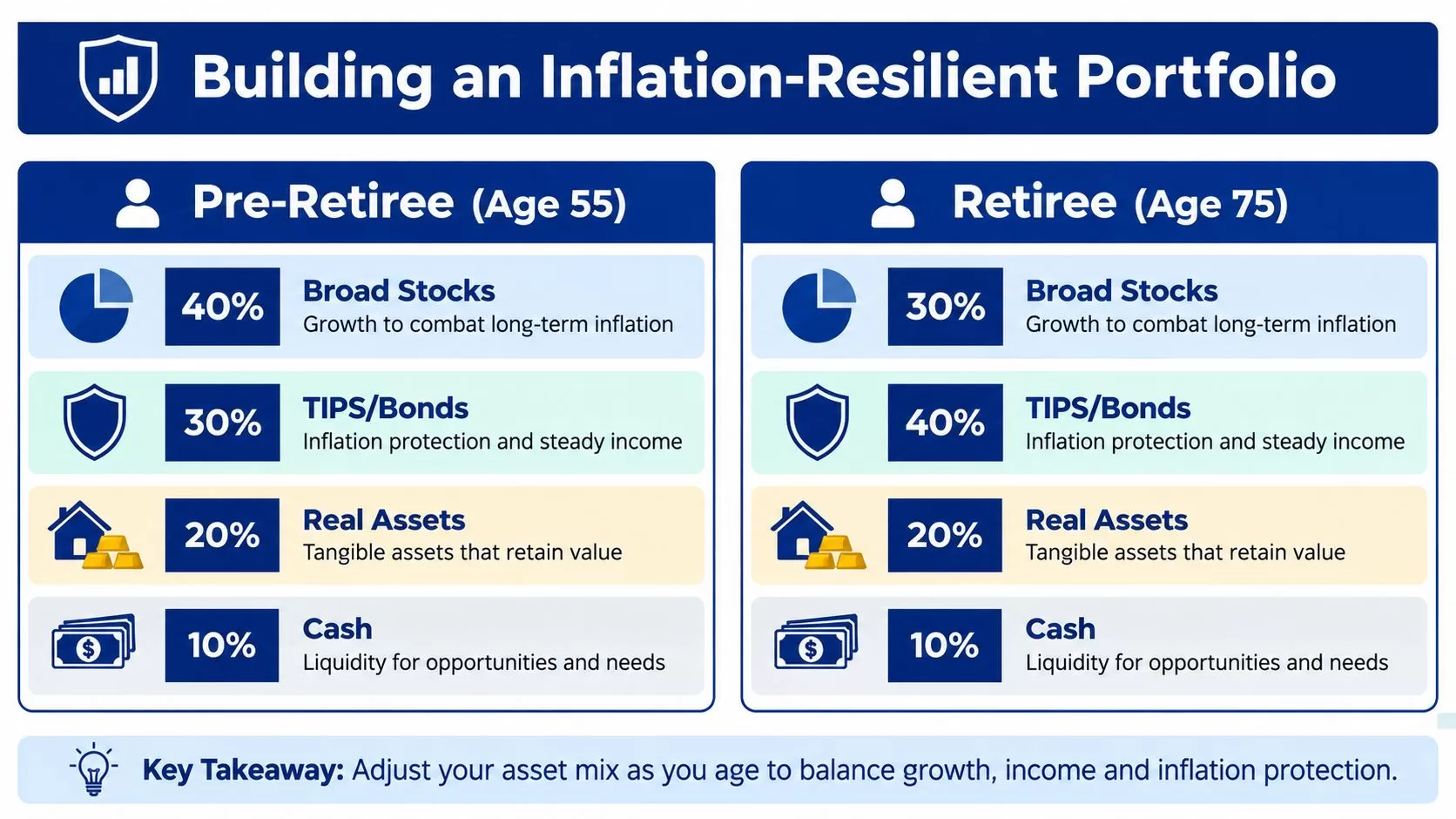
The allocation should reflect age and spending needs, not fear. The following scenarios are illustrations, not personalized recommendations:
- A 35-year-old pre-retiree: A 5% metals allocation and 15% TIPS can leave most capital focused on long-term growth while adding inflation-sensitive exposure. The trade-off is accepting market volatility over a long accumulation period.
- A 55-year-old near-retiree: A 10% metals allocation and 20% TIPS may provide more shock diversification as retirement approaches. The cost is less exposure to dividend-paying equities and other growth assets.
- A 70-year-old retiree: 5% to 10% metals and 25% to 30% TIPS may fit a more defensive structure, particularly when withdrawals and sequence-of-returns risk matter. Too much metal can still create an income shortfall because gold doesn't pay a coupon or dividend.
The right question isn't “How much gold should everyone own?” It's “How much volatility can the household tolerate, and which assets pay the bills?” Gold functions more like shock insurance than an income source. An oversized allocation can force the investor to sell productive assets or accept lower cash flow during retirement.
Rebalancing annually can keep metals from dominating after a strong run or becoming too small after a decline. Some investors may hold part of their precious-metals exposure inside an IRA for tax deferral and another portion in a taxable account for easier access, but the tax consequences differ. The allocation policy should be written down, including the target range, rebalancing rules, withdrawal priorities, and beneficiary instructions.
Documentation matters because heirs may not understand why the account owns physical metal. Clear records can prevent a diversification tool from becoming an expensive, confusing inheritance.
Checklists and Questions for Choosing a Custodian
A Gold IRA custodian deserves the same diligence as any other retirement-account administrator. The provider may arrange metals and storage, but the investor remains responsible for understanding the account structure, costs, liquidity, and tax consequences.
Before signing paperwork, verify:
- Metal eligibility: Confirm that the proposed gold, silver, platinum, or palladium meets the applicable fineness and approval rules.
- Storage structure: Ask whether the depository offers segregated or commingled storage and what each option costs.
- Written pricing: Request setup, administration, storage, insurance, transaction, wire, and liquidation charges in one document.
- Buyback process: Learn whether the custodian or metals provider facilitates sales, how pricing is determined, and how long funds typically take to arrive.
- Insurance and audits: Ask who insures the metals, what the policy covers, and whether independent third-party audits are used.
Questions should be specific. What is the total first-year cost in dollars? What are the annual storage and insurance charges? What markup applies over spot for standard coins? Is there a minimum purchase threshold? How are required distributions handled when the account contains physical metal? Can the investor sell only part of the holding?
Home-storage promises deserve particular caution because IRA-owned metals must follow the account's custody rules. Beneficiaries should be named and reviewed after major family or estate changes. Required minimum distributions may be satisfied through cash or, where permitted, an in-kind distribution, but the tax treatment and valuation need professional review.
Existing 401(k) rules also matter. Some plans restrict rollovers while the employee remains active, while others permit certain distributions. The plan administrator and tax professional should confirm whether a direct transfer or rollover is available before money moves.
For households evaluating digital assets alongside physical metals, CoinHub.pro's digital asset allocation offers a separate framework for considering that higher-volatility category. It shouldn't be confused with an inflation guarantee or with the custody rules governing precious metals.
Red flags include high-pressure sales calls, vague storage descriptions, unclear spreads, guaranteed-return language, and reluctance to provide a complete fee schedule. A clearer overview of selecting an IRA custodian for gold can help investors organize the comparison.
This is not financial advice. Consult a licensed financial advisor, CPA, or tax professional before making investment decisions.
Gold IRA Association provides educational guides on precious-metals IRAs, rollovers, IRS requirements, fees, and provider comparisons. Visit Gold IRA Association to review the relevant checklists and learn what questions to ask before deciding whether a Gold IRA belongs in an inflation-resilient retirement plan.