



A near-retiree opens a self-directed IRA to hold physical precious metals, expecting one clear annual charge. The first fee schedule arrives with setup, administration, transaction, storage, wire, and closing line items. The account may still be suitable, but the cost isn't visible in the headline fee.
Self directed IRA fees are best understood as a layered cost structure. The custodian handles account administration, a depository stores physical metals, and transactions may create separate processing charges. The sections below show how those costs work, which charges deserve the most scrutiny, and how to compare providers using an all-in annual estimate.
Why Self Directed IRA Fees Catch Investors Off Guard
A standard brokerage IRA often presents costs through familiar account fees, fund expenses, or trading charges. A self-directed IRA can look different because the account supports assets that require specialized custody, recordkeeping, processing, or storage. A precious-metals account isn't a portfolio displayed on a brokerage platform. It involves an account administrator, a metals transaction, and an approved custody arrangement for physical holdings.
The surprise usually comes from treating the annual maintenance charge as the total price. A fee schedule might show an attractive recurring amount, while separate charges apply whenever the account buys an investment, moves cash, stores metals, or closes. The more assets an account holds and the more transactions it requires, the less useful the headline annual fee becomes as a comparison tool.
The first fee schedule deserves a slower read
A reader reviewing a first statement may see a one-time establishment charge, an annual custodial fee, a transaction amount, and storage. None of those categories is automatically improper. Each can correspond to a real administrative service. The issue is whether the provider explains when the fee applies, how often it is billed, and whether the amount changes with the asset or account structure.
Neutral fee summaries describe setup charges commonly ranging from $0 to $300, annual maintenance from about $199 to $2,000 or more, transaction fees from roughly $25 to $175 per trade, and precious-metals storage at about $100 to $150 or more per year. These ranges are summarized in this breakdown of self-directed IRA costs. The figures aren't a quote for any particular provider. They show why two accounts with similar balances can carry very different expenses.
Practical rule: Compare the fee schedule against the account's expected activity, not against the advertised annual fee alone.
The right question isn't merely, “What does the account cost each year?” It's, “What will this account cost given the number of holdings, purchases, transfers, storage arrangement, and likely distributions?” That shift turns a confusing disclosure into a planning document.
The Six Fee Types Every Self Directed IRA Investor Must Know
A useful review starts by separating the charges into distinct buckets. The six categories below cover the costs most investors should expect to investigate, although a provider may use different names or combine certain services.
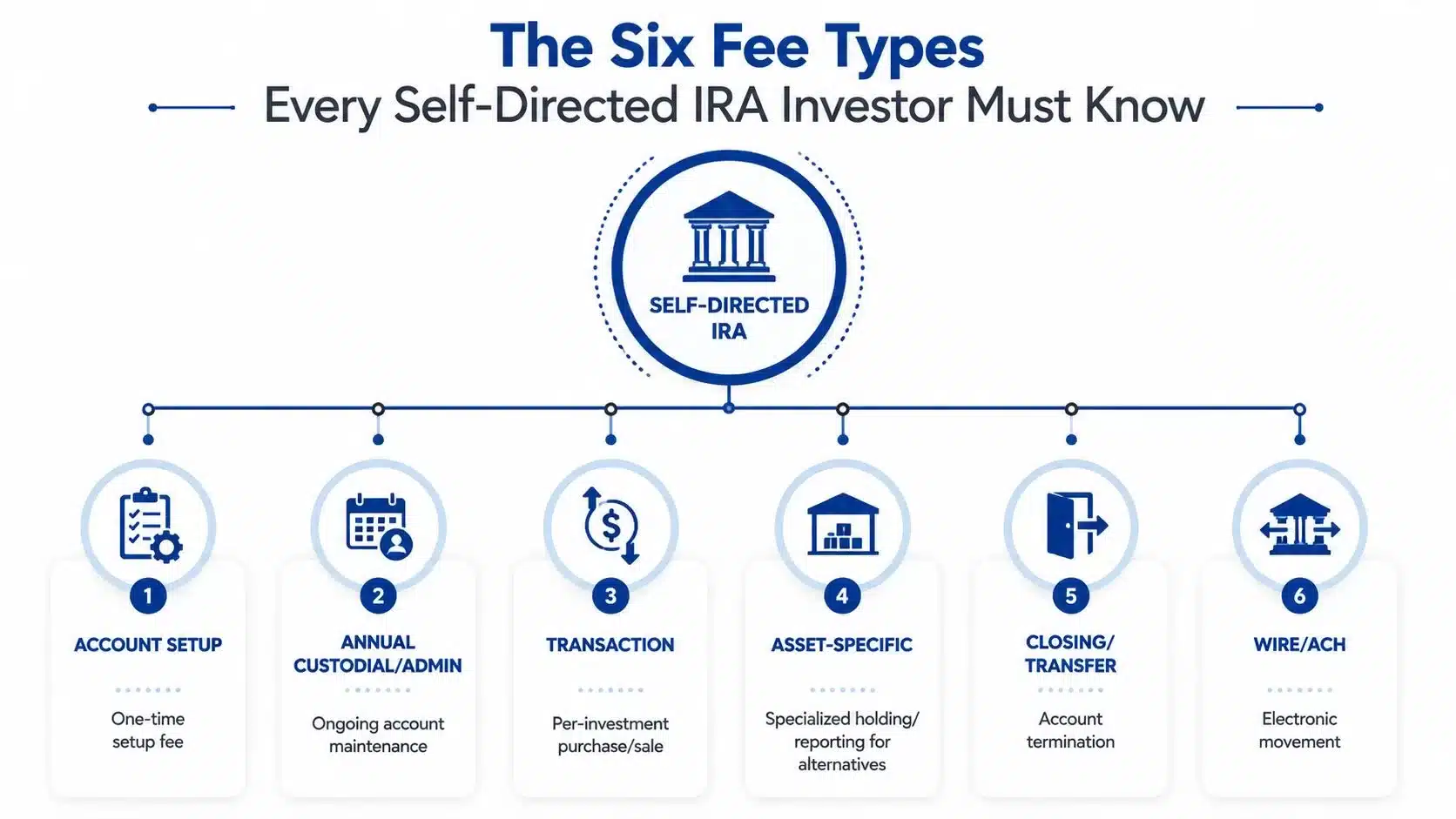
Account setup
The establishment fee is generally charged when the self-directed IRA is opened. The common range is $0 to $300, according to the cited industry summary above. A low or waived setup charge shouldn't end the review. Some providers make up for a low initial fee through higher annual, asset-specific, or transaction charges.
Annual custodial or administrative fees
This recurring charge pays for account maintenance, recordkeeping, statements, and related administration. Industry schedules place annual flat fees around $199 to $595, while broader summaries report annual maintenance charges of about $199 to $2,000 or more. The difference reflects the account type, service model, asset complexity, and pricing method.
Transaction fees
Transaction charges apply when the custodian processes an investment purchase, sale, transfer, or another account-level action. The cited range is roughly $25 to $175 per trade. Investors who intend to make repeated purchases should calculate the annual effect rather than treating each charge as insignificant.
Asset-specific charges
Alternative assets can require specialized recordkeeping, valuation work, or processing. Some custodians charge by asset, while others build those costs into a broader schedule. A comparison in the available fee data lists an annual flat charge of $199 for one asset and $274 for two assets, illustrating how holdings can change the bill even when the account balance doesn't.
Wire or electronic transfer fees
Moving money can create a separate charge. Fee summaries cite wire or related transfer costs ranging from about $25 to $250, depending on the provider and activity. Investors should ask whether electronic transfers, checks, expedited delivery, or termination processing are priced separately.
Closing and transfer fees
A final category covers account termination, outgoing transfers, or moving assets to another custodian. These charges may appear only when an investor changes providers, takes a distribution, or closes the account. The amount matters less than the trigger. A schedule that doesn't clearly define the event leaves the investor unable to estimate the cost of changing course.
The complete fee picture is therefore setup plus annual administration plus activity-based charges. A provider's document should identify each bucket, even if the provider bundles some of them.
Flat Fee vs Asset Based Custodian Pricing Models
Pricing structure matters more than many investors realize. A flat-fee custodian generally charges a stated amount that is less sensitive to the account's value, while an asset-based or tiered custodian links costs to the balance or pricing tier. Industry summaries report flat annual custodian charges around $199 to $495, while tiered pricing can rise to $2,500 or more for larger balances, as described in this self-directed IRA pricing overview.
A flat model may appeal to an investor with a larger balance or several holdings because the annual charge doesn't automatically rise with account value. An asset-based model may be more economical for a smaller account, particularly when the provider's minimum annual cost is modest. The answer depends on the actual schedule, not on the label.
A side-by-side comparison
| Account Balance | Flat Fee Model (Typical) | Asset-Based Model (Typical) | Which Is Cheaper |
|---|---|---|---|
| Smaller account | Stated annual charge, often less sensitive to balance | May scale with account value | Depends on the provider's tiers and minimums |
| Mid-size account | Cost remains comparatively stable | Charge rises as the balance grows | Compare the actual annual totals |
| Larger account | Can become more efficient when the balance increases | Can create a larger cost drag | Flat pricing may be preferable |
The table is a decision framework, not a quote. The verified data doesn't establish a universal flat-fee or asset-based rate for every balance, so a provider's written schedule must control the comparison.
A reader evaluating an IRA custodian for gold should ask four direct questions:
- Does the annual charge stay the same as the account value changes?
- Does each additional asset create a new charge?
- Are storage and transactions outside the annual fee?
- Are there minimums, caps, tiers, or different rates for physical metals?
Larger balances need special attention. An asset-based schedule can create a continuing drag as the account grows, even if the portfolio's holdings and transaction activity remain unchanged. A flat schedule can work the other way, making the account's cost roughly insensitive to portfolio size. Investors should calculate the annual bill under both models using their expected balance and asset count.
How Hidden Costs Compound Over Time
The annual maintenance fee is only the starting point. A precious-metals account may also incur a charge for every purchase, a storage charge for physical holdings, and a wire fee when cash moves. The investor's behavior determines how heavily those layers affect the account.
Suppose an investor makes four metal purchases during a year, uses segregated storage, and occasionally wires funds. The exact total can't be calculated without the provider's schedule, because the purchase amount, storage model, wire frequency, and bundled services vary. Still, the method is straightforward:
- Start with the recurring custodial or administrative fee.
- Add the setup charge in the opening year.
- Multiply the transaction charge by the number of expected purchases or sales.
- Add storage based on segregated or commingled custody.
- Add wire, transfer, or other service charges expected during the year.
- Include any asset-specific or closing charges that the schedule says will apply.
The available fee data gives transaction costs of roughly $25 to $175 per event, segregated storage of about $100 to $150 per year, and wire or termination charges of approximately $25 to $250, as summarized in this guide to self-directed IRA fees. Those amounts should be inserted into the investor's own activity estimate rather than added as generic assumptions.
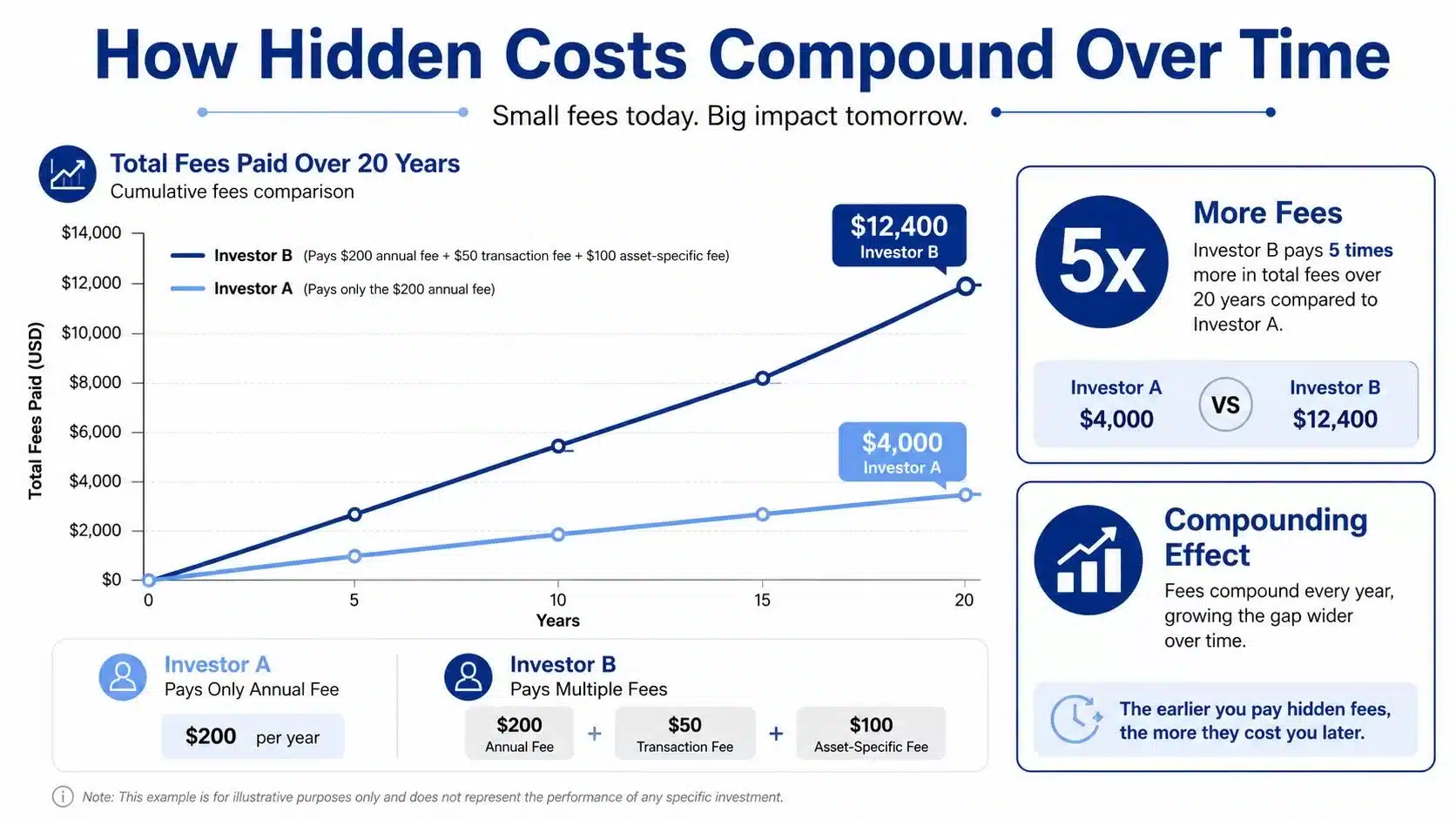
A fee's effect also depends on how the account pays it. The IRS explanation of retirement plan fees notes that investment and administration fees may be paid directly from the account or indirectly through lower returns. That distinction makes fee visibility important. Money removed from the IRA isn't available for investment, while costs reflected through returns can be harder to identify.
The practical conclusion is clear: estimate realized annual cost from expected activity. An investor who rarely trades may care most about the recurring and storage charges. An investor who buys repeatedly should focus on per-event pricing, batching rules, and whether multiple holdings generate extra administration.
How to Compare Self Directed IRA Fee Schedules
A fair comparison requires more than collecting the annual fee from several websites or phone calls. Each provider should be evaluated using the same account assumptions, the same asset count, and the same transaction pattern.
Build a normalized worksheet
Request the complete written fee schedule, not just a promotional summary. Then record each charge in a worksheet with columns for the fee name, amount, billing frequency, trigger, and whether the fee is mandatory.
Use this checklist:
- Request the full document: Ask for the current schedule, account agreement, storage schedule, and transfer terms.
- Identify all six categories: Confirm setup, annual administration, transaction, asset-specific, wire, and closing charges.
- Separate recurring from one-time costs: Mark the opening-year fee separately from future annual costs.
- Test fee scaling: Ask whether balance tiers, asset count, storage type, or transaction volume changes the bill.
- Clarify every trigger: Find out whether purchases are charged per trade, per asset, per instruction, or per batch.
- Check promotional terms: Confirm whether a waiver or reduced charge expires and what the standard fee becomes afterward.
Ask questions that expose the all-in cost
Storage deserves a direct question: Is it segregated or commingled, and is it priced as a flat charge or as a percentage of assets? Transaction wording also needs precision. “Transaction fee” may cover one action, several related actions, or only the custodian's part of a larger metals purchase.
Ask whether the provider charges for:
- Cash contributions or rollovers
- Incoming and outgoing wires
- Asset purchases and sales
- Additional holdings
- Statements or special reporting
- Distributions and account closure
- Expedited documents or delivery
The comparison should use the investor's expected behavior. If one schedule bills annually and another bills monthly, convert both into a yearly estimate. If one provider bundles storage while another lists it separately, add the separate charge before deciding which is cheaper.
A Gold IRA comparison is useful only when it evaluates the complete fee structure alongside custody, storage, service, and investment procedures. The lowest displayed annual number isn't necessarily the lowest realized cost.
Storage Costs and Segregated vs Commingled Options
Physical precious metals require a custody and depository arrangement rather than personal possession. Storage is therefore a distinct cost, not an optional convenience added after the account opens. The choice between segregated and commingled storage affects both the service arrangement and the annual bill.
Segregated storage keeps an investor's metals separately identified. A neutral cost guide places segregated storage at about $100 to $150 per year, while commingled storage is described as roughly $100 or less per year. Another summary places gold IRA storage around $100 to $300 annually or 0.15% to 0.50% of assets, showing that providers may use either flat pricing or an asset-based approach. These figures are detailed in this explanation of precious-metals storage costs.
Choosing the storage arrangement
Commingled storage generally groups holdings with other investors' metals of the same type, while segregated storage provides separate identification. Neither label should replace a review of the depository terms. The investor should confirm how ownership records work, how metals are identified, whether insurance is included, and whether the quoted price is per account, per holding, or tied to asset value.
The precious-metals storage guide can help readers understand the custody question before comparing charges. A lower storage fee may be reasonable for an investor who doesn't require separate identification, while segregated storage may better suit someone who places a higher value on individualized handling.
Storage is part of the ownership structure for physical metals inside an IRA. It shouldn't be treated as an optional add-on.
Investors should also resist the assumption that storage is the only cost associated with metals. Purchases, sales, wires, and special processing can materially change the annual total. The sound comparison is custody plus storage plus activity, not storage in isolation.
Tax Treatment of Self Directed IRA Fees and Common Misconceptions
The question “Can the account owner pay the fee personally?” has no safe universal answer without professional review. A recent fee guide states that, under current law, the IRS doesn't allow a deduction for IRA custodian fees paid outside the IRA, while also emphasizing that treatment has changed over time and may depend on legislative developments and individual circumstances. The practical point is that paying personally shouldn't be assumed to create a tax benefit. The issue is discussed in this guide to self-directed IRA setup fees.
Payment handling also intersects with prohibited-transaction rules. A rules summary states that a self-directed IRA can't sell, exchange, or lease property already owned by the account owner to the IRA, transfer assets or income to a disqualified person, lend IRA money to a disqualified person, or allow fiduciaries to use IRA investments for personal benefit. Another summary says an improper transaction can cause the IRA to be distributed and lose its tax-protected status, with a penalty beginning at 15% and potentially increasing to 100% of the amount involved if not corrected promptly. See the self-directed IRA prohibited-transaction rules before taking action.
Certain holdings and activities are also restricted. Available rules material identifies life insurance, collectibles such as art and antiques, and S-corporations as disallowed IRA holdings, and it describes disqualified persons as including certain ancestors, fiduciaries, and entities owned at least 50% by those persons. Paying an expense personally, using IRA income for personal purposes, or benefiting from an IRA transaction can create serious compliance concerns.
Before opening or funding an account, the investor should request a complete schedule, calculate the expected all-in cost, and ask a CPA or tax professional how fees should be paid. This is not financial advice. Consult a licensed financial advisor, CPA, or tax professional before making investment decisions.
Gold IRA Association offers educational guides, fee explanations, rollover resources, and provider comparisons designed to help readers evaluate precious-metals retirement accounts more clearly. Visit Gold IRA Association to review self-directed IRA fee resources and compare the questions that matter before choosing a custodian.