



A reader with a 401(k) or traditional IRA often assumes moving into gold works like buying a fund online. It doesn't, because physical metal inside an IRA needs a specialized custodian to hold title, process trades, and report to the IRS. This guide explains IRA custodian responsibilities in plain English, and where that protection stops.
Why IRA Custodian Responsibilities Matter When You Add Metals
The typical starting point is familiar. Someone near retirement has savings in a former employer's 401(k) or a brokerage IRA and wants part of that money in physical gold or silver as diversification.
That move changes the account type in practice. A precious metals IRA is a self-directed IRA, meaning the owner chooses the asset and gives instructions, rather than picking from a brokerage menu of stocks and funds.
Three separate parties then handle three separate jobs, and confusing them causes most beginner mistakes.
- The custodian: Opens and administers the IRA, receives rollover funds, executes written buy and sell instructions, and files IRS paperwork.
- The dealer: Sells the coins or bars to the IRA at a price the owner accepts.
- The depository: Physically stores the metal and issues storage records.
The custodian is the hub connecting those parties. Money doesn't flow from the owner's bank account to a dealer, and metal doesn't ship to the owner's home. Both move through the custodian's records so the IRS can see the IRA, not the individual, owns the asset.
That distinction matters for tax treatment. If the paperwork, title, or storage breaks down, the IRS may treat the purchase as a personal transaction rather than a retirement account investment.
Practical rule: Choosing a Gold IRA is first a decision about who administers the account. The metal choice comes second.
Readers who understand that order ask better questions early. They check how a custodian processes rollovers, values holdings, and reports distributions before debating which coin to buy.
What an IRA Custodian Actually Is and Who Can Serve in That Role
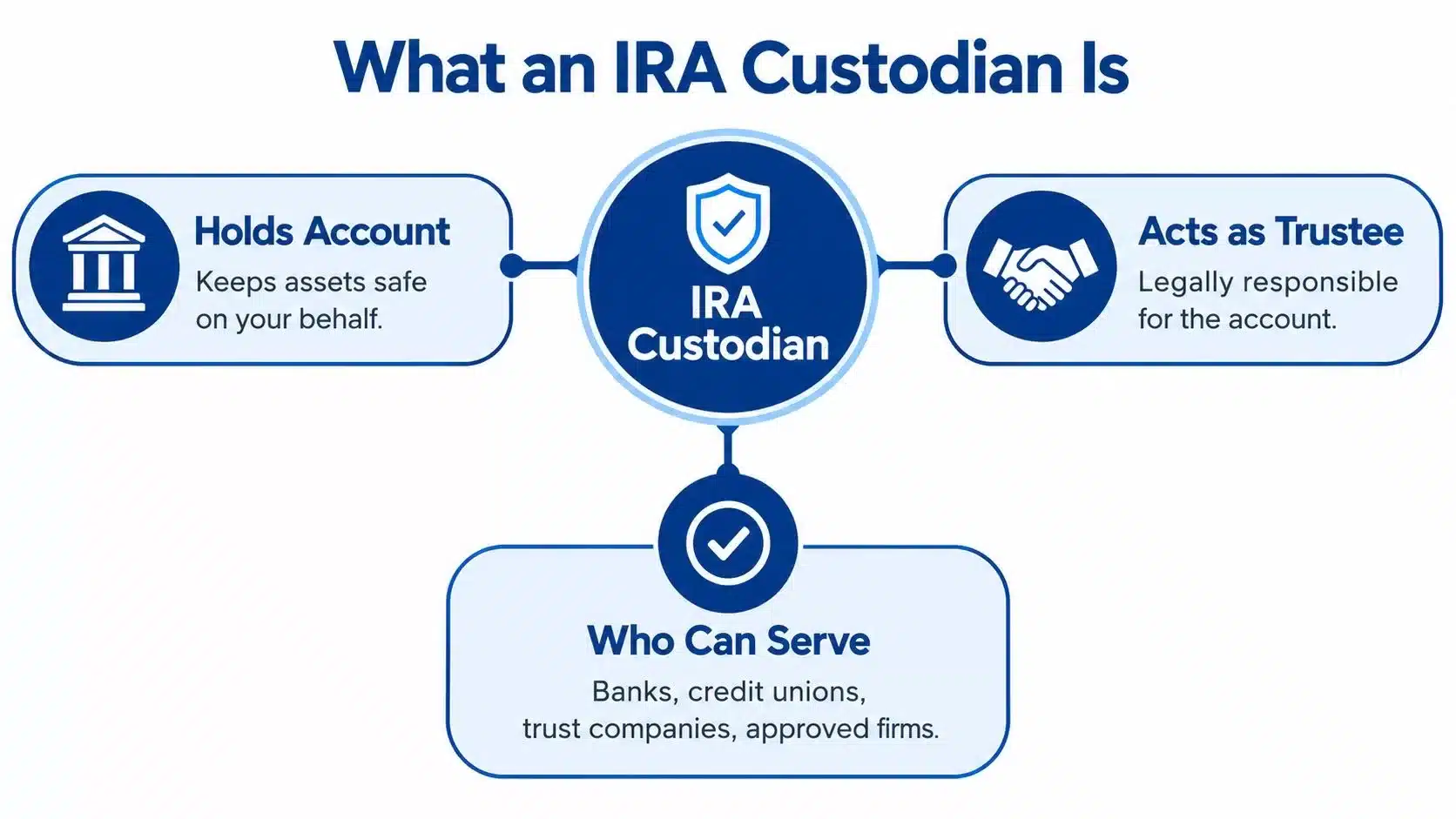
An IRA custodian is the institution that legally holds the account for the owner's benefit. The owner directs investments, but the custodian maintains the account structure that keeps it recognized as an IRA.
Not any company can fill that role. The GAO review of IRA custodial requirements confirms every IRA must be held by a custodian or trustee that is a bank, federally insured credit union, savings and loan association, or an entity approved by the IRS, because an investor generally cannot preserve IRA tax treatment while personally taking possession of account assets.
How This Differs From a Brokerage IRA
At a typical brokerage, one firm acts as custodian, provides the investment menu, and executes trades on its own platform. The owner rarely notices the custodial layer because everything happens inside one login.
A self-directed metals account separates those functions. The custodian doesn't sell the metal and doesn't store it, yet it records the purchase, pays the dealer from IRA funds, and tracks what the depository holds.
That separation is intentional. It creates an independent paper trail showing the IRA bought the metal, the IRA paid for it, and a third party stores it.
Why Specialized Custodians Exist
Most mainstream brokerages aren't set up to record physical assets, coordinate with depositories, or value holdings that don't trade on an exchange. Self-directed custodians build their systems around those tasks.
Vetting therefore matters as much as dealer selection. A dealer affects price, but the custodian affects whether the account's records, reporting, and transactions hold up over decades.
Day-to-Day Duties of a Gold or Silver IRA Custodian
Daily work starts before any metal changes hands. The custodian opens the account, verifies identity documents, and receives funds through a contribution, transfer, or rollover.

Consider a simple purchase. The owner directs the custodian in writing to buy specific American Eagle gold coins from a chosen dealer. The custodian reviews the instruction, sends IRA funds to the dealer, and records the invoice under the IRA's name.
The dealer then ships the coins to an approved depository, not to the owner. Readers reviewing how that handoff works can consult the guide to approved precious metals storage arrangements for the storage side of the process.
Records the Custodian Maintains
- Transaction ledger: Dates, amounts, and counterparties for every contribution, purchase, sale, and distribution.
- Asset descriptions: Metal type, quantity, weight, and serial numbers where bars carry them.
- Supporting documents: Dealer invoices, storage receipts, and transfer confirmations tied to the account.
Sales run in reverse. The owner instructs a sale, the depository releases metal to the buyer, and proceeds return to the IRA as cash rather than landing in a personal account.
The short video below walks through how those instruction, payment, and storage steps connect in sequence.
Valuation continues between trades. The custodian must maintain a fair market value record for the account each year, using dealer or market pricing for metals, because tax reporting depends on that figure even when no sale occurs.
IRS Reporting the Custodian Handles on Your Behalf
Tax reporting is the most measurable part of IRA custodian responsibilities. Two forms do most of the work, and owners should know what each one proves.
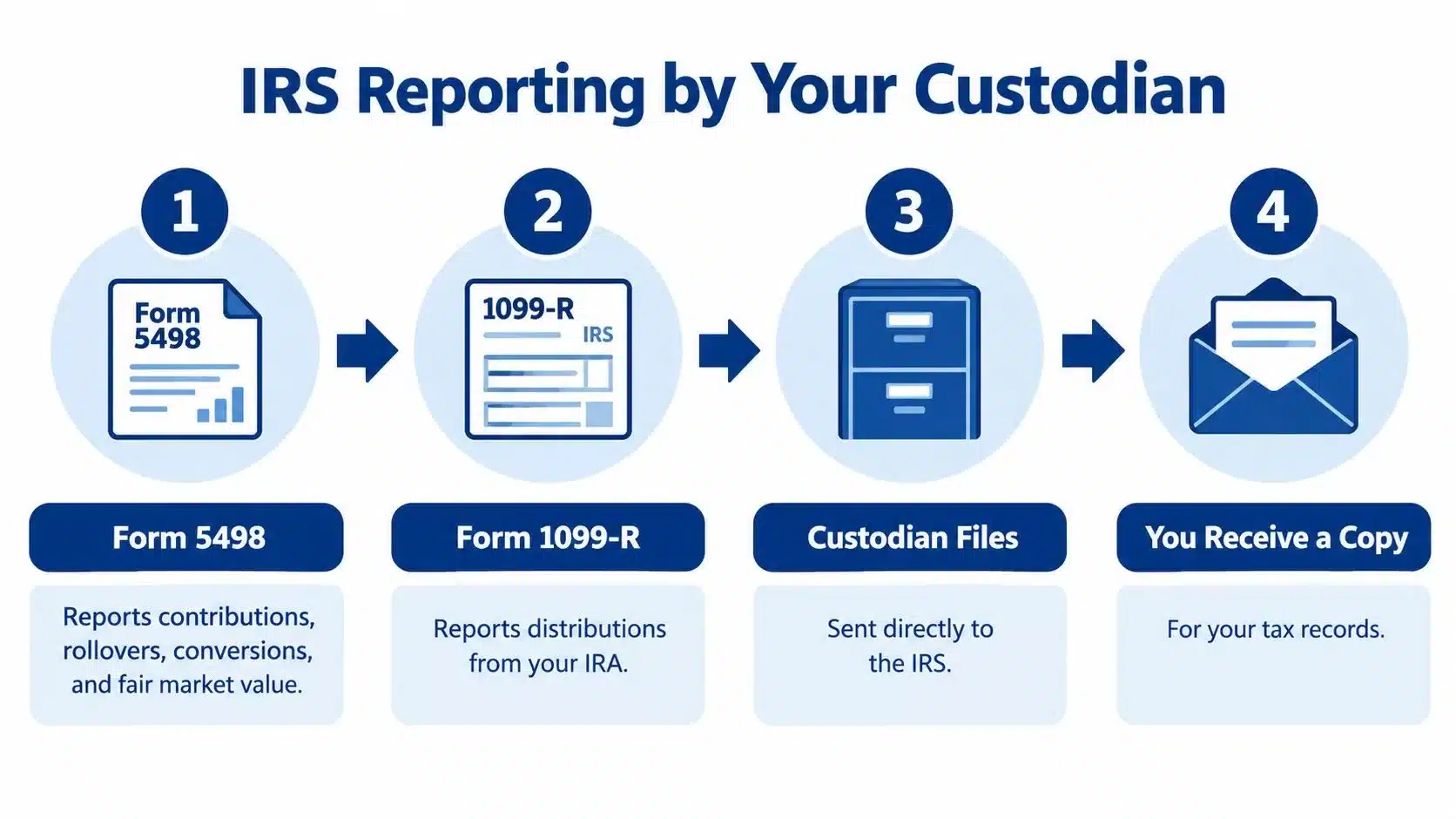
Form 5498 reports contributions, rollovers, Roth conversions, repayments, required minimum distribution information, and the account's fair market value. IRS guidance on reporting IRA transactions notes the custodian generally files it by May 31 of the following year, and specifically identifies incorrect contribution years, omitted conversion coding, duplicate Forms 5498, and missing or incorrect RMD data as recurring custodian errors.
Form 1099-R covers the other direction. It reports distributions, so withdrawals of cash or metal show up as taxable events where applicable.
Details That Matter for Metals Accounts
Form 5498 includes boxes identifying the portion of fair market value tied to nonmarket assets and codes for the asset type. That's how the IRS distinguishes an account holding physical metal from one holding only traded securities.
Owners matching rollover paperwork to tax returns can review the explanation of the IRA rollover tax form alongside the copies the custodian sends.
Timing also applies to RMD notices. IRS guidance on trustee reporting duties states the trustee holding the IRA on December 31 of the prior year must provide the owner's required minimum distribution statement by January 31 of the distribution year.
Errors here aren't cosmetic. A rollover miscoded as a regular contribution can trigger an IRS notice the owner then has to unwind, which is why written correction procedures deserve a direct question before funding.
What the Custodian Does Not Do for Your Gold IRA
The most expensive misunderstanding is assuming an IRS qualified custodian has vetted the investment. It hasn't, and federal investor materials say so directly.
SEC materials on self-directed IRA custodians state that self-directed IRA custodians generally do not research or recommend investments, verify statement accuracy, ensure complete disclosure, or perform the investment-analysis functions associated with an investment adviser, and typically do not investigate either the asset or the promoter.
That means a purchase can be administratively clean and still be a bad deal. The custodian may process payment for metal that's overpriced, carries wide resale spreads, or comes from a dealer with poor service, because judging price fairness isn't its job.
Custody confirms the account paperwork is in order. It does not confirm the deal was wise.
What the Owner Still Has to Verify
- Dealer reputation: Complaint history, transparency on pricing, and how buyback requests work in practice.
- Product eligibility: Whether the specific coin or bar meets IRS fineness rules for IRA ownership.
- Pricing: The premium over spot price, compared across more than one quote.
- Storage terms: Segregated versus commingled storage, insurance coverage, and audit practices at the depository.
- Exit terms: How sales are priced and how quickly proceeds settle back into the IRA.
Fees need the same scrutiny. Account opening, annual, administrative, and asset specific charges can all apply, and the custodian's own fee schedule is separate from dealer markups and depository storage fees.
Three controls protect the owner, and only one belongs to the custodian. Custodian compliance checks cover account structure, depository arrangements cover physical safety, and the owner's own verification covers price, product, and dealer quality.
Skipping that third layer is exactly where precious metals marketing does its damage. Promotional language about IRS approved custodians can sound like an endorsement of the metal or the seller, when it only describes who keeps the records.
Prohibited Transactions and How Custodians Keep the Account Compliant
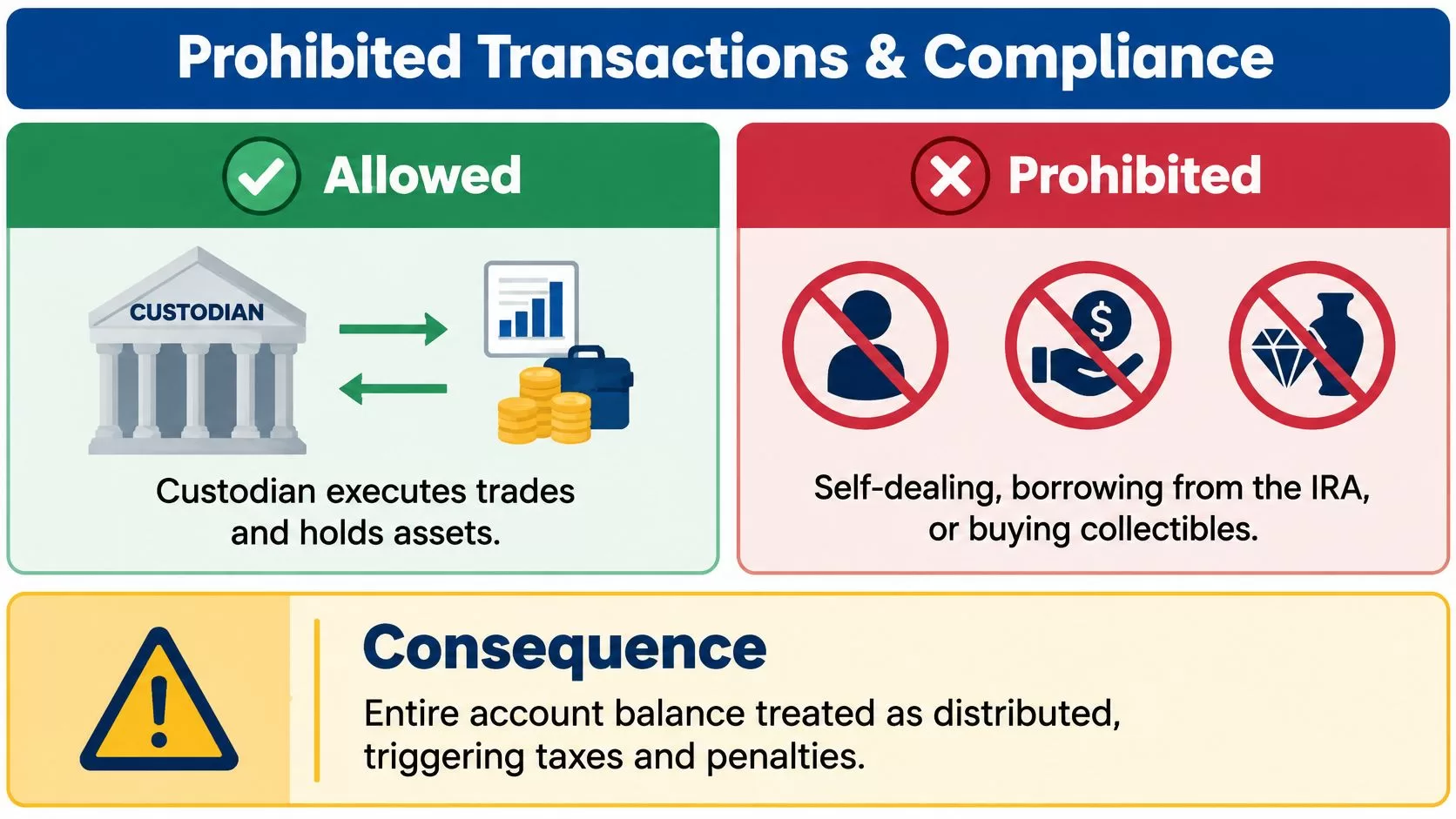
Prohibited transaction rules set the outer boundary of everything a custodian administers. The penalty for crossing it is severe enough to reshape how every purchase gets handled.
IRS reporting instructions on prohibited transaction consequences state that when an IRA owner engages in a prohibited transaction, the account's assets are treated as distributed on the first day of the tax year in which the transaction occurred, so the resulting tax treatment can apply to the full account rather than merely to the disputed asset.
Custodian Controls Versus Owner Obligations
| Custodian screens | Owner must avoid |
|---|---|
| Purchases titled to the IRA | Borrowing money from the IRA |
| Payments flowing through IRA funds | Selling personal property to the IRA |
| Storage with a third party depository | Using IRA assets as loan security |
| Related party transaction flags | Personally using IRA owned property |
Those owner side examples come from IRS Publication 590-A on prohibited transactions, and they apply even if a custodian never sees the conduct. Personal possession of IRA metal at home falls on the wrong side of that line.
The custodian's audit trail supports its side. Dealer instructions, invoices, inventory records, custody transfers, valuations, and liquidation proceeds should all connect, and suspected violations should follow a written escalation path. Readers checking who counts as a related party can use the overview of the self-directed IRA disqualified person rules before involving family members in any transaction.
Property restrictions from outside retirement law can also intersect with account decisions during major life events. For readers going through a divorce, a separate explanation of standing order divorce property limits shows how courts can temporarily restrict what someone does with assets, which is worth reviewing before moving retirement funds.
How Rollovers, Contributions, and Distributions Move Through a Precious-Metals IRA
Most Gold IRAs start with money that already exists somewhere else. The custodian coordinates that arrival so the move doesn't accidentally become a taxable withdrawal.
Funding the Account
In a direct rollover or trustee to trustee transfer, funds move between custodians without passing through the owner's hands. The receiving custodian documents the source so the money is coded as a rollover, not a new contribution.
Fresh contributions follow aggregate limits across all of an individual's traditional and Roth IRAs combined, not per account. IRS guidance on IRA contribution limits sets the combined limit for 2026 at $7,500, or $8,600 for someone age 50 or older, subject to the lower taxable compensation limit, and confirms that since 2020 taxpayers may make regular IRA contributions at any age if they have taxable compensation.
That aggregate tracking matters for owners holding several IRAs. A custodian only sees its own account, so the owner must disclose contributions made elsewhere to avoid an excess contribution.
Years of Holding, Then Withdrawals
During the holding years, the custodian's routine work continues. Statements arrive, fair market value gets reported annually, and storage and administration fees are paid from IRA funds under the account agreement.
Distributions reverse the funding flow. The custodian reports RMD information to the owner, but the owner stays responsible for making sure the distribution happens by the deadline.
Owners generally choose between two forms of payout. The custodian can sell metal and distribute cash, or distribute specific coins or bars in kind, transferring title to the owner personally.
An in kind distribution is still a distribution. The metal's fair market value counts for tax reporting, and Form 1099-R reflects it, even though no cash changed hands.
Liquidity planning belongs in this picture too. An account holding only metal and no cash may need a sale before an RMD can be satisfied in cash, so the custodian's processing timelines deserve attention well before the first distribution year arrives.
Questions to Ask a Custodian and Your Next Step
Can one custodian hold gold and silver together? Yes, a single self-directed account can generally hold both metals, since the custodian records assets rather than restricting the account to one metal type. The account agreement should confirm this in writing.
What happens if a custodian goes out of business? IRA assets are held for the owner's benefit, not owned by the custodian itself. Accounts typically transfer to a successor custodian, and complete records make that transfer cleaner.
Who decides fair market value each year? The custodian reports it, using pricing information for the holdings. Owners should ask what pricing source is used and how disputes get resolved.
How are RMD amounts communicated? IRS Notice 2003-3 on RMD reporting explains an IRA trustee must report RMD information and may satisfy its obligation by giving the owner a statement showing the RMD amount and the date by which it must be distributed, or by stating that an RMD is required and offering to calculate the amount upon request.
Before funding, readers should request written procedures for valuation, prohibited transaction screening, error correction, and RMD reporting, plus a complete fee schedule. This is not financial advice. Consult a licensed financial advisor, CPA, or tax professional before making investment decisions.
Gold IRA Association publishes independent educational guides and provider comparisons covering custodian selection, rollover steps, storage, and fees for precious metals IRAs. Readers ready to compare custodians and request a free Gold IRA information kit can visit Gold IRA Association to review the checklists and company reviews before opening an account.