


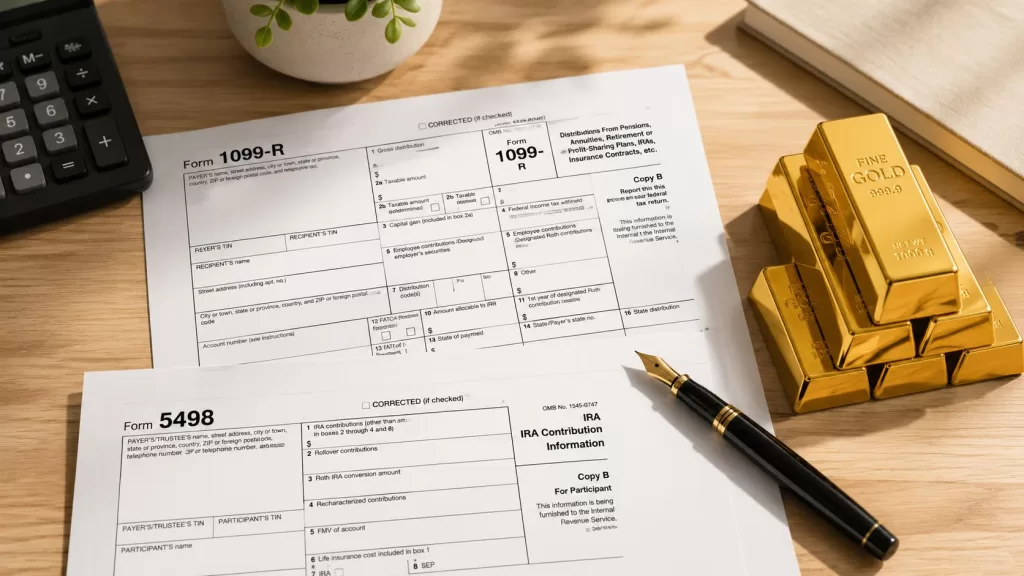
Navigating an IRA rollover means dealing with specific tax forms that tell the IRS what you did with your retirement savings. For most Gold IRA rollovers, the paperwork has two key parts: Form 1099-R, which reports the money leaving your old account, and Form 5498, which documents the funds arriving in your new IRA. Understanding how these forms work together is crucial to ensuring your rollover remains tax-free.
Which IRA Rollover Tax Form Applies to You?
Think of the process like a tracked package. The old plan administrator sends a "shipped" notice to the IRS (Form 1099-R), and the new custodian sends a "delivered" notice (Form 5498). When the IRS sees both, they can confirm the transfer was a legitimate, non-taxable rollover.
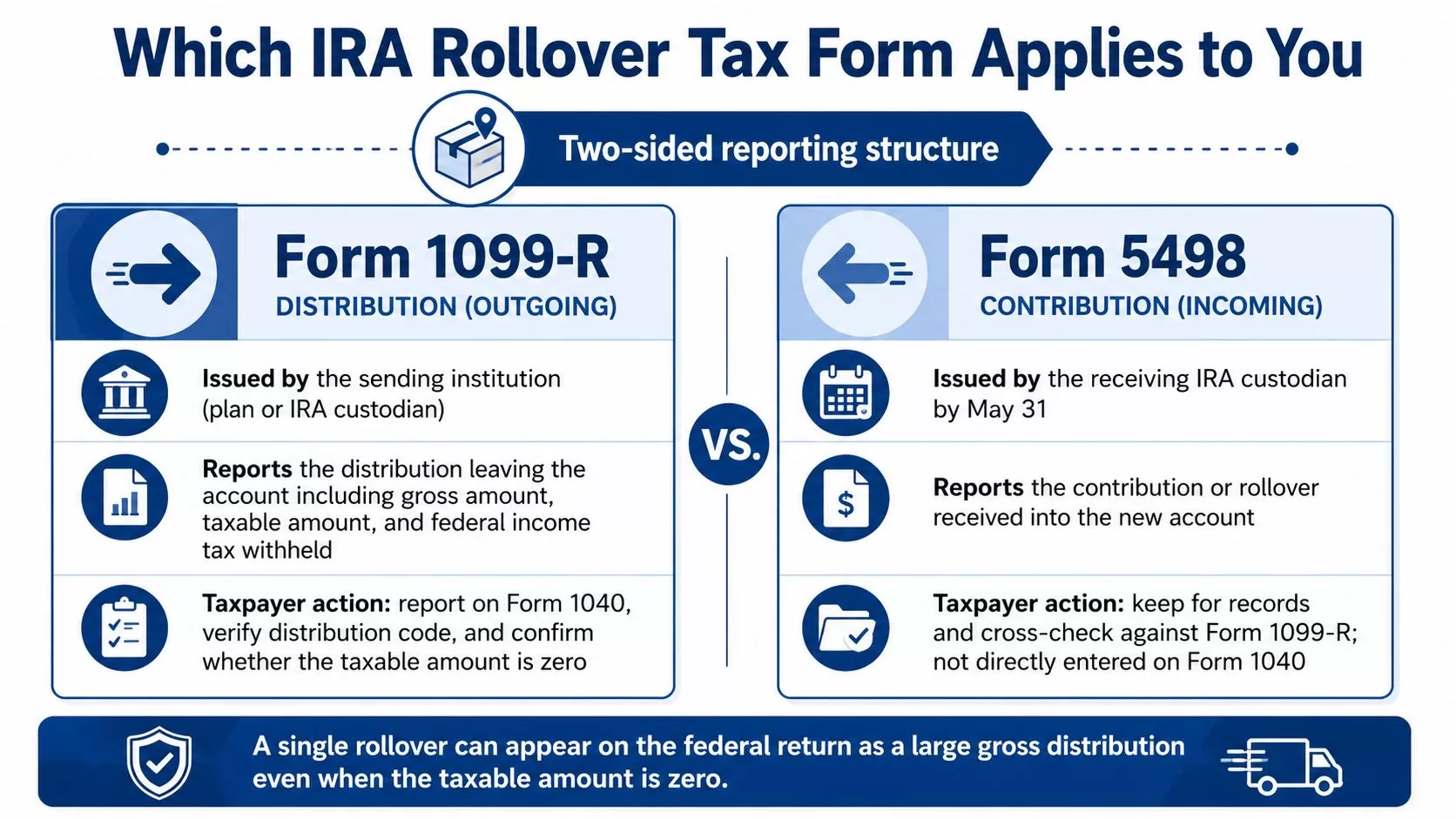
This system explains why your tax return might show a large distribution, yet the taxable amount is zero—the IRS sees both the outgoing and incoming parts of the same transaction.
What Each Form Reports
Form 1099-R: This form comes from your old 401(k) administrator or IRA custodian. It shows the gross amount distributed, the taxable amount (which should be $0 in a proper rollover), and specific distribution codes that tell the IRS what type of transaction occurred. You'll use this information to report the distribution on your Form 1040 tax return.
Form 5498: This form is sent by your new IRA custodian, typically by May 31 for the previous tax year. It confirms the rollover contribution was received and states the fair market value of your IRA. You don't file this form with your taxes; you keep it for your records as proof the rollover was completed.
Quick Comparison Table
| Form | Issued By | What It Reports | Taxpayer Action |
|---|---|---|---|
| 1099-R | Sending plan or custodian | Gross distribution, taxable amount, distribution code | Report on Form 1040; confirm code and taxable amount are correct. |
| 5498 | Receiving IRA custodian | Rollover contribution received, year-end fair market value | Keep for your records; use it to cross-check against the 1099-R. |
Key Takeaway: The IRS matches the information on Form 1099-R and Form 5498. Meticulous documentation is essential, even when your rollover is completely tax-free.
Want a deeper dive into the specifics? Check out our full breakdown of IRA rollover tax rules.
How the 60-Day Rule Shapes Rollover Tax Reporting

If you personally receive a distribution from a retirement account that you intend to roll over, the IRS gives you exactly 60 days to deposit it into another qualified retirement plan. This is known as an indirect rollover. Missing this deadline can turn what should have been a tax-free move into a taxable distribution, potentially with an early withdrawal penalty.
How Direct Rollovers Avoid the Clock
A direct rollover is the simplest and safest method. The funds move directly from your old custodian to your new one without you ever touching the money. Because you never take personal receipt of the distribution, the 60-day rule doesn't apply. On Form 1099-R, these transfers are typically marked with distribution code G, showing a gross distribution but a taxable amount of $0.
The Risks of Indirect Rollovers
An indirect rollover, where the funds are first sent to you, introduces complications. If the distribution comes from a 401(k) or other employer plan, the administrator is required to withhold 20% for federal taxes. This amount is reported in Box 4 of your Form 1099-R.
To complete a tax-free rollover, you must deposit the full original amount into your new IRA within 60 days. This means you have to come up with the 20% that was withheld from your own pocket.
- If you successfully deposit the full amount on time, you can reclaim the 20% withholding when you file your taxes.
- If you only deposit the 80% you received, the 20% shortfall is considered a taxable distribution.
Why Gold IRA Moves Need Extra Care
Rolling over into a Gold IRA involves more logistical steps than a standard rollover, including coordinating between custodians and depositories and arranging for the secure shipment of physical metals. These steps can introduce delays, making indirect rollovers especially risky. A direct, trustee-to-trustee transfer is almost always the safer and more reliable route for a Gold IRA rollover.
Direct Versus Indirect Rollovers on the Tax Forms
The way a rollover is handled determines how it appears on your tax forms and whether it remains tax-free. Let's look at how direct and indirect rollovers are reported on Form 1099-R.
How Direct Rollovers Appear on Form 1099-R
With a direct, trustee-to-trustee transfer, funds move from one financial institution to another. Since you never take control of the money, the transaction is generally non-taxable.
- Form 1099-R from the old plan will show the gross distribution amount in Box 1.
- The distribution code in Box 7 will typically be G, indicating a direct rollover.
- The taxable amount in Box 2a should be $0.
While seeing a large distribution on your 1099-R can be alarming, the code G and $0 taxable amount clarify for the IRS that it was a non-taxable transfer.
Key Insight: A direct trustee-to-trustee transfer is the cleanest method, as it avoids both the 60-day rule and the once-per-year rollover limitation.
How Indirect 60-Day Rollovers Appear on Form 1099-R
With an indirect rollover, you receive the funds and have 60 days to deposit them into a new IRA. If the money comes from an employer plan, the payer will typically withhold 20% for federal taxes.
- Form 1099-R will show the gross distribution in Box 1.
- Box 4 will report the federal income tax withheld (often 20%).
If you redeposit the full gross amount within the 60-day window (making up the 20% withholding from other funds), the rollover is non-taxable. The amount withheld can be claimed back when you file your taxes. If you fail to redeposit the full amount, the shortfall becomes taxable income and may be subject to penalties.
Common Rollover Errors and Risks
A simple mistake can convert a tax-free transfer into a costly taxable event. The most common errors include:
- Missing the 60-day deadline: Any amount not redeposited in time becomes taxable.
- Failing to replace withheld tax: Not making up the 20% withholding on an indirect rollover creates a taxable shortfall.
- Incorrect 1099-R coding: An incorrect distribution code can misclassify the transfer and trigger an IRS inquiry.
To avoid these issues, always opt for a direct, trustee-to-trustee transfer when possible. Save all paperwork from both the sending and receiving custodians to create a clear paper trail.
For more details on moving funds from a 401(k), read our guide on 401(k) to Gold IRA rollovers.
The Once-Per-Year Rule and Why It Matters for Gold IRA Moves
The IRS enforces a strict "once-per-year" rule for IRA-to-IRA rollovers where you personally take possession of the funds. This rule is often misunderstood: it applies to you as an individual across all your IRAs, not to each separate account. This means you get one such rollover in any 12-month period, regardless of how many IRAs you own.
Attempting a second indirect IRA-to-IRA rollover within a 12-month window can disqualify the transaction, making the entire distribution taxable income, potentially with added penalties.
The most reliable way to avoid this trap is to use direct trustee-to-trustee transfers. Since you never take possession of the funds, these transfers are not considered rollovers for the purpose of this rule and are not subject to the once-per-year limitation. For a Gold IRA, where logistics can be complex, using direct transfers is the most prudent strategy.
Step-by-Step Reporting Scenarios on Your Federal Return
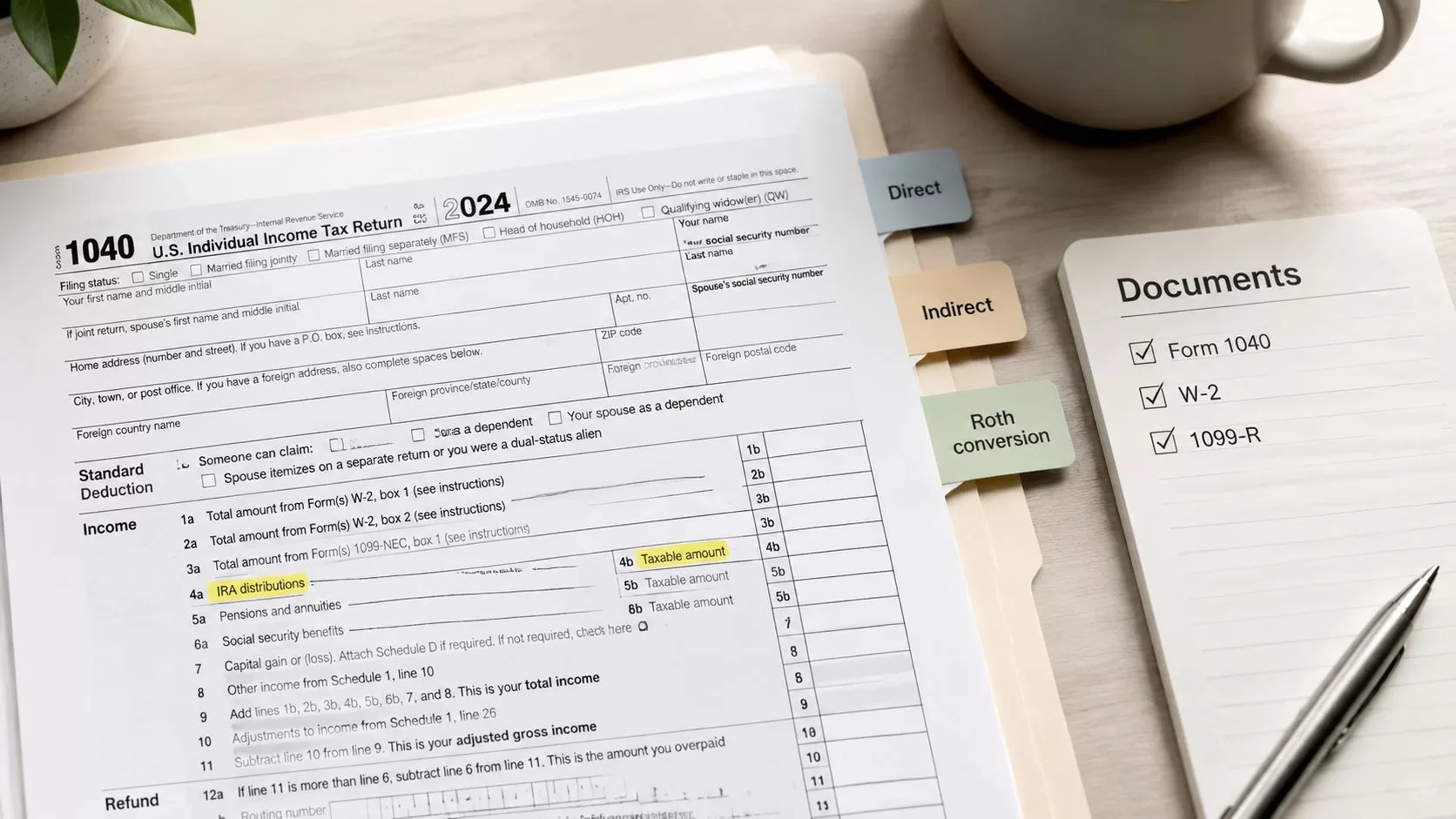
Let's walk through how to handle the paperwork for a few common rollover situations when tax season arrives.
Scenario One: The Clean Direct Rollover
This is the ideal scenario. Your funds move directly from the old custodian to your new Gold IRA custodian in a trustee-to-trustee transfer.
You will receive a Form 1099-R showing the full distribution amount in Box 1 and distribution code G in Box 7. Crucially, Box 2a will show a taxable amount of $0. On your Form 1040, you report the gross amount on the appropriate line for IRA distributions but list the taxable amount as zero. You should also write "rollover" next to the entry. A few months later, you will receive Form 5498 from your new custodian confirming the rollover was completed.
Scenario Two: The Indirect Rollover with Withholding
This is more hands-on. Your old plan sends you a check, and the 60-day clock begins. If the funds came from a 401(k), the administrator will have withheld 20% for federal taxes.
For example, on a $100,000 distribution, you would receive a check for $80,000. To complete a full, tax-free rollover, you must deposit the entire $100,000 into your new IRA within 60 days, using $20,000 from your own funds to cover the withholding. The $20,000 that was withheld is then claimed as a credit on your tax return.
Scenario Three: A Roth Conversion (A Taxable Event)
Converting funds from a traditional IRA to a Roth IRA is not a tax-free rollover; it is a taxable conversion. The amount you convert is added to your ordinary income for the year.
You'll receive a Form 1099-R with a distribution code indicating a Roth conversion, and Box 2a will show the taxable amount. While you are prepaying taxes in exchange for future tax-free withdrawals, it's critical to plan for the immediate tax liability.
Printable Checklist for Filing
Before you file your taxes, gather these documents:
- Form 1099-R from the old custodian. Check Box 1 (gross amount), Box 2a (taxable amount), Box 4 (withholding), and Box 7 (distribution code).
- Form 5498 from the new custodian, confirming the rollover was received.
- Bank records showing your deposits, especially if you had to replace withheld funds in an indirect rollover.
- A timeline confirming you met the 60-day deadline for any indirect rollovers.
Having this paperwork organized will make filing much smoother and provide a solid defense in case of an IRS inquiry. For a complete walkthrough, see our guide on Gold IRA rollovers and reporting.
Common Filing Errors and How to Avoid Them
A simple paperwork mistake during a rollover can lead to an unexpected tax bill. Here are the most common errors and how to prevent them.
- Mistaking a Direct Rollover for Taxable Income: Seeing a large gross distribution on Form 1099-R can be confusing. Remember to report the taxable amount as $0 on your Form 1040 for a proper rollover and write "rollover" next to the line.
- Misreading Distribution Codes: The code in Box 7 on Form 1099-R is critical. Code G (direct rollover) is treated differently than code 1 or 7 (distributions). If the code looks wrong, contact the issuing institution immediately.
- Missing the 60-Day Window: For an indirect rollover, you have exactly 60 days to deposit the full gross amount. The safest strategy, especially for a Gold IRA, is to use a direct, trustee-to-trustee transfer.
- Confusing a Rollover with a Roth Conversion: A rollover moves pre-tax funds to another pre-tax account. A Roth conversion moves pre-tax funds to a post-tax account and is a taxable event. Do not treat them the same.
Key Takeaway: Your paperwork is your proof. A clear trail including Form 1099-R, Form 5498, and custodial statements protects you from avoidable tax issues.
This is not financial or tax advice. We recommend you consult a licensed financial advisor, CPA, or tax professional before making investment decisions.
Key Takeaways And Your Next Step
Successfully navigating an IRA rollover comes down to understanding the paperwork and the rules. The system relies on two forms—Form 1099-R showing money out and Form 5498 showing money in—to verify a tax-free transfer.
The two biggest pitfalls for investors are violating the 60-day rule for indirect rollovers and the once-per-year limit on IRA-to-IRA rollovers. Remember, the once-per-year rule applies to you as an individual, not per account.
The most effective way to avoid these risks is to use a direct, trustee-to-trustee transfer. This method is particularly recommended for Gold IRA rollovers, as it simplifies the logistics and removes the risk of a costly timing error.
If you are ready to learn more about protecting your retirement savings with physical precious metals, a good next step is to get more information from a trusted provider. You can request a free Gold IRA kit to understand the process, fees, and options available to you.