



A near-retiree may already have a Roth IRA, a 401(k), and a nagging question about whether some of that money should be tied to gold or silver instead of staying in paper assets. A precious metals Roth IRA can be a useful way to think about that choice, but the rules are stricter than many readers expect. The tax break comes from the Roth wrapper, not from the metals themselves, and the IRS still controls what can be bought, how it must be stored, and when withdrawals are tax-free.
What a Precious Metals Roth IRA Is
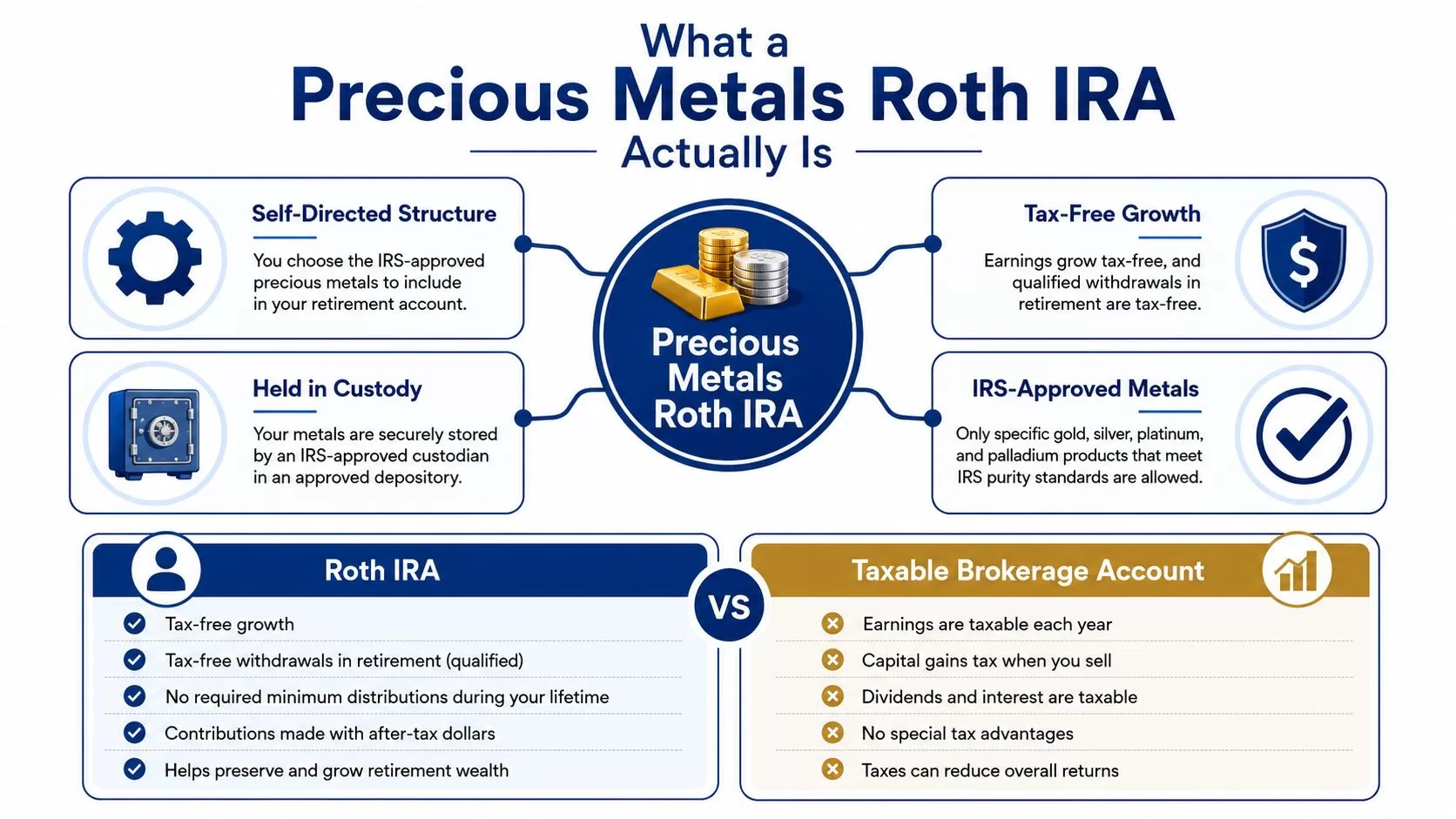
A useful way to picture this account is as a self-directed Roth IRA that can hold certain physical bullion metals under IRS rules. It is not a separate federal account class, it is a Roth IRA structure that expands the list of assets the account may hold while keeping the Roth tax treatment in place. That means after-tax contributions, tax-free qualified withdrawals, and generally no lifetime RMDs for the owner, while the metals must stay with an IRS-approved custodian or depository, not at home. Precious metals IRA basics and market size Roth custody and tax treatment
A practical example helps. Suppose a saver in their 50s wants inflation resistance inside retirement accounts, but also wants the Roth feature that lets qualified withdrawals come out tax-free later. In that setup, the metals are just the investment held inside the account, while the Roth rules govern the tax result.
The Gold IRA Association explains the IRS rules for precious metal IRAs in plain terms, and those rules are the frame that matters here. A precious metals Roth IRA follows the same custody and eligibility requirements as other self-directed precious metals IRAs, while the Roth wrapper controls how contributions and qualified withdrawals are taxed.
The market for physical metals inside self-directed IRAs is still small relative to the broader retirement system. Industry reporting places that niche at about $15 billion to $20 billion in mid-2026 versus roughly $19.2 trillion in total U.S. IRA assets, or about 0.1% of the market. Gold dominates the category, accounting for about 80% of metal value held in these accounts, while silver sits around 15% to 18% and platinum and palladium make up low single digits combined.
Practical rule: if the metal would be handled like personal property, the account is already off track. A compliant precious metals Roth IRA is about custody, storage, and IRS eligibility first.
That distinction matters because readers often ask the wrong first question. The better questions are whether the account can be funded cleanly, which products qualify, and what the all-in cost looks like once storage and administration are included.
Roth Contribution, Income, and Distribution Rules
The Roth rules do not change just because the account holds bullion. For 2024, the annual IRA contribution limit is $6,500 for people under 50 and $7,500 for people age 50 or older, and those limits apply to both traditional and Roth IRAs, including a precious metals Roth IRA. 2024 contribution limits A reader should still verify the current IRS limit before contributing, because retirement limits change over time.
Why the Roth wrapper matters more than the metal
A Roth IRA is funded with after-tax dollars, and qualified withdrawals are generally tax-free. That is the main tax advantage, not the fact that the account holds gold or silver. Roth IRAs also generally do not require lifetime RMDs, which is especially useful for retirees who want to keep a metal position intact instead of being forced to liquidate at a specific age. Roth tax treatment and RMD rule
Readers also get tripped up by income eligibility. Roth IRA contribution eligibility still depends on modified adjusted gross income, just as it does in any other Roth IRA. If income is too high for a direct contribution, a licensed tax professional can explain whether a conversion route fits the household's full tax picture.
The five-year rule still matters. A Roth IRA holding bullion does not escape the normal distribution rules, so tax-free treatment depends on the Roth clock and the owner's age and account history, not just on the metal inside the account.
One practical way to think about this is simple. The IRS sees a precious metals Roth IRA as a Roth IRA first and a storage-and-purity question second. That means retirement planning starts with eligibility, contribution room, and distribution timing, then moves to metal selection.
Readers can review the account structure on Gold IRA Association's precious metal IRA rules guide, then confirm any timing issue with a CPA or tax professional before funding the account.
Which Coins and Bars the IRS Will Accept
The IRS does not accept just any gold or silver item in a Roth IRA. The key technical rule is Internal Revenue Code Section 408(m), and the fineness thresholds are the gatekeeper, gold at 99.5% purity, silver at 99.9%, and platinum and palladium at 99.95%. IRA fineness rules and Section 408(m) That purity screen is why many common bullion products qualify, while jewelry and most collectible coins do not.
The products people usually ask about
Standard bullion tends to fit the compliance mold best because it is uniform, easy to verify, and easier to price at liquidation. Commonly recognized examples include American Gold Eagles, American Gold Buffalos, Canadian Maple Leafs, Austrian Philharmonics, and approved bars from recognized refiners, provided they meet the purity standard and are held correctly. The IRS-approved product list is narrow on purpose, which reduces ambiguity for custodians and depositories.
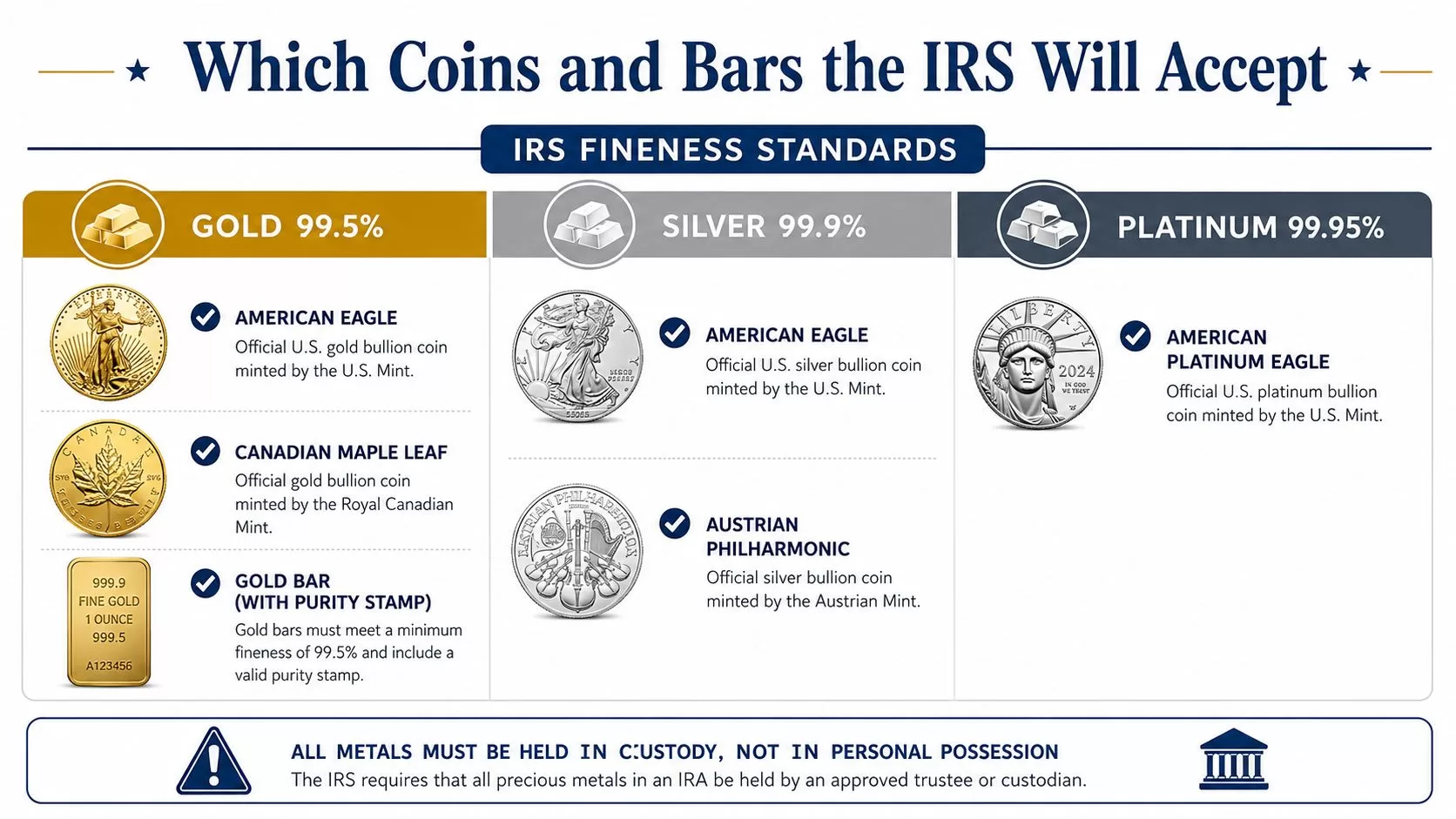
A useful distinction is between bullion and numismatic exposure. Bullion is usually the cleaner fit because pricing is more standardized and resale is generally simpler, while most collectible or rare coins do not qualify for IRA treatment. That matters because a product can look attractive in a dealer's catalog and still fail the IRS test for retirement-account use. Eligibility and purity discussion Eligible gold coin overview
Practical rule: eligibility is necessary, not sufficient. Even an approved coin becomes a problem if it is not held by an approved custodian in an approved depository.
An approved product also has to be sourced and stored correctly. That means the account owner should care just as much about custody as about the coin or bar itself. One misplaced assumption about storage can undo the tax shelter entirely.
Funding the Account Through Rollovers and Transfers
Funding is where many readers accidentally create a tax problem. The cleanest path is usually a trustee-to-trustee transfer or a direct rollover that keeps the money moving between custodians without the owner taking personal possession. That process is especially important when the end goal is a precious metals Roth IRA, because the account must stay inside the retirement system from start to finish.
The three paths that matter
Direct rollover from another Roth IRA.
The new custodian receives the assets directly, so the owner never handles the funds. That is the lowest-friction way to move Roth money.Transfer from a traditional IRA or 401(k) through Roth conversion.
This can work, but the conversion is generally taxable because pre-tax money is being moved into a Roth structure. A licensed tax professional should confirm the household impact before any conversion is signed.Taxable distribution, which should usually be avoided.
If the owner receives the money and later tries to redeposit it, the distribution rules and timing rules can create taxes or penalties if the paperwork slips. Indirect rollovers also carry the familiar 60-day redeposit risk.
The mechanics are straightforward once the account is open. The investor opens a self-directed Roth IRA, names the new custodian as the receiving institution, requests the transfer or rollover, waits for the funds to settle, and then places the metals order. That sequence protects the retirement account from unnecessary tax friction.
Readers who are moving retirement money from an employer plan can review the rollover framework in Gold IRA Association's 401(k) to Gold IRA rollover guide. The right paperwork matters more than speed here.
If a dealer pushes for a fast deposit without explaining whether the move is direct, indirect, or taxable, that is a warning sign. Slow, documented, custodian-led processing is usually safer than rushed account funding.
A good checklist includes the transfer request, beneficiary designation, custodian disclosures, and fee acknowledgments. If any of those documents are vague, incomplete, or rushed, the investor should stop and ask questions before money moves.
Custody, Storage, and the Real Cost Stack
The custody rule is the part that surprises many investors. The IRS requires IRA metals to be held by an approved custodian and stored at an approved depository, which is why home storage can put the account at risk. A precious metals Roth IRA is not a personal safe with tax benefits layered on top, it is a retirement account with strict third-party custody rules.
Segregated versus commingled storage
There are two common storage setups. Segregated storage means the investor's specific bars or coins are kept separate and identified to that account. Commingled storage means identical holdings are stored alongside other investors' metal of the same type.
Practical rule: segregated storage gives more individualized tracking, while commingled storage can be simpler operationally. The account owner should ask the custodian to explain exactly how identification and retrieval work before signing.
The full cost stack usually has several layers, and each one matters over time. The ranges below are typical for self-directed precious-metals IRAs, according to independent coverage of the category. Cost structure overview
| Fee Category | What It Covers | Typical Range |
|---|---|---|
| Setup fee | Opening the self-directed account | $50 to $150 |
| Annual maintenance | Custodian administration and account servicing | $50 to $150 |
| Storage charges | Depository storage and safekeeping | Varies by facility and storage type |
| Dealer spread or commission | Buying and selling the metals | Varies by product and dealer |
These costs are why fee transparency matters. A saver who likes the idea of bullion but ignores the fee stack may end up with a smaller net result than expected, especially if the position stays in the account for many years. The right question is not whether the fee is visible, it is whether the investor can understand the total cost before the first purchase.
Benefits and Risks Worth Weighing Honestly
A Roth structure paired with physical metals can be attractive for a very specific reason. It combines tax-free qualified withdrawals with a tangible asset that some retirees prefer for diversification, and it can also function as an estate-planning vehicle because heirs generally inherit the Roth tax treatment subject to their own distribution rules and holding clocks. That combination has appeal for savers who want a retirement asset that is both physically backed and tax-efficient.
The case for it, and the case against it
The benefit side is easy to understand. A metal position inside a Roth IRA can sit alongside stocks and bonds without creating a taxable event each time the market moves, and that can simplify long-term planning. For households that already have a diversified core, a modest allocation to bullion may provide an additional balancing element.
The risk side deserves equal space. Precious metals IRAs usually carry more fee drag than low-cost exchange-traded funds, and the account can be less liquid when a retiree needs cash quickly. There is also no yield, so the position does not throw off interest or dividends, and the investor still depends on the dealer and depository to execute properly even when the metal is allocated.
Gold and silver can move sharply in both directions. They can be part of a retirement plan, but they are not a substitute for a full plan.
That is why a precious metals Roth IRA works best as a slice of a diversified retirement portfolio, not as the whole thing. The category can make sense for people who value tangibility and tax-free growth, but it does not remove market risk, liquidity risk, or storage friction.
A final point matters for heirs. Beneficiaries may appreciate the Roth structure, but they still inherit a retirement account with rules, not a free-for-all vault. That is why an estate plan should match the account setup, not assume the metal itself solves every succession issue.
Choosing a Reputable Custodian and Dealer
The safest approach is to separate the roles in your mind. The custodian holds and administers the account, while the dealer sources and prices the metals. Those are two different counterparty relationships, and both need to be vetted with the same seriousness a retiree would use for any long-term financial commitment.
A practical vetting checklist
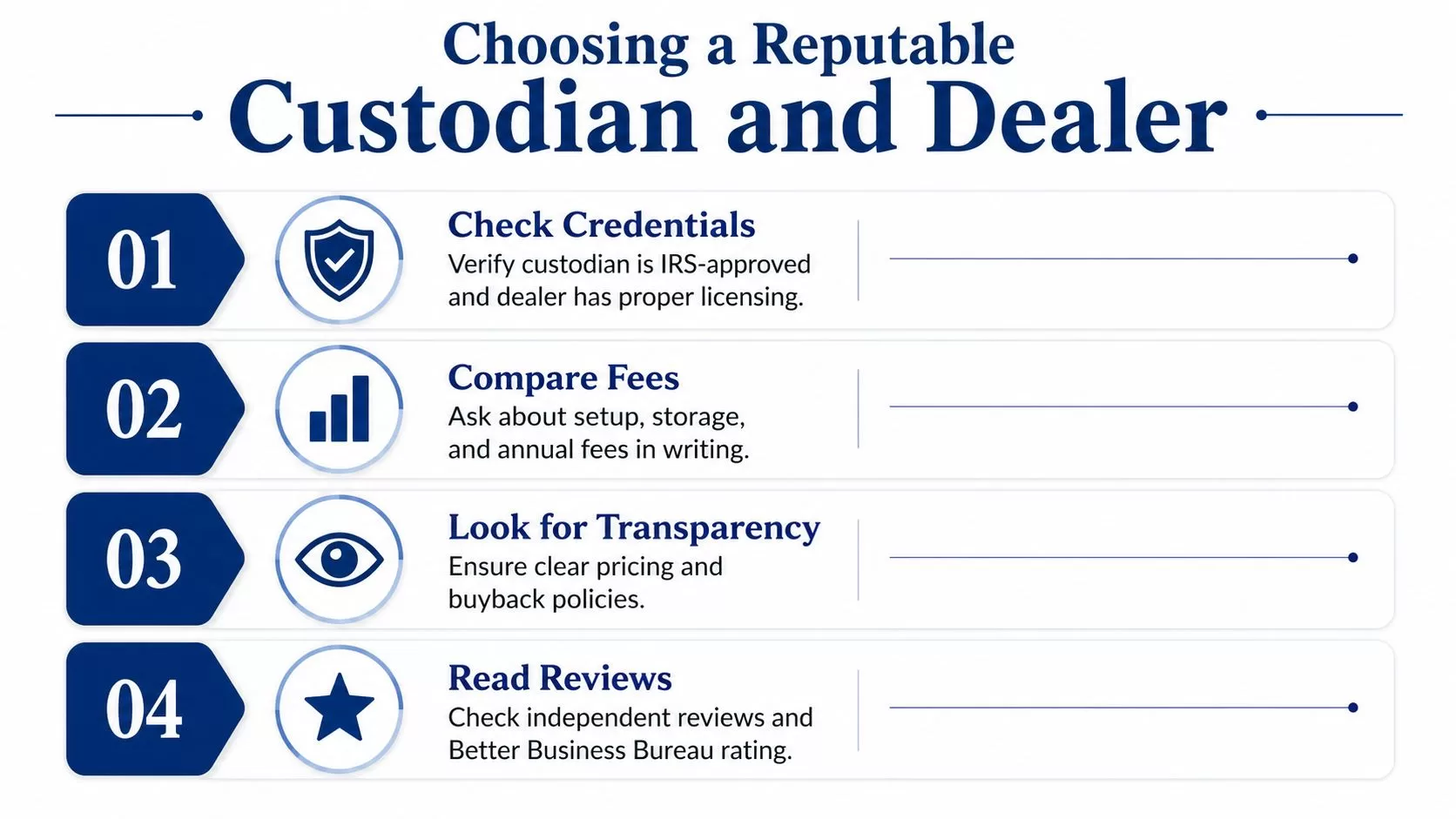
- Check credentials. Verify that the custodian is set up to handle self-directed IRAs and that the depository is IRS-approved.
- Compare fees in writing. Ask for setup, annual administration, storage, and transaction charges before any account is opened.
- Look for transparency. The provider should explain pricing, buyback terms, and storage choices in plain English.
- Read independent reviews. Balanced editorial coverage is more useful than glossy marketing material when service quality matters.
Vague answers are a red flag. If a representative cannot explain how the account is funded, how the metal is stored, or what happens on liquidation, the investor should slow down. Pressure to sign quickly is also a warning sign, especially when the fee schedule is missing or hard to understand.
The best providers make it easy to see where the money goes and who is responsible at each step. Brand recognition alone does not tell a retiree whether the account is compliant, fairly priced, or easy to unwind later.
Key Takeaways and Your Next Step
A precious metals Roth IRA is best treated as a Roth IRA with a specialized asset menu, not as a separate tax category. That means the most important decisions are still the ordinary Roth decisions, whether the account is eligible, whether the contribution room exists, whether the funding path is clean, and whether the metals meet IRS purity rules. After that, the primary judgment call is cost, custody, and whether the position fits inside a larger retirement plan.
A short checklist keeps the process grounded.
- Confirm Roth eligibility and contribution room.
- Choose only IRS-eligible metals.
- Use a direct transfer or trustee-to-trustee move whenever possible.
- Understand whether storage is segregated or commingled.
- Read the full fee schedule before signing anything.
The broader lesson is simple. This niche can help with diversification, but it still carries administration costs, storage rules, and liquidity tradeoffs. A retiree should think of it as a measured allocation choice, not a replacement for a complete retirement strategy.
Gold IRA Association publishes plain-English guides that help readers sort out Roth rules, eligible metals, rollover steps, and fee questions before they speak with a provider. If this topic is on your mind, visit Gold IRA Association to compare educational resources, review provider guidance, and take the next step with a clearer understanding of the rules. This is not financial advice. Consult a licensed financial advisor, CPA, or tax professional before making investment decisions.