



Tax compliance consumed 3.21 billion hours for individual taxpayers in tax year 2000, according to IRS Publication 5743, which estimated 125.9 million individual taxpayers spent that time and $18.8 billion complying with federal individual income tax requirements. A Gold IRA doesn't remove that burden. It changes where mistakes happen, from paying a bill to proving eligibility, custody, rollovers, and distributions were handled correctly.
What Tax Compliance Means for a Gold IRA
Owing tax and being compliant aren't the same thing. A taxpayer can owe nothing on a rollover and still create a penalty by missing a deadline, holding metal personally, or reporting the transaction incorrectly.
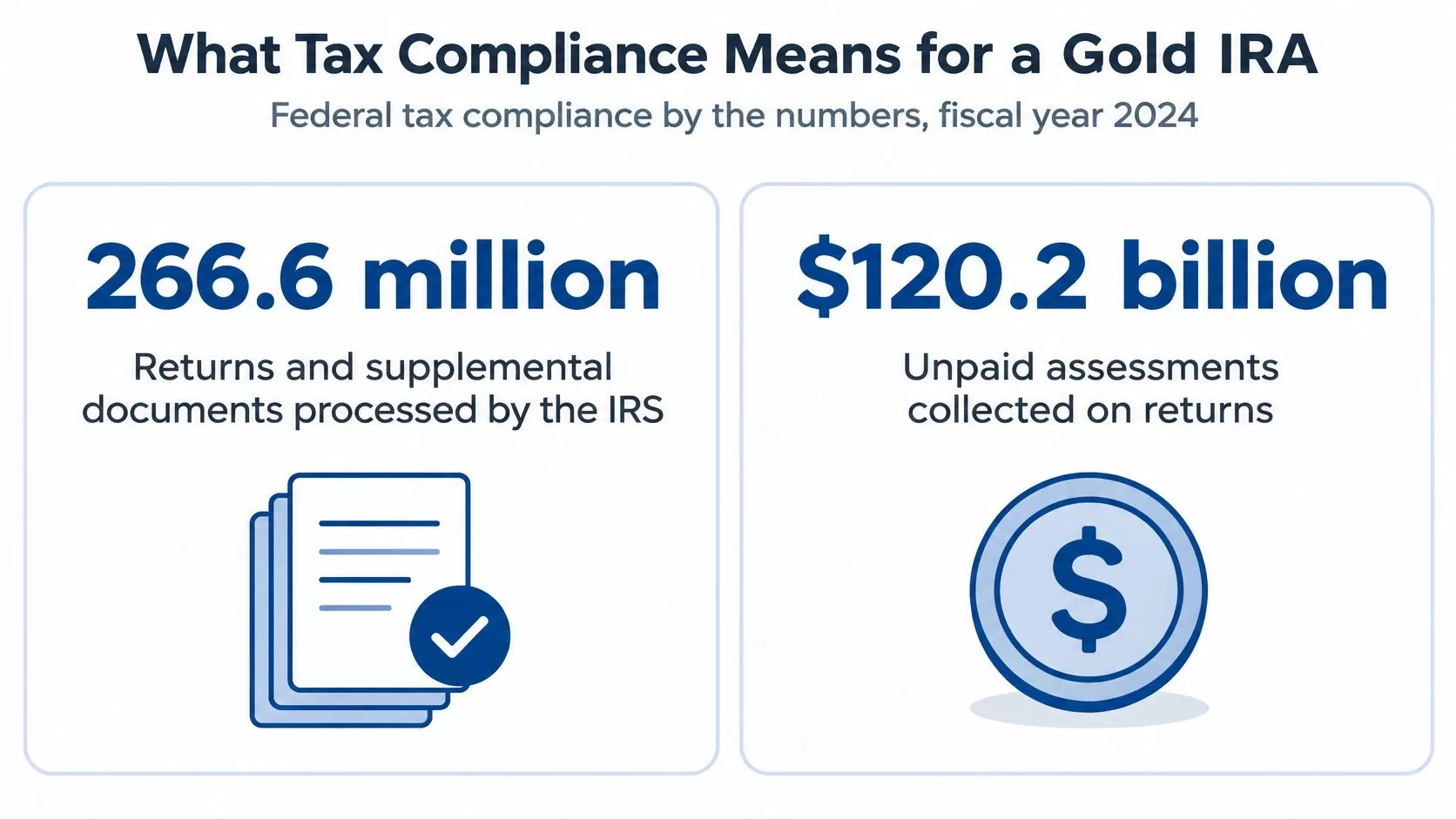
The scale explains why records matter. The IRS fiscal year 2024 data book on collections, penalties, and appeals reports the IRS processed more than 266.6 million federal tax returns and supplemental documents in fiscal year 2024. It collected $120.2 billion in unpaid assessments on returns filed with additional tax due and assessed $84.1 billion in civil penalties that year.
For a Gold IRA, tax compliance requirements cover the metal, the account, and the paperwork. Readers who fall behind on filing or payment can review general guidance on restoring compliance with the IRS from Omni Tax Help, then apply the IRA-specific rules below with a qualified tax professional.
Core Tax Compliance Requirements for a Gold IRA
| Requirement | What the Rule Covers | Primary Responsibility |
|---|---|---|
| Eligible metal | Must meet IRS fineness and product standards | Custodian verifies, investor selects eligible products |
| Custody | Metals held by an IRS-approved trustee or depository, not at home | Custodian and depository |
| Transaction path | Purchases made through the IRA, not personally | Investor and custodian |
| Prohibited transactions | No personal use, borrowing or pledging of IRA assets | Investor |
| Rollover execution | Direct transfer preferred; 60-day deadline for indirect rollovers | Investor with both custodians |
| Annual reporting | Forms 1099-R and 5498 issued and reconciled | Custodians issue; investor reconciles |
| Required minimum distributions | Withdrawals from traditional IRAs at the applicable age | Investor, with custodian calculation support |
The division of labor is simple. The custodian checks eligibility, executes purchases, arranges storage, and issues forms. The investor controls personal use, timing, and whether the forms match before filing.
A tax-advantaged account doesn't eliminate reporting. It makes accurate reporting the condition for keeping the tax treatment.
IRS Purity Standards for Gold and Silver IRAs
An IRA cannot hold just any metal an investor finds appealing. Federal law sets fineness minimums and names specific approved products, so rarity or design alone never qualifies a coin.
Under 26 U.S.C. § 408, gold must be at least 0.995 fine, silver at least 0.999, and platinum or palladium at least 0.9995, with certain coins named as statutory exceptions. Fineness measures purity in parts per thousand: a 0.999 silver coin contains at least 999 parts silver per 1,000. Each threshold works like a minimum grade the metal must hit before the IRA is allowed to buy it.
IRA-Eligible Fineness Thresholds and Example Products
| Metal | Example Eligible Products |
|---|---|
| Gold | American Gold Eagle (22-karat exception), Canadian Gold Maple Leaf, approved gold bars |
| Silver | American Silver Eagle, Canadian Silver Maple Leaf, approved silver bars |
| Platinum | American Platinum Eagle, Canadian Platinum Maple Leaf |
| Palladium | American Palladium Eagle, Canadian Palladium Maple Leaf |
The American Gold Eagle causes the most confusion. 31 U.S.C. § 5112 specifies it as a 22-karat coin at 0.9167 fineness, below the general gold threshold, yet it is IRA-eligible because the law names it expressly. Don't reject it for failing a test it was specifically excepted from, and don't assume other 22-karat coins receive the same treatment.
Bars clear a different gate. A bar must meet the fineness threshold and come from a recognized, approved refiner. Weight and hallmark alone prove nothing, which is why custodians publish approved product lists for investors to check.
- Coins: Match the exact coin, year type where relevant, and metal against the custodian list.
- Bars: Confirm fineness, refiner, and bar size before the IRA buys.
- Proof and collectible versions: A proof, graded, or limited-edition coin does not automatically qualify because its bullion counterpart does.
Confirm eligibility against current rules and the custodian's approved list before the purchase clears. Buying first and asking later reverses the safe order.
Prohibited Transactions and Personal Use Rules
One personal-use mistake can affect the whole account, not just one coin. That's the risk readers underestimate when a home storage pitch sounds convenient.
The IRS retirement plan investments FAQs explain that an IRA owner may not borrow from the account, pledge it as loan collateral, buy property for personal use, or use IRA assets for the benefit of a disqualified person. A prohibited transaction can cause the entire IRA to cease qualifying as an IRA as of the first day of that tax year, with assets treated as distributed at fair market value and amounts exceeding basis potentially becoming taxable income.

Permitted and Prohibited Actions
- Custodian buys and holds metal in an approved depository: Permitted, because the IRA owns the asset and the custodian controls custody.
- Storing coins at home or in a personal safe: Prohibited in practice, because personal possession breaks the custody separation.
- Displaying or wearing IRA-owned coins: Prohibited, because that's personal use of plan assets.
- Pledging metals for a loan: Prohibited, because the IRA is being used as collateral.
- Buying metal personally, then transferring it into the IRA: Generally avoided, because it can look like personal use or self-dealing.
- Buying from a family member or the owner's own business: Generally prohibited, because the seller may be a disqualified person. Readers can review the self-directed IRA disqualified person rules before any related-party transaction.
Say an investor takes one coin home for a weekend photo, then returns it. The short duration doesn't fix the problem. Personal use occurred while the IRA owned the coin.
Operational controls reduce that risk. Retain product specifications, invoices, custody records, and valuation evidence. Route every purchase, sale, and transfer through the IRA, never through a personal account.
How to Complete a Rollover Without Triggering Taxes
The safest rollover is the one where cash never reaches the owner. A direct rollover keeps the money between custodians, while an indirect rollover can work but adds withholding and a hard deadline.
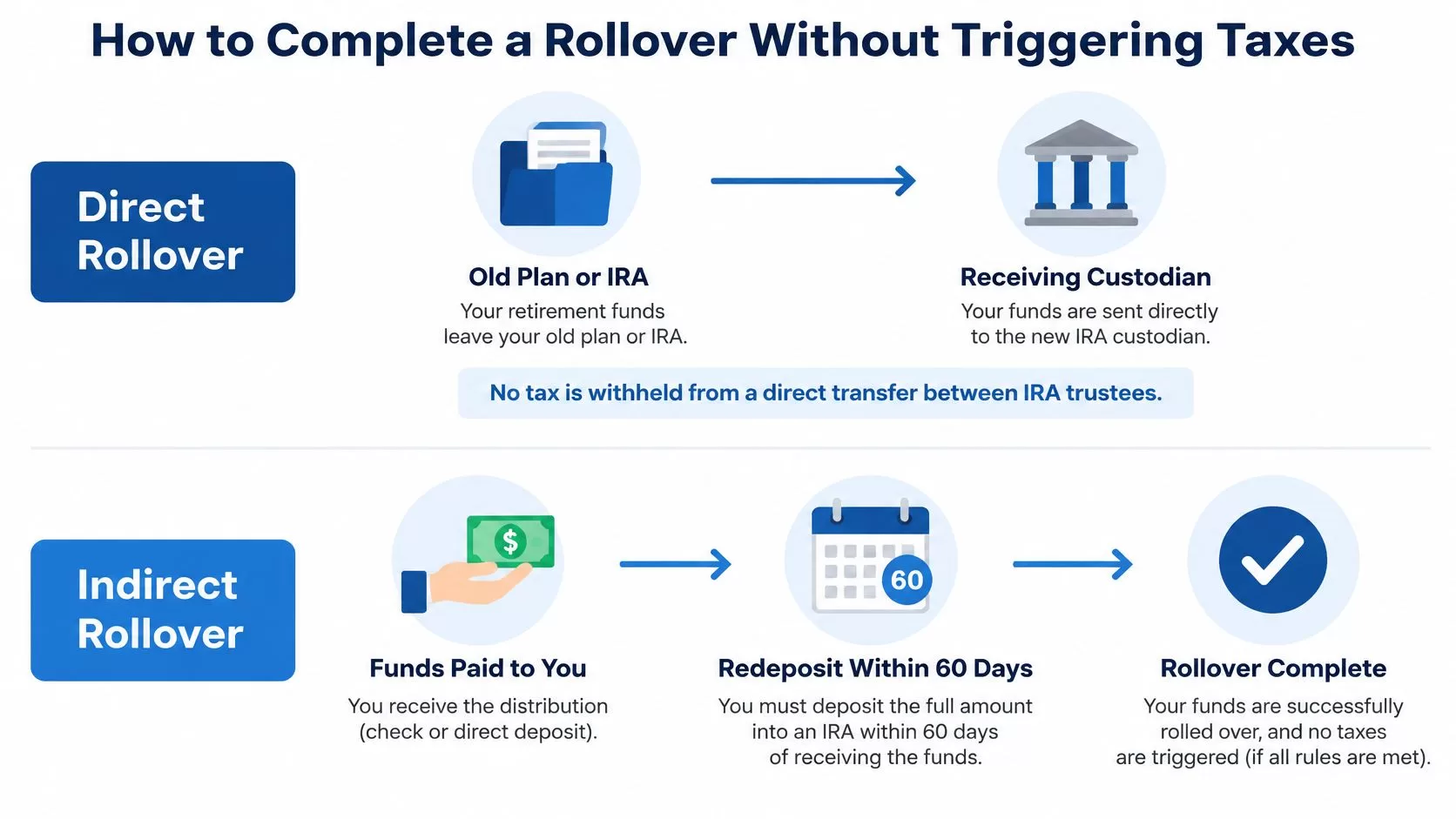
When an eligible rollover distribution is paid to the account owner, IRS Publication 590-A says the payer generally withholds 20% of the taxable portion, and the recipient has 60 days to deposit the distribution into the receiving account. A trustee-to-trustee payment avoids that withholding because the funds are made payable to the new custodian rather than to the person.
Withholding works like a security deposit that never comes back unless the owner replaces it. If $100 is distributed and $20 is withheld, the owner receives $80 but still must deposit the full $100 within 60 days. Depositing only $80 leaves $20 outside the rollover, and that $20 becomes taxable when the deadline passes. The owner needs other cash on hand to make the rollover whole.
Direct Rollover Procedure
- Request a direct trustee-to-trustee transfer from the former plan administrator, so funds are not paid personally.
- Confirm payee wording so the check or wire is payable to the new custodian for the benefit of the account owner.
- Open the receiving IRA first and select eligible metals only after the custodian can receive funds.
- Keep the transfer confirmation and purchase invoice together, because they prove timing and ownership.
- Compare the next Form 1099-R and Form 5498 against the confirmation before filing.
The video below walks through the rollover timing issue in visual form.
Readers comparing outcomes can review IRA rollover taxes before choosing a method. The main risk usually sits in timing and amount, not in the metal itself.
Which Forms Report Your Gold IRA Activity
A successful rollover can still generate a form showing a distribution. That surprises readers who expect no paperwork when no tax is due, but the distributing custodian must still report money leaving the old account. The reporting trail has three checkpoints: the payer reports what left, the receiving custodian reports what arrived, and the return classifies the result.
The IRS instructions for Form 1099-R state that a direct rollover is reported by the distributing payer in Form 1099-R box 1 with zero in box 2a in the ordinary case. The receiving custodian's Form 5498 records rollover contributions, and excess IRA contributions can trigger a 6% excise tax reported through Form 5329.
Tax Forms for Gold IRA Rollovers and Distributions
| Form | Issued or Filed By | What It Reports | What to Check |
|---|---|---|---|
| Form 1099-R | Distributing plan or IRA custodian | Distributions, including direct rollovers | Box 2a taxable amount is zero for a direct rollover; distribution code is correct |
| Form 5498 | Receiving IRA custodian | Rollover contributions and year-end fair market value | Rollover amount matches the transfer confirmation |
| Form 1040 | Taxpayer | Traditional IRA distributions and rollovers (lines 4a and 4b) | Taxable amount on line 4b matches the 1099-R |
| Form 8606 | Taxpayer | Nondeductible (after-tax) IRA basis | Filed when after-tax basis exists in any traditional IRA |
| Form 5329 | Taxpayer | Additional taxes, such as excess contributions or an RMD shortfall | Filed only when an additional tax applies |
Form 1040 is where the taxpayer classifies the event. Line 4a shows the total distribution, and line 4b shows the taxable amount, which may be zero for a qualifying rollover. Physical metal does not change that logic: the forms track dollars and classification, not a coin-by-coin inventory. A taxable amount or distribution code that does not fit a direct rollover is a correction item before filing. Readers who want a form-focused walkthrough can see the IRA rollover tax form guide.
A correct 1099-R should not be erased because a rollover succeeded. The form reports the distribution side. The return, supported by Form 5498, reports the rollover side.
How to Reconcile Forms and Keep Compliant Records
A rollover is complete for tax purposes only when the return classifies it correctly and every amount ties across documents. "Ties across" has a specific meaning here: the gross distribution on Form 1099-R, the rollover contribution on Form 5498, and the amount on the transfer confirmation should all agree to the dollar.
IRS Publication 590-A on IRA contributions and rollovers requires a traditional IRA rollover to be reported on Form 1040 even when it is nontaxable, and treats amounts that leave the account without being rolled over as taxable distributions that can carry the 10% additional tax on early withdrawals. On the return itself, the distribution goes on line 4a and the taxable amount on line 4b, which reads zero for a qualifying rollover.
Reconciliation Procedure
- Collect transfer confirmations from the former plan and the receiving custodian, including dates and gross amounts.
- Match Form 1099-R to the confirmation, checking gross distribution, taxable amount, withholding, and distribution code.
- Match Form 5498 to the account statement, checking the rollover contribution amount and year-end fair market value.
- Enter the result on Form 1040 lines 4a and 4b, so a nontaxable rollover is still visible and classified.
- Add Form 8606 when after-tax basis exists, because basis changes how much of a later distribution is taxable.
Practical rule: If the 1099-R, the 5498, and the transfer confirmation don't agree to the dollar, resolve the difference before filing, not after a notice arrives.
Keep a permanent file for each account. Include purchase invoices showing metal type, weight, and fineness, custodian and depository statements, storage receipts, and year-end valuation evidence. Add transfer confirmations and copies of every tax form issued or filed.
Three parties hold parts of the trail. The former administrator knows what left, the receiving custodian knows what arrived, and the taxpayer files the return that connects them. Personal copies matter because no single party holds the whole record, and a complete file is what lets a custodian correct a wrong form or lets a CPA work from documents rather than memory.
Taking Required Minimum Distributions From Physical Metals
An RMD can't be rolled into a Gold IRA to postpone tax. That single rule drives the sequencing for older account owners, and it's easy to miss when rollovers are described as broadly tax-free.
IRS Publication 590-A guidance states an RMD for a particular year is not eligible for rollover treatment, and attempting to roll it over can make the amount subject to excess contribution rules. For traditional IRA owners, RMDs generally begin by April 1 of the year after reaching age 73. The 2025 Form 5329 instructions describe an additional tax of 25% of the shortfall, potentially reduced to 10% when correction requirements are met.

Timing needs care in the first year. Delaying the first RMD until April 1 leaves the next RMD due by December 31 of that same year, so two taxable distributions can land in one tax year. Under IRS required minimum distribution rules, the starting age is 73 for many owners and 75 for those born in 1960 or later. Confirm which beginning age the custodian is using before year-end.
The calculation starts with the prior December 31 account balance divided by the applicable life expectancy divisor from IRS tables. An RMD works like a minimum invoice: the IRS specifies the dollars that must leave, and the account decides which asset pays the bill. Physical metal doesn't change the required dollar amount. It changes how the account produces cash or title.
RMD Sequencing for a Metals IRA
- Calculate the RMD for each traditional IRA using the prior year-end balance and the correct divisor.
- Take the required amount first, in cash or in kind, before any rollover is considered.
- Evaluate a rollover only for remaining eligible funds, after the RMD has left the account.
The deadline is the hard part.
An in-kind distribution means metal itself is distributed to the owner. It's taxable based on fair market value, and the owner then holds the metal personally outside the IRA. A cash distribution may require the IRA to sell metal first, which takes time and depends on dealer and custodian processing. For an in-kind payout, confirm how the depository retitles the bars and which date sets fair market value. For cash, ask for the sale cutoff and settlement date.
Liquidity planning should start early in the year. Decide which coins or bars would be sold or distributed, confirm valuation procedures, and leave time for settlement before December 31. Waiting until December turns a routine calculation into a forced sale problem.
Confirm Your Custodian and Tax Advisor Before Acting
Compliance holds together only when eligible metals, approved custody, clean rollover execution, accurate reporting, and timely RMDs all line up. Two short conversations can verify most of it before money moves.
Questions for the Custodian
- Eligible products: Which exact coins and bars are on the IRA-eligible list?
- Custody: Who holds the metal, at which depository, and how is ownership recorded?
- Rollover execution: How is a direct rollover requested, addressed, and confirmed?
- Forms: Which forms will be issued, and when will they arrive?
Questions for a CPA or Tax Professional
- Reporting: How should a specific rollover appear on Form 1040?
- RMD sequencing: How should required amounts be taken across multiple traditional IRAs?
- Basis: Does any after-tax basis require Form 8606?
This is not financial advice. Consult a licensed financial advisor, CPA, or tax professional before making investment decisions, because rules vary by individual circumstances. Readers who want a low-pressure next step can talk to a Gold IRA specialist at 888-910-8386 or compare top Gold IRA companies, keeping the final choice with the reader.
Gold IRA Association offers plain-language guides on Gold IRA rules, rollover reporting, eligible metals, and provider comparisons for retirees working through these tax compliance requirements. Readers can use those resources to prepare better questions for a custodian and CPA before any funds move. Visit Gold IRA Association to continue researching at a comfortable pace.