


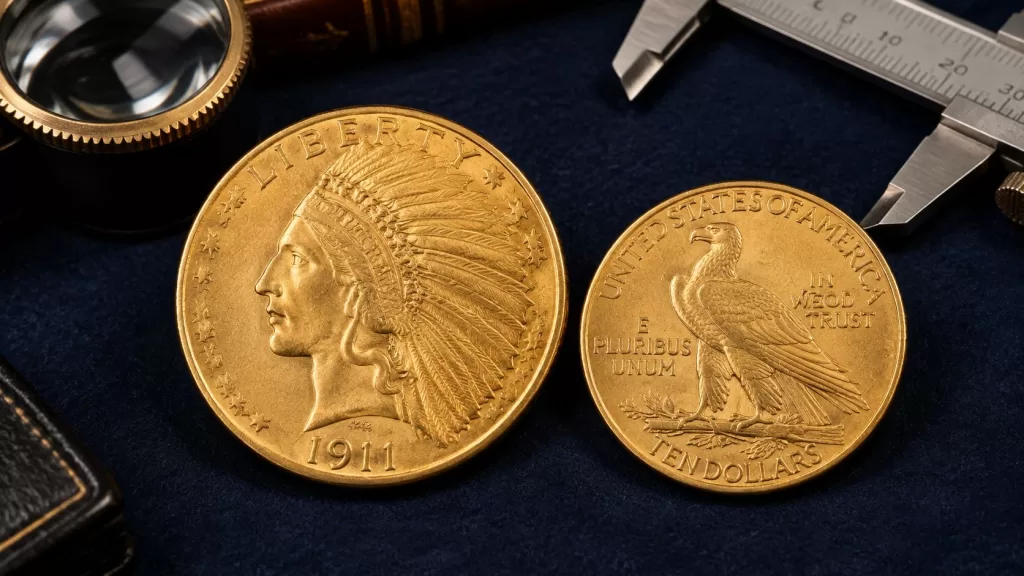
The most common shortcut for valuing a $10 Indian Head gold coin is to look up its gold content and stop there. That misses the coin's date, mint, condition, and collector appeal, and it can lead to a costly mistake if someone assumes that a historic gold coin automatically belongs in a retirement account. The right first step is to identify the coin, then separate its metal value from its collectible value and consider any IRA rules independently.
What the Indian Head Eagle Is
Roosevelt wanted American coins to look like art, not just money. That push led to the $10 Indian Head eagle, struck from 1907 through 1933, with Liberty in a feathered headdress on the front and a standing eagle on the back. Sculptor Augustus Saint-Gaudens supplied the design, and the Indian Head eagle's history and specifications place it among the most recognizable U.S. gold coins.
The $10 stamped on the coin is the denomination assigned at issue.
Production started steadily, then turned irregular after 1916. No coins in this series carry the dates 1917, 1918, or 1919. Identifying an example starts with its date, mint mark, and design type, then condition. The same date can appear in more than one variety, and small differences in preservation change how collectors judge it.
An inherited coin often creates the same first question. What exactly is sitting in the holder or drawer? Record the date and the mint mark on the reverse near TEN DOLLARS, confirm the Liberty headdress and standing eagle match the series, and note wear, marks, and color before looking at any sale results.
Weight Fineness and Gold Content
Think of the specification list as an identity card for the series. Each Indian Head eagle was built to the same federal standard, so a coin that falls clearly outside these figures deserves closer inspection for wear, damage, or a copy.
| Spec | Standard figure | How to use it |
|---|---|---|
| Face value | $10 | Historical denomination, not the market price |
| Years of issue | 1907–1933 | Defines the full series range |
| Designer | Augustus Saint-Gaudens | Names the originator of the design |
| Fineness | 90% gold, 10% copper PCGS specifications for a 1910 Indian Head eagle | Identifies the alloy used for eagles |
| Gross weight | 16.70–16.718 g PCGS specifications for a 1910 Indian Head eagle | Weigh uncleaned coin on a gram scale |
| Pure gold | 0.48375 troy oz, about 15.05 g PCGS specifications for a 1910 Indian Head eagle | Input for the melt calculation below |
| Diameter | 26.80–27.0 mm PCGS specifications for a 1910 Indian Head eagle | Measure with calipers across the rim |
| Mint mark | None, D, or S | Records the three issuing mints |
The copper portion gave circulating eagles added hardness. It also means surface friction still shows. Collectors discount for rub, scratches, and rim contacts even when the gold content remains intact.
To estimate the melt component, multiply 0.48375 by the current spot price per troy ounce.
Example: 0.48375 x spot price = melt component. A $2,400 spot price produces a melt component near $1,161. The result tracks metal only.
Collector value sits above that line when date, preservation, and demand support a premium. A refresher on why gold uses troy ounces instead of regular ounces helps explain why the math uses 0.48375 rather than a kitchen scale ounce.
Practical rule: Use weight with diameter and edge together. One matching number never settles identity on its own.
Design Varieties and Mint Marks
Hold the coin on its side under a loupe and read the edge first. That narrow rim sorts early 1907 strikings from everything that followed. Early 1907 issues include both Wire Rim and Rolled Edge varieties, while later regular coins use a raised-star edge, as documented in the PCGS reference for the 1907 Wire Rim variety.
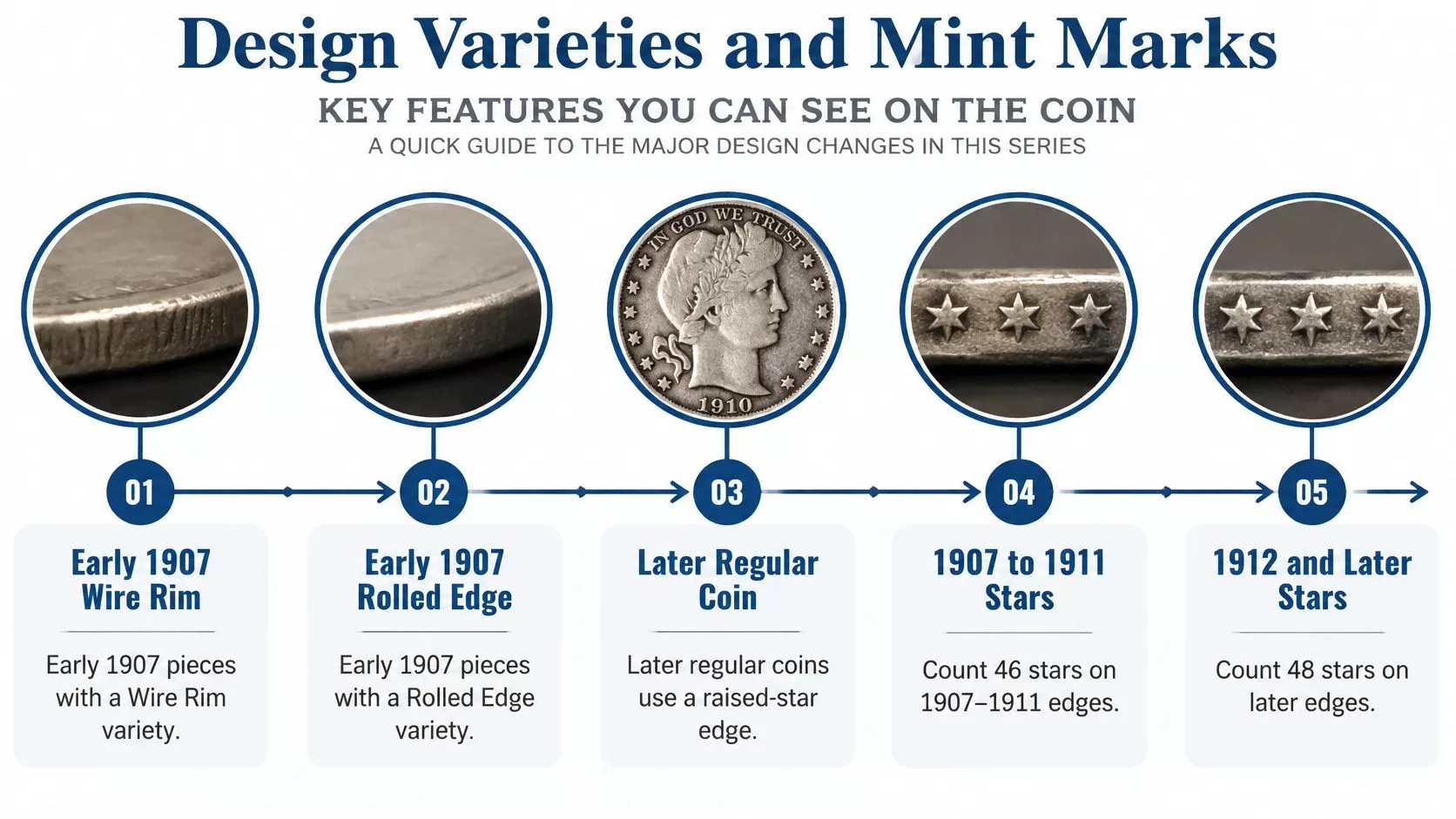
Count the stars when the edge is the raised-star type. Coins dated 1907 through 1911 show 46 stars on the edge, and issues dated 1912 through 1933 show 48 stars on the edge, according to the PCGS reference for the 1907 Wire Rim variety. The change follows statehood, so write the star total next to the date in your notes.
The obverse shows Liberty in a feathered headdress. On the reverse, an eagle stands on arrows and an olive branch. The design is incuse, which means fields and lettering sit below the surface instead of rising above it, like an engraving pressed inward. That construction collects friction differently, so bright luster can hide rub on the high points of the headdress or the eagle's feathers. Judge wear, contact marks, and surface quality together.
The 1908 motto split
The year 1908 has both “No Motto” and “In God We Trust” versions. A date alone does not fully identify the type. Check whether the reverse motto is present and record it with the date, edge type, mint mark such as the 1908-S, and surface preservation. The mint mark sits on the reverse, to the left of TEN DOLLARS.
A certified coin can be easier to evaluate because an established grading service has assessed its condition and authenticity. Strike quality, surface marks, and eye appeal still matter for how collectors view it.
Mintage Tiers and Key Dates
Production totals set the starting point for rarity. A low output Denver issue and a high output late Philadelphia issue show how wide that range runs within one series.
The Denver Mint struck a small business strike run of the 1911-D, the lowest business strike total in the series, while Philadelphia struck a very large run of coins dated 1932, the highest total in the series, according to the PCGS account of Indian Head eagle mintage history. That gap explains why collectors treat one as a key date and the other as the most available date for type purposes.
| Issue | Mint | Reported mintage | Scarcity note |
|---|---|---|---|
| 1911-D | Denver | 30,100 | Lowest business-strike mintage in the series |
| 1908-S | San Francisco | Low five-figure branch-mint issue | Low branch-mint issue |
| 1932 | Philadelphia | 4,463,000 | Highest mintage in the series |
| 1907 Wire Rim and Rolled Edge | Philadelphia | Special early varieties | Edge type, not a normal business-strike comparison |
Mintage counts production. It does not count survival. Melts, government storage, and later handling reduced some issues well below their struck totals. A coin with a larger original mintage can still be difficult to find with clean surfaces and sharp detail, while a lower mintage issue sometimes survived in larger relative numbers.
The 1920-S illustrates that gap. Much of its production was melted at the Mint or otherwise failed to enter broad circulation, so surviving examples are scarce relative to the original output. Its original mintage alone cannot tell a buyer how many suitable coins remain.
Early 1907 Wire Rim and Rolled Edge pieces belong in a separate category. Collectors value them by edge type and early production method rather than by ordinary business strike comparisons. Before comparing any price, sort the coin into one group: special variety, key date, or available issue. Readers who want a separate starting point for organizing a coin search can check coin values with ScanFlip AI, then verify any candidate against its specific date, mint, condition, and type.
For a retirement minded buyer, gold content provides a metal value reference. Mint, date, preservation, and collector interest shape any price above that reference. Each tier carries a different scarcity premium.
How to Spot Common Counterfeits
Counterfeits of the Indian Head eagle often fail on small details that a patient side by side comparison will show. Work through the coin in the same order each time, before buying, selling, or sending it for professional evaluation.
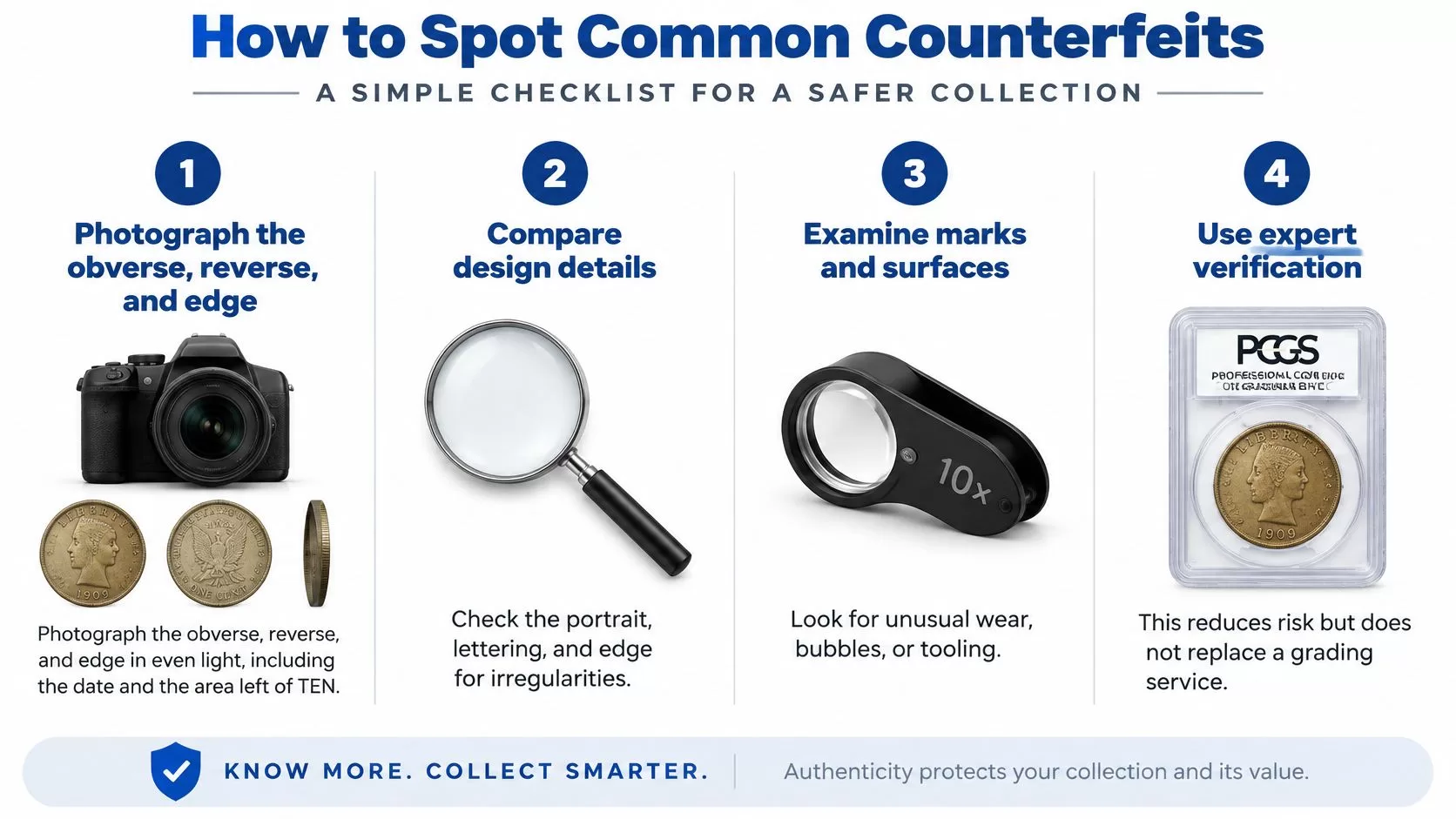
Photograph all sides. Use even light to capture the obverse, reverse, and full edge. Take clear close-ups of the date and the reverse area left of TEN DOLLARS, where the mint mark appears.
Record weight and diameter together. Use a scale that reads to hundredths of a gram and calipers for diameter. Log both figures with the date and mint from the coin.
Inspect lettering, portrait, stars, and edge in hand. The design is incuse, with details cut into the surface rather than raised. Letters and numerals should have clean, even edges with no blobs, doubling, softness, or tool marks. Liberty's portrait should show clear hair strands and headdress feathers. Stars should be uniform in size, spacing, and sharpness. Turn the coin slowly and check the full edge for a continuous finish, with no seam, filed area, or abrupt change in texture.
Confirm the date fits the series. Indian Head eagles were not issued for circulation with dates of 1917, 1918, or 1919. If you see one of those dates, stop the transaction and place the coin aside for grading-service authentication.
Verify a certification holder. If the coin is in a grading-service holder, look up its certification number directly on that service's own site. Confirm the date, mint, grade, and any available photographs match the coin in hand.
Compare ways to sell. If selling, obtain at least two independent offers. Compare an outright sale with auction consignment after fees, shipping, insurance, and any applicable tax, especially if the transaction crosses national borders.
Common concerns include added mint marks, altered dates, cleaned surfaces, and base-metal copies. A key date offered at an unusually low price is a reason to pause and seek expert review. A genuine common-date coin can also be a poor purchase if its premium over melt is high and it may be difficult to resell. For very rare dates such as 1933, ownership questions should go to a specialist rather than be handled as an ordinary coin purchase.
Prices by Grade and Sale Venue
One catalog figure cannot price every Indian Head eagle because date, grade, certification and venue all move the result. Reported sales for 1926 coins graded around MS62 were about $1,550 to $1,822 in early 2025 (1926 sale examples), while later reported MS63 examples brought about $2,301 to $2,700. For 1910-D coins, reported sales during 2025–2026 ranged from about $1,540 for an MS62 to about $2,795 for an AU58 example with CAC approval (1910-D sale examples). These are past reported sales, not current bids or guarantees of what a similar coin would sell for, and they show how grade, approval and marketability can influence reported prices.
| Example | Grade or note | Reported range | What it shows |
|---|---|---|---|
| 1926 | Around MS62 | About $1,550–$1,822 in early 2025 | A common-date certified coin can carry a premium |
| 1926 | MS63 | About $2,301–$2,700 | A one-grade difference can accompany a large dollar gap |
| 1910-D | MS62 | About $1,540 in 2025–2026 | Branch-mint gold isn't priced by spot alone |
| 1910-D | AU58 with CAC | About $2,795 | Approval and marketability can outweigh a higher numeric grade |
Think through the grades in plain terms. Mint State means no wear from circulation, although contact marks still affect value based on number and placement. About Uncirculated means slight wear is present.
Certification and eye appeal sit beside the number. A higher numeric grade does not always bring a higher offer than every lower-graded coin, as the 1910-D pair shows. Price guides have a narrow use. PCGS guide figures apply to PCGS-graded coins, so those figures do not transfer directly to a raw, cleaned, damaged or altered coin. Compare the exact date, mint, grade, certification and appearance, not only the denomination.
Sale venue changes the net outcome. A dealer outright offer gives a direct sale. Auction consignment can broaden bidding but adds fees, shipping and insurance before proceeds reach the seller. Private buyers, dealers and auction audiences may price the same coin differently. Buyers outside the United States should add shipping, insurance and any applicable tax when comparing options. Gold prices and collector demand shift over time. For a broader framework on the factors behind gold-coin pricing, see Gold IRA Association's guide to how much an American Eagle gold coin is worth.
Collectible Coins Versus Gold IRA Bullion
A $10 Indian Head eagle holds real gold, yet that metal alone does not make it an IRA holding. Collector demand for date, mint mark, grade, strike, and originality often drives its price far above melt. That split is what separates a historic coin from bullion made for retirement accounts.
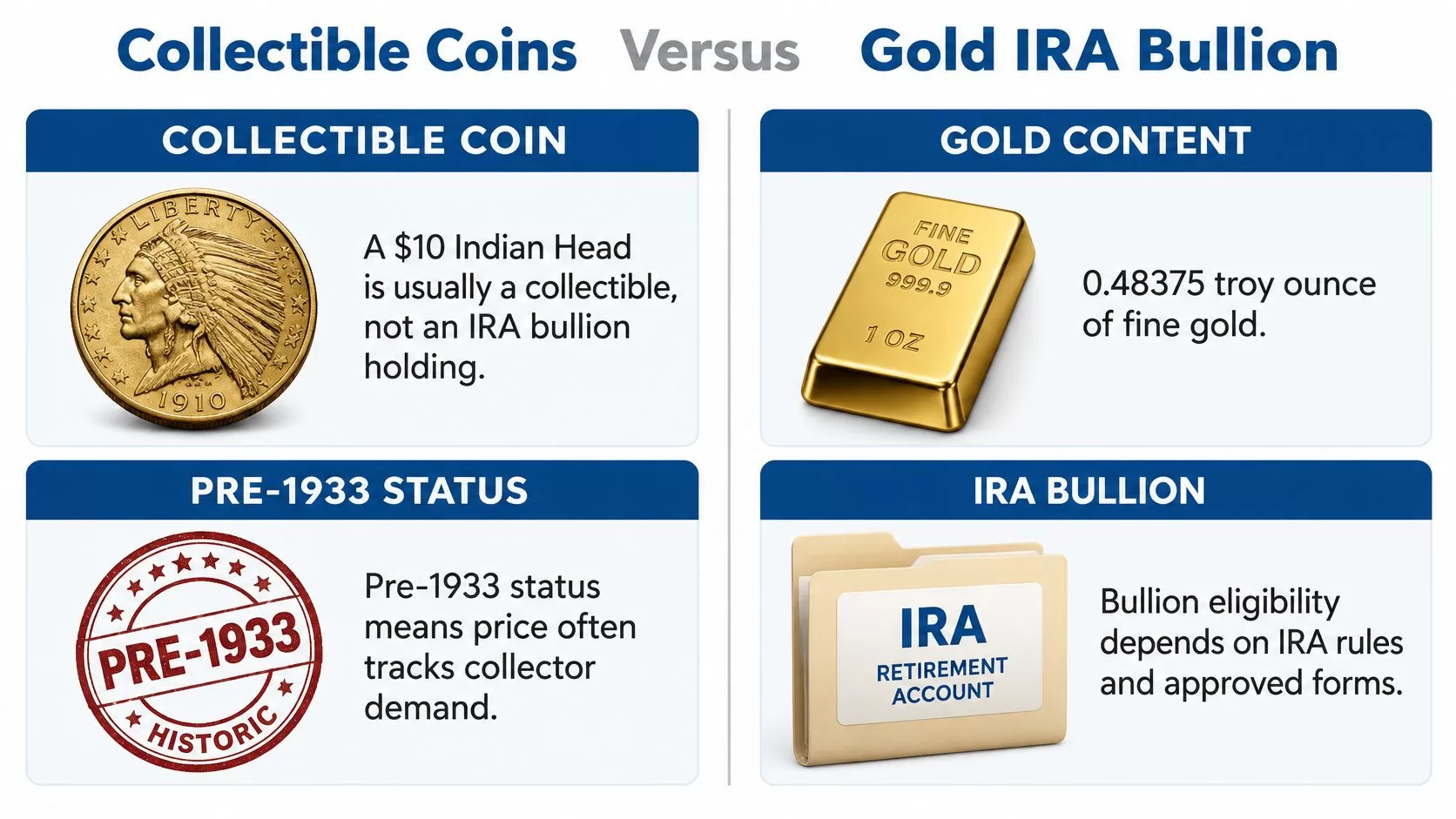
IRS rules generally bar collectibles from IRAs, with a narrow exception for certain bullion and specified coins that meet fineness and custody rules. A high purity reading or a dealer product label does not settle the question. Check the specific product and account arrangement under current rules before assuming it qualifies.
Ownership falls into three distinct paths. Personal ownership outside a retirement account lets price reflect both gold and numismatic traits. A taxable dealer purchase calls for attention to authentication, price, and resale options. A precious metals IRA allows only eligible products held through the required custodian and depository structure.
Modern IRA selections center on bullion products that meet published fineness standards, including qualifying American Eagle bullion, rather than 1907 to 1933 eagles. Confirm current IRS guidance with a custodian, CPA, or tax professional before acting on a rollover. For a side by side look at format tradeoffs, see the guide to gold bars versus gold coins for retirement investors.
Gold IRA Association publishes educational material on gold and silver tax treatment, including “Capital Gains Tax on Gold: A Plain-English Guide” and “Tax on Silver: What Retirees Must Know.” The site also has sections on Gold IRAs, rollovers, Silver IRAs, retirement planning, precious metals, 401(k)s, and gold coins. This is educational information, not financial, legal, or investment advice, and it does not promise a tax result or IRS approval.
Frequently Asked Questions About the Indian Head Eagle
Is a 1933 Indian Head eagle legal for a private collector to own?
A 1933 gold coin has a restricted legal history, so ownership should be checked before purchase. The outcome can depend on the specific piece and current rules. Talk with a professional numismatist who handles pre-1933 U.S. gold, or a coin authentication service, and review the U.S. Mint coin specifications and historical issue notes for Eagle coinage before buying one.
Are gold-plated or replica Indian Head coins worth buying?
Plated pieces and replicas lack the gold content and numismatic value of genuine issues. A replica may look convincing in a photo, yet it will fail the weight, edge, date style, and mint mark checks used to assess any genuine example.
How often should a holder check a coin's value?
Check when making a buying or selling decision, using recent evidence rather than an old guide alone. Gold prices and collector demand move. A recent certified sale or a current written dealer offer is more useful than an outdated estimate, and getting two or three independent offers shows what the market will pay now.
Does a coin's age automatically make it a good investment?
No. Pre-1933 status does not guarantee value. Condition, certification, and resale depth matter more.
A common-date eagle offered to one local buyer may bring only a single bid near melt. That same coin listed where certified collectors compete can draw several bids and a stronger premium. Age alone cannot tell you which result you will get.
Confirm the Coin Before You Buy or Sell
A $10 Indian Head eagle can serve three separate purposes. It can sit in a graded set, it can be sold for cash, or it can prompt interest in retirement-account gold. Each path needs its own check.
For a graded collection, match the coin to its certification record first, then weigh the premium against recent sales of the same date, mint mark and grade. For retirement diversification, do not assume a pre-1933 eagle qualifies. Eligibility turns on the specific product and custodian rules, so collectibles stay out unless a qualified professional confirms an exception. For a sale, document the outcome. Save the certification number, weight and photos, plus the final settlement statement after fees.
Gold IRA Association's materials are provided for informational purposes only and aren't financial, legal, or investment advice. Market values and account rules shift, so confirm current details before you act. A licensed financial advisor, CPA, or tax professional should review any rollover.
Gold IRA Association offers educational articles and comparison resources on Gold IRAs, rollovers, eligible metals, and retirement-account rules. Visit Gold IRA Association to explore those resources and compare providers as you consider how a historic coin fits into your broader plans.