



An IRA owner gets one 60-day IRA-to-IRA rollover in any 12-month period, and that single allowance covers every traditional, Roth and SIMPLE IRA the person owns. A direct trustee-to-trustee transfer isn't a rollover for this purpose and doesn't use the allowance at all.
So why do so many careful savers still end up holding a taxable distribution and a corrected tax form? Almost never because they broke the rule on purpose. They classified the transaction wrong before the money moved, and the classification decision is what decides whether a limit applies at all.
The once-per-year IRA rollover rule is narrow, but it's unforgiving once it's engaged. Sort the transfer into the right category first and most of the confusion evaporates.
Which Retirement Account Moves Count Toward the Limit
The once-per-year rule caps exactly one kind of movement: the 60-day indirect rollover from one IRA to another, at one per 12-month period across all of a person's traditional, Roth and SIMPLE IRAs. Everything else on the retirement-transfer menu sits outside that cap, which is why the classification question matters far more than counting accounts.
The IRS guidance on rollovers of retirement plan and IRA distributions separates indirect IRA rollovers from transactions that stay unlimited. Trustee-to-trustee transfers, where one custodian sends assets straight to another, aren't treated as rollovers for this limitation, so they can be repeated as often as a person needs. Roth conversions from a traditional IRA to a Roth IRA also fall outside the cap, though the converted amount can land as taxable income under the separate conversion rules.
Employer plans follow their own logic. The IRA-to-IRA limitation doesn't reach eligible rollover distributions from plans such as 401(k)s, so more than one distribution from the same employer plan can be rolled over within a year when each transaction otherwise qualifies. A qualifying 60-day rollover generally still has to be completed within 60 days after the distribution is received.
Sorting the five common moves side by side makes the pattern visible.
| Transfer type | Counts toward the limit? | Deadline | Note |
|---|---|---|---|
| Indirect IRA rollover (you receive the check) | Yes | 60 days to redeposit | The limit applies to the redeposit and cannot be waived by the IRS |
| Trustee-to-trustee IRA transfer | No | None | The custodian sends funds directly and you never take possession |
| Direct rollover from 401(k) to IRA | No | None | Employer-plan distributions sit outside the IRA-to-IRA cap |
| Indirect rollover from 401(k) to IRA | No, not against the IRA cap | 60 days to redeposit | The deadline still applies even though the IRA cap doesn't |
| Traditional IRA to Roth IRA conversion | No | None | Not a rollover, and the converted amount may be taxable income |
Read the deadline column as carefully as the cap column. Two rows show "Yes" or "60 days" in the same line, and those are the transactions where possession of the money creates the exposure.
Before requesting anything, answer two questions in writing:
- Will the money pass through your hands? If a check is payable to you, the once-per-year allowance is now in play.
- How many IRA rollovers have you completed in the last 12 months? Count by receipt date, not by account.
Many precious-metals IRA fundings can be structured as direct custodian transfers, which keeps the allowance untouched. The direct transfer versus rollover comparison walks through which paperwork each path requires.
How the 12-Month Clock Starts and Adds Up
Suppose you receive an IRA distribution on June 10, 2026. That receipt date starts the 12-month period. If the funds are redeposited into an IRA within 60 days, the 12-month rollover limit still applies. Under the IRS rollover guidance that took effect in 2015, the period would run through June 10, 2027. Confirm the applicable end date with your custodian and current IRS guidance before making another rollover.
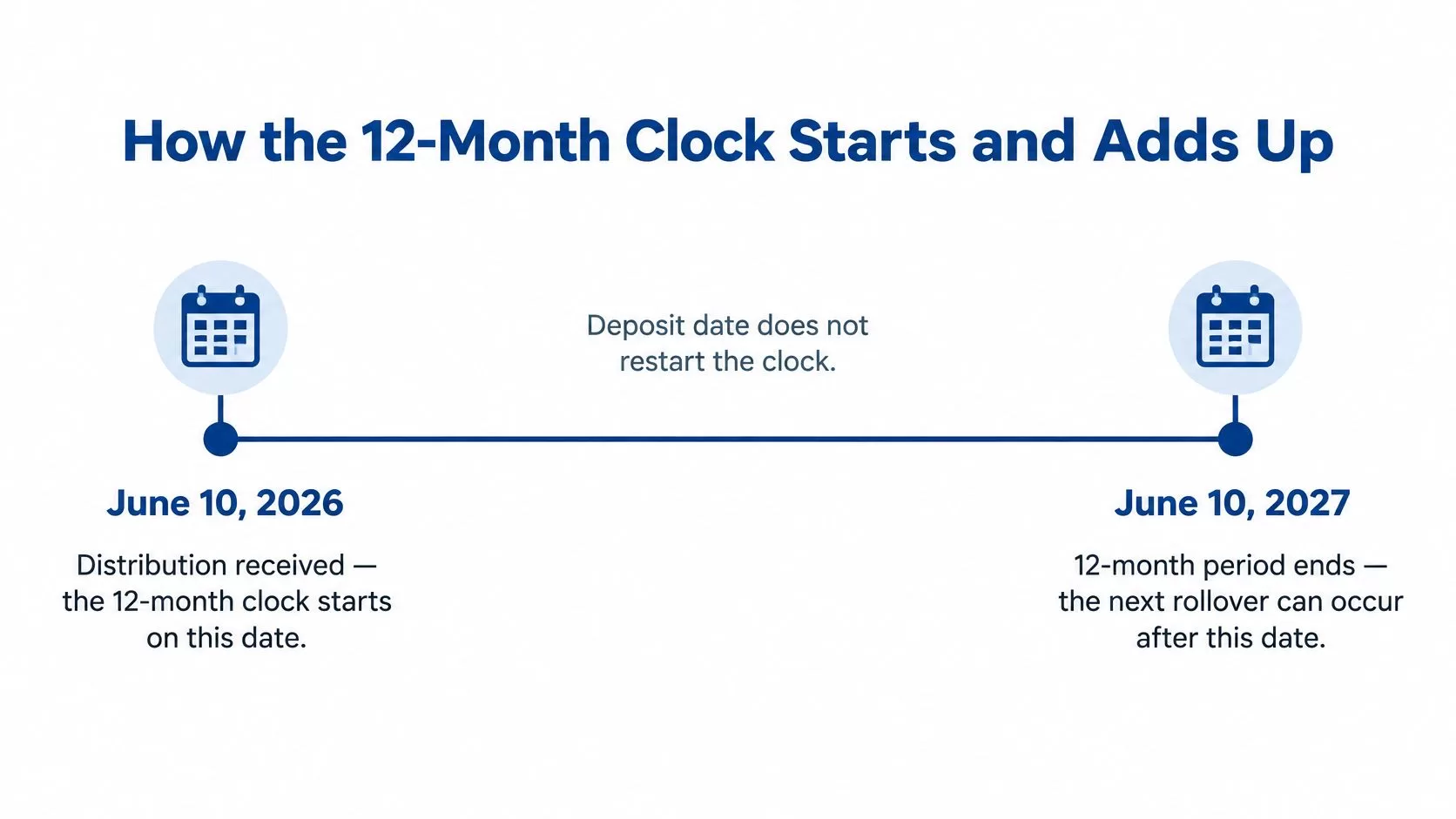
The rule changed in 2015. Before then, taxpayers generally assessed the 60-day rollover limit separately for each IRA. Since 2015, a person may generally make only one tax-free IRA-to-IRA rollover during any 12-month period, whether the funds go to another IRA or back to the same one. The number of accounts does not create additional allowances.
The 60-day redeposit deadline and the 12-month limit measure different things. The first sets the time allowed to put eligible funds back into an IRA. The second determines when another rollover may be made. A delay in the receiving custodian's processing does not change the receipt date used to measure the 12-month period.
Follow the dates in order:
- Record the distribution receipt date. Use the date you receive the funds as the starting point.
- Rede posit eligible funds within 60 days. This deadline applies alongside the 12-month limit.
- Check the 12-month period before another rollover. A later rollover may be restricted even if it involves a different account.
Why owning five IRAs doesn't buy five rollovers
The limit applies across your IRAs, rather than separately to each account. Traditional, Roth, SEP and SIMPLE IRAs are counted together for this purpose. Five accounts at four custodians do not provide five separate rollover allowances.
Practical rule: Keep one dated list of IRA distributions and rollovers across all your accounts. That makes it easier to check whether a proposed rollover falls within the applicable 12-month period.
Returning a distribution to the same IRA also counts as a rollover. Before requesting another move, review the dates of your IRA distributions and check the timing with your custodian and current IRS guidance.
The Hidden Lockout on the Receiving IRA
"One rollover per year" is the shorthand everyone learns, and it's incomplete in a way that costs people real money. The limit doesn't just follow the distributing account. It follows the receiving one too.
IRS guidance states that during the 12-month period, a person cannot make another rollover from the IRA to which the first distribution was rolled over. Read that again as an account-level lock: the destination IRA is frozen for rollover purposes for the rest of the window, not only the source.

Here's how it plays out in practice. Say a $50,000 distribution leaves IRA A and is received on March 3, 2026, then gets redeposited into IRA B on March 20, 2026. The move is clean and inside the 60-day deadline. Now suppose the owner decides in July to roll IRA B's balance into a new self-directed precious-metals IRA. That second rollover is blocked until the window closes, so the metals purchase stalls for months. The IRS draft guidance on the one-rollover limitation describes this restriction on the receiving IRA directly, and it's the consequence most explainers skip.
The same trap catches split moves, partial withdrawals, and temporary bridge accounts. Each distribution is its own rollover event, so a "temporary" IRA set up to hold funds for a few weeks still consumes the allowance and still locks its own receiving side.
The four-question check to run before requesting a check
- Which IRA is distributing the funds? Name the institution and the account number.
- Which IRA receives them? Confirm the receiving custodian is open and able to accept the assets.
- What is the exact date of receipt? Not the request date, not the deposit date.
- Can a direct trustee-to-trustee transfer accomplish the same move without the limit? If the answer is yes, the rollover question disappears.
Add three supporting records: the name of the distributing IRA or plan paired with the receiving custodian, a list of every IRA-to-IRA rollover completed in the past 12 months by receipt date, and the 60-day deadline marked on a calendar if any funds will touch your hands during the process.
Commit the answers to writing before any paperwork goes out. A custodian's call center will process whatever form is submitted, and a spouse or an heir inheriting the situation later will need the paper trail. Where a household is weighing a specific move and the answers don't line up cleanly, that's a signal to consult a professional advisor for guidance on the individual situation rather than guess.
How to Move Funds Into a Precious-Metals IRA Directly
A direct trustee-to-trustee transfer moves money from one custodian to another without paying it to you. That distinction keeps the move outside the once-per-year IRA rollover limit. An indirect rollover, by contrast, puts the funds in your hands and generally requires redeposit within 60 days.
The IRS guidance on plan and IRA rollovers explains how these transfer types differ. Before paperwork is submitted, check whether the transaction is a direct transfer or a rollover. The label on a form matters less than where the funds go.
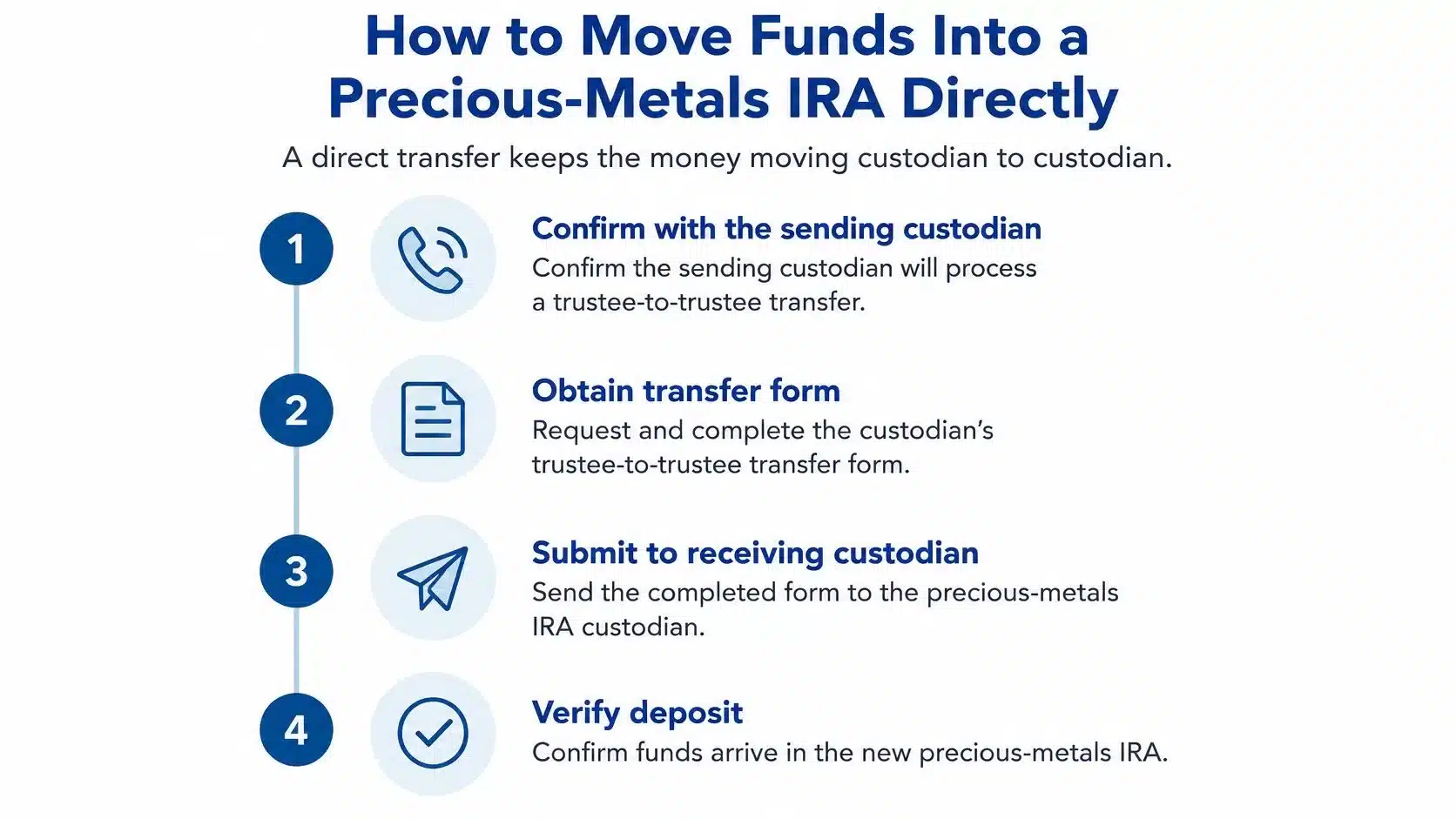
- Confirm the sending custodian will process a trustee-to-trustee transfer. Ask for that transaction type specifically. A request described only as a “rollover” could result in a check payable to you instead.
- Open a self-directed IRA with a custodian that accepts precious metals. Confirm the account can receive the transfer and obtain its account number before funds leave the existing account.
- Arrange payment to the receiving custodian. The sending custodian may issue a check payable to the receiving custodian for your benefit or send the funds electronically. Confirm the account title and number to reduce the chance of a rejected or delayed transfer.
- Wait for the funds to post before placing a metals order. This keeps the purchase separate from the transfer and avoids placing an order before the IRA has the cash.
- Place the order through an approved dealer and ensure the metals are titled to the IRA custodian. Metal held personally is not held in the IRA.
- Check that the products meet IRS purity standards. The IRS rules for precious metals in IRAs generally set fineness thresholds of 99.5 percent for gold and 99.9 percent for silver, with listed exceptions such as certain American Eagle gold coins. Confirm current eligibility before ordering.
- Save the transfer confirmations. Keep records showing how the funds moved and which accounts were involved.
Three specific errors can complicate the transaction: receiving the funds personally can turn a direct transfer into an indirect rollover; ordering before the cash arrives can leave the purchase unfunded; and missing transfer records can make it harder to establish how the money moved.
Before you call the custodian: Ask whether the paperwork results in a check payable to you or a transfer between institutions. That answer helps identify the transaction type before any funds move.
For a closer look at metal selection and account mechanics, read the ThriveXDNA precious metals guide. For the account-opening process, see this guide to starting a precious-metals IRA.
What Happens When a 60-Day Deadline Is Missed
A missed deposit deadline and a prohibited second rollover are two different compliance problems, and they produce different outcomes. Sorting by timing makes the difference clear.
| Situation | Rollover status | Likely tax result | Relief to check |
|---|---|---|---|
| Redeposit within 60 days | Valid rollover that still counts toward the one-per-year limit | Not taxable | None needed |
| Late deposit for a reason outside your control | May qualify for relief, and still counts toward the limit | Taxable unless relief applies | Automatic waiver, self-certification or an IRS private letter ruling |
| Late deposit with no qualifying reason | Not a valid rollover | Taxable income, with possible additional tax if under 59½ (verify) | No standard relief; a private letter ruling request is the remaining route |
| Second IRA-to-IRA rollover within 12 months | Prohibited | Taxable income | None, because the IRS cannot waive the one-per-year rule |
The 60-day clock is the one people know about. IRS materials explain that a recipient generally has 60 days to redeposit an IRA or eligible retirement-plan distribution, and that late deposits may qualify for an automatic waiver, self-certification, or an IRS private-letter ruling in limited circumstances, as described in IRS Publication 590-A.
Here's the nuance that catches retirees coordinating several moves at once: relief on the deadline does not erase the separate 12-month limitation. A late rollover can still count as the permitted rollover for that period. Relief restores the tax treatment of the deposit, not the unused allowance.
Two surprises worth planning around
A custodian can issue an incorrect tax form. The client believes the transaction was coded as a transfer, and the paperwork later reports a distribution. Reconstructing the timeline from statements is possible, but it's slow, and it generally requires help from a tax professional.
The second surprise is self-inflicted. An investor believes they requested a transfer and discovers, when the check arrives in the mailbox made out to them personally, that a distribution was processed instead. Cashing it or depositing it begins a 60-day countdown that may not have been planned for.
Documentation to keep: the distribution statement with its receipt date, the deposit confirmation with its posting date, the custodian's transfer form, and any written explanation of why a deadline was missed.
There are three relief routes, and they fit different situations:
- Automatic waiver. Applies to specific situations the IRS has already carved out, such as certain bank errors. Keep the correspondence that establishes the reason.
- Self-certification. A written statement the taxpayer provides for a qualifying reason, used when the late deposit fits one of the recognized categories. Keep a copy with the return.
- Private letter ruling. The route for everything else, requested from the IRS in advance. It's slower and involves a user fee, and eligibility details should be verified against current IRS procedure.
Tax consequences deserve a professional read. The amount can become taxable income, and an additional tax may apply if the owner is under 59½, which is worth confirming against current rules. The overview of IRA rollover taxes explains how the reporting typically flows.
Next Steps Before Requesting Any Transfer
Before requesting any transfer, bring four written answers to a licensed advisor, CPA, or tax professional:
- Which account will send the funds?
- Which account will receive them?
- Will the money be paid to you, and, if so, when will you receive it?
- Can a direct transfer accomplish the same move?
These details help the professional identify the transaction type before paperwork or funds move. A check payable to you, for example, calls for different deadline planning than a transfer handled between custodians.
The information in this article is educational, not financial, legal, or investment advice. Consult a professional about your circumstances, and verify current IRS guidance on deadline relief, additional taxes for account owners under 59½, and eligible metals before acting.
Readers seeking educational information about account rules and provider comparisons can call 888-910-8386 and ask for resources.
Gold IRA Association publishes guides on rollover procedures, custodial paperwork, and eligible metals. Its website also offers resources about retirement account rules and provider comparisons. Start with the relevant account-rules material at Gold IRA Association, then confirm the transfer classification with a professional before signing forms.