



A rental property sits inside a self-directed IRA, and the owner's daughter needs a place for a long weekend. Or the unit needs a new water heater, and the owner is handy. Or a dealer offered a fair price on gold coins, and it would be simpler to keep the metal in a home safe. Each of these feels like a small practical decision, and each one sits on the wrong side of a prohibited transaction rule. The penalty doesn't stop at the single deal either. It can reach the whole account.
Prohibited Transactions at a Glance
The line a self-directed IRA has to respect isn't drawn around asset types. It's drawn around people. Internal Revenue Code §4975 defines a prohibited transaction as a transaction involving a retirement plan and a "disqualified person" that improperly benefits the account owner or related parties, and it attaches an excise tax to the amount involved for each year of the taxable period. The statute lists borrowing money from the IRA, selling personal property to it, using IRA assets as security for a loan, and buying property for the owner's personal use among its foundational examples. Notice what's absent from that list. Nothing turns on whether the investment is a rental, a private company, or bullion, which is why the rules read as conflicts-of-interest law rather than asset law.
The table that answers most of the questions
Nine transactions cover the bulk of what account owners ask about. Treat each status as a starting point rather than a ruling on your particular facts.
| Transaction | Status | Why |
|---|---|---|
| Borrowing money from the IRA | Prohibited | Lending between the IRA and a disqualified person |
| Selling personal property to the IRA | Prohibited | Direct sale between the plan and a disqualified person |
| Buying property from the owner or a family member | Prohibited | Covered relatives are disqualified persons |
| Personal use of IRA-owned real estate | Prohibited | Owner or family cannot live in, vacation in, or otherwise use the property |
| Pledging IRA assets as loan collateral | Prohibited | Treated as using plan assets for a disqualified person's benefit |
| Paying the owner or family for services on IRA property | Prohibited | Furnishing services between the plan and a disqualified person |
| Taking physical possession of IRA-owned gold at home | Treated as a distribution | Metals must be held through the IRA's custodian |
| Buying gold from an unrelated dealer at arm's length | Generally permitted | No disqualified person involved; confirm eligibility with the custodian |
| Taking a distribution after eligible age | Permitted but taxable | Not a prohibited transaction; income tax applies |
The permitted row deserves a second look. Bullion bought from an unrelated dealer at arm's length, held by the custodian, keeps the account's economics separate from the owner's. The asset didn't make that deal safe. The counterparty did. Put the owner's own coin shop on the other side of the sale and the identical purchase becomes a violation worth the full penalty.
Four questions to run before signing
Who benefited, who paid, who controlled the asset, and who used it. Four answers, applied to every planned transaction, catch most problems before a custodian ever processes the paperwork.
Working rule: If any of those four answers names the account owner, a family member, or a business the owner controls, stop and get a professional read before anything is signed.
Who Counts as a Disqualified Person
Readers often get surprised here. The list reaches further than many expect in one direction and stops shorter than they fear in another. Under §4975(c), a prohibited transaction isn't limited to the owner personally taking cash. It covers direct or indirect dealings between the IRA and a disqualified person involving the sale, exchange, or lease of property, loans or extensions of credit, goods, services, or facilities, and any transfer or use of IRA income or assets for that person's benefit, as the IRS explains in its prohibited transaction overview. Fiduciary self-dealing is on the list too. So the analysis has two halves, the transaction and every related party attached to it.
The family list runs straight up and straight down
The owner's fiduciary, spouse, ancestors such as parents and grandparents, lineal descendants such as children and grandchildren, and the spouses of those descendants are all disqualified persons. Sideways relationships mostly are not. A brother, a sister, a cousin, an aunt, a nephew, or a longtime friend usually stays outside the definition, though any of them becomes disqualified the moment they serve as a fiduciary or a paid service provider to the account. That asymmetry is why the family tree, not the family feeling, decides the answer. A reader who confirms only "my kids aren't involved" may still be dealing with a granddaughter's husband.
When a business counts as a disqualified person
In business structures the category extends to employers, plan fiduciaries, service providers such as custodians, attorneys, and administrators, and any corporation, partnership, or trust in which disqualified persons hold a substantial ownership interest. Ownership gets combined here. A reader at 20%, a spouse at 20%, and a parent at 15% can push a single entity over the threshold together, and control can count even when equity doesn't. The full relationship map sits in this guide to who counts as a disqualified person, and it's worth walking through before structuring anything with a family business attached.
| Person or entity | Disqualified? | Why it matters |
|---|---|---|
| IRA owner or fiduciary | Yes | Core disqualified person in every IRA transaction |
| Owner's spouse | Yes | Covered even if the spouse has no role in the account |
| Parents and grandparents | Yes | Ancestors are listed disqualified persons |
| Children and grandchildren | Yes | Lineal descendants are listed disqualified persons |
| Spouse of a child or grandchild | Yes | Spouses of lineal descendants are covered |
| Siblings | Generally no | Not a listed relationship category |
| Unrelated friend | Generally no | Becomes disqualified if acting as a fiduciary or service provider |
| Custodian, attorney or administrator serving the IRA | Yes | Service providers are disqualified persons |
| Company or trust 50% or more owned by a disqualified person | Yes | Ownership threshold brings the entity within the rules |
Before proceeding, write down every person and entity that touches a planned deal and the relationship each one has to the owner. That single sheet of paper settles more questions than any online calculator.
Noncash Violations and Real Scenarios
The expensive misunderstanding in this area is the belief that money has to leave the account for a violation to occur. It doesn't. Guidance reaches any transfer or use of plan income or assets for a disqualified person's benefit, and the Government Accountability Office warns that unconventional assets, particularly ones the account owner directly controls, raise the risk of a prohibited transaction and of losing tax-favored status. Value moves as a free weekend, a discounted repair, a commission, a wage, or preferential access. Cash is only the most obvious form.
A condo held by an IRA is the everyday version of this. The property itself is unremarkable.

Five cases, verdict first
Prohibited. A daughter spends a weekend in an IRA-owned condo and pays market rent. She's a lineal descendant, her personal use is a benefit, and paying rent doesn't cure it. The payment doesn't convert personal use into an arm's-length lease.
Prohibited. The owner's son's renovation company does work on IRA property at fair market rates. Price isn't the problem. A disqualified person furnishing services to the plan is.
Prohibited. An owner-controlled LLC provides services to the IRA, or the owner draws wages from a business the IRA owns. Compensation flowing back to a disqualified person is self-dealing even when the disqualified person wasn't a party to the original purchase.
Treated as a distribution. Gold coins bought through the IRA and stored in a home safe. Metals have to be held through the IRA's custodian. Taking possession is taxed as a distribution, which is a different problem from a prohibited transaction and just as unwanted.
Generally permitted. The IRA buys gold through its custodian from an unrelated dealer at market price, or buys commercial property leased to an unrelated tenant. Anyone weighing buying a vacation rental property in Destin through an account can apply the same logic. The seller, the tenant, the property manager, and the contractor all need to sit outside the disqualified list.
Roles that look administrative carry the same weight, which is why personal guarantees and loans between the account and its owner follow an identical pattern. The self-directed IRA loan rules explain the non-recourse structure that keeps financing out of the disqualified zone.
Where the gray areas actually live
Rental property is the classic example. An IRA-owned house with a family member handling repairs, an owner paying the property tax from a personal account, or an owner-controlled company managing the unit all create indirect benefits that never show up as a withdrawal. The "I didn't take money out" defense misses compensation, preferential access, and free use of property.
The overview below pairs well with the cases above.
Separate prohibited activity from two things that are perfectly fine. A participant distribution taken at an eligible age is taxable, not prohibited. Ordinary investment expenses paid from IRA funds, such as a custodian fee or a property manager's invoice, are normal account costs when the payee isn't disqualified. Document the reasoning behind each decision as if a stranger will read it later, because eventually one will.
Any verdict that names a relative, an owner-controlled company, or personal use is a stop sign. Raise it with a CPA before the deal moves.
What a Prohibited Transaction Costs You
The cost isn't a fee attached to one transaction. It's a change in the account's tax status. IRS Publication 590-A states that when the IRA owner engages in a prohibited transaction, a traditional IRA generally ceases to qualify as an IRA as of the first day of that year, as summarized in the IRS guidance on plan assets. The account may then be treated as having distributed its assets to the owner at fair market value. Using IRA-owned property personally or routing a benefit to a related party can therefore tax the entire balance, not just the benefit received.
Who pays which cost
The excise tax and the income tax land on different people, which is the detail most explanations skip.
| Consequence | Who bears it | Trigger or timing |
|---|---|---|
| Excise tax of 15% of the amount involved | Disqualified person who participates | Each year or part of a year in the taxable period |
| Additional tax of up to 100% | Disqualified person | Transaction not corrected within the correction period |
| Loss of IRA tax status | IRA owner or beneficiary | Account treated as distributed at fair market value on January 1 of the violation year |
| Income tax on the deemed distribution | IRA owner or beneficiary | Taxed as ordinary income in the year of the deemed distribution |
| Possible 10% additional tax | IRA owner under age 59½ | Applies where no exception applies; confirm with a tax professional |
An important split sits inside that table. The IRS retirement plan investments FAQs note that a disqualified person who participates in a prohibited transaction must pay the tax. Where the transaction causes the account to stop being an IRA, the owner or beneficiary generally isn't subject to the excise tax itself, even though the account may be treated as distributed and become taxable. Two different consequences, two different pockets.
A $100,000 loan, walked through
Say an owner borrows $100,000 from the IRA. That's a prohibited lending arrangement, and the excise tax runs 15% of the amount involved, or $15,000, for each year in the taxable period. If the transaction isn't corrected within the correction period, an additional 100% tax can apply on the same amount, which on this example would be another $100,000. All of it arrives before any income tax on the deemed distribution. These are illustrative figures built from the statutory rates, not a projection for a specific account.
If it already happened
Stop the activity that created the problem, including any personal use, payment, or service arrangement still running. Write down the facts in date order with the documents attached. Then bring the custodian and a CPA into the conversation about the correction period and any reporting obligation, such as IRS Form 5330 for the disqualified person. Corrections turn on deadlines and sequence, so the professionals should be involved before anything is moved or refunded.
How to Stay Compliant Before Every Transaction
Section 4975 identifies the categories that matter most for self-directed accounts: the direct or indirect sale, exchange, or leasing of property between the plan and a disqualified person, lending or extending credit between them, furnishing goods, services, or facilities, transferring or using plan income or assets for a disqualified person's benefit, and a fiduciary's use of plan assets for the fiduciary's own interest, according to this IRS guidance on §4975 categories. An owner therefore can't use IRA-owned real estate personally, provide personal services to the property, borrow from the account, or arrange an investment so retirement assets indirectly benefit the owner or a prohibited relative. Seven checks handle the practical side.
Build a related-party list. Include the owner, spouse, ancestors, lineal descendants, spouses of descendants, fiduciaries, service providers, and any entity 50% or more owned by that group. Names slip onto deals through a family member's company, which is the most common way an otherwise clean purchase fails.
Screen the counterparty on paper. Confirm that no listed person is the seller, buyer, tenant, lender, borrower, or contractor. A verbal "it's a friend of ours" isn't screening.
Get an independent valuation. Use a qualified appraiser with no relationship to the owner before any purchase or sale. A valuation from a friend of the owner is a documented conflict, not documentation.
Pay every IRA expense from IRA funds. Keep personal and account money in separate accounts, because a single personal payment of a property tax bill creates exactly the kind of noncash benefit that's hardest to unwind.
Put arm's-length terms in writing. Record the price, the market-rate evidence behind it, and who signed for each side. Fair terms with no paper trail look like self-dealing with a story attached.
Confirm with the custodian and a tax professional before signing. Custodians review asset eligibility and the counterparty, and the IRA custodian requirements show what they'll ask for before processing a purchase. Their review isn't legal advice, so pair it with your own CPA.
Review the arrangement every year. Leases, repairs, insurance, and any personal use need a fresh look annually, since a tenant's circumstances or a family member's new role can change the analysis without any new paperwork.
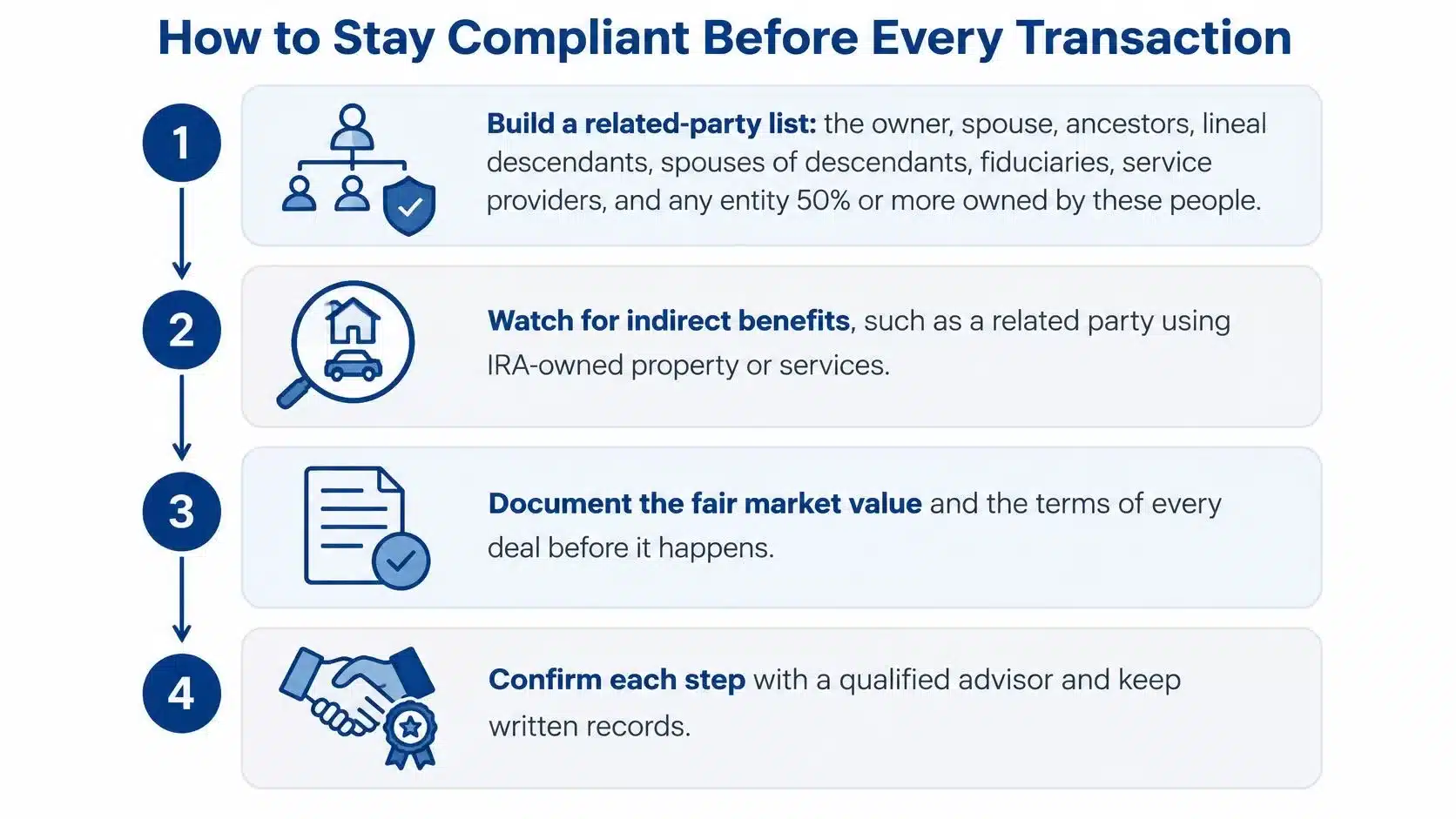
Those seven steps cover the same ground as the four checks above, with the operational detail filled in.
The most expensive mistake isn't a complicated structure. It's a helpful relative who quietly fixes a furnace and gets paid nothing.
Confirm Your Next Step Before Any IRA Purchase
Three takeaways are worth carrying away. Self-directed IRA prohibited transactions turn on personal benefit and related parties, not on the asset label, so gold, real estate, and private equity are neither safe nor suspect on their own. The consequences can reach the entire account through disqualification, not just the improper deal. And prevention rests on four ordinary habits: related-party screening, independent valuation, written documentation, and custodian review before anything is signed.
The next step is concrete. Run any planned transaction through the lookup table and the related-party list before signing, and flag every family member, owner-controlled company, or hint of personal use for professional review. Investing in precious metals and IRAs involves risk, including the potential loss of principal. The materials on the Gold IRA Association website are provided for informational purposes only and aren't intended as financial, legal, or investment advice. Readers can consult a professional advisor for guidance specific to their own situation, and anyone with account-rule questions can use the online contact form for help finding educational information.
This is not financial advice.
Gold IRA Association exists for readers who want the rules explained before any money moves, and self-directed IRA prohibited transactions sit at the center of that work. Its guides cover eligible metals, custodian requirements, rollover mechanics, and provider comparisons in plain English, so a conversation with a CPA or custodian starts from a stronger place. Visit Gold IRA Association to read the guides and compare providers before choosing an account structure.