



A lot of retirees get to this point with the same worry. The retirement accounts are doing fine on paper, but the headlines keep getting louder, and the question becomes simple: should any part of a 401(k) or IRA be tied to gold, silver, or mining stocks without going all the way to coins and a self-directed account? Mutual funds for precious metals sit right in that gap, and the right answer depends on whether the goal is diversification, liquidity, or direct bullion ownership.
That question matters because these funds are not the same thing as a Gold IRA, and they are not the same thing as a plain stock fund either. They can be useful, but only if the retiree knows what they own, what they cost, and what risk they carry. This guide keeps the focus on those trade-offs and separates the fund sleeve from the bullion sleeve.
Why Pre-Retirees Are Asking About Precious Metals Funds
A 60-year-old looking at a steady but uninspiring portfolio usually is not chasing excitement. The worry is simpler than that. If retirement may last for decades, and the next market drop hits just as withdrawals begin, the portfolio has to do more than grow. It has to handle stress without pushing the retiree into bad timing decisions.
That is why precious metals keep coming up. Some savers want direct bullion, some want a fund tied to the metals theme, and some want an easier way to add a defensive sleeve without storing coins or opening a separate account. A mutual fund can give that kind of exposure while staying inside a familiar brokerage or retirement-account setup.
The deeper question behind the question
The issue is whether the retirement portfolio needs a small diversifier that behaves differently from stocks and bonds. Mutual funds for precious metals can do that through miners, through commodity exposure, or through bullion-linked structures, but each path behaves differently.
Practical rule: if the retiree wants convenience and daily liquidity, a fund is easier to live with than physical metal. If the retiree wants direct ownership of bullion inside a tax-advantaged account, that calls for a different tool.
The next decision is whether the exposure should be tactical, long-term, or a hedge sleeve. At that point, many people compare a mutual fund, a precious-metals ETF, and a physical Gold or Silver IRA. Those are three different instruments, and each one solves a different problem.
What Mutual Funds for Precious Metals Actually Are
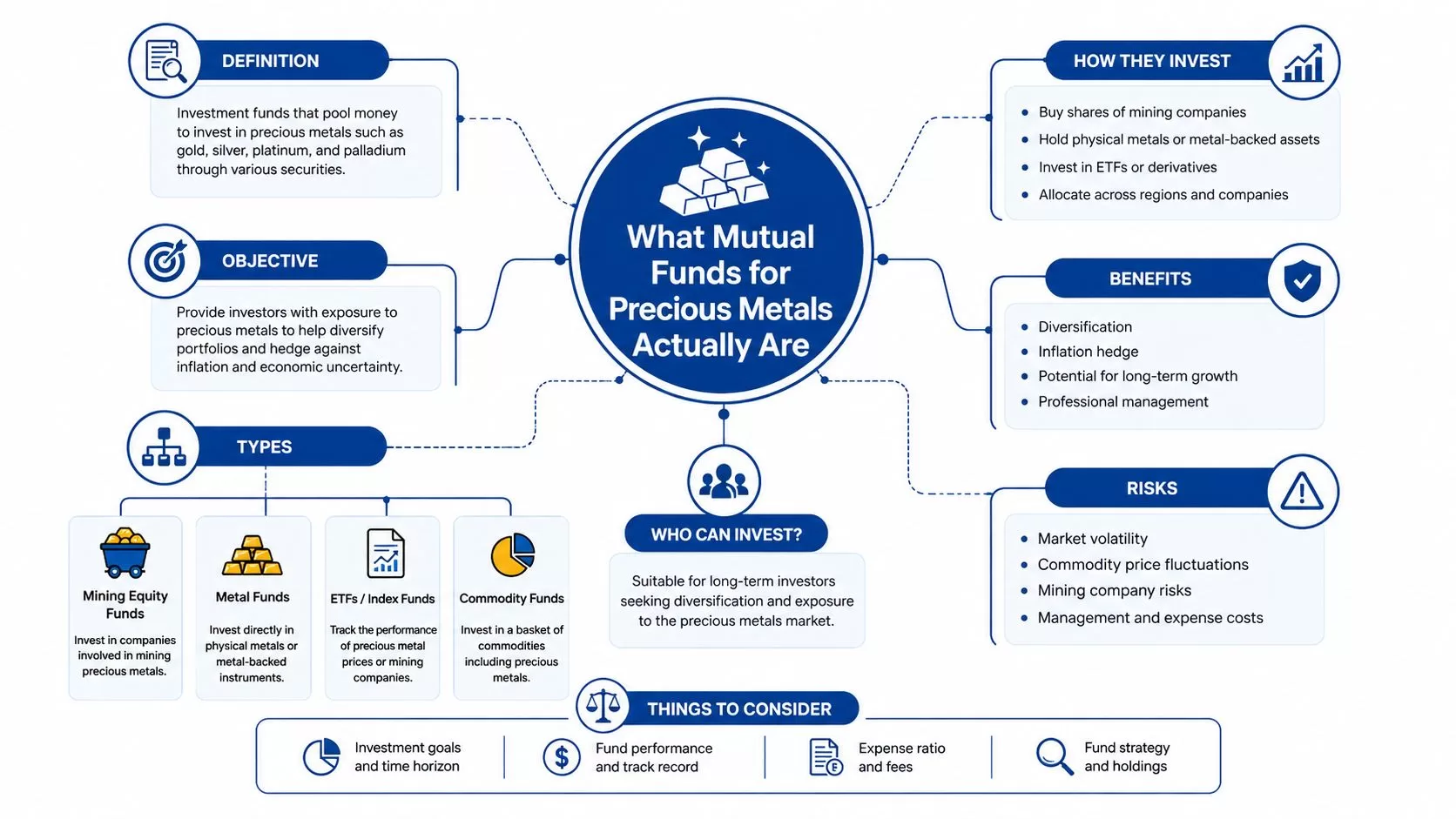
A precious-metals mutual fund is a pooled investment that gives shareholders exposure to gold, silver, platinum, palladium, or the companies tied to those metals. In practice, most of these funds lean toward mining and related equities rather than bars in a vault, which is why the return pattern can look much more like a stock sector than a quiet store of value. Investopedia's overview of precious-metals mutual funds makes that structure clear.

Four common structures
The category is broad, but the designs usually fall into four buckets:
- Mining-stock funds: These own shares of miners, explorers, and processing firms. They rise and fall with both metal prices and corporate results.
- Commodity funds: These try to follow the metals themselves, often through futures or other derivative exposure. That adds extra moving parts.
- Physically backed funds: These hold bullion directly, so the fund behaves more like a metal holding than a mining bet.
- Index-tracking funds: These follow a published metals or miners benchmark and tend to be more rules-based.
The supplied examples make the differences easier to see. The long-running U.S. example of the Allspring Precious Metals Fund, dating back to January 30, 1978, shows how established this niche is and how active, specialized portfolios can exist for decades. The ProFunds Precious Metals UltraSector ProFund, operating since June 3, 2002, is another reminder that some products in this area are built for aggressive exposure rather than calm, bullion-like behavior. Allspring Precious Metals Fund details show the category's age and the active style many funds use.
Most people hear “precious metals” and assume they're getting metal. With mutual funds, that's often not true. They're usually buying mining businesses first and metals exposure second.
The key point is blunt: most mutual funds in this space are not bullion funds. They are concentrated, specialized, and often actively managed. That's why they deserve a careful look before anyone assumes they're a simple substitute for gold coins or bars.
The Four Types Compared and What Each One Owns
The biggest mistake retirees make is treating every precious-metals fund as if it owns the same thing. It does not. A mining-stock fund, a commodity fund, a physically backed fund, and an index-tracking fund behave differently because they own different assets and respond to different return drivers.
A fund that owns miner shares is a business bet first. A fund tied to metal contracts follows the commodity more closely, but the contract structure can still change the ride. A physically backed fund holds bullion, so it tracks metal price behavior more directly. An index-tracking fund follows a published rules set, which can tilt it toward miners, metals, or a mix depending on how the index is built.
Side-by-side differences that matter
| Fund Type | Primary Holding | Return Driver | Volatility vs. Bullion |
|---|---|---|---|
| Mining-stock fund | Miner and explorer equities | Metal prices plus company earnings | Usually higher |
| Commodity fund | Futures or other metal-linked exposure | Spot-like metals movement and contract structure | Often higher |
| Physically backed fund | Bullion | Metal price itself | Closer to bullion |
| Index-tracking fund | A metals or miners index | Index rules and underlying members | Depends on index design |
The retirement takeaway is straightforward. A mining-stock fund is a business bet wrapped around a metals theme. If miners control costs well and metal prices move up, the fund can respond fast. If operating costs rise or production disappoints, the losses can be sharper than the metal move alone would suggest.
Commodity funds look cleaner on the surface because they aim to track the metal, but the mechanics can be messy. Futures-based exposure can bring contract-rolling issues that a plain bullion owner never sees. Physically backed funds are closer to owning metal directly, but they still remain fund products, not piles of bars in a safe.
That distinction matters if you want retirement money tied to gold without turning the account into a storage project. The relevant comparison is plain enough in this guide to physical gold versus ETFs in an IRA, because the job of a fund is not the same as the job of direct bullion ownership. If a product starts promising exotic downside behavior, readers should also be cautious and get inverse silver ETF fraud help.
The supplied U.S. fund examples underline that range. Franklin Gold and Precious Metals Fund shows the active-fund side of the category, and the point is the structure as much as the name. Franklin Templeton's fund page is a clean example of how these funds are often positioned.
Mutual funds vs physical gold in an IRA helps frame the decision between securities exposure and direct metal ownership. That choice matters more than the fund name on the statement.
Mutual Funds vs Gold IRAs vs Precious Metals ETFs
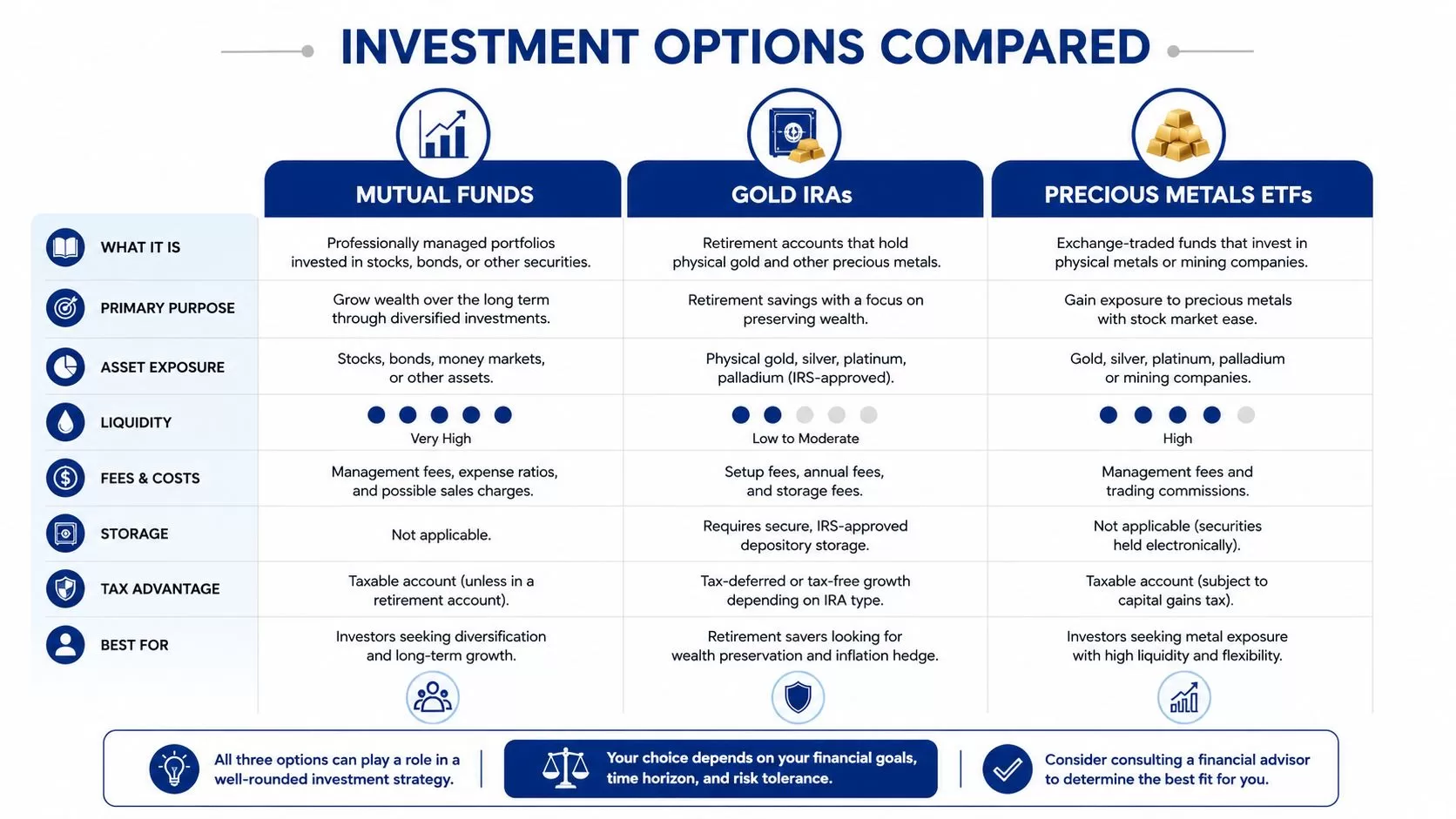
These three tools are often mentioned in the same breath, but they do different jobs. A mutual fund is a securities product. A precious-metals ETF is also a security, but it trades on an exchange and usually follows the metal more closely. A Gold or Silver IRA is a retirement account structure built to hold approved physical bullion through a custodian and depository.
What the investor actually owns
A mutual fund gives the retiree a claim on a portfolio, not a pile of metal. That means daily liquidity, routine account statements, and no storage chores. It also means the retiree lives with the manager's structure, turnover, and fee schedule.
A Gold or Silver IRA works differently. The account is built around approved bullion, so the investor gets direct metal ownership inside the retirement wrapper, but with custodial and storage complexity attached. For many retirees, that trade-off is the whole reason to use it. They want the metal itself, not a proxy for it.
A precious-metals ETF sits between the two. It is usually simpler and often cheaper than a mutual fund, but it still remains a market-traded security rather than a self-directed bullion account. That makes ETFs useful for tactical exposure, while a physical IRA fits better for people who want a long-term, allocated sleeve. For a plain comparison of mutual funds vs physical gold in an IRA, the key issue is ownership, not branding.
One practical warning belongs here. Complex silver products can be marketed in ways that sound safer than they are, so anyone who has been pitched a product they do not fully understand should seek inverse silver ETF fraud help.
Different jobs, not competing religions
The right answer is often to use more than one tool. A retiree might keep a liquid fund or ETF for small portfolio shifts and reserve physical bullion for the part of the account meant to sit. That split keeps the portfolio flexible without pretending every precious-metals vehicle does the same thing.
IRA and 401(k) Eligibility and Rollover Rules
Mutual funds for precious metals are easy to place inside a retirement account because they are securities, not bullion. If the IRA or 401(k) menu includes them, they can usually sit there without special purity standards, depository rules, or a separate precious-metals custodian. That simplicity is one reason some retirees prefer them to physical holdings.
Physical metals are a different animal. A Gold or Silver IRA requires IRS-approved bullion, an approved custodian, and storage at an approved depository. The investor cannot just move a few bars into a safe and call it a retirement account.
Transfers and rollovers aren't the same thing
A direct custodian-to-custodian transfer keeps the account movement clean. The money moves between institutions without the retiree taking possession, which lowers the chance of a tax mistake.
An indirect 60-day rollover is riskier. The retiree receives the money first and then has a short window to redeposit it correctly. If the process goes wrong, the tax consequences can be ugly, especially in a retirement context where a clean paper trail matters.
For readers weighing a rollover into physical metals, the mechanics matter as much as the asset choice. The internal guide on 401(k) to Gold IRA rollover steps is relevant because the account structure changes the rules, even when the retirement goal stays the same.
Plain-spoken rule: if the goal is direct bullion ownership, the account setup has to match that goal first. Buying the wrong product inside the wrong account creates avoidable stress.
These are general rules, not personal tax advice. Current IRS guidance should be checked before any rollover, transfer, or account conversion, because account rules and eligibility can shift with individual circumstances.
Fees, Loads, and the Tax Picture
A retiree can like the story and still get hurt by the bill. In this corner of the market, fees eat returns fast, and the examples provided show U.S. precious-metals mutual fund expenses running from about 0.87% to 1.17%. The TD Precious Metals Fund reports a MER of 2.28% as of Dec. 31, 2025, with total fund assets of $281.22 million. That kind of cost is hard to ignore in an account that may need to support withdrawals for years. TD Precious Metals Fund details show how much the numbers can vary inside the category.
The headline expense ratio is only part of the bill. Some funds also charge 5.50% front-end loads and 1.00% contingent deferred sales charges, so the investor starts in a hole before the position has time to do anything. Sales charges matter just as much as annual expenses, because they take money off the table at the beginning or on the way out.
What fees really do over time
A 1% fee gap sounds small until you let it sit inside a retirement account for years. The manager gets paid first, and the investor gets the net result later. If the fund also charges a front-end load, part of the initial contribution never enters the compounding process.
Tax treatment deserves the same blunt look. Equity-style precious-metals mutual funds can throw off dividends and capital gains in taxable accounts, which can create tax bills even in years when the investor does not sell. Physically backed products can be treated differently, and that changes the after-tax result in a taxable account.
The lesson is simple. A precious-metals fund is not a tax shelter just because it holds a gold or silver theme. The structure, not the label, drives the tax bill.
Before moving retirement money into a niche fund, review the IRA rollover fees explained guide so the account-level costs do not surprise you later.
What Drives Performance and the Real Risks
Precious-metals mutual funds have two engines. One is the metal price itself. The other is the mining company's operating result, which means the fund can move for reasons that have nothing to do with bullion. That is why many of these funds feel more like a high-beta equity sleeve than a calm metal substitute.
Mining funds are especially sensitive to operating. When metal prices rise, miners' margins can improve quickly. When prices fall, costs and write-downs can bite hard. That makes these funds useful for some diversification work, but not for anyone expecting smooth behavior.
The hidden concentration problem
These funds are usually narrow by design. Many hold a short list of miners or related companies, and some include only a limited bullion sleeve. That means the retiree can end up with much more company-specific risk than expected.
Derivative use can add another layer of complexity. Some products rely on contracts or swaps to shape exposure, and that brings tracking and counterparty considerations that ordinary stock funds don't face in the same way. For a retiree who wants a simple hedge, that can be a poor fit.
The honest conclusion is simple. Mutual funds for precious metals can be a diversifying sleeve, but they are not a core retirement anchor. Their value comes from how they behave differently, not from any promise of protection.
Due Diligence Checklist and Practical Next Steps
A retiree evaluating any precious-metals fund should start with the basics and stay there. Expense ratio comes first, then any front-end load or deferred charge. After that, the investor should look at fund age, assets under management, and how concentrated the top holdings are.
A simple checklist
- Cost burden: Check the stated expense ratio and any sales loads before looking at past returns.
- Fund size and age: Larger, longer-lived funds can be easier to assess than thinly traded niche products.
- What it owns: Confirm whether the fund holds miners, bullion, or a mix of both.
- Concentration: Review whether a handful of holdings dominate the portfolio.
- Tax fit: Decide whether the fund belongs in a taxable account or a retirement account.
- Account compatibility: Make sure the choice matches the menu inside the IRA or 401(k).
A clean decision sequence
- Define the job. Decide whether the sleeve is meant for diversification, crisis sensitivity, or a metals allocation.
- Pick the vehicle. Choose between a mutual fund, ETF, or physical Gold IRA based on that job.
- Verify costs and structure. Read the fee schedule, not the marketing sheet.
- Match the account. Keep securities inside a standard retirement account when that's all that's needed, and use a physical IRA only when direct bullion ownership is the actual goal.
- Set a modest target. Keep the position sized to the purpose, not to headlines.
- Rebalance once a year. Let the sleeve stay a sleeve.
If the product's structure is hard to explain in one sentence, it's probably too complicated for a retiree who just wants a cleaner portfolio.
This is educational content, not personalized financial, tax, or legal advice. A licensed financial advisor, CPA, or tax professional should review any rollover, allocation, or account change before money moves.
Gold IRA Association publishes plain-English guides on precious metals, rollovers, fees, and retirement-account rules for readers who want the facts without the sales pitch. If you're weighing a precious-metals fund against physical bullion inside an IRA, visit Gold IRA Association to compare the options and keep your next step grounded in the actual account rules.


