




Gold has delivered a 10.9% average annual return from 2000 to 2025 in one major dataset, but that headline number can mislead retirement investors if fees, storage, and timing aren't included (Visual Capitalist). For near-retirees, the important question isn't whether gold has moved up over time. It's whether the return on gold still makes sense after accounting for the costs that can reduce what ends up in the account.
Understanding Gold Returns in the Current Market
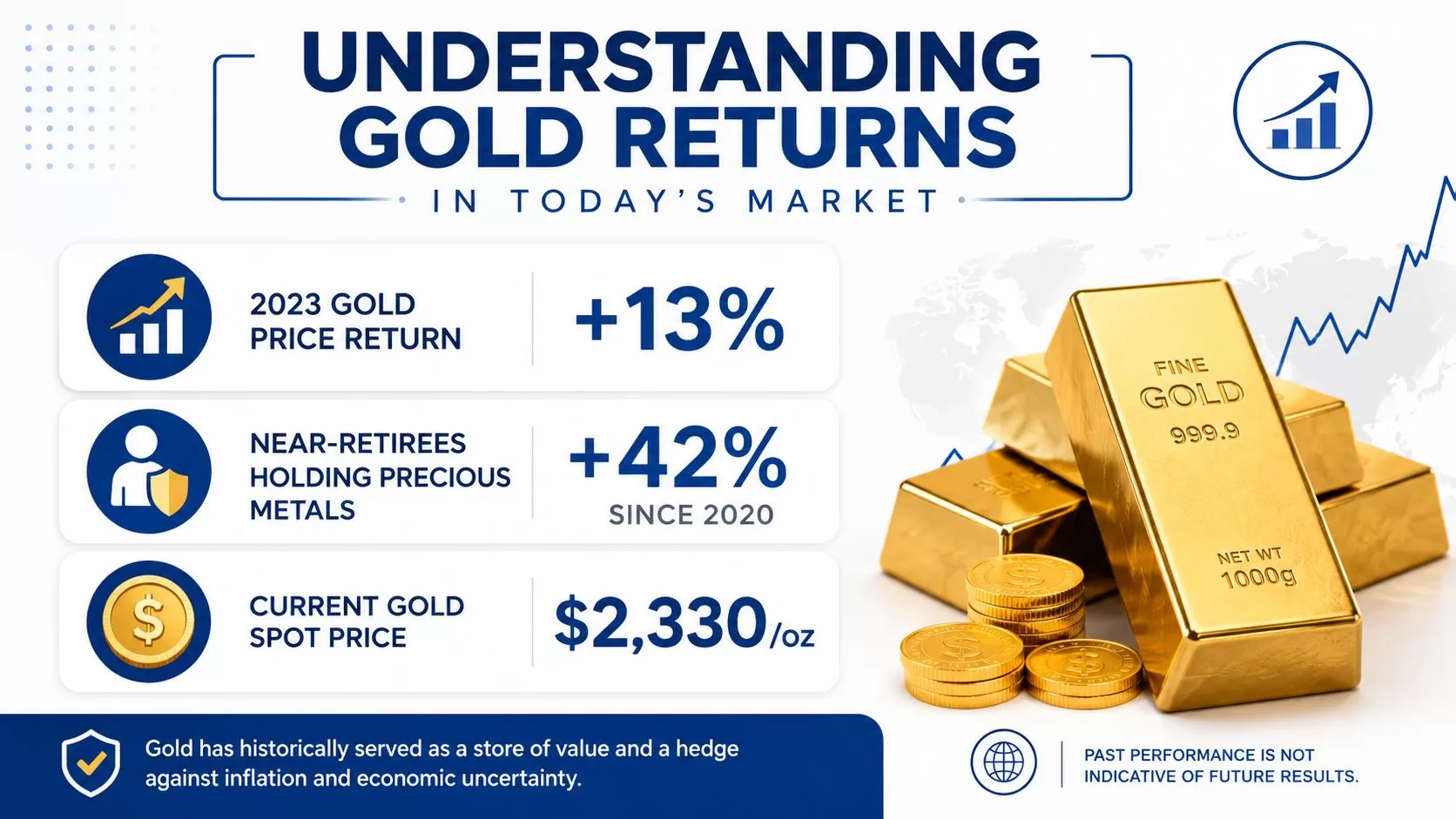
Gold's recent strength is one reason it keeps appearing in retirement discussions. Analyses of recent market history show that gold has delivered gains over time, but the headline price alone does not tell a retiree what lands in the account. Fees, storage, and the timing of buys and sells can trim the result, especially inside a retirement account where every layer of cost matters more than it may at first seem.

Why the recent numbers matter
Recent performance is useful, but it should be read with the full holding period in mind. A broad post-gold-standard review found that gold has produced long-run gains, while other market comparisons show that its path has been uneven and highly dependent on when an investor entered. That is the part near-retirees often miss. Gold can preserve purchasing power, yet it does not behave like an income asset that pays you along the way.
Gold works more like a reserve asset than a paycheck stream. A retirement portfolio can benefit from that, but only if the investor understands how the return is built and how much of it survives after account charges. A simple analogy helps here. A gross return is the price change on paper, while a net return is what remains after the friction of owning and storing the metal. That difference can be modest in some cases and meaningful in others, especially in an IRA where custodian fees, storage costs, and transaction spreads all eat into the final result.
The other point that often causes confusion is unit size. Gold is commonly quoted by the troy ounce, not the regular ounce, and knowing the difference between a troy ounce and a regular ounce helps prevent mistakes when comparing quotes or calculating value. A retiree who is evaluating a rollover or a physical purchase should be precise about the measurement used, because a small mismatch can distort the return calculation from the start.
A better way to judge gold is to ask what the position is expected to do inside the portfolio. If the goal is to help stabilize savings, the right question is not only whether the price has risen. It is whether the gain survives the account structure, and whether the after-cost result still supports the role gold is meant to play. That is why investors who want to calculate gains on stocks and real estate often need a similar discipline here. Gross appreciation is only the first layer. True return comes after the costs are counted.
What retirees should take from the current market
For retirement planning, gold can still have a place, but it should be judged with clear eyes. A strong spot price does not erase the drag from storage, dealer spreads, or IRA-related fees. Those charges matter because they reduce the amount that compounds for the owner, and the effect is even more noticeable when the holding period is long.
The practical lesson is simple. Gold may help with diversification, but the decision should always start with net return, not with the quoted market price alone.
How to Calculate Your Return on Gold
The calculation itself is simple, but many investors misread it because gold doesn't pay interest or dividends. Physical gold produces no income while it is held, so the return comes only from price appreciation. That means the right starting point is not yield, it's the change in value.
The basic formula
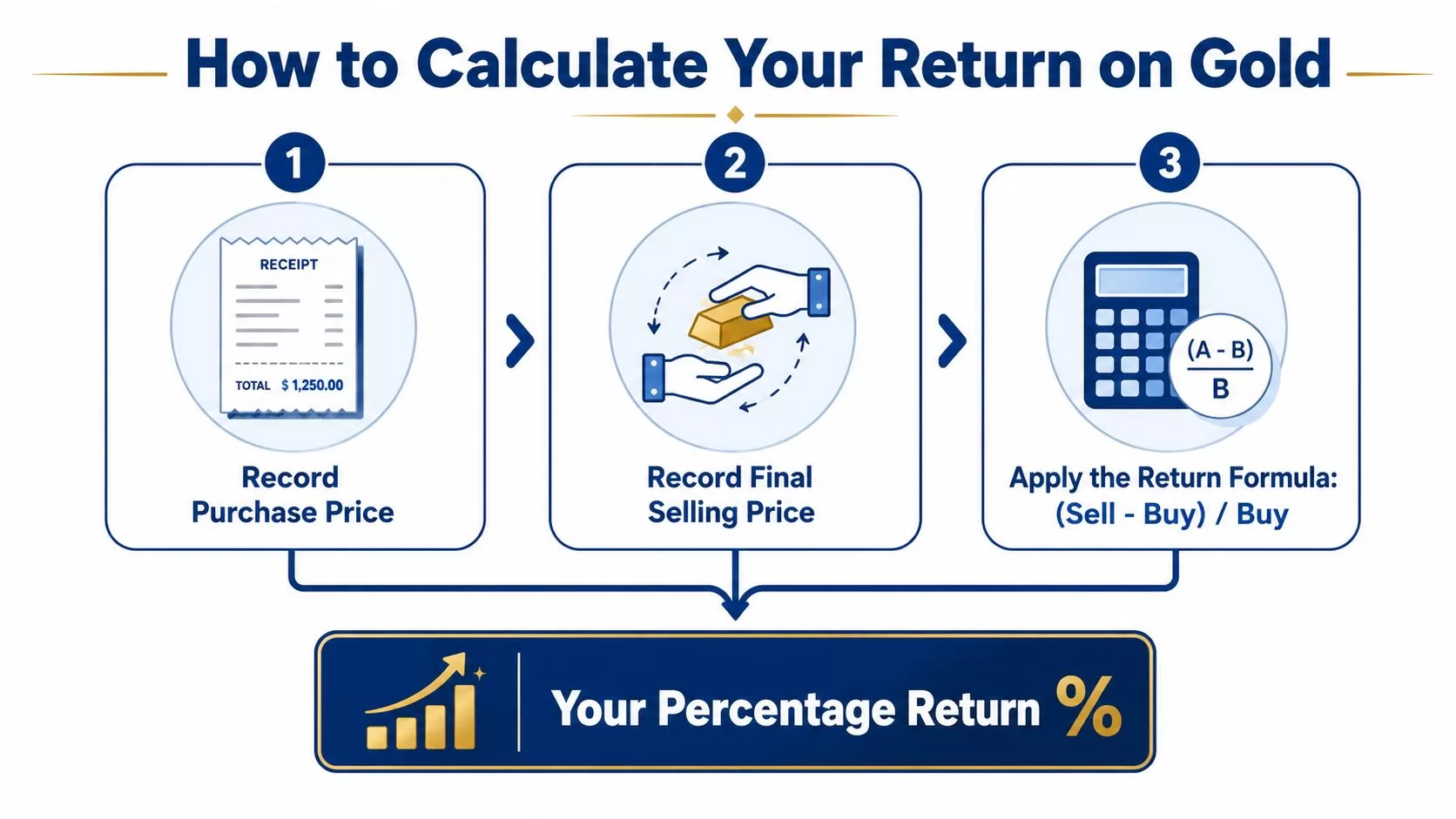
The plain-English formula is:
((Current Value – Purchase Price) / Purchase Price) x 100
That formula measures price return, not income return. If someone bought gold at one price and sold it later at a higher price, the gain is the difference between the two values. If they held it in an IRA, they also need to subtract account-level costs before calling the result a true net return.
A simple example makes the math easier. Suppose gold was bought for one amount and later sold for a higher amount. The return is the gain divided by the original purchase price, then multiplied by 100. The exact numbers can be filled in for any holding period, whether the investor is looking at bullion outside a retirement account or metals held inside one.
Nominal return versus real return
The next confusion point is inflation. A nominal return is the raw percentage gain. A real return adjusts that gain for purchasing-power changes over time. For retirees, the distinction matters because gold is often bought to preserve value, not just to show a larger number on paper.
When comparing gold to other assets, it helps to calculate returns the same way across categories. A useful companion resource for understanding that logic in other asset classes is calculate gains on stocks and real estate, because the core idea is the same, price in versus price out, then adjust for costs that reduce the final result.
A return figure that ignores fees and spreads can look better than the money a retiree actually keeps.
One more detail matters for metal buyers. A troy ounce is not the same as a regular ounce, and using the wrong unit can distort the result. The difference is worth checking before comparing quoted prices or calculating a gain, especially in a retirement account where every percentage point matters. For a clear explanation, see the troy ounce versus regular ounce guide.
Historical Gold Returns Across Different Time Periods
Gold's record changes a lot depending on the window you choose. That is the first thing retirees should notice, because a short burst of strength can hide a long period of slower progress, and a long average can hide rough patches in between. In one long-run summary, gold is shown with a 7.98% return from 1971 to March 2024, while another places its return at 10.6% from January 1971 to December 2019. A separate market chart shows a 10.9% average annual return for 2000 to 2025 (Curvo, Visual Capitalist). Taken together, those figures show that gold has earned returns over time, but the path has not been smooth.
| Gold Returns by Time Period | Average Annual Return | Total Return |
|---|---|---|
| 1971 to March 2024 | 7.98% | |
| January 1971 to December 2019 | 10.6% | |
| 2000 to 2025 | 10.9% | |
| 2000 to 2009 | +288% | |
| 2010 to 2019 | +39% |
What the decade view tells investors
The decade view is more useful than a single long-term average because it shows how gold behaves under different market regimes. One decade can be strong when inflation fears, policy uncertainty, or safe-haven demand are high, then the next can flatten out once those pressures fade. That is why gold often works better as a diversifier than as a steady compounding asset.
The pattern also helps explain why retirees should focus on net results, not just the price chart. A gold position in an IRA can look attractive on paper, yet storage charges, dealer spreads, account fees, and transaction costs can reduce the gain that reaches the account holder. A return that sounds strong in headline form can be much smaller after those costs are applied.
Recent history shows the same uneven pattern. Since 2000, analysts have found positive annual returns in 18 of 25 years, which means gold has delivered gains often, but not in a straight line. The bigger lesson is timing. A purchase made before a strong run can look very different from one made after prices have already moved higher, which is one reason near-retirees need to judge gold by allocation size, fee drag, and holding period instead of by the most recent price move.
Gold's record across decades makes more sense when it is treated as a cyclical asset. It can hold value well in some periods and lag for long stretches in others, especially when real yields rise and the market prefers income-producing assets. That is the same pressure traders point to in articles such as hawkish Fed caps gold gains, where tighter policy expectations make a non-yielding asset less appealing.
Gold's historical returns are easier to interpret when investors separate price appreciation from the costs that quietly reduce what a retirement account keeps.
The broader takeaway is straightforward. Gold has produced meaningful returns across multiple time frames, but the decade-by-decade pattern shows why investors should avoid treating one average as a guarantee.
What Drives Gold Returns and Price Movements
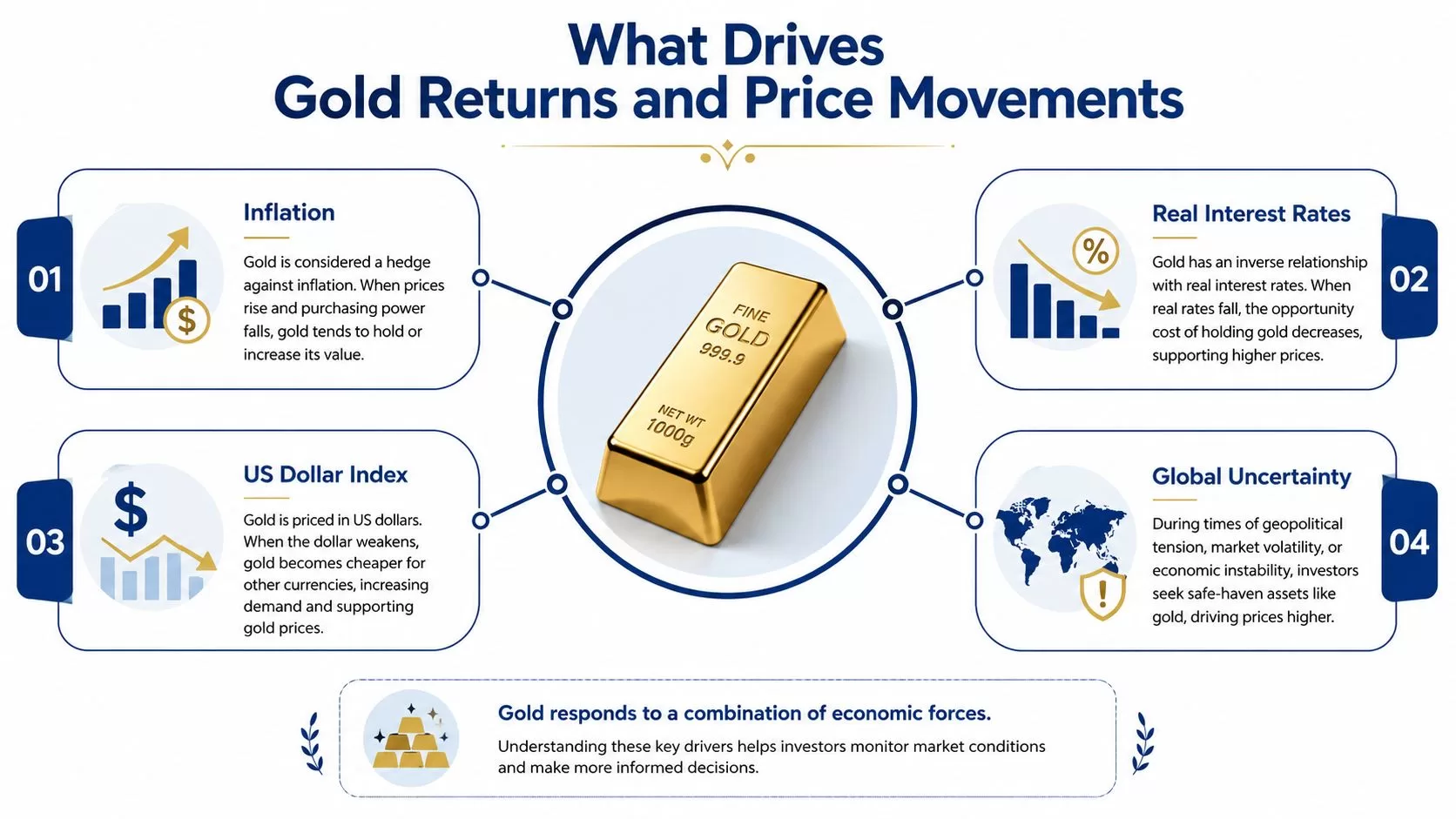
Gold doesn't respond to just one economic factor. It tends to react to a mix of inflation, interest-rate expectations, dollar strength, and uncertainty, which is why its price can feel disconnected from the rest of the market. In practical terms, those forces affect whether buyers are willing to pay more for a non-income-producing asset.
Inflation and uncertainty
Inflation matters because gold is often used as a store of value when purchasing power feels less secure. The World Gold Council says that in inflation years of 2% to 5%, gold's price increased about 8% per year on average, which helps explain why the metal draws attention during price pressure (World Gold Council). Geopolitical stress can also lift demand, since investors often look for assets they view as more durable in uncertain periods.
Interest rates and the dollar
Gold also reacts to real interest rates. When rates are more attractive elsewhere, holding a non-yielding asset becomes less appealing. That's why gold can struggle when markets expect tighter policy or stronger returns from cash and bonds. A market article discussing a hawkish Federal Reserve outlook shows that the rate backdrop can cap gold gains even when broader interest remains in the metal (The Coin Course).
Structural demand is changing the backdrop
The World Gold Council also says central banks have been large, persistent buyers of gold and describes gold as a strategic asset in a fragmented world (World Gold Council). That matters because gold's return profile isn't being shaped only by inflation headlines anymore. Official demand, portfolio diversification needs, and crisis protection all sit in the mix.
For retirement investors, the lesson is not to predict every move. It's to recognize that gold tends to work best when macro conditions favor caution, not exuberance.
The Hidden Costs That Reduce Your Net Gold Returns
The biggest mistake in gold planning is focusing on the metal's price chart and ignoring the account structure around it. Gold held in a retirement account can come with setup charges, annual custodian fees, storage expenses, and transaction costs. Those items don't always look large on paper, but they can reduce net return enough to change the outcome.
Gross return is not the same as what lands in the account
A gross gain on gold is only the starting point. If an investor sees a healthy price increase but pays ongoing account costs each year, the final result is lower than the headline move. That's especially important for near-retirees, because a modest drag repeated over time can matter more than it first appears.
A useful way to evaluate an arrangement is to add up the full cost stack:
- Setup charges: The one-time cost to open the account or establish the structure.
- Annual custodial charges: The fee for administrative oversight and account maintenance.
- Storage expenses: The cost of holding metal in an approved facility.
- Transaction costs: Buying and selling costs that reduce realized gains.
Why the fee structure matters so much
Many investors get tripped up here. A gold position that looks attractive at the metal level can become less appealing once the account is priced as a whole. That's why fee comparisons should focus on total cost impact, not just the lowest advertised line item.
The cost discussion is especially relevant in rollover situations, where account movement may involve separate steps and documentation. A detailed guide on IRA rollover fees can help frame the question the right way, because the expense profile often matters as much as the destination itself.
Bottom line: Gold can be a sensible diversifier and still produce a disappointing net result if the account costs are too heavy.
A better way to judge providers
The right question isn't, “Is gold up?” It's, “How much of that move stays in the account after all costs?” That mindset is more realistic for retirement planning. It also helps investors avoid overestimating what a Gold IRA can contribute if the fee structure is too aggressive for the account size.
Comparing Gold Returns to Stocks and Bonds
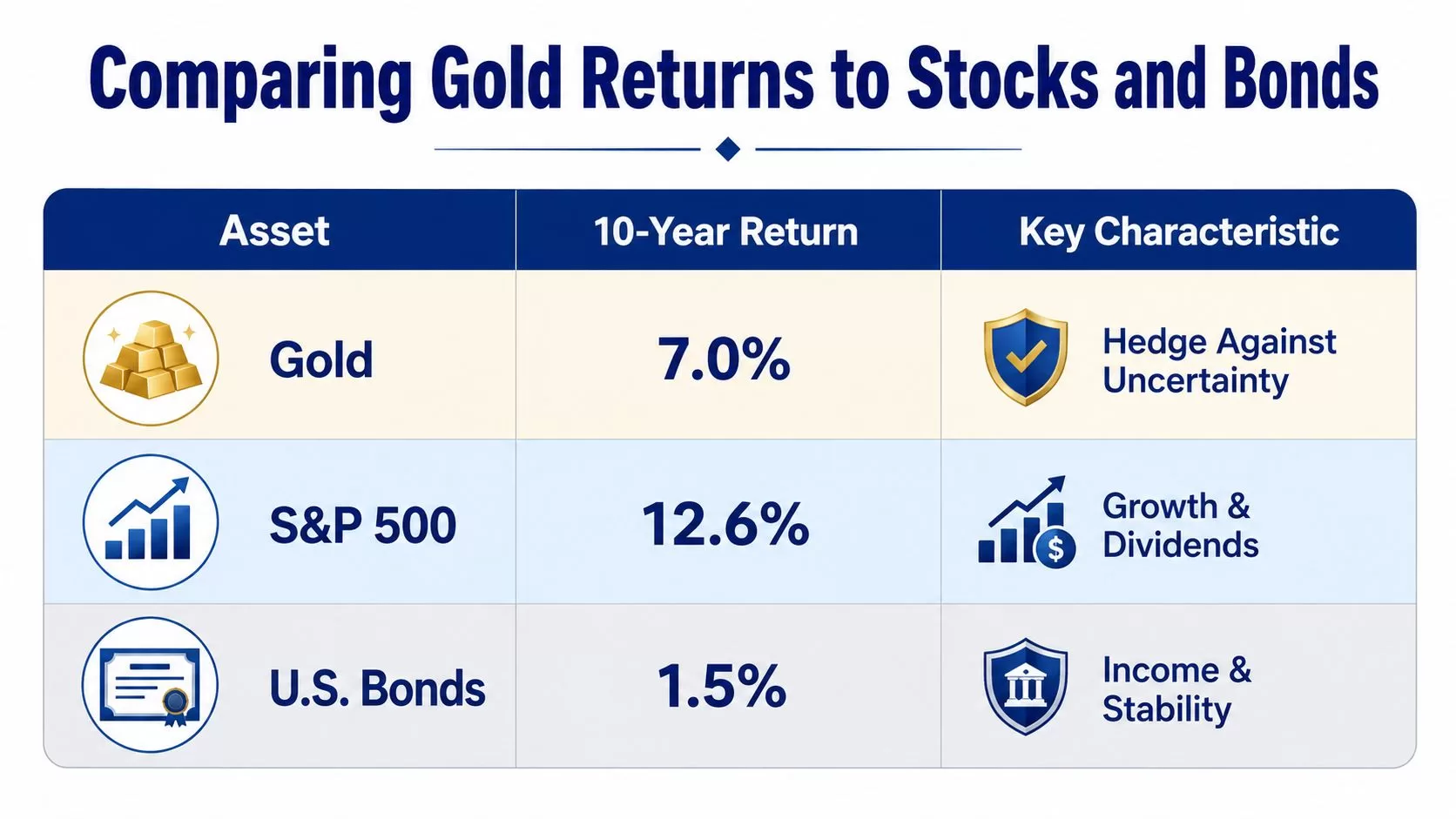
A retirement portfolio can tell a more useful story about gold than a standalone price chart. Gold may rise over time, but its real value depends on how it behaves beside assets that produce income, grow earnings, or provide fixed payments. That is why the better comparison is not “Did gold go up?” It is “What did gold add to the whole mix after costs, volatility, and income needs are considered?”
Gold's role is different, not necessarily better
Stocks and bonds have jobs that gold does not share. Equities can compound through business growth and dividends, while bonds can add interest income and help steady a portfolio. Gold sits in a different bucket. It is often used as a diversifier, especially when paper assets are under pressure or when an investor wants an asset that may not move in lockstep with the rest of the account.

That difference matters more than a simple return ranking. The historical comparison cited earlier shows that gold can hold its own over long stretches, while stocks have historically offered a separate advantage because of growth and income. In other words, gold is often judged too harshly when people expect it to behave like an equity fund or a bond ladder. It is better understood as a stabilizing sleeve inside the portfolio, not the engine of long-term wealth creation.
Risk-adjusted returns matter more than headline returns
A useful comparison has to account for volatility, not just price appreciation. A return that looks attractive on paper can feel very different if it arrives in a choppy pattern, or if fees and spreads reduce the amount that stays in the account. That is especially true in a retirement setting, where drawdowns and liquidity needs can matter as much as average performance.
The NBER notes that gold has no cash flow, so its value is often debated in terms of portfolio construction rather than income generation. That framing helps explain why a modest allocation may improve risk-adjusted returns even if it does not maximize raw growth. For near-retirees, that distinction is more practical than asking whether gold can beat equities in every period.
A Gold IRA adds another layer to that comparison because the account structure itself can affect the net result. A self-directed account, such as a self-directed gold IRA, may give investors access to physical metal, but the true outcome still depends on the fees attached to the account, the storage arrangement, and the costs of buying and selling. A position can look reasonable at the asset level and still underperform after those expenses are taken out.
The right comparison is portfolio role
Gold is usually most useful when it fills a gap the rest of the portfolio does not cover. That may mean adding balance to a stock-heavy account, providing a potential cushion during stress, or giving a retiree another source of diversification when other assets are closely tied to market cycles. The point is not to make gold the hero of the plan.
It is to judge whether gold improves the shape of the portfolio once the full cost stack is included. That includes account fees, storage, transaction costs, and the opportunity cost of holding an asset that does not pay income. Once those pieces are added together, the comparison becomes clearer. Gold may be a good fit, but only if its role matches the investor's need for diversification and the account remains efficient enough to preserve the return that is earned.
Practical Gold IRA Strategies for Retirement Planning
A Gold IRA can fit into retirement planning, but only if the investor understands the tradeoffs. Gold in an IRA still needs to make sense after fees, liquidity limits, and account rules are considered. The best use case is usually not maximum growth. It's a thoughtful allocation that supports diversification and long-term resilience.
How to think about allocation
For a cautious retiree, the decision often starts with the role gold should play. Some investors want a small stabilizing position. Others want a larger hedge against uncertainty, especially if they already hold plenty of equities or paper assets. The exact allocation belongs in a broader plan, not in a one-size-fits-all rule.
A few practical checkpoints help narrow the choice:
- Match the role to the goal: Use gold as diversification if the portfolio already depends heavily on market-linked assets.
- Check the cost drag: A smaller account can be more sensitive to ongoing fees than a larger one.
- Think in holding periods: Gold's cyclical returns make more sense over longer windows than short trading horizons.
Tax structure, rollovers, and liquidity
Traditional and Roth structures can lead to different tax outcomes, so the account type matters before any rollover begins. The same is true for timing, because a poor rollover can trigger avoidable taxes or penalties. Gold also has a liquidity consideration, since metals aren't as easy to redeem as cash or mutual fund shares.
For investors considering a self-directed structure, a clear overview of self-directed Gold IRA basics is a useful starting point. It helps frame the custodian role, approved metals, and the difference between holding bullion directly and owning it inside a retirement account.
The final checklist before moving money
Before making any move, retirees should confirm the account's rules, cost schedule, and distribution requirements. The IRS treatment of precious metals can be strict, and the right setup depends on the investor's specific circumstances. This is not financial advice. Consult a licensed financial advisor, CPA, or tax professional before making investment decisions.
The best Gold IRA plan is usually the one that stays disciplined: reasonable allocation, clear fees, compliant metals, and an exit strategy that preserves flexibility.
Gold can be a useful retirement asset, but only when the investor measures net return, not just metal appreciation. Gold IRA Association publishes plain-English guides on gold IRA rules, rollover mechanics, and fee tradeoffs so retirees can make clearer decisions before moving savings. For a deeper look at how a Gold IRA may fit into a diversified retirement plan, visit Gold IRA Association and review the educational resources before choosing a path.


