




You're considering a New York gold company because you want physical metal inside a retirement account, but the dealer's sales pitch has left important questions unanswered. Who holds the money? Which custodian owns the account? Is the gold IRA-eligible, and what fees appear after the quoted premium? The right evaluation starts with licensing, separation of roles, purity records, and written pricing, not with the lowest advertised spread.
What a New York Gold Company Actually Does
A New York gold company may advertise several services under one roof, but the dealer's proper role is narrower than many buyers assume. It can sell bullion, quote products, prepare an order, explain available metals, coordinate with a retirement-account custodian, and sometimes describe a buyback process. It shouldn't personally hold IRA funds, serve as the IRA custodian, or store the retirement account's metal.
That distinction matters because the transaction normally involves three separate parties:
- The dealer: Sources the coins or bars, quotes the purchase price, and prepares the trade documents.
- The custodian: Opens and administers the self-directed IRA, receives transferred retirement funds, and records the account's assets.
- The depository: Stores the IRA-owned metal under the custody arrangement selected for the account.
A long-running local presence can be relevant, but longevity alone doesn't prove that a company's current IRA process is clean. New York Gold Co. states that it has operated for 40 years from Jackson Heights, New York, and lists its address as 37-19 74th Street, 2nd Floor, Jackson Heights, New York 11372, with telephone ordering at (718) 507-8787. Its public website is described as available 24 hours a day, 7 days a week, 365 days a year in the company information filed with New York Gold Co.’s business disclosure.
The practical question isn't whether a dealer offers every service. It's whether the company can document exactly where each responsibility begins and ends.
Practical rule: Ask for the dealer agreement, custodian disclosure, depository details, product specifications, and complete fee schedule before sending retirement funds.
This guide uses three verification gates. First, check the dealer's state records. Second, confirm that the custodian and depository are independent from the dealer. Third, verify the metal's purity and eligibility. Readers who want a broader reference can review these precious-metal IRA rules before approving an order.
The Three-Part Compliance Check Before You Sign
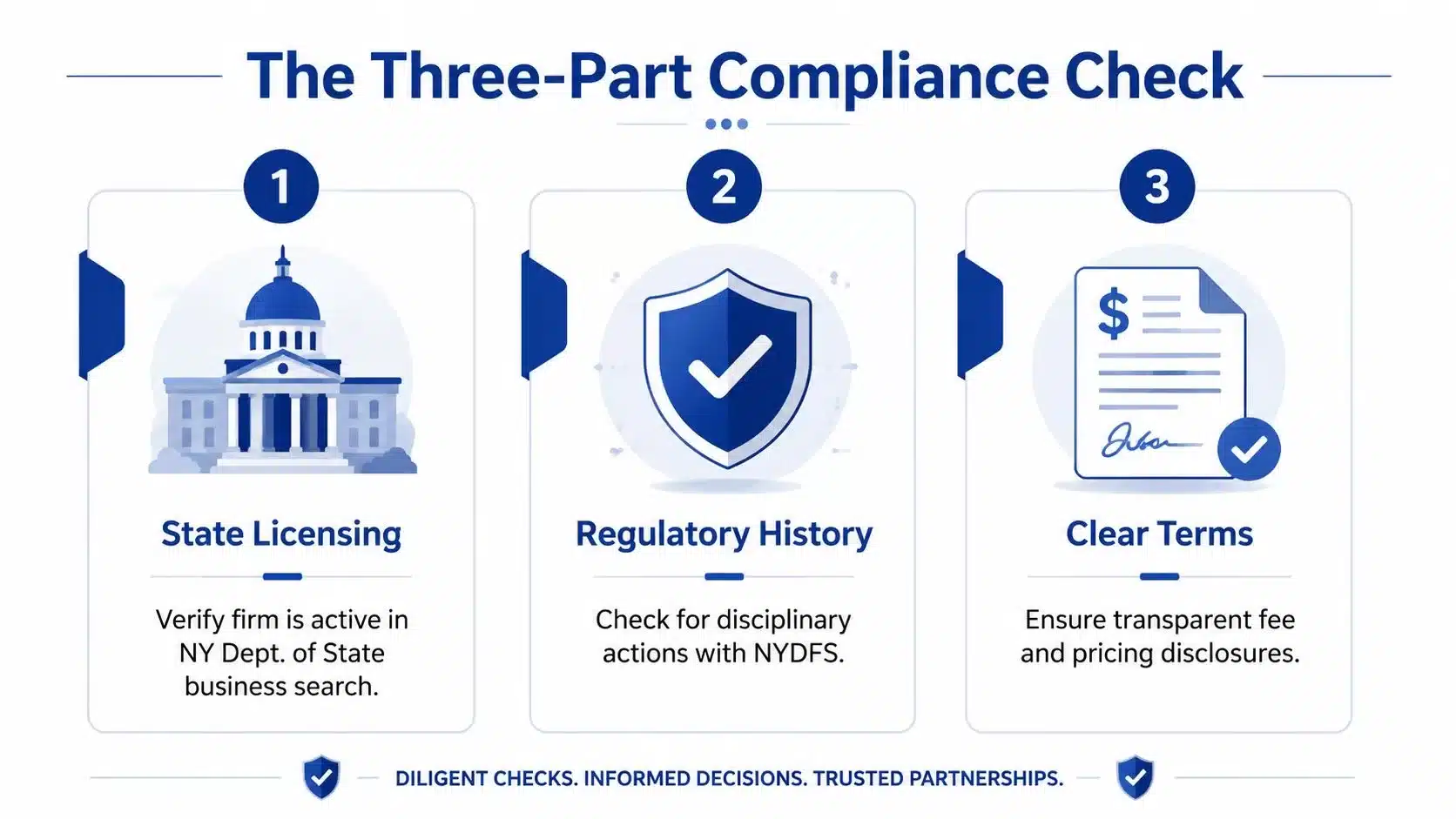
A serious dealer should clear three separate checks before a buyer signs an order or authorizes a rollover. Treat each check as a document request, not as a verbal assurance.
Gate one verifies the dealer's state status
Search the company in the New York Department of State business records and confirm that the entity is active under the name used in the contract. Where the business activity requires a specific precious-metals, second-hand dealer, or related registration, ask which registration applies and request the relevant number or certificate.
New York City requires licensed second-hand dealers and pawnbrokers to keep detailed electronic records describing precious-metals items. City consumer guidance also tells consumers that they can check licenses and file complaints if they believe they were treated unfairly when selling gold. New York has also seen movement toward tighter oversight of second-hand precious-metals dealers, including a 2025 Senate bill addressing registration for mail-in dealers and expanded access to transaction records, as described in the New York legislative bill record.
The important point is simple. A business search and license check can identify the legal entity you're dealing with, while the contract should identify the same entity.
Gate two separates the account from the seller
The dealer shouldn't open and administer the IRA. An IRS-approved self-directed custodian should establish the account, receive the rollover or transfer, execute the purchase instruction, and issue account statements. The depository should separately hold the metal.
If a salesperson says the company can act as dealer, custodian, and storage provider without clearly identifying independent entities, stop the process. Ask for the custodian's legal name, the depository's legal name, the account-opening documents, and the storage agreement.
Gate three confirms fineness and origin
For IRA-eligible gold, the principal technical threshold is 0.995 fineness, or 99.5% purity. The explicit exception is the American Gold Eagle, which is permitted despite being 91.67% pure, according to this IRA precious-metals eligibility guide.
Bars and rounds should come from an accredited refiner or assayer recognized by an accepted exchange or standards body. Request assay records, mint documentation, and product specifications in writing. Gold-colored or marketable isn't the same as IRA-eligible.

Dealers, Custodians, and Depositories Explained
The cleanest way to evaluate a New York gold company is to map the transaction from the retirement account to the vault. Each party should have a defined job, a separate agreement, and a clear record of what it controls.
The retail dealer sells the metal. It may source products, apply a premium over the market price, prepare a purchase order, and coordinate delivery instructions with the custodian. It shouldn't take possession of IRA funds or personally store the retirement account's bullion after the purchase.
The self-directed IRA custodian administers the account. It receives the rollover or transfer, follows the account owner's investment direction, records legal ownership for the IRA, and provides statements. For a plain-language explanation of this role, see the guide to an IRA custodian for gold.
The approved depository stores the metal under the IRA's custody arrangement. Buyers should ask whether the storage is allocated or segregated, what insurance applies, how audits are handled, and whether the storage contract permits the type of product being purchased. LBMA Good Delivery standards are a major wholesale benchmark for bar quality, covering more than purity and including physical specifications and provenance controls through LBMA market standards.
| Party | Primary Role | Holds the Money? | Holds the Metal? | Key Document |
|---|---|---|---|---|
| Retail dealer | Sells and documents the bullion purchase | No | Only during the sales and delivery process, if applicable | Purchase order and invoice |
| Self-directed custodian | Opens and administers the IRA | Yes, within the account | Records legal custody for the IRA | Custodial agreement and account statement |
| Approved depository | Stores the IRA-owned bullion | No | Yes, under the storage arrangement | Storage agreement and inventory record |
A dealer that refuses to identify the custodian or depository is withholding information a buyer needs before funding. Ask three direct questions: Which custodian will hold the account? Which depository will store the bars? May the storage agreement be reviewed before funding?
Completing a Rollover Without Triggering Taxes
A rollover is a retirement-account transaction first and a metals purchase second. The safest process keeps the retirement funds moving between qualified institutions rather than placing the money in the buyer's personal hands.
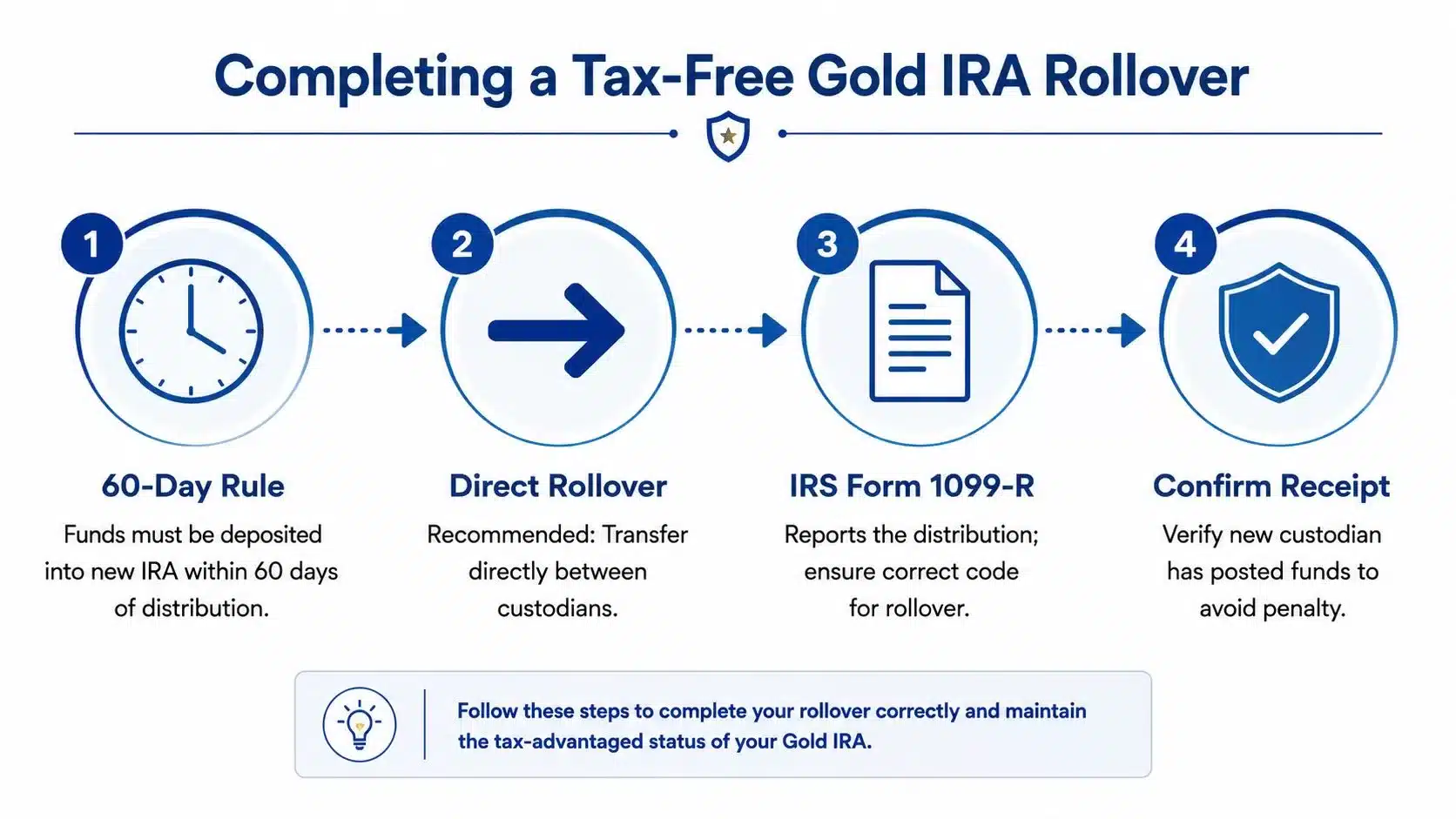
Suppose a pre-retiree leaves an employer and wants to move a 401(k) into a self-directed IRA that can purchase approved gold. The account owner should ask the existing plan administrator whether a direct rollover is available. In that arrangement, the plan administrator sends the funds directly to the new IRA custodian, and the buyer doesn't receive the distribution personally.
An indirect rollover works differently. The plan sends the distribution to the individual, who must deposit the funds into another IRA or retirement plan within 60 days of receipt, as explained by the IRS rollover rules. Missing that deadline can make the distribution taxable, and an early-distribution penalty may also apply when the individual is below the applicable retirement age.
Why direct movement is usually cleaner
A direct 401(k)-to-IRA rollover avoids the practical risks that accompany a check payable to the account owner. The custodian can document receipt, the buyer can verify that the funds posted, and the dealer can coordinate the metal order after the account is funded.
The IRS generally limits indirect rollovers from the same IRA to one rollover within any one-year period. That restriction applies to IRA-to-IRA indirect rollovers, not every retirement transfer. A 401(k)-to-IRA movement isn't subject to that specific once-per-year limit, according to this explanation of 401(k)-to-IRA rollover mechanics.
A New York gold company should help coordinate timing with the custodian. It shouldn't tell the buyer to take personal receipt of a distribution merely to speed up the metal purchase.
Before authorizing anything, verify:
- Distribution type: Confirm whether the transaction is direct or indirect.
- Payee: Check who receives the rollover check or electronic transfer.
- Deadline: If funds come to the individual, calendar the 60-day deposit requirement immediately.
- Receipt: Obtain written confirmation that the new custodian posted the funds.
- Purchase timing: Approve the metals order only after the custodian confirms the account can transact.
The following video can help readers visualize the sequence of a rollover, but it doesn't replace guidance from the plan administrator, custodian, tax professional, or financial advisor.

Comparing the Four Fee Buckets in Writing
A dealer's headline premium does not show the full cost. Compare the all-in written cost, including account setup, administration, storage, and the amount paid above the underlying value of the gold. This documentation matters more than a low advertised premium because it shows what the transaction will cost years later.
| Fee Bucket | Charged By | Typical Structure | Ask For In Writing |
|---|---|---|---|
| Setup fee | Dealer or custodian | One-time charge when the account opens | Exact amount, payment timing, and refund policy |
| Custodian fee | Self-directed custodian | Ongoing account-administration charge | Annual amount, billing date, and included services |
| Storage fee | Approved depository | Ongoing charge, sometimes flat or based on account value | Storage method, insurance, audit terms, and annual cost |
| Buy-side premium | Dealer | Amount added above the market value of the metal | Product price, reference price, spread, shipping, insurance, and assay costs |
The buy-side premium often matters more than recurring administrative charges. A 5% premium on a $100,000 purchase equals $5,000. That calculation uses the quoted purchase amount, not a general market statistic. Compare the total purchase price before approving the order.
New York consumer-protection materials require gold buyers to disclose the basis for pricing, including the troy weight of customer items, as described in the New York consumer-protection materials. Apply the same standard to bullion purchased for an IRA. The invoice should identify the product, quantity, weight, purity, price basis, premium, shipping, insurance, and every other charge.
Pricing test: If the salesperson explains the price verbally but refuses to provide the same explanation in a written invoice, do not approve the quote.
A New York Attorney General filing alleged deceptive sales practices by a major gold and silver dealer, including hidden commission fees alleged to reach 33% on more than $43 million in sales since 2014. The filing shows why written disclosure matters. Before signing, compare contracts line by line using this IRA rollover fee guide. A lower annual fee does not compensate for an undisclosed purchase spread.
Request one document showing every fee and one invoice showing the exact metal pricing. Have the custodian's agreement, depository terms, dealer order, and payment instructions match. If any amount appears in a sales call but not in the paperwork, stop the transaction until the company corrects the documents.
Red Flags and Pricing Traps to Watch For
The lowest advertised premium isn't automatically the best deal. A clean transaction depends on documentation, role separation, product eligibility, and a complaint process that works when something goes wrong.
Watch for these warning signs:
- Compressed decision-making: A salesperson pressures the buyer to liquidate or roll over retirement funds within days.
- Missing paperwork: The firm won't provide fees, product details, or agreements before account opening.
- Blended roles: The company claims it can be dealer, custodian, and depository without naming separate legal entities.
- Unsolicited account details: A caller references an IRA balance or retirement holdings without a clear explanation of how the information was obtained.
- Collectible substitution: The representative pushes collectible or numismatic products into an IRA without proving eligibility.
- Incomplete spot quotes: “Spot plus” excludes shipping, insurance, assay charges, or other costs.
- Bait pricing: One product carries an attractive headline price while the requested product carries a much larger markup.
Complaint research deserves more than a quick star rating. Review the Better Business Bureau record, New York Department of State licensing information, and federal court records through the Southern District of New York's PACER system. One prominent New York bullion dealer had 20 total BBB complaints in the last three years and 10 closed in the last 12 months, according to the complaint information supplied for this guide. Those figures don't establish wrongdoing, but they do justify questions about fulfillment and post-sale support.
A company that resists documentation is the wrong company, regardless of its advertised spread. Buyers need a record that can be reviewed years later, not a promise that disappears when the salesperson changes jobs.
Your Verification Checklist and Next Step
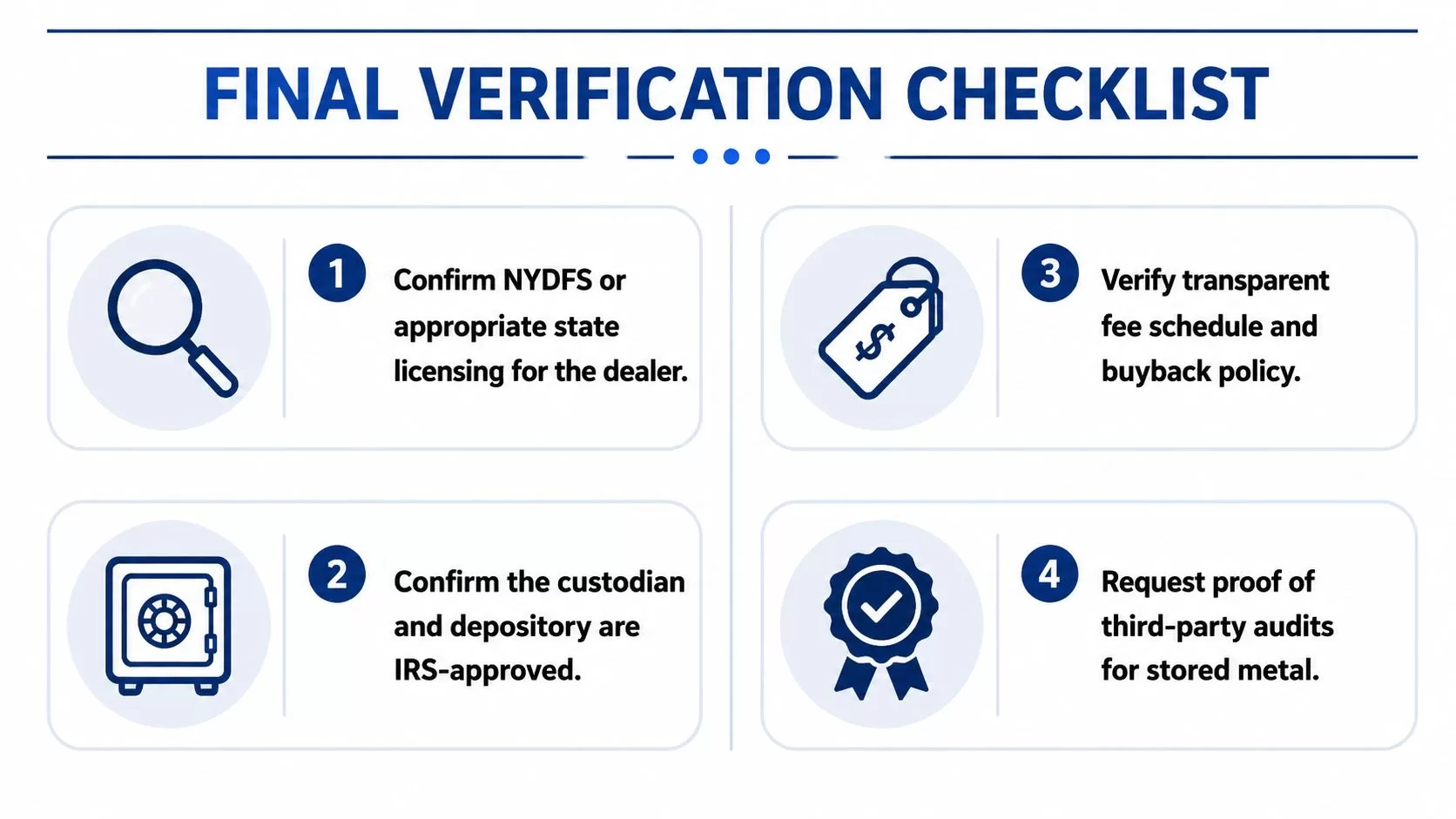
Before funding a precious-metals IRA, require a paper trail that can survive a later review:
- Confirm licensing: Search the dealer's legal entity in New York records and verify applicable state or city registration.
- Separate the roles: Confirm that the dealer, self-directed custodian, and depository are separate legal entities.
- Verify eligibility: Confirm 0.995 fineness for gold, while recognizing the permitted American Gold Eagle exception at 91.67% purity.
- Request the quote: Get an itemized invoice listing the product, weight, purity, premium, shipping, insurance, and every other charge.
- Review storage: Read the depository agreement. Confirm storage method, insurance, audit process, and inventory records.
- Check complaints: Review complaint history with the Better Business Bureau and relevant consumer-affairs records.
- Confirm rollover receipt: Have the custodian post the funds before approving the metal purchase.
Apply the same record-by-record discipline used in a broader due diligence process for transactions. Pull written disclosures from two or three firms and place them side by side. If the documents do not match the verbal quote, do not fund the account.
Paperwork protects the account years after purchase. This is not financial advice. Consult a licensed financial advisor, CPA, or tax professional before making investment decisions.
Gold IRA Association provides educational guides and checklists. Its comparison checklist can help organize the disclosures before you call. Use it to compare documents, then refuse to proceed until the written terms support the quote.


