




Sitting on a 401(k) statement and wondering whether a slice of retirement savings should move into gold or silver is a real, practical decision, not a theory exercise. The hard part isn't understanding the metals, it's choosing the precious metals IRA company that won't nickel-and-dime the account or talk you into a bad setup. The right choice comes down to trust, fees, storage, eligible metals, and how easily you can get out later.
| Company type | Best fit | Main trade-off |
|---|---|---|
| Lower-minimum provider | Smaller rollovers and first-time buyers | Lower entry, but recurring costs can matter more |
| Mid-market provider | Balanced service and account size | Usually a middle ground on fees and support |
| Premium-service provider | Larger balances and hands-on help | Higher minimums and often higher annual costs |
What Makes a Precious Metals IRA Company Worth Your Trust
A lot of people reach this decision after one jarring moment, maybe a market drop, maybe inflation eating into a nest egg, maybe a 401(k) statement that suddenly feels too exposed. That is when the sales calls start. In a crowded market, the core issue is not whether there are enough providers. It is whether the person on the phone is helping you build a retirement strategy or just pushing a rollover.
The market has gotten far more crowded. More firms now chase this business, which means more scripts, more pressure, and more variation in how companies handle an account. A cautious buyer should treat that as a warning to screen harder, not a reason to move faster.
The five questions that matter
The best way to screen precious metals IRA companies is to ignore the polish and focus on five things:
- Credibility and track record, because a retirement account is no place for a fly-by-night operation.
- Fee transparency, because small recurring costs can matter more than a shiny sales pitch.
- Custodial and storage arrangements, because the account has to work inside the IRA rules, not around them.
- Eligible product breadth, because a narrow menu can box you in later.
- Buyback liquidity, because getting in is only half the job, getting out cleanly matters too.
That last point gets overlooked constantly. A company can look affordable on day one and still prove expensive over a decade if the dealer premium is wide, storage is layered on top, and the exit spread is ugly. A retiree does not need clever branding. A retiree needs a firm that can explain the full path from rollover to storage to sale without dodging the hard questions. For the custodian side of that setup, see this guide to choosing an IRA custodian for gold.
Practical rule: If a provider cannot explain fees, custodian duties, storage, and buyback terms in plain English, it is not ready for a retirement account.
The asset mix inside these accounts is also telling. Industry estimates show gold accounts for about 80% of metal value held, silver runs around 15% to 18%, and platinum and palladium make up only a small single-digit share (source). That points to two clear takeaways. First, this is mostly a gold-led retirement allocation. Second, if a company pushes a broad “metals basket” pitch but cannot support the actual account structure, the pitch is stronger than the plumbing.
A trustworthy company earns that label by clearing objective benchmarks. If it cannot do that, it should not be near a rollover decision.
IRS Rules Every Precious Metals IRA Company Must Follow
The compliance rules are the floor. Any company handling a precious metals IRA has to work inside IRS-allowed metal standards, custodian rules, and storage requirements. If a salesperson is fuzzy on those basics, that is a warning sign.
The purity and sourcing test
The IRS-allowed metals have specific fineness standards. Gold must be at least 99.5% pure, silver at least 99.9% pure, and platinum and palladium at least 99.95% pure. The metal also has to come from an accredited refiner, assayer, manufacturer, or a national government mint. That makes eligibility more mechanical than most sales pages admit.
A provider that glosses over purity thresholds or steers you toward collectibles is not simplifying the process, it is muddying it. Ask for the exact product class and make sure it clears the eligibility test before anything is purchased.
The cleanest compliance check is simple. If the metal, the custodian, or the storage arrangement cannot be explained clearly, pause the process.
Custody and tax treatment
A precious metals IRA is still a self-directed IRA. The same basic tax framework applies, contributions can be tax-deductible, growth is tax-deferred, and taxes are generally due at withdrawal. The account must be held by an IRS-approved custodian, because the investor is not allowed to personally manage or take possession of the metals. For the basic rule set, start with Read the basic IRS rule set for precious metals IRAs.
That is the line in the sand. If a company suggests home storage as a casual option, treat that as a stop sign. A legitimate provider should explain the custodial framework, not try to route around it.
| Metal | Minimum purity | Typical qualifying formats |
|---|---|---|
| Gold | 99.5% | Coins or bars that meet IRS rules |
| Silver | 99.9% | Coins or bars that meet IRS rules |
| Platinum | 99.95% | Coins or bars that meet IRS rules |
| Palladium | 99.95% | Coins or bars that meet IRS rules |
A good company does not just know these rules, it can explain why they matter to your account. That is the difference between a salesperson and a real guide.
Side-by-Side Fee and Minimum Comparison of Top Providers
The retiree who only checks the minimum deposit usually misses the full bill. The bigger number is what the account costs over time, because dealer spreads, storage charges, and admin fees keep showing up long after the first purchase. Market comparisons put annual fees in a broad range, and the spread depends on how a company structures storage and service. Minimums also vary, with some firms opening the door at a lower balance and others reserving their service for larger accounts.
What the numbers mean in practice
A lower minimum makes an account easier to start, but it does not make the account cheap. Fixed annual charges can weigh hard on a smaller balance, especially when the metal itself is already priced above spot through dealer premiums. For a buy-and-hold investor, the better question is simple, which company leaves the least money on the table over a long holding period.
The clean way to compare providers is to look at the full cost stack, not the entry pitch.
- A lower-entry provider can work for someone starting with a modest balance, but setup, storage, and annual administration still need to be counted together.
- A mid-range provider can make sense if the fee structure is steadier and the service is better organized.
- A higher-minimum provider may be reasonable for a larger account if the service is stronger and the ongoing drag stays controlled.
The right choice depends on your account size and how long you plan to keep the metals inside the IRA. If you are building a smaller account, recurring fees can swallow the advantage of a low minimum. If you already have a larger balance, a higher minimum is easier to justify when the service is solid and the annual cost stays predictable.
See how a precious metals IRA is opened and funded
Bottom line: Judge the provider by total cost of ownership, not by the minimum deposit alone. A cheap entry can turn expensive if recurring fees and buyback spreads keep draining the account.
Opening and Funding a Precious Metals IRA Step by Step
The process is more paper-driven than many expect. It's not a retail purchase, and it's not supposed to feel like one. A legitimate account uses a documented workflow because the IRS wants the money and the metals handled inside the retirement structure, not casually moved by the investor.
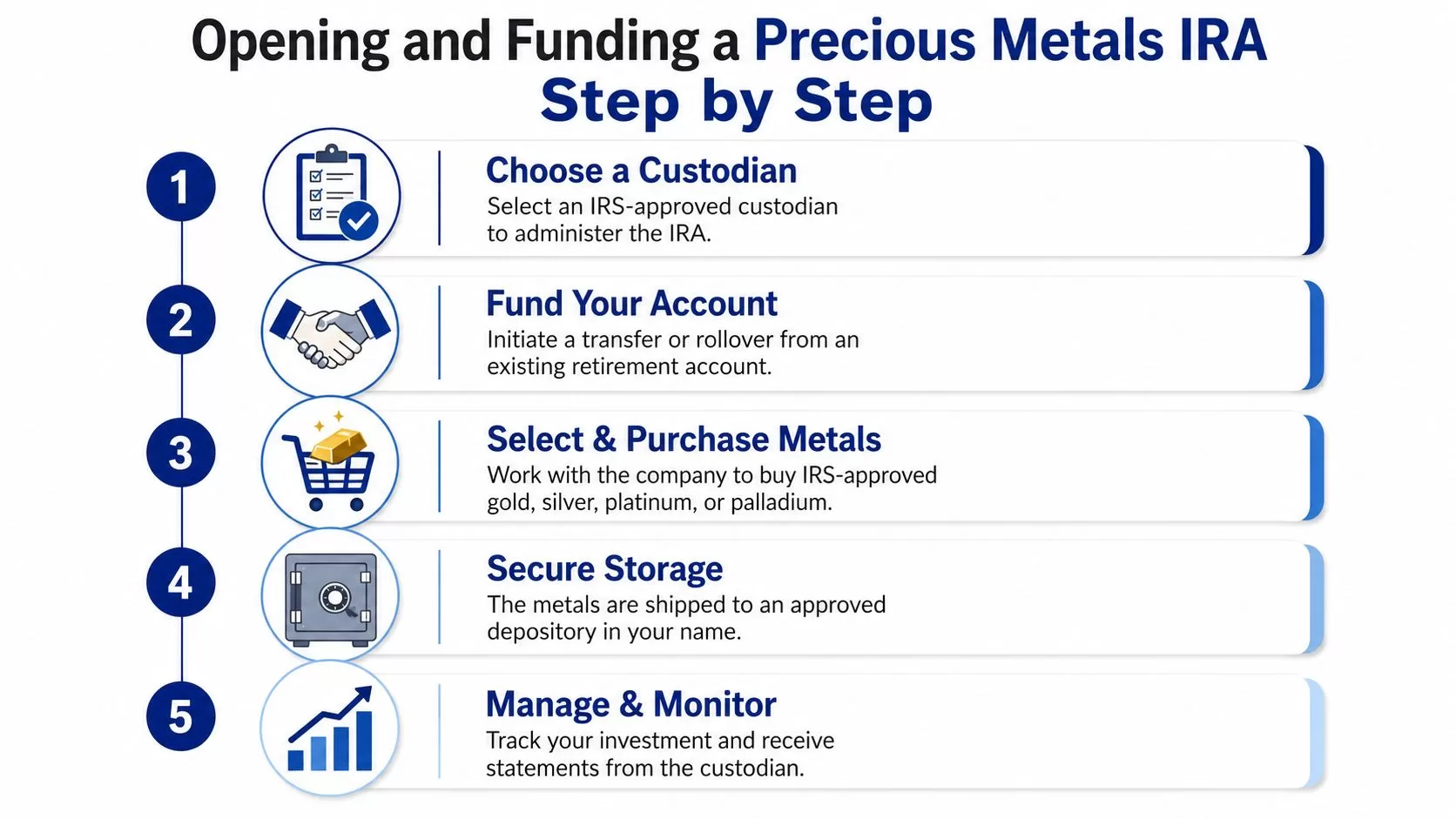

The sequence usually starts with a self-directed IRA custodian and a funding decision. From there, the account can be funded by a direct rollover from a 401(k) or a transfer from an existing IRA. A direct rollover keeps the money moving custodian-to-custodian, which avoids the tax and timing risk that comes with the indirect version.
A direct-to-custodian path is the one to insist on when possible. An indirect rollover puts the funds in the investor's hands first, and that creates avoidable withholding and deadline pressure. For most retirees, that's unnecessary risk.
The paperwork chain matters
Entrust's guide lays out the purchase workflow in a way that's worth paying attention to. The investor opens a self-directed IRA, funds the account, then completes a Precious Metals Buy Direction Letter, signs the dealer invoice marked “READ and APPROVED,” signs the Depository Holdings Election Form, and submits the forms to the Precious Metals Department before the metals are acquired and stored.
That sounds formal because it is formal. It should be. The more orderly the paperwork, the less room there is for a mistaken trade or a compliance problem. Once the forms are processed, the dealer acquires the metals and ships them to an approved depository for storage.
Review the account-opening process in more detail

A company that knows this process cold will walk you through the forms without drama. A company that makes it sound loose or optional is not the one to trust with retirement money.
True Total Cost and Liquidity Most Comparisons Miss
The biggest mistake in this category is focusing only on the annual fee. That number matters, but it's only one layer of the cost stack. Physical metals inside an IRA usually come with dealer premiums over spot, recurring storage and insurance costs, annual custodian administration fees, and then a buyback spread when the time comes to sell.
Why the exit matters as much as the entry
A lower-minimum provider can still be more expensive over a long retirement horizon if it charges wider dealer premiums or gives you weaker buyback pricing. That's the part most comparison pages leave out. A retiree who plans to hold for 10 to 20 years should care about liquidation terms just as much as opening fees, because the spread on the way out determines what lands back in the account.
The true question is not “What does this company charge to start?” It's “What does this account cost from purchase to storage to sale?” That includes all the drag that never shows up in a glossy brochure.
Practical rule: Ask for the full buyback policy before you fund the account. If the company won't put the terms in writing, assume the exit isn't favorable.
A lot of people get talked into the idea that physical gold or silver is automatically simple because it's tangible. It isn't. It's a layered asset inside a retirement wrapper, and the wrapper has costs. That doesn't make it a bad allocation, it just means the math has to be honest.
The most useful screening question is this. If two providers both meet the IRS rules, which one gives the cleaner all-in economics for your account size and time horizon? That's the right comparison, and it's the one too many sales pages avoid.
Red Flags and Pressure Tactics to Watch For
Bad sales behavior is easy to recognize once you know what to listen for. The worst callers create urgency, gloss over fees, and try to move the conversation before the investor has a chance to think. A legitimate precious metals IRA company should do the opposite, it should slow the process down enough for the facts to land.
The classic warning signs
- High-pressure calls or “limited-time” language, because retirement money should never be rushed.
- Refusal to provide written fees upfront, which usually means the numbers are worse than advertised.
- Pushing non-IRS-approved collectibles or rare coins, which can derail the account.
- Discouraging independent research, which is a bad sign in any financial decision.
- Vague answers about storage and insurance, because those details should be straightforward.
- Educational material that only talks about price predictions, because real guidance covers rules, fees, and process.
The home-storage pitch deserves special attention. If a company suggests you take physical possession of the metals, that's not a convenience feature. It's a compliance problem that can disqualify the IRA. A company that understands the rules should say that plainly.
The better firms look boring on this front. They send itemized fee schedules, explain the custodian role, and give buyback terms in writing. They don't lean on fear, and they don't pretend that a retirement account should be decided in a 10-minute phone call.
Matching the Right Provider to Your Retirement Scenario
There isn't a single “best” company for everyone, and anyone claiming otherwise is usually selling something. The right fit depends on account size, the level of hand-holding you want, and whether your goal is simple gold exposure or a broader multi-metal setup. A retiree with a modest rollover and a larger investor with a more complex allocation should not be looking for the same thing.
The smaller rollover
A first-time buyer rolling a smaller 401(k) balance should prioritize a low minimum, clear education, and simple onboarding. In that case, the provider's job is to keep the process understandable and the recurring costs from swallowing the account. A low entry point is useful here, but only if the company is honest about the full fee stack.
The larger balance
A higher-balance investor with $40,000 or more to allocate can afford to weigh service quality more heavily. For that person, a premium support model may be reasonable if the custodian coordination is smooth and the fee structure is still transparent. A higher minimum is not automatically a problem when the account can absorb it.
The broader metals allocation
An investor who wants silver, platinum, or palladium should screen for a provider that supports multiple IRS-eligible metals through a true self-directed structure. That matters because product breadth is not the same thing as a broad menu in a brochure. The provider has to support the account operationally, not just advertise it.
A useful filter is this. If the company can't support the metals you may want later, it may force an account change at the worst possible time. That's a setup issue, but it can turn into a cost issue fast.
The most dependable rule is simple. Match the provider to the account, not the marketing. A small account needs accessibility and clarity. A larger account can justify more service. A multi-metal investor needs flexibility. The “best” company is the one whose fees, service level, and metal support fit the retirement plan you're building.
Frequently Asked Questions About Precious Metals IRA Companies
Can physical metals be held at home inside an IRA? No. Personal possession is a problem because the metals have to remain inside the IRA structure with an IRS-approved custodian and approved storage.
How long does a 401(k) rollover usually take? A direct custodian-to-custodian transfer usually takes about one to three weeks, depending on how quickly each institution processes the paperwork.
Do precious metals IRAs follow the same contribution framework as other IRAs? Yes. The precious metals sit inside a self-directed IRA, so the underlying IRA contribution rules still apply.
Can platinum or palladium be added later through the same custodian? Yes, if the custodian supports those metals and the products meet the IRS purity standards.
Gold IRA Association keeps this topic practical, not promotional. If you're comparing precious metals IRA companies and want a cleaner way to judge fees, storage, compliance, and buyback terms, Gold IRA Association gives you the research framework to do it with less guesswork. Take the next step by reviewing the provider differences before you move retirement money anywhere.


