




Most retirement guides reduce the Roth vs non-Roth debate to a single guess: will your tax bracket be higher or lower when you stop working? That shortcut misses the mechanics that decide how much of your nest egg you keep, including forced withdrawals, income sequencing, and how conversions affect the rest of your tax return.
Millions of Americans are already weighing these exact rules as Roth accounts grow more common alongside traditional plans. According to an analysis of the 2025 Survey of Consumer Finances published by the Budget Lab at Yale, 58% of U.S. households with an IRA held a Roth account, up from slightly more than 50% in 2022. Understanding how both structures work side by side, and how they behave during rollovers or precious-metals investments, helps savers avoid expensive surprises later in retirement.
Roth vs Non-Roth IRAs Side by Side
Think of a Roth vs non-Roth choice as choosing where to place a heavy suitcase on a trip. The suitcase still weighs something. You are choosing whether to carry it at the start of the journey or near the end. Roth accounts take the tax hit before the money grows. Traditional accounts usually delay that hit until withdrawals.
| Feature | Roth IRA | Traditional (non-Roth) IRA |
|---|---|---|
| Tax on contributions | After-tax, no upfront deduction | May be deductible, depending on income and workplace plan coverage |
| Tax on qualified withdrawals | Earnings tax-free if qualified | Withdrawals generally taxable as income |
| Required minimum distributions | None for original owner | Generally begin by April 1 of the year after age 73 |
| 2026 contribution limit | $7,500 combined, or $8,600 at age 50 or older | Same combined limit, shared across both IRA types |
| Income eligibility | Contributions phase out at higher incomes | Deductibility depends on income, workplace plan coverage and filing status |
The table works best as a set of cause-and-effect clues. A Roth contribution gives no upfront tax break, so its value depends on later qualified withdrawals. A deductible traditional contribution may reduce taxable income in the year of the deposit, but later withdrawals are generally treated as income. That difference shapes cash flow at two very different points in life: while you are working and after you stop.
Two rows deserve special attention because people often mix them up. The annual contribution ceiling limits how much goes in each year. Opening both account types does not double that ceiling. Income eligibility, meanwhile, affects whether you can contribute directly or claim a deduction. Earning above certain thresholds can block direct Roth contributions, while higher earners can still fund a traditional IRA even if the deduction disappears.
Required minimum distributions (RMDs) are another practical distinction. Original Roth owners do not face mandatory lifetime withdrawals, while traditional owners eventually face taxable distributions whether they need the cash or not. Treat the table as the map and the tax timing section as the driving directions. Qualified withdrawal rules also deserve a closer read later, because the label “qualified” carries specific meaning.
Early withdrawals add another layer. The accounts differ in how they treat contributions, earnings and taxes before retirement, and income phase-out ranges can change. Check current IRS guidance before funding an account, especially if income sits near a threshold or you are close to age 50.
Why Both Account Types Anchor U.S. Retirement Planning
Both vehicles grew out of separate federal laws, which helps explain why they behave so differently. As detailed in a Congressional Research Service report, Congress created traditional IRAs through the Employee Retirement Income Security Act of 1974 and authorized Roth IRAs 23 years later under the Taxpayer Relief Act of 1997. Congress structured both so retirement dollars are generally taxed once rather than twice.
That head start helps explain why traditional accounts still hold far more total assets, even though Roth ownership has expanded. According to the Investment Company Institute, 41.1 million U.S. households (31.3%) owned traditional IRAs with roughly $11.4 trillion in assets during the cited period, compared with 31.9 million Roth-owning households (24.3%) holding about $1.4 trillion. The same ICI publication reported 57.9 million U.S. households (43.8%) owning at least one IRA in mid-2024, and Roth IRA assets reached $2.0 trillion by year-end 2024.
The key decision is when you pay tax and what forced withdrawals do to your bracket later. For precious-metals rollovers, that same test matters because the account wrapper controls the tax mechanics, while the asset inside the IRA follows the account's rules.
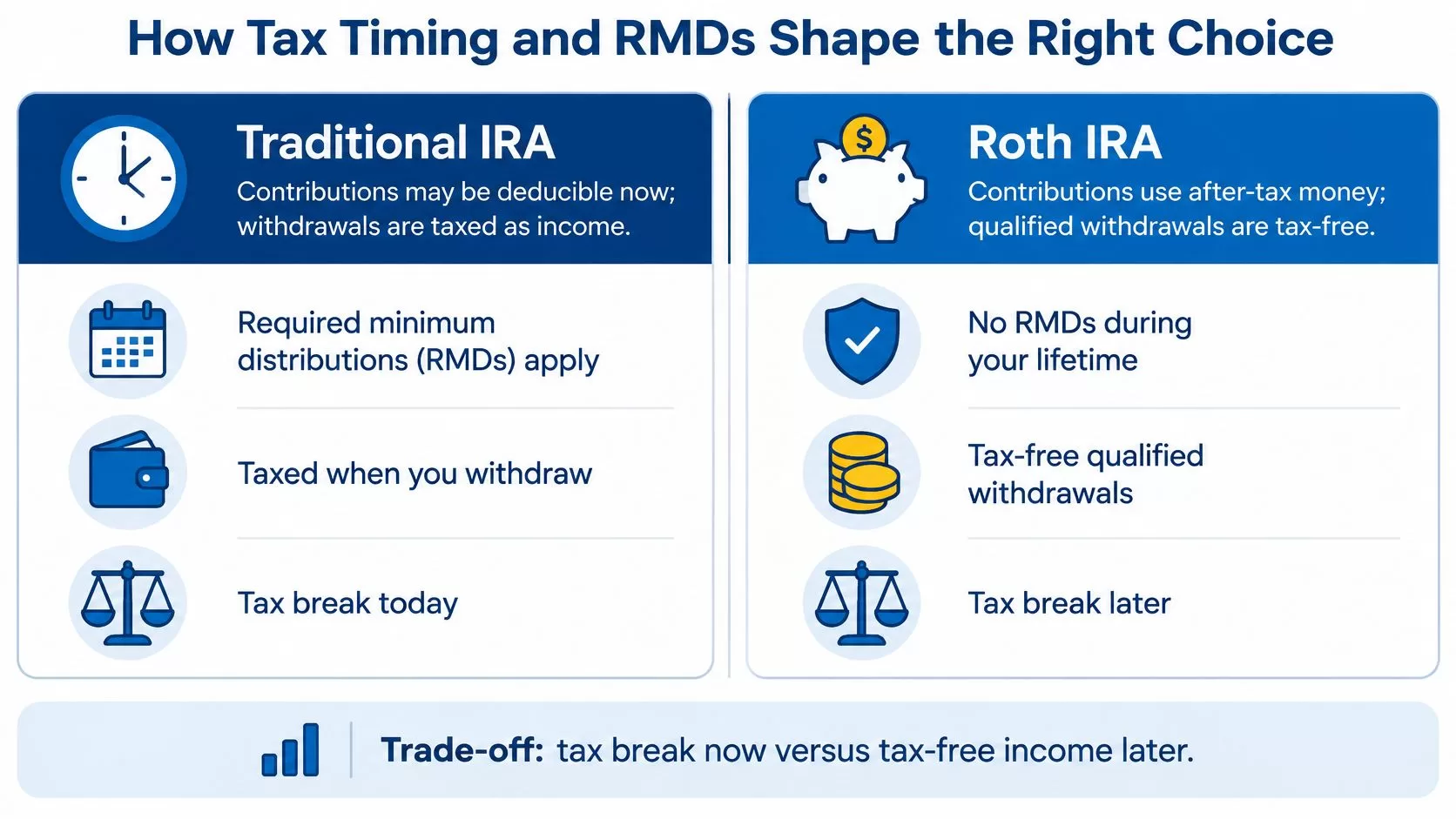
How Tax Timing and RMDs Shape the Right Choice
When will you need your retirement money, and how much control will you have over the tax bill? The seed-versus-harvest analogy helps explain tax timing, but withdrawal schedules determine how that trade-off plays out. A voluntary withdrawal can be timed around other income. A mandatory distribution leaves less room to choose.
Access rules matter, too: taking traditional IRA funds before age 59½ can trigger an additional 10% tax unless an exception applies, under IRS rules for traditional and Roth IRAs. The later withdrawal table explains early-access rules and qualified Roth withdrawals in more detail. For this decision, focus on when withdrawals will arrive and what other income will accompany them.

Compare the Tax Rates on the Dollars You Will Use
A saver facing a higher marginal rate while working and a lower rate in retirement may favor traditional treatment. A saver expecting the reverse may favor Roth treatment. These are starting points, because the timing and size of withdrawals can change the expected result.
Work through these four checks:
- Check today's marginal tax rate against expected retirement rates. Use the top rate on the dollars you deduct today, and compare it with the marginal rate those dollars will face at withdrawal. An average rate across all income can blur that comparison.
- Stack all future retirement income streams together. Add projected Social Security benefits, pensions, taxable brokerage dividends, and mandatory traditional distributions. Consider how taxable withdrawals would sit on top of that income.
- Account for state income taxes where you plan to live. Moving from a high-tax state to a no-income-tax state in retirement can favor traditional deductions now. Moving in the opposite direction can favor Roth treatment.
- Weigh today's upfront deduction against future tax-free compounding. Consider both the immediate tax savings and the spending money available later. Decades of growth make the future tax treatment important, but growth alone doesn't establish which account will produce the better outcome.
The practical comparison is after-tax spending power. Apply that same test when considering a precious-metals IRA rollover: the account's tax treatment, withdrawal timing, and any conversion belong in the comparison alongside the investment choice.
How Required Minimum Distributions Change Retirement Brackets
Traditional IRA owners generally must begin annual required minimum distributions (RMDs) by April 1 of the year after reaching age 73, according to IRS Tax Topic 451. Missing the required amount can trigger an additional tax. Original Roth IRA owners don't face lifetime RMDs, although inherited Roth accounts have separate beneficiary requirements.
Mandatory withdrawals can affect retirees who already have enough cash for living expenses. A larger traditional balance can mean larger required distributions, adding taxable income when Social Security and pension payments are already filling lower tax brackets. A projection that assumes only voluntary withdrawals may therefore understate future taxable income.
Review the required minimum distribution rules to understand calculation schedules and deadlines before estimating how withdrawals will stack on top of other income.
Planning insight: Looking at nominal account balances alone hides the tax bill built into a traditional IRA. Equal balances can provide different spending power because taxable traditional withdrawals leave less to spend, while qualified Roth withdrawals are tax-free.
Using Low-Income Years for Partial Roth Conversions
Retirees with substantial traditional savings can reconsider that balance over time. Leaving full-time work before starting Social Security or mandatory distributions may create a temporary period of lower taxable income.
Some households use partial Roth conversions during those years, moving pre-tax money into a Roth IRA gradually. The aim is to use room in a lower tax bracket without unnecessarily pushing income into a higher one. A conversion creates a current tax cost in exchange for different treatment of future withdrawals.
The pre-tax amount converted adds to taxable income in the conversion year. Larger conversions can also affect income-tested thresholds, including Medicare premiums or the taxation of Social Security benefits. Compare several years of projected income, planned withdrawals, and future RMDs before choosing a conversion amount. That broader view helps assess whether paying tax sooner could improve later spending flexibility.
2026 Contribution Limits and Income Eligibility
One rule trips up more IRA savers than almost any other: traditional and Roth IRAs share a single combined annual contribution ceiling. Think of the limit as one doorway with two rooms behind it. Opening both accounts does not create a second doorway. Each dollar placed in a traditional IRA leaves less room for a Roth contribution for the same tax year.
The IRS 2026 retirement plan announcement and IRS IRA contribution limit guidance set the 2026 figures. For 2026, the main amounts are $7,500 for most savers under age 50, $8,600 for savers age 50 or older, and a 6% excise tax on excess amounts that remain uncorrected.
- Base annual ceiling: Individuals under age 50 can contribute up to $7,500 combined across all traditional and Roth IRAs for 2026.
- Age 50 catch-up allowance: Savers age 50 or older can contribute up to $8,600 for 2026, including an extra $1,100 catch-up contribution.
- Taxable compensation cap: Total contributions for the year cannot exceed the account owner's taxable compensation, so someone with less earned income cannot deposit the full statutory limit.
- Excess contribution penalty: Putting in more than the allowed amount can trigger a 6% excise tax each year the excess remains uncorrected.
A common mistake happens when a saver holds a traditional IRA at one institution and a Roth IRA at another, then deposits the full maximum into each. Custodians do not automatically track deposits held at other firms. The taxpayer has to add them up, much like checking two checking accounts before spending against a single budget.
Roth Phase-Outs Versus Traditional Deductibility
Even when a saver stays under the annual dollar cap, income rules treat Roth and traditional accounts very differently. Direct Roth IRA contributions phase out based on modified adjusted gross income (MAGI) and filing status. For 2026, the IRS places the Roth phase-out range for single taxpayers and heads of household at $153,000 to $168,000 in its IRS 2026 retirement plan announcement. Married filing jointly and other filing statuses carry separate phase-out brackets in IRS IRA contribution limit guidance, so households should check the range for their own filing status before funding the account.
Traditional IRAs do not block contributions at high incomes the way Roth IRAs do, provided the saver has taxable compensation. Instead, income limits determine whether the contribution is tax-deductible. Deductibility depends on filing status, MAGI, and whether the saver or their spouse is covered by a workplace retirement plan like a 401(k).
Making a nondeductible traditional contribution creates a different tax profile from a deductible one. The saver receives no upfront tax break, still owes ordinary income tax on future investment earnings, and must track after-tax basis carefully so those dollars are not taxed twice at withdrawal. Because the IRS adjusts caps and phase-out ranges over time, check current-year figures against official IRS publications before funding an account.
Withdrawal Rules, the Five-Year Clock and Early Access
Many savers assume Roth money is always completely free to pull out at any time, while traditional money is completely locked up until retirement. Neither assumption holds up under IRS distribution rules, which divide IRA balances into separate buckets with distinct tax and penalty triggers.
| Money type | Roth IRA treatment | Traditional IRA treatment | Rule to check |
|---|---|---|---|
| Contributions | Generally returned tax-free | Distributions generally taxable as income | Early distributions may face the additional 10% tax |
| Earnings | Tax-free only if the distribution is qualified | Taxable as income | Age 59½ or another qualifying condition, plus the five-year rule |
| Converted amounts | Not taxed again on conversion; separate five-year period for the 10% tax | Taxable when converted to Roth | Five-year period generally starts in the conversion year |
| Early withdrawal before 59½ | Earnings may be taxed and penalized if not qualified | Taxable, plus possible 10% additional tax | Check for an exception before withdrawing |
How the Two Five-Year Clocks Actually Work
Confusion around early Roth access almost always traces back to the five-year rule, because there isn't just one clock. As outlined in IRS Publication 590-B, the first five-year clock governs tax-free earnings on qualified distributions. It doesn't apply separately to each investment or each deposit; instead, the five-year period begins with the first tax year for which the taxpayer made a contribution to any Roth IRA for their benefit, and it must be paired with a qualifying condition such as reaching age 59½.
The second five-year clock applies specifically to converted amounts moved from a traditional IRA into a Roth IRA. Under IRS rules, each conversion generally starts its own five-year period in the conversion year for purposes of the 10% early-distribution tax, unless the taxpayer already had an established Roth IRA contribution history that satisfies the rule or meets an age/exception threshold. Pulling converted dollars out before that five-year window closes can trigger the 10% additional tax even when the withdrawal itself isn't included in gross income. Savers mapping out conversions or early retirement access can study the Roth IRA five-year rule in detail before moving funds.
Ordering Rules, Pro-Rata Math and Safe Rollovers
When money leaves a Roth IRA, IRS withdrawal ordering rules determine which bucket comes out first. In general, regular Roth contributions come out first (tax-free and penalty-free), followed by converted amounts, and finally investment earnings. That sequence means a saver who runs into a cash crunch can often tap original Roth contributions without triggering tax, though confirming exact ordering rules against current IRS Publication 590-B before taking a distribution prevents costly reporting errors.
Savers holding multiple traditional IRAs face a separate trap called the pro-rata rule. Guidance from the IRS on using IRAs for retirement savings distinguishes among deductible amounts, nondeductible basis, earnings, and converted funds. When someone holds both pre-tax traditional dollars and nondeductible after-tax basis across one or more traditional IRAs, the IRS treats all traditional IRA balances as one combined pool for tax calculations. A saver can't cherry-pick only the after-tax dollars for a tax-free conversion or withdrawal; each dollar distributed or converted carries a proportional slice of taxable and nontaxable money.
Moving funds between custodians requires just as much care. Requesting a direct trustee-to-trustee rollover sends money straight from one financial institution to another without passing through the saver's hands. Receiving a rollover check personally opens the door to mandatory withholding, tight redeposit deadlines, and accidental taxable distributions if paperwork slips.
"Tax-free" never automatically means "penalty-free," and a Roth IRA shouldn't replace a dedicated cash emergency fund. Any saver who expects to tap retirement dollars before age 59½ should review withdrawal ordering and pro-rata calculations with a qualified tax professional before touching the account.
Roth vs Non-Roth Choices for Precious-Metals IRA Investors
Precious-metals savers sometimes wonder whether holding physical gold or silver changes how the IRS taxes a retirement account. It doesn't. Tax status follows the account wrapper, not the metal inside it, so a Roth Gold IRA follows Roth tax rules and a Traditional Gold IRA follows traditional tax rules. Physical custody, depository storage, bullion valuation, and dealer transaction fees sit alongside those tax rules and never alter whether a distribution is taxable or tax-free.

Three Rollover and Distribution Scenarios to Model
For adults age 50 and older who already hold a 401(k) or traditional IRA and want to diversify a portion of their savings into physical precious metals, the tax outcome depends heavily on how the transfer is structured. Three common paths illustrate the difference:
- Direct rollover from a 401(k) to a traditional Gold IRA: Moving pre-tax employer plan funds via a direct trustee-to-trustee transfer into a traditional self-directed precious-metals IRA generally keeps pre-tax money pre-tax, triggering no current-year tax bill when executed properly.
- Rollover or conversion into a Roth Gold IRA: Shifting pre-tax 401(k) or traditional IRA dollars into a Roth account generally adds the entire pre-tax amount to taxable income for the conversion year. As highlighted in a Congressional Research Service analysis of IRA policy, rollovers or conversions involving alternative assets can generate a real tax bill even when the investor doesn't sell the underlying retirement strategy, so savers need outside cash ready to pay the tax rather than draining the IRA to cover it.
- Taking physical delivery of metals (in-kind distribution): Requesting coins or bars shipped out of a depository to your home counts as an IRA distribution. Inside a traditional Gold IRA, the withdrawal is generally taxed as ordinary income based on the metal's fair market value at distribution, and early-distribution penalties still apply before age 59½. Inside a qualified Roth Gold IRA, an in-kind distribution may avoid income tax if age and holding rules are met.
Savers weighing whether after-tax dollars belong in physical bullion can review how a precious-metals Roth IRA handles contributions, conversions, and depository custody before committing funds.
Purity Rules, Custodian Standards and Tax Education
Physical metals held inside any IRA must meet strict IRS fineness and eligibility standards and stay with an approved custodian and depository rather than in a home safe. Eligible product lists and specific purity thresholds should always be verified against current IRS rules and the chosen custodian's compliance checklist before purchasing coins or bars. No single metal or custodian fits every portfolio, and precious metals may serve as one option for diversification rather than a guaranteed hedge against inflation or market volatility.
Understanding how IRA metal taxation differs from owning physical bullion in a personal taxable account also helps retirees avoid miscalculating net returns. Gold IRA Association publishes articles on the tax treatment of gold and silver, including "Capital Gains Tax on Gold: A Plain-English Guide" and "Tax on Silver: What Retirees Must Know," helping investors see where retirement-account rules diverge from personal bullion sales.
Which Account Fits Your Tax Picture
A Roth versus traditional decision is usually won or lost on timing: when tax is paid, whether RMDs force income later, and whether a conversion creates a bill before retirement. Put your household's current income, deduction eligibility, and future distribution goals on one grid, then test each row against those three clocks.
| Situation | Often favors | Check before deciding |
|---|---|---|
| Expect a higher tax bracket in retirement | Roth | Projected retirement income and RMD exposure |
| Expect a lower tax bracket in retirement | Traditional | Whether the contribution is deductible |
| Need a deduction to reduce tax now | Traditional | Income, workplace coverage and filing status |
| Want no lifetime RMDs or flexibility for heirs | Roth | Beneficiary distribution rules |
| Income above Roth contribution limits | Traditional, possibly with a conversion | Eligibility and tax cost of any conversion |
| Unclear future tax rates | Split between both, within one combined limit | Total 2026 limit and projected brackets |
For a quick visual checklist you can keep beside your tax return, the summary below pairs each common profile with the first rule to verify.
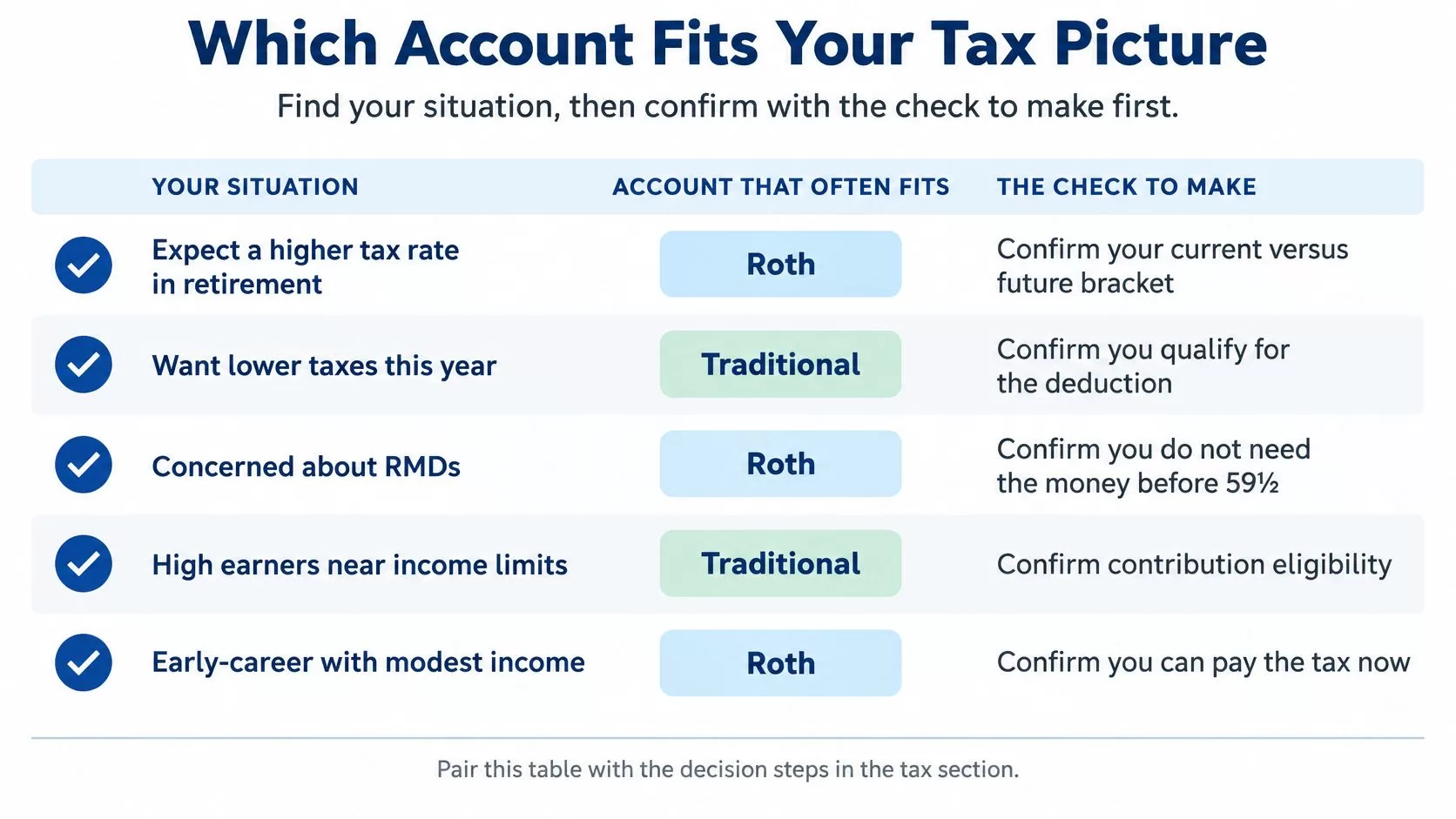
High-income savers who sit above direct Roth eligibility limits often default to a traditional IRA first, then evaluate whether a later conversion makes sense. Because converting pre-tax money creates taxable income in the calendar year of conversion, the size of that bill matters more than the headline bracket alone. Coordinating retirement accounts with taxable brokerage holdings can also smooth out your tax return; understanding how to harvest investment losses in a taxable account can offset capital gains in the same year when you are already managing retirement income brackets.
For savers who prefer a spoken walkthrough of how these tax brackets and account trade-offs interact over time, the short video below walks through the core comparison.

The right choice between Roth and non-Roth accounts hinges on comparing today's marginal bracket against projected retirement income and future RMD exposure, while remembering that one shared annual contribution ceiling applies no matter how you divide your deposits. For precious-metals rollovers, the same test applies before funds move: compare today's bracket with expected retirement income, RMD exposure, and the tax cost of any conversion. Savers who want help sorting through precious-metals IRA provider rules, fees, and account setup can contact Gold IRA Association; you can call 888-910-8386 or send a message through the contact form for help finding educational information about account rules and provider comparisons. Its team offers personalized advice aligned with an individual's retirement goals and financial situation, while personal tax filings and conversion calculations always belong with a licensed CPA.
Disclaimer: This is not financial advice. Consult a licensed financial advisor, CPA, or tax professional before making investment decisions.
Roth vs Non-Roth Questions Readers Ask
Can a Saver Hold Both a Roth and a Traditional IRA
Yes. An individual can own a Roth IRA and a traditional IRA at the same time, even at different custodians. Think of them as two drawers in the same retirement dresser: one holds money already taxed for qualified withdrawals, while the other may give a deduction now and create taxable income later. Holding both gives a retiree tax diversification, letting them draw from taxable or tax-free buckets depending on the year's income. Annual deposits across both accounts still draw from one shared yearly ceiling, and eligibility rules apply to each account.
How Does a Backdoor Roth Strategy Work
A backdoor Roth is a two-step approach used by savers whose income exceeds direct Roth contribution limits. The taxpayer makes a nondeductible contribution to a traditional IRA and then converts those funds into a Roth IRA. The key confusion is that the contribution and the conversion are separate mechanics. If the saver holds other pre-tax traditional IRA balances, the IRS pro-rata rule can make a portion of the conversion taxable. A tax professional can review the numbers before the conversion, especially when several IRA balances are involved.
How Are Inherited Roth IRAs Treated
Beneficiaries who inherit a Roth IRA follow separate beneficiary distribution rules. The required payout schedule depends on the beneficiary's relationship to the original owner, such as a surviving spouse versus an adult child, along with the account's terms and whether the five-year holding requirement was met. Beneficiaries should confirm exact withdrawal deadlines with both the custodian and a CPA before taking a distribution.
One final precaution matters for older savers managing rollovers, RMDs, and inherited accounts: tax-season scams frequently target retirees with urgent calls or letters claiming a problem with an IRA distribution or unpaid IRS balance. Practical guidance on protecting seniors from fake tax agents can help households recognize pressure tactics and keep sensitive retirement account details secure.
Comparing traditional and Roth structures helps frame whether physical precious metals fit a long-term retirement plan. Gold IRA Association publishes articles and guides on rollover procedures, tax treatment of gold and silver, fee breakdowns, and side-by-side company reviews. Its free newsletter covers news on hedging against U.S. inflation with a Gold IRA. Readers can also use an online contact form or send a direct message for help finding educational information about account rules and provider comparisons. Materials are provided for informational purposes only, so readers can consult a professional advisor for advice specific to their situation.


