



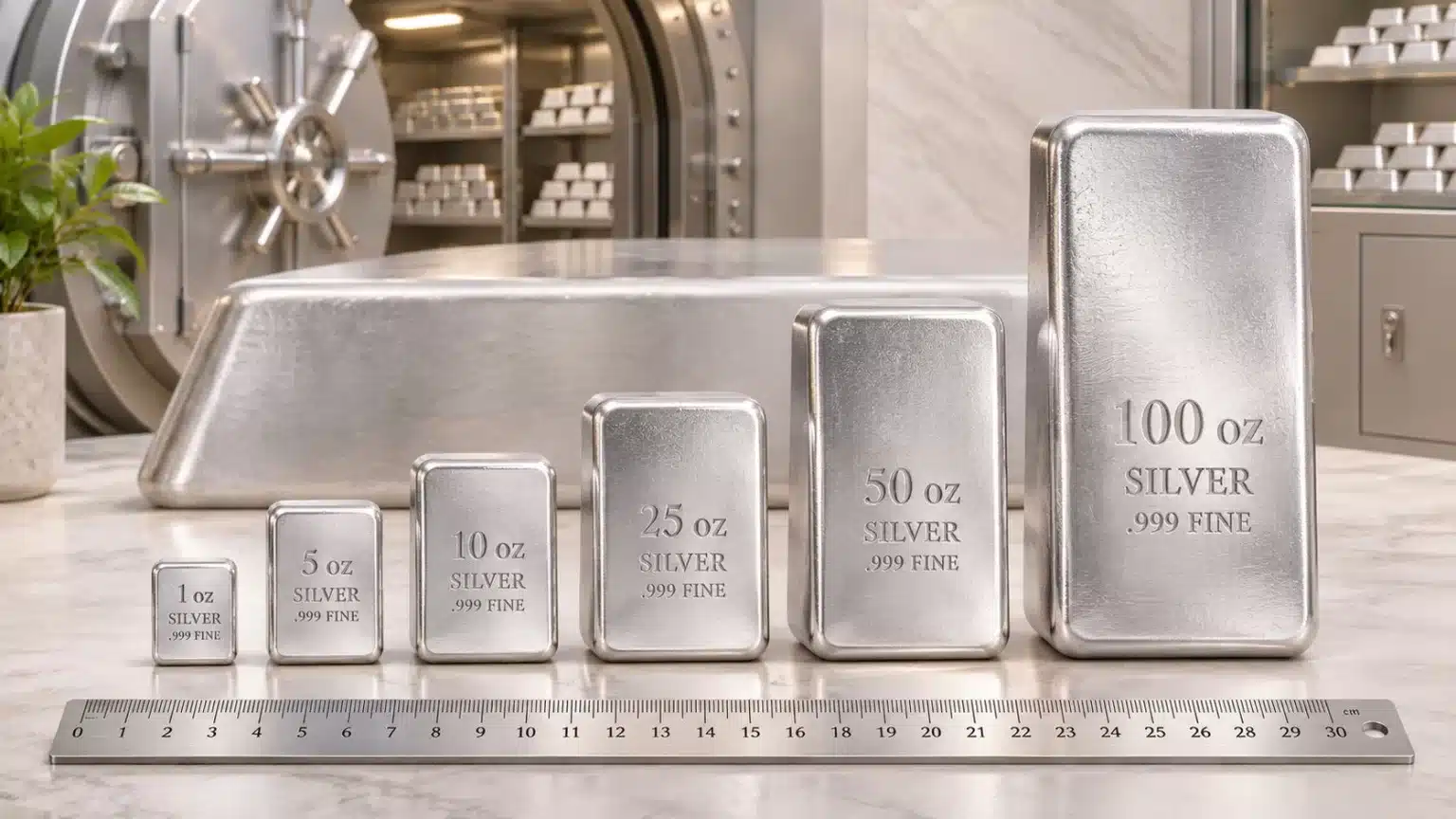
Silver bars are sold in sizes that run from a one-ounce rectangle smaller than a credit card to a vault bar that takes two people to move, and every one of them carries the same two words on the label. Most buyers compare them on price per ounce alone. The attributes that decide how a bar behaves after the purchase, its measured weight, how easily part of it can be sold, and whether a retirement custodian will accept and document it, sit outside the price tag. This guide walks through silver bar sizes one at a time, with the weights, dimensions and checks that matter at each step, then shows why size alone never settles eligibility for a Silver IRA.
Silver Bar Sizes and Dimensions at a Glance
The table below sets the standard silver bar sizes side by side, with weight in troy ounces, grams and pounds, plus the dimensions mints publish for each format. Read across a row to understand one size, or down a column to watch the metal and the volume grow.
Standard silver bar sizes, weights and dimensions
| Bar size | Troy ounces | Grams | Pounds | Dimensions (mm) |
|---|---|---|---|---|
| 100 g bar | 3.22 | 100 | 0.22 | 47.00 × 27.00 × 7.96 |
| 1 oz bar | 1.00 | 31.10 | 0.07 | No single standard (Royal Canadian Mint 49.8 × 28.6) |
| 500 g bar | 16.08 | 500 | 1.10 | 110.00 × 46.00 × 10.50 |
| 10 oz bar | 10.00 | 311.03 | 0.69 | 90.00 × 51.90 × 6.44 |
| 1 kg bar | 32.15 | 1,000 | 2.20 | 118.00 × 54.00 × 16.00 |
| 100 oz bar | 100.00 | 3,110 | 6.86 | 131.85 × 77.90 × 31.12 |
| 1,000 oz LBMA Good Delivery bar | 1,000 nominal, 900 to 1,100 accepted | About 31,100 | About 68.6 | Maximum 300 × 130 × 80 |
The retail end of that scale is well documented. The Royal Mint's silver investment guide lists 100-gram bars at 47.00 × 27.00 × 7.96 millimeters, 500-gram bars at 110.00 × 46.00 × 10.50 millimeters and 1-kilogram bars at 118.00 × 54.00 × 16.00 millimeters, alongside 10-ounce bars at 90.00 × 51.90 × 6.44 millimeters and 100-ounce bars at 131.85 × 77.90 × 31.12 millimeters, all described as 999.9-fineness silver. The same guide notes that 100 ounces equals approximately 3.11 kilograms, which makes the 100-ounce format roughly three times heavier than a kilogram bar.
Reading the Rows From Retail to Institutional
The 100-gram through 100-ounce range is the retail and exchange-accessible band, sized for individual purchase, home storage and resale. The 1,000-ounce row belongs to a different market entirely, where bars settle between institutions rather than move through a dealer's counter.
Two rows deserve a second look. The 1-ounce bar has no agreed footprint, so dimensions change with the mint: the Royal Canadian Mint's 1-ounce pure silver bar measures 49.8 by 28.6 millimeters in 99.99% pure silver. Volume grows faster than weight as bars climb the scale, and the 100-ounce bar is far thicker than a kilogram bar, which changes how it fits a safe, a box or a shipping parcel.
Match each row to how the metal will be stored, carried and eventually sold. Then check any published dimension against the exact product in front of you, because manufacturers vary and cast bars are never identical to the millimeter.
Why Troy Ounces Change Every Weight Calculation
A 1-ounce silver bar weighs about 31.1 grams, while a kitchen scale calls the same word only 28.35 grams, and that gap is one of the most common sources of confusion for first-time buyers. Precious metals are priced and stamped in troy ounces, a different unit from the avoirdupois ounce used for groceries, postage and bathroom scales. The two share a name, which is exactly why the mistake is easy to make and rarely caught at the counter.
Three conversions cover almost everything a buyer needs:
- Grams to troy ounces: divide the gram weight by 31.1035.
- Troy ounces to grams: multiply the troy ounces by 31.1035.
- Kilograms to troy ounces: multiply the kilograms by 32.15.
A worked example makes it concrete. A 250-gram bar divided by 31.1035 comes to about 8.04 troy ounces. A listing that describes it as an 8-ounce bar is rounding for convenience, and a dealer quoting spot multiplied by 8.04 is pricing the metal correctly. Those four hundredths of an ounce add up across a large holding, and account statements and custody paperwork record the troy figure, so the conversion matters at purchase, in recordkeeping and again at resale.
A postal scale that shows 31 grams for a 1-ounce bar is right, and the bar is right too. The scale reads in avoirdupois ounces, and the refiner's stamp counts troy ounces. Run the conversion before assuming either side made an error.
The gap widens with every step up in size. Weighed on an ordinary scale, a 100-ounce bar shows close to 110 ounces, because each of its troy ounces outweighs the scale's unit. Converted the other way, that same bar comes to about 3.11 kilograms, or 6.86 pounds, and a kilogram bar works out to 32.15 troy ounces, or 2.20 pounds. A buyer who prices either format in the wrong unit misprices nearly a tenth of the silver, which is a costly error to carry into a resale negotiation.
For the history behind the split, troy ounce versus regular ounce explains where the two measures came from and why bullion markets settled on the heavier unit.
The practical check is simple. The stamped weight is the specification, so weigh the bar in grams, divide by 31.1035, and compare the result with the stamp and the dealer's product listing. Any mismatch is a question worth asking before money changes hands.
The 1,000-Ounce Benchmark Bar and Its Limits
The London Good Delivery bar is the institutional reference point for the global over-the-counter bullion market, and its rules are looser than the name suggests. Under the LBMA's technical specifications for Good Delivery silver, a standard bar is nominally 1,000 troy ounces, equivalent to approximately 32 kilograms, with a permitted tolerance of plus or minus 10%. An acceptable newly produced bar can therefore weigh anywhere from about 900 to 1,100 troy ounces, or roughly 28 to 34 kilograms.
The specification card is short enough to memorize.
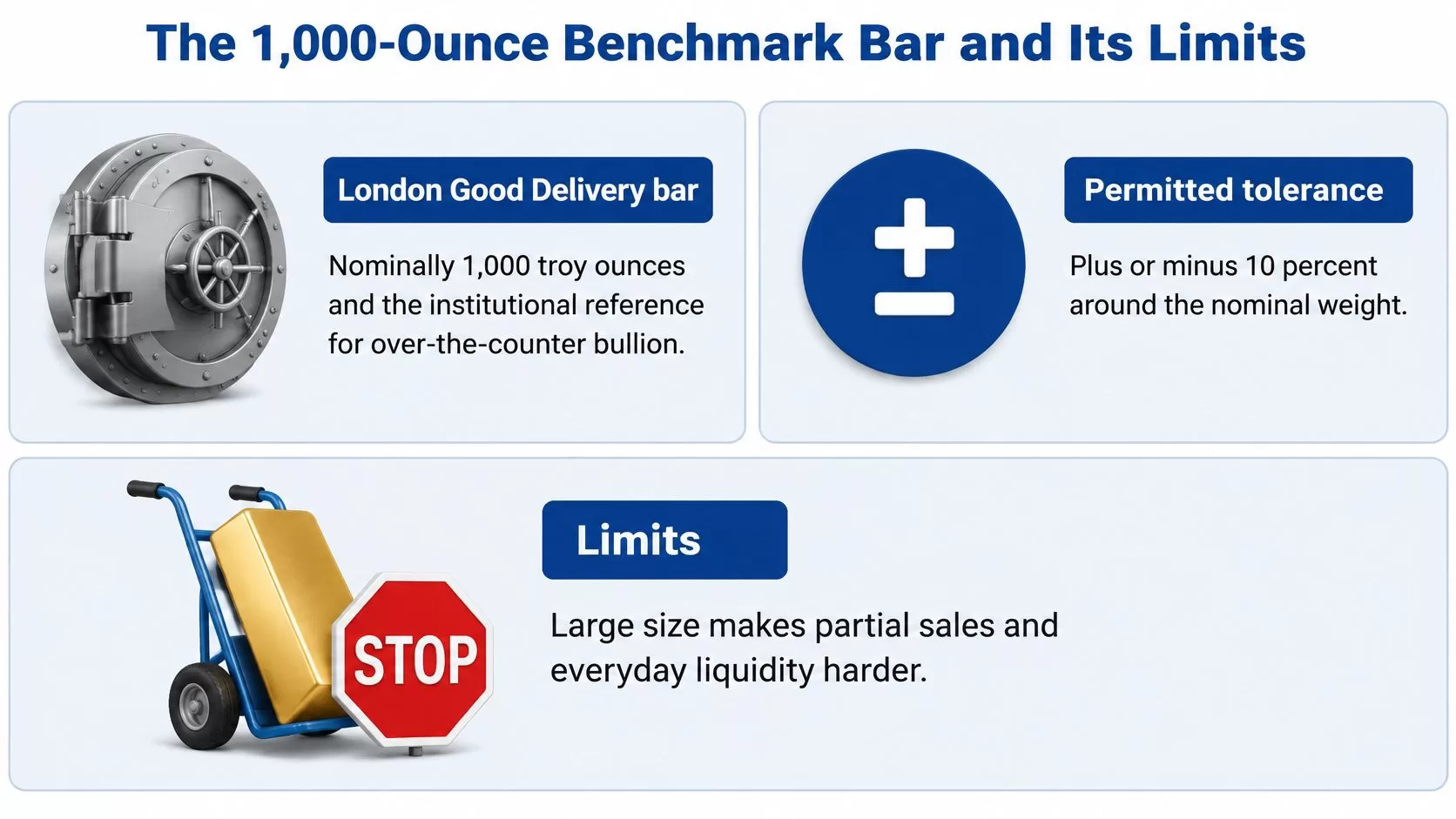

The same rules set maximum approximate dimensions of 300 millimeters long, 130 millimeters wide and 80 millimeters high, each with its own stated tolerance. They also accommodate history: bars produced before January 1, 2025 may remain acceptable if they fall between 750 and 1,100 troy ounces, and bars made before January 1, 2008 may still qualify within the older 500 to 1,250 troy ounce range. Weight is reported in increments of 0.10 troy ounce, rounded down, which keeps settlement, inventory records and assay paperwork consistent across vaulting markets.
Two conclusions follow. First, "1,000 ounces" describes a market benchmark rather than an exact physical weight, which is why institutional confirmations quote an actual assayed figure instead of the label. Second, the 32-kilogram figure is a rounded specification: a true 1,000 troy ounces is about 31.1 kilograms, so a buyer holding one of these bars should read the stamp rather than the marketing.
For an individual, the format is a reference point and not a purchase target. At roughly 31 kilograms, the bar needs mechanical handling and institutional vaulting, and it can't be split when part of the position needs to be sold. Most private buyers never take delivery of one. The 1,000-ounce row in the reference table earns its place by showing where the premium ladder ends, not by being a practical holding.
Premiums and Partial Sales by Bar Size
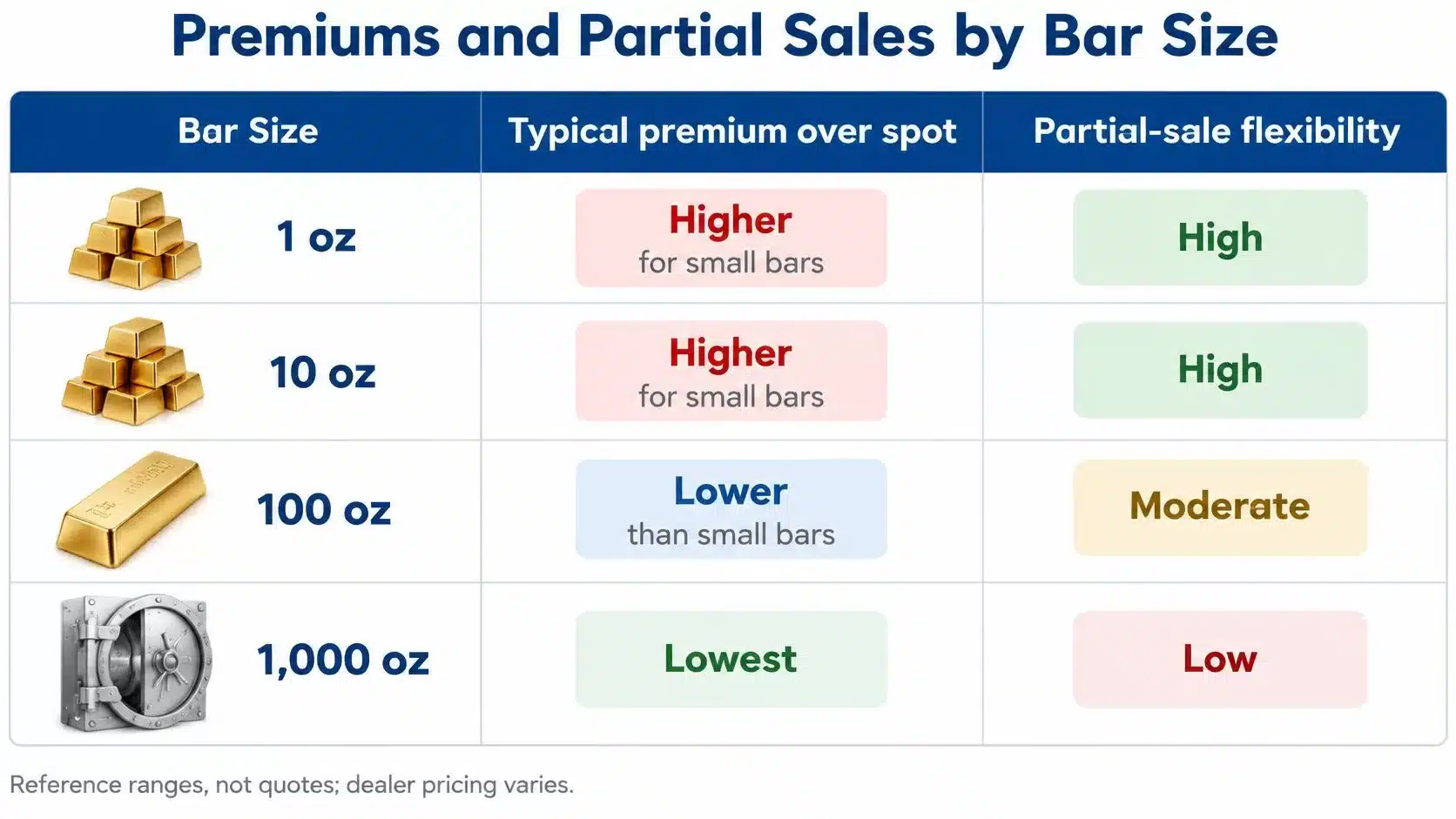
A bar's purchase premium is only the entry cost. The full cost of owning and exiting a position also includes the dealer's buyback spread, shipping, and any assay charge. Those extras matter because smaller bars usually cost more upfront but give the owner more ways to sell part of a holding.
Typical purchase premium and partial-sale flexibility by bar size
| Bar size | Typical premium over spot | Partial sales | Typical fit |
|---|---|---|---|
| 1 oz bar | 8 to 15% | Yes | Small holdings and partial sales |
| 10 oz bar | 4 to 8% | Yes | Mid-sized positions with some flexibility |
| 1 kg bar | 3 to 6% | Limited | Larger positions with lower premium |
| 100 oz bar | 2 to 5% | Usually no, the whole unit is sold | Large fixed positions held long term |
| 1,000 oz bar | Lowest of the sizes listed | No | Institutional settlement, rarely held by individuals |
Premium ranges are author estimates and typical market reference ranges. They are not dealer quotes, and actual pricing changes with market conditions, bar condition, and the buyer's buyback policy.
Why the Cheapest Premium Isn't the Cheapest Exit
A 100-ounce bar is one saleable unit. Selling a third of that position generally means selling the whole bar, then using the proceeds to buy smaller bars or taking cash. A dealer may be willing to split the position, but that can bring a lower buy price and an assay charge to confirm the metal.
That is where the premium ladder becomes less straightforward. A larger bar may look cheaper at purchase, yet its resale path can be narrower. The buyer has fewer practical ways to raise cash without closing the entire position.
The 1-ounce and 10-ounce formats work differently. They let an owner sell a portion while keeping the rest, and they usually attract a wider range of buyers. That flexibility is one reason their purchase premiums tend to sit higher. The kilogram bar sits between those formats and the very large bars. It offers bulk-style pricing while still giving the owner more options than a 100-ounce unit, though partial sales can still be limited.
A Practical Break-Even Check
- Price the premium in dollars. Apply each size's percentage to the amount you plan to invest.
- Estimate the exit costs. Ask a dealer what it would pay for that exact size today, then add shipping and any authentication fee.
- Subtract exit costs from the premium savings. What remains is the advantage of the bigger bar.
- Weigh the remainder against divisibility. Then ask how much flexibility is worth over the years you expect to hold the metal.
A 2 percentage point premium gap on a $100,000 position is $2,000. On the same money, a 10-point gap between the cheapest and priciest formats is $10,000. That saving is real until the owner needs to sell a portion and finds that the whole unit has to go.
Custody changes the calculation again. Metal held inside a retirement account is custodied, and selective sales or personal access can trigger distribution consequences, so divisibility may matter less there than it does in a taxable brokerage or personal holding.
Gold IRA Association publishes investor resources ranging from beginner guides to advanced investment strategies, including material on how gold and silver are taxed. Its educational materials are provided for informational purposes only and are not intended as financial, legal, or investment advice. Investing in precious metals and IRAs involves risk, including the potential loss of principal.
Which Silver Bar Sizes Qualify for an IRA
No bar size qualifies for an IRA on its own, and no size rules one out on its own either. Weight is a practical choice, while eligibility depends on fineness, production, documentation, and whether the custodian will accept that exact format.
The exchange convention helps explain where the 1,000-ounce benchmark came from, and it also shows why contract size has nothing to do with retirement accounts. According to the CFTC filing describing COMEX silver delivery, a COMEX silver futures contract represents 5,000 troy ounces and is delivered as five refined bars of approximately 1,000 troy ounces each, with each bar allowed to vary by plus or minus 10% in weight. Exchange-deliverable silver must assay to at least 999 fineness, and every bar must be marked with its weight, fineness, bar number and brand or refiner hallmark. Those rules govern exchange delivery, not what a private retirement account can hold.
A bar's description should answer four separate questions. Treat them like four legs of a chair: one weak leg can make the whole setup unstable, even if the other three look fine.
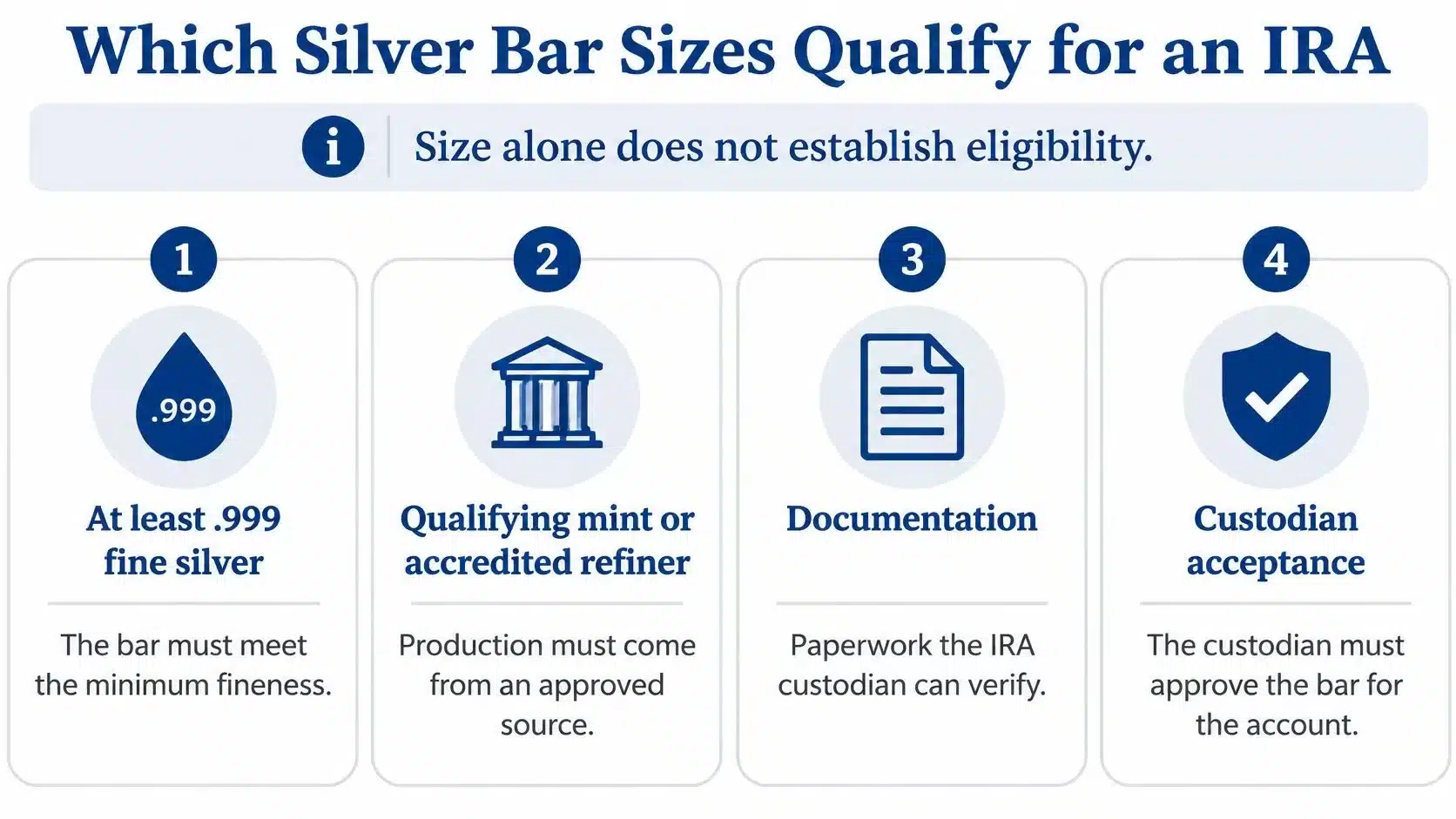
Start with the weight itself. Confirm that the stamped figure matches the product listing and, where relevant, the assay card. A 10-ounce bar should read as 10 troy ounces, not as a round number close to 10. Small mismatches deserve a closer look before the bar enters an account, because size affects storage records, insurance schedules and later resale conversations.
Fineness is the next check. According to the IRS rules governing precious metals IRAs, silver must be at least .999 fine, so read the fineness stamp on the bar rather than relying only on a product title or marketing copy. A bar described as "pure silver" still needs a clear fineness mark that can be matched to the paperwork.
Production and provenance come next. Look for a recognized mint or accredited refiner whose name appears on the bar and in the accompanying documentation. The name on the metal and the name on the records should tell the same story. If they do not, the bar may be harder for a custodian to document even when its weight and fineness appear acceptable.
The custodian's accepted-format list is the last gate. A 1-ounce bar and a 100-ounce bar can both sit in a dealer's inventory while only one matches a given custodian's accepted formats and documentation requirements. Buyers comparing formats should review how IRA-approved silver bars are screened and then confirm the specific sizes a custodian stocks, rather than assuming any particular weight is fine.
Larger bars can reduce fabrication premiums, but they also create less flexible units when an owner wants to sell only part of a position. That tradeoff matters inside a custodied account, where the account's rules and the custodian's accepted formats sit alongside the metal's own markings. A bar can be attractive on price and still awkward to document, store, or later liquidate in the size required.
Before committing to a format, check that the fineness stamp, refiner's name and serial number appear on the bar, and get written confirmation that the custodian accepts that exact format and its documentation. That confirmation turns the eligibility question from a guess into a matching exercise.
Distributions add a second layer. Withdrawals from a metals IRA are taxed, and the treatment differs from ordinary income in ways worth understanding in advance; Gold IRA Association publishes plain-English articles on that subject, including "Capital Gains Tax on Gold: A Plain-English Guide" and "Tax on Silver: What Retirees Must Know."
How Storage and Custody Change by Bar Size
Storage questions split cleanly in two, and mixing them up is how people end up with metal they can't easily reach or sell.
For a personal holding, the bar sits wherever the owner puts it: a home safe, a bank safe-deposit box or a private vault. Size becomes a physical constraint rather than a paperwork one. The 100-ounce format is long, wide and thick enough that it doesn't lie flat in a shallow deposit box alongside much else, while a kilogram bar at the same weight class as roughly 32 troy ounces stores more tidily. List the footprint and thickness of each size against the space available before buying, not after.
For an IRA holding, the metal is generally held by an approved custodian or depository rather than kept at home. The questions change to accepted formats, insurance coverage, access terms and fees. Ask for all four in writing, because precious metals storage arrangements differ by depository and the details decide what the account can hold. A holder generally cannot select a specific bar, carry it home, or sell a portion without a distribution, so the storage fee schedule belongs in the same conversation as the bar size.
Ask first, buy second: request the depository's accepted-format list and fee schedule in writing, then buy metal that already appears on both.
Treat the two situations separately. A size that stores well at home may be awkward inside a custodied account, and the reverse is just as true.
How to Verify a Bar's Weight, Purity and Markings
A 100-ounce bar that reads 98 on a calibrated scale fails its own specification, no matter how convincing the hallmark looks. Verification takes a few minutes with a scale and a pair of calipers, and it checks each claim a seller makes about the metal before money changes hands.
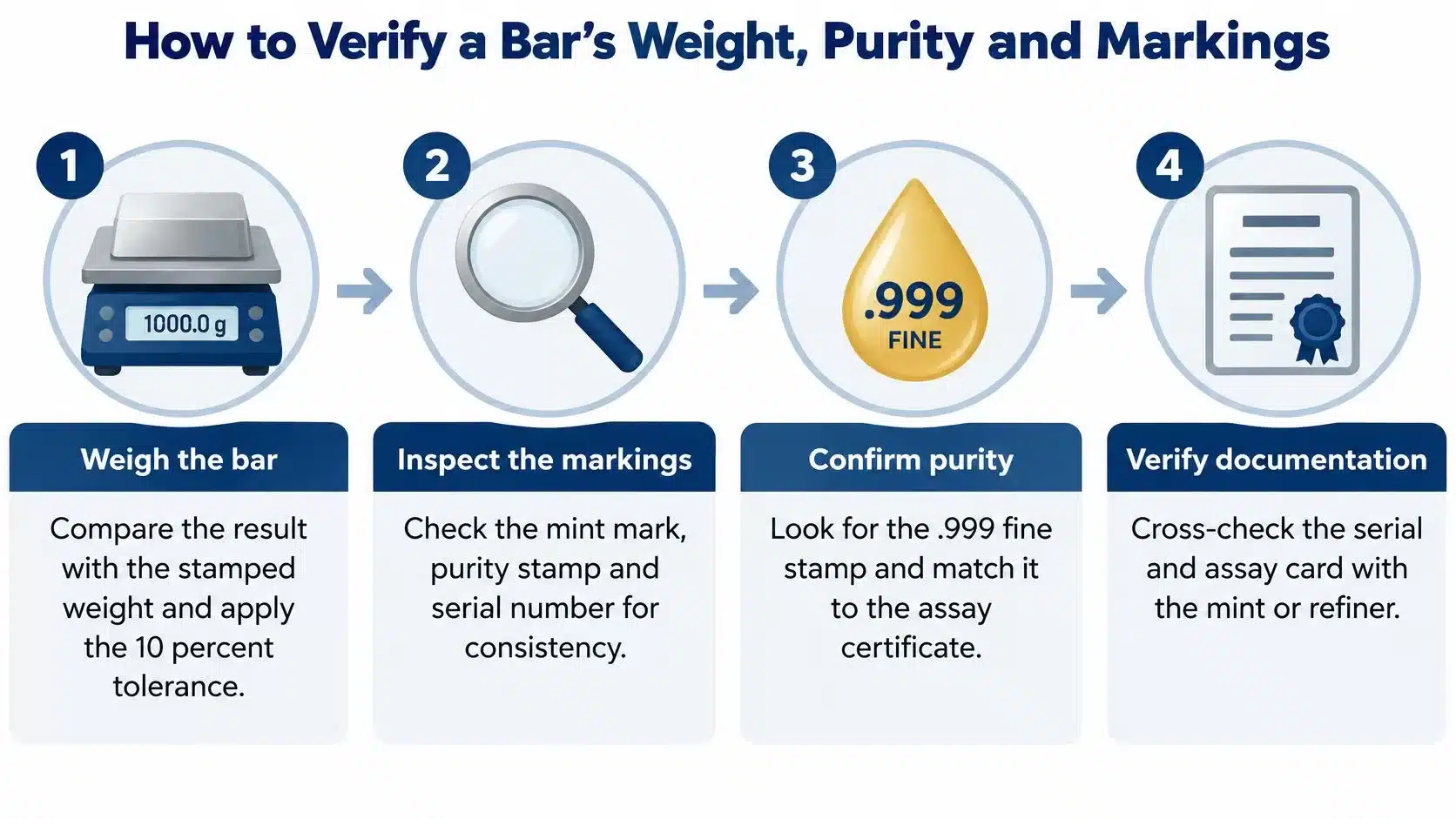
- Weigh the bar on a calibrated scale. Compare the result with the stamped weight, and apply the 10% tolerance only to institutional LBMA and COMEX-style bars. Retail products carry their own stated tolerance, so use the one on the listing.
- Read the fineness mark. Confirm .999 or higher and check that it matches the seller's description, since a mismatch usually signals a different product than the one advertised.
- Find the hallmark and serial number. The refiner's name and the bar number identify who made it and which unit it is, which is what a buyer or custodian will ask for later.
- Match the serial to the assay card. A card that belongs to another bar proves nothing, so line up the numbers character by character.
- Measure the dimensions with calipers. Compare them with the published specification for that exact product, remembering that thickness and shape vary by manufacturer and between cast and minted bars.
- Get custodian confirmation in writing. For an IRA purchase, ask whether that exact format and its documentation are accepted, because a verbal yes isn't a record.
- Keep the records together. Store the weight reading, serial number and assay card in one place so a future sale or distribution doesn't stall on missing paperwork.
For a walk-through of the handling and inspection steps, this short video covers the basics.

The clearest reason to pause a purchase is a weight outside the stated tolerance, because the bar fails its own specification. A serial number on the assay card that differs from the one stamped on the bar is nearly as serious, since it breaks the documentation a custodian or future buyer will rely on. The quietest warning sign is an unfamiliar refiner name with no paperwork at all. At that point there is nothing left to verify against, whatever the price.
Confirm the Right Bar Size Before You Buy
Use a simple rule of thumb: if the silver may need to be sold in pieces within a few years, smaller bars fit that plan better. If the bars are intended for long-term holding and the owner accepts selling a full bar at a time, larger bars can make more sense because the cost per ounce is often lower.
The purchase premium is only part of the decision. A big bar may look cheaper per ounce at checkout, but it can reduce resale flexibility because the owner cannot easily sell half of it. A smaller bar may carry a higher premium, yet it can be easier to price, document, and liquidate in partial amounts. Think of bar size like a suitcase: a larger one holds more, but a smaller one is easier to manage when plans change.
For an IRA, size alone never settles eligibility. The bar must fit the custodian's accepted formats and documentation requirements. That is why the practical check comes before the purchase: confirm how the custodian records that exact bar type, then compare the all-in cost, including the resale spread. Gold IRA Association answers educational questions about bar formats, custodians and documentation at 888-910-8386, and its team aims to respond to all inquiries within 24 hours.
Materials on the Gold IRA Association website are provided for informational purposes only and are not intended as financial, legal, or investment advice. Investing in precious metals and IRAs involves risk, including the potential loss of principal.
Gold IRA Association is an online information resource focused on gold and silver IRAs, with educational articles and guides on eligible metals, custodians, storage and account mechanics. If this walk through silver bar sizes raised questions about which formats a custodian will accept and document, the library at Gold IRA Association covers eligible products, fee structures and account mechanics in the same step-by-step format. Its free newsletter is a low-pressure way to keep those questions current as metals markets and account rules shift.


