



If both options can hold real bullion, why would one gold investment take more paperwork, cost more to maintain, or take longer to become spendable cash? The Gold IRA vs. physical gold decision is less about the metal than about who holds it, which rules apply, and what remains after costs. For retirement savers, the most useful comparison starts with all-in expenses and time-to-cash, not tax benefits alone.
Gold IRA vs. Physical Gold at a Glance
Inside a Gold IRA, the account owns the metal; physical gold bought personally belongs directly to the buyer. Both arrangements can involve actual coins and bars, but only one places those assets inside a retirement-account structure.
Internal Revenue Code Section 408(m)(3) permits certain bullion within an IRA, subject to statutory requirements. A Gold IRA combines physical-metal exposure with custodian oversight, account administration, reporting, and distribution procedures.
| Feature | Gold IRA | Physical gold held personally |
|---|---|---|
| Ownership | Held by the IRA account, not the individual | Owned directly by the buyer |
| Eligible products | Only bullion and coins permitted under IRS rules | Any gold product the buyer chooses |
| Tax treatment | Tax-advantaged account treatment under IRA rules | Normal investment tax rules apply when sold |
| Storage | Held through an approved custodian or depository | Chosen by the owner, such as a home safe or bank box |
| Funding | Contributions or rollovers from eligible retirement accounts | Bought with cash or other personal funds |
| Administration | Custodian handles documentation, reporting, and distributions | Owner manages records and sales |
Custody changes what ownership allows
A self-directed IRA lets the investor select qualifying investments. Personal possession of the account's bullion still remains off-limits under that arrangement.
IRA metals must stay in the physical possession of the trustee or an approved custody arrangement, and taking personal possession can be treated as a taxable distribution. A home safe therefore cannot substitute for compliant IRA storage. The chain works like a relay team: the custodian, the depository, and the dealer each handle one leg, and each leg adds both a layer of protection and a step between the investor and the metal.
That chain also shapes the two factors that tend to decide fit in practice: all-in cost and time-to-cash. Every party in the custody chain charges for its role, and converting IRA gold into spendable money means moving back through the chain rather than walking a coin into a shop. Personally held bullion skips those layers entirely.
The ownership and access differences are summarized below.
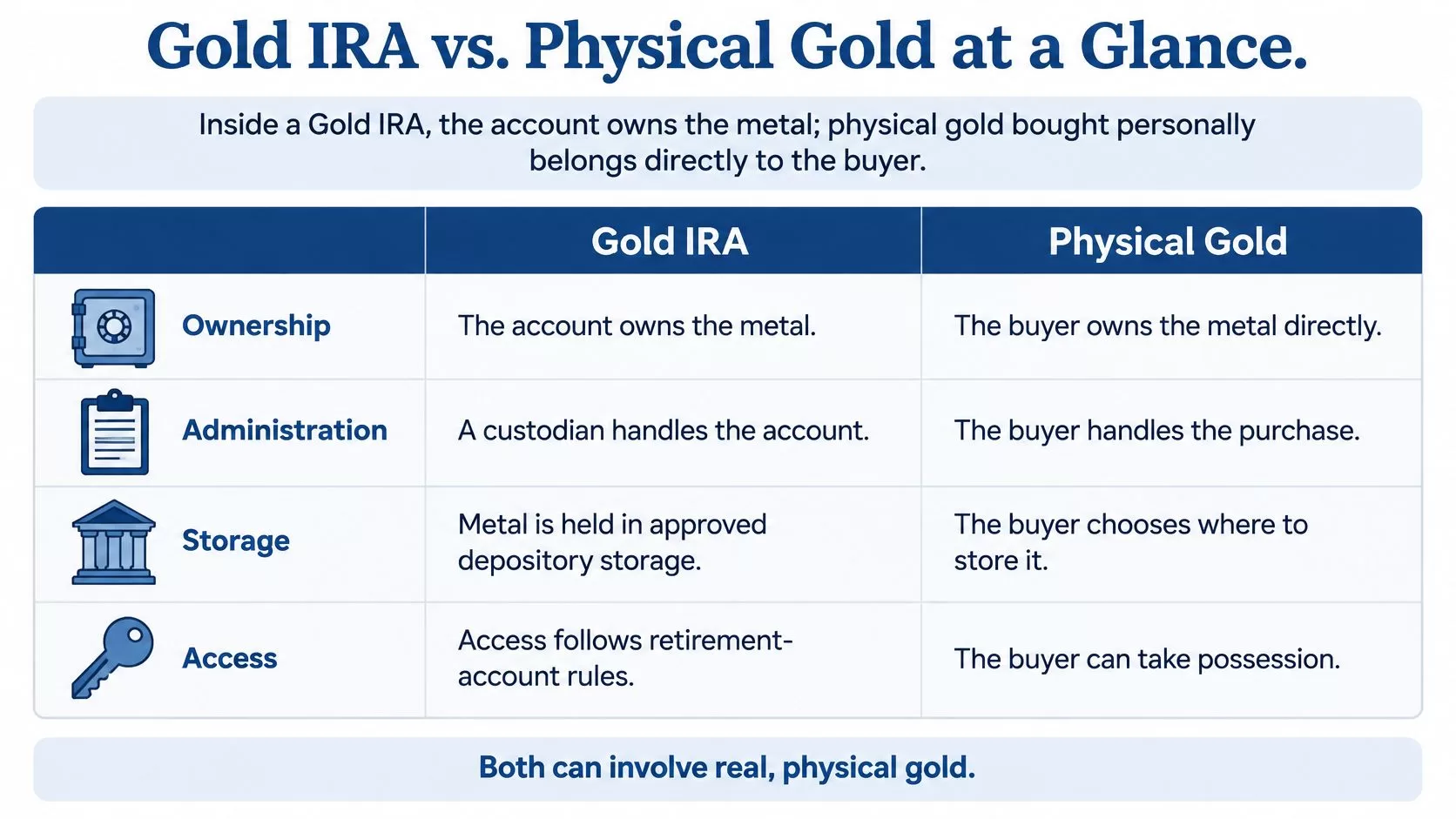
Personally held bullion gives the buyer control over storage and selling arrangements. That freedom also leaves the owner responsible for security, insurance decisions, transaction records, and finding a buyer. A seller in a hurry has no custodian to call, but also no one verifying the paperwork.
Key distinction: A Gold IRA is a regulated way to hold qualifying physical gold inside a retirement account, with custody and reporting rules attached.
The choice therefore centers on structure, custody, and account rules rather than whether the metal is genuine. Product eligibility adds one more wrinkle: a valuable gold item does not automatically qualify for an IRA, because statutory standards, not market value, decide what the account may hold.
Which Metals and Products Qualify for an IRA
Product rules matter because a valuable metal can still be a poor fit for a retirement account. The general minimum bullion fineness standards are:
- Gold: At least 99.5% purity, under the standards summarized in IRS's Publication 590-A.
- Silver: At least 99.9% purity, under the same standards described by the IRS.
- Platinum and palladium: At least 99.95% purity, under the same IRS guidance.
Purity alone doesn't settle eligibility. The product must also fall within a permitted category, and certain qualifying coins have specific statutory treatment.
The IRS permits certain U.S. Treasury-minted gold coins in one-, one-half-, one-quarter-, and one-tenth-ounce denominations, along with certain platinum coins and specified gold, silver, palladium, and platinum bullion. The important word is certain: this isn't blanket permission for every bar, round, or coin.
A useful analogy is a security checkpoint. The metal's fineness is one gate, and the exact product form is another. Clearing one gate says little about the other. That is why eligibility depends on the specific product and its fineness, not its format.
Verify the exact product before purchase
Jewelry, many collectible or numismatic coins, and nonqualifying bullion generally don't belong in a Gold IRA. A collector's premium, attractive packaging, or a dealer's description doesn't establish retirement-account eligibility.
A practical verification checklist includes:
- Identify the product: Record the exact coin or bar, mint or refiner, weight, and product description.
- Confirm fineness: Obtain the product specification rather than relying on its appearance.
- Check the custody requirements: Compare the exact item with the custodian's accepted products.
- Document eligibility: Obtain confirmation before the account completes the purchase.
The comparison of gold bars vs. gold coins can help distinguish product format from investment suitability. Bars and coins can each qualify when the exact product meets the account rules. A coin can also fail when it falls outside the permitted categories.
Personally owned gold needs separate treatment
Product eligibility and contribution eligibility are separate questions. Personally owned bullion generally can't be deposited into an IRA as an ordinary contribution, even when the metal satisfies the product rules.
Existing IRA-owned bullion moving between custodians is a different situation. Before arranging any movement, the owner should establish who currently owns the metal, what transaction is proposed, and how the receiving custodian will document it.
What Each Option Costs and What Returns Remain
The setup fee is only one layer of a Gold IRA's cost. A useful comparison includes recurring expenses, the cost of buying the metal, and the deductions that apply when it's eventually sold.
Materials filed with the SEC describing physical-gold investing explain that bars and coins can carry premiums above gold's price and that owners bear storage and vaulting expenses. Personal ownership doesn't remove those costs; it changes who arranges and pays them.
| Cost layer | Gold IRA | Physical gold held personally |
|---|---|---|
| Account setup | Custodian setup charge according to its schedule | No IRA account setup fee |
| Annual custodian or administration | Recurring custodian charge | No IRA administration charge |
| Storage | Segregated or commingled depository storage | Home safe, bank box, or private vault paid by the owner |
| Insurance | Included in some storage arrangements or charged separately | Owner-arranged coverage; policy exclusions need checking |
| Purchase premium over spot | Dealer markup on each coin or bar | Dealer markup also applies |
| Selling spread | Dealer buy-back spread at sale | Dealer buy-back spread also applies |
| Distribution or transfer | Custodian charges may apply | No IRA distribution fee; shipping or transaction charges may remain |
Compare holding costs and exit costs separately
Account setup is an opening expense. Custodian administration is a continuing charge, while storage and insurance may appear together or separately on a fee schedule.
Segregated storage generally separates an investor's holdings from others' holdings. Commingled storage uses shared arrangements under the depository's records. The written agreement should explain what the account owns, how it's identified, and what can be delivered later.
For personally held metal, a home safe has purchase and installation costs, while a bank box or private vault may involve recurring charges. Ordinary household coverage shouldn't be assumed to cover the full bullion holding.
Purchase premiums and selling spreads affect both structures. The premium is the amount above the reference metal price paid when buying; the selling spread reflects the dealer's purchase terms when the owner exits. Equal gold weights don't guarantee equal transaction costs.
A useful comparison requests a purchase quote and a contemporaneous buy-back quote for the same product. Distribution, shipping, account closure, and transfer charges should also be included rather than discovered at withdrawal.
Gold IRA Association reviews companies for credibility, customer service, fees, and investment options; its materials are informational, not financial, legal, or investment advice. Its Gold IRA fee explanation provides a framework for organizing those charges.
Historical appreciation isn't an investor's net return
Measured in U.S. dollars, gold rose at approximately 8% annualized over more than five decades since the U.S. gold standard ended in 1971, according to the World Gold Council. That period included the inflation shock of the 1970s and the global financial crisis of 2008.
That's a historical observation, not a promised return. Gold pays no interest or dividends, and the account structure doesn't change the underlying metal's price path.
Compare the amount likely to remain after ownership and selling costs, not merely the change in gold's quoted price.
A practical net-return framework is:
Spot-price change minus purchase premium, selling spread, storage, insurance, account fees, and applicable taxes on sale or distribution.
This is a comparison tool, not a substitute for a cash-flow-based return calculation. Holding periods matter because recurring charges accumulate.
For a broader perspective on holding-period decisions, Semper Terra's discussion of why patient holds outperformed early sales offers a separate investment context, not evidence of future gold returns. Patience alone can't make an unsuitable allocation suitable.
Gold may offer diversification and may help hedge against some forms of inflation. Investing in precious metals and IRAs involves risk, including potential loss of principal.
Tax Treatment and Rollover Rules
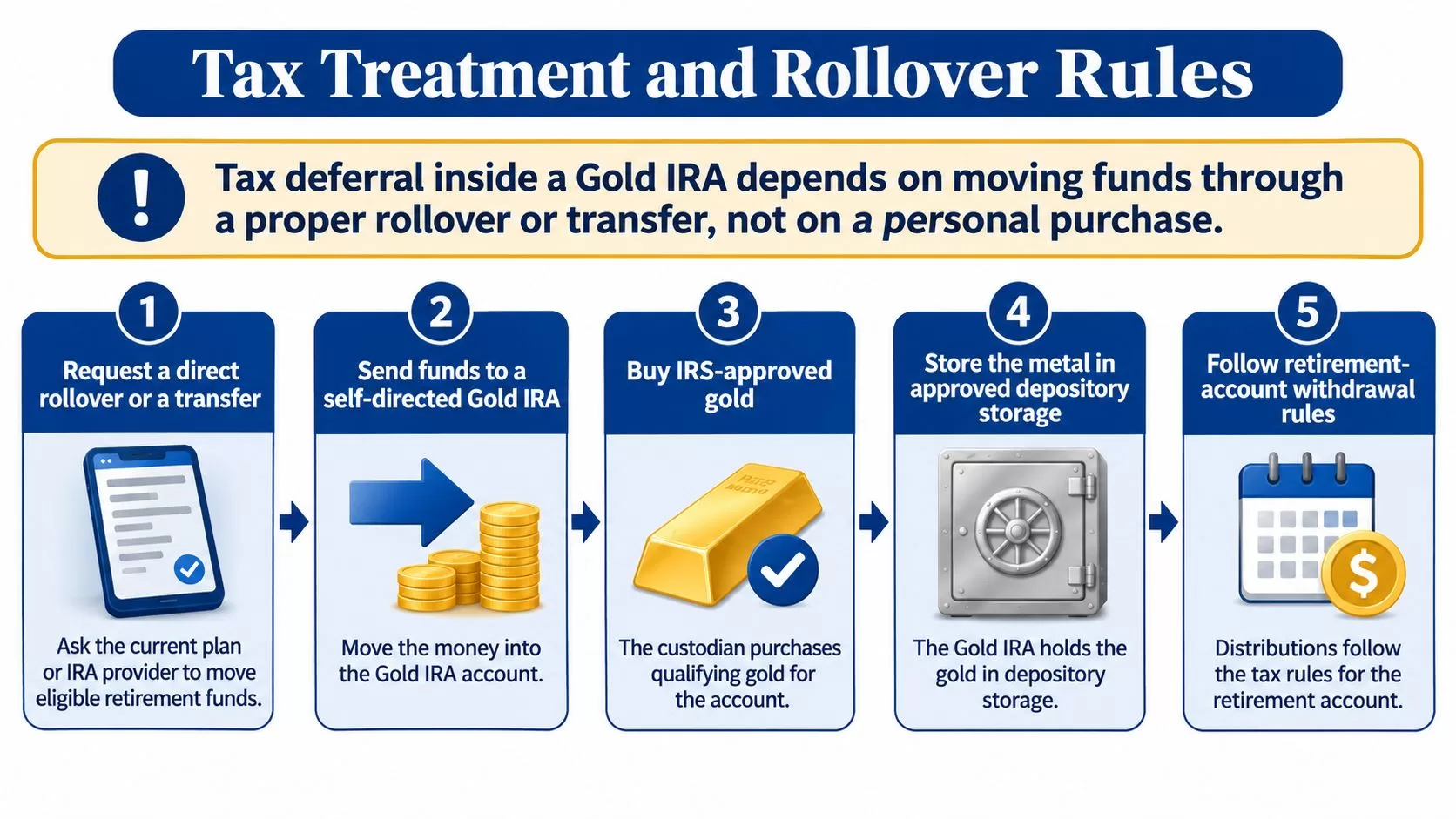
A properly structured rollover or transfer keeps eligible retirement assets inside the retirement-account framework, where taxes stay deferred. A direct rollover works like a bank-to-bank wire: the money moves between institutions without ever passing through your hands, so the movement itself creates no tax bill. Withdrawing the money yourself and then buying gold personally is a distribution, and distributions follow a completely different set of tax rules.
A sensible sequence is:
- Request the appropriate movement. For eligible employer-plan assets, request a direct rollover; for an existing IRA, consider a custodian-to-custodian transfer.
- Confirm the receiving account. Establish that the new custodian accepts the intended metals and can arrange compliant storage.
- Move funds directly. Have the existing provider send eligible funds to the receiving account rather than to the owner personally.
- Complete the account purchase. The IRA buys qualifying metal through its documented process.
The process below illustrates the distinction between funding the account and taking personal ownership.
The video below walks through the same funding sequence in motion, showing how the rollover request, the custodian transfer, and the metal purchase connect in practice.
Receiving the money personally adds deadline risk
The IRS rollover guidance generally gives an owner 60 days from receipt to deposit all or part of an eligible distribution into another eligible plan or IRA. An amount not properly rolled over may become taxable, with additional consequences based on individual circumstances.
Consider what that means in practice. An account owner receives a distribution check, deposits it in a personal bank account, and finishes the IRA deposit on day 65. The portion that never reaches the IRA is generally treated as taxable income for that year. Unlike dealer premiums or storage fees, which apply to part of a position, a missed deadline can expose the entire distributed amount to tax. That makes the rollover method one of the biggest cost variables in this comparison, even though it never appears on a fee schedule.
Limited waivers may apply when circumstances beyond the taxpayer's control cause the failure. They shouldn't be treated as an expected extension or a substitute for arranging a direct movement.
Bullion distributions have a same-property rule
Under the IRS's property-rollover guidance in Publication 590-A, a property distribution receives tax-free rollover treatment only when the same property is contributed back. Selling distributed bullion and contributing different gold or cash doesn't automatically preserve that treatment.
This rule surprises people who assume gold is interchangeable. It works like returning a borrowed item: the lender expects the same item back, not an equivalent replacement.
A personal owner can exchange one bar for another without trying to meet IRA rollover requirements, although a sale can still have tax consequences. The explanation of capital gains tax on gold addresses that separate issue.
Where a divorce divides retirement assets, ownership and documentation questions can affect how a rollover or transfer proceeds. The Law Office of Bryan Fagan, PLLC's retirement division guidance for Texas spouses provides context for that distinct legal situation.
A CPA or tax professional should review the proposed transaction before money or bullion leaves the existing account.
Access, Liquidity and Required Distributions
Gold has to be converted before it spends like cash. Dealers may need to inspect metal, confirm payment instructions, or receive shipment before releasing proceeds. An IRA adds another set of processing steps on top of that.
Planned retirement withdrawals
A planned withdrawal allows time to coordinate a dealer quote, custodian instructions, settlement, and payment. The owner should distinguish the date a sale is requested from the date cash becomes available outside the account.
The sequence matters more than the calendar. A typical dealer buy-back moves through several stages: price quote, shipment or vault release, inspection, settlement, and bank delivery. When the metal sits inside an IRA, the custodian authorizes each step, so the chain runs longer than a direct sale even when every party responds quickly.
For personally held bullion, the owner arranges the transaction directly. Private-vault release procedures or shipping can still affect timing, so direct ownership doesn't guarantee immediate cash.
Emergency cash needs
An urgent medical bill or household repair creates a different test. Personally owned metal can be sold without IRA distribution procedures, and some lenders accept bullion as collateral for a loan.
IRA bullion usually requires coordination among the dealer, custodian, and storage provider. A sale inside the account also isn't automatically a withdrawal: the proceeds remain as IRA cash until a distribution is requested. That distinction surprises many account holders, because the metal can be sold while the cash stays locked inside the retirement wrapper.
The sharper risk in a forced sale is the dealer's buy-back spread. Dealers buy below retail prices, and a seller who must accept the first available quote because a bill is due has no room to compare offers or wait for better terms.
Liquidity check: Obtain the expected sequence from sale request to cleared cash, including inspection, settlement, custodian processing, and bank delivery.
Required minimum distributions
The IRS's Publication 590-A states that amounts required to be distributed under required-minimum-distribution rules aren't eligible for rollover treatment. A Gold IRA doesn't remove an applicable RMD obligation.
An owner can't satisfy that obligation by relabeling an existing bullion holding as a rollover contribution. The distribution must be handled under the applicable retirement-account rules.
A retiree with substantial bullion holdings should therefore plan how withdrawals will be funded well before the first RMD comes due. Selling metal is one possibility, but it forces a sale on the distribution schedule rather than the owner's. Holding enough cash or other liquid assets inside or alongside the retirement portfolio lets the bullion position stay intact while the RMD is paid from funds that are already spendable.
Personally held gold has no RMD attached to the metal itself, although selling it can create taxable investment gains. Before selecting an allocation, retirees should map routine spending, foreseeable large expenses, emergency reserves, and required withdrawals.
Which Structure Fits Your Situation
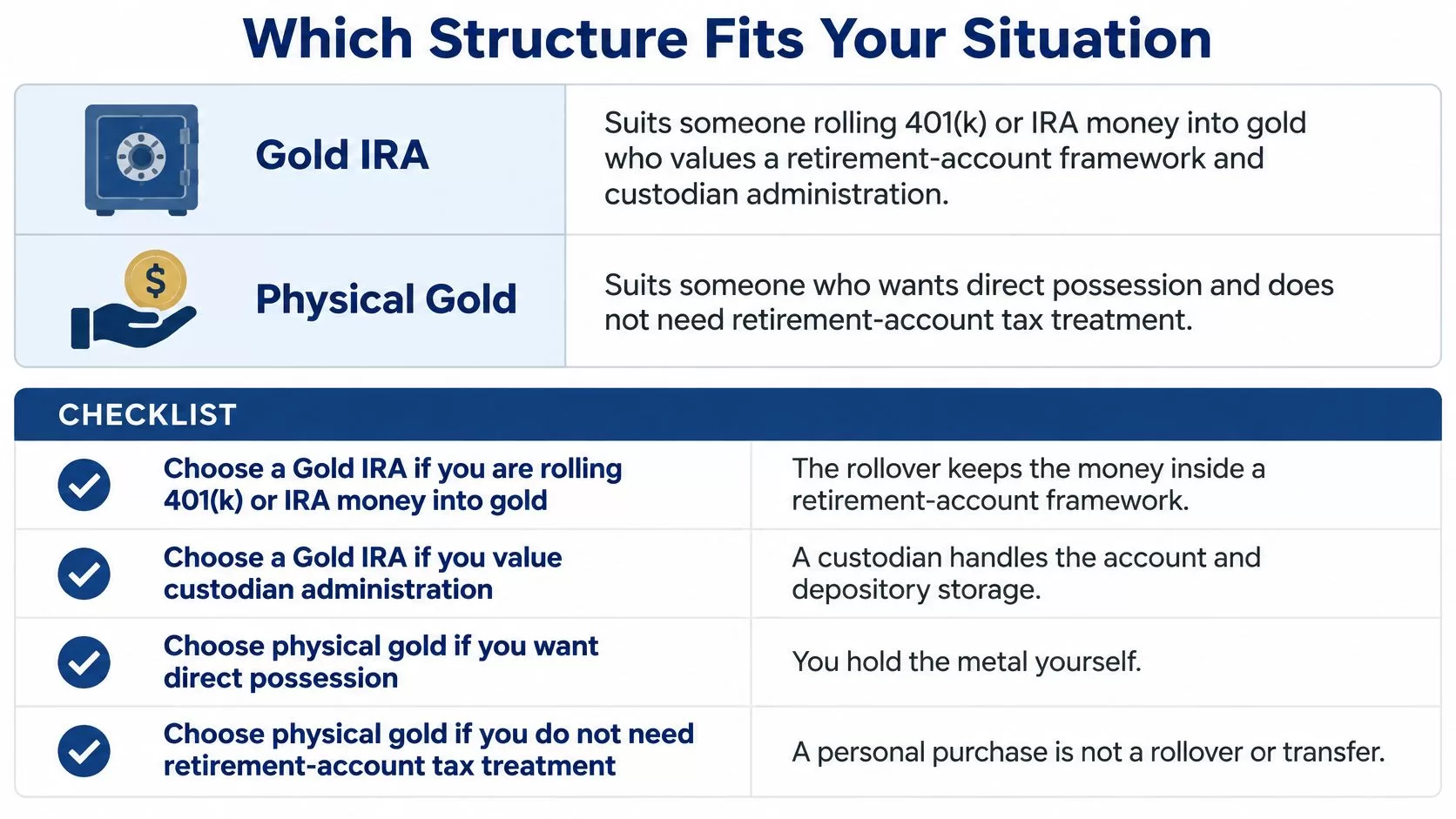
A Gold IRA generally fits retirement money intended to remain within an IRA framework. Personally held gold generally fits a desire for direct possession and flexible sales. Gold in either form belongs in the long-term portion of a retirement plan, while money needed for near-term bills belongs in cash or equally liquid holdings.
| Situation | Likely better fit | Main reason |
|---|---|---|
| Rolling retirement money into gold for a tax-deferred framework | Gold IRA | Properly moved funds remain within retirement-account rules |
| Owning gold for direct possession and flexible sales | Physical gold held personally | No IRA distribution procedures apply |
| Tight cash needs or upcoming required distributions | Revisit the liquidity and withdrawal planning points in Section 5 before committing | Sale sequencing and withdrawal funding shape the outcome more than the structure itself |
| Expecting to hold for a decade or longer | Compare both structures on total cost | Recurring custodial, storage, or insurance charges matter more over a long horizon than any one-time setup expense |
| Wanting a custodian-managed paper trail | Gold IRA | Custodian administers account records, reporting, and storage arrangements |
The decision checklist below connects those preferences with the ownership structure.
Complete the checks before funding
Holding period deserves a careful look, because it changes how the cost comparison reads. A structure with modest opening expenses but recurring annual charges can cost more over fifteen years than one with a higher upfront price and little ongoing expense. Section 3's cost breakdown gives the categories; this section is where those categories get applied to an actual timeline.
A pre-funding file should contain:
- Product confirmation: Exact product descriptions and eligibility documentation.
- An all-in cost comparison: Opening, recurring, transaction, and exit expenses.
- Movement instructions: Written confirmation of a direct rollover or custodian-to-custodian transfer where appropriate.
- Property records: Identification of any IRA bullion being moved, particularly when an in-kind distribution is contemplated.
- Storage and withdrawal terms: The custody agreement, insurance terms, sale process, and distribution schedule.
Administration deserves attention beyond the initial purchase. Family members or authorized representatives may eventually need to locate records and understand access arrangements.
For families facing incapacity, the Law Office of Bryan Fagan, PLLC's discussion of protecting an incapacitated adult's assets provides a separate legal perspective on oversight. Owning an account, holding authority to act for the owner, and physically reaching the metal are three distinct arrangements, and each one is documented separately.
Gold IRA Association's listed number is 888-910-8386 for questions about educational materials on account rules and provider comparisons, and it aims to respond to all inquiries within 24 hours. Educational assistance doesn't replace individualized professional review.
This is not financial advice. Consult a licensed financial advisor, CPA, or tax professional before making investment decisions.
Gold IRA vs. Physical Gold FAQ
What records should I keep for a Gold IRA?
Keep the paperwork that shows what the account owns, what it cost, and who controls access. That includes purchase confirmations, product descriptions, fee disclosures, custody documents, rollover instructions, and distribution records. Good records are useful because a Gold IRA works like a wrapper around the metal, and the rules attach to that wrapper.
The goal is to make the account easy to reconstruct later. If a family member, accountant, or representative needs to review the account, clear records reduce guesswork about ownership, custody, and transaction history.
Can gold already owned personally move into a Gold IRA?
A metal's purity matters, but it does not answer the whole question. Personal bullion usually cannot be “contributed” the way cash can be contributed to an IRA. In some cases, metal already held inside another retirement account may move through a properly arranged account-to-account transfer.
The custodian and tax professional should confirm the transaction type before coins or bars are shipped. One small paperwork error can turn a planned transfer into a taxable event or an ineligible purchase.
What happens when IRA money is withdrawn to buy gold personally?
IRA money withdrawn to buy personal bullion generally leaves the retirement account first. Unless the withdrawal qualifies for the applicable rollover rules and deadline requirements, the taxable portion may be subject to tax. The metal bought afterward is personally owned property, even if the purchase follows soon after the withdrawal.
This is a common point of confusion. Buying gold feels like an investment move, but tax treatment follows the account transaction before it follows the metal.
Is a Gold IRA always more expensive?
A Gold IRA usually adds account-level costs, such as custodial, storage, transaction, and exit-related charges. Personally held gold can also carry real costs, including secure storage, insurance, appraisal, and selling expenses. The better comparison is the full cost of each structure over the same holding period.
A setup-fee waiver says little about the total cost. Two options with the same gold price can end up very different after recurring account charges, storage arrangements, dealer spreads, and sale costs are included.
Does gold protect against inflation?
Gold is often discussed as a hedge, but it should be treated as one tool rather than a guarantee. Its price can fall, and it does not produce income like a bond or dividend-paying stock. A retirement allocation should account for spending needs, time horizon, and tolerance for losses.
Tax treatment also varies by individual circumstance. A CPA should review any proposed rollover, purchase, or withdrawal plan before funds move.
What questions should I ask before choosing one structure?
Start with the practical test: how much will the structure cost over time, and how quickly can the metal become cash? Those two points often decide fit more clearly than tax labels alone.
Use these questions as a short checklist:
- What is the full opening, annual, transaction, and exit cost?
- Who has custody of the metal, and how is that arrangement documented?
- What documents are needed if the metal is sold or distributed?
- How long does a typical sale or distribution take?
- Can the same product be bought and sold under both structures?
- What records must be kept for tax and account reviews?
- Who can access information if another family member becomes involved?
Gold IRA Association publishes educational material on custody, rollover procedures, eligible metals, provider comparisons, and tax treatment. The free newsletter covers news on hedging against U.S. inflation with a Gold IRA. Materials are provided for informational purposes and are not financial, legal, or investment advice.