



A gold IRA works through three players, a custodian, a dealer, and a depository, and the rule the investor has to accept is simple, the physical metal stays in a vault, never at home. In plain English, that means the retirement account can own approved gold, but the person who owns the IRA does not take personal delivery of the bars or coins.
For a lot of 60-year-olds, that sounds a little strange at first. You've spent years building a 401(k) or IRA, and now you're trying to understand whether gold belongs inside it, who handles the metal, and what happens to the money along the way.
What a Gold IRA Is and Who Runs It
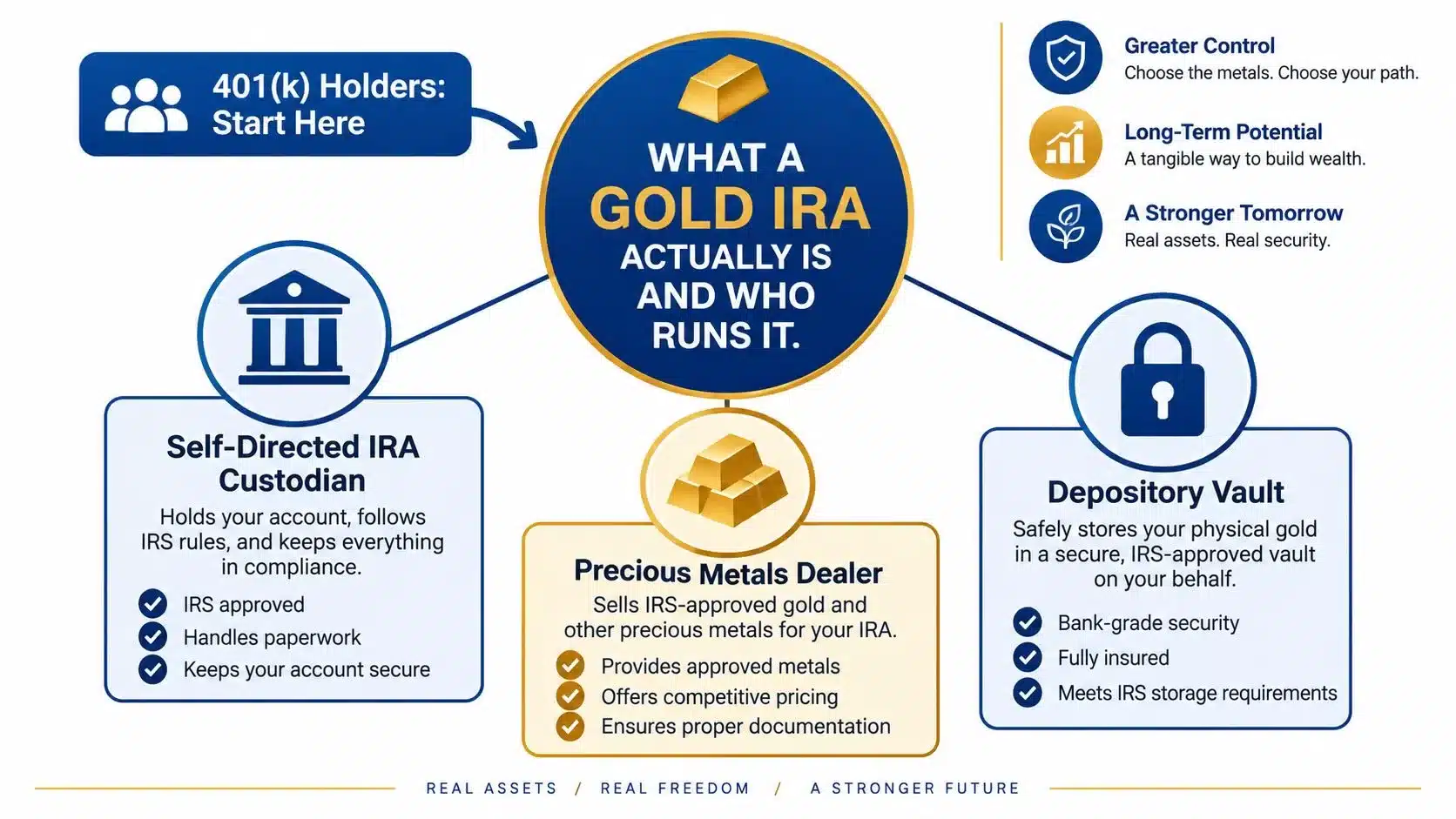
A Gold IRA is a self-directed individual retirement account that holds IRS-approved physical precious metals instead of only stocks or mutual funds, and it is usually opened through a specialized custodian that arranges purchase and storage in an IRS-approved depository. The setup matters because the account is not a private gold stash, it is a retirement account with a specific legal structure.
The easiest way to understand it is by role. The custodian administers the IRA, the dealer sells the approved bullion, and the depository stores it under IRS-compliant conditions. The investor gives instructions, but does not hold the metal personally. That separation is the backbone of the arrangement, and it is why the account has to stay inside the rules from start to finish.
Practical rule: if you can physically take the gold home, it is no longer behaving like a compliant Gold IRA asset.
That rule is what separates a retirement account from ordinary ownership. The IRS treatment depends on the custodian, dealer, and depository each doing their part, while the investor accepts that the metal belongs in storage, not in a safe at home. The account can be set up as a Traditional or Roth IRA, but the physical handling rules stay the same either way.
If a reader wants a closer look at the middleman role, the custodian piece is laid out in more detail in this Gold IRA custodian guide.
Choosing the Right Account Type for Your Tax Situation
A Gold IRA can hold the same kind of metal and still have different tax outcomes. The IRA wrapper decides the tax treatment. That is the part many readers miss, because the account can sit inside either a Traditional IRA or a Roth IRA, while the bullion itself stays the same.
Traditional and Roth work like different tax shells
A Traditional Gold IRA is usually funded with pre-tax dollars, and taxes are generally due when money comes out. A Roth Gold IRA is funded with after-tax dollars, and qualified withdrawals can be tax-free. The gold does not change that rule. A gold coin inside a Roth follows Roth rules, and the same coin inside a Traditional follows Traditional rules.
That is why the decision starts with taxes, not with the metal. If your current tax bill feels heavier than what retirement may look like later, a Traditional wrapper can fit that picture. If your current tax burden is manageable and you want qualified withdrawals that are not taxed later, the Roth wrapper may be a better fit.
A Gold IRA is really two choices, the metal and the wrapper. The wrapper sets the tax story, not the bullion.
A good way to sort it out is to compare today's tax situation with the one you expect later. If you are still earning well and expect a lower taxable income in retirement, the Traditional structure may make more sense. If you have already handled the tax bill on the money and want future withdrawals to be simpler, the Roth structure may fit better. The rules in IRS Publication 590 explain the basic IRA tax framework, and the same framework is what governs a Gold IRA once the metal is placed inside it.
This is also why people should start with the account type before they start looking at coins. Once the wrapper is chosen, the custodian can place approved metal into the correct account without changing the account's tax character. The IRS purity standard still applies either way, and the storage rules stay the same whether the account is Traditional or Roth.
If the money is coming from another retirement account, the tax wrapper should be matched before anything is moved. A rollover handled the wrong way can create tax trouble, so it helps to read a plain-language Gold IRA rollover guide before giving instructions. If the funds are tied to a larger family decision, such as a lump sum from an inheritance, the same tax questions matter there too, and the timing should be handled with care alongside Velzee inheritance planning advice.
Funding the Account With a Rollover or Transfer
Most Gold IRAs begin with money that is already sitting in another retirement account. The investor is usually moving existing savings, not mailing in fresh cash, and that money has to arrive through a rollover or a direct transfer. The direct transfer is usually the cleaner path, because the investor never takes possession of the funds, which reduces the chance of a tax mistake (source).
Rollover versus transfer
A rollover works a little like carrying a check from one desk to another yourself. The money can pass through the investor first, and that starts a clock. If the funds are not redeposited within 60 days, the IRS can treat the distribution as taxable under IRA rules (source). A direct trustee-to-trustee transfer keeps the money between custodians the whole time, so the timing risk drops away and the paper trail stays cleaner.
A common example is someone leaving an old employer and moving a 401(k) balance into a self-directed IRA that can hold approved bullion. Another common example is moving money from one IRA to another IRA without the cash ever landing in a personal checking account. In both cases, the custodian handles the retirement money, and the investor does not buy the metal directly.
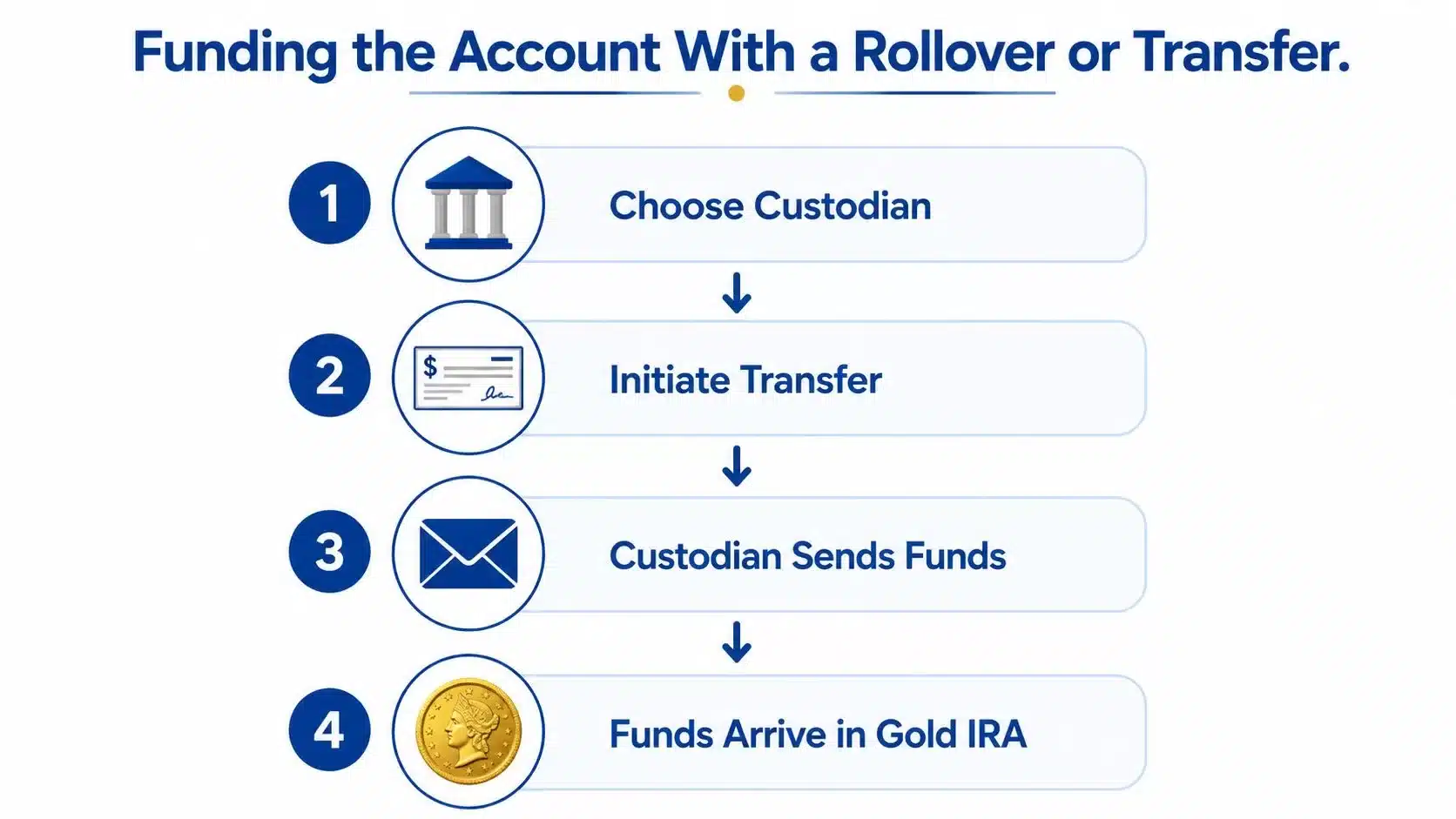
What happens in sequence
- Choose the custodian first. The custodian is the account's legal administrator, so this step comes before anything else.
- Open the self-directed IRA. The account is set up under the correct tax type.
- Submit the rollover or transfer request. The old retirement account releases the funds.
- Wait for the money to arrive in the Gold IRA. Only then does the metal purchase begin.
For a plain-language walkthrough of the rollover side, the Gold IRA rollover guide is a useful companion resource. For people thinking about inherited money and retirement accounts, Velzee's inheritance planning advice gives broader context on how families often handle new cash decisions.
Video: Understanding the funding flow
New annual contributions are separate from rollovers. The IRA contribution limit changes by year, and the amount can also be higher for investors who qualify for a catch-up contribution. Those limits apply to fresh yearly contributions, not to moving an existing retirement balance into a Gold IRA (source).
Understanding the Real Costs of Owning a Gold IRA
A Gold IRA usually costs more to operate than a standard brokerage IRA because the account needs people and places a paper account doesn't need. There's a custodian, there's vault storage, and there's a physical buy-sell process every time metal moves.
The fee layers to ask about
The typical cost structure has four parts.
| Fee Type | How It's Usually Charged | What It Covers |
|---|---|---|
| Account setup | One-time charge | Opening and establishing the self-directed IRA |
| Custodial administration | Ongoing charge | Account records, compliance, statements, and processing |
| Depository storage | Annual charge | Vault space, handling, and safeguarded storage |
| Transaction costs | Per trade or buy/sell event | Buying bullion and, later, selling it through the account |
Those charges matter because they reduce what stays invested over time. A standard brokerage IRA usually doesn't carry storage and vault handling costs, while a Gold IRA has to pay for both the account structure and the metal's physical safekeeping. The exact pricing varies, so a reader should ask for the whole cost picture before funding anything.
What to ask before signing
The best question is simple. What is the total annual cost as a percentage of my account balance? That question forces the provider to talk in plain English instead of hiding pieces of the bill in separate line items.
Good rule: if the fee schedule is hard to explain, it'll probably be hard to live with.
Gold IRAs also have ongoing transaction friction. Buying and later selling physical metal takes coordination between the custodian and the dealer, so liquidity is not as immediate as selling shares in a brokerage account. That's not a reason to avoid the structure automatically, but it is a reason to size it carefully.
Which Metals the IRS Allows Inside
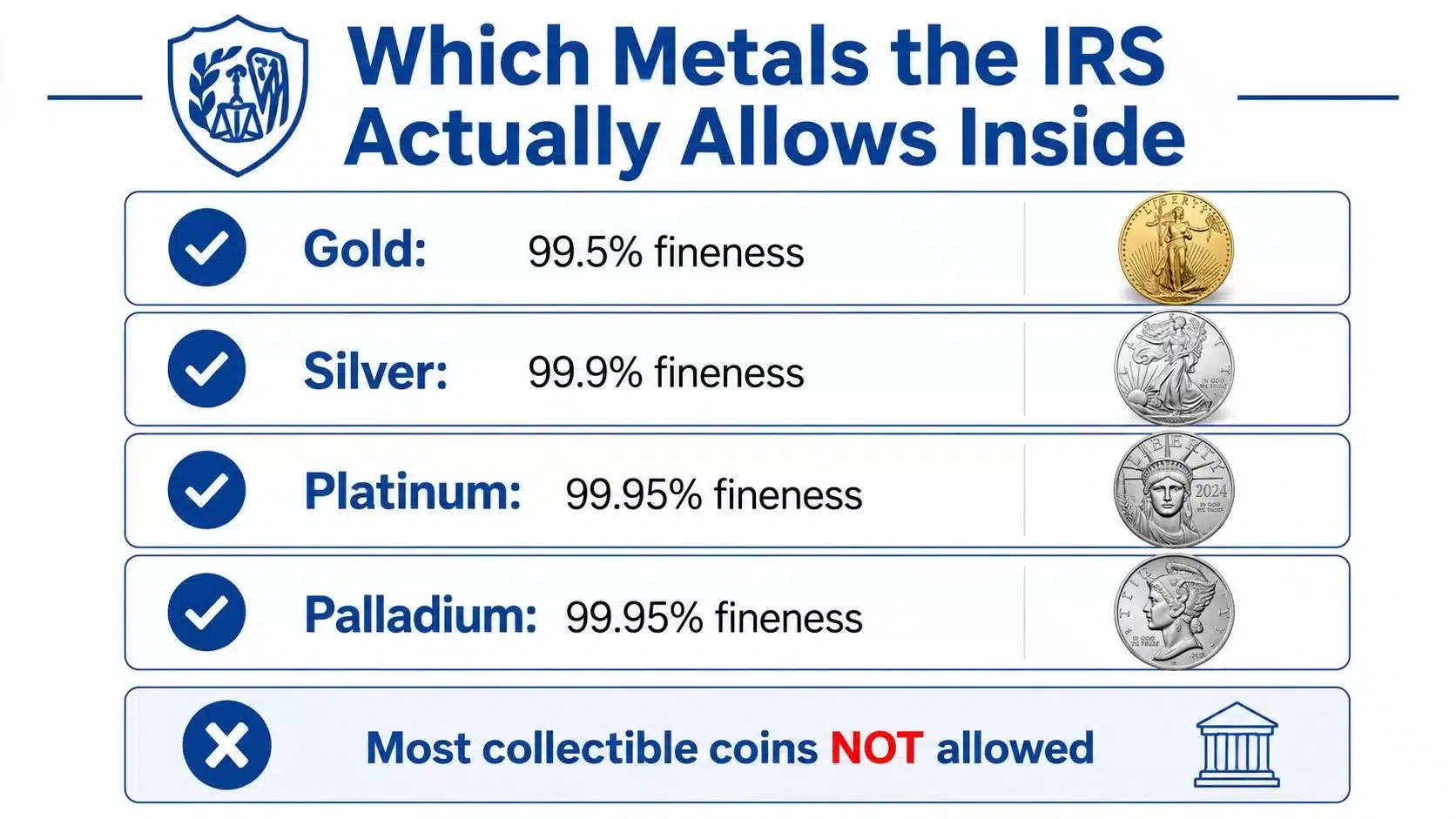
A lot of people get tripped up. A Gold IRA can hold physical precious metals, but the IRS draws a tight line around what counts. For gold, the metal must be at least 99.5% pure. In plain terms, that means the account is built for bullion, not for most collectible pieces.
The IRS rules are meant to keep the account in standard, easy-to-value metal, not in items whose price depends mostly on rarity or appearance. That is why the paperwork, the dealer, and the depository all work from the same simple idea, only approved metal belongs in the IRA. For a closer look at the categories and purity standards, these precious metal IRA rules are a useful reference before any purchase order goes out.
What qualifies and what usually doesn't
Approved inventory is usually standard bullion bars or coins that meet the fineness rule. Collectible or numismatic coins generally do not belong in the account because the IRS wants standardized metal, not pieces whose value is driven by rarity. That matters because the account has to stay clean from a compliance standpoint and predictable from a storage standpoint.
Eligible bullion also tends to trade closer to spot value than collectible coins do. That does not make gold cheap, it just means the product fits retirement-account rules better. The custodian and depository workflow is set up around handling standardized bars and coins, not one-off collector inventory.
The bigger rule is the no-possession rule. The investor cannot take the metal home, use it personally, or treat it like an asset sitting under personal control. The metal belongs to the IRA, and the IRA owns it through the custodian. Once a person takes delivery, even briefly, the account can run into serious trouble.
The IRS publishes the approved metal standards in its guidance, and the four metals shown in a chart showing the four IRS-approved metals for IRAs with their required minimum fineness levels. are the reference point most buyers start with.
For readers who want a broader view of how precious metals fit into retirement planning, Coveredly's inflation protection insights can help put the metal choice in context.
The Honest Pros and Cons of a Gold IRA
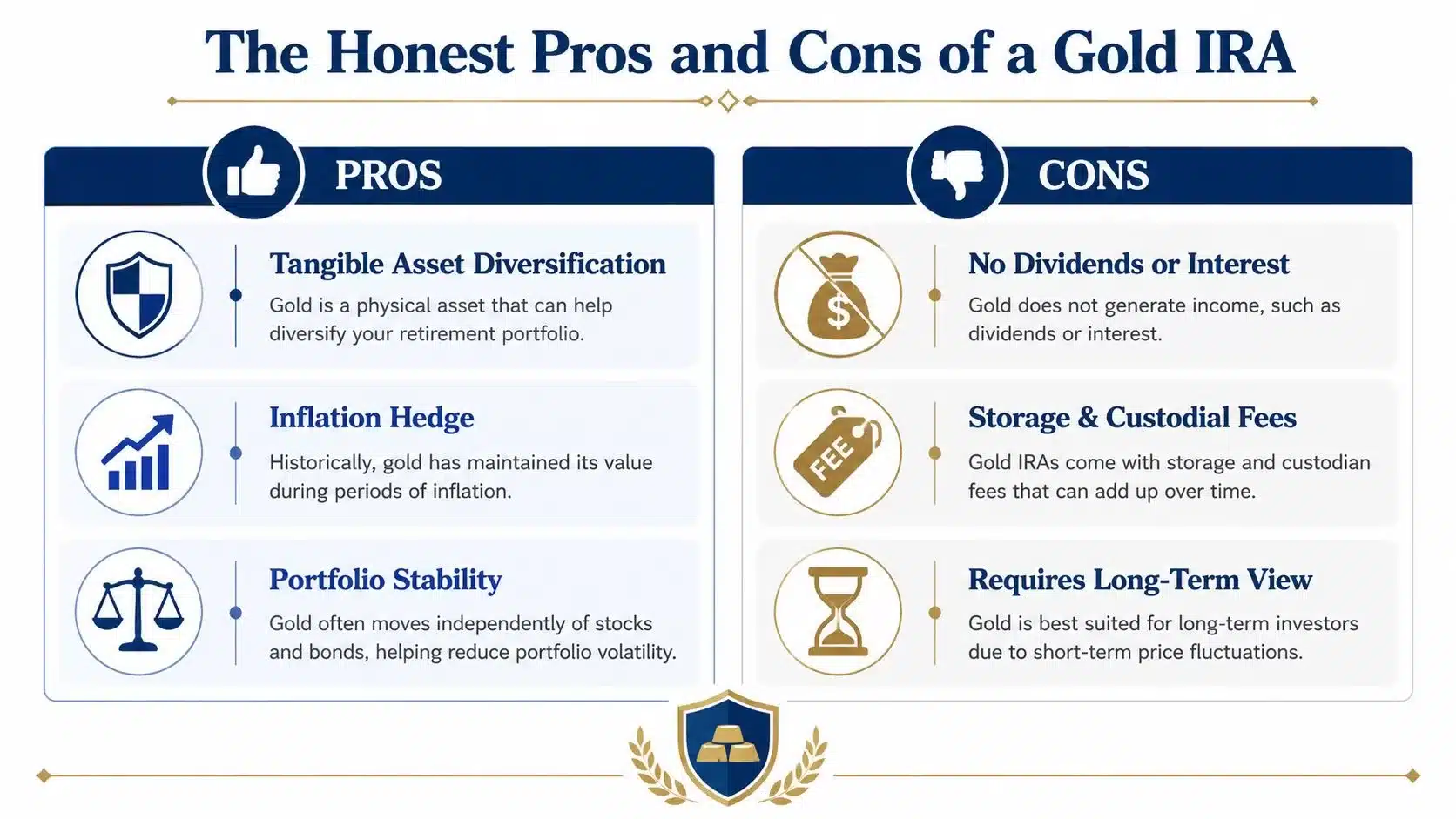
A Gold IRA can make sense, but only for the right kind of saver. The strongest case for it is diversification inside a tax-advantaged account. The weakest case against it is simple, the metal sits in a vault and doesn't produce income while it's there.
Where the structure helps
The main appeal is tangible ownership through a retirement wrapper. Some investors like having part of their savings in physical metal instead of only in paper assets. It can also serve as one more way to diversify a retirement portfolio when stock and bond risk feel too concentrated.
Gold is often discussed as a possible hedge against inflation and dollar weakness. That's part of why people look at it during periods of uncertainty. The account also lets the investor hold the metal without personally managing transport, insurance, or secure storage.
Where the structure falls short
The trade-offs are just as real. Storage and custodial fees are part of the package, and they raise the all-in cost. The account also tends to be less liquid than a standard IRA because selling requires coordination between the custodian and dealer.
There's another quiet drawback. Gold doesn't generate dividends or interest while it sits in the vault. That means the long-term story is usually more about preservation and diversification than income growth.
For readers who want a broader view of inflation and savings behavior, Coveredly's inflation protection insights can be a useful outside perspective to compare against their own retirement goals.
Your Step-by-Step Timeline and Setup Checklist
A realistic setup usually moves in stages, not all at once. For someone starting from an existing retirement account, the full process often unfolds over a couple of weeks, depending on how quickly paperwork clears and funds move.
A practical timeline
- Pick a custodian and dealer. That usually takes a few days because the reader needs to compare paperwork, storage setup, and fee schedules.
- Open the self-directed IRA. Once the forms are complete, the account can usually be opened quickly.
- Start the rollover or transfer. A direct trustee-to-trustee move is usually the cleaner path, while an indirect rollover has the 60-day clock attached to it.
- Approve the metal purchase. After funds settle in the account, the custodian executes the buy instruction.
- Confirm vault receipt. The depository should receive and store the bullion under the IRA's name.
A short checklist to keep nearby
- Verify metal eligibility. Check that the product meets the IRS purity rules before anything is bought.
- Confirm separate roles. The custodian and depository should be distinct entities.
- Request the fee schedule in writing. Hidden costs are much easier to spot on paper.
- Ask how storage works. Segregated and commingled storage are different arrangements, and the investor should know which one applies.
- Document the buyback path. Future selling is easier when the liquidation process is clear from the start.
Keep the paperwork, account statements, and purchase instructions together. When retirement money moves, the cleanest file usually saves the most time later.
Common Questions About How a Gold IRA Works
Are withdrawals from a Gold IRA taxed? Yes, the tax treatment follows the underlying IRA type. Traditional withdrawals are generally taxed as ordinary income, while qualified Roth withdrawals can be tax-free.
Can the gold be stored at home? No. Personal possession is treated as a distribution risk and can trigger taxes and penalties because the metal is supposed to stay in an approved depository.
Can more metals be added later? Yes. The custodian can use cash already in the account to buy additional approved bullion later on.
Is a Roth Gold IRA allowed? Yes. The metal can sit inside a Roth wrapper, but the same purity and storage rules still apply.
If the next step is comparing account setup details, storage rules, and provider questions, Gold IRA Association keeps the basics in one place for readers who want a calmer way to sort through the paperwork. For a more guided look at how these accounts are put together, visit Gold IRA Association. This is not financial advice. Consult a licensed financial advisor, CPA, or tax professional before making investment decisions.